



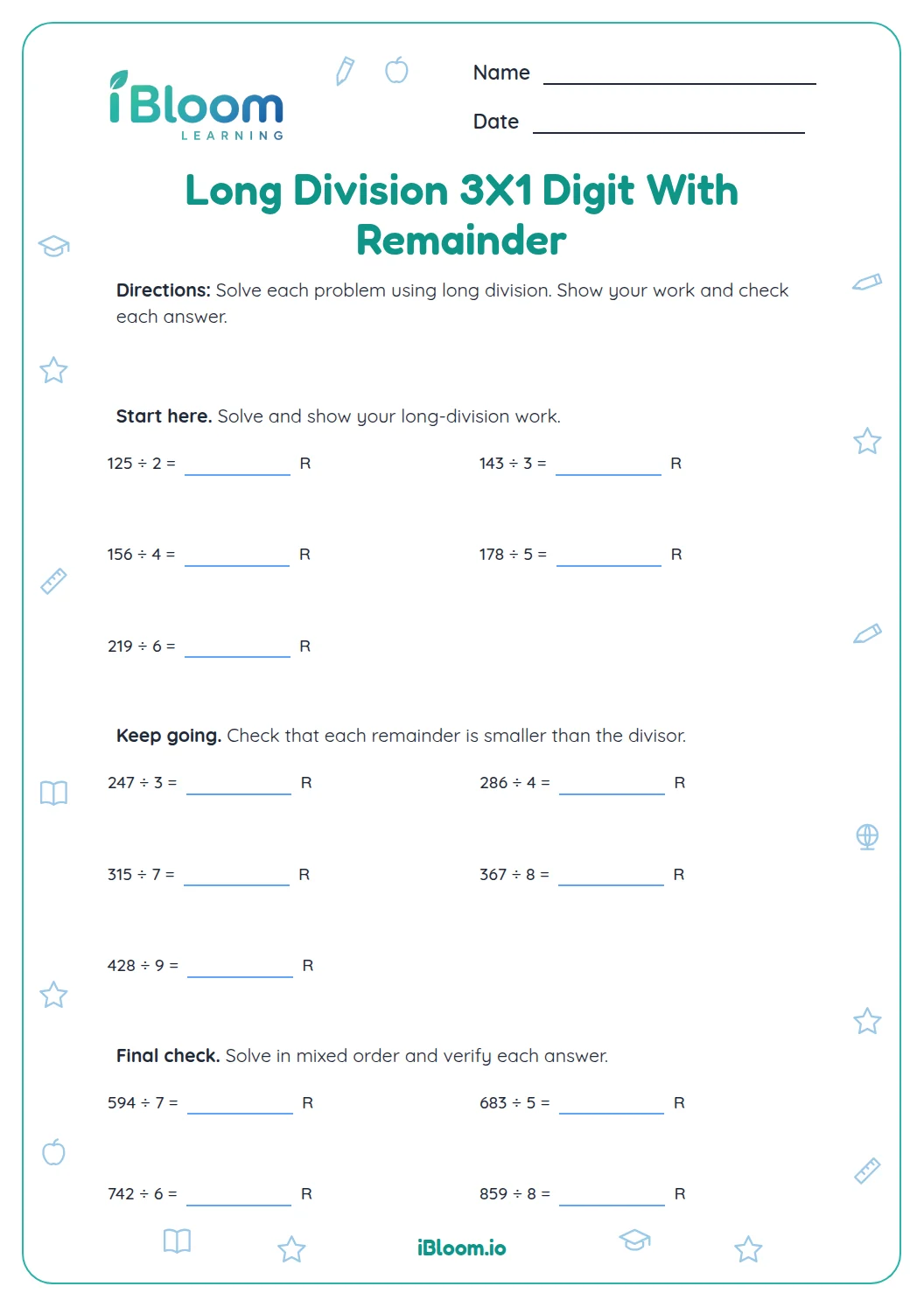
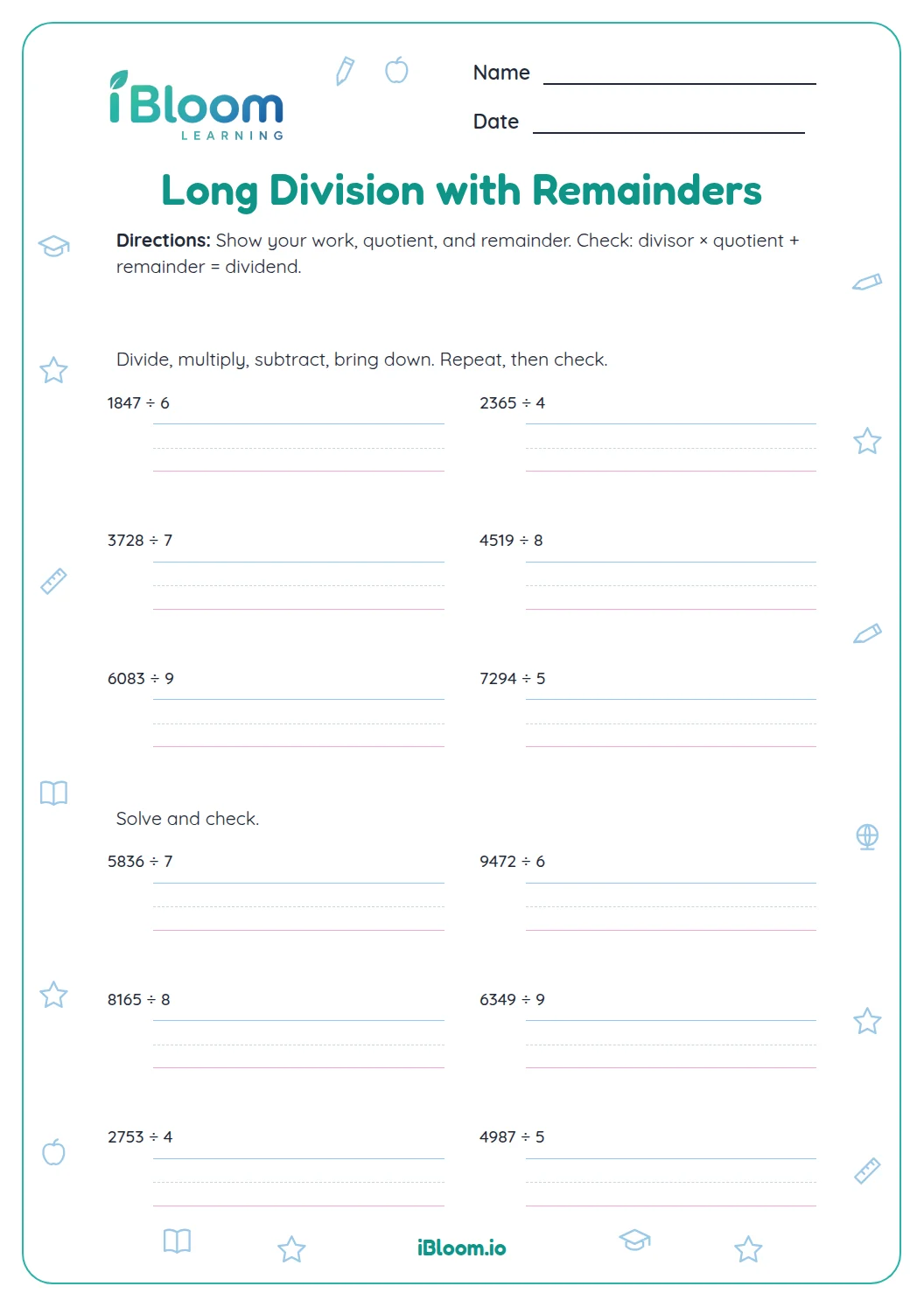
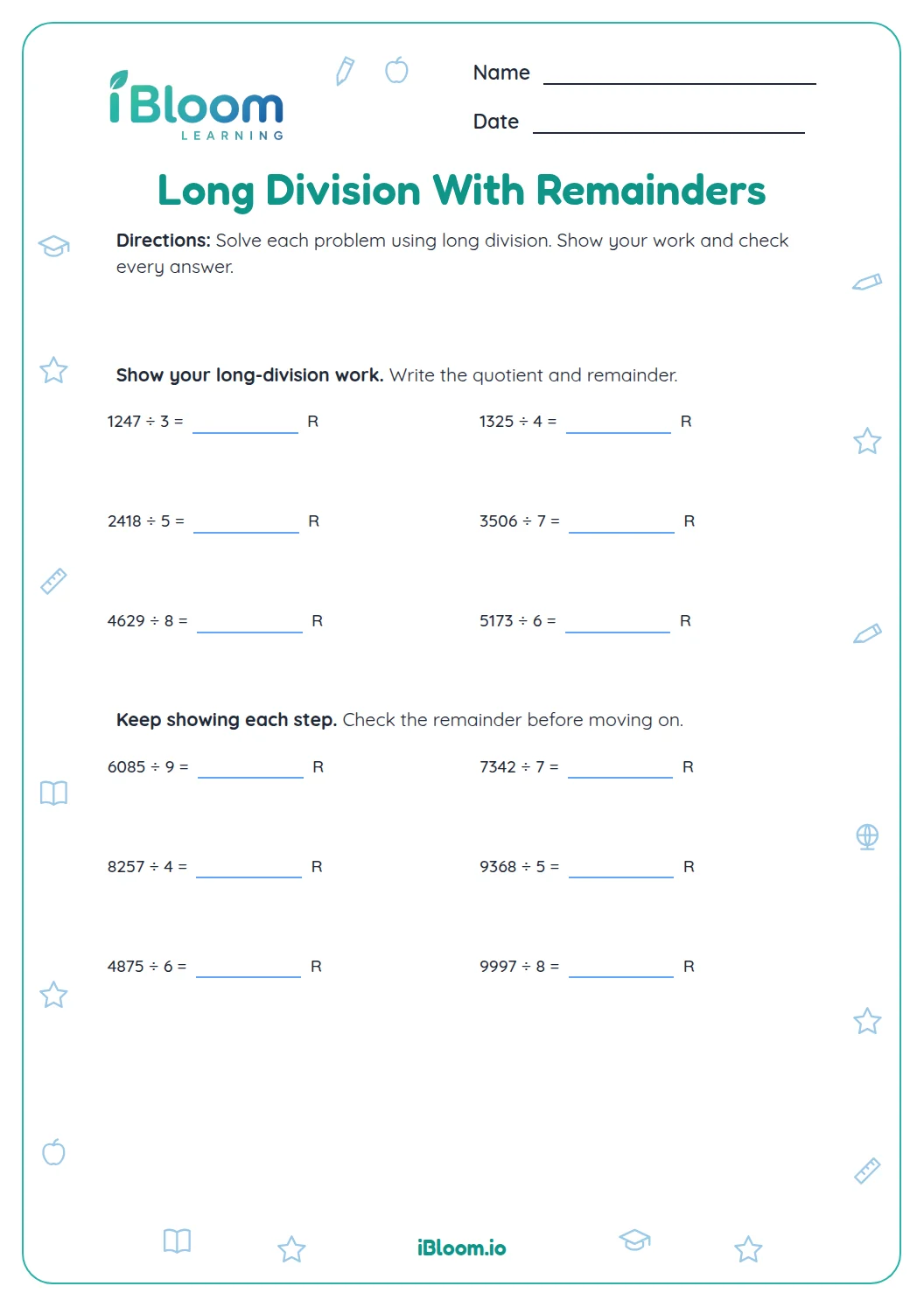
About this worksheet
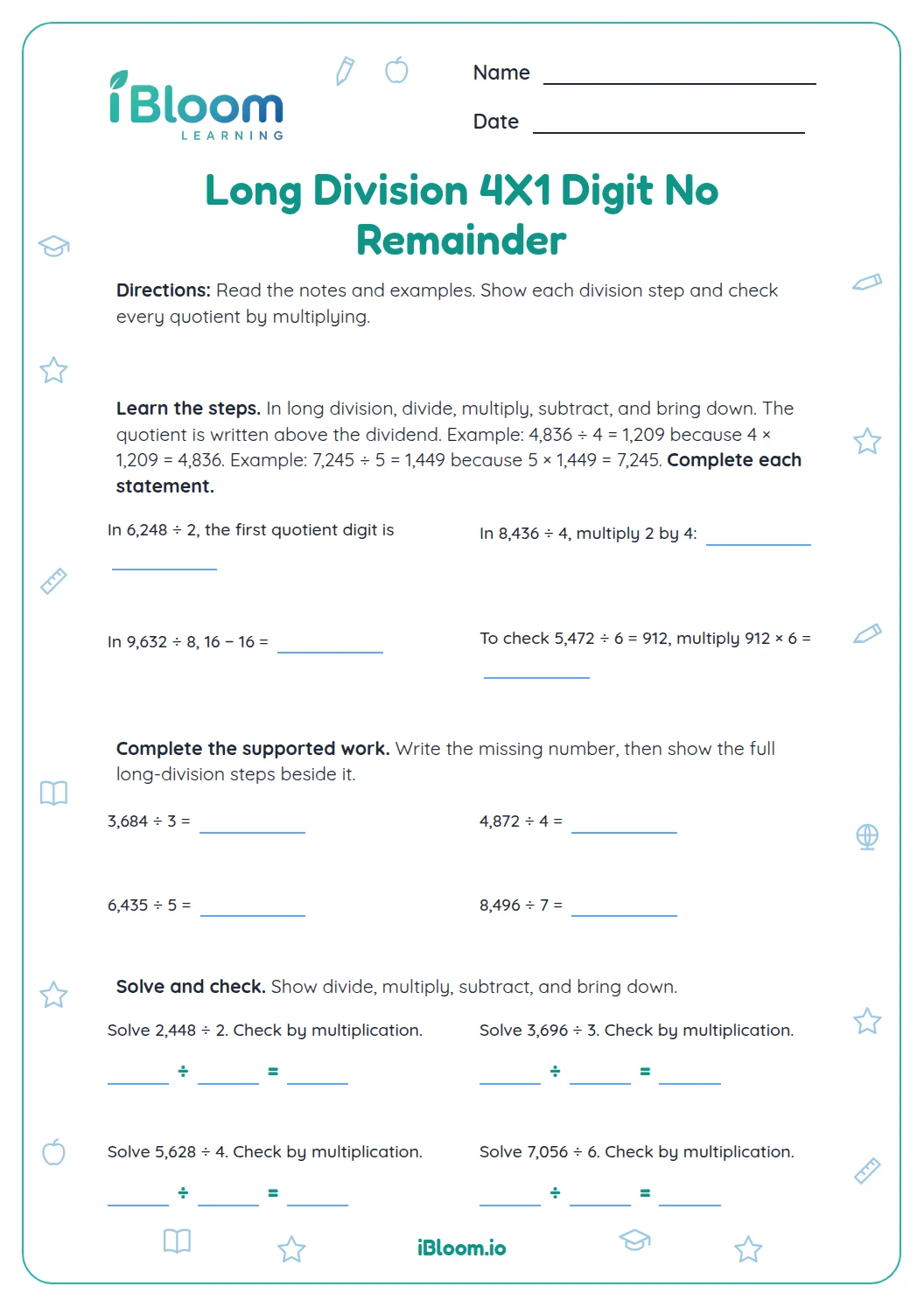
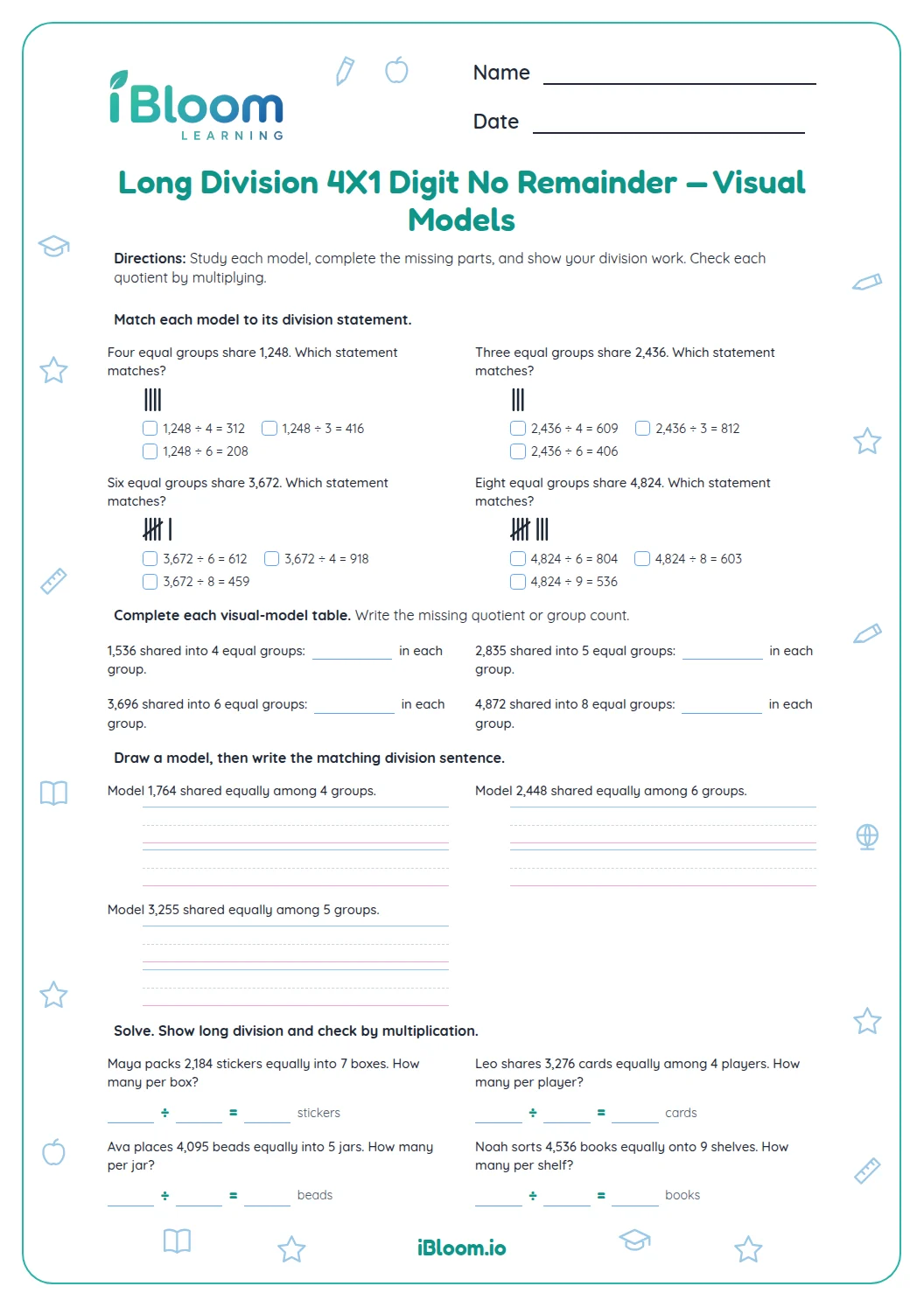
This printable Grade 4 worksheet gives students guided practice dividing four-digit whole numbers by one-digit divisors with no remainder. Fourteen problems move from familiar division steps to larger quotients, with room to show the long-division process. The answer key shows each quotient. It practices Common Core 4.NBT.B.6: finding whole-number quotients with up to four-digit dividends and one-digit divisors.
Aligned to CCSS 4.NBT.B.6
What is the long-division routine?
Divide the first workable part of the dividend, multiply, subtract, then bring down the next digit. Repeat until every digit has been used. Check by multiplying the quotient by the divisor.
- 11,248 ÷ 4
- 212 ÷ 4 = 3; subtract 12, bring down 4.
- 34 ÷ 4 = 1; subtract 4, bring down 8.
- 48 ÷ 4 = 2. The quotient is 312.
How does this sheet build practice?
Part A begins with dividends that make the place-value steps easy to see. Part B keeps the same no-remainder goal while varying the quotient and divisor, so students must attend to each digit.
How can students check a quotient?
Multiply the quotient by the divisor. The product should equal the original dividend. If it does not, revisit the first subtraction that changed the remaining number.
How to use this worksheet
- 1Read the divisor and dividend before starting.
- 2Work from left to right, using the first part large enough to divide.
- 3Write one quotient digit above each place you use.
- 4Multiply and subtract before bringing down the next digit.
- 5Multiply the final quotient by the divisor to check.
Common mistakes and quick fixes
The mistake
Skipping a quotient place.
The fix
Write zero when a place value cannot be divided yet.
The mistake
Subtracting before multiplying.
The fix
Multiply the quotient digit by the divisor first.
The mistake
Bringing down the wrong digit.
The fix
Move one dividend digit at a time and check the remaining number.
This worksheet practices CCSS 4.NBT.B.6.
Use place-value steps to find each exact quotient.
On this sheet:
Show the official wordingHide the official wording
Find whole-number quotients and remainders with up to four-digit dividends and one-digit divisors, using strategies based on place value, the properties of operations, and/or the relationship between multiplication and division. Illustrate and explain the calculation by using equations, rectangular arrays, and/or area models.
What to practice next
Make more practice
Further reading
Questions parents and teachers ask
How many questions are on the sheet?
There are 14 long-division problems. Each uses a four-digit dividend and a one-digit divisor, and every quotient is a whole number with no remainder. Check the dividend place by place and look for a missed quotient digit. Check the dividend place by place and look for a missed quotient digit.
What should students write in the work space?
Students can write each quotient digit, multiplication step, subtraction, and brought-down digit. Keeping the steps aligned makes place-value errors easier to spot. The divisor times the quotient should return the starting dividend exactly. The divisor times the quotient should return the starting dividend exactly.
How can I check an answer?
Multiply the quotient by the divisor. For example, 312 × 4 = 1,248, so 312 is the correct quotient for 1,248 ÷ 4. If estimation helps, compare the quotient with a nearby multiple before finishing. If estimation helps, compare the quotient with a nearby multiple before finishing.
Is this a timed worksheet?
No. Students can work at a careful pace and check each result. It is useful to pause after Part A and review the sequence before moving to Part B. A pause between parts can help students check alignment and the order of steps.
Does the answer key come with the printable?
Yes. A separate key lists the quotient for every problem so an adult can check the work. Students can use the worked example on the page as a reminder of the routine. Students can use the worked example on the page as a reminder of the routine.