


About this worksheet
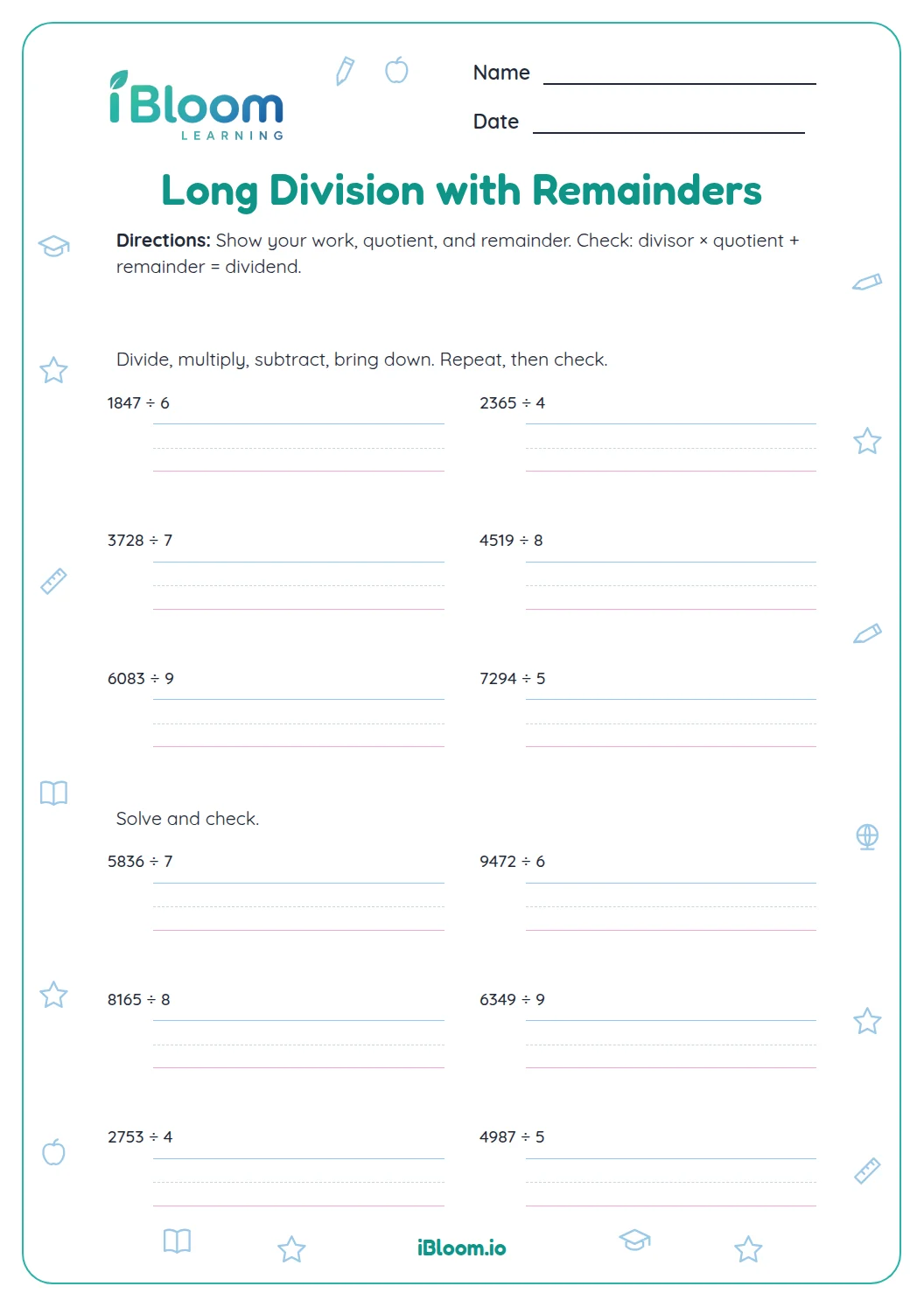
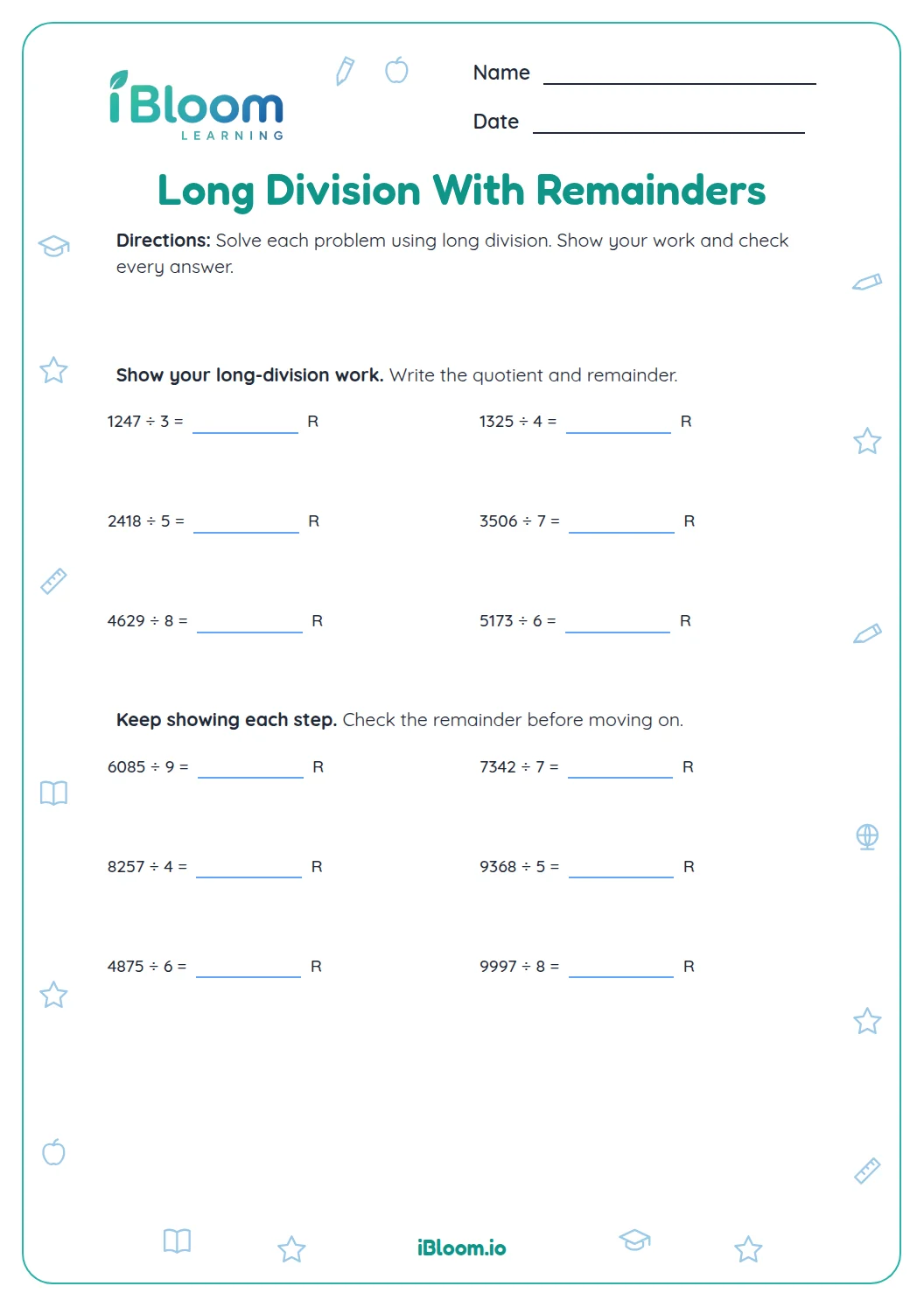
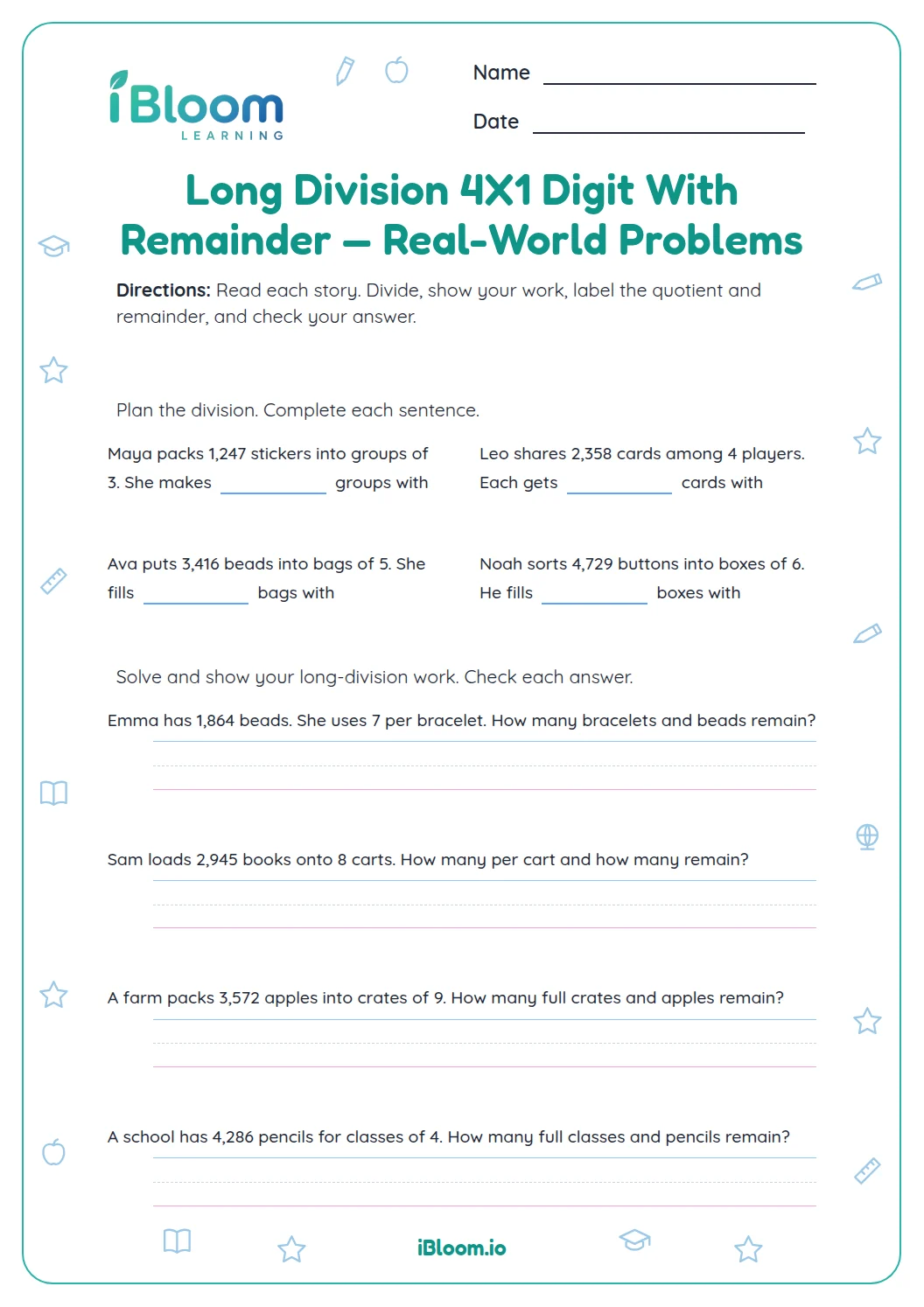
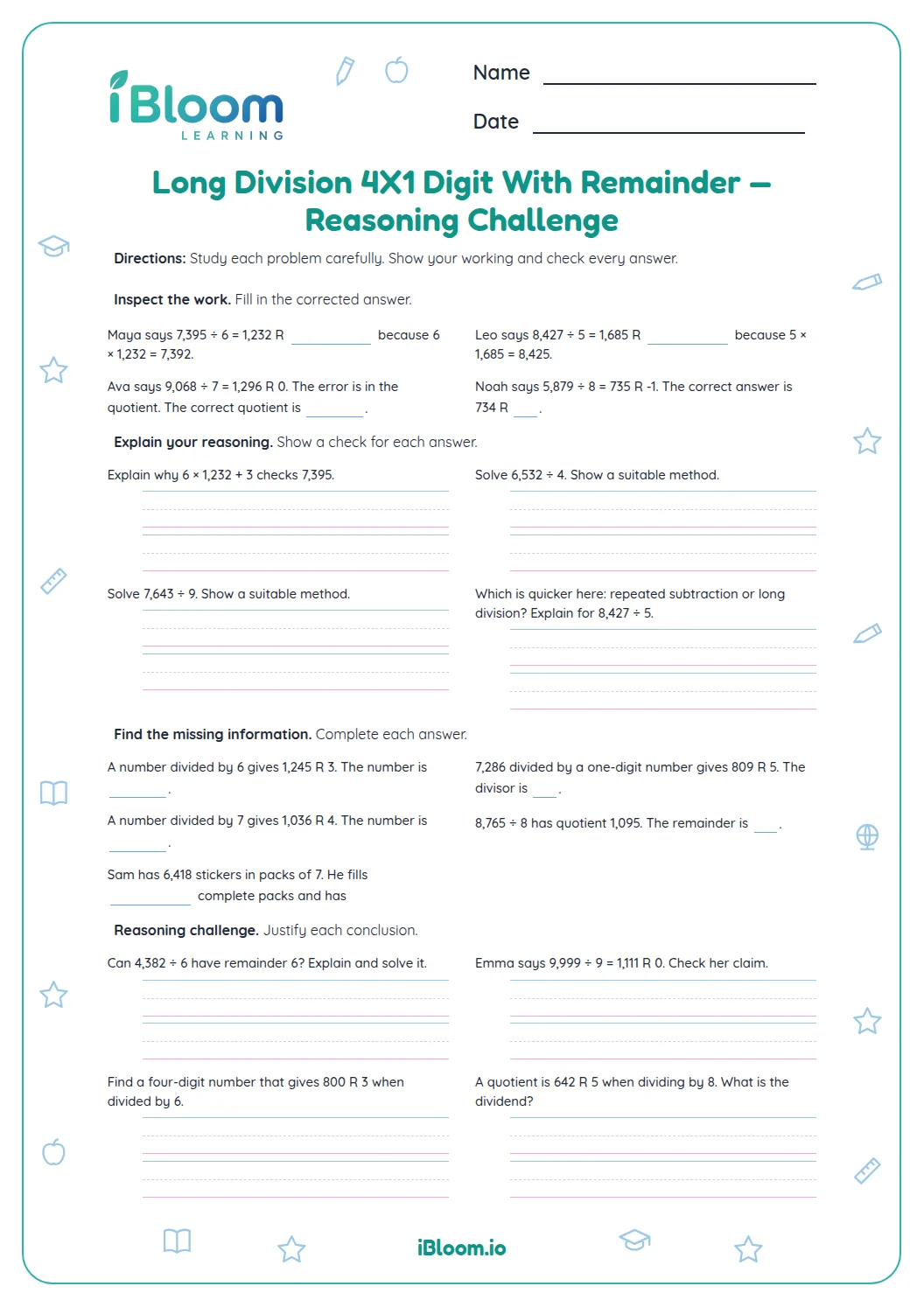
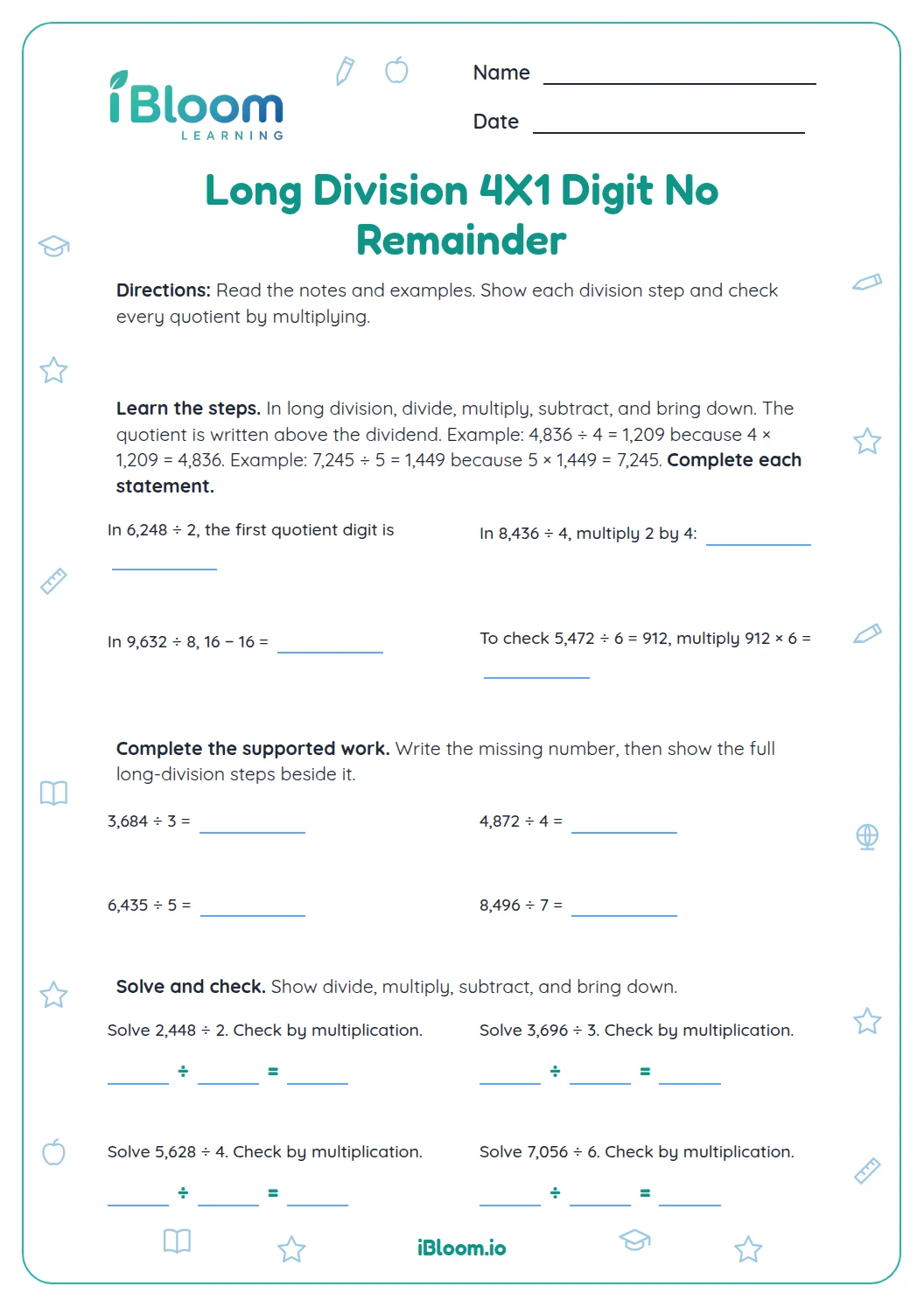
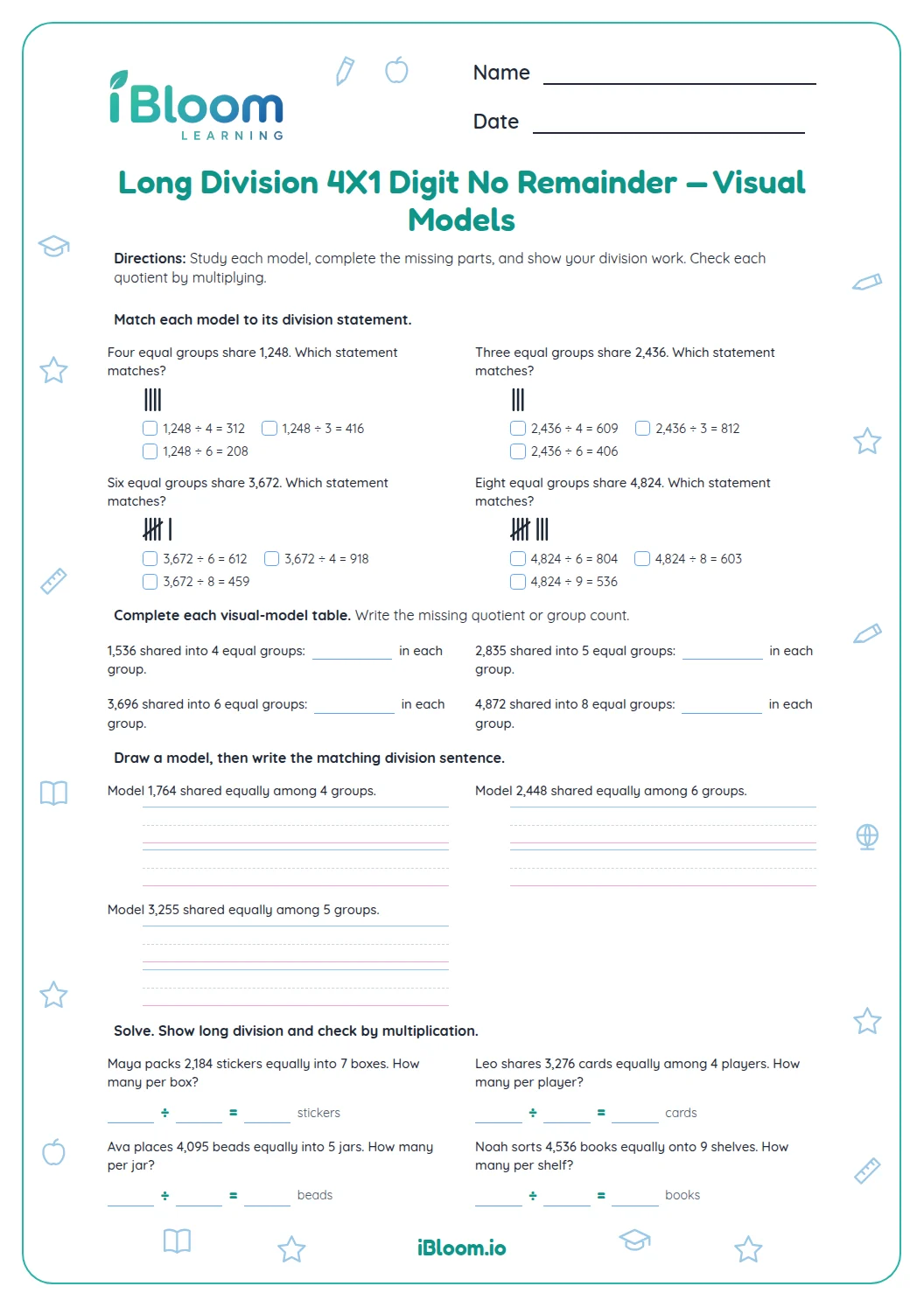
This free printable Grade 4 worksheet teaches long division with four-digit dividends and one-digit divisors. Students identify the dividend and remainder, choose a valid remainder, follow four linked steps for 1,327 ÷ 4, find one missing remainder, then solve four divisions with working space. Each independent calculation leaves a nonzero remainder, and one quotient needs a zero in the tens place. Common Core 4.NBT.B.6 connects this work to place value and the relationship between multiplication and division. The separate answer key gives all twelve answers; students check each division with multiplication and addition.
Aligned to 4.NBT.B.6
What does the remainder tell us?
The remainder is the amount left after making as many complete equal groups as possible. For 1,327 ÷ 4, a quotient of 331 accounts for 1,324, leaving 3. A remainder must be smaller than the divisor; otherwise another complete group can be made.
Part A checks the dividend and the meaning of the remainder. Part B begins by asking which remainder is possible when dividing by 6, then guides students through a complete division.
How do the long-division steps track place value?
After checking a possible remainder, Part B works through 1,327 ÷ 4 from left to right. Since 1 thousand cannot be divided into 4 whole thousands, begin with 13 hundreds. Divide, multiply, subtract and bring down the next digit. Each quotient digit belongs above the place being divided.
After the four linked steps, question 8 gives a new dividend and quotient. Students multiply 314 by 4, then subtract 1,256 from 1,257 to find the missing remainder of 1.
- 113 hundreds ÷ 4 = 3 hundreds, with 1 hundred left. Write 3 above the hundreds digit.
- 2Multiply and subtract: 13 − 4 × 3 = 1. Bring down 2 to make 12 tens.
- 312 tens ÷ 4 = 3 tens. Subtract 12, then bring down 7 ones.
- 47 ones ÷ 4 = 1 one, with 3 left. The answer is 331 R 3.
- 5Check: 4 × 331 + 3 = 1,327, and 3 < 4.
Why does 3,625 ÷ 6 need a zero in the quotient?
After dividing 36 hundreds by 6, the next amount is 2 tens. There are zero whole groups of 6 tens in 2 tens, so write 0 in the tens place. Bring down the 5 ones to make 25 ones. The result is 604 R 1.
Part C provides room to set up each calculation. Ask students to include a multiplication check in that space after they finish the division.
How to use this worksheet
- 1Read 1,327 ÷ 4 = 331 R 3 aloud and name each part.
- 2Complete Part A, then choose a valid remainder for division by 6 at the start of Part B.
- 3Follow the four long-division steps in Part B, then find the missing remainder in a new problem.
- 4Set up each Part C problem vertically and keep quotient digits over their place-value columns.
- 5Check each answer with multiplication and addition, then compare with the key.
Mistakes to notice and how to fix them
The mistake
Keeping a remainder equal to the divisor.
The fix
Make one more whole group and reduce the remainder.
The mistake
Writing 64 R 1 for 3,625 ÷ 6.
The fix
Record the zero tens in 604; then check that 6 × 604 + 1 = 3,625.
The mistake
Checking only divisor × quotient and deciding the answer is wrong.
The fix
Add the remainder as well; it accounts for the amount that did not fit into a full group.
Common Core alignment
Track place values in long division and check four-digit quotients and remainders with multiplication.
On this sheet: The guided example tracks hundreds, tens and ones; students find remainders and check four independent divisions.
Show the official wordingHide the official wording
Find whole-number quotients and remainders with up to four-digit dividends and one-digit divisors, using strategies based on place value, the properties of operations, and/or the relationship between multiplication and division. Illustrate and explain the calculation by using equations, rectangular arrays, and/or area models.
What to practice next
Make more practice
Further reading
Questions parents and teachers ask
What does 4-digit by 1-digit division mean?
It means dividing a four-digit number by a one-digit number. On this sheet, 2,418 ÷ 7 is one example: 2,418 is the dividend and 7 is the divisor. Students find a whole-number quotient and record the amount left over as a remainder.
What do the six blanks in Part B teach?
The first blank checks the rule that a remainder must be smaller than the divisor. The next four follow 1,327 ÷ 4 through its place-value steps and assemble the quotient. The last asks for a new remainder, found by multiplying the quotient and subtracting from the dividend.
What is the answer to 2,418 ÷ 7?
The answer is 345 R 3. Seven times 345 is 2,415, and adding the remainder 3 gives 2,418. Because 3 is smaller than 7, the division is complete. Students can put this multiplication check beside their long-division work in Part C.
How should students record a zero inside a quotient?
Students should write the zero in its correct place-value column. In 3,625 ÷ 6, the quotient is 604 because the tens step produces zero tens. Omitting that zero changes the answer to 64, which fails the multiplication check by a large amount.
What does the answer key include?
The answer key includes two selected choices, six blanks and four final quotients with remainders. Have students retain their written work when checking. Ask them to explain each quotient digit and write a multiplication-and-addition check beside each independent division in Part C.