
About this worksheet
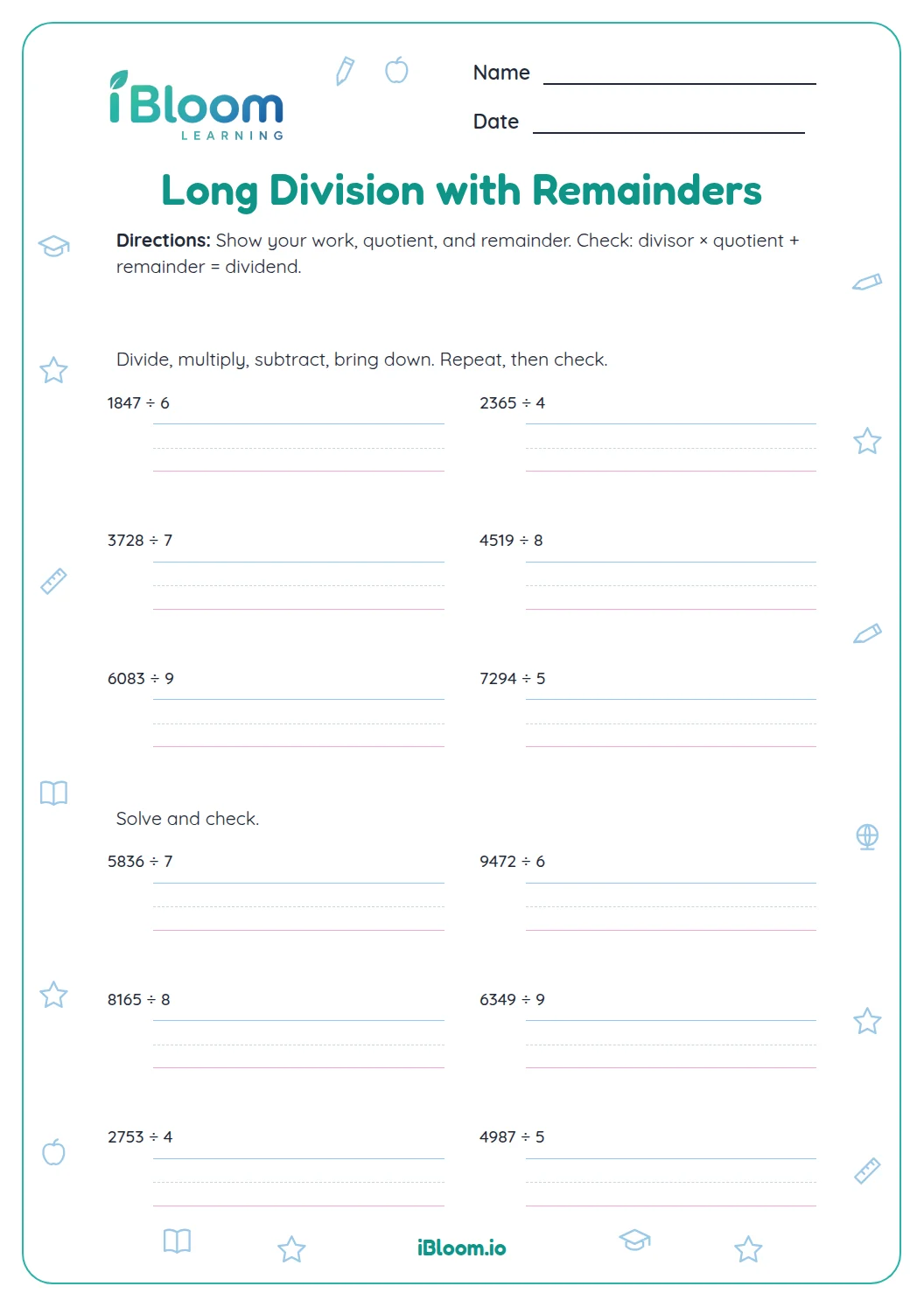
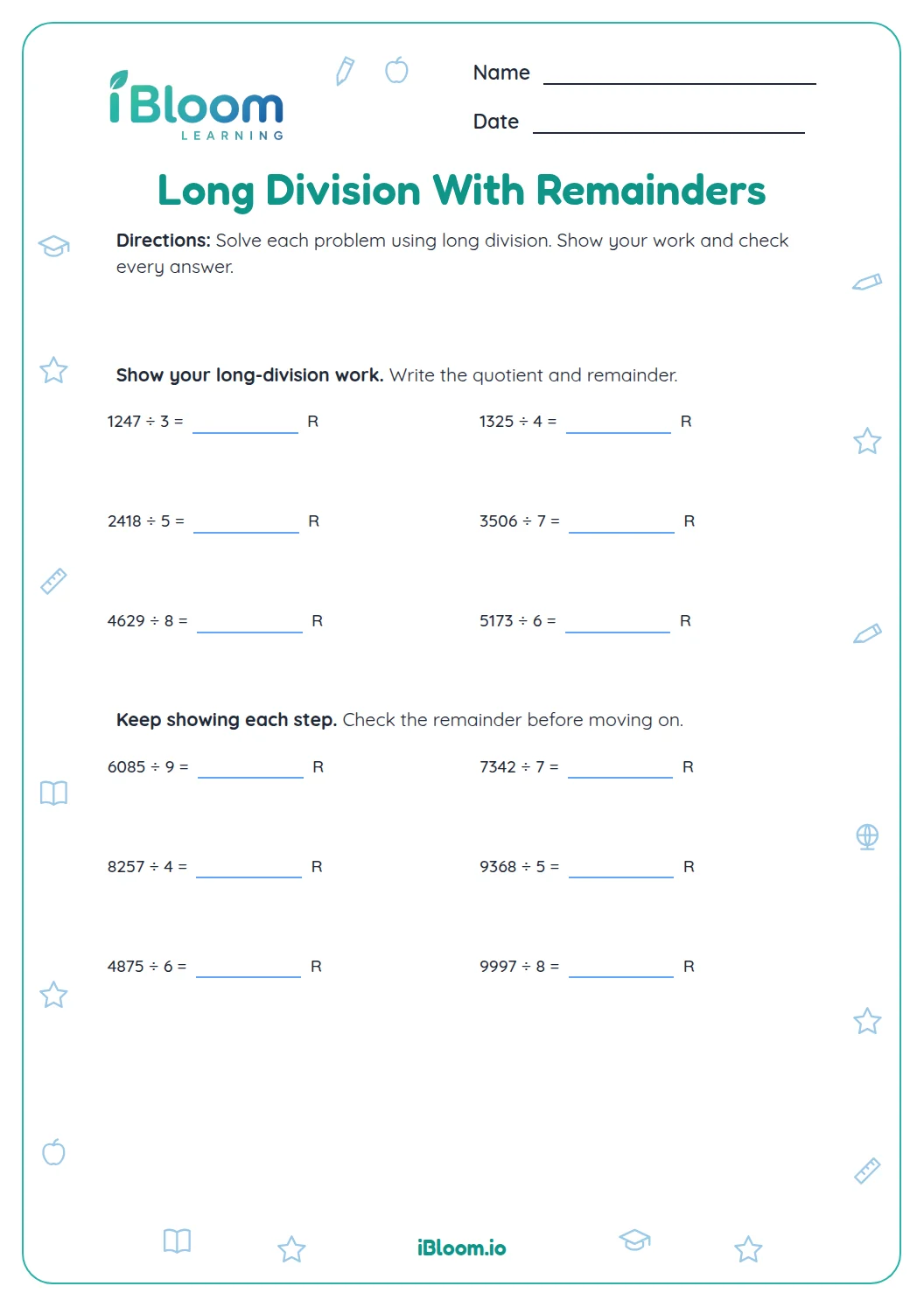
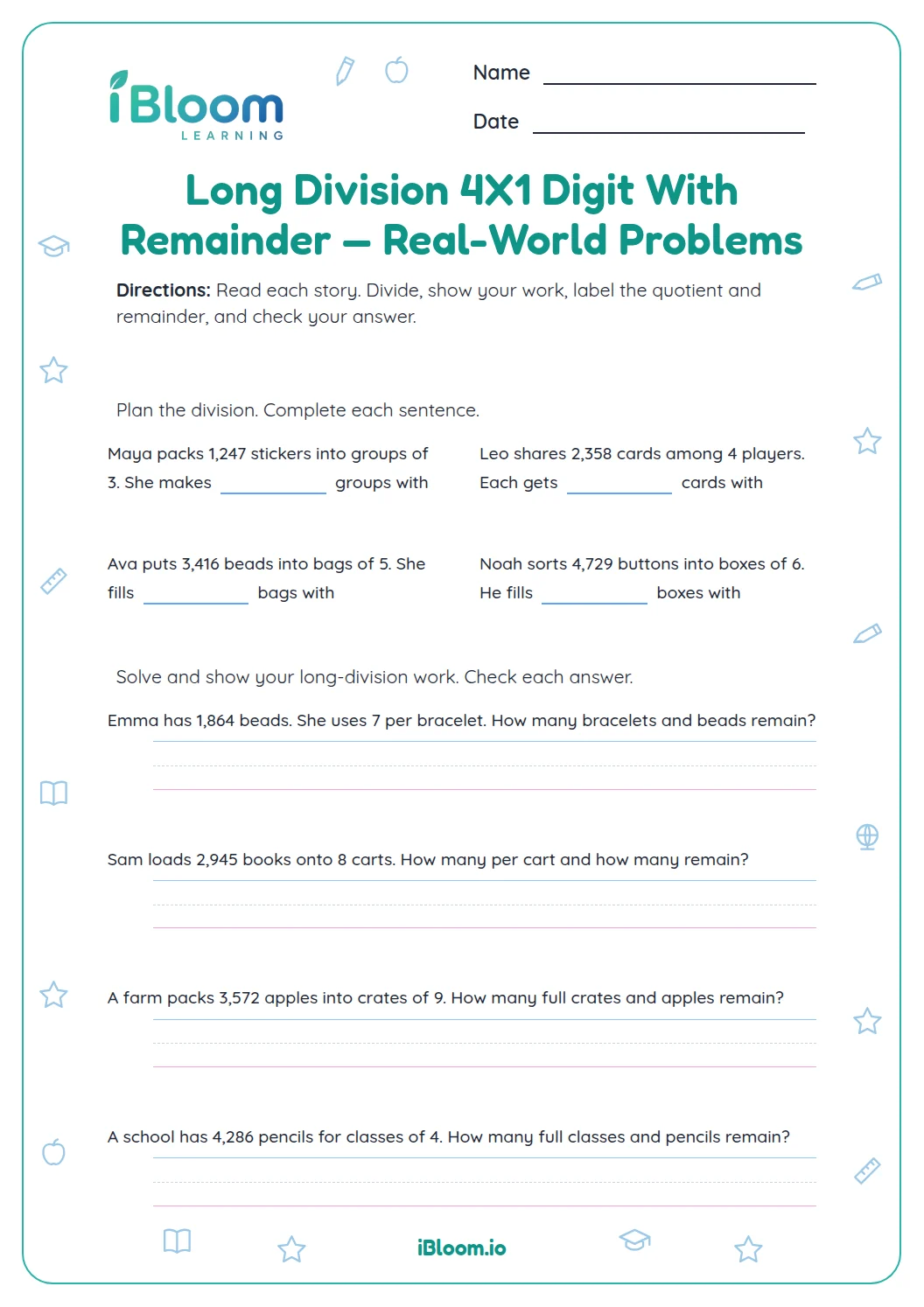
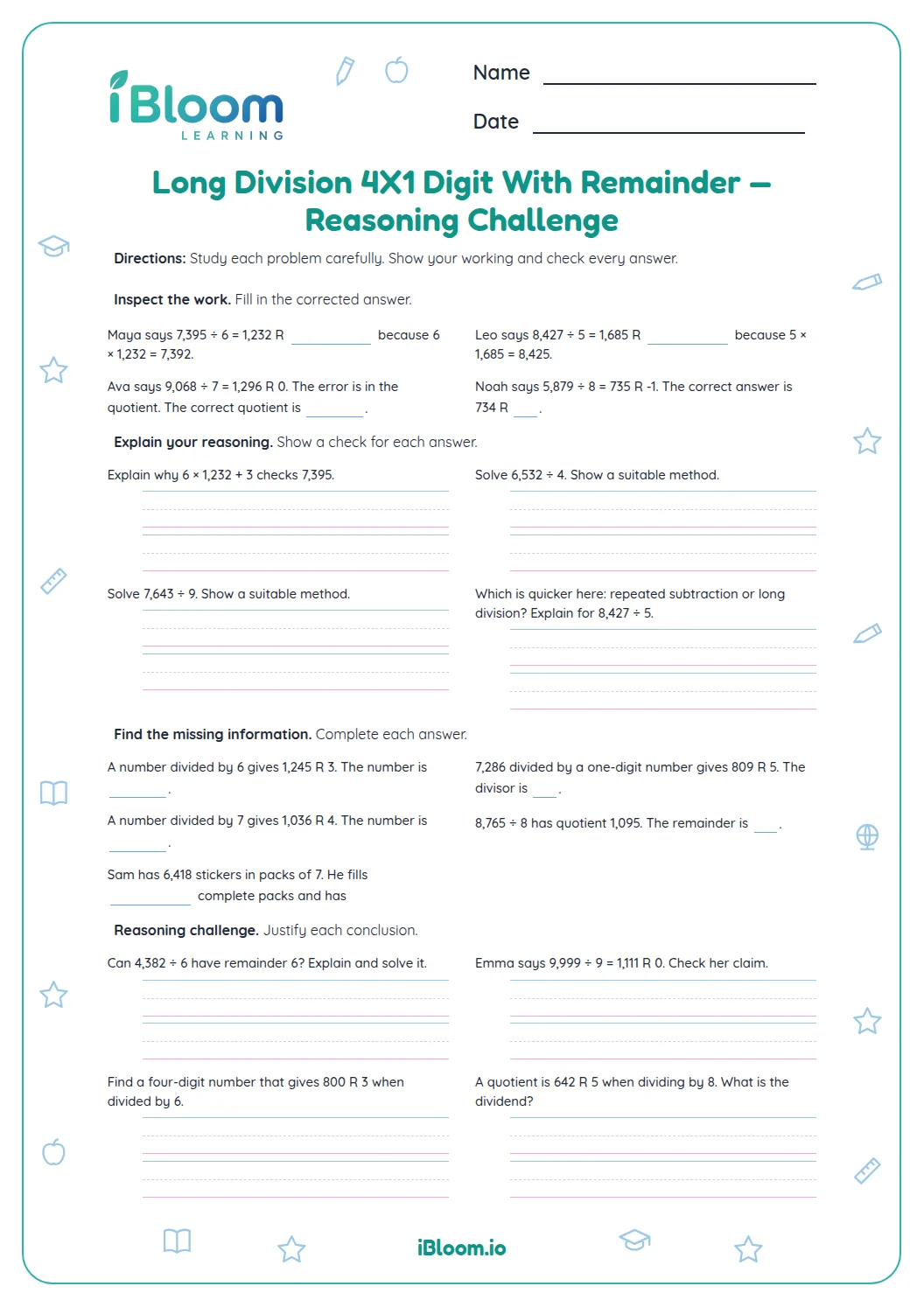
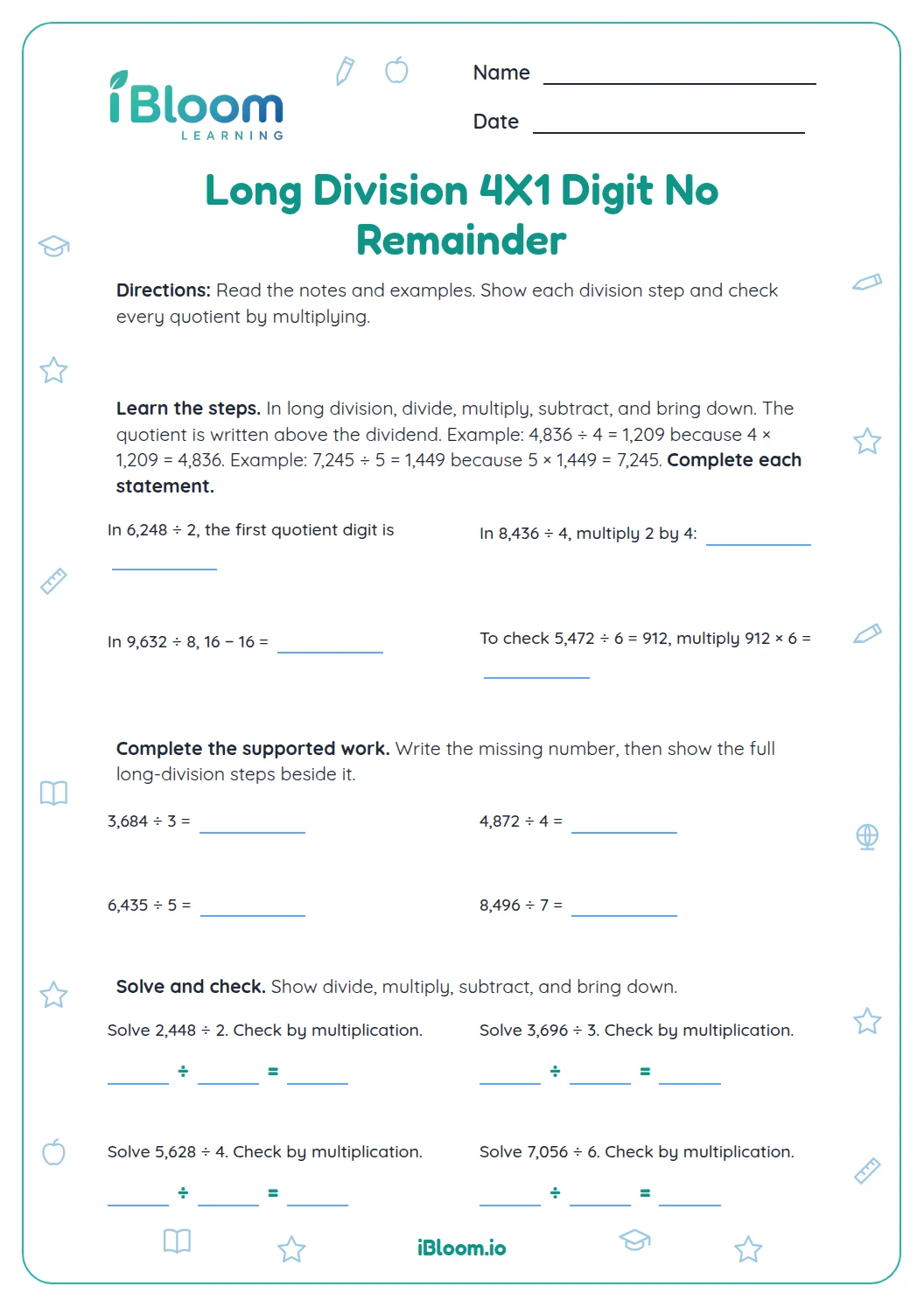
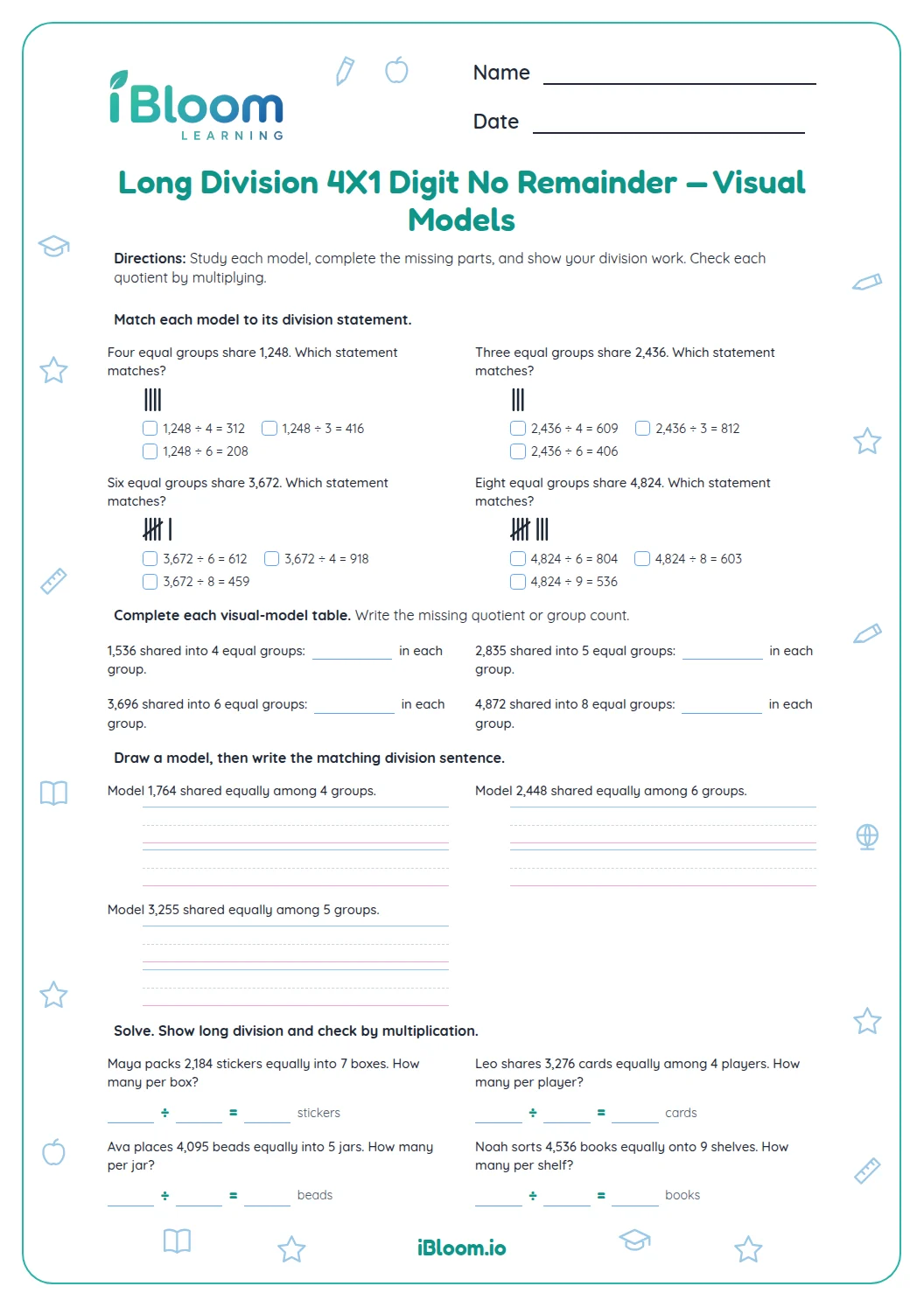
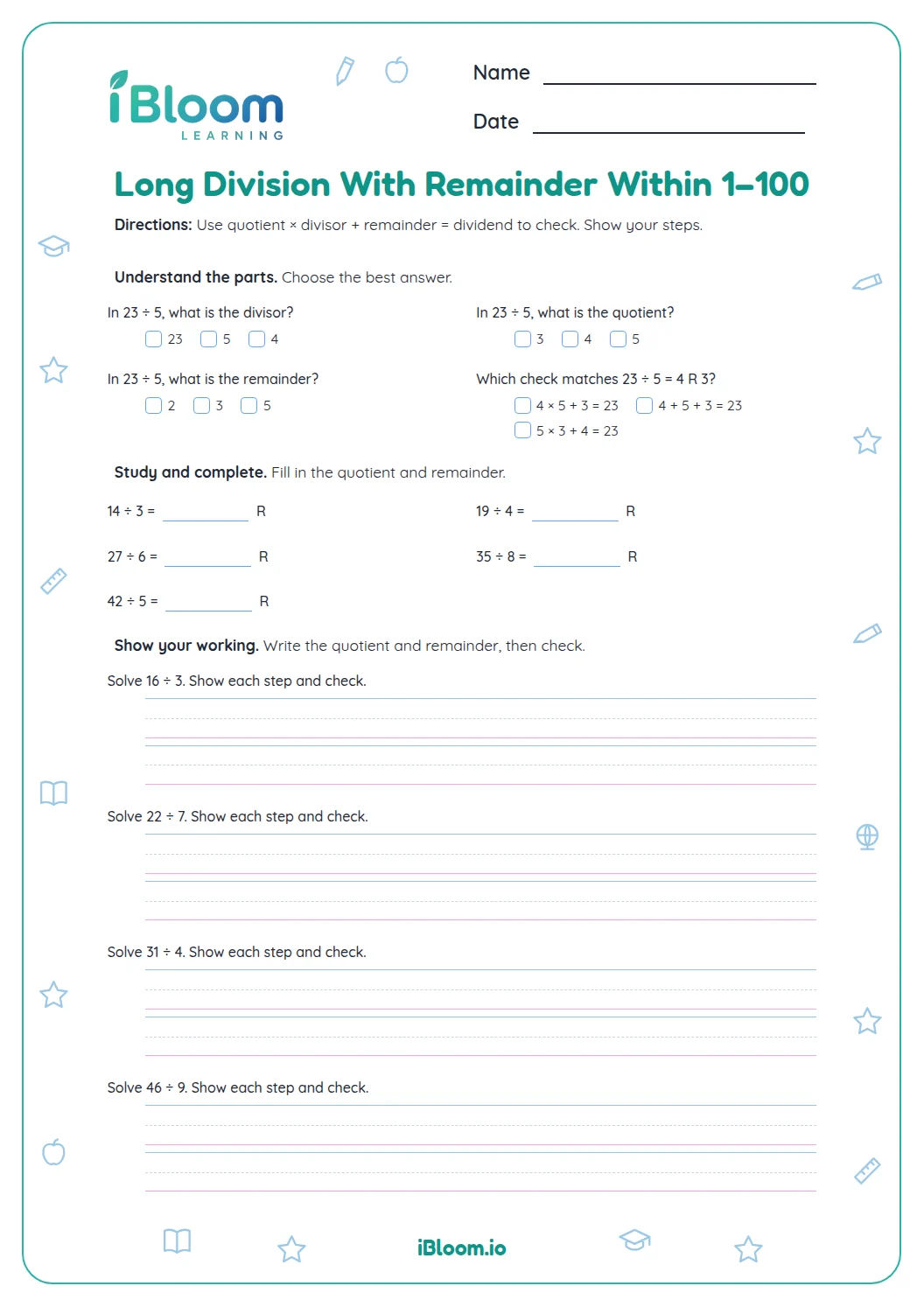
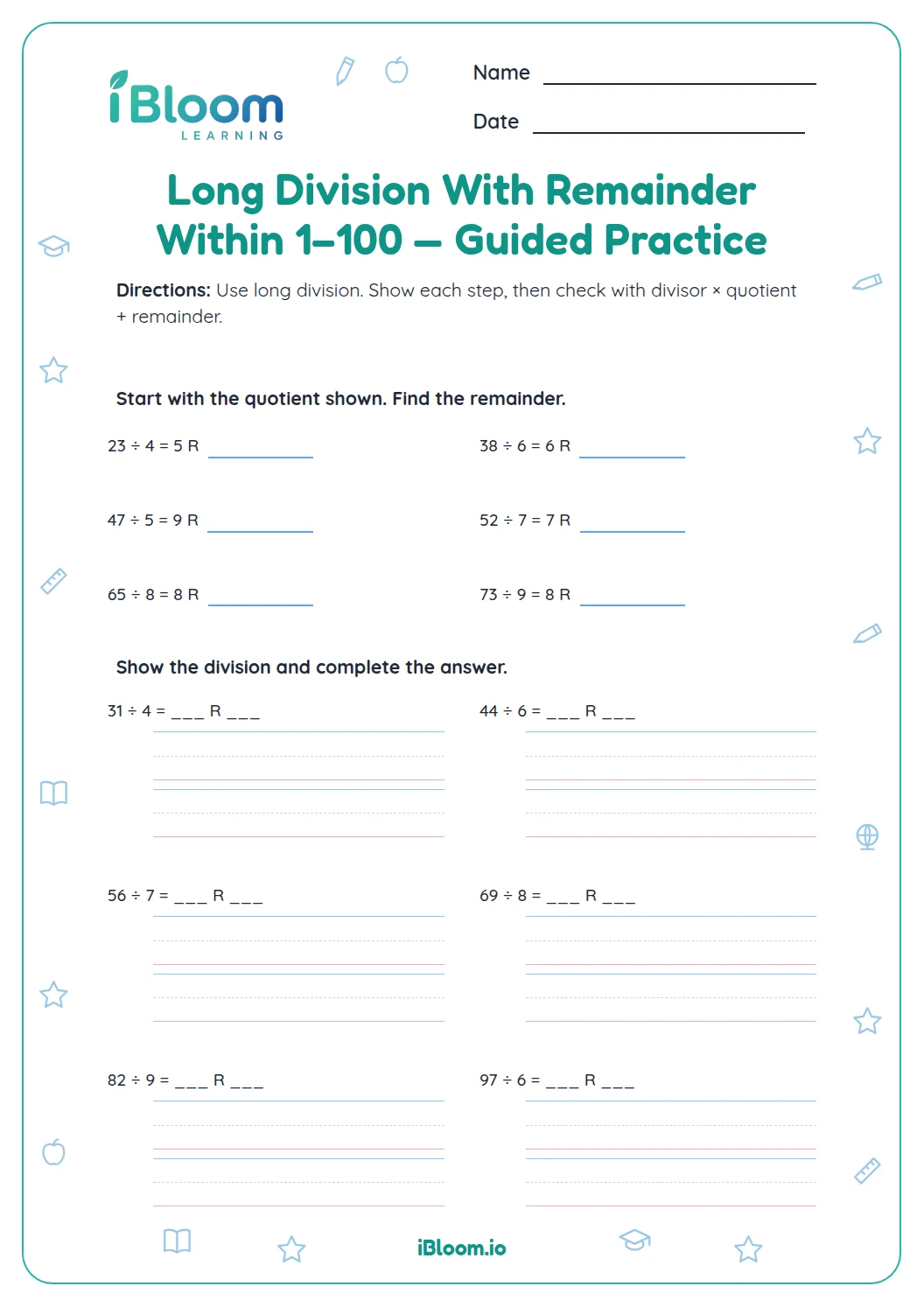
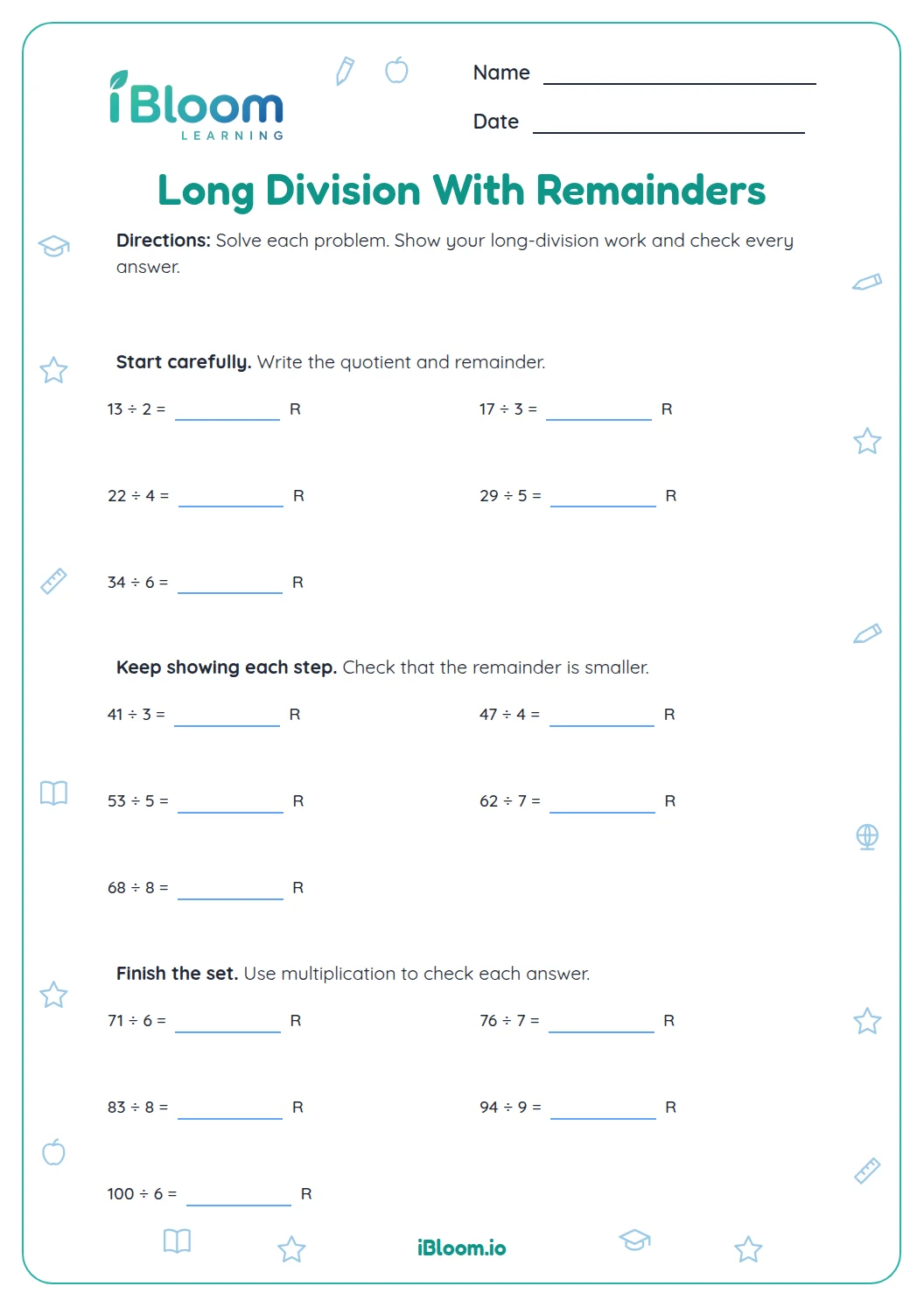
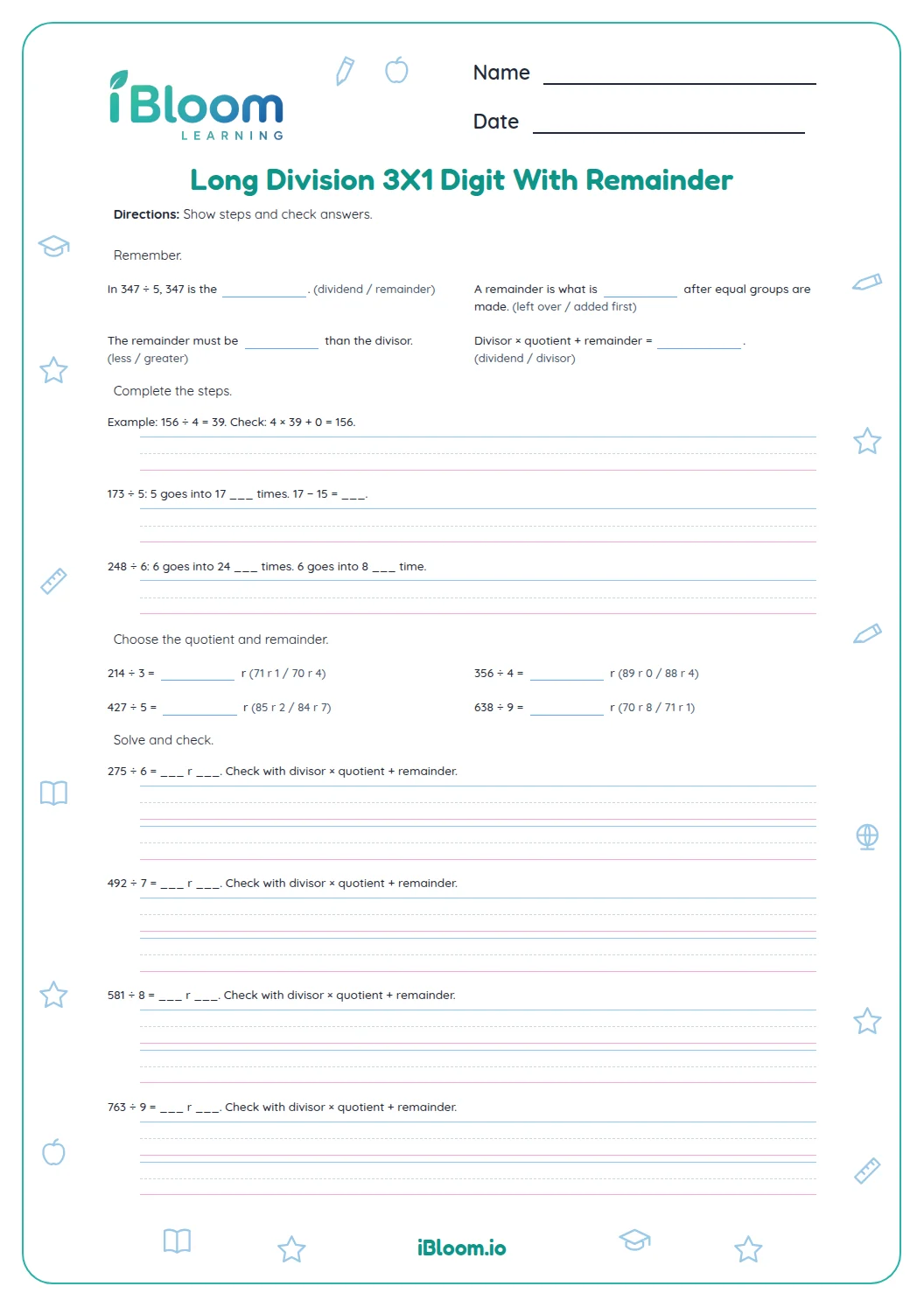
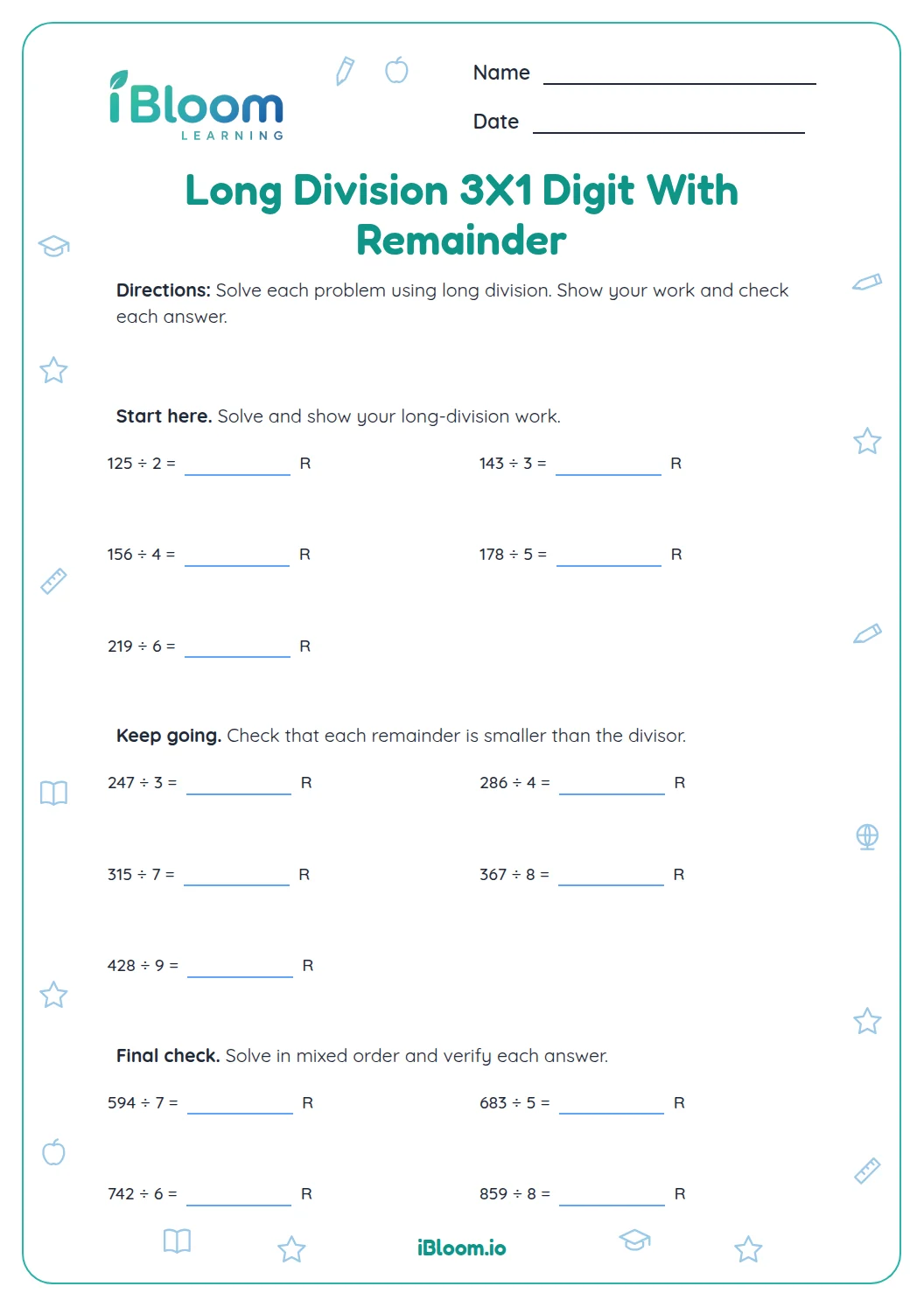
This Grade 4 worksheet gives 20 four-digit-by-one-digit division problems, each with a remainder. Three items include a place-value table to organize the dividend before using long division. Students record the quotient and remainder, then practice checking a result with divisor × quotient + remainder. The work aligns with 4.NBT.B.6.
Aligned to 4.NBT.B.6
What do quotient and remainder tell me?
The quotient counts complete equal groups. The remainder is what is left after making as many full groups as possible. It must be less than the divisor.
- 11,247 ÷ 3 = 415 R2
- 23 × 415 + 2 = 1,247, and 2 is less than 3.
How do I check long division?
Multiply the quotient by the divisor and add the remainder. If the sum equals the dividend and the remainder is smaller than the divisor, the answer is consistent.
How does place value guide division?
Divide the dividend from its greatest place to its ones. The table on selected problems helps keep each digit in order while you work through the long-division steps.
- 11,247 ÷ 3 = 415 R2
- 23 × 415 + 2 = 1,247
How to use this worksheet
- 1Start with the thousands digit and divide from left to right.
- 2Bring down the next digit after each division step.
- 3Write the quotient and then R with the leftover amount.
- 4Check by multiplying divisor × quotient and adding the remainder.
Common mistakes and quick fixes
The mistake
Writing a remainder as large as or larger than the divisor.
The fix
If the remainder is at least the divisor, another equal group still fits. Divide again.
The mistake
Stopping after finding the quotient and forgetting leftover ones.
The fix
Check with divisor × quotient + remainder. The check should return the original dividend.
The mistake
Leaving out a zero in the quotient when a divisor does not fit a place-value group.
The fix
Keep quotient digits aligned with the dividend places; a zero may hold a place before you bring down the next digit.
Common Core alignment
This Grade 4 worksheet practices the grade-level skill described by the Common Core standards below.
Find whole-number quotients and remainders with up to four-digit dividends and one-digit divisors.
On this sheet: Every problem has a four-digit dividend, one-digit divisor and quotient with a remainder.
Show the official wordingHide the official wording
Find whole-number quotients and remainders with up to four-digit dividends and one-digit divisors, using strategies based on place value, the properties of operations, and/or the relationship between multiplication and division. Illustrate and explain the calculation by using equations, rectangular arrays, and/or area models.
What to practice next
Make more practice
Further reading
Questions parents and teachers ask
What do quotient and remainder mean?
The quotient counts complete equal groups. The remainder is what is left after making as many complete groups as possible. It is always smaller than the divisor. In 1,247 divided by 3, the quotient is 415 and the remainder is 2.
How can I check a division answer?
Multiply the quotient by the divisor, then add the remainder. The result should equal the dividend, and the remainder must be smaller than the divisor. For 1,247 ÷ 3 = 415 R2, calculate 415 × 3 + 2 to return to 1,247.
Can the remainder equal the divisor?
No. If the remainder were as large as the divisor, one more complete group would fit. Divide again until the remainder is smaller. For example, 17 ÷ 4 is 4 R1, because 4 groups use 16 and one is left.
What does R mean in an answer?
R stands for remainder. For example, 1,247 ÷ 3 = 415 R2 means 415 groups of 3, with 2 left over. The remainder is part of the answer, not a decimal or another quotient digit. Always check that multiplying the quotient by the divisor and adding the remainder returns the dividend.
What is a place-value model doing on this page?
The table separates a dividend into thousands, hundreds, tens and ones so its digits stay in order. It is a planning aid for the long-division steps. Students still calculate the quotient and remainder, then check that the remainder is smaller than the divisor.