

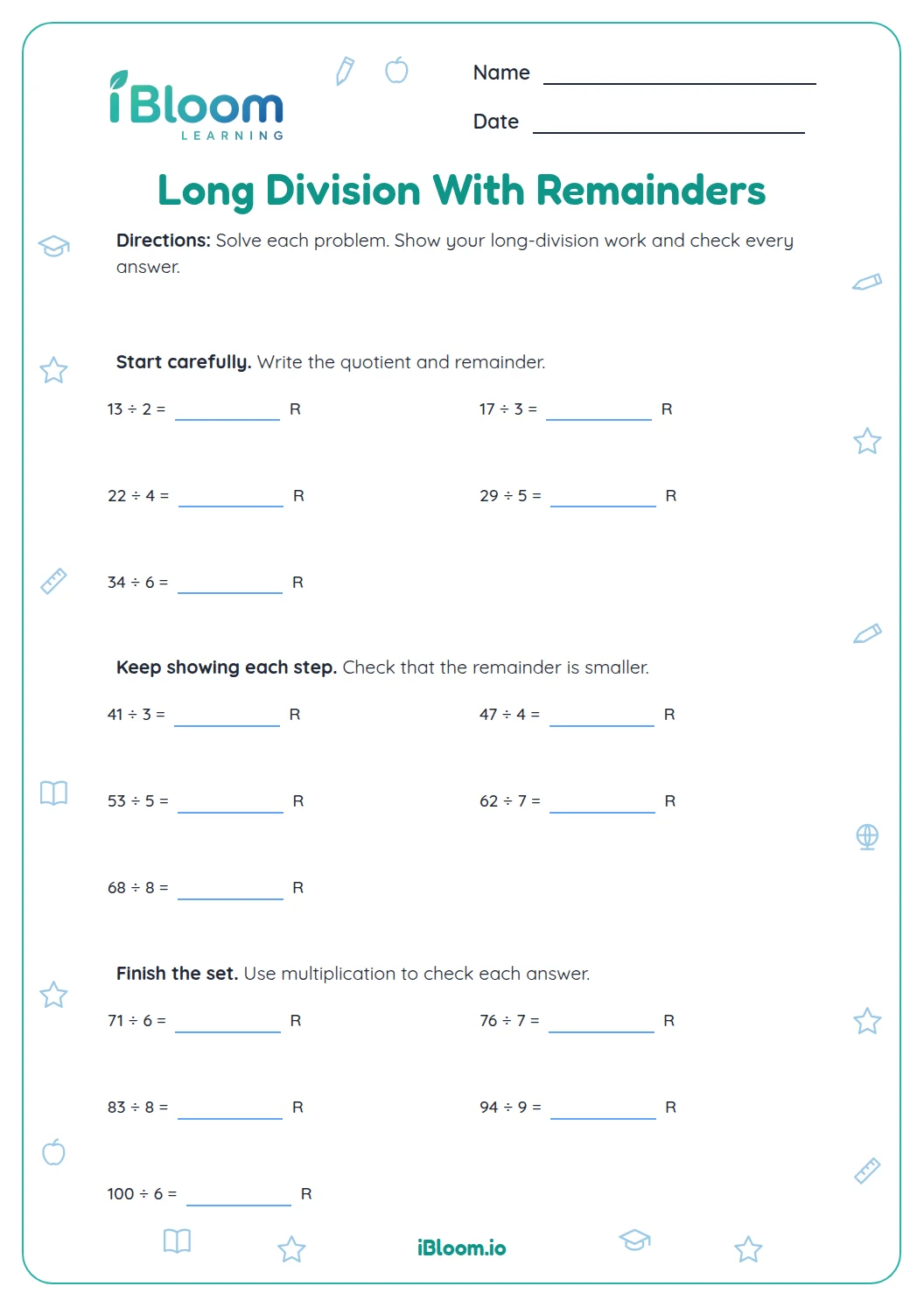
About this worksheet
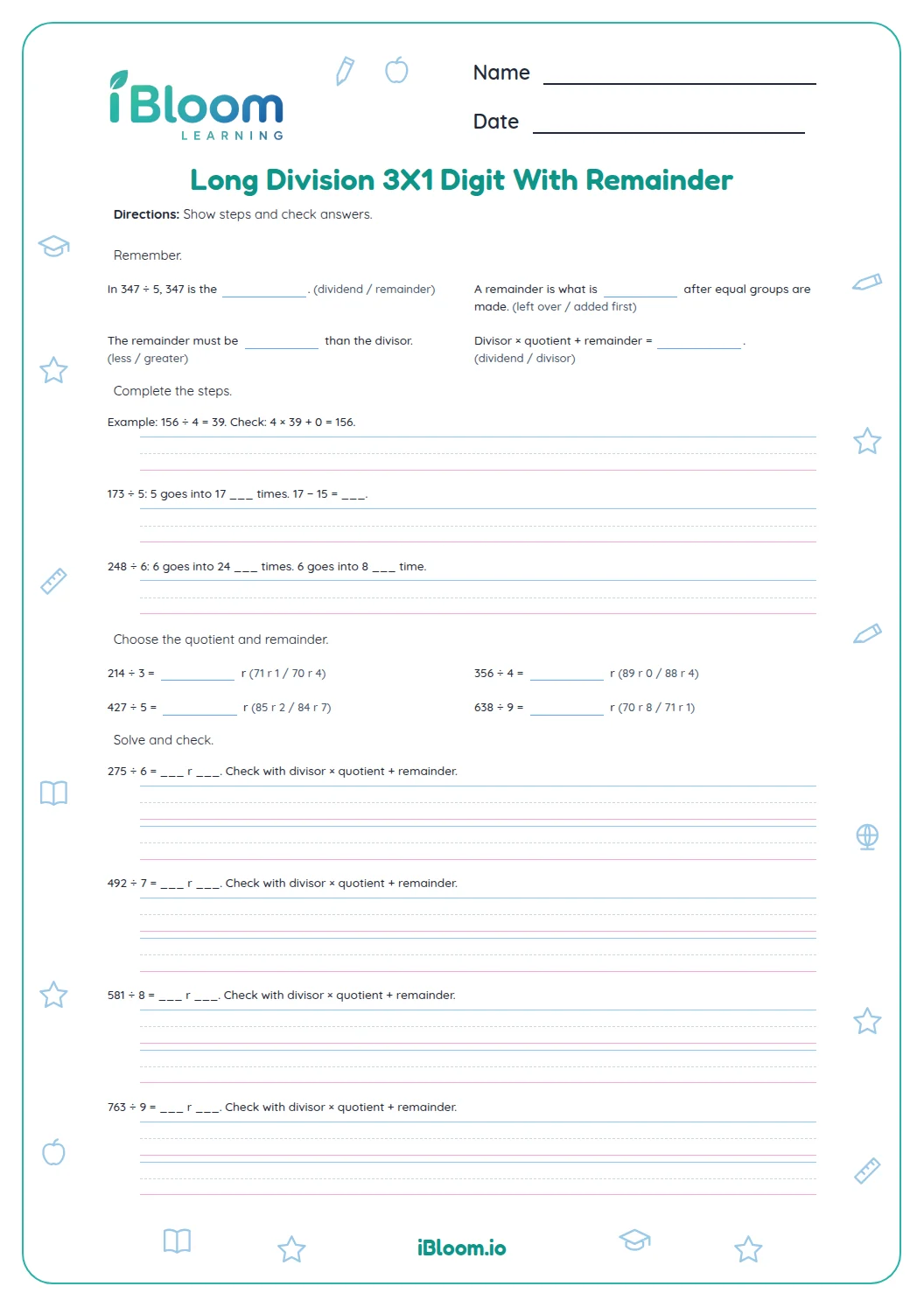
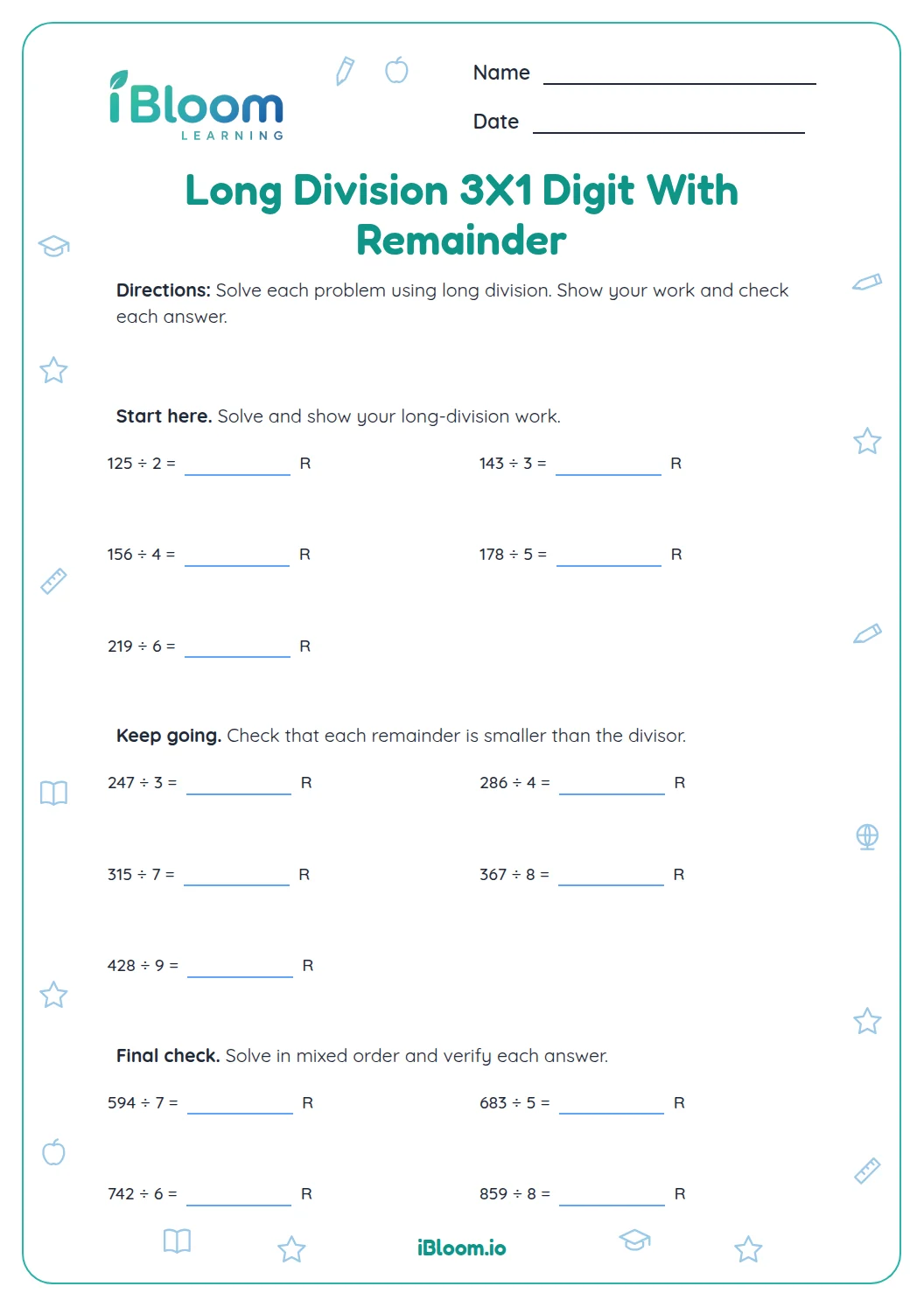
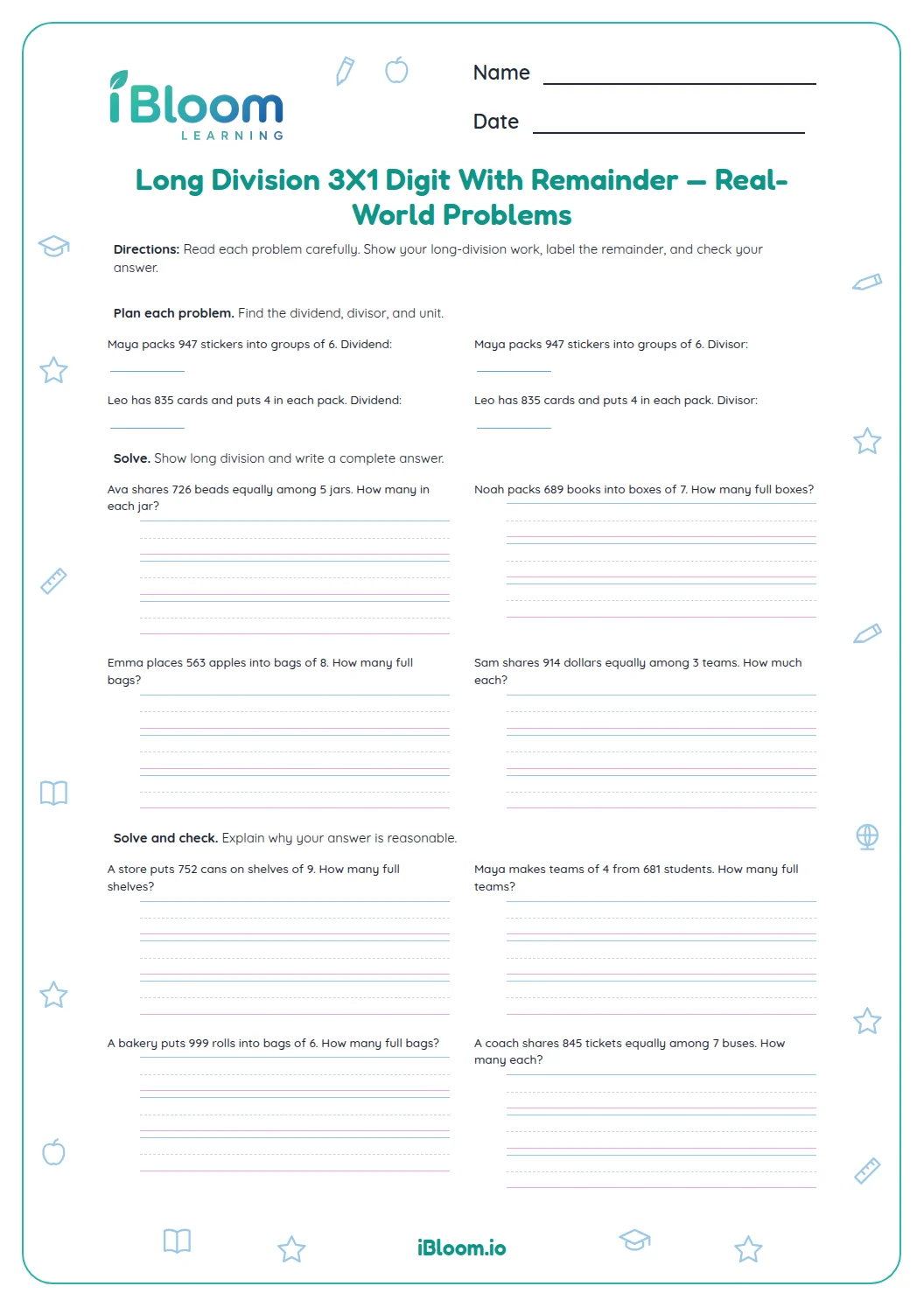
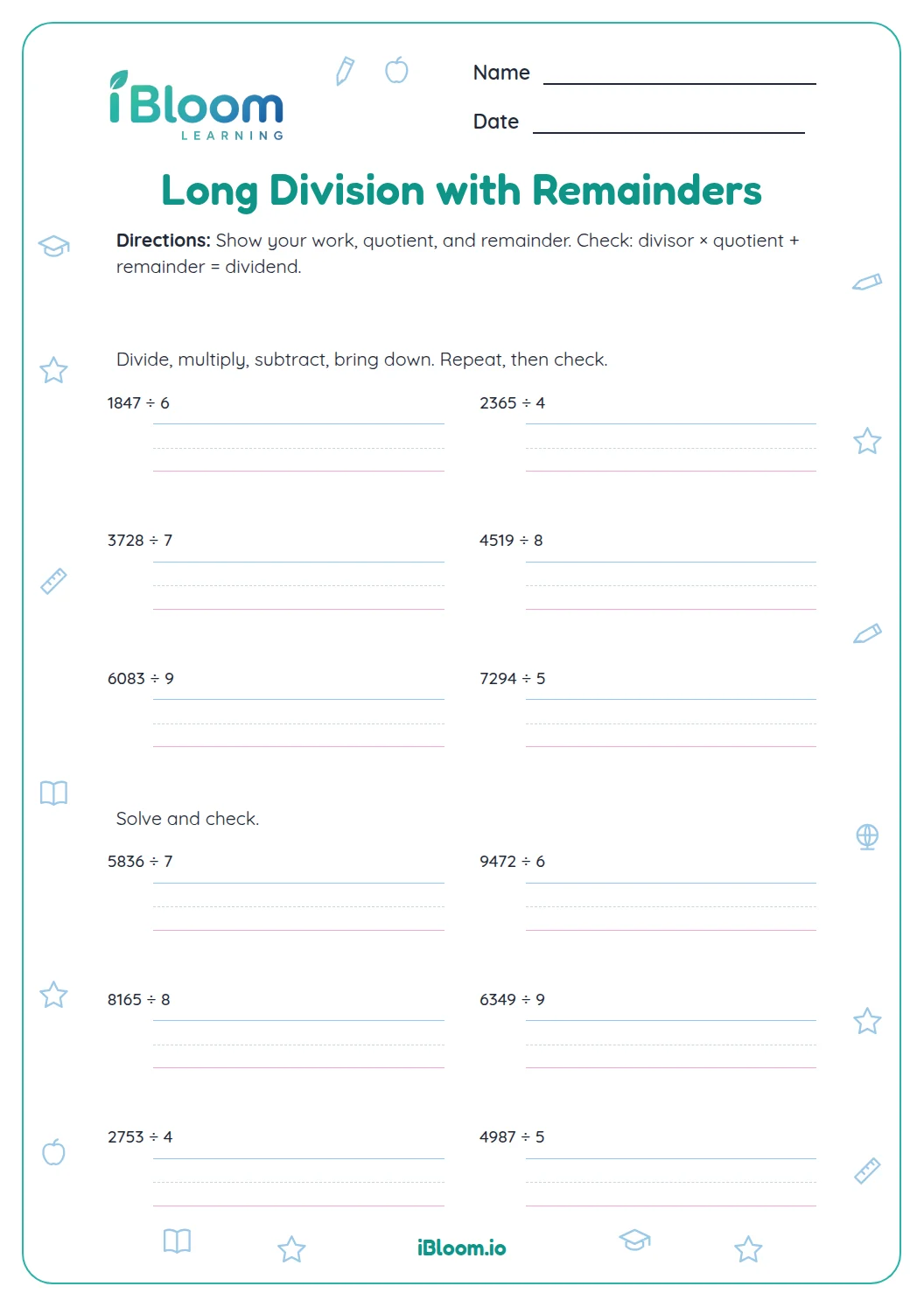
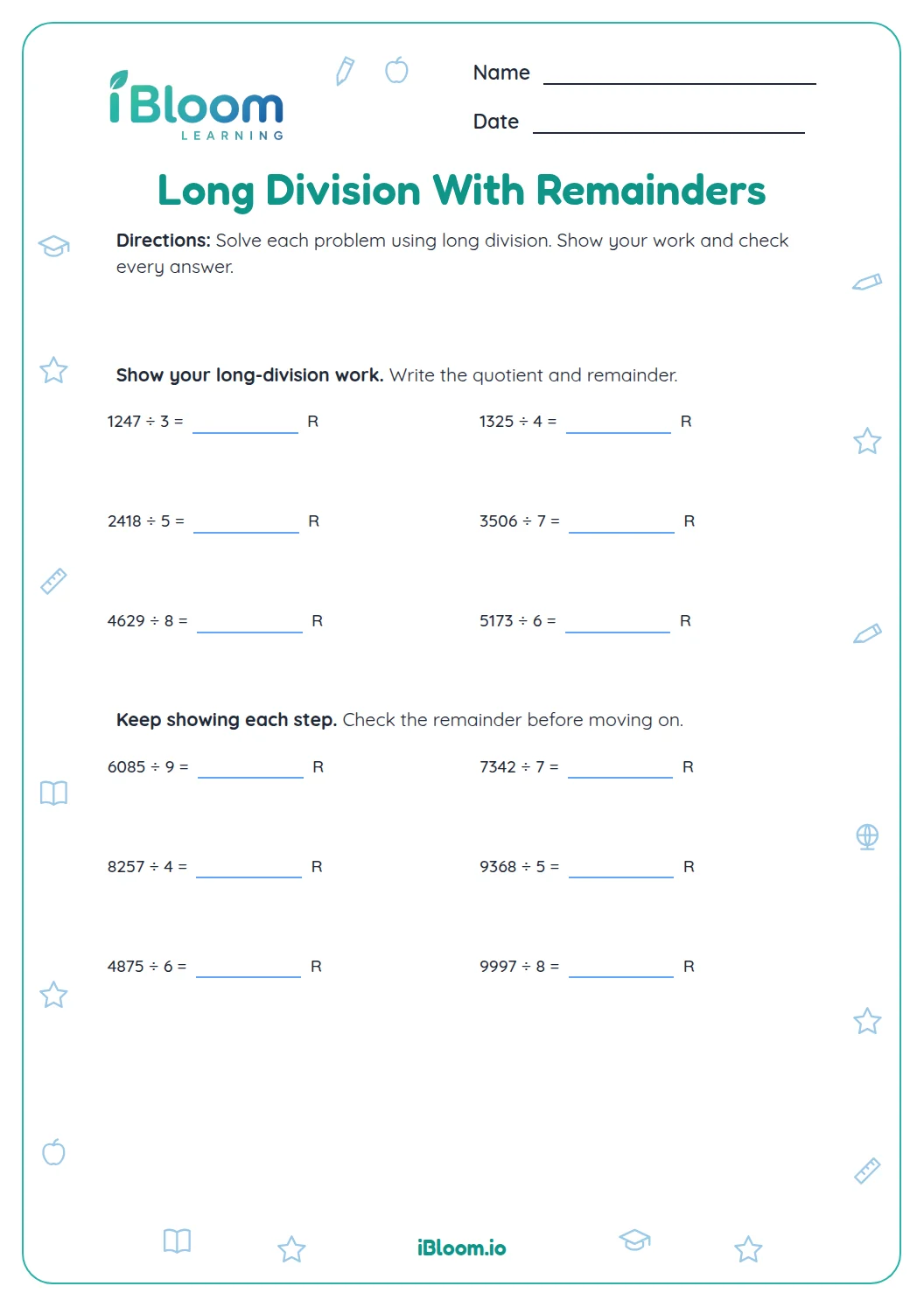
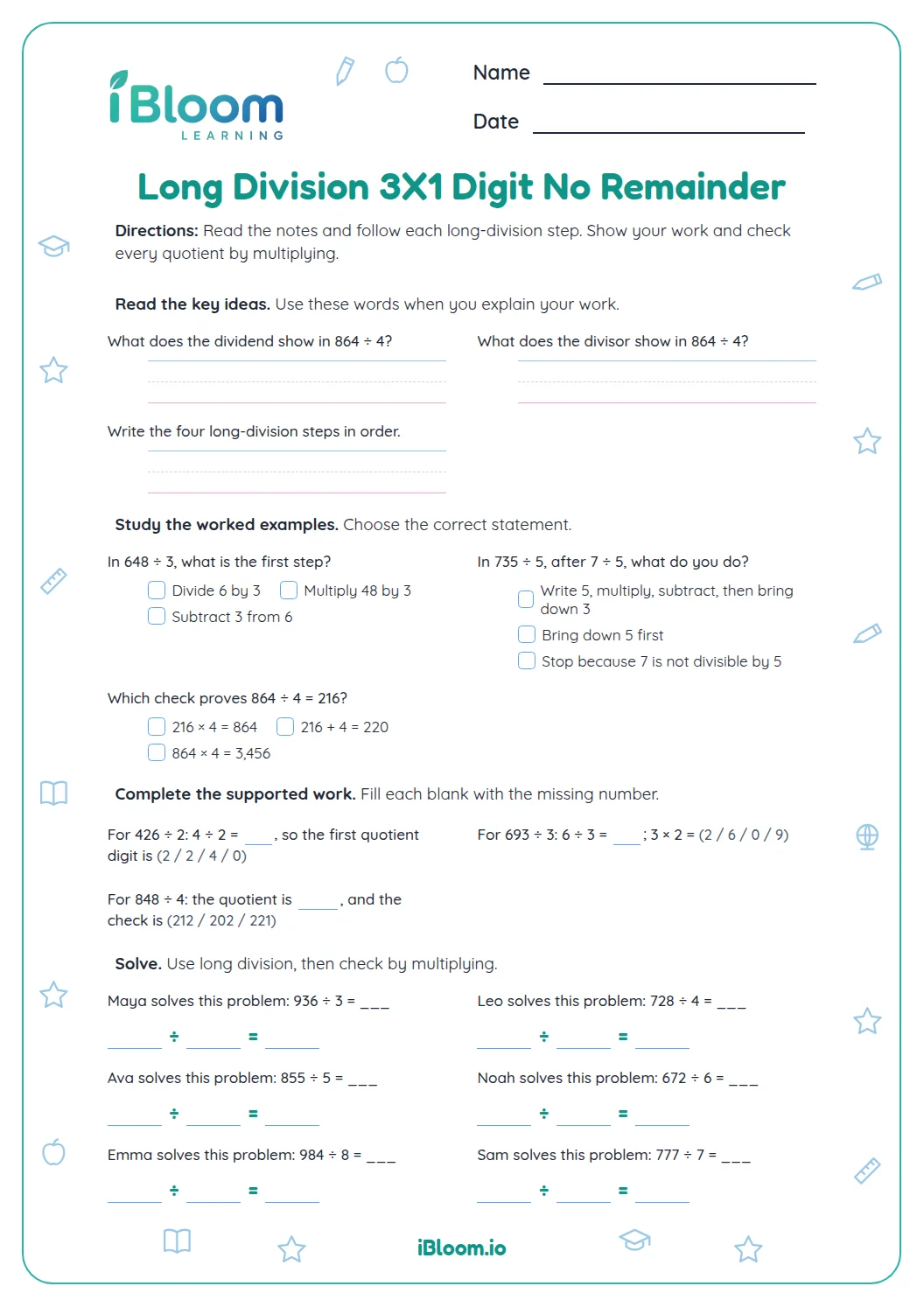
This Grade 4 printable builds long division skill with three-digit dividends and one-digit divisors. Students work through guided examples, solve division problems, apply division to equal-sharing situations, and check whether remainders make sense. It includes 14 questions and a separate answer key, aligned to CCSS 4.NBT.B.6.
Aligned to 4.NBT.B.6
What steps help with long division?
Work from the leftmost place. Divide, multiply, subtract, and bring down the next digit. Repeat until no digits remain.
For question 1, 157 ÷ 4: 4 goes into 15 three times, leaving 3; bring down 7 to make 37. Four goes into 37 nine times, leaving 1. The answer is 39 R1.
How to use this worksheet
- 1Write the divisor outside and dividend inside the long-division bracket.
- 2Divide the first place value that is large enough.
- 3Multiply and subtract, then bring down the next digit.
- 4Repeat and write any leftover amount as the remainder.
- 5Check quotient × divisor + remainder equals the dividend.
Common mistakes and quick fixes
The mistake
Writing a remainder equal to the divisor.
The fix
Trade one more group: increase the quotient and reduce the remainder.
The mistake
Leaving out a zero in the quotient.
The fix
Check each place value as you bring down digits.
The mistake
Forgetting the remainder in the check.
The fix
Add the remainder after multiplying divisor and quotient.
Common Core alignment
This worksheet gives focused practice with the standard below.
Find whole-number quotients and remainders using place value and operations.
On this sheet: The sheet uses three-digit dividends, one-digit divisors, remainders, and multiplication checks.
Show the official wordingHide the official wording
Find whole-number quotients and remainders with up to four-digit dividends and one-digit divisors, using strategies based on place value, the properties of operations, and/or the relationship between multiplication and division.
What to practice next
Make more practice
Further reading
Questions parents and teachers ask
How do you divide a three-digit number by a one-digit number?
Divide one place at a time, multiply, subtract, and bring down the next digit. Repeat until the dividend is used, then record any remainder. The first examples cue the routine, then later questions ask students to solve independently and apply division in equal-sharing situations.
How do you check a remainder?
Multiply the quotient by the divisor and add the remainder. The total should equal the dividend, and the remainder must be smaller than the divisor. For 157 ÷ 4, 39 × 4 = 156, and one is left. Since 1 is less than 4, 39 R1 is valid.
What does R mean in a division answer?
R means remainder: the amount left after making as many equal groups as possible. For example, 13 divided by 5 is 2 R3. For example, 13 ÷ 5 = 2 R3 because two groups of five use ten, leaving three. The leftover amount is the remainder.
Is there an answer key?
Yes. The separate key gives quotients and remainders, with sample reasoning for the explanation questions so work can be checked. For story problems, the remainder represents items left over after making full equal groups. Read the wording to describe that amount clearly.
Why must the remainder be smaller than the divisor?
A remainder is what is left after making as many full groups as possible. If it were as large as the divisor, one more full group could be made. In question 13, 7 is too large for division by 5, so 372 ÷ 5 is 74 R2.