



About this worksheet
Practice dividing three-digit numbers by one-digit divisors. Start by choosing a quotient and remainder, then solve division problems and short grouping stories. The final questions use multiplication to check whether a remainder is correct.
Aligned to 4.NBT.B.6
How to divide and record a remainder
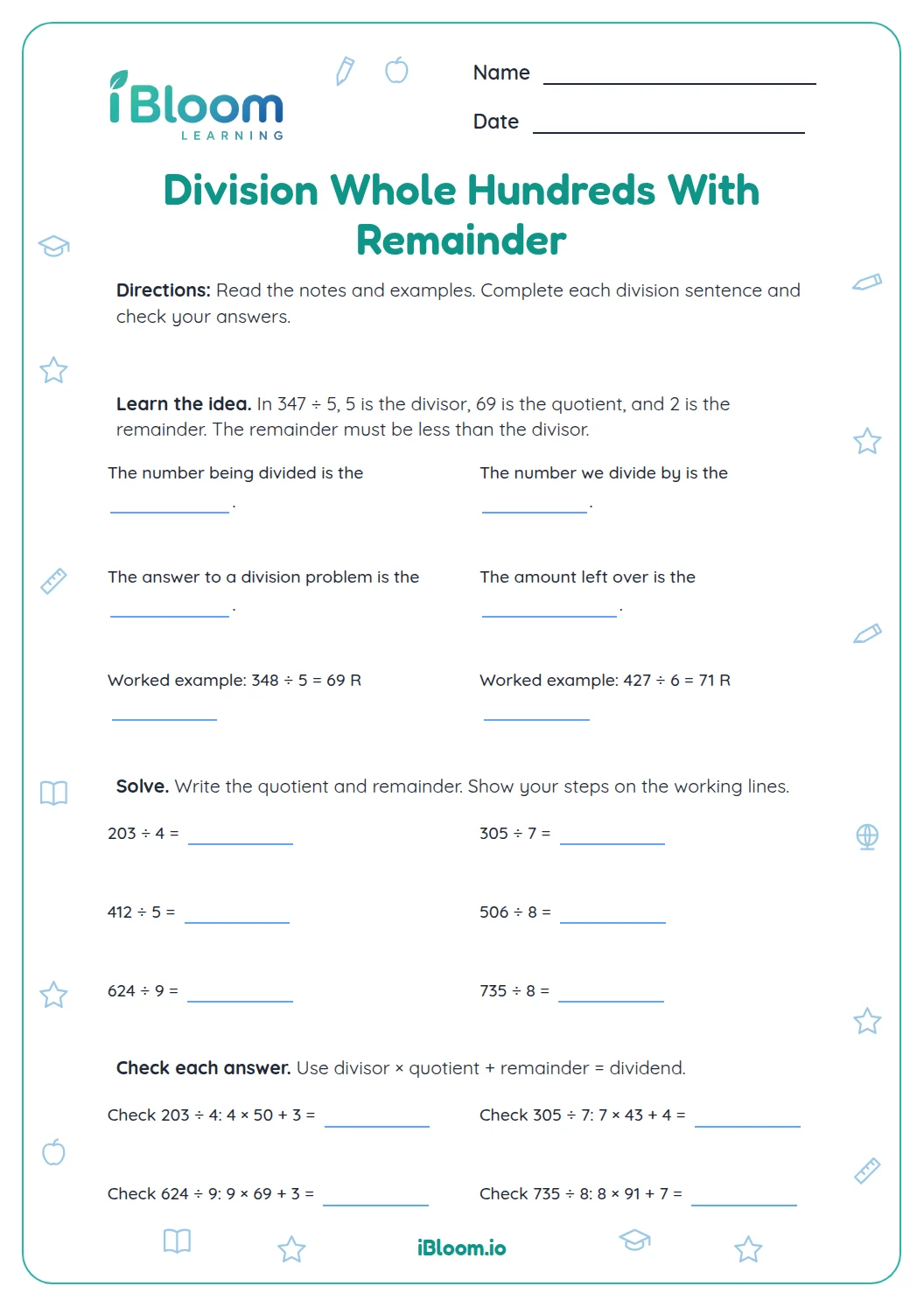
A remainder is what is left after making as many equal groups as possible. For 526 ÷ 5, 5 goes into 52 ten times, leaving 2; bring down 6 to make 26. Five goes into 26 five times, leaving 1. So 526 ÷ 5 = 105 R 1.
Check by multiplying: 105 × 5 = 525, and 525 + 1 = 526. The remainder, 1, is less than the divisor, 5.
- 15 × 105 = 525
- 2525 + 1 = 526
- 31 is less than 5
What is on this worksheet?
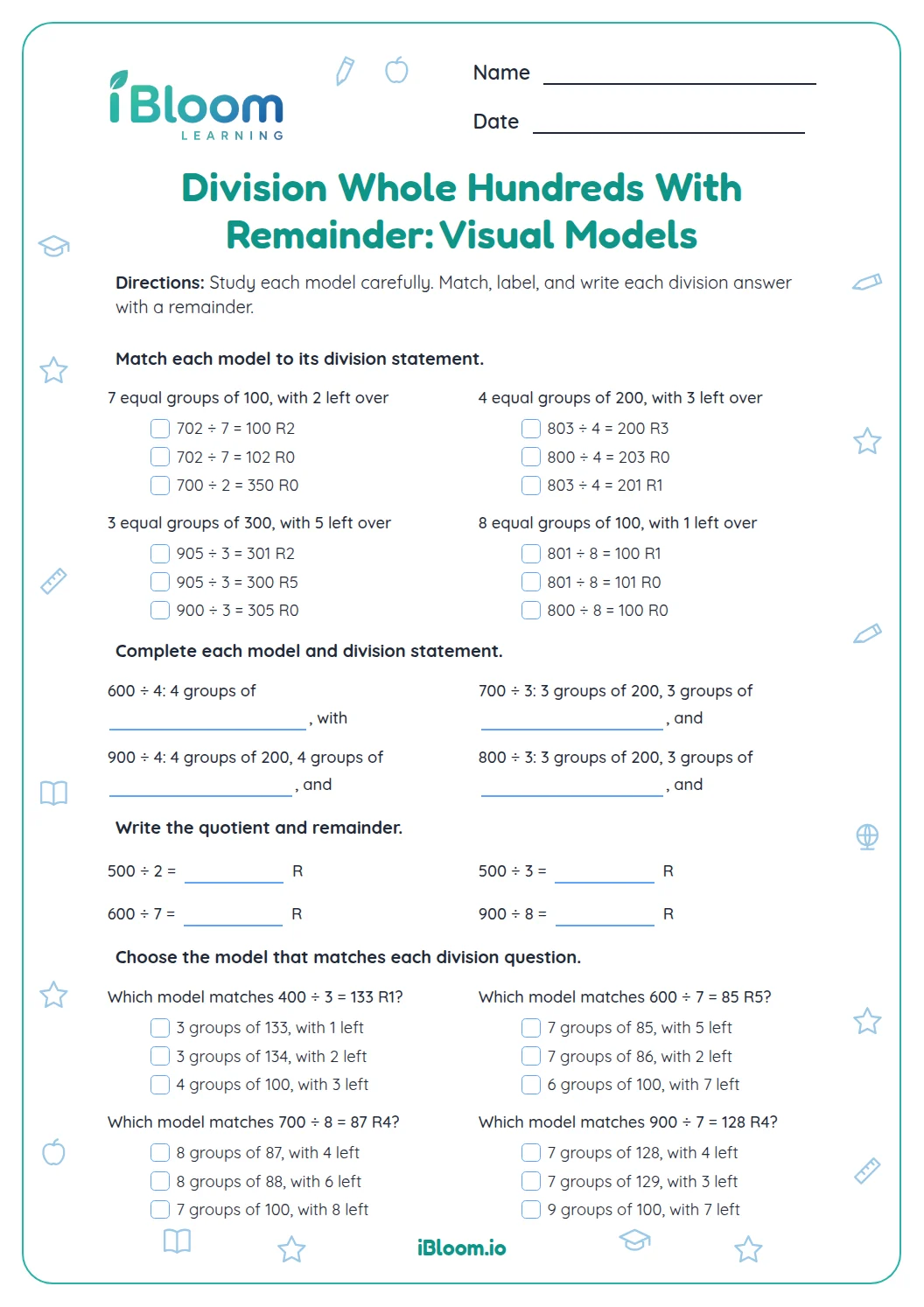
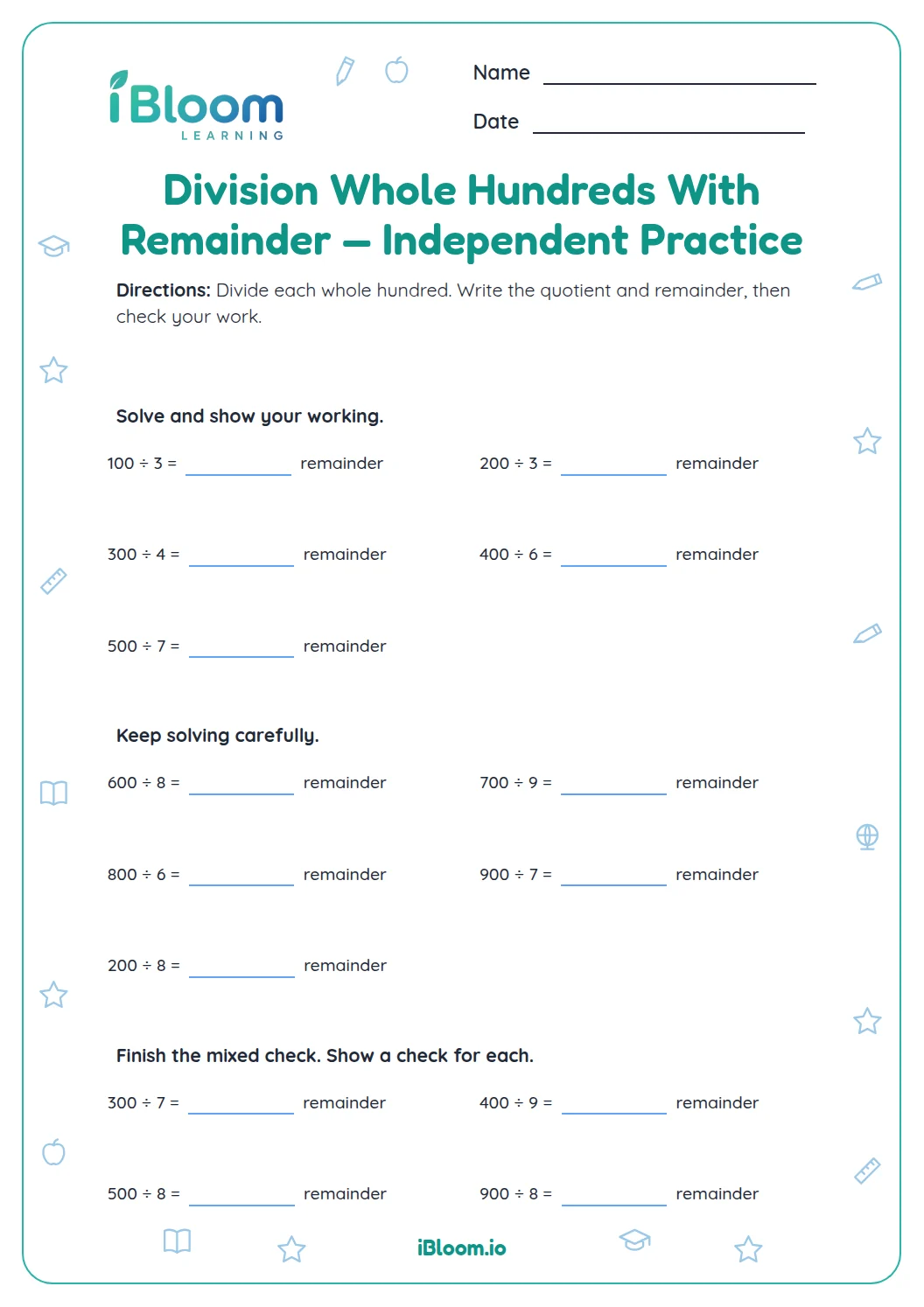
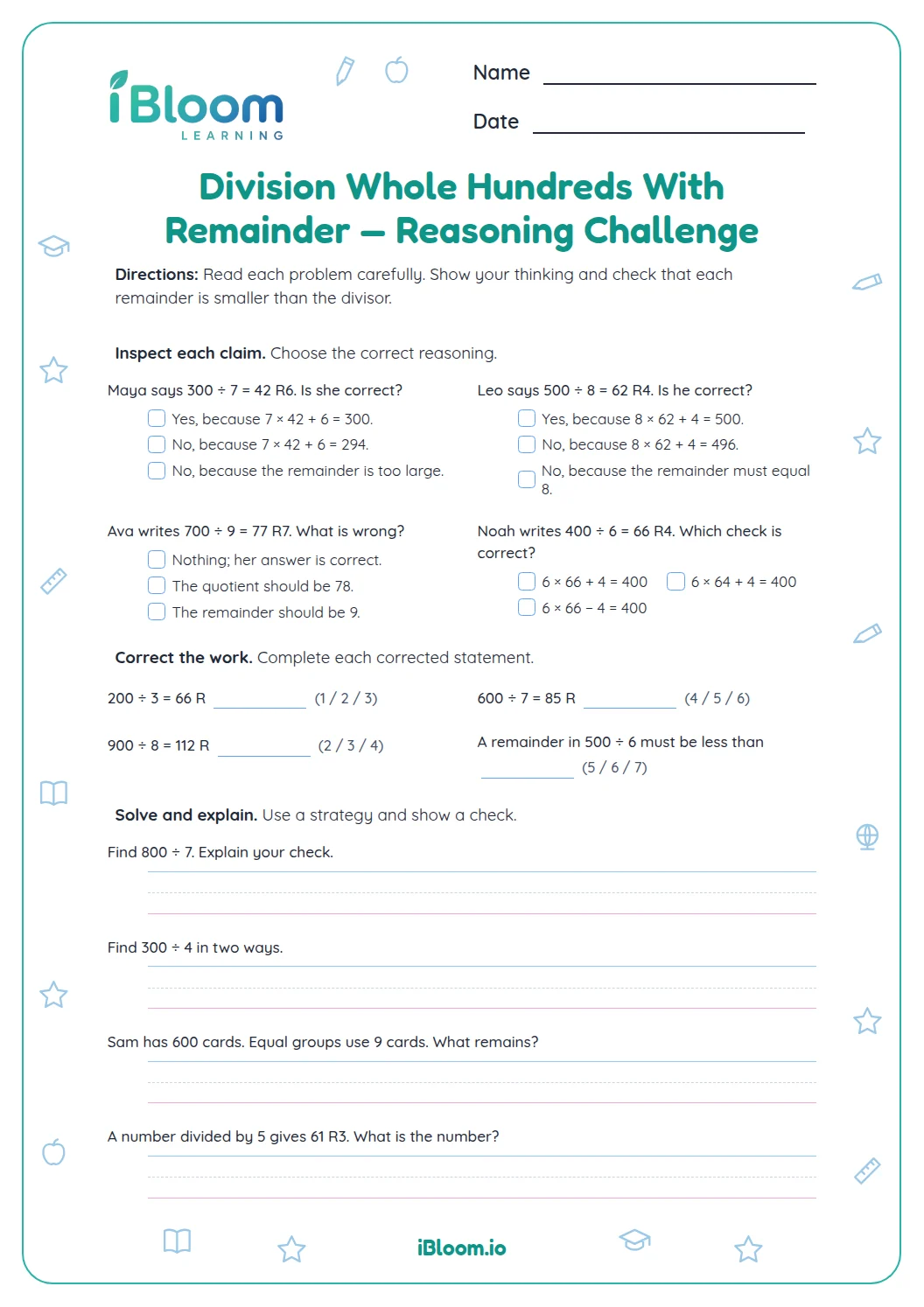
Part A checks quotient-and-remainder pairs. Part B gives six divisions to solve. Part C has four equal-group stories, followed by two remainder checks in Part D.
- Part A: four choice questions
- Part B: six division problems
- Part C: four grouping stories
- Part D: two remainder checks
- A separate answer key
How to use the worksheet
- 1For Part A, test a choice by multiplying and adding its remainder.
- 2In Part B, divide and write the remainder after R.
- 3For each story, identify the divisor and what one group represents.
- 4Check that the remainder is smaller than the divisor.
Common division mistakes
The mistake
Writing a remainder that is as large as the divisor, such as 6 R 5 when dividing by 5.
The fix
Make one more group whenever the remainder is at least the divisor.
The mistake
Stopping before bringing down the next digit.
The fix
After each division step, bring down the next digit and continue.
The mistake
Checking only the quotient and forgetting the leftover amount.
The fix
Multiply the quotient by the divisor, then add the remainder.
Common Core alignment
This worksheet practices CCSS 4.NBT.B.6 through one-digit division and remainder checks.
Divide up to four-digit dividends by one-digit divisors and check remainders.
On this sheet: Every item divides a three-digit dividend by a one-digit divisor and interprets or checks the remainder.
Show the official wordingHide the official wording
Find whole-number quotients and remainders with up to four-digit dividends and one-digit divisors, using strategies based on place value, the properties of operations, and/or the relationship between multiplication and division. Illustrate and explain the calculation by using equations, rectangular arrays, and/or area models.
What to practice next
Make more practice
Further reading
Questions parents and teachers ask
What does R mean in a division answer?
R stands for remainder, the amount left after making as many equal groups as possible. In 526 ÷ 5, the quotient is 105 and 1 is left over, so the answer is 105 R 1. The remainder must be less than the divisor.
How can I check a quotient and remainder?
Multiply the quotient by the divisor, then add the remainder. For 105 R 1 when dividing by 5, calculate 105 × 5 + 1 = 526. The result should match the dividend, and the remainder should be smaller than the divisor.
What is on this division worksheet?
The 16 questions move from selecting quotient-and-remainder pairs to independent division, equal-group situations, and checking answers. Story problems ask for full groups and leftovers, so students report both when the context calls for them. The separate key gives a result for every question.
How should a child report a remainder in a story?
Read what is being grouped and what is left. For example, a carton problem asks for the number of full cartons and the eggs that remain. The quotient gives the full groups, while the remainder gives the leftover items.
Is an answer key included?
Yes. The separate key gives the quotient and remainder for each item. For the final explanation questions, it also models the multiplication check or identifies why a remainder is invalid, so a parent can compare the reasoning as well as the number.