




About this worksheet
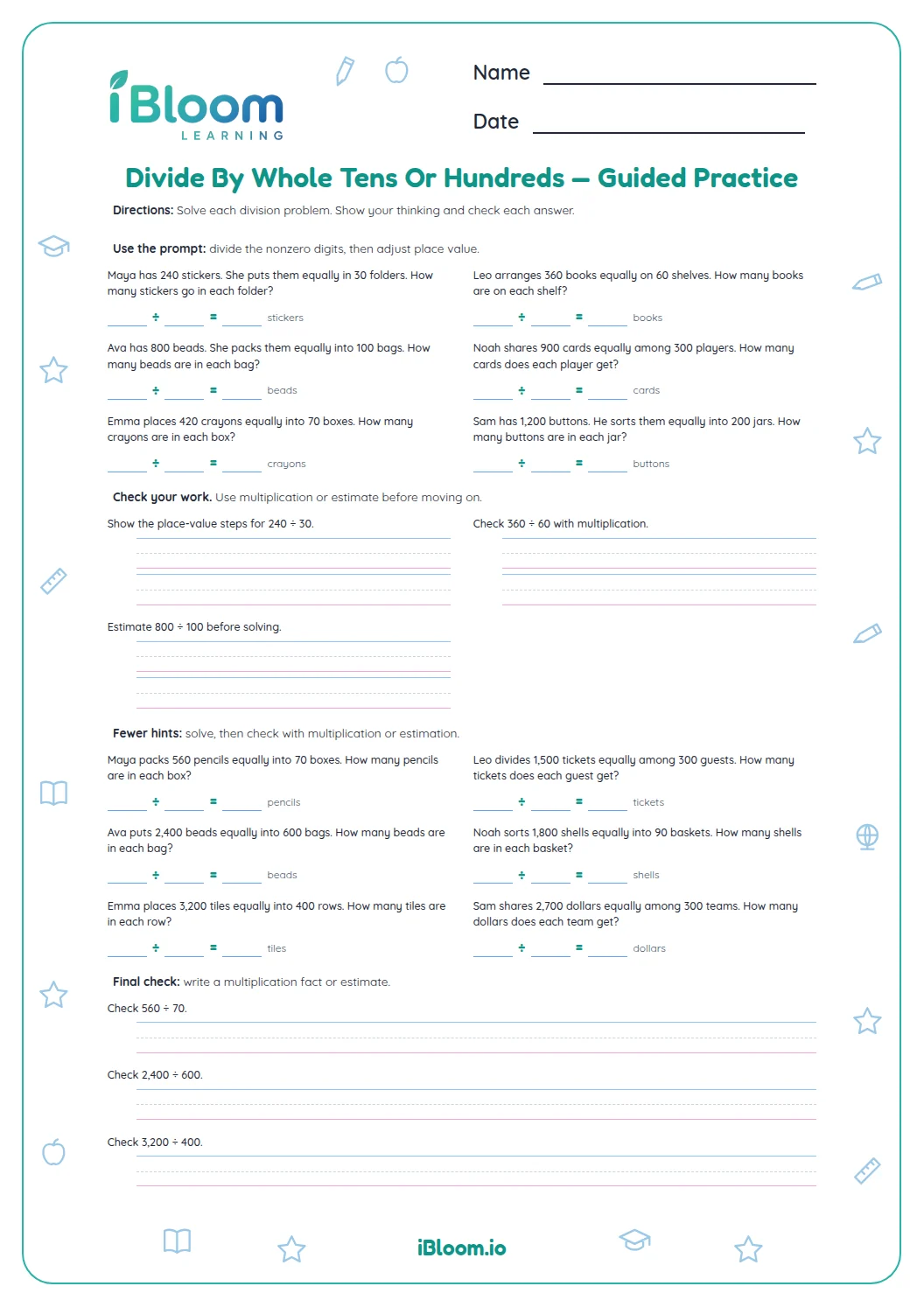
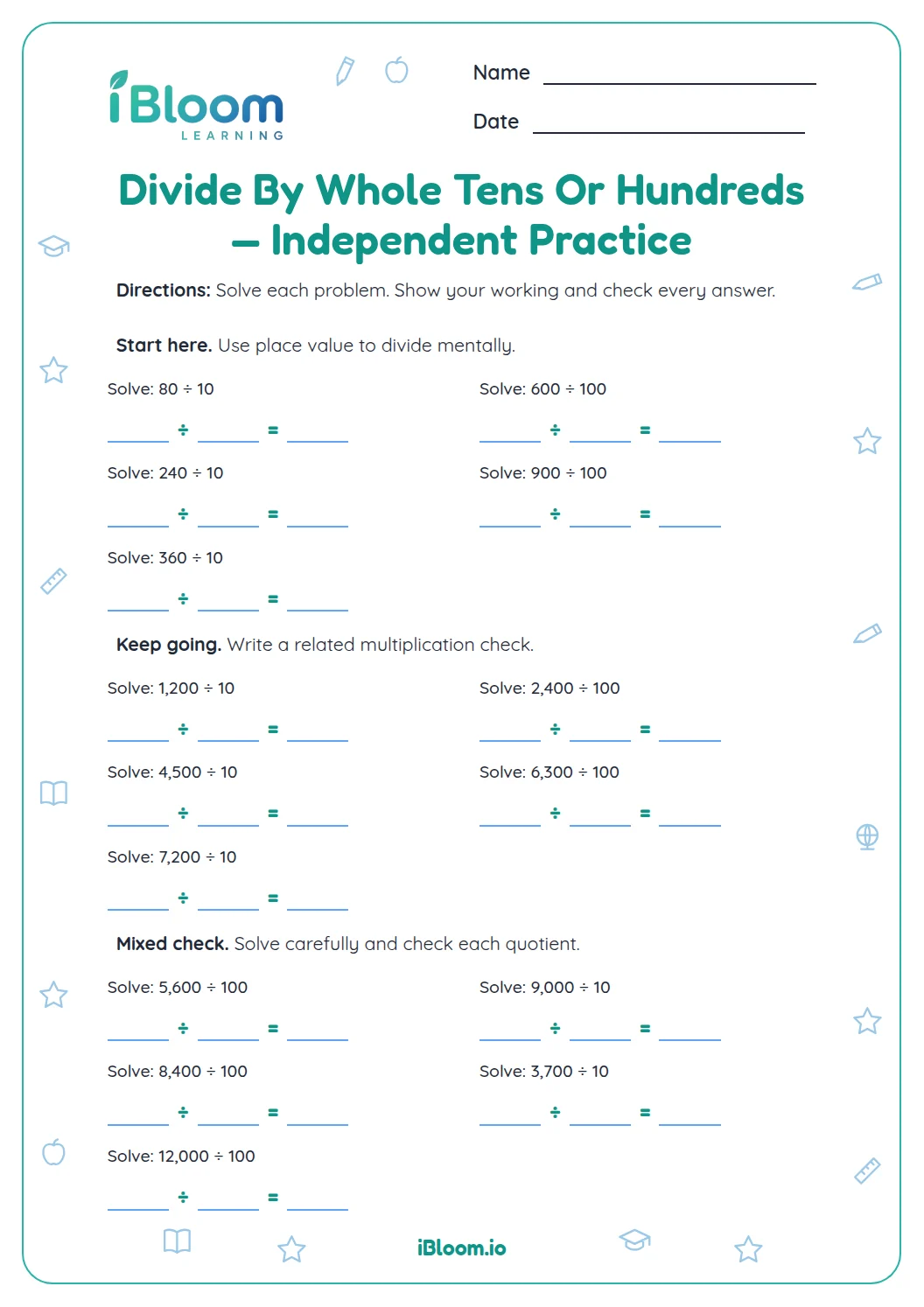
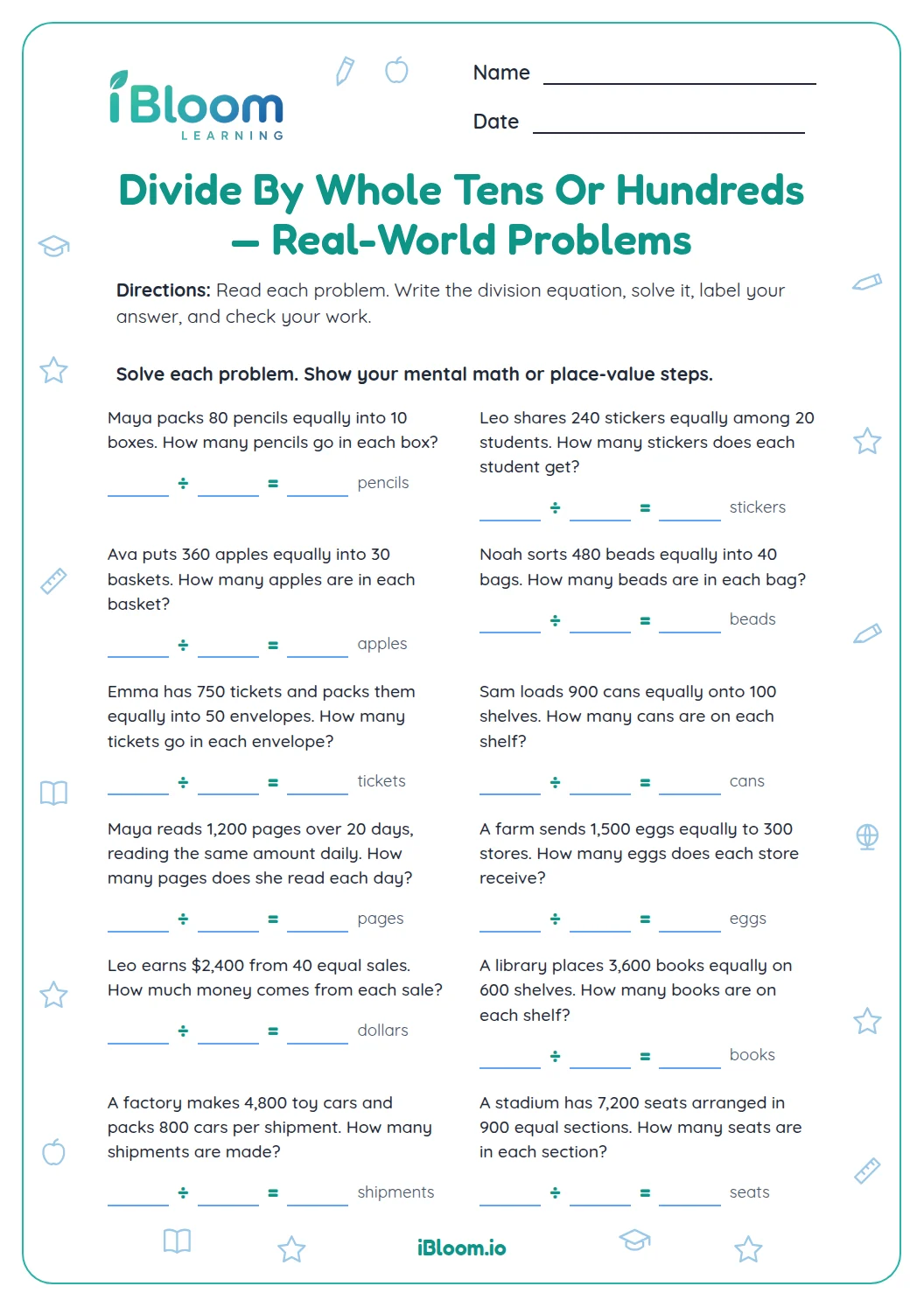
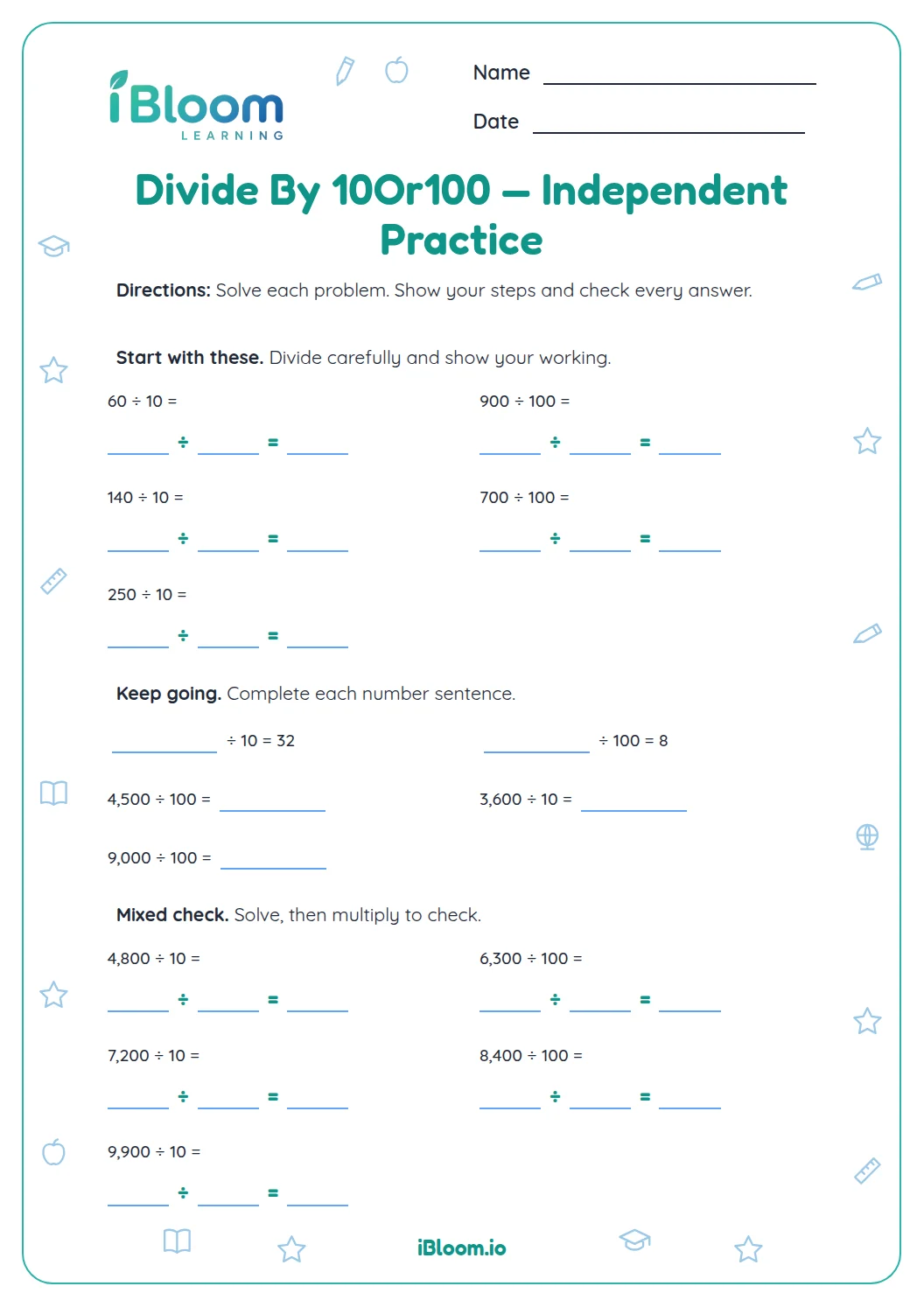
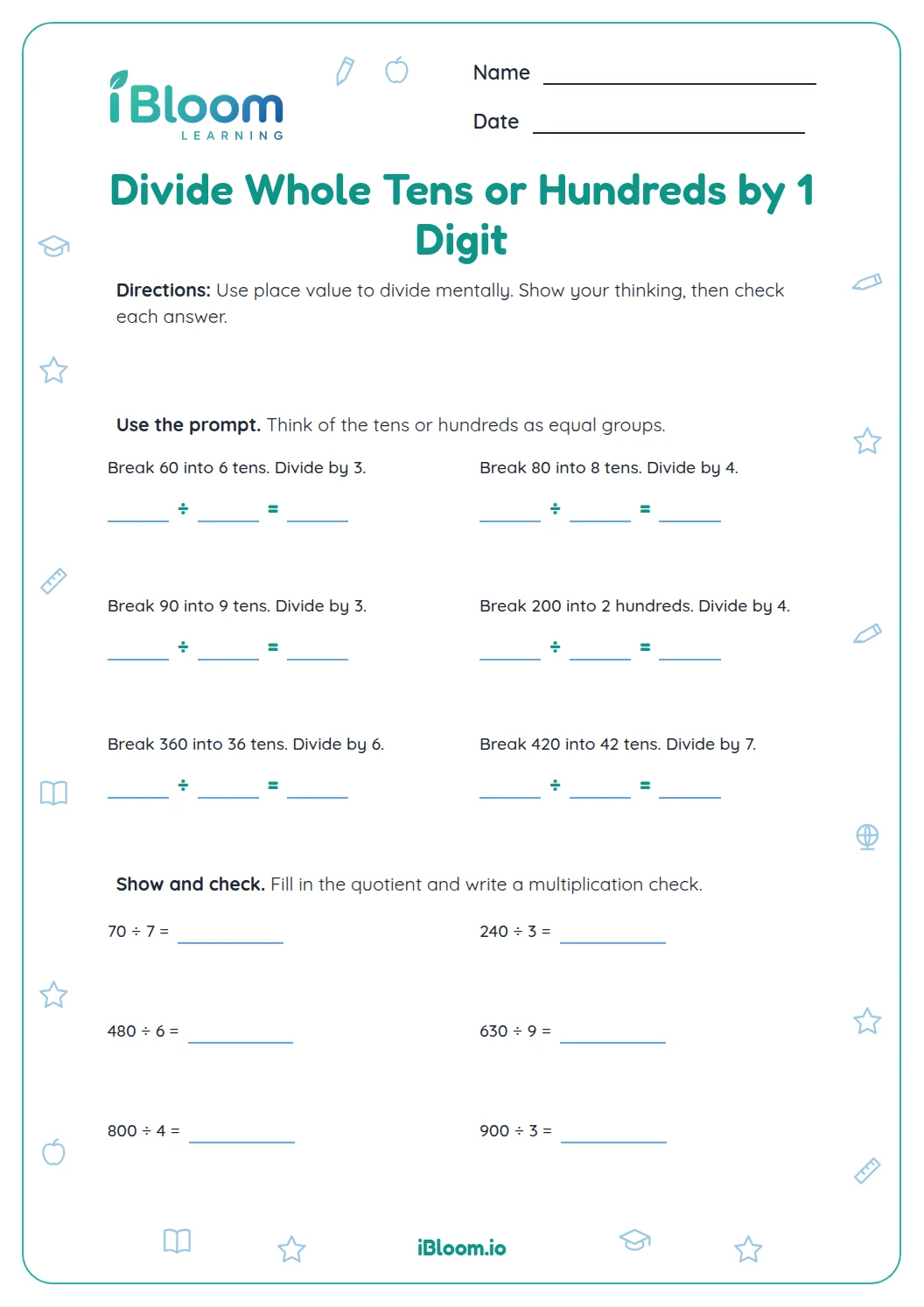
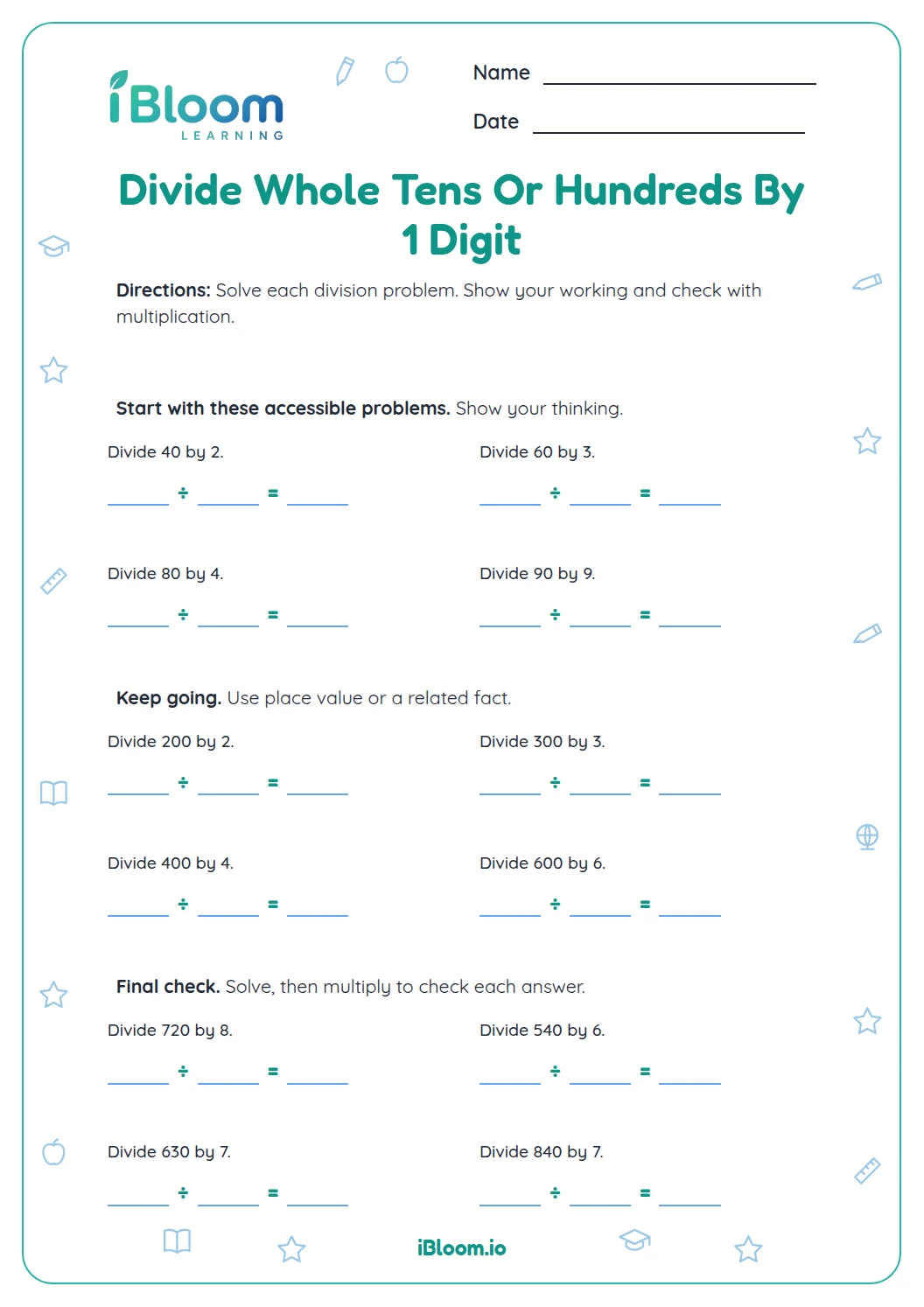
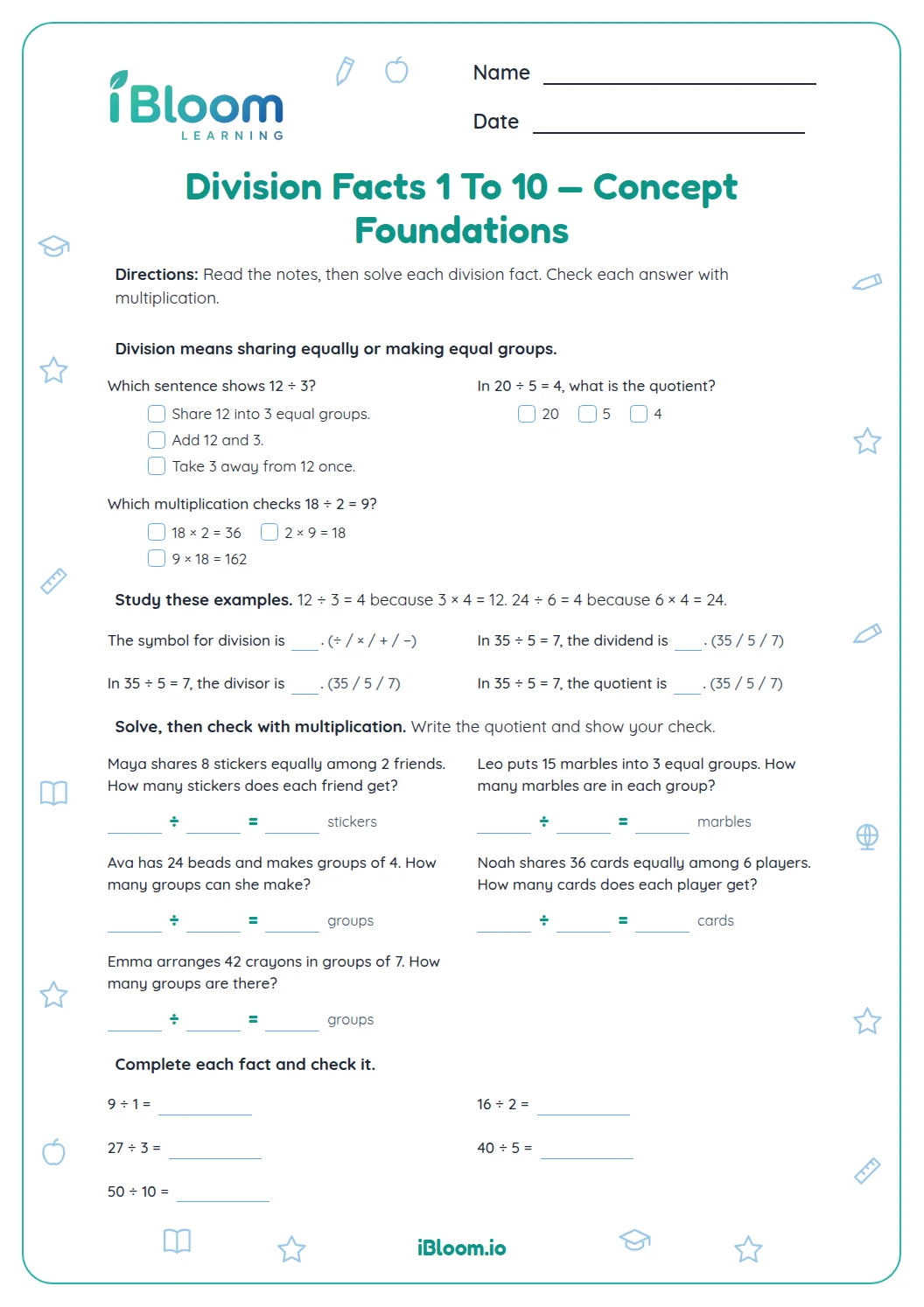
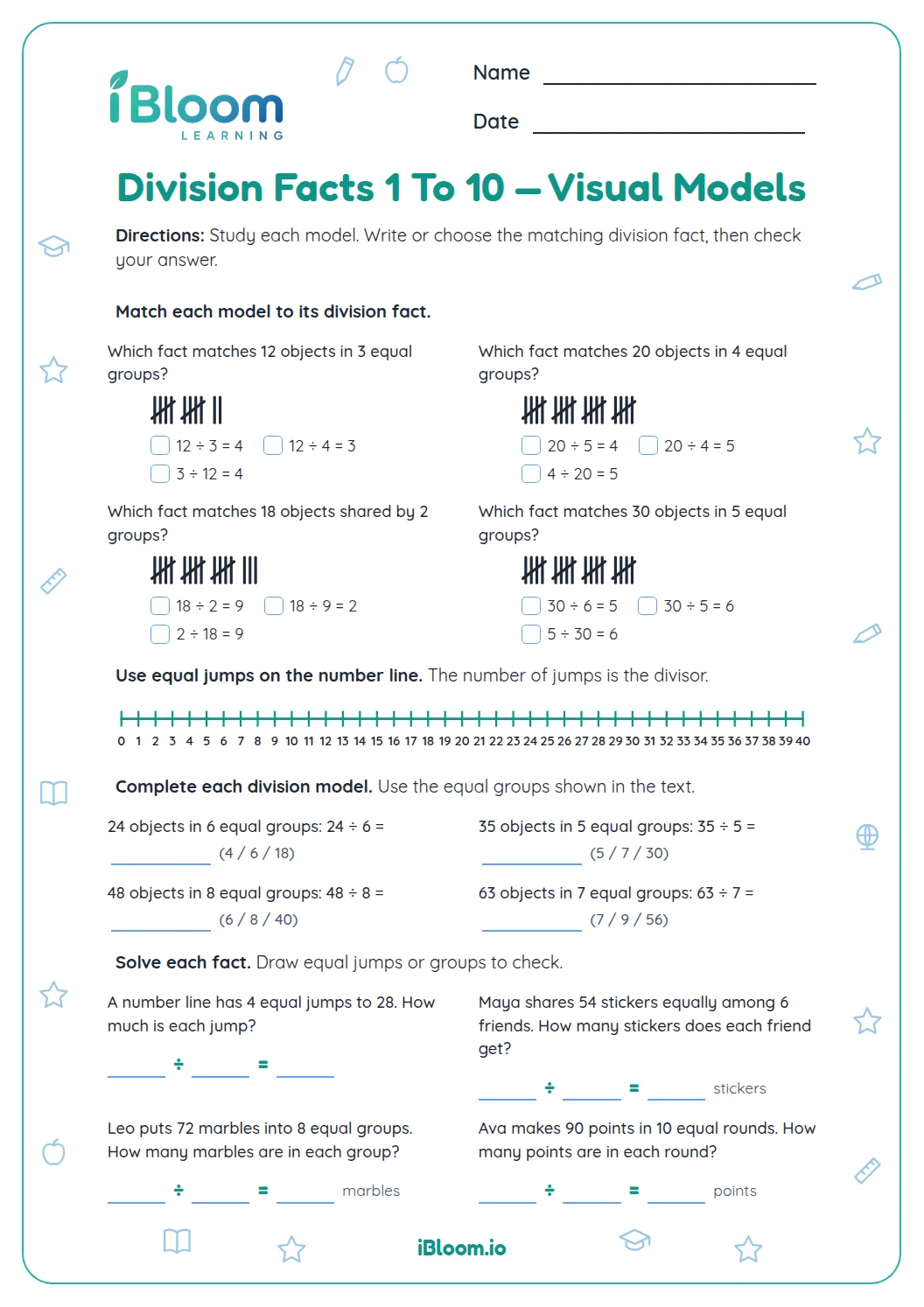
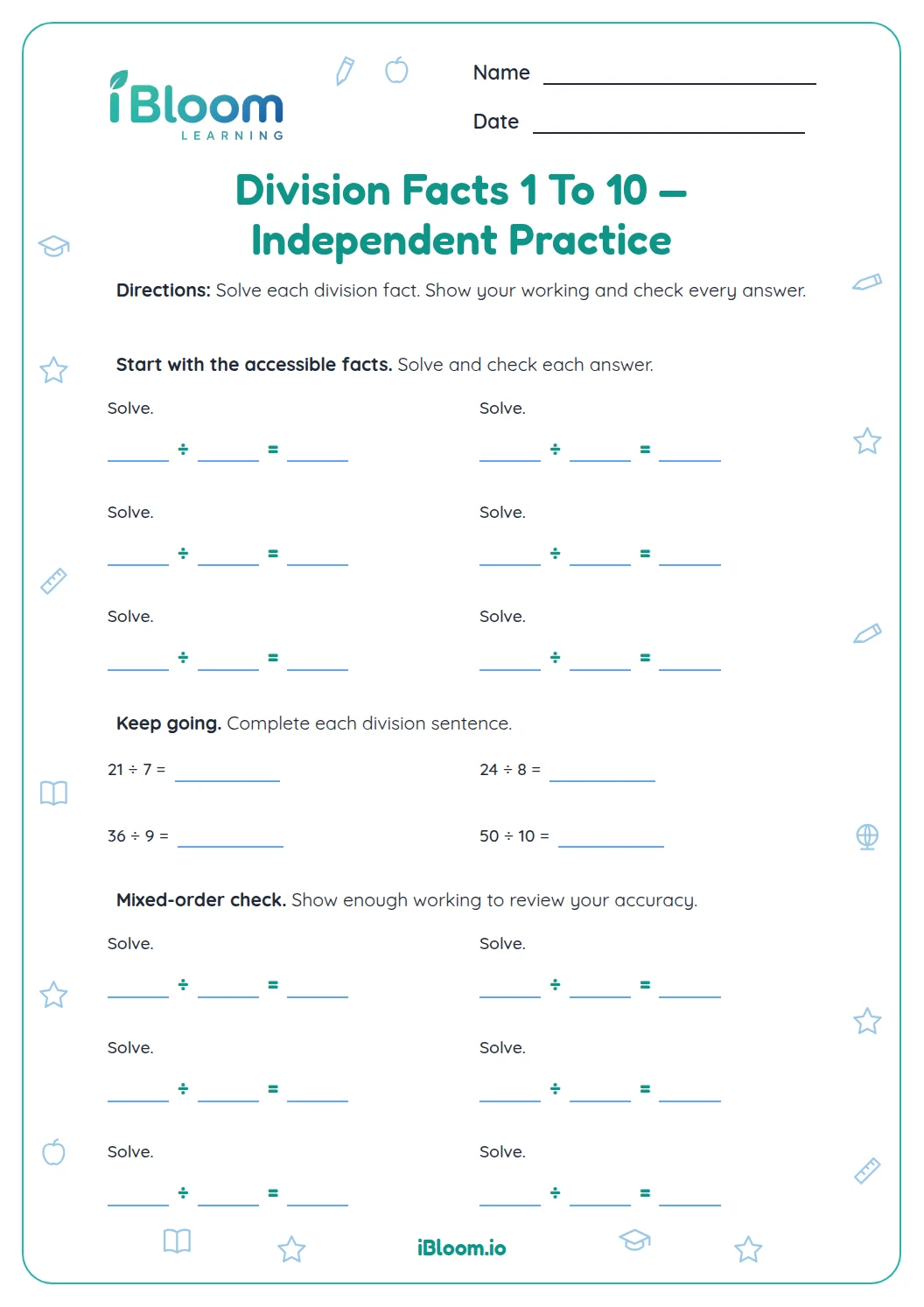
This free printable Grade 4 worksheet practices mental division by whole tens and hundreds. Learners use place value to divide both numbers in a quotient by the same power of ten, then solve familiar division facts and equal-group stories. Missing factors and a correction question provide another way to check the quotient. A separate answer key is included.
Why can matching zeros be removed?
Dividing both numbers by the same factor keeps their quotient unchanged. In question 1, 240 ÷ 30 becomes 24 ÷ 3, which is 8. Multiplication checks the result: 30 × 8 = 240.
- 1240 ÷ 30
- 224 ÷ 3
- 324 ÷ 3 = 8
- 4Check: 30 × 8 = 240
How do hundreds fit the same idea?
For 2,400 ÷ 400, remove two zeros from both numbers to get 24 ÷ 4 = 6. The divisor may be tens or hundreds; divide both numbers by the same power of ten.
How do the word problems show division?
The missing-factor items invite learners to use multiplication to check division facts. The story problems then describe equal groups, such as packing 360 pencils equally into 40 boxes. Divide the total by the number of groups to find the amount in each group, then label the answer.
How to use this worksheet
- 1Read the divisor and dividend.
- 2Find a power of ten that divides both numbers.
- 3Remove the same number of zeros from each.
- 4Solve the simpler division fact.
- 5Multiply the quotient by the original divisor to check.
Common mistakes and quick fixes
The mistake
Removing zeros from only the dividend.
The fix
Scale both numbers by the same amount so the quotient stays unchanged.
The mistake
Appending an extra zero to the quotient.
The fix
Check with multiplication: 90 × 8 = 720, so the answer is 8.
The mistake
Confusing group size with number of groups.
The fix
In 360 pencils split into boxes of 40, divide 360 by 40 to find boxes’ contents.
What to practice next
Make more practice
Further reading
Questions parents and teachers ask
What is 240 divided by 30?
240 ÷ 30 = 8. Divide both numbers by 10 to make the simpler fact 24 ÷ 3 = 8, then check with 30 × 8 = 240. This is the first problem on the worksheet and shows how place value supports mental division.
Why can the same number of zeros be removed?
Removing one zero from both numbers divides each by 10; removing two divides each by 100. Because the dividend and divisor are scaled equally, the quotient stays the same. For example, 2,400 ÷ 400 becomes 24 ÷ 4, or 6. Both expressions have the same quotient.
How can multiplication check a division answer?
Multiply the quotient by the divisor. For 800 ÷ 100 = 8, calculate 8 × 100 and check that it equals 800. This inverse relationship helps catch a quotient that is too large or too small. The answer key includes a sample check for the stories too.
How many pencils go in each box in question 15?
There are 360 pencils shared equally among 40 boxes, so calculate 360 ÷ 40 = 9. Each box gets 9 pencils. The story uses the same whole-tens division as the number problems, then asks learners to attach a unit to the answer.
Does the worksheet include an answer key?
Yes. A separate two-page key gives the quotients, story answers with units, and a sample division sentence. Use it after the two worksheet pages to check both the calculation and whether each answer matches what the story asks.