



About this worksheet
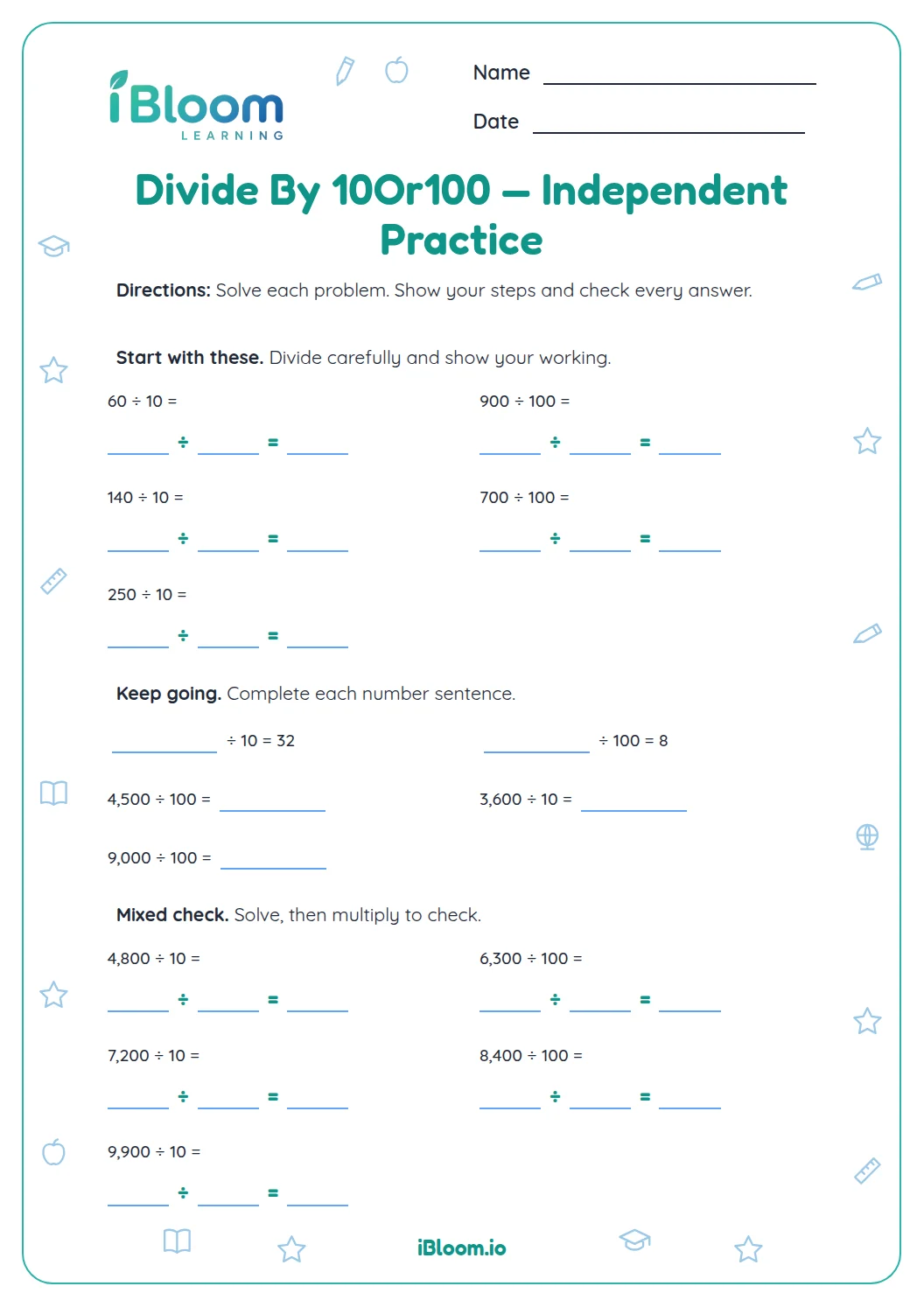
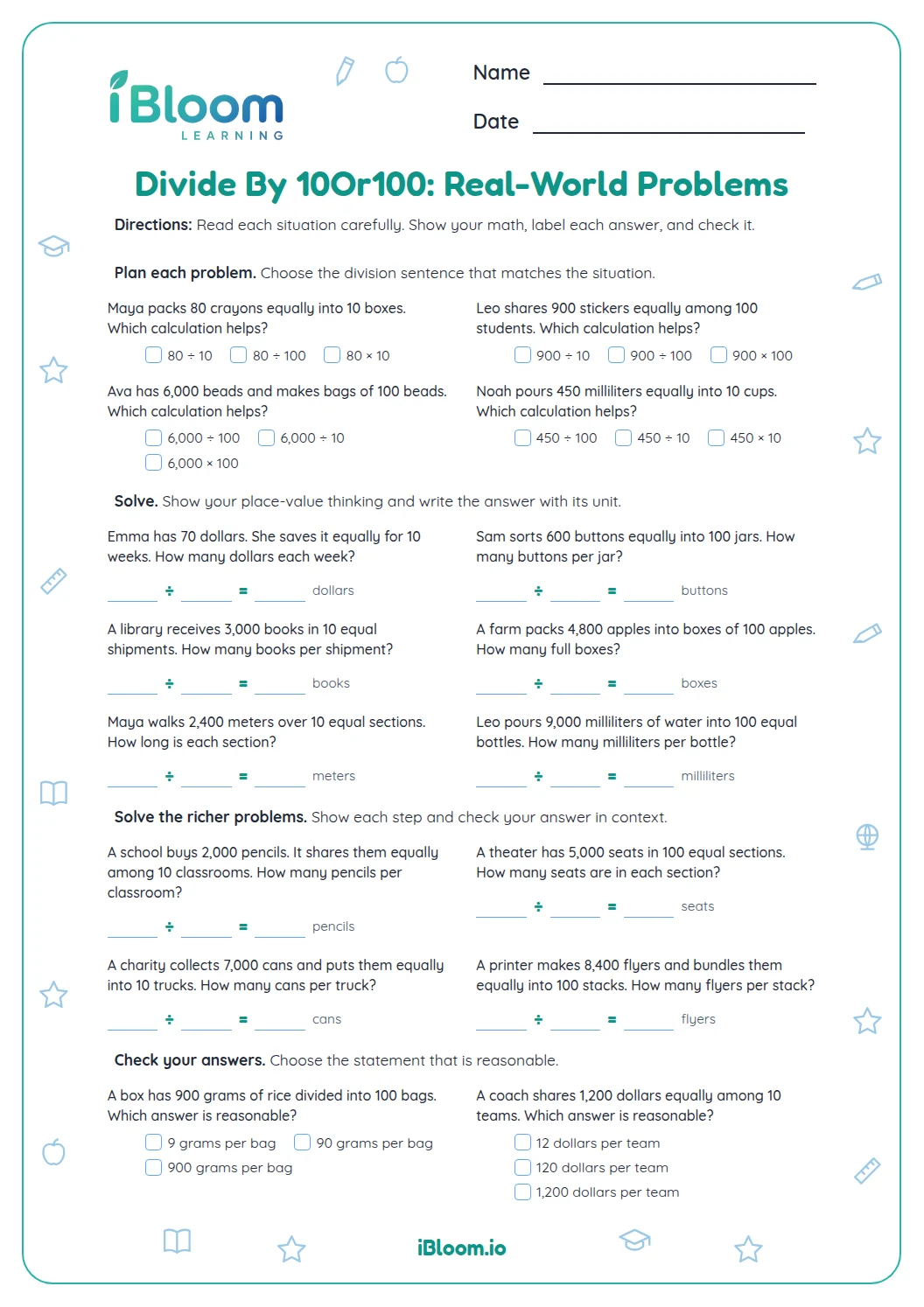
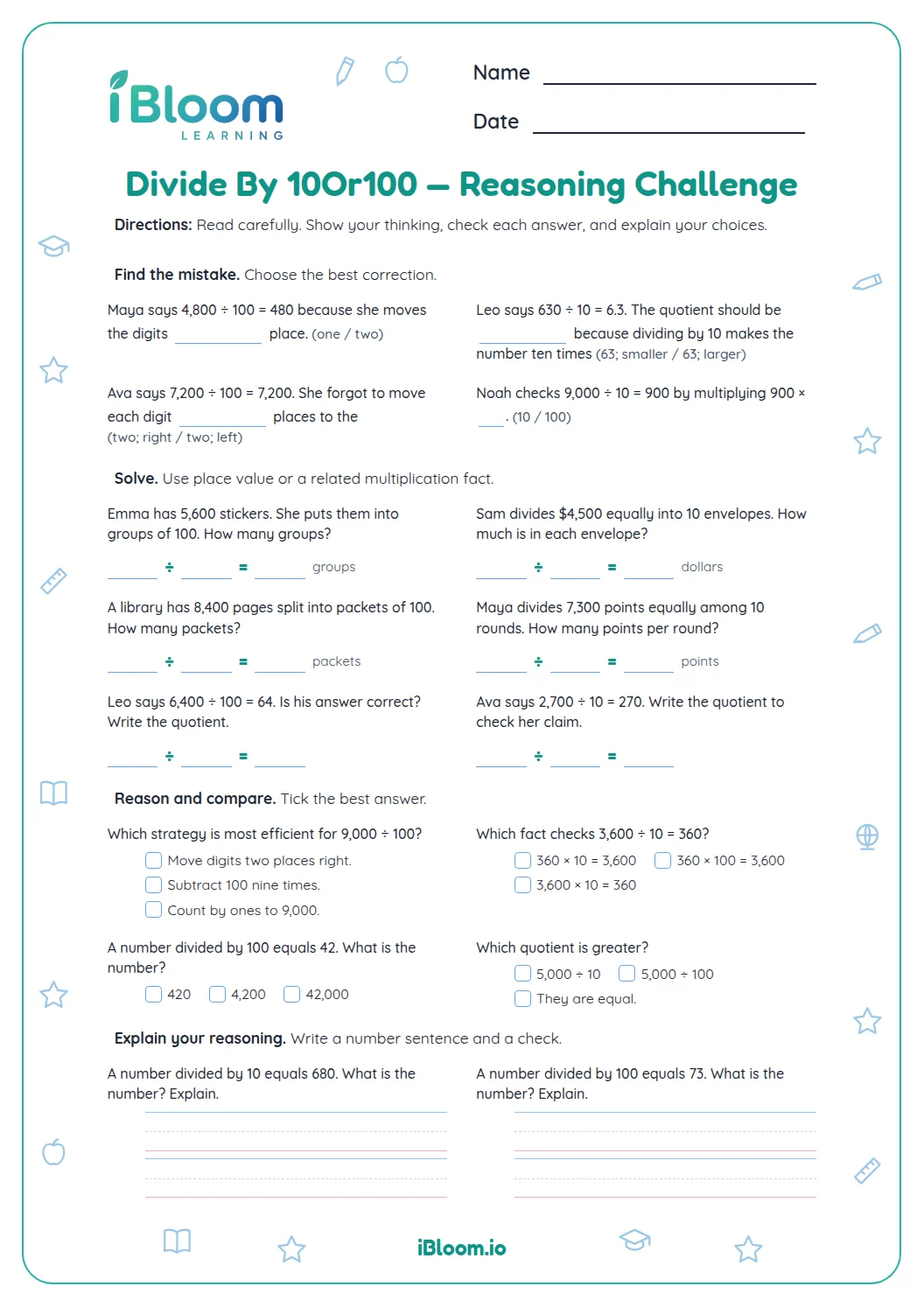
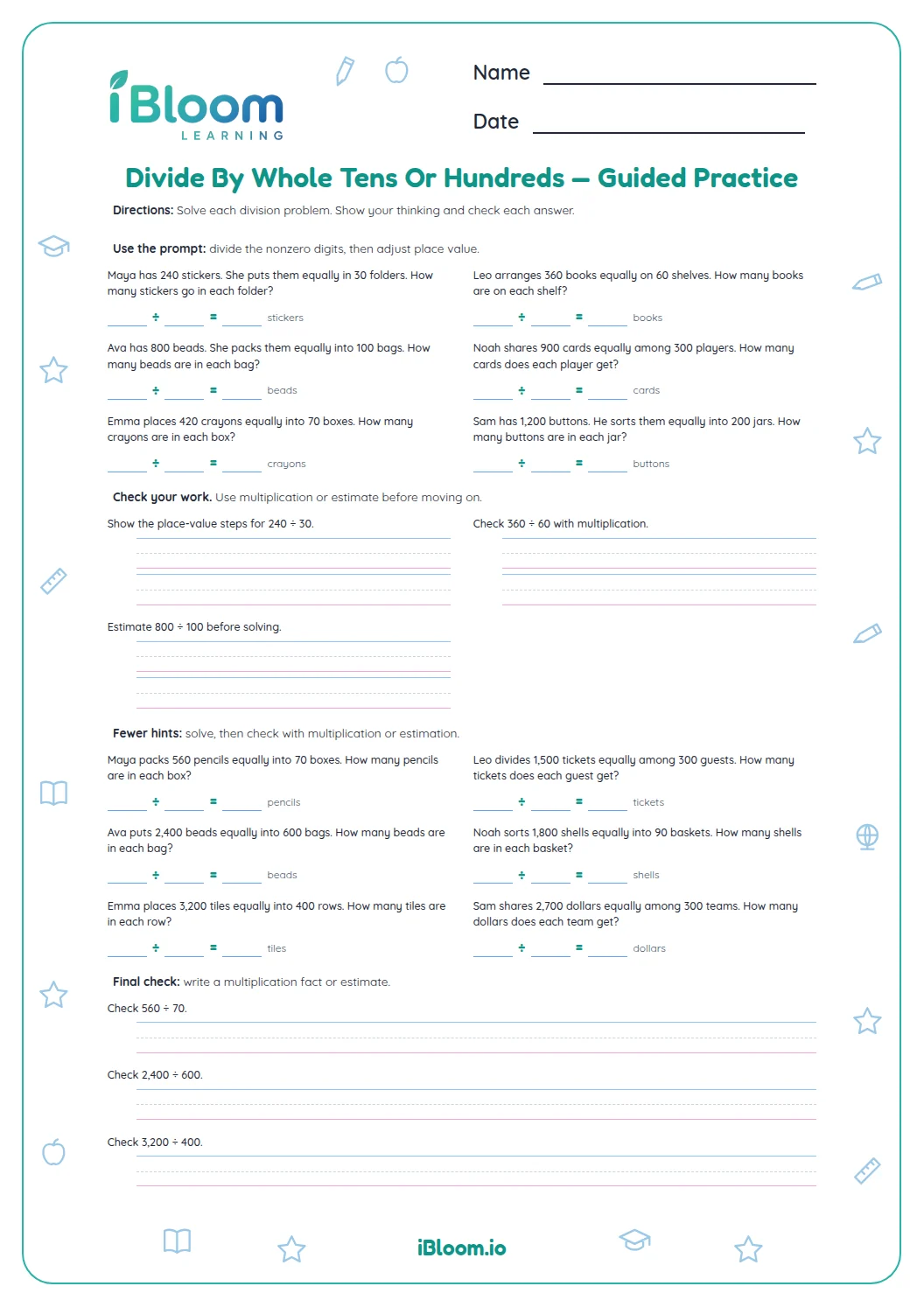
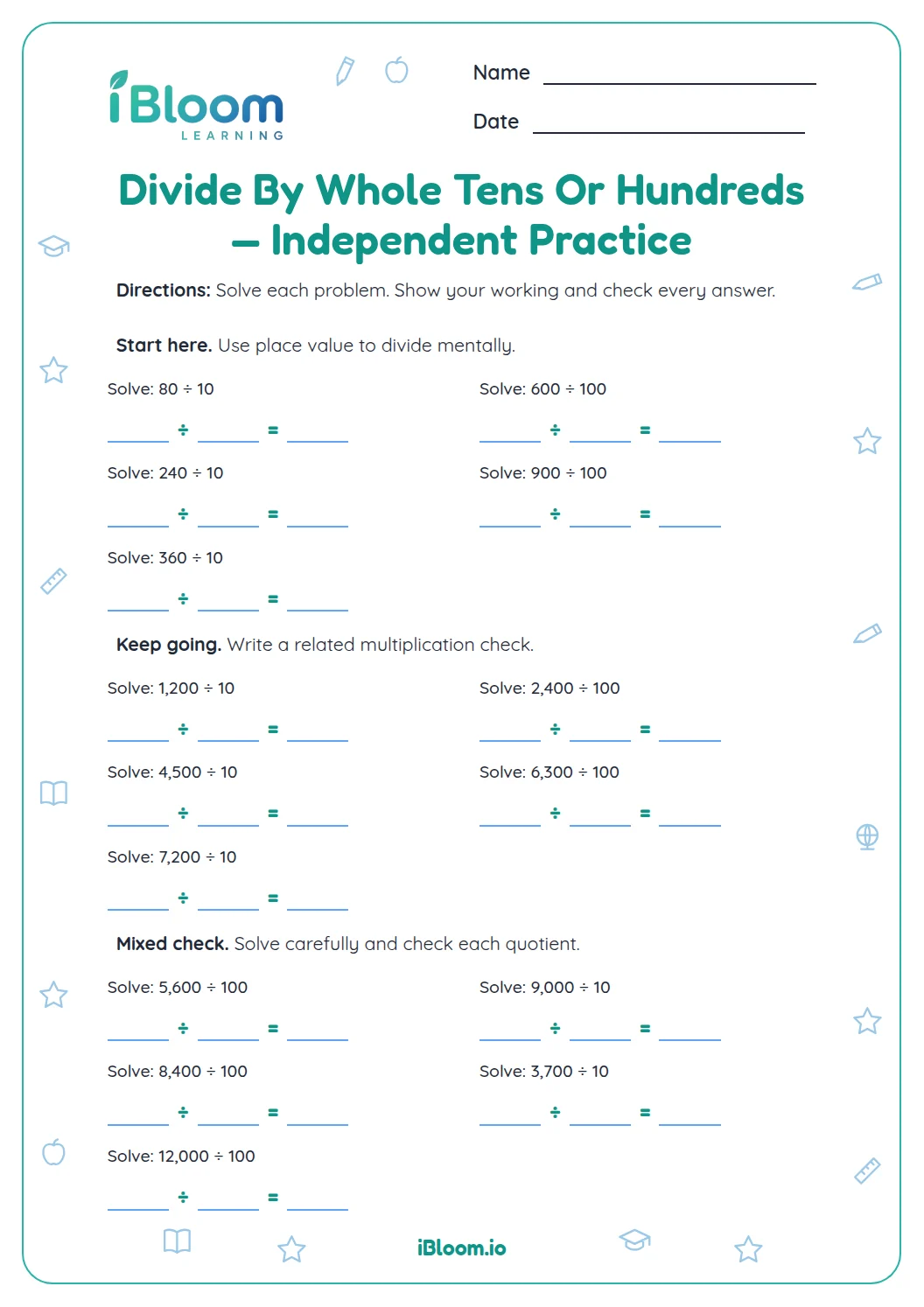
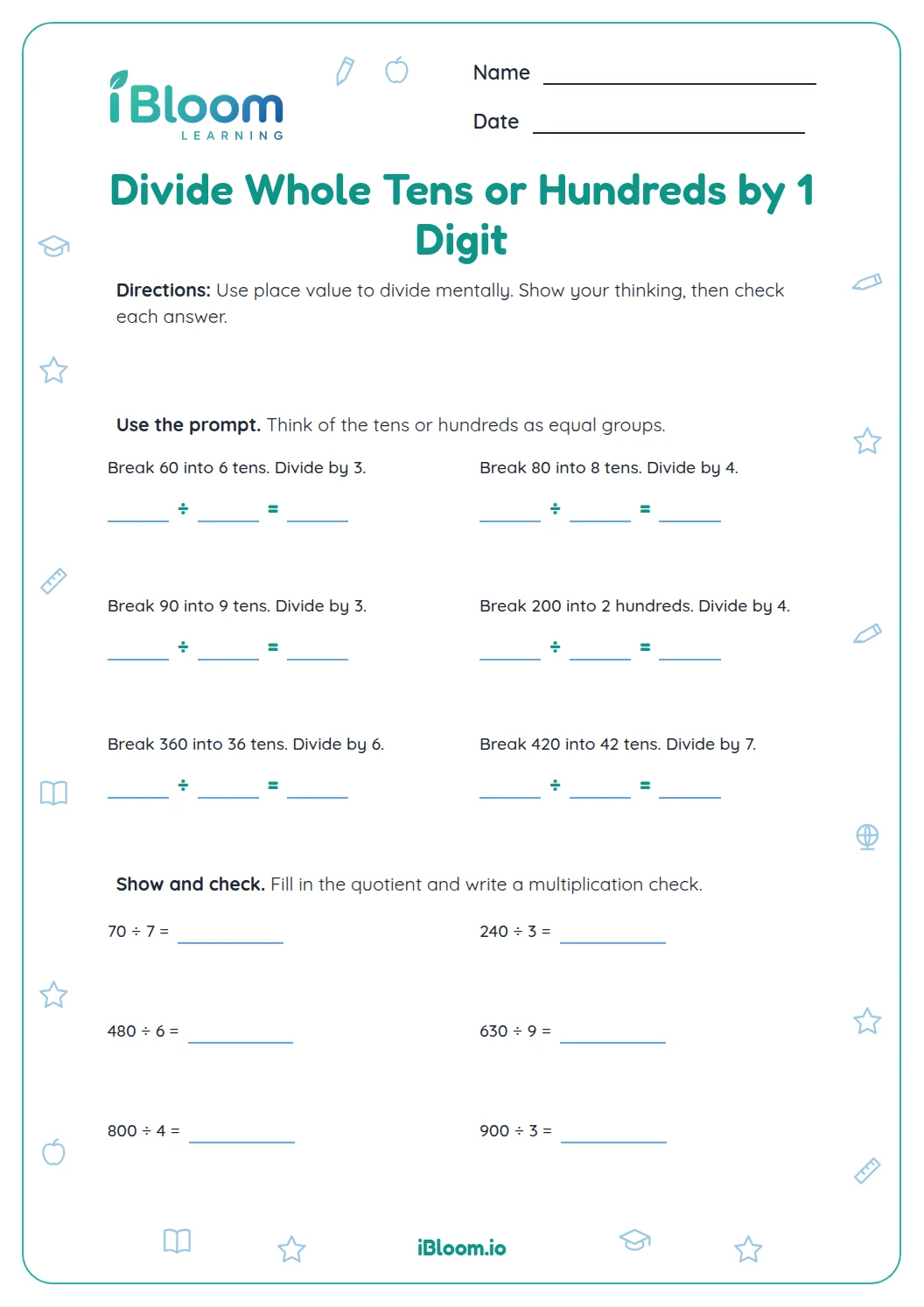
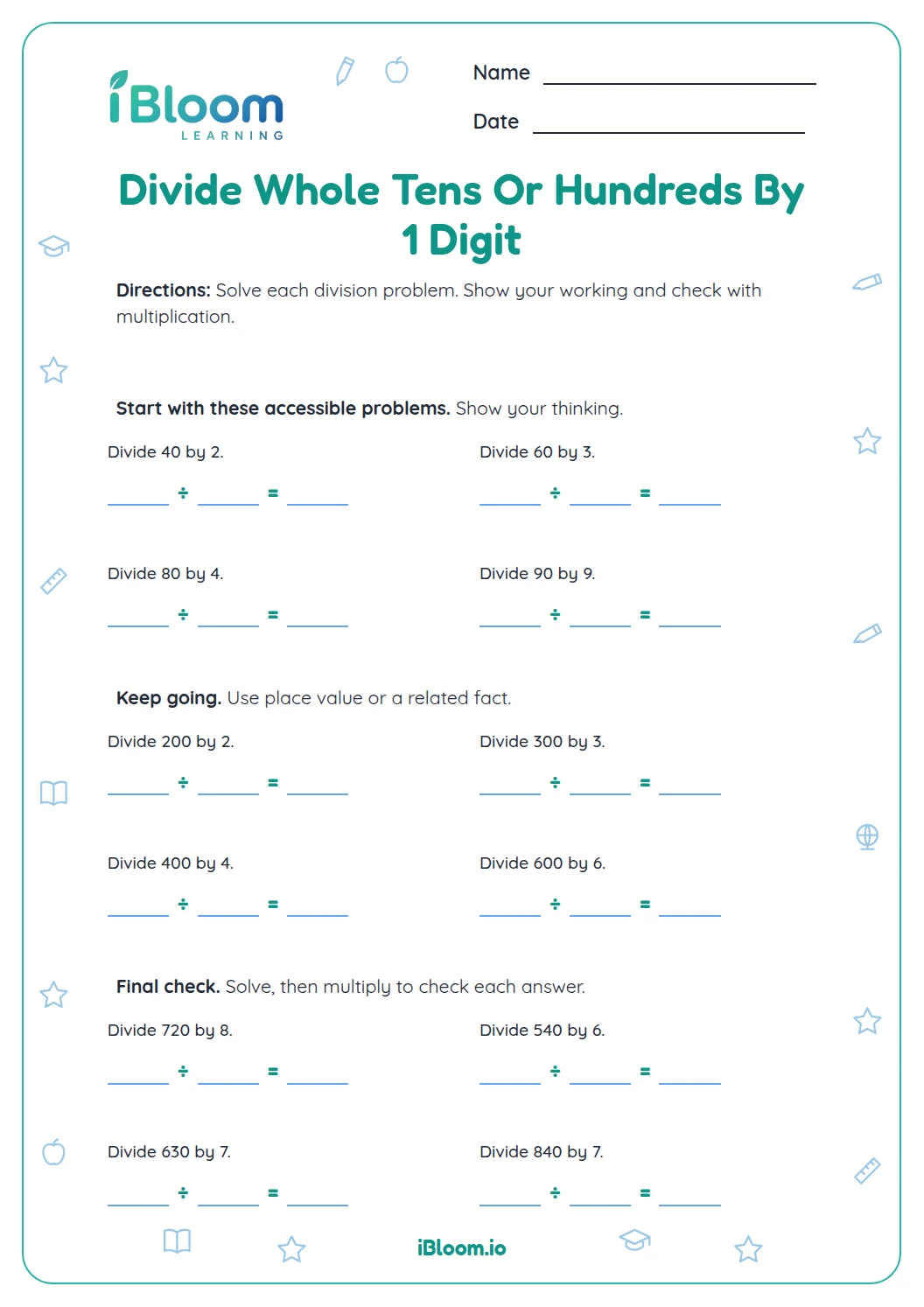
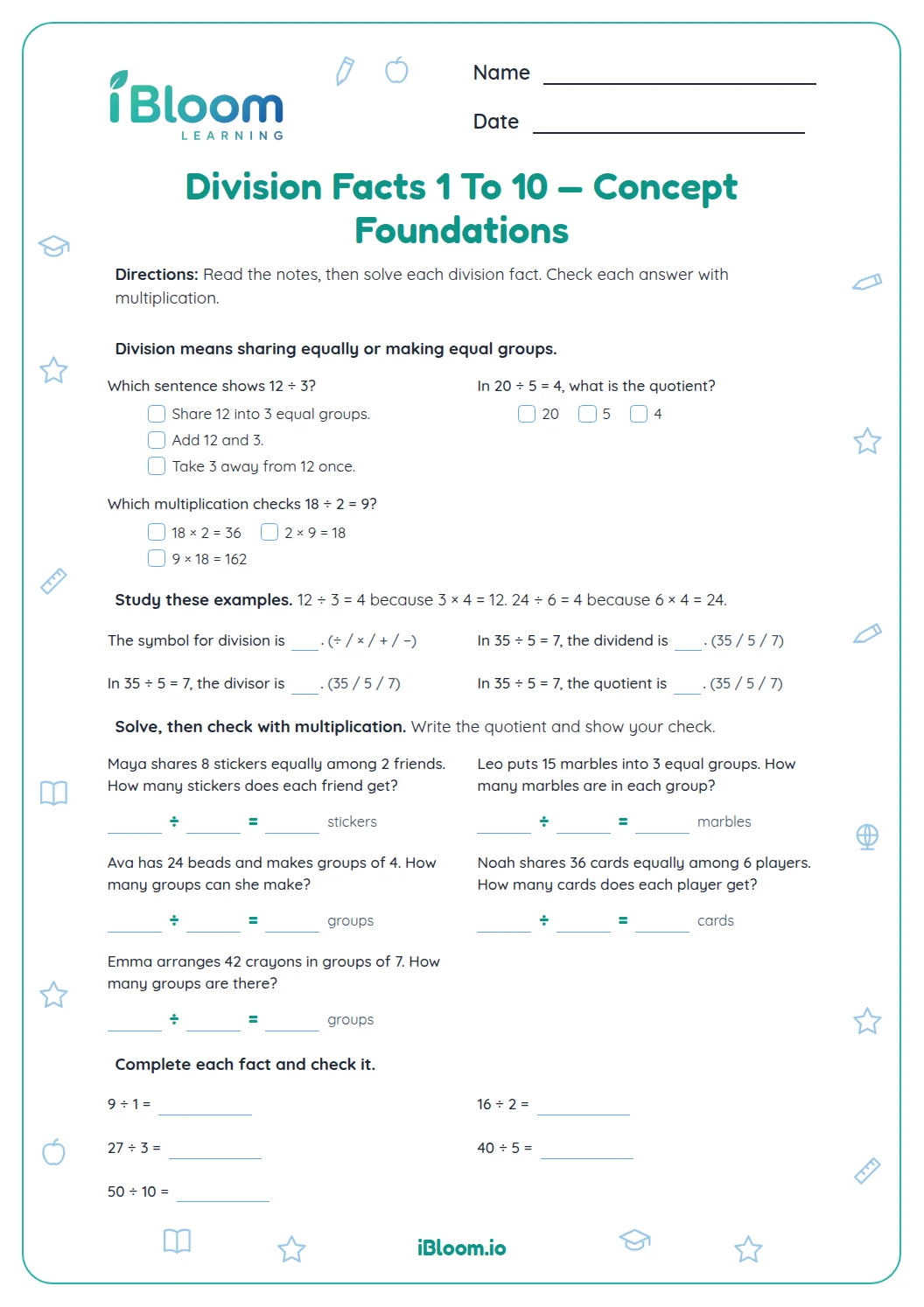
This Grade 4 printable builds mental division with 10 and 100. Learners find quotients, use place value to solve sharing situations, and compare related quotients. Fifteen questions move from direct number sentences to application, with a separate answer key.
Why does dividing by 10 change the digits’ values?
Each digit moves one place to the right in the written quotient because its value becomes ten times smaller. For example, 4,800 ÷ 10 = 480. Dividing by 100 makes each value one hundred times smaller: 6,300 ÷ 100 = 63.
- 14,800 ÷ 10
- 2The 4 thousands become 4 hundreds.
- 3The quotient is 480.
How does place value help with sharing problems?
A sharing story can be written as a division equation. Question 7 shares 3,600 beads equally among 10 bags, so 3,600 ÷ 10 gives 360 beads in each bag. Writing the equation first keeps the group count clear.
How can learners check a quotient?
Compare related quotients. Dividing 3,200 by 10 gives a quotient ten times as large as dividing 3,200 by 100. Multiplication provides another check: 360 × 10 returns 3,600.
How can learners work through this sheet?
- 1Read whether the divisor is 10 or 100.
- 2Write the division equation for any sharing story.
- 3Use place value to find the quotient.
- 4Check by multiplying the quotient by the divisor.
- 5Compare related quotients to see whether the size makes sense.
Common mistakes and quick fixes
The mistake
Moving the digits the wrong way when dividing.
The fix
Check that the quotient is smaller than the dividend, then multiply back.
The mistake
Changing the value by only one place when dividing by 100.
The fix
A divisor of 100 makes each digit’s value one hundred times smaller.
The mistake
Reporting the total number of objects instead of the number in each group.
The fix
Divide by the number of equal groups and label the result per group.
What to practice next
Make more practice
Further reading
Questions parents and teachers ask
What is 4,800 divided by 10?
It is 480. Each digit’s value becomes ten times smaller when dividing by 10, so 4 thousands become 4 hundreds and 8 hundreds become 8 tens. Question 1 uses this same place-value change. Multiply 480 by 10 to check that it returns 4,800.
How is dividing by 100 different from dividing by 10?
Dividing by 100 makes each digit’s value one hundred times smaller, while dividing by 10 makes it ten times smaller. For example, 6,300 ÷ 100 = 63, while 6,300 ÷ 10 = 630. Compare the two quotients to notice the tenfold difference.
How can a learner solve the bead-sharing question?
The word “equally” signals that the total is being split into same-size groups, and the answer should name beads per bag. This is a useful clue for recognizing division. The divisor tells how many groups there are; the quotient tells how many beads go in each bag.
Why is 8,000 divided by 10 equal to 800?
Dividing by 10 reduces the value by a factor of ten. Since 8,000 has eight thousands, the quotient is eight hundreds, or 800. Multiplication checks the result: 800 × 10 = 8,000. The worksheet asks learners to correct an incorrect quotient.
What does the answer key include?
The separate key gives the missing quotients and answers to the sharing and comparison questions. For any missed item, ask the learner to multiply the quotient by 10 or 100. That inverse check helps show whether the place-value reasoning matches the original number.