





About this worksheet
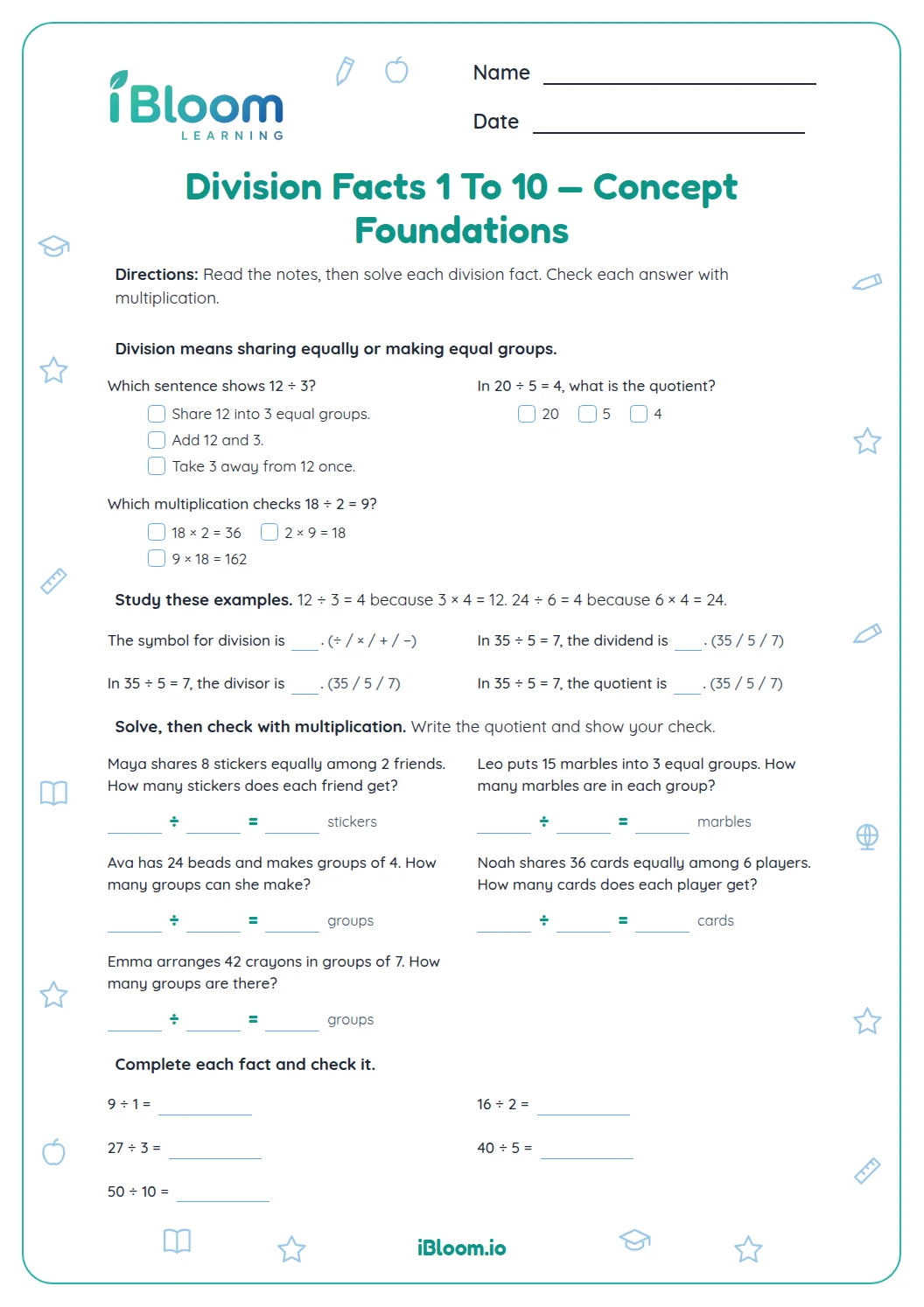
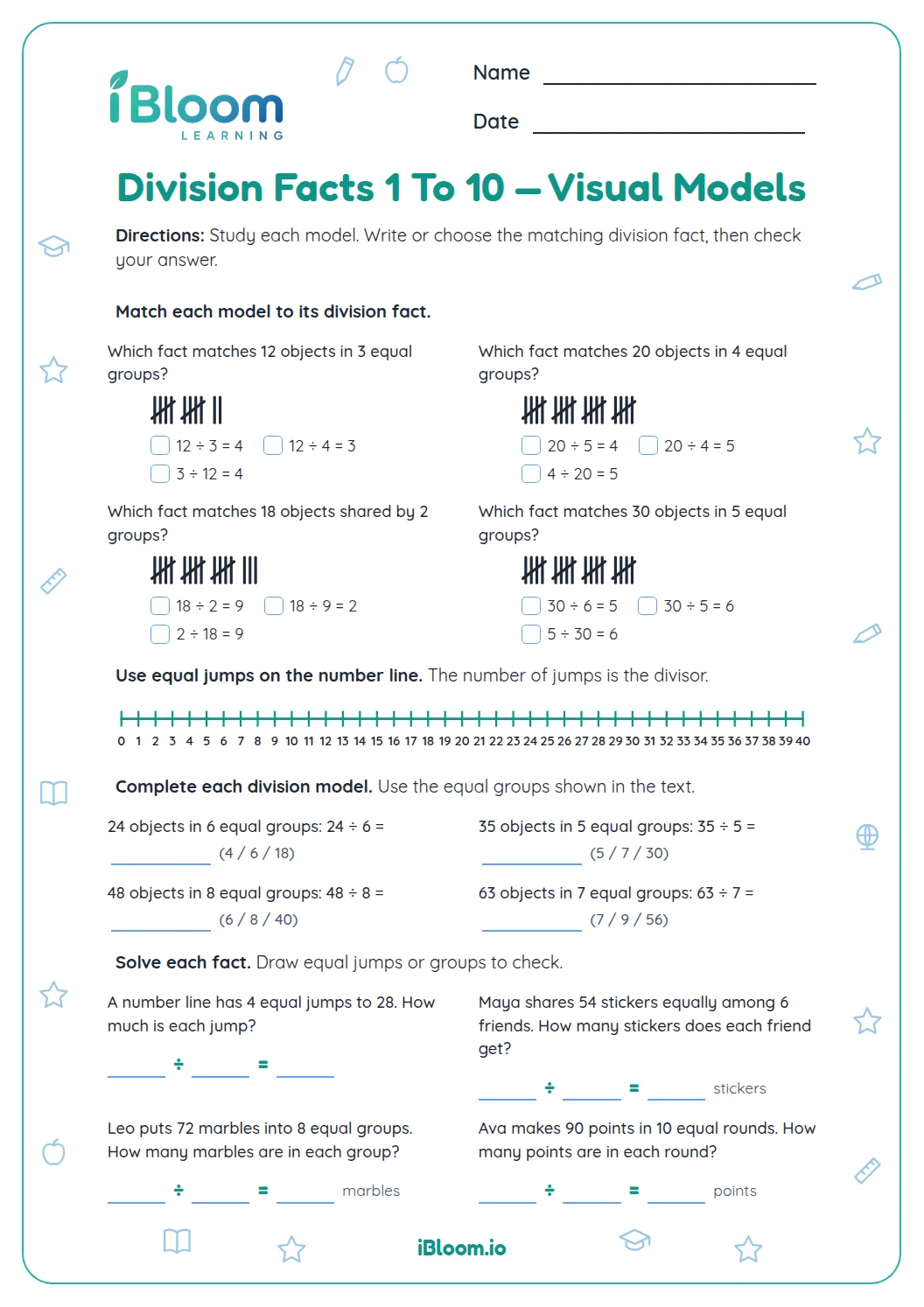
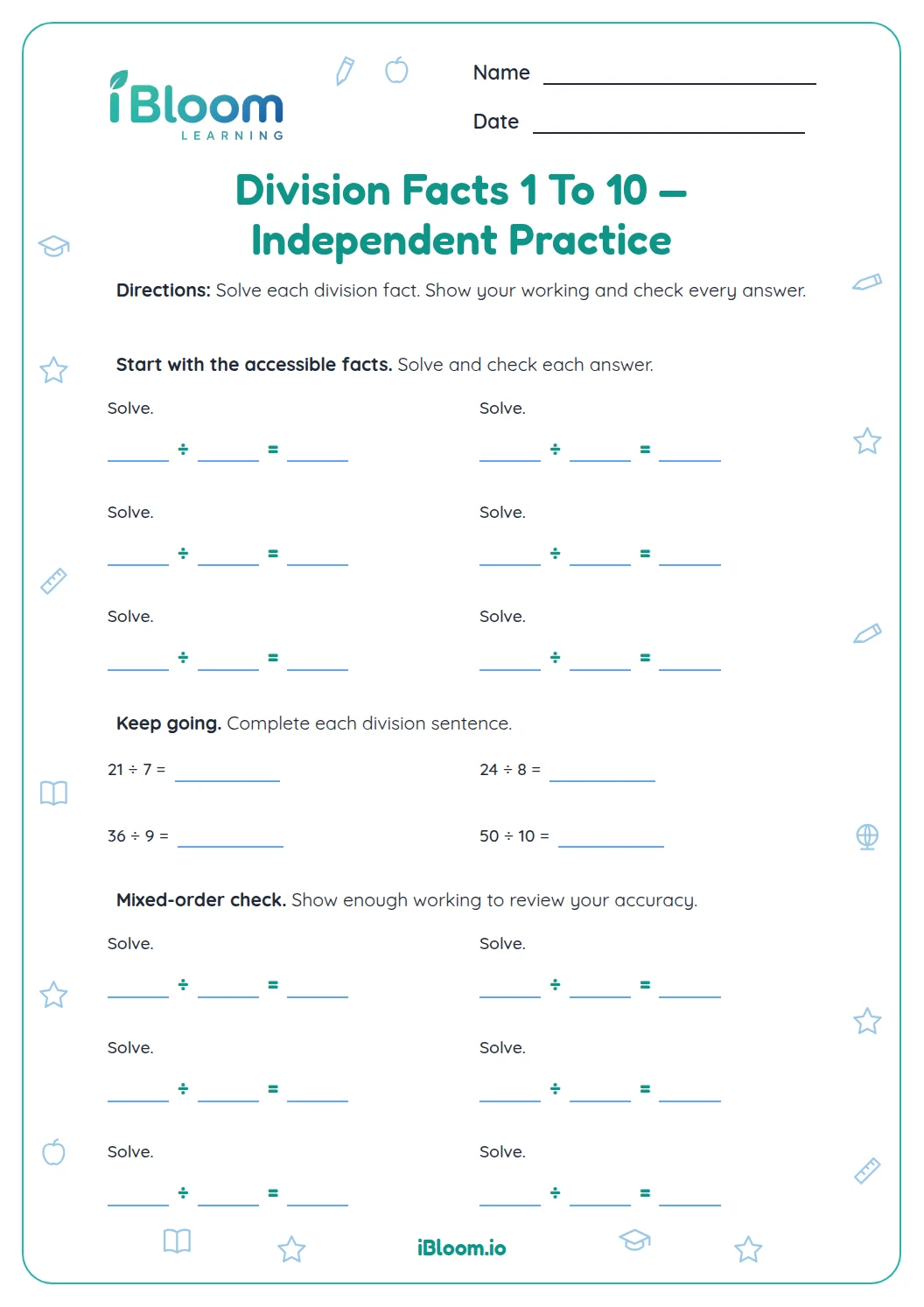
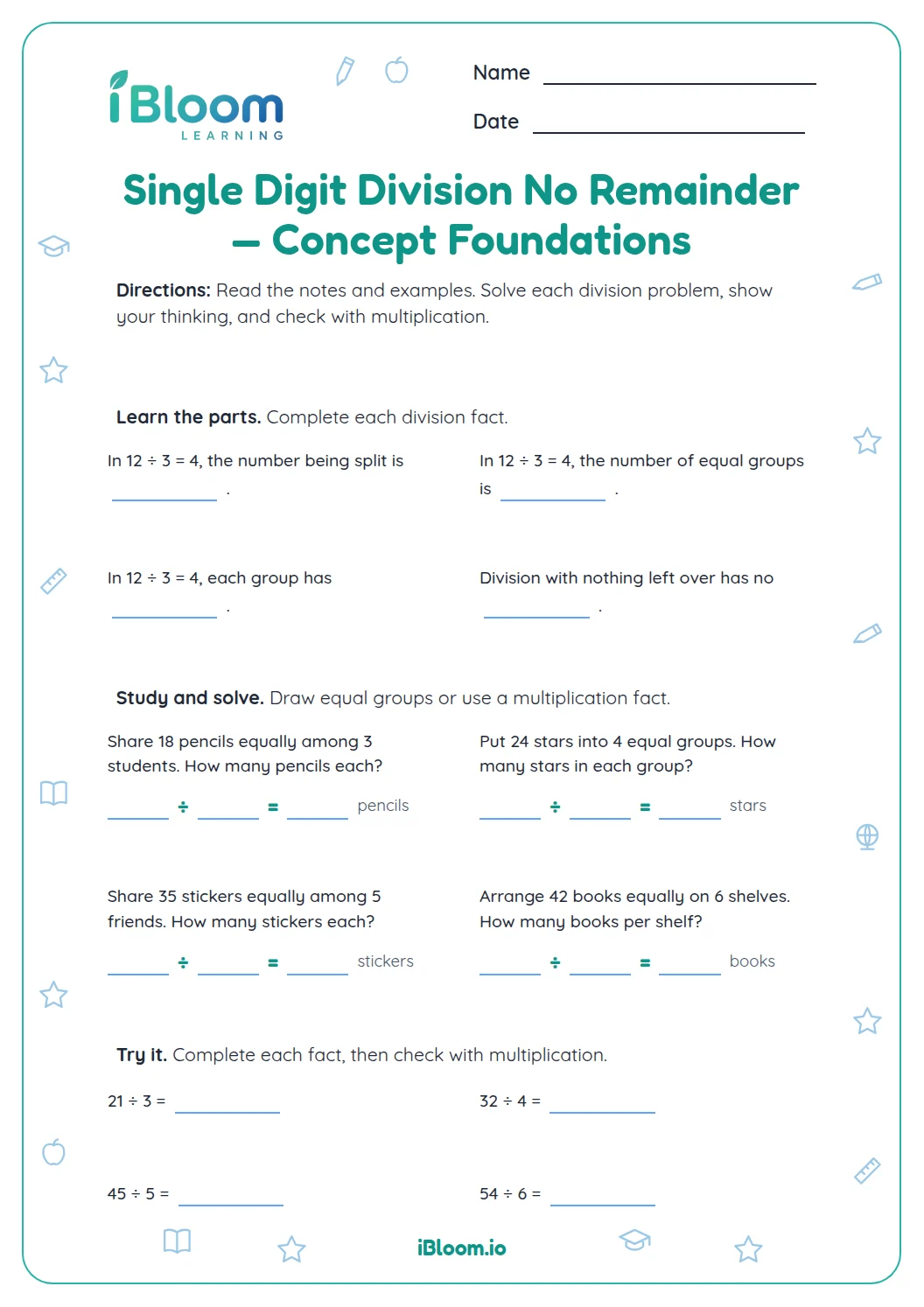
This Grade 4 printable reviews division facts with divisors from 1 through 10. Students use related multiplication facts to find 12 quotients, then choose a multiplication fact that checks four division answers. The named fact skill supports CCSS 3.OA.C.7, which describes fluency with multiplication and division within 100. A separate answer key shows each quotient and check.
Aligned to 3.OA.C.7
How can a multiplication fact solve a division fact?
Division asks how many equal groups or how many items are in each group. Use the matching multiplication fact to find the missing quotient. Since 4 × 9 = 36, 36 ÷ 4 = 9.
Question 4 uses 32 ÷ 4. Check the quotient by multiplying 4 by 8 to return to 32.
- 132 ÷ 4 = 8 because 4 × 8 = 32
What does “facts 1 to 10” mean here?
The first 12 questions include every divisor from 1 through 10, with two additional facts for practice. Each quotient is a whole number.
How can multiplication check a quotient?
Questions 13–16 ask you to choose the multiplication fact that proves a division answer. The divisor and quotient are the factors, and their product is the dividend.
- 156 ÷ 7 = 8, so 7 × 8 = 56
- Questions 1–12: division facts covering every divisor from 1 to 10
- Questions 13–16: choose the multiplication check for a quotient
- Multiply the divisor and quotient to check the dividend
How to use this worksheet
- 1Read the dividend and divisor in the number sentence.
- 2Recall the multiplication fact with the same divisor.
- 3Write the quotient and check it by multiplying.
- 4For questions 13–16, match the divisor and quotient to their product.
- 5Use the answer key to check each response.
Common mistakes and quick fixes
The mistake
Using the divisor as the quotient.
The fix
Ask what number multiplied by the divisor equals the dividend.
The mistake
Multiplying the dividend by the divisor.
The fix
Division reverses multiplication: find the missing factor instead.
The mistake
Choosing a nearby multiplication fact with a different product.
The fix
Multiply the divisor by the quotient and check that the product equals the dividend.
Common Core alignment
This worksheet supports the listed Common Core skill through focused practice.
Use multiplication and division relationships to solve whole-number facts within 100.
On this sheet: The named 1-to-10 division-fact skill practices fluency with whole-number quotients within 100 and applies those facts to equal sharing.
Show the official wordingHide the official wording
Fluently multiply and divide within 100, using strategies such as the relationship between multiplication and division (e.g., knowing that 8 × 5 = 40, one knows 40 ÷ 5 = 8) or properties of operations.
What to practice next
Make more practice
Further reading
Questions parents and teachers ask
Does the sheet include every divisor from 1 to 10?
Yes. The first 12 questions use each divisor from 1 through 10 at least once, with two additional facts for practice. Four more items ask students to choose a multiplication fact that checks a division result. The key lists each quotient and check.
How can students check a division answer?
Multiply the quotient by the divisor and see whether the product is the dividend. For example, 8 × 4 = 32 checks 32 ÷ 4 = 8. Questions 13–16 ask students to select the multiplication fact that matches a given division answer, so they practice the relationship directly.
Are remainders part of these questions?
No. Every division fact has a whole-number quotient with no remainder. The facts focus on divisors from 1 to 10, and the check questions use multiplication facts to confirm the quotient. Students can check each answer before moving on.
Why does the standards row name Grade 3?
The worksheet practices division facts within 100, the fluency described by CCSS 3.OA.C.7. Students use related multiplication facts to find quotients and select multiplication equations that check them. The questions review this fact relationship with divisors from 1 through 10.
What do questions 13–16 ask students to do?
For each division fact, choose the multiplication equation that proves its quotient. The divisor and quotient multiply to make the dividend. For example, 56 ÷ 7 = 8 is checked by 7 × 8 = 56. Read each choice and find the product that matches the dividend.