




About this worksheet
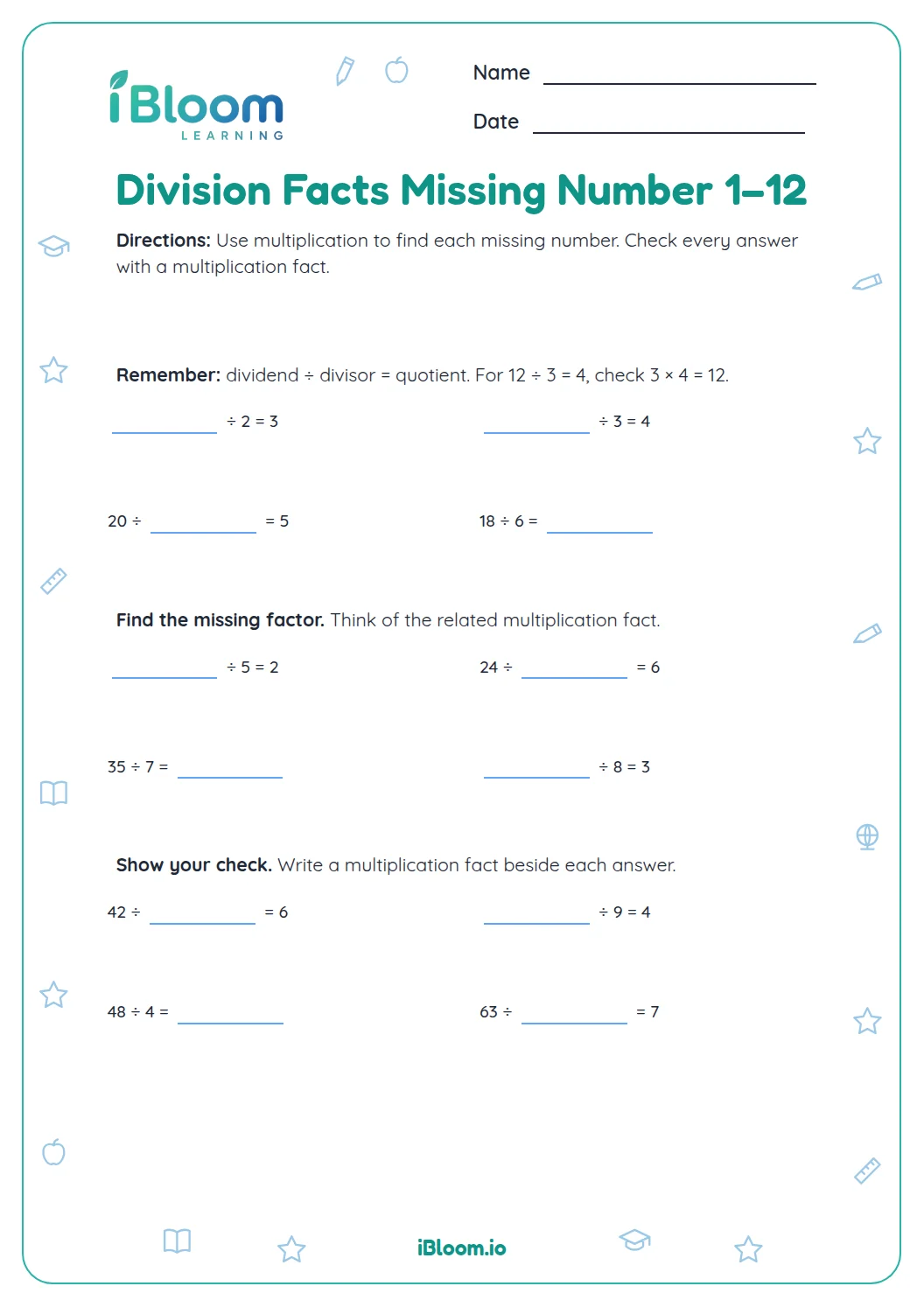
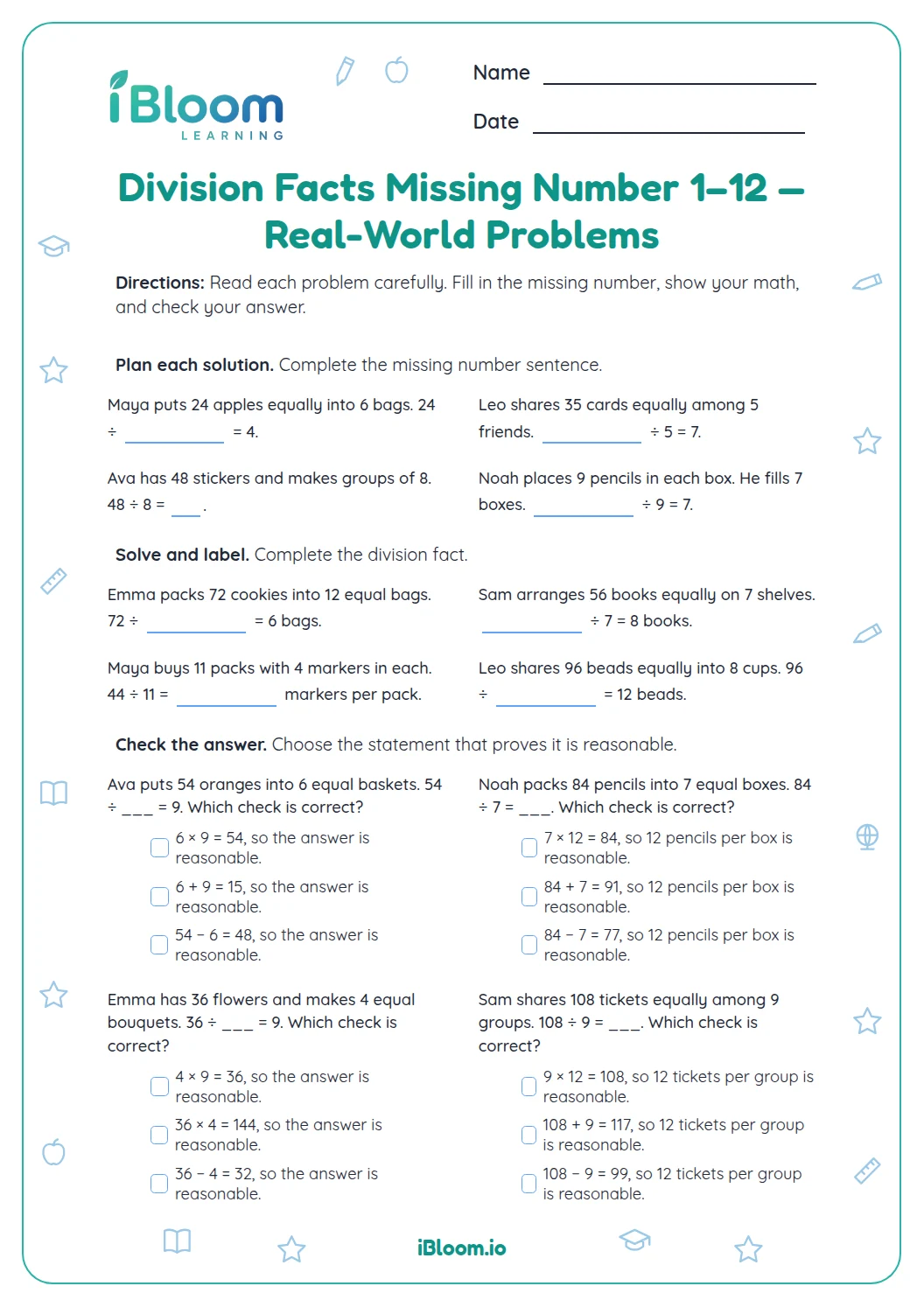
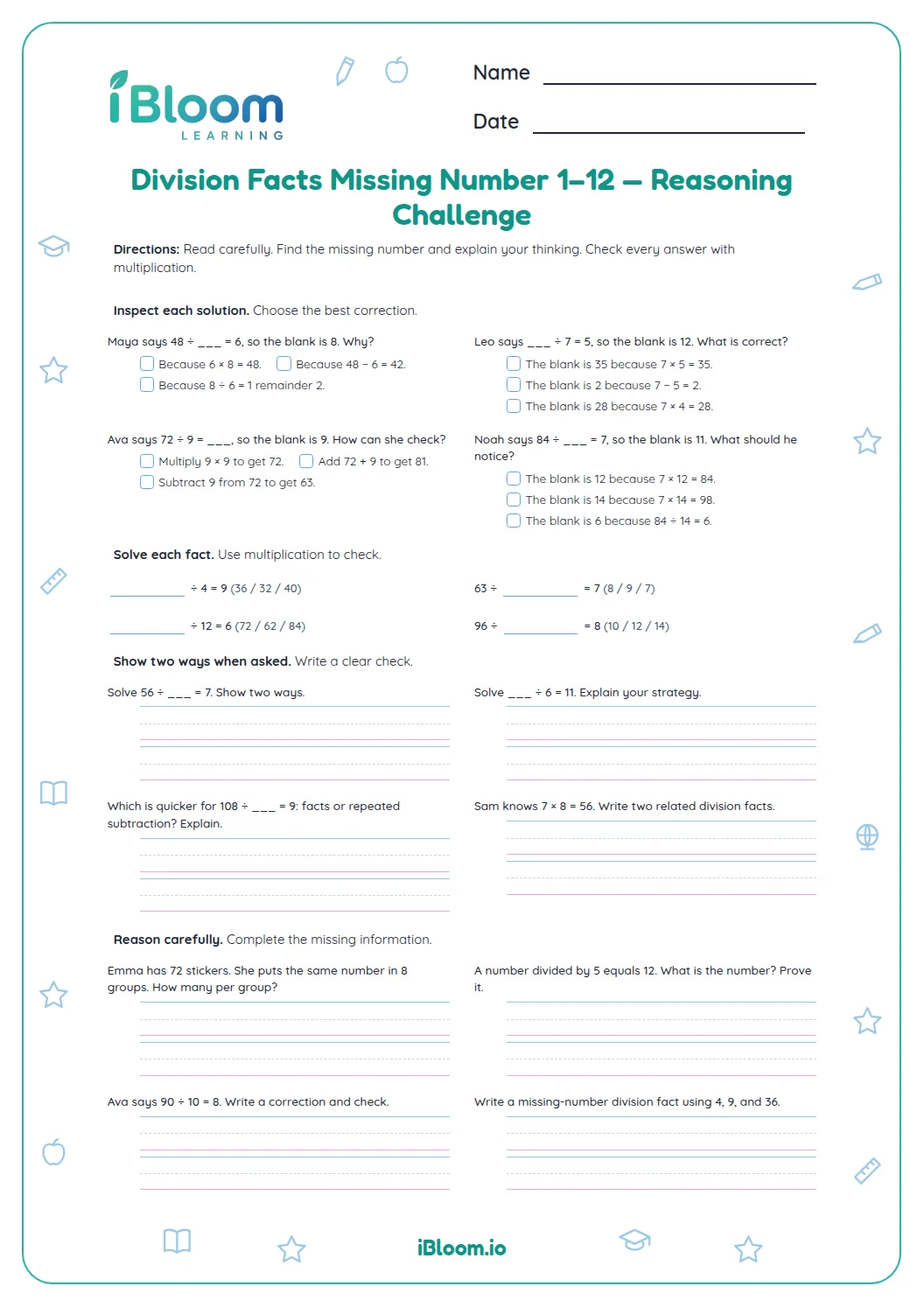
This free printable Grade 4 worksheet practices division facts with a missing number, including every missing divisor from 1 through 12. Students read two equal-row arrays, complete ten division equations, and solve three equal-group stories. The answer key shows the missing values and story units. Students can check division by using the related multiplication fact, as in CCSS 3.OA.A.2.
Aligned to 3.OA.A.2
How do equal groups show division?
The number line helps locate a missing divisor. In question 1, point A is at 4, so 24 ÷ 4 = 6. Check with multiplication: 4 × 6 = 24.
- 124 ÷ ___ = 6
- 2Point A marks 4 on the number line
- 324 ÷ 4 = 6
- 4Answer: 4
How do you find a missing divisor?
Use the related multiplication fact. For 18 ÷ ___ = 9, ask what number times 9 equals 18; the missing divisor is 2. The ten equations include each divisor from 1 to 12.
What is included in the practice?
The worksheet has 15 questions: two number-line models, ten missing-divisor equations, and three equal-group stories. The separate two-page answer key shows the missing values and labels the story answers.
How to use this worksheet
- 1For each array, identify the total and the number of rows.
- 2Count the objects in one row to find the quotient.
- 3For a blank in a division fact, rewrite it as multiplication.
- 4Decide whether a story asks for items per group or number of groups.
- 5Check by multiplying the quotient by the divisor.
Common mistakes and quick fixes
The mistake
Mixing up the number of groups and the number in each group.
The fix
Read the question: does it ask how many groups, or how many objects per group?
The mistake
Filling a blank without checking the multiplication fact.
The fix
Multiply the divisor by the proposed quotient and see whether it equals the dividend.
The mistake
Giving a bare number when the story asks for a count of items.
The fix
Add the matching label, such as cones, players, beads, bags or boxes.
Common Core alignment
This worksheet gives practice with the following Common Core standard.
Interpret whole-number quotients as equal shares or as the number of equal groups.
On this sheet: Students solve equal-group division situations and use related multiplication facts to find missing divisors.
Show the official wordingHide the official wording
Interpret whole-number quotients of whole numbers, e.g., interpret 56 ÷ 8 as the number of objects in each share when 56 objects are partitioned equally into 8 shares, or as a number of shares when 56 objects are partitioned into equal shares of 8 objects each. For example, describe a context in which a number of shares or a number of groups can be expressed as 56 ÷ 8.
What to practice next
Make more practice
Further reading
Questions parents and teachers ask
How does a number line help with division?
The marked point shows the missing divisor. In question 1, point A is at 4, so 24 ÷ 4 = 6. Check with multiplication: 4 × 6 = 24. The number line connects the division fact to its missing value.
How can I solve a missing-divisor fact?
Use the quotient and dividend to find the missing divisor. For 18 ÷ ___ = 9, ask what number multiplied by 9 makes 18; the answer is 2. The equation set gives practice with divisors from 1 through 12.
Do division stories always ask how many are in each group?
Some questions ask how many are in each group; others ask how many groups can be made. For example, 84 cones shared among 7 teams asks for the amount each team gets. In the pencils problem, 12 pencils per box is given and the number of boxes is unknown.
What does the answer key include?
The separate key pages give the quotient for each marked model, the missing numbers, and the story answers. It also shows the unit for answers such as cones, players, beads, bags and boxes, making the meaning of each result clear.
How many models and problems are on this sheet?
There are 15 questions: two number-line models, ten more missing-divisor facts, and three equal-group stories. Together, the missing-divisor facts practice every divisor from 1 through 12. The key gives each missing value and labels the answers to the stories.