



About this worksheet
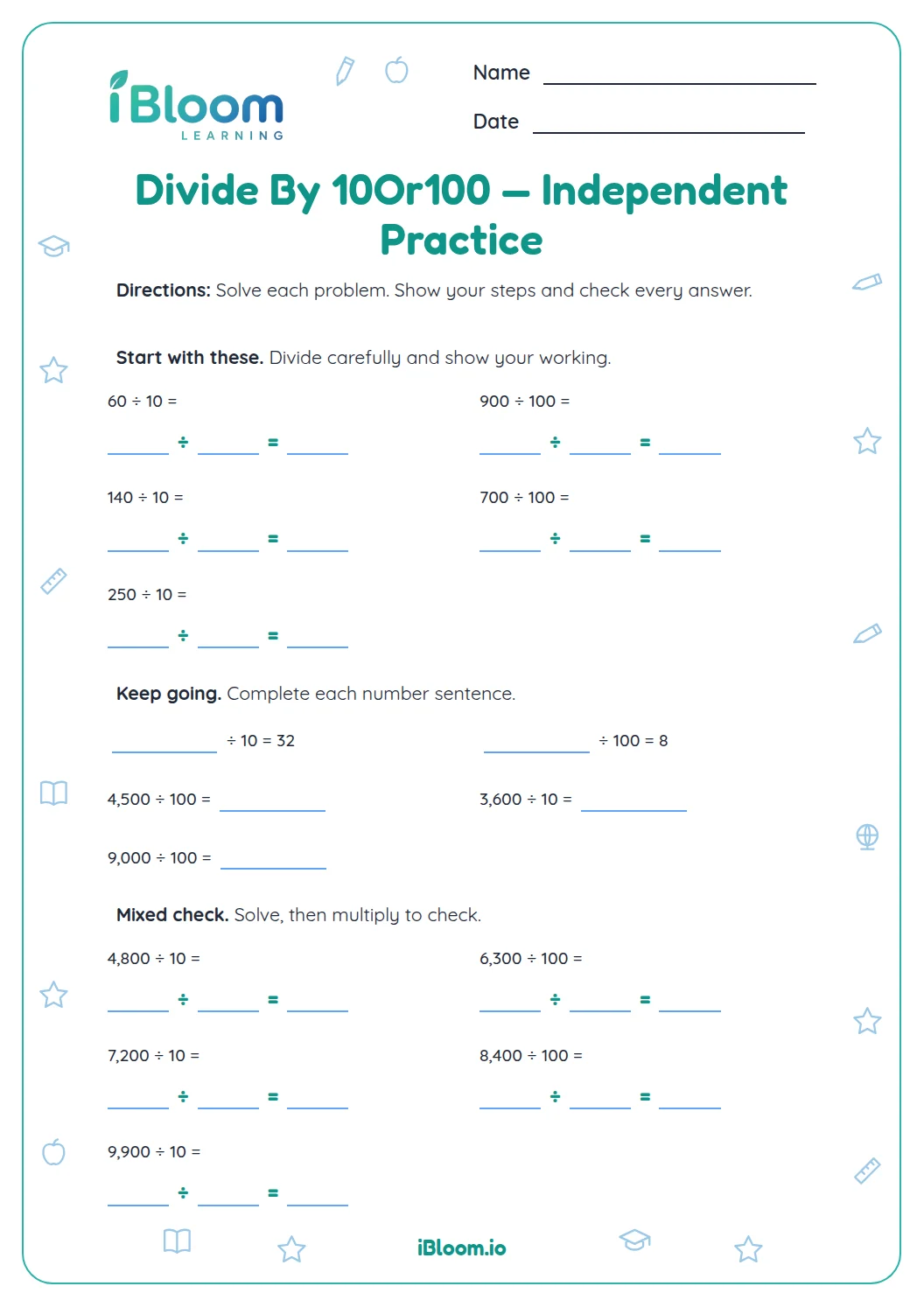
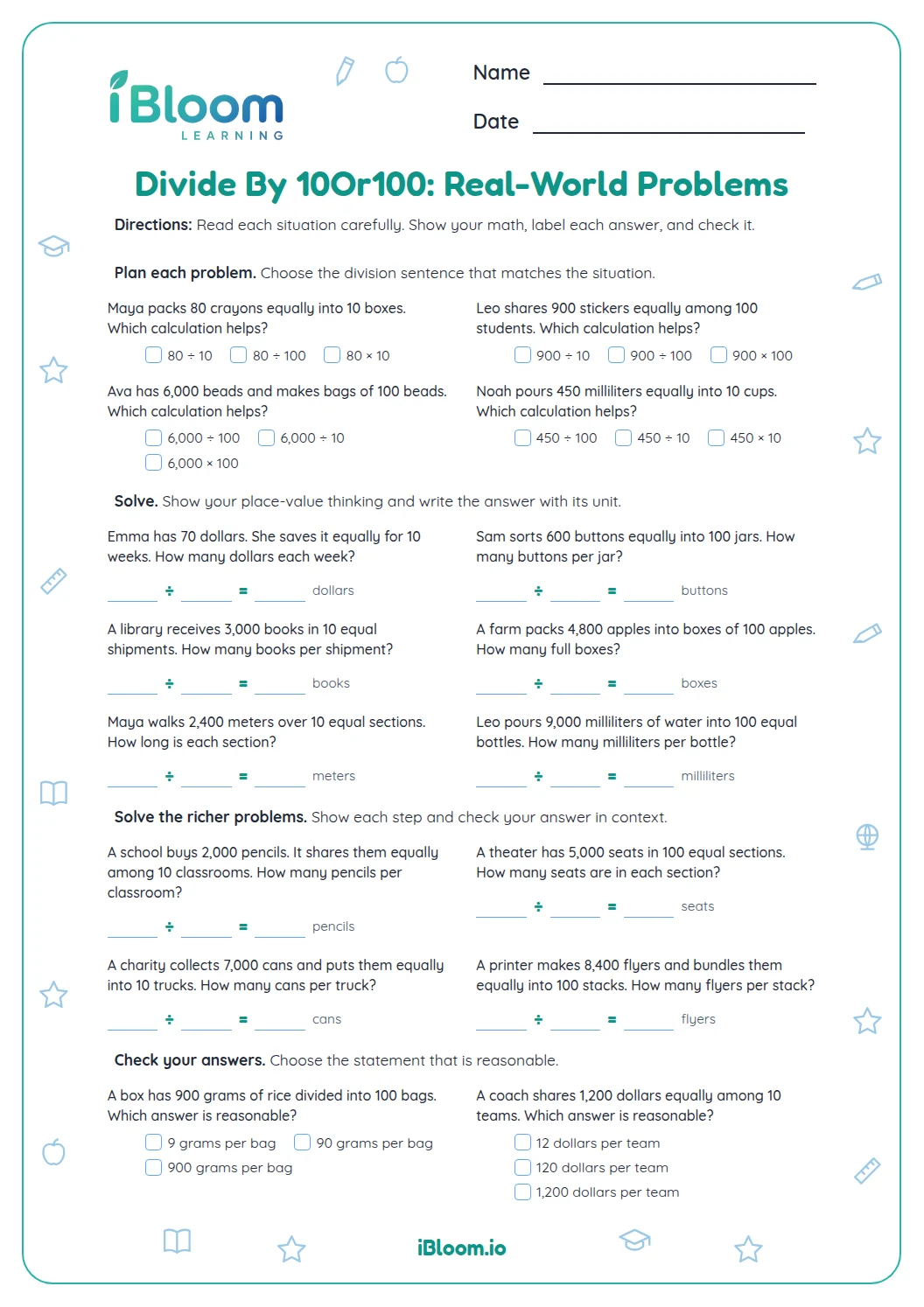
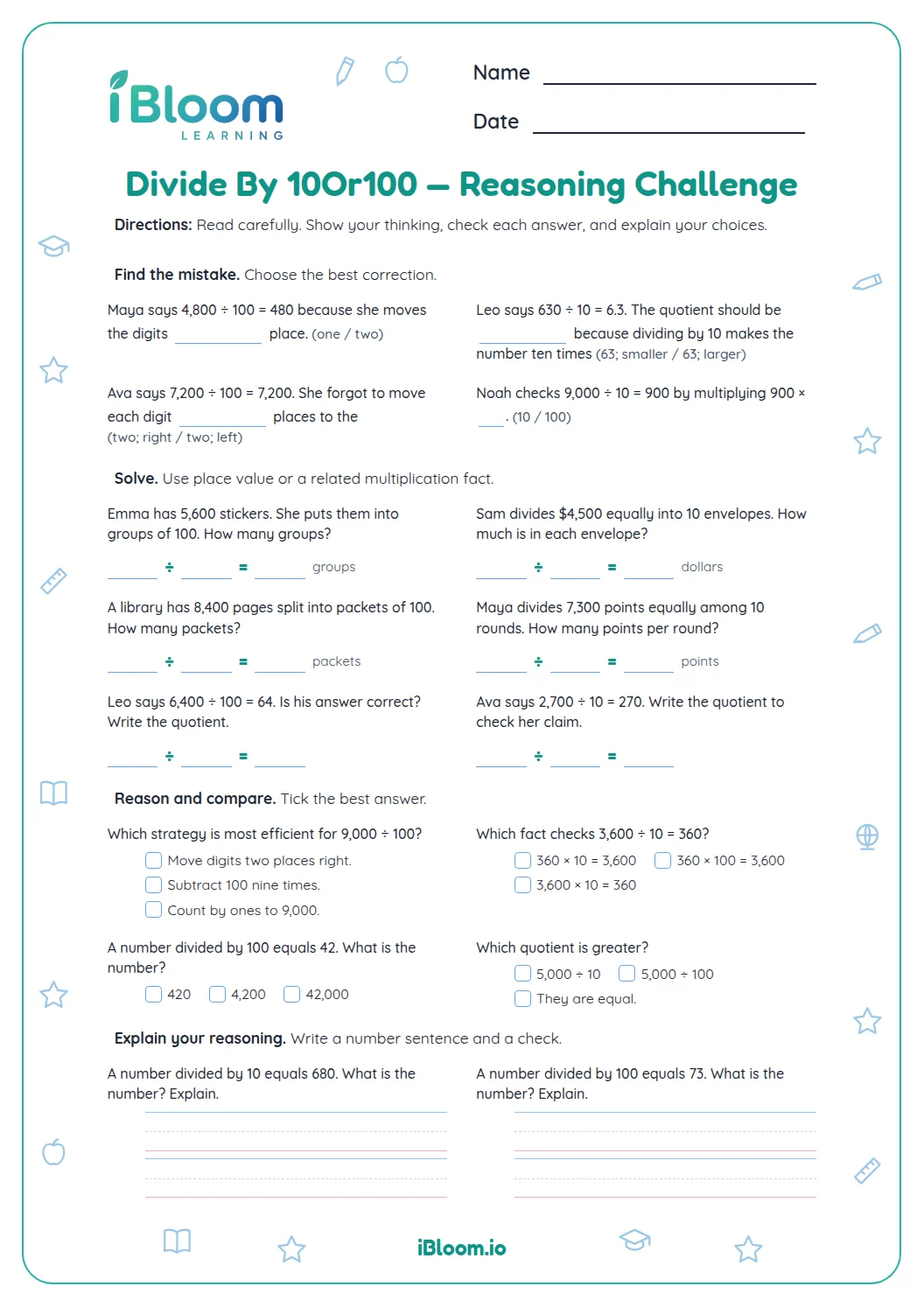
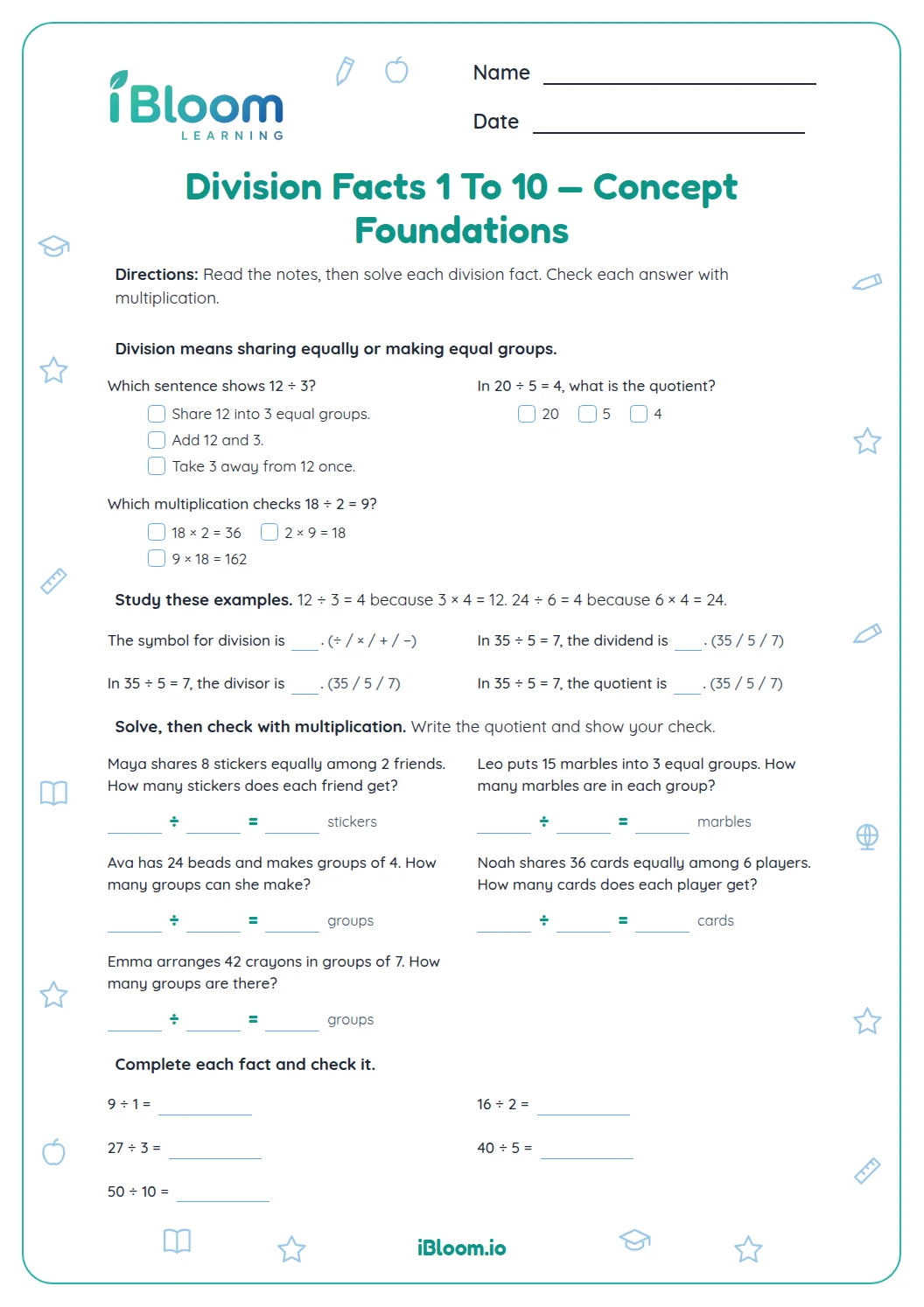
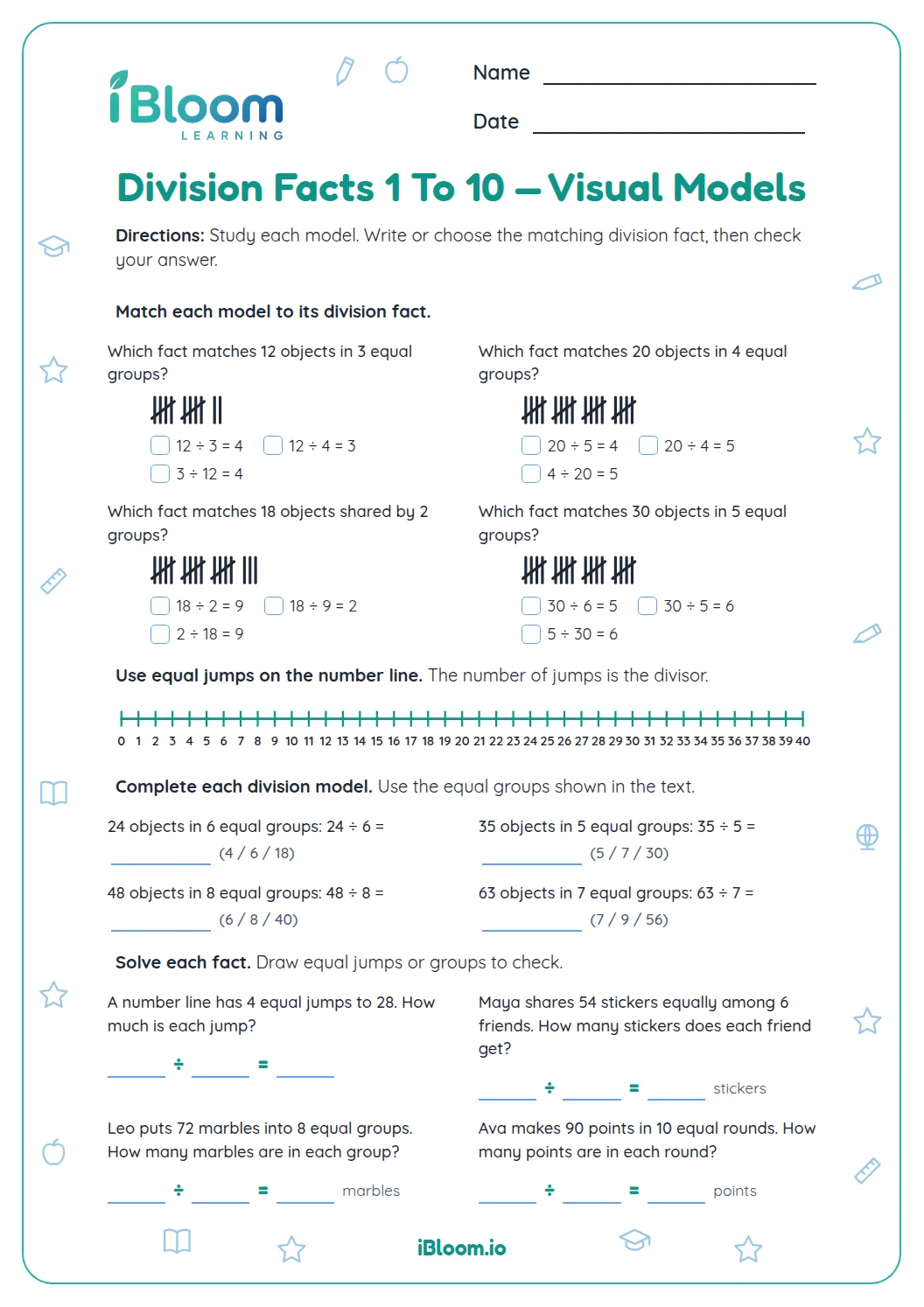
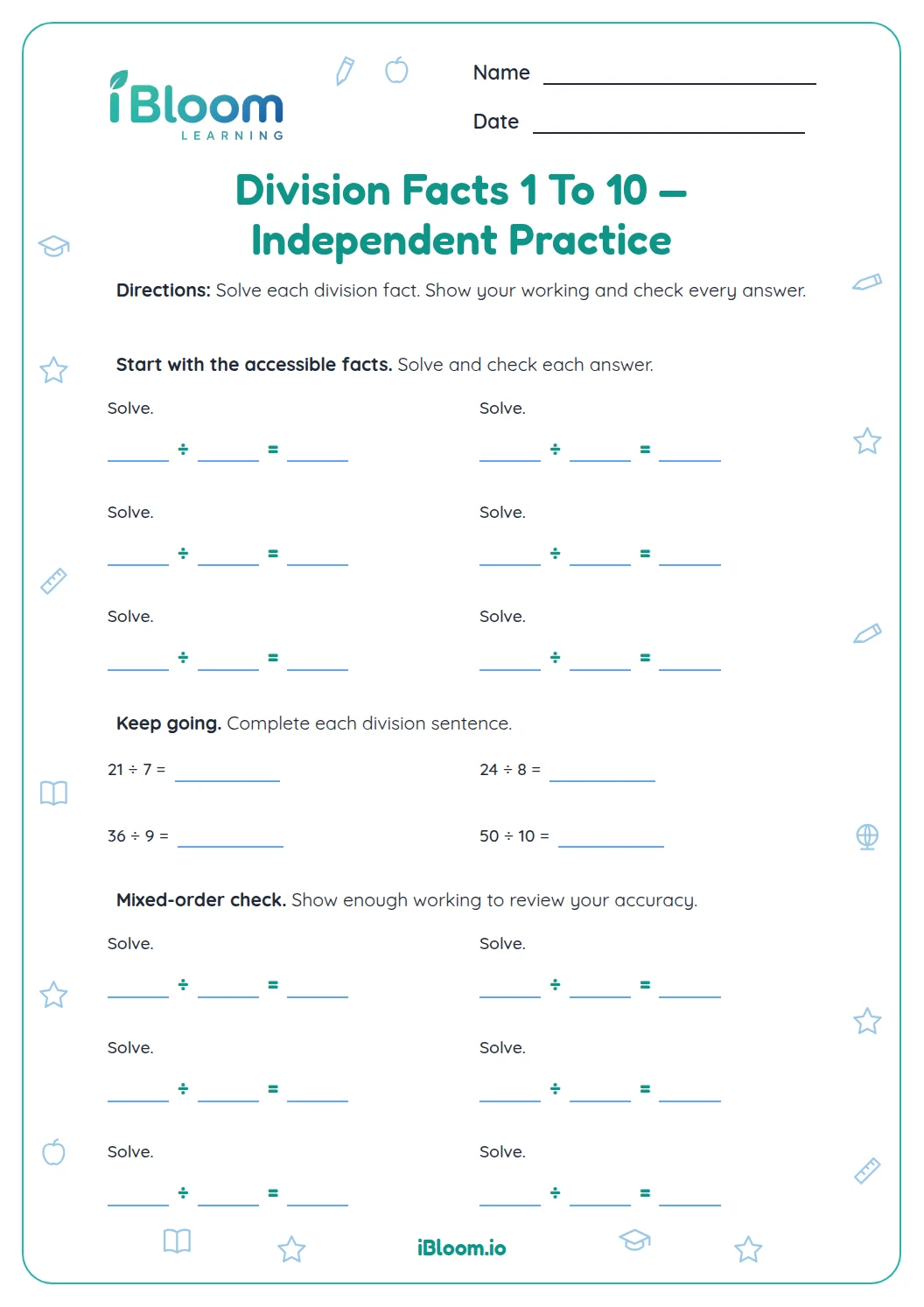
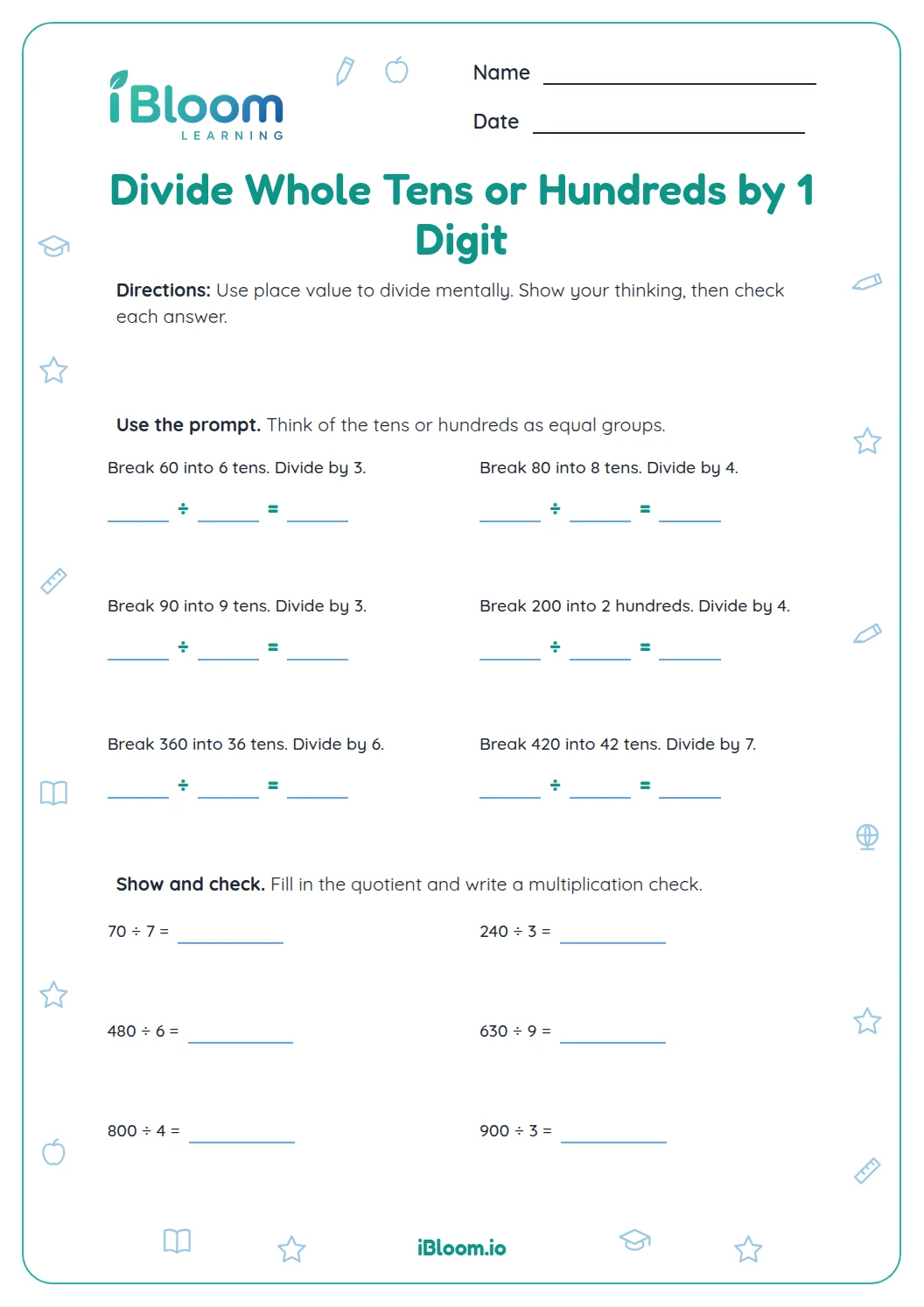
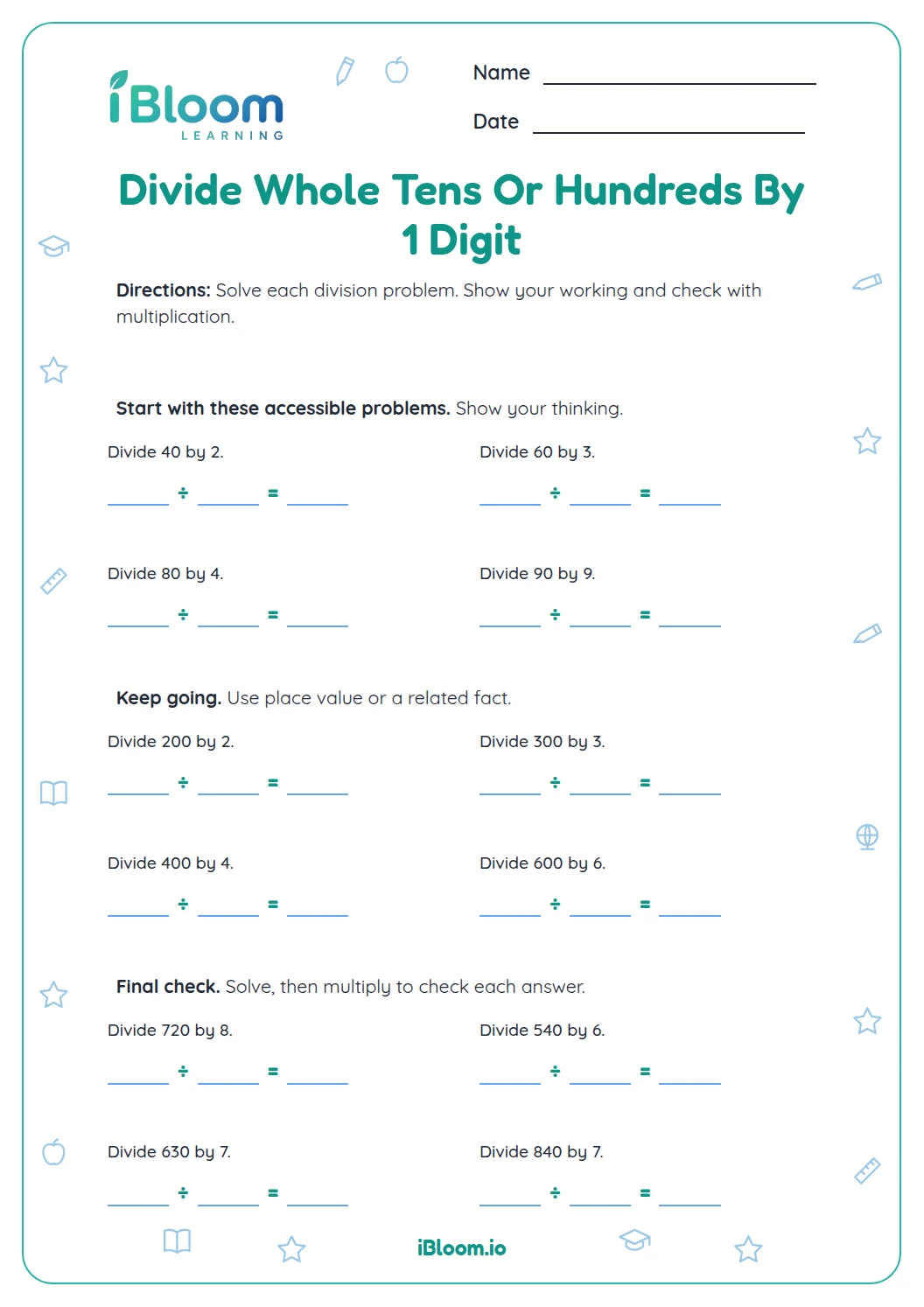
This free Grade 4 worksheet connects division by 10 and 100 to groups children can see. Part A uses four base-ten block drawings. Part B uses four number lines marked in equal intervals of 10 or 100. Part C asks children to carry that grouping idea into four larger mental-division facts. All 12 quotients are whole numbers. The practice supports Common Core 4.NBT.A.1 by connecting place value and division, and the separate answer key shows each quotient. Ask children to name the size of a group before counting how many groups fit.
Aligned to 4.NBT.A.1
What do the blocks mean when dividing?
Each long rod represents 10, and each large square represents 100. Question 1 counts rods. In question 2, rename each hundred-square as 10 tens: three hundreds make 30 tens. Questions 3 and 4 count groups of 100.
Ask the learner to say the group size with the answer: “Three groups of one hundred.” This keeps the value of a block separate from the number of blocks.
- 1Question 3: 300 ÷ 100 = ___
- 2Three hundred-flats make 300.
- 3There are 3 groups of 100, so the quotient is 3.
- 4Check: 3 × 100 = 300.
How do the number lines represent division?
Every interval between neighboring marks is one group. The prompt names its size. On the line from 0 to 80, each interval is 10; eight intervals reach 80, so 80 ÷ 10 = 8.
Have the child move a finger from one mark to the next while counting. The starting mark at zero is a location, not an interval. Part B includes two lines in tens and two in hundreds.
How do children move from drawings to mental division?
Part C uses numbers such as 2,700 and 6,400 that would need many blocks. Rename 2,700 as 27 hundreds, then count the hundreds mentally: 2,700 ÷ 100 = 27.
Multiplication checks the result without redrawing every group. For 680 ÷ 10, a quotient of 68 works because 68 × 10 = 680. Use the place-value explanation each time rather than treating zeros as marks to erase.
How to use this worksheet
- 1Name the value of one rod and one large square.
- 2Count the groups in Part A and write the quotients.
- 3Trace each equal interval with a finger in Part B.
- 4Rename Part C dividends as tens or hundreds.
- 5Multiply each Part C quotient by its divisor to check.
Mistakes to discuss
The mistake
Answering 300 ÷ 100 with 300 because that is the total value.
The fix
Count how many groups of 100 fit into 300: three.
The mistake
Counting nine tick marks as nine intervals from 0 to 80.
The fix
Start counting only when moving from zero to the next mark; there are eight intervals.
The mistake
Writing 2,700 ÷ 100 = 270.
The fix
Check 270 × 100. Then rename 2,700 as 27 hundreds to find 27.
Common Core alignment
Rename each hundred as ten tens, then use place value to divide by 10 and 100.
On this sheet: Question 2 renames three hundreds as thirty tens; the other drawings and mental facts apply this place-value structure.
Show the official wordingHide the official wording
Recognize that in a multi-digit whole number, a digit in one place represents ten times what it represents in the place to its right. For example, recognize that 700 ÷ 70 = 10 by applying concepts of place value and division.
What to practice next
Make more practice
Further reading
Questions parents and teachers ask
What do the rods and squares represent?
A rod represents ten units, and a large square represents one hundred units. Part A prints these values above the questions. For 300 ÷ 10, children rename each hundred-square as ten tens. Three squares make thirty tens, so the quotient counts thirty groups of ten.
Why are most number-line marks unlabeled?
The endpoints and the interval size give enough information to count equal groups. Children follow the spaces between marks instead of copying a quotient from a label. On the 0-to-120 line, twelve jumps of 10 reach the endpoint, which makes 120 ÷ 10 equal to 12.
Does this sheet include both divisors?
Yes, the sheet practices division by both 10 and 100 in every part. There are two examples of each divisor among the block models, two among the number lines, and two among the mental facts. This gives six questions with each divisor across the complete worksheet.
How can I explain 6,400 divided by 100?
Explain that 6,400 is 64 groups of one hundred, so dividing by 100 gives 64. Connect it to the smaller block examples first, then say “64 hundreds” aloud. The multiplication check is 64 × 100 = 6,400, which rebuilds the original amount from those groups.
What should I check besides the written answers?
Check that the child can name the size of each group and count intervals accurately. A correct quotient is stronger evidence of understanding when the learner can explain it. Ask for a multiplication check on the final four facts, using the divisor and quotient to rebuild the dividend.