



About this worksheet
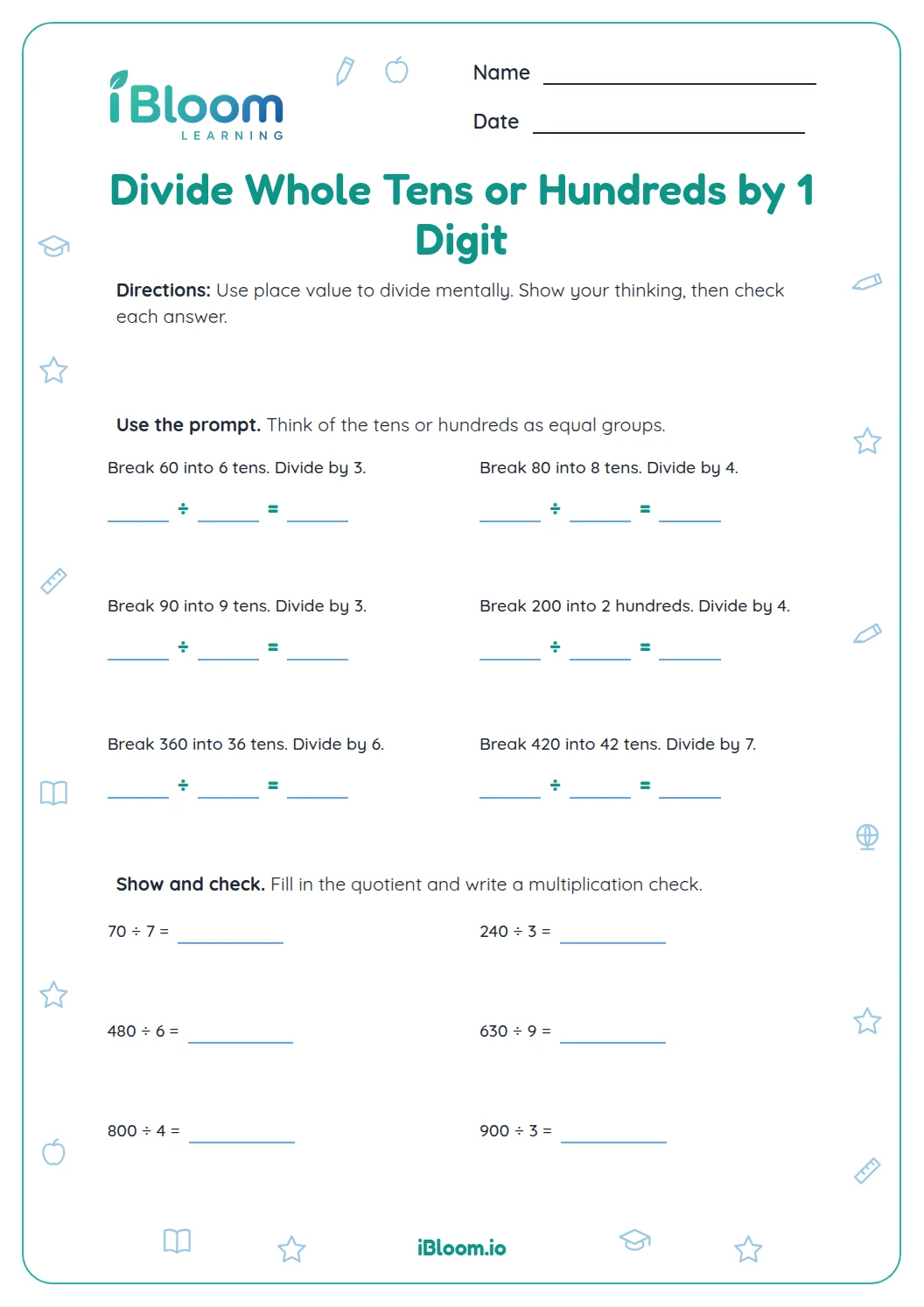
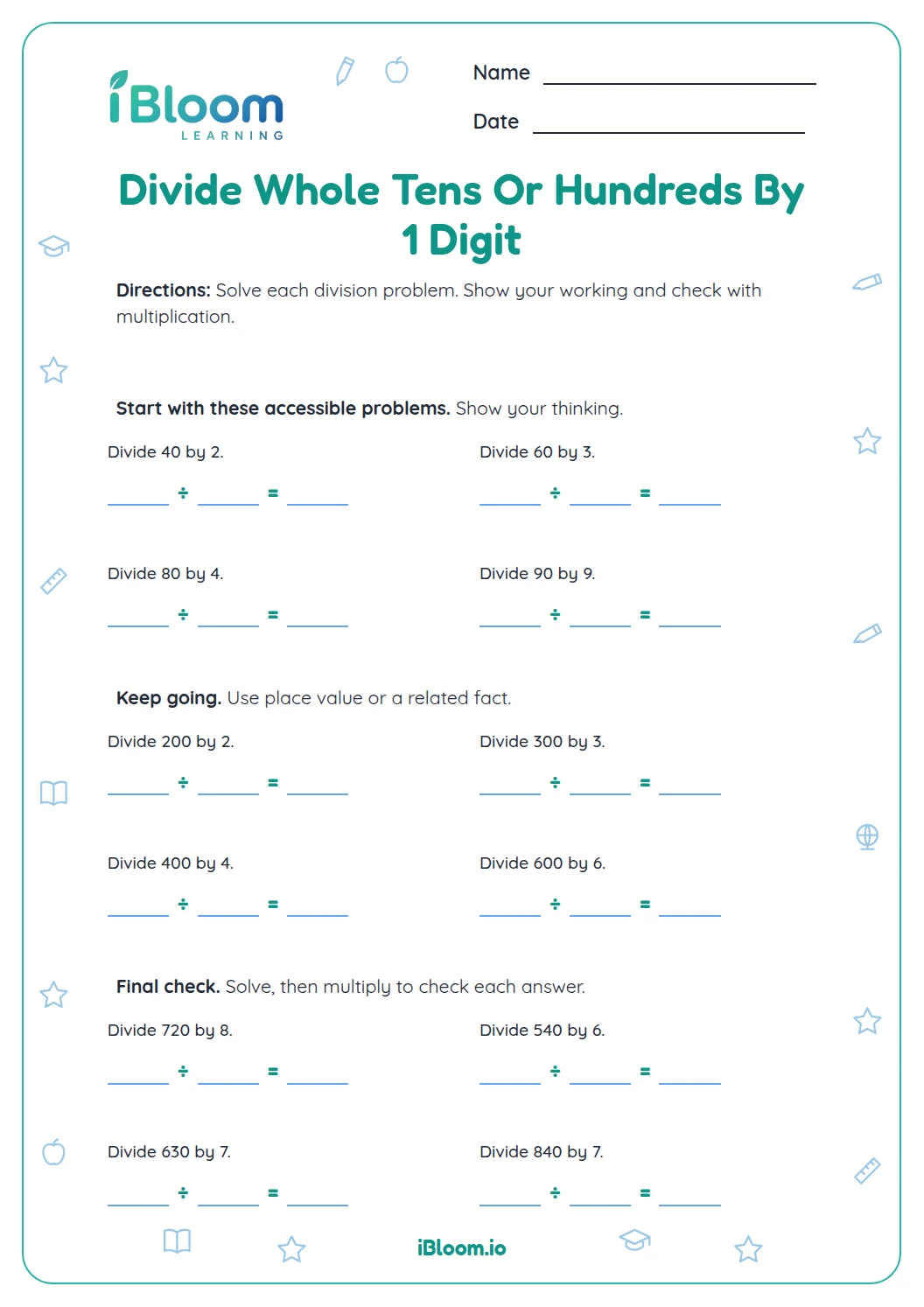
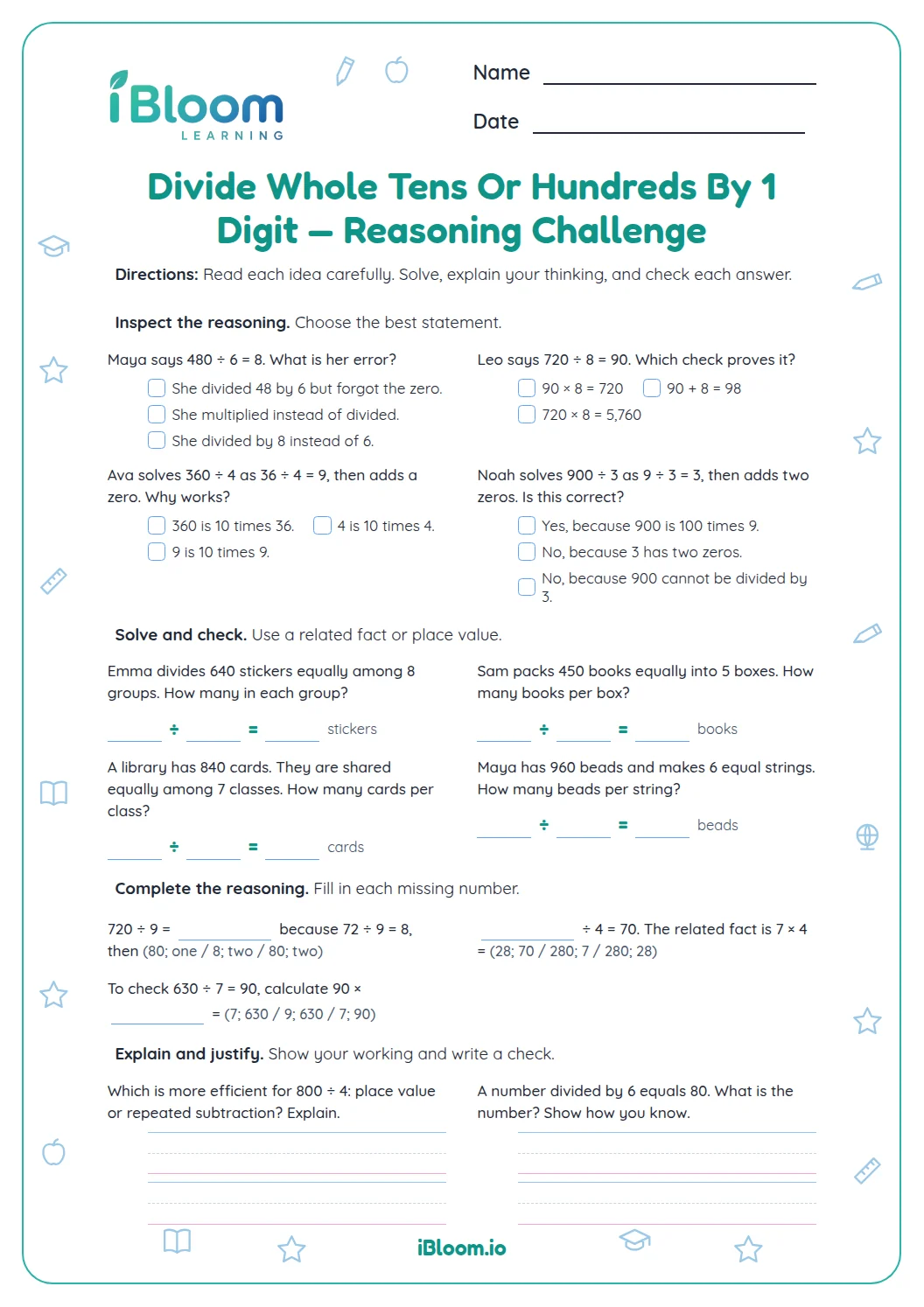
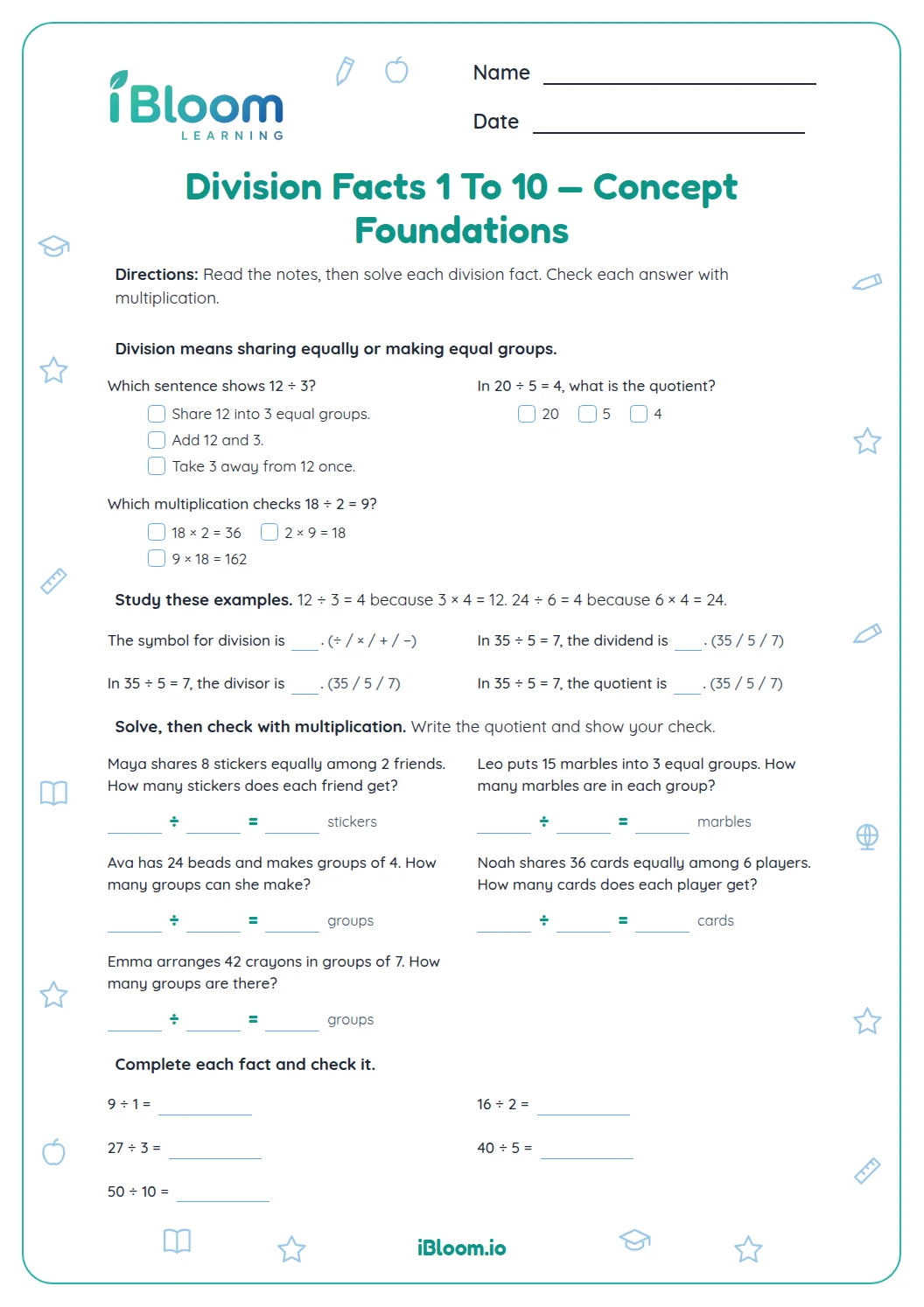
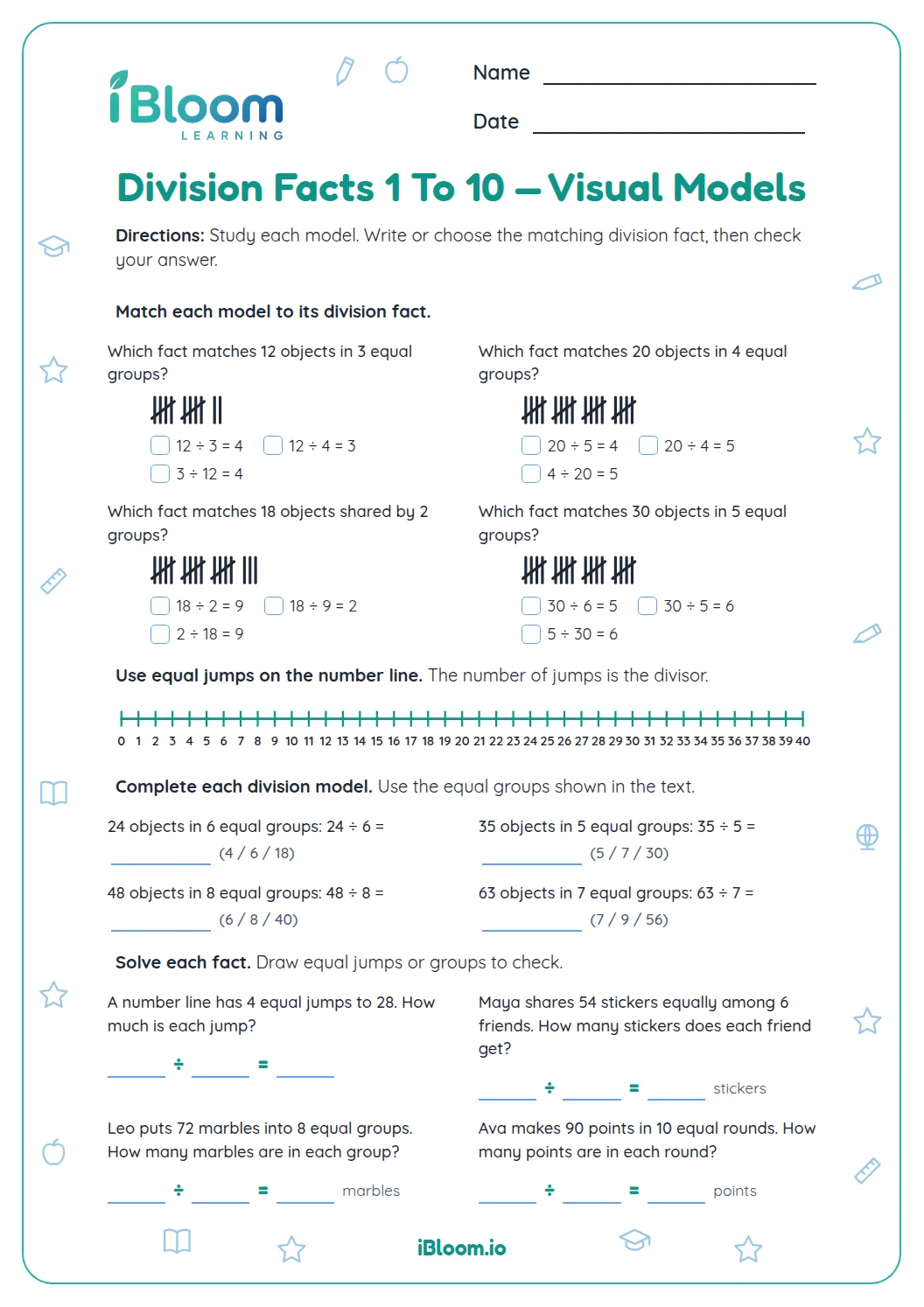
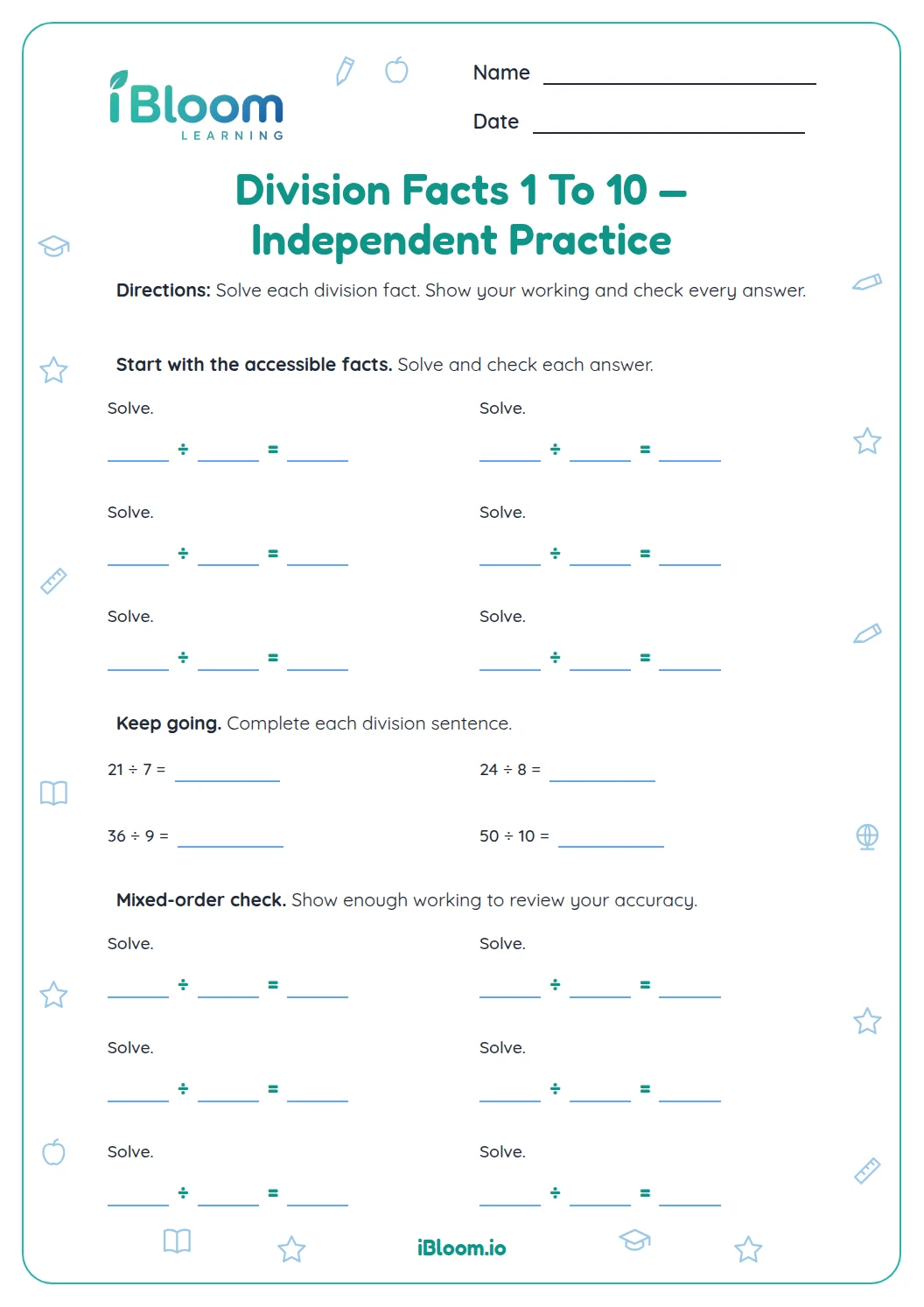
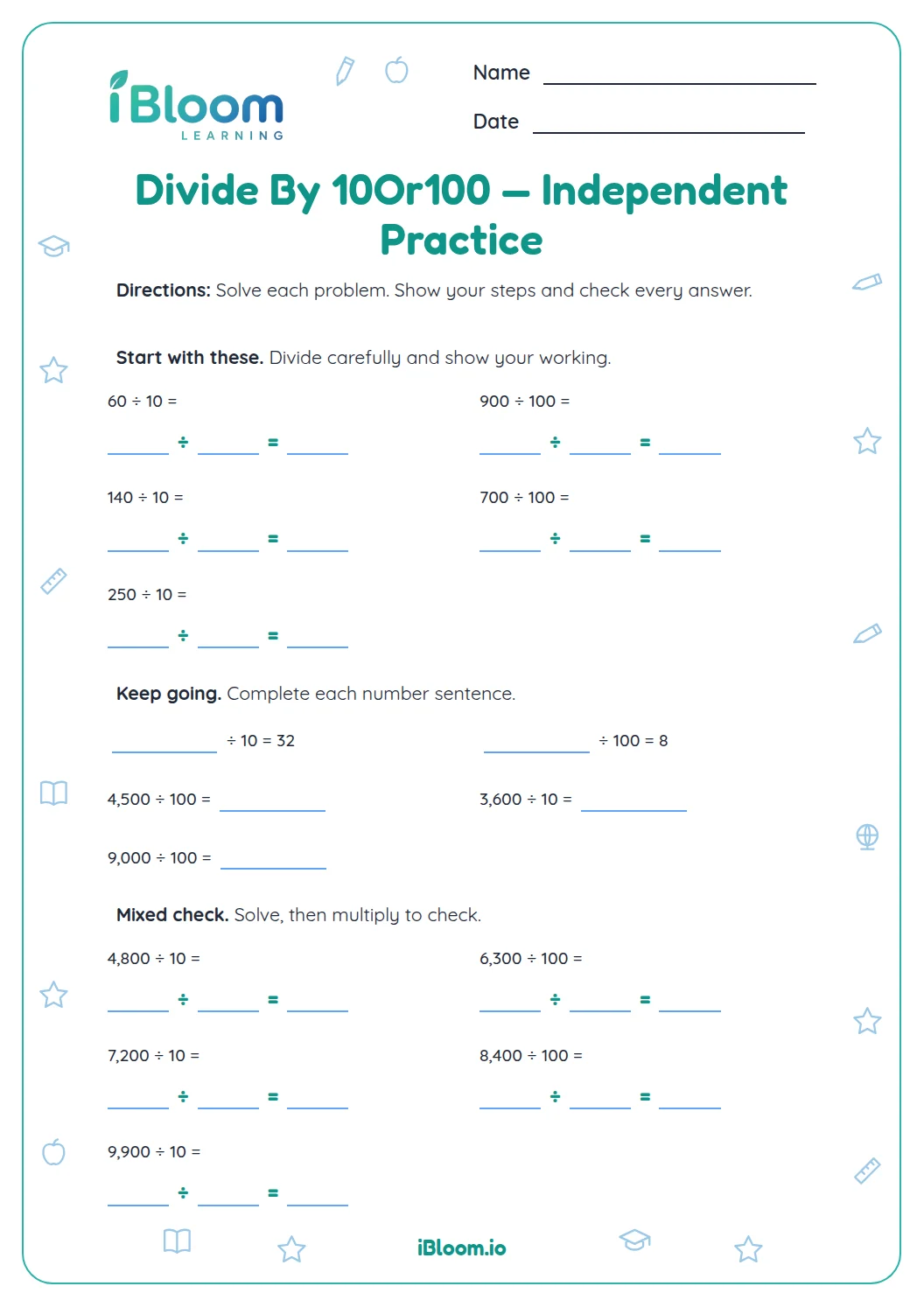
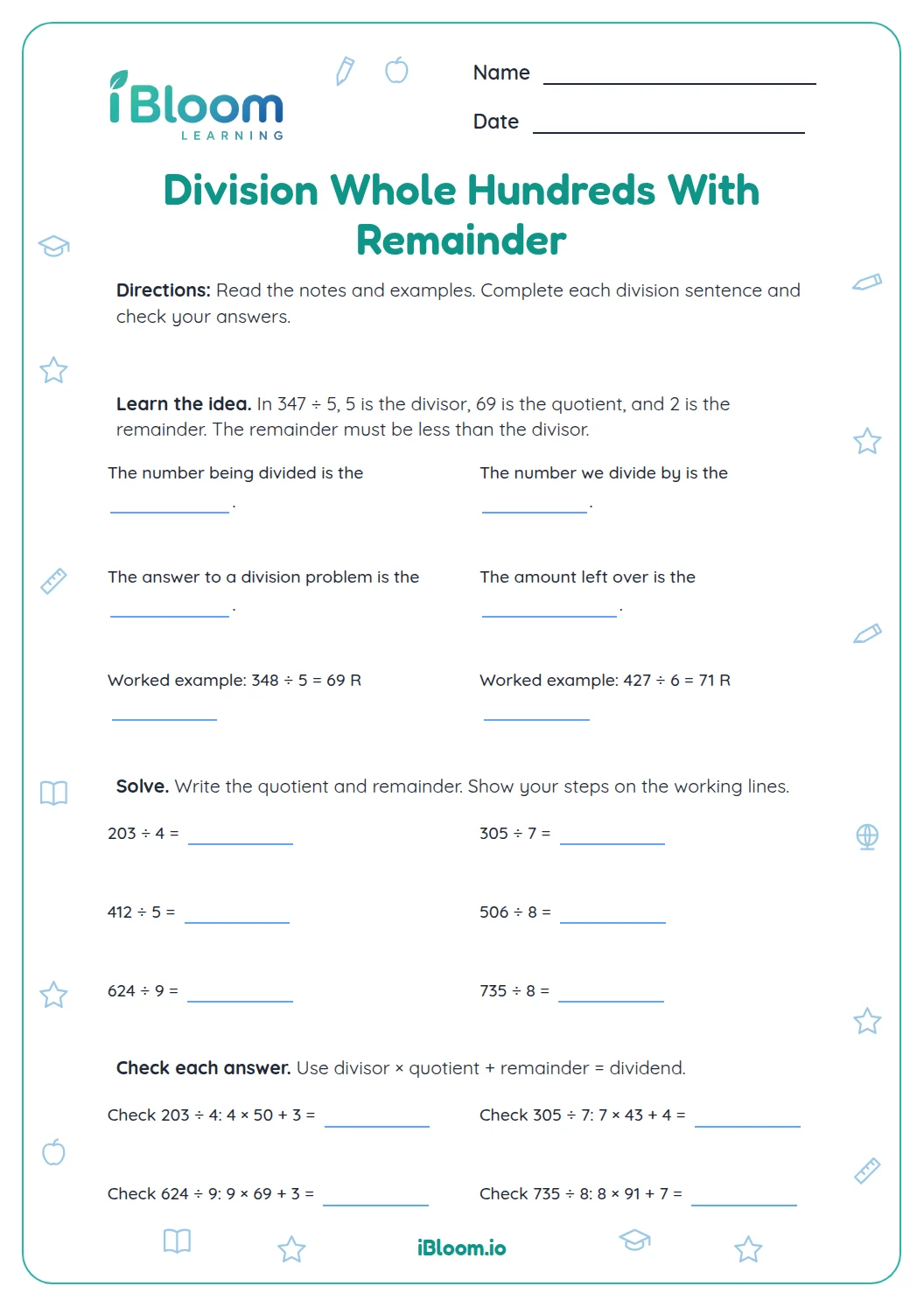
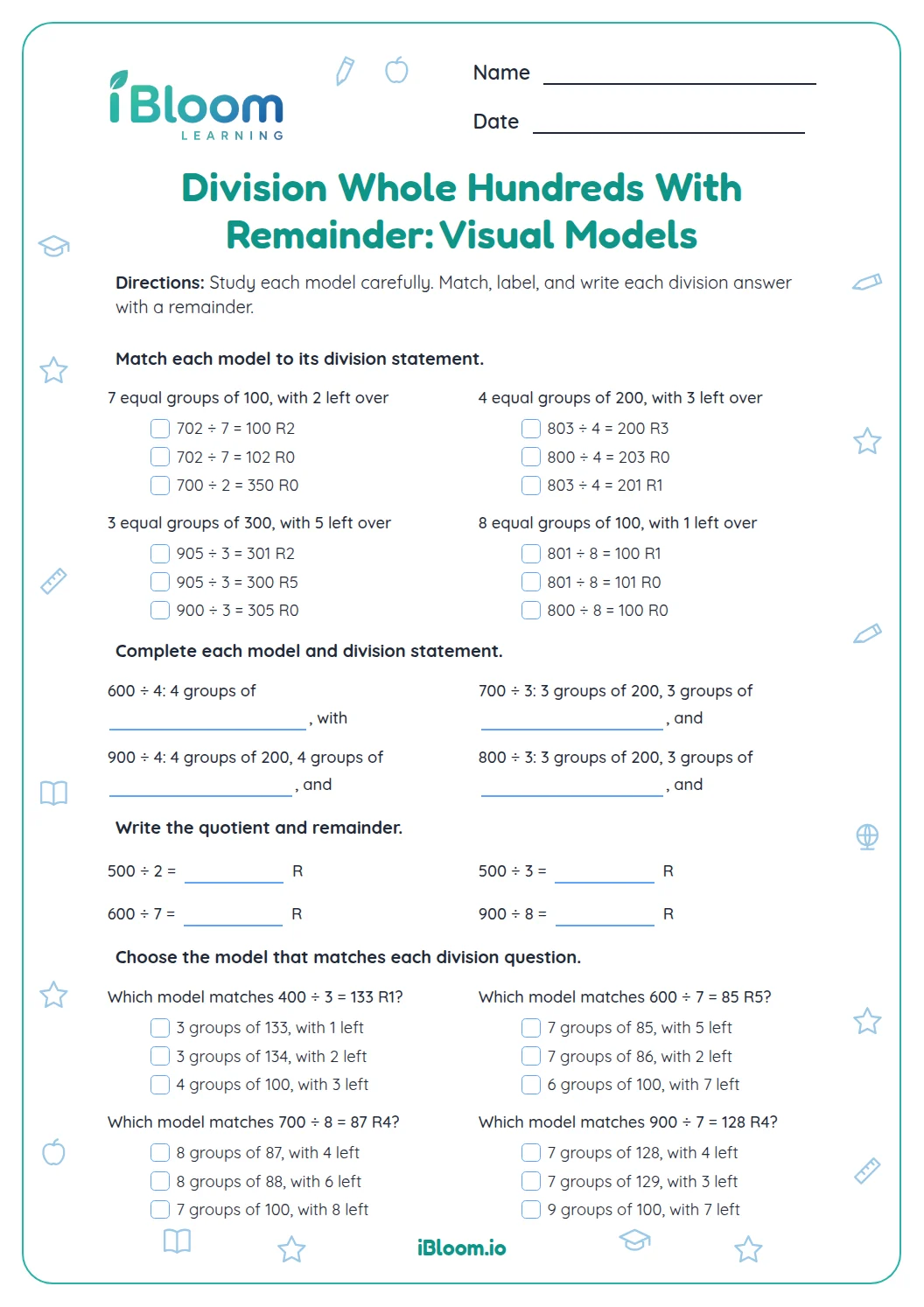
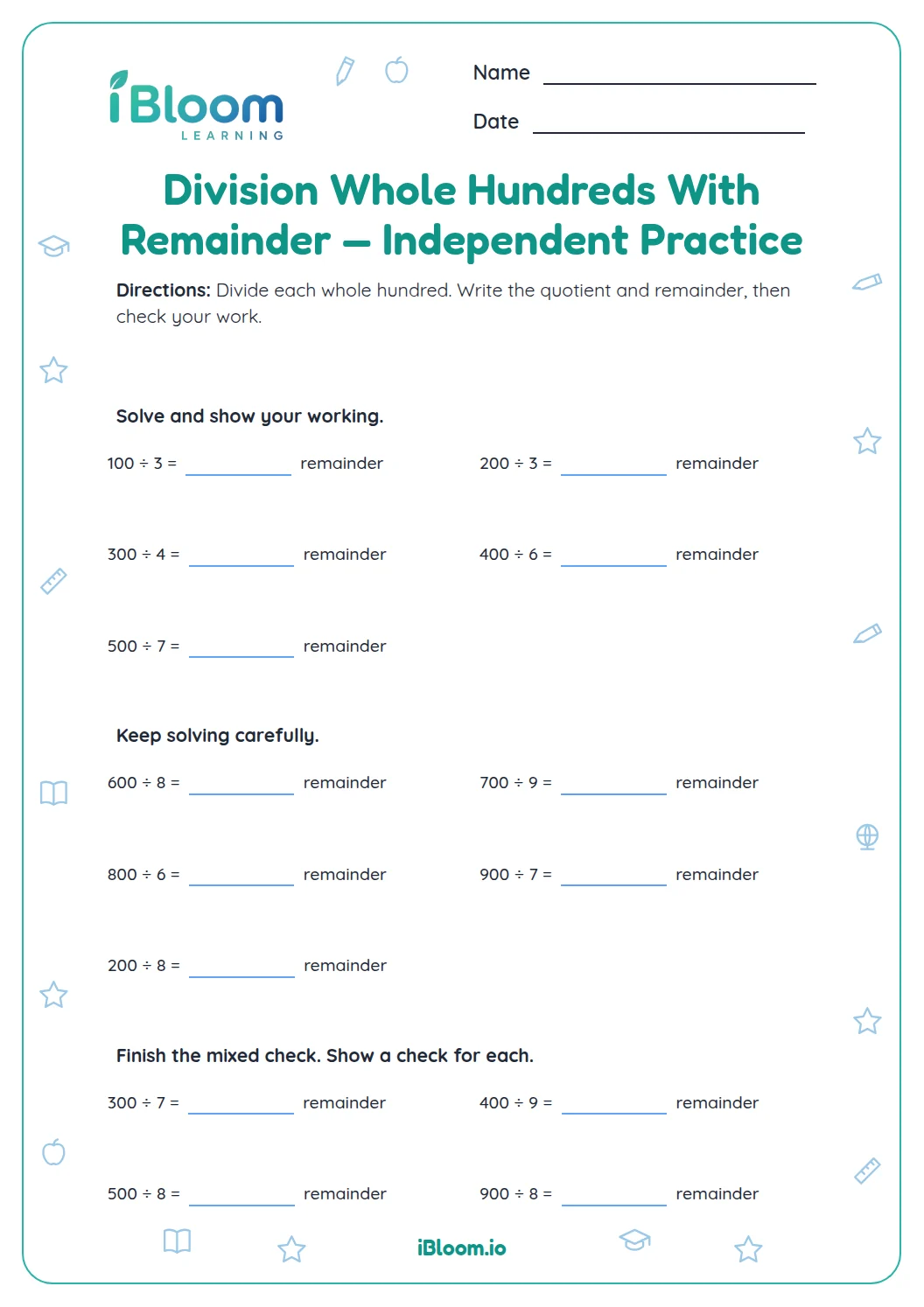
This Grade 4 worksheet practices mental division of whole tens and hundreds by one-digit divisors. Students use related facts and place-value units, then check quotients with multiplication. Its 18 problems move from tens to hundreds and larger multiples of hundreds. The work practices the place-value and multiplication strategies named in CCSS 4.NBT.B.6, with a separate answer key.
Aligned to 4.NBT.B.6
How can a basic fact help divide tens?
Think of 80 as 8 tens. Since 8 ÷ 4 = 2, 8 tens ÷ 4 = 2 tens, or 20.
- 180 ÷ 4: use 8 ÷ 4 = 2.
- 2The 8 stands for 8 tens, so the quotient is 2 tens: 20.
How do you divide whole hundreds?
Use the same relationship with hundreds. For 240 ÷ 6, use 24 ÷ 6 = 4, then read the 24 as 24 tens: the quotient is 4 tens, or 40.
How can multiplication check a quotient?
Multiply the quotient by the divisor. For 720 ÷ 9 = 80, check 80 × 9 = 720. The product should match the dividend.
How to use this worksheet
- 1Read the dividend and one-digit divisor.
- 2Use a related fact with the nonzero digits.
- 3Keep the place-value unit in the quotient.
- 4Multiply quotient by divisor to check.
Common mistakes and quick fixes
The mistake
Writing 4 instead of 40 for 240 ÷ 6
The fix
The 24 in 240 represents 24 tens, so the quotient is 4 tens.
The mistake
Adding a zero even when it does not belong
The fix
Use the related fact and track the dividend's place-value unit.
The mistake
Checking with another division fact
The fix
Multiply the quotient by the divisor and compare with the dividend.
Common Core alignment
Students use place-value facts and multiplication to solve one-digit division equations.
On this sheet:
Show the official wordingHide the official wording
Find whole-number quotients and remainders with up to four-digit dividends and one-digit divisors, using strategies based on place value, the properties of operations, and/or the relationship between multiplication and division. Illustrate and explain the calculation by using equations, rectangular arrays, and/or area models.
What to practice next
Make more practice
Further reading
Questions parents and teachers ask
What is the mental strategy for 80 ÷ 4?
Think of 80 as 8 tens. The basic fact 8 ÷ 4 = 2 tells you there are 2 tens in each group, so 80 ÷ 4 = 20. This connects a familiar fact to place value. Use the same quotient as 8 ÷ 4, but remember that the 8 represents eight tens. The answer is two tens, or 20.
Why does 240 ÷ 6 equal 40?
Think of 240 as 24 tens. Since 24 ÷ 6 = 4, the quotient is 4 tens, or 40. Multiplication checks it: 40 × 6 = 240. Think 24 ÷ 6 = 4, then keep the place-value unit: 24 tens divided into six groups makes four tens, or 40.
Are any answers remainders?
Every equation on this worksheet divides evenly. The dividends were chosen so the quotient is a whole number, letting students focus on the place-value strategy and check each result with multiplication. The questions have exact whole-number quotients so students can focus on the relationship between place value and a basic fact.
How can students avoid losing a zero?
Say what the digits represent before writing the answer. In 360 ÷ 9, 36 means 36 tens. Four groups of ten make 40, so the quotient is 40, not 4. Use the related basic fact, then check whether the quotient times the divisor equals the dividend. This catches a missing or extra zero.
What should I do if a quotient seems too small?
Multiply it by the divisor. If the product is smaller than the original dividend, check the place-value unit and the basic fact. For example, 40 × 9 is 360, which confirms 360 ÷ 9 = 40. Multiplication is the inverse operation: multiply the quotient by the divisor and verify that the product matches the starting number.