




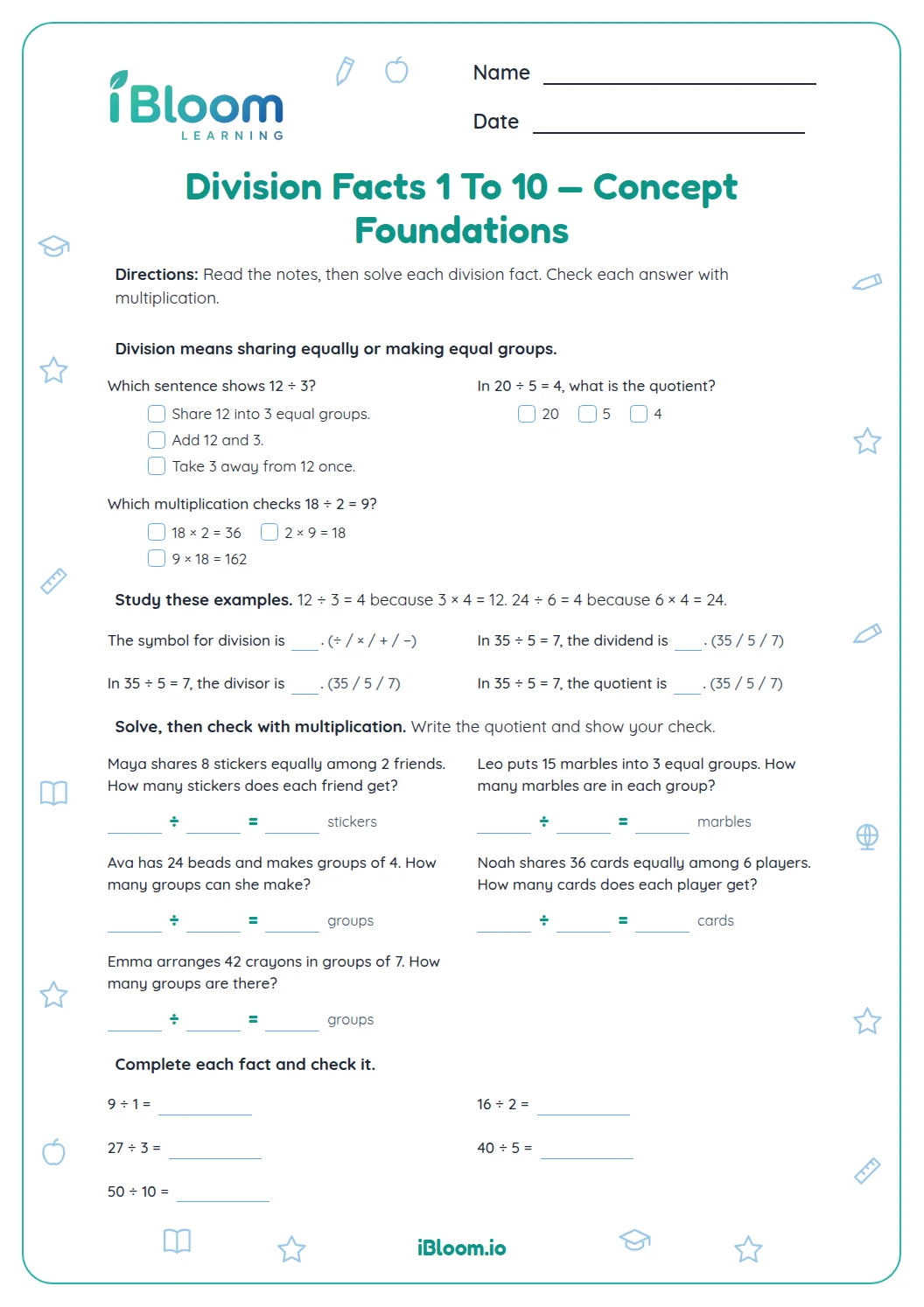
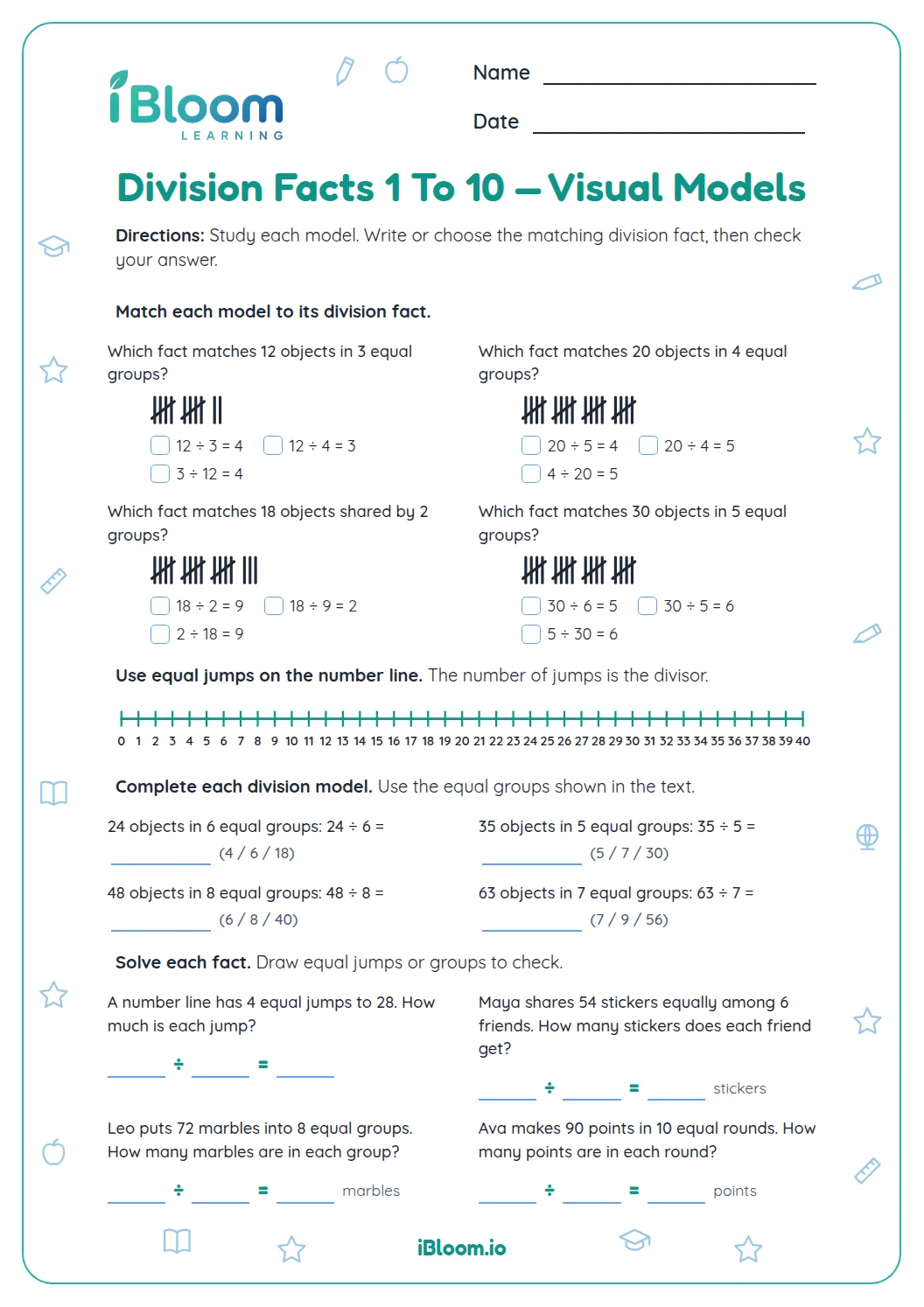
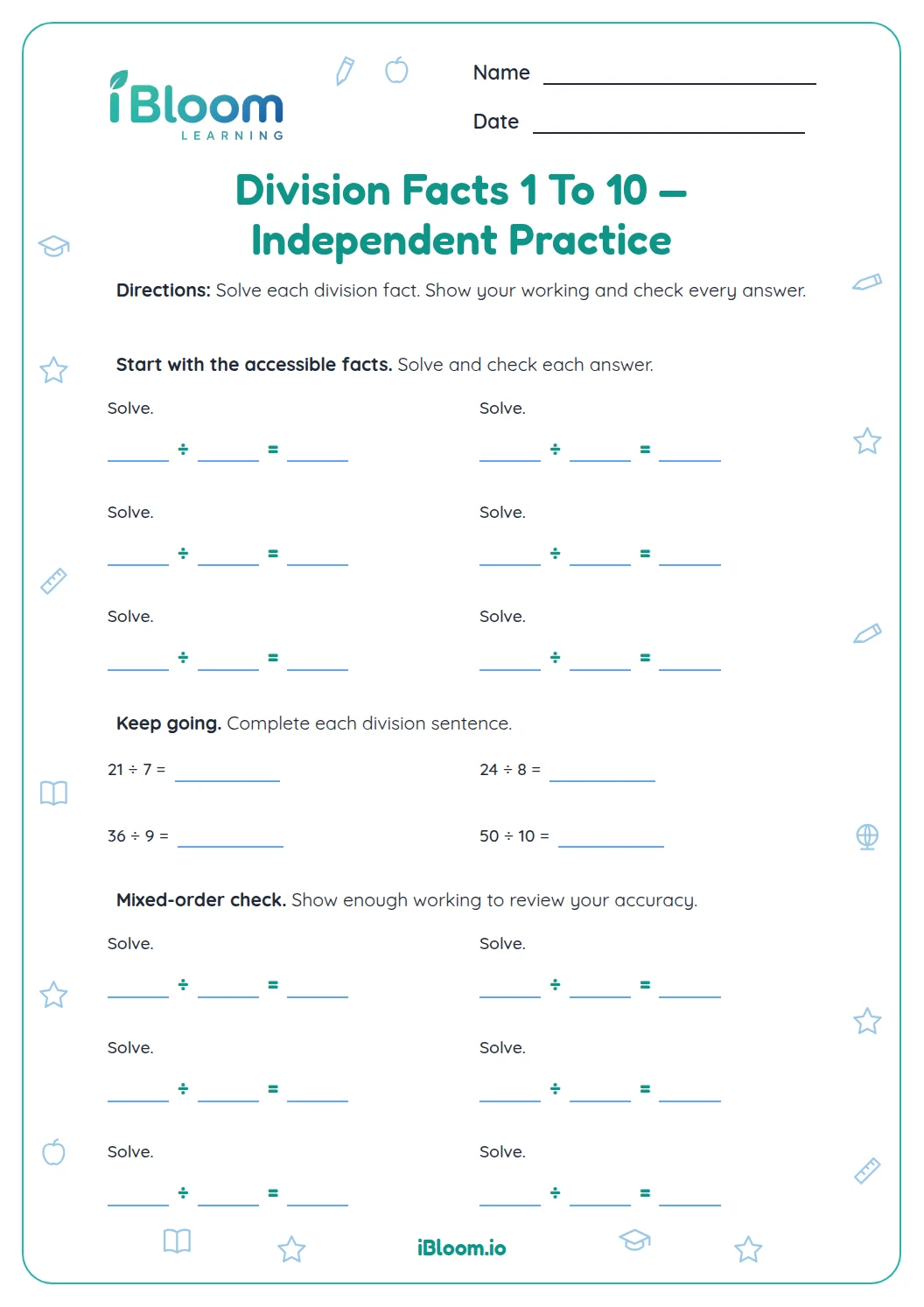
About this worksheet
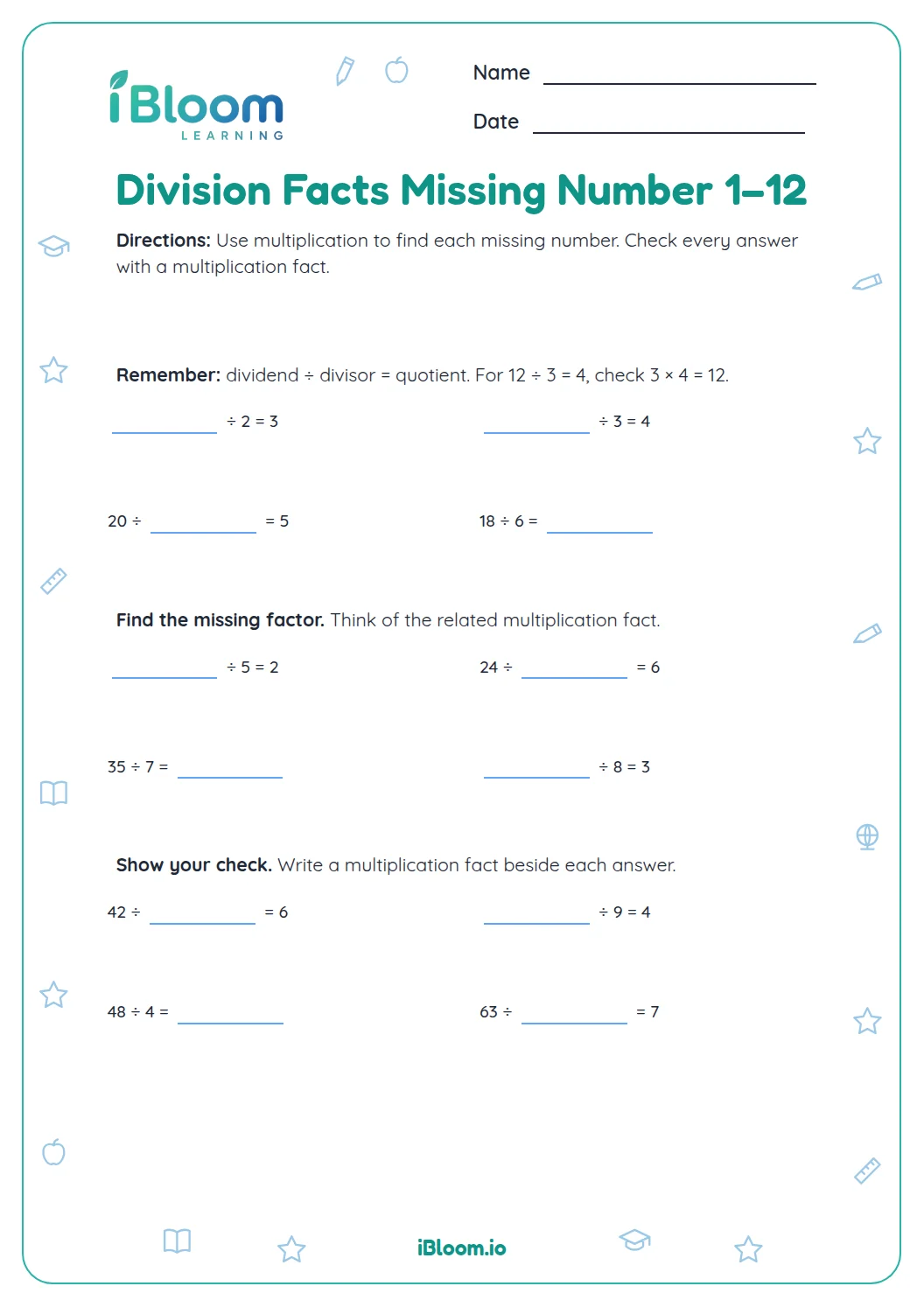
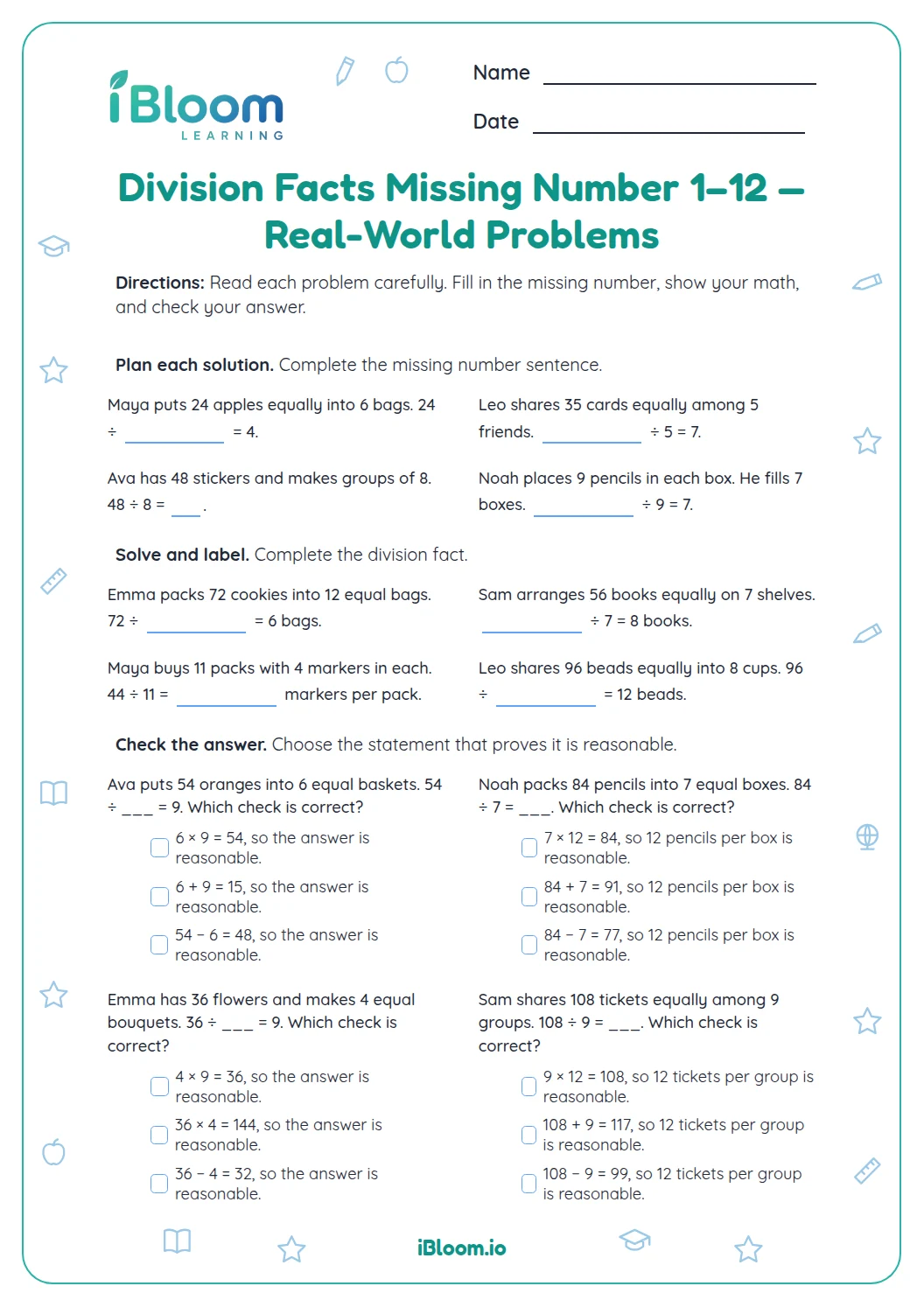
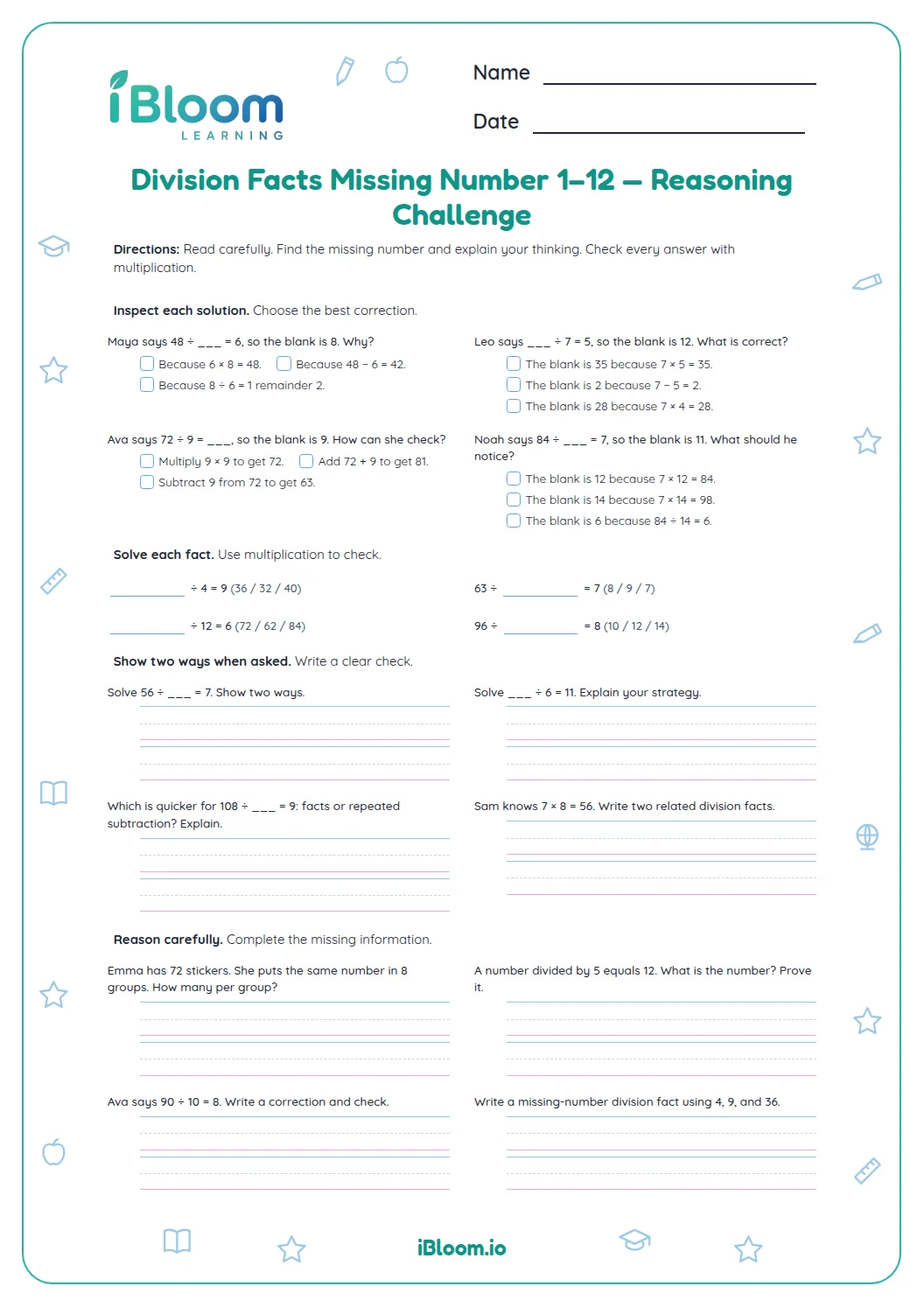
This free printable worksheet is for Grade 4 learners practicing division facts with missing numbers from 1 to 12. It includes 18 questions in 3 parts, with focused directions and a separate answer key for checking.
Aligned to 3.OA.C.7
How do you find a missing divisor?
Use the quotient to build a multiplication fact. For 24 ÷ ___ = 4, ask what number multiplied by 4 makes 24. Since 6 × 4 = 24, the missing divisor is 6.
- 1___ ÷ 7 = 8
- 27 × 8 = 56
- 356 ÷ 7 = 8
How do you find a missing dividend?
Multiply the divisor by the quotient. In ___ ÷ 7 = 8, calculate 7 × 8 = 56. The dividend is 56, and 56 ÷ 7 checks the fact.
How do division facts help in a story?
A story about equal groups can be represented by division. If 84 stickers are shared equally among 7 children, calculate 84 ÷ 7 to find 12 stickers per child.
How to use this worksheet
- 1Identify whether the blank is the dividend, divisor, or quotient.
- 2Turn the division sentence into a related multiplication fact.
- 3Use a multiplication fact with factors from 1 to 12.
- 4Put the missing number back into the division sentence.
- 5For a story, check that the answer tells the number of groups or items in each group.
Common slips and how to fix them
The mistake
Swapping the divisor and dividend.
The fix
In a ÷ b = c, a is the dividend and b is the divisor; keep their places clear.
The mistake
Multiplying the divisor by the quotient but placing the product in the wrong spot.
The fix
The product is the dividend, as in 7 × 8 = 56 and 56 ÷ 7 = 8.
The mistake
Reporting the number of groups when asked for items in each group.
The fix
Read what the question asks: name the unit or quantity in the answer before writing it.
Curriculum alignment
Use multiplication and division facts to complete equations within 100.
On this sheet: The division equations use known multiplication facts and their inverse division facts within 100.
Show the official wordingHide the official wording
Fluently multiply and divide within 100, using strategies such as the relationship between multiplication and division (e.g., knowing that 8 × 5 = 40, one knows 40 ÷ 5 = 8) or properties of operations. By the end of Grade 3, know from memory all products of two one-digit numbers.
What to practice next
Make more practice
Further reading
Questions parents and teachers ask
How do you find a missing divisor?
Use the quotient to build a multiplication fact. In 24 ÷ ___ = 4, ask what number times 4 makes 24. Since 6 × 4 = 24, the missing divisor is 6. Use the same reasoning on the other questions in this section. Read the final question to identify the number being found.
How do you find a missing dividend?
Multiply the divisor by the quotient. For ___ ÷ 7 = 8, calculate 7 × 8 = 56. Substitute 56 into the division equation to check that 56 ÷ 7 equals 8. Use the same reasoning on the other questions in this section. Read the final question to identify the number being found.
Why use multiplication to solve division facts?
Multiplication and division undo each other. A known multiplication fact can reveal a missing number in a division equation, and the division equation can then check the result. The sheet uses facts with numbers from 1 to 12. Use the same reasoning on the other questions in this section.
What does a sharing story ask the learner to find?
A sharing story asks for the number of items in each equal group. For 84 stickers shared equally among 7 children, divide 84 by 7 to find 12 stickers per child. The unit helps explain what the quotient means. Use the same reasoning on the other questions in this section.
What is included in the answer key?
The separate two-page key lists answers for all 18 missing-number equations and short applications. Learners can check whether the blank was a dividend or divisor and confirm each fact with related multiplication. Use the same reasoning on the other questions in this section.