




About this worksheet
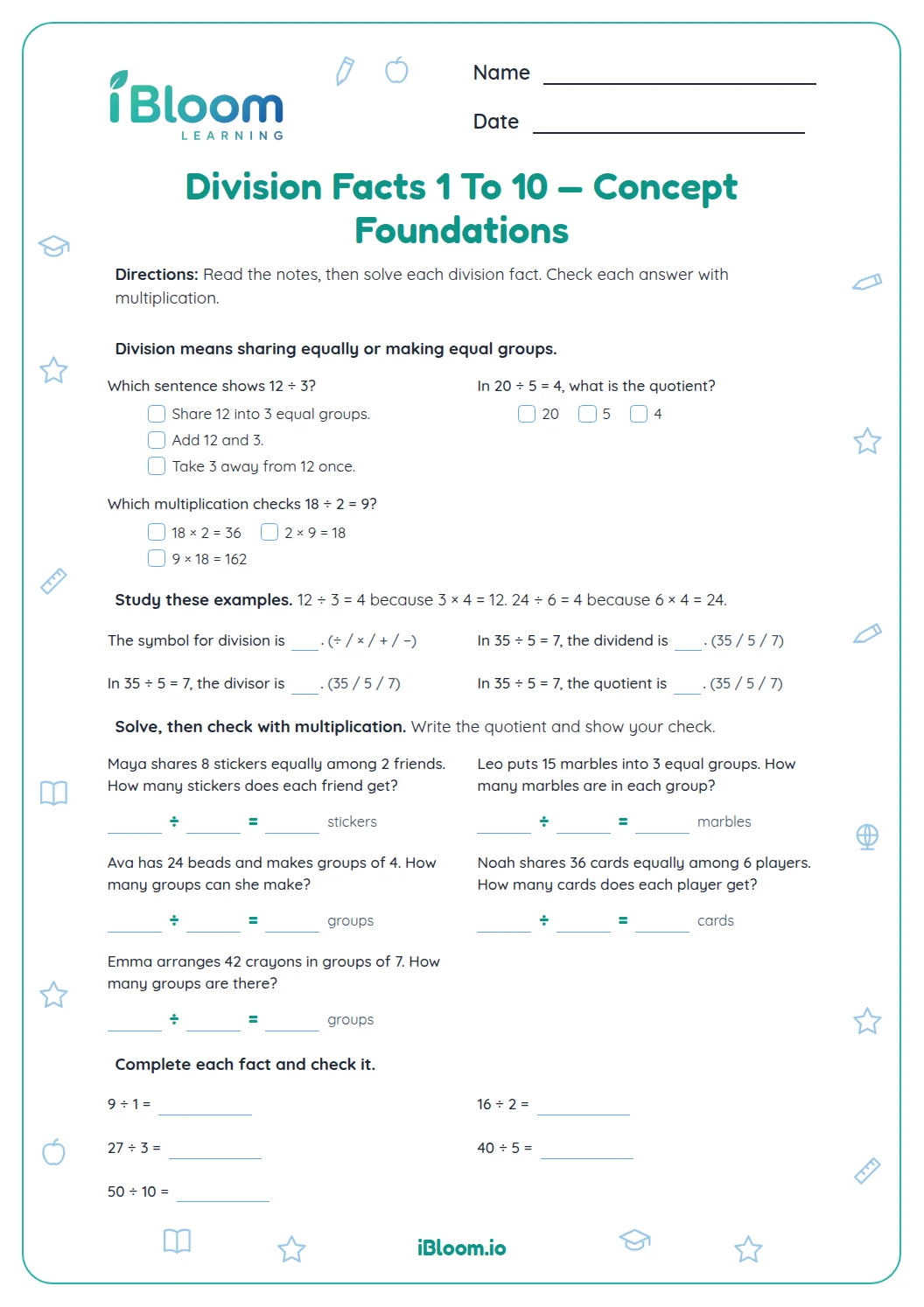
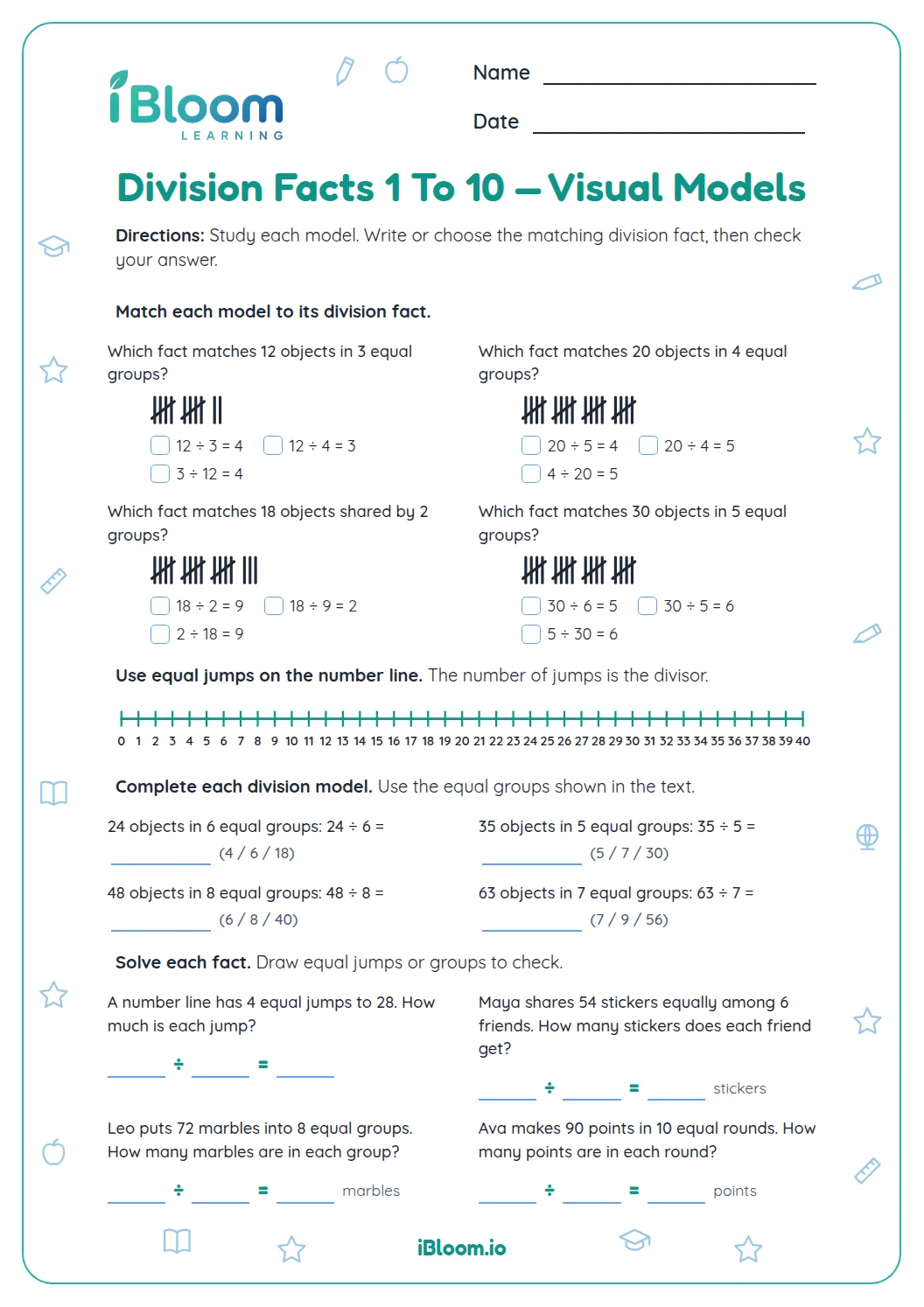
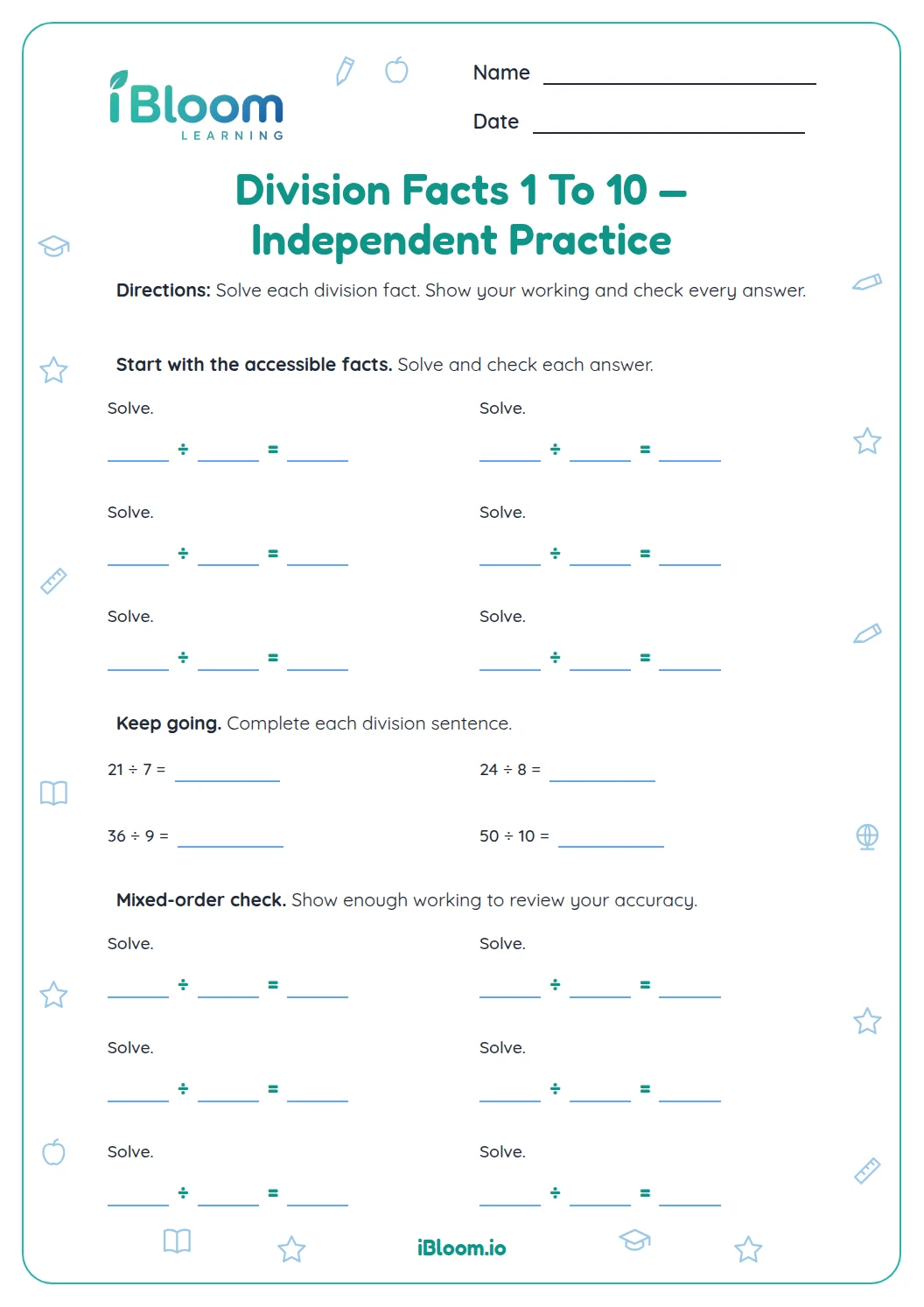
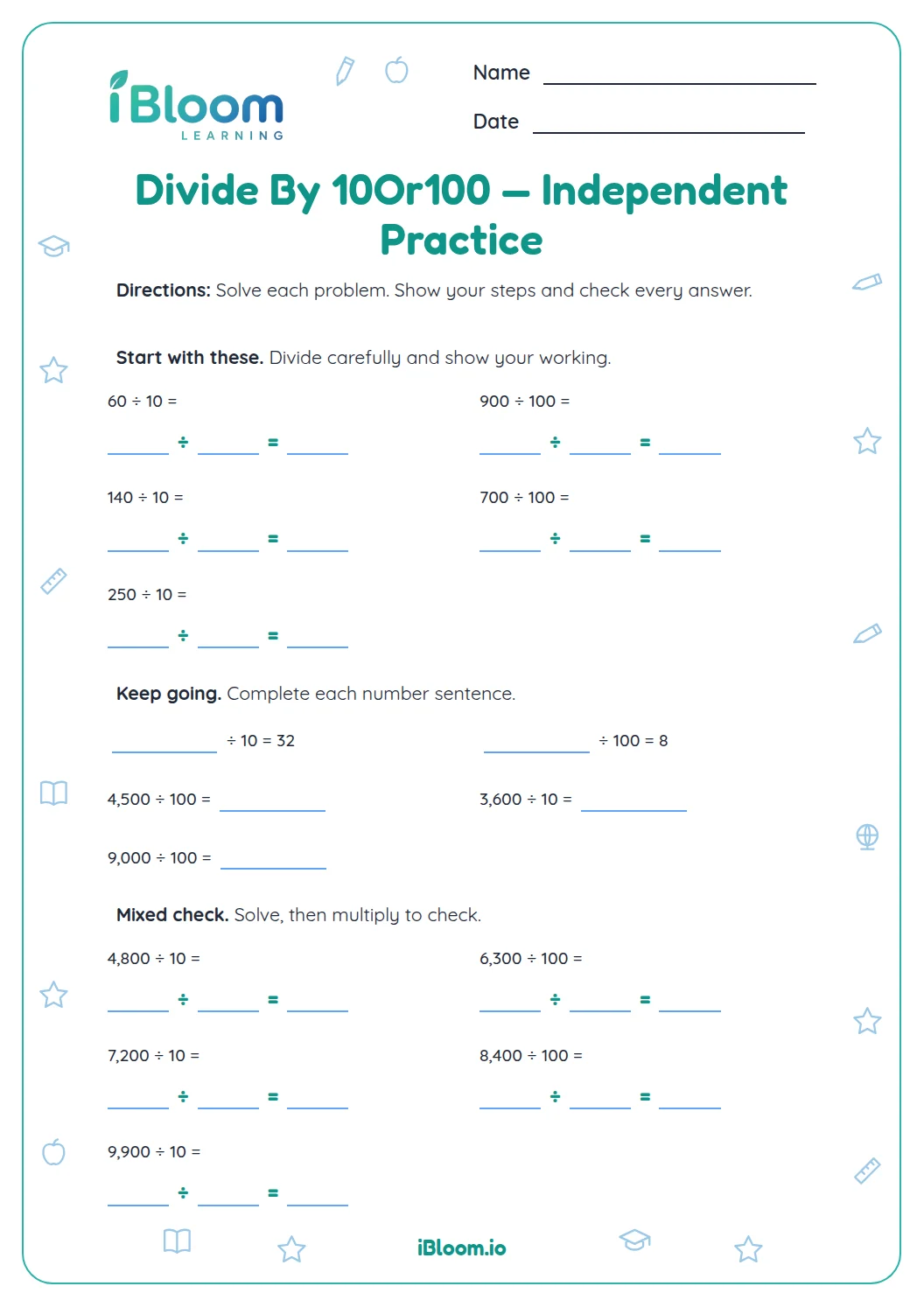
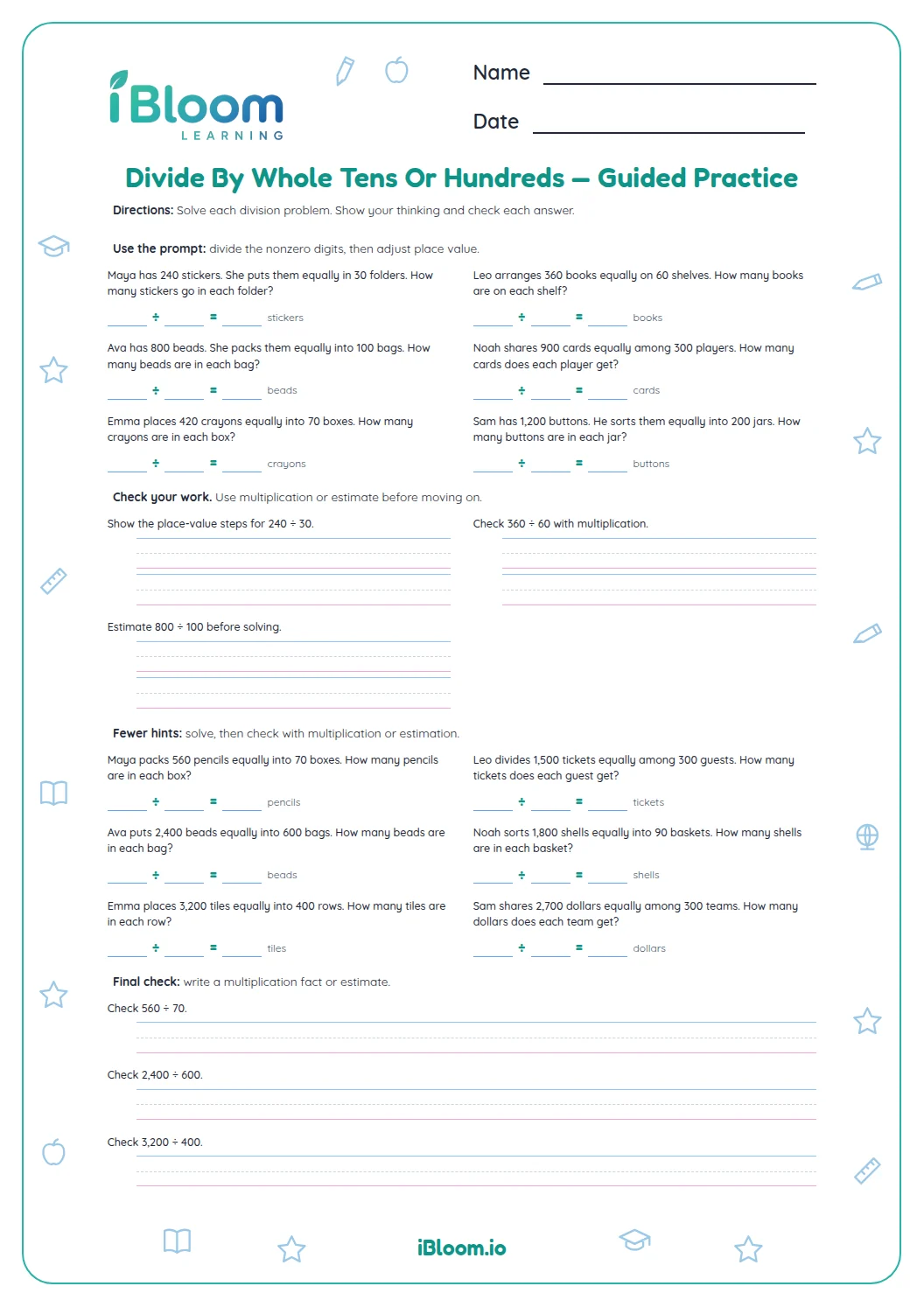
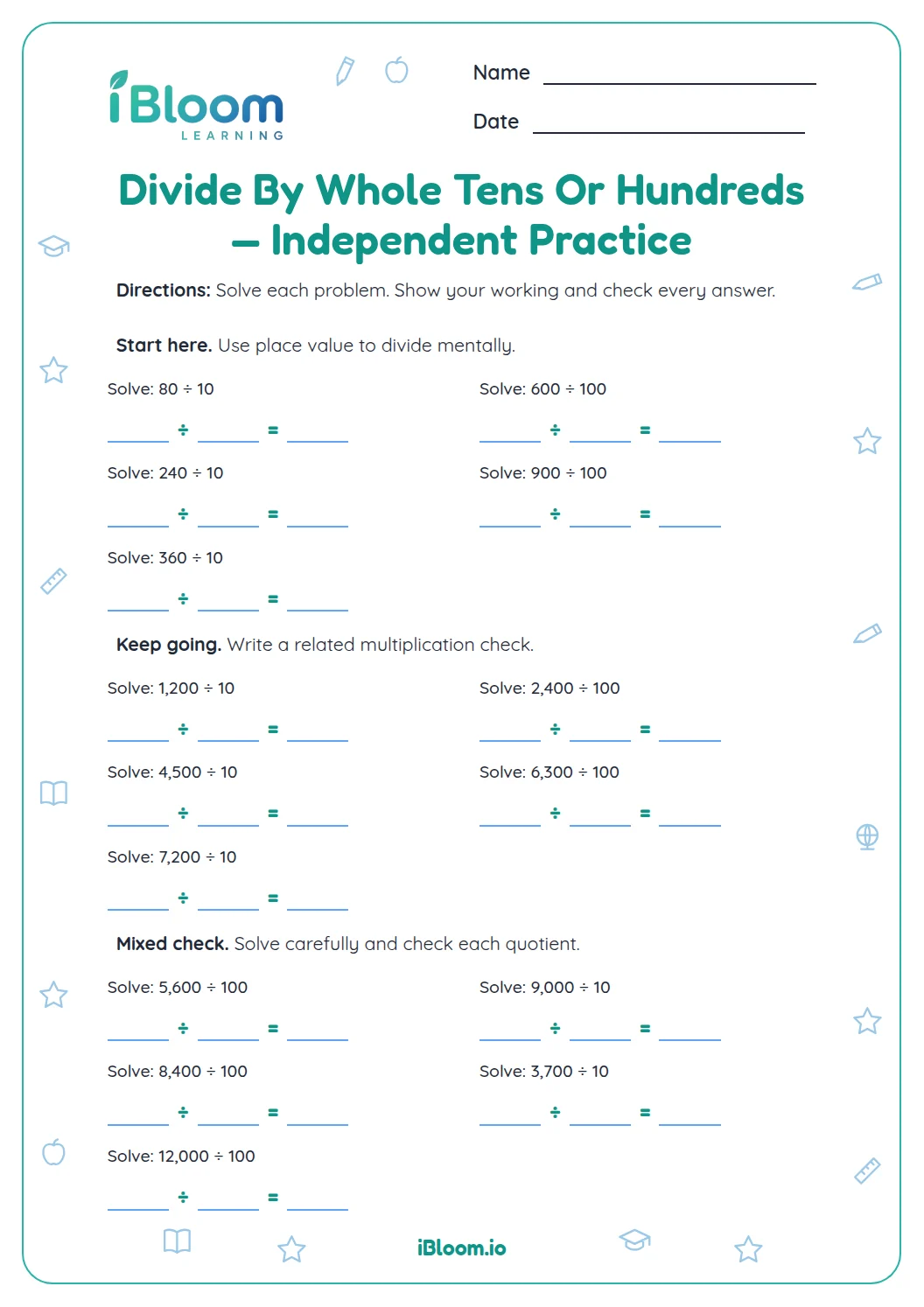
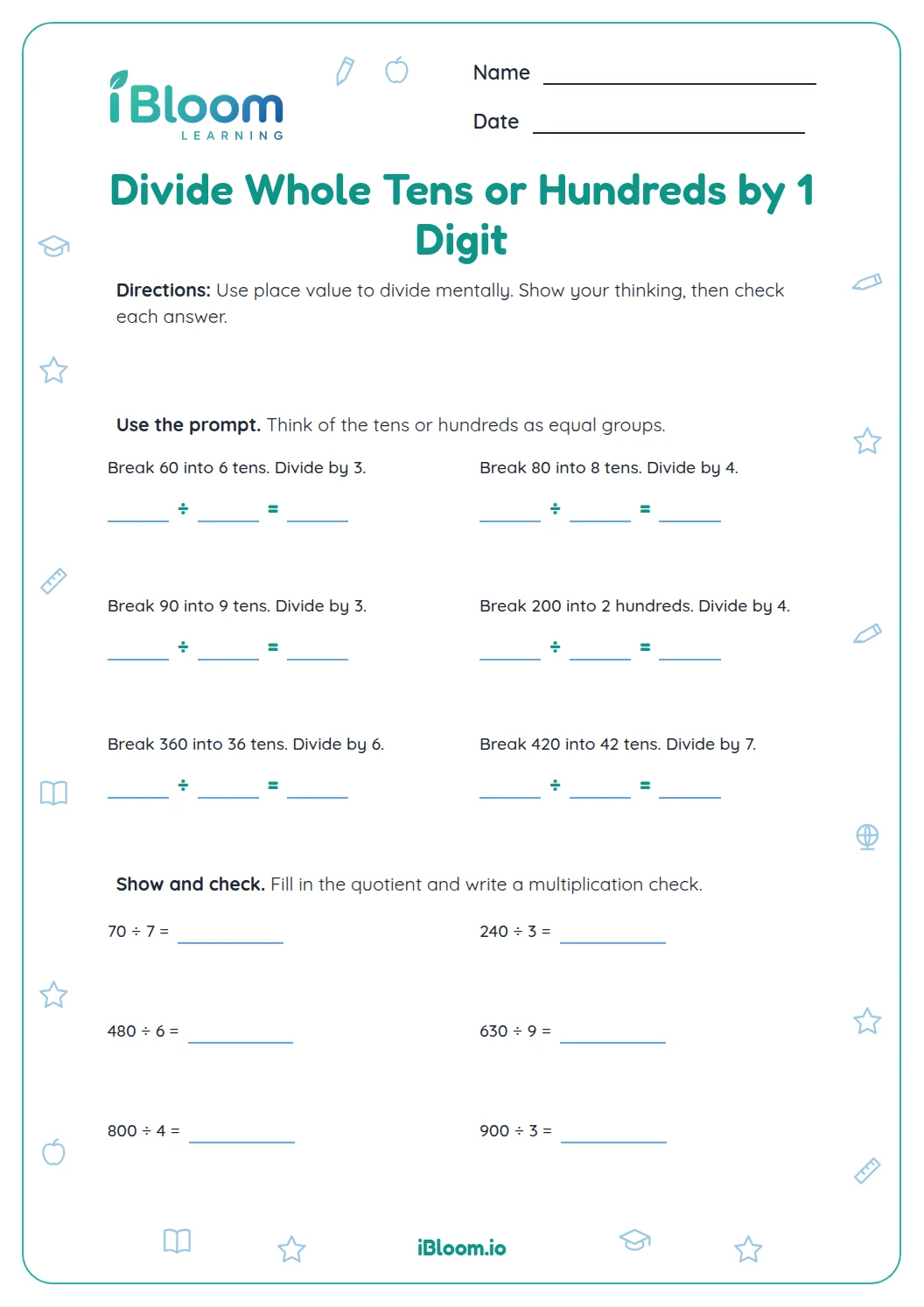
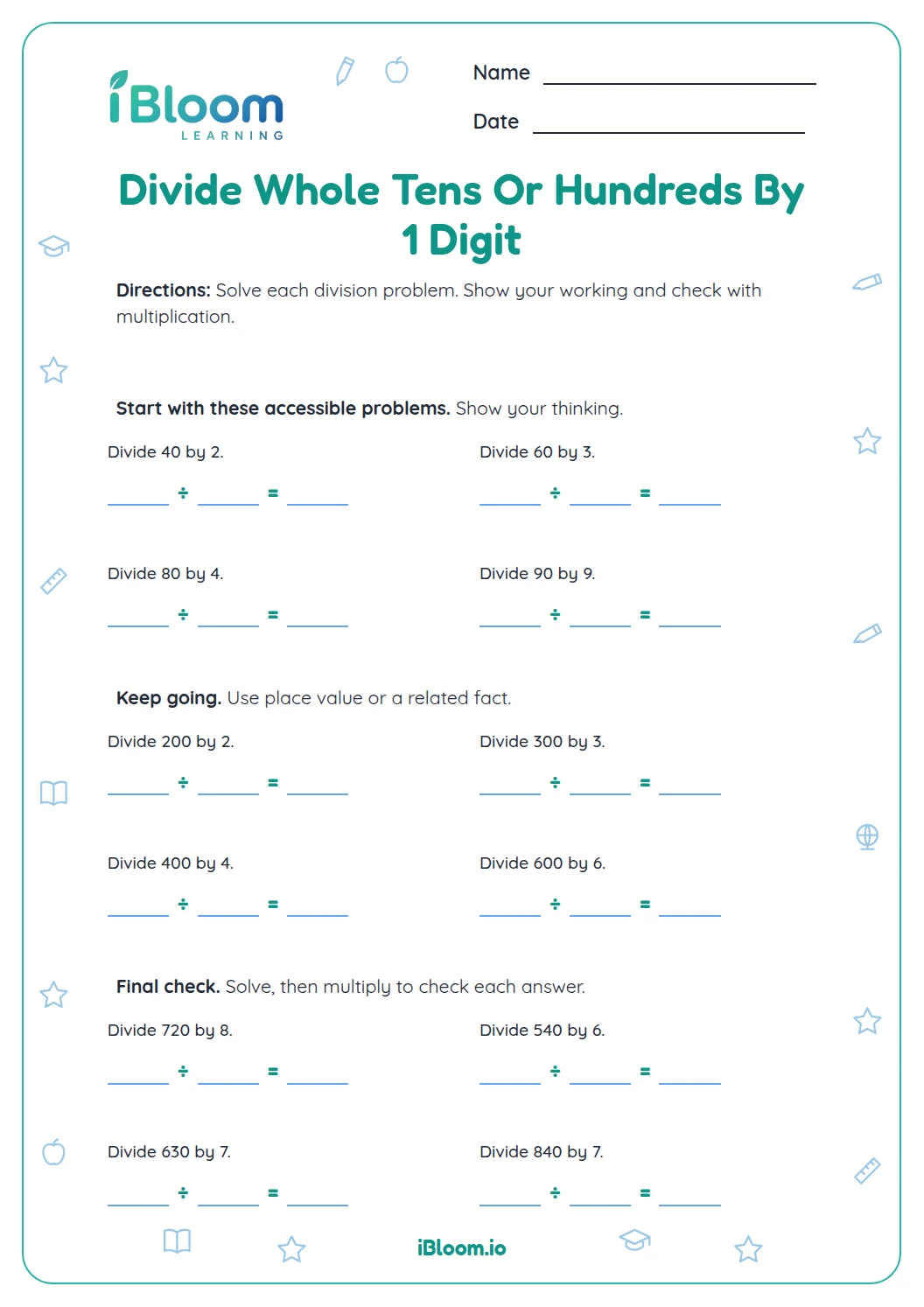
This Grade 4 printable presents 15 real-world division stories and concise division questions using divisors from 1 through 10. Students solve equal-group and sharing situations and label what the quotient counts. A separate answer key supports checking with related multiplication facts.
Aligned to 3.OA.A.3
What does the quotient count?
Some stories ask how many groups can be made; others ask how many items belong in each group. Underline the total and the equal-group amount before choosing a division sentence.
How can a division fact solve a story?
For 36 pencils packed equally into 4 boxes, write 36 ÷ 4 = 9. The 9 counts pencils in each box, so include the unit in the answer.
- 136 pencils ÷ 4 boxes = 9 pencils per box.
- 2Check: 9 × 4 = 36.
- 3The quotient names pencils in each box.
How can multiplication check a quotient?
Multiply the quotient by the number of groups or the group size. The product should match the total in the story, and the label should answer the question asked.
How can you use this worksheet?
- 1Read the whole story before choosing an operation.
- 2Mark the total and the equal group information.
- 3Write a division equation using those numbers.
- 4Use a known multiplication fact to find the quotient.
- 5Label the answer with what the quotient counts.
- 6Multiply to check that the groups make the total.
What errors should you watch for?
The mistake
Dividing by the total and treating the group count as the answer.
The fix
Ask what the story gives: group size or number of groups. Divide the total by that amount.
The mistake
Giving a quotient without saying what it counts.
The fix
Add the story unit, such as 5 bottles per player or 4 bags.
The mistake
Using multiplication but not checking the story.
The fix
Write a division equation first, then use the related multiplication fact to check it.
Common Core alignment
The stories ask students to use division facts and explain the quotient in a context.
Solve equal-group division word problems within 100.
On this sheet: Each story presents an equal-group situation and asks students to find the unknown group size or number of groups.
Show the official wordingHide the official wording
Use multiplication and division within 100 to solve word problems in situations involving equal groups, arrays, and measurement quantities, e.g., by using drawings and equations with a symbol for the unknown number to represent the problem.
What to practice next
Make more practice
Further reading
Questions parents and teachers ask
Do these problems have remainders?
No. Each story divides evenly into equal groups, so the quotient is a whole number. Students can check each answer by multiplying the quotient by the group count or group size to see whether the product returns to the story total.
Which divisors appear?
The 18 problems use divisors from 1 through 10, including equal-group and sharing situations. Read each story carefully because it may give the number of groups or the amount in each group, and the question asks for the other value. The answer key repeats both the quotient and its context label for a quick check.
Why write the unit with a quotient?
The unit shows what the number counts. In a story about 36 pencils in 4 boxes, the quotient is 9 pencils per box. Writing only 9 leaves out whether that number counts boxes, pencils, or something else. The answer key repeats both the quotient and its context label for a quick check.
How can multiplication help check division?
Use the related fact. If 45 stickers are shared among 5 friends and each gets 9, then 9 × 5 = 45. That confirms both the quotient and the equal sharing described in the question. The answer key repeats both the quotient and its context label for a quick check.
Is a separate answer key included?
Yes. The key gives the quotient and context label for all 18 stories. Students can compare the unit as well as the number, then revisit the equation if the label does not answer the story question. Students can compare the number and label together, then review the related division fact if the two do not match.