




About this worksheet
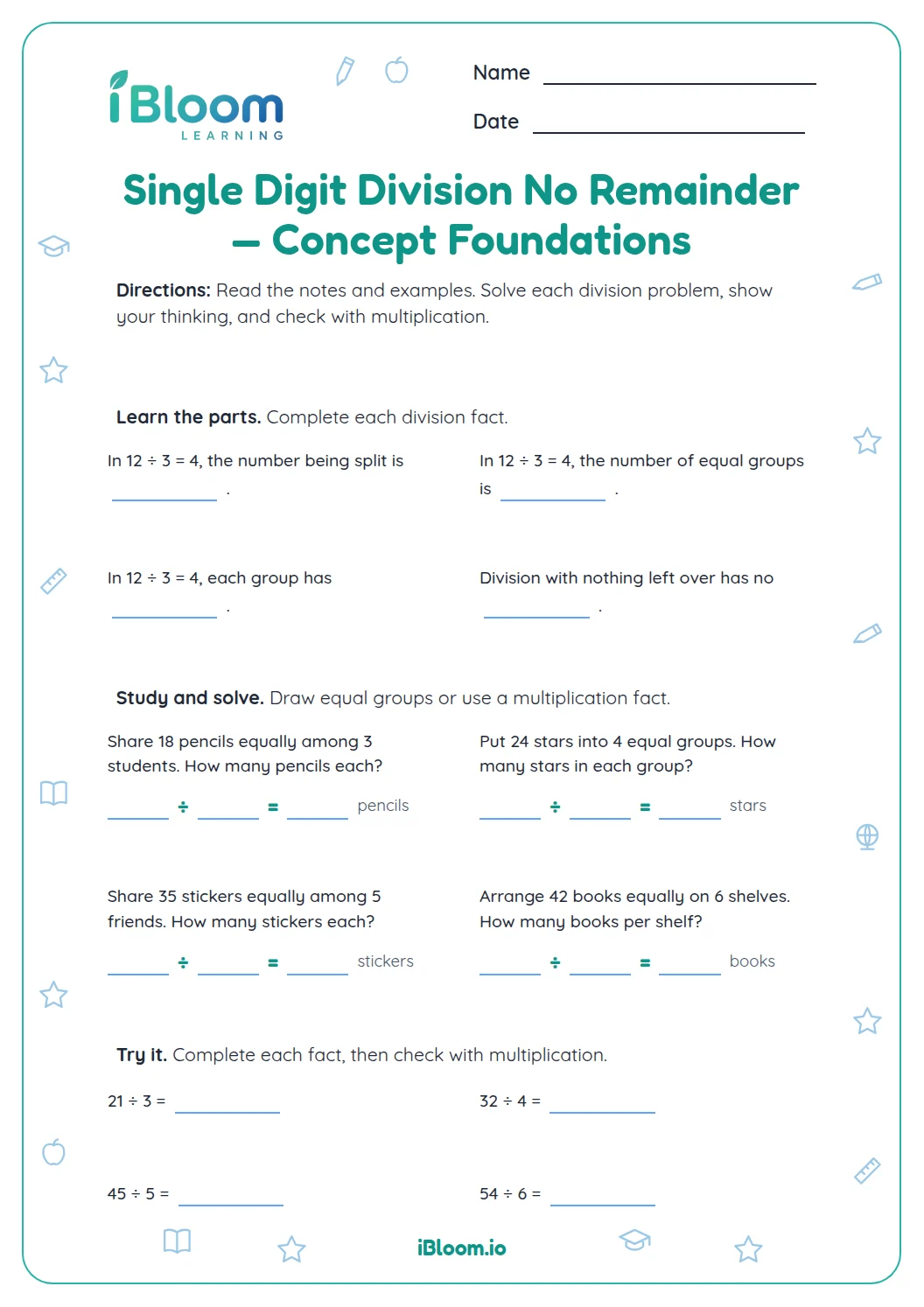
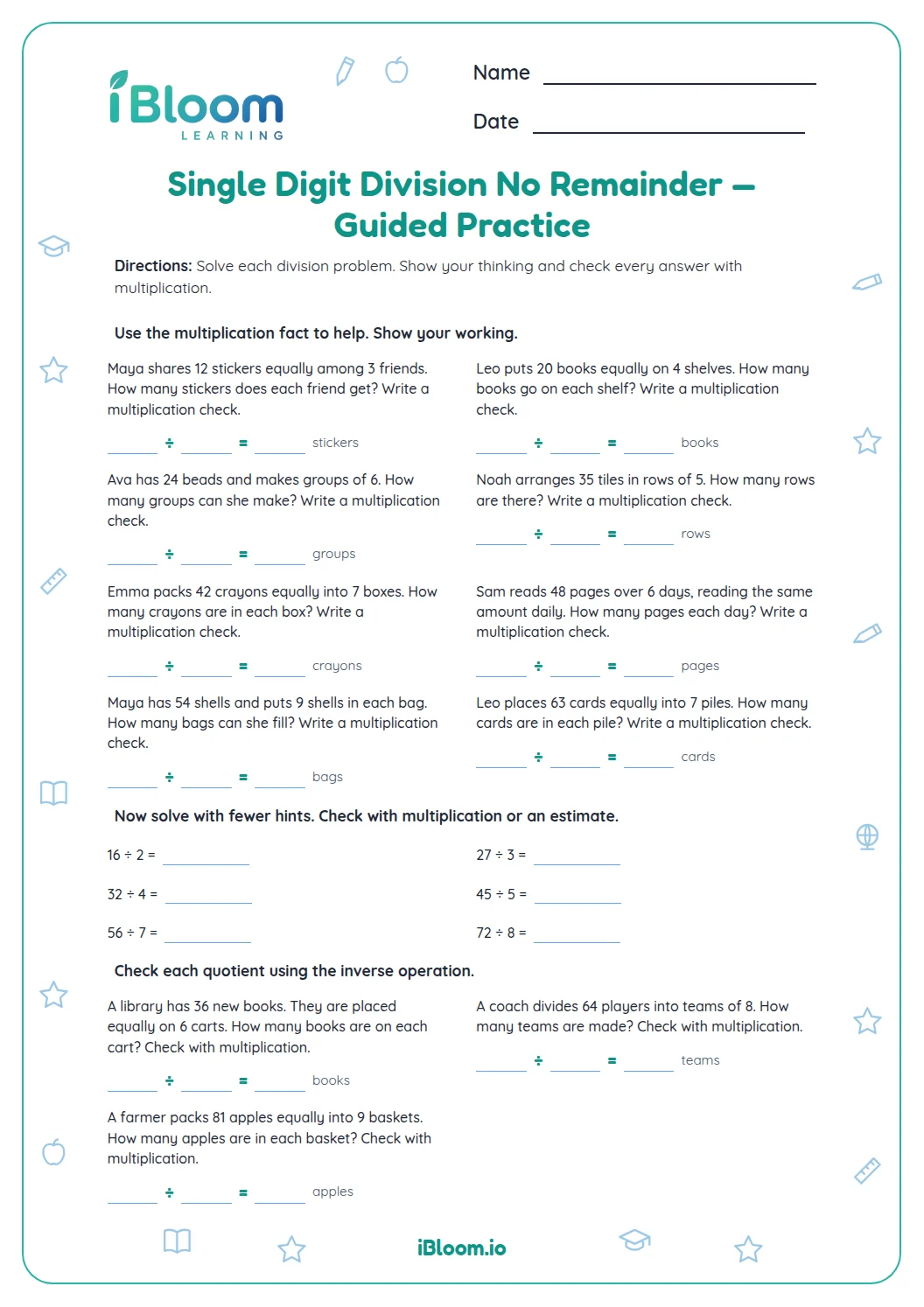
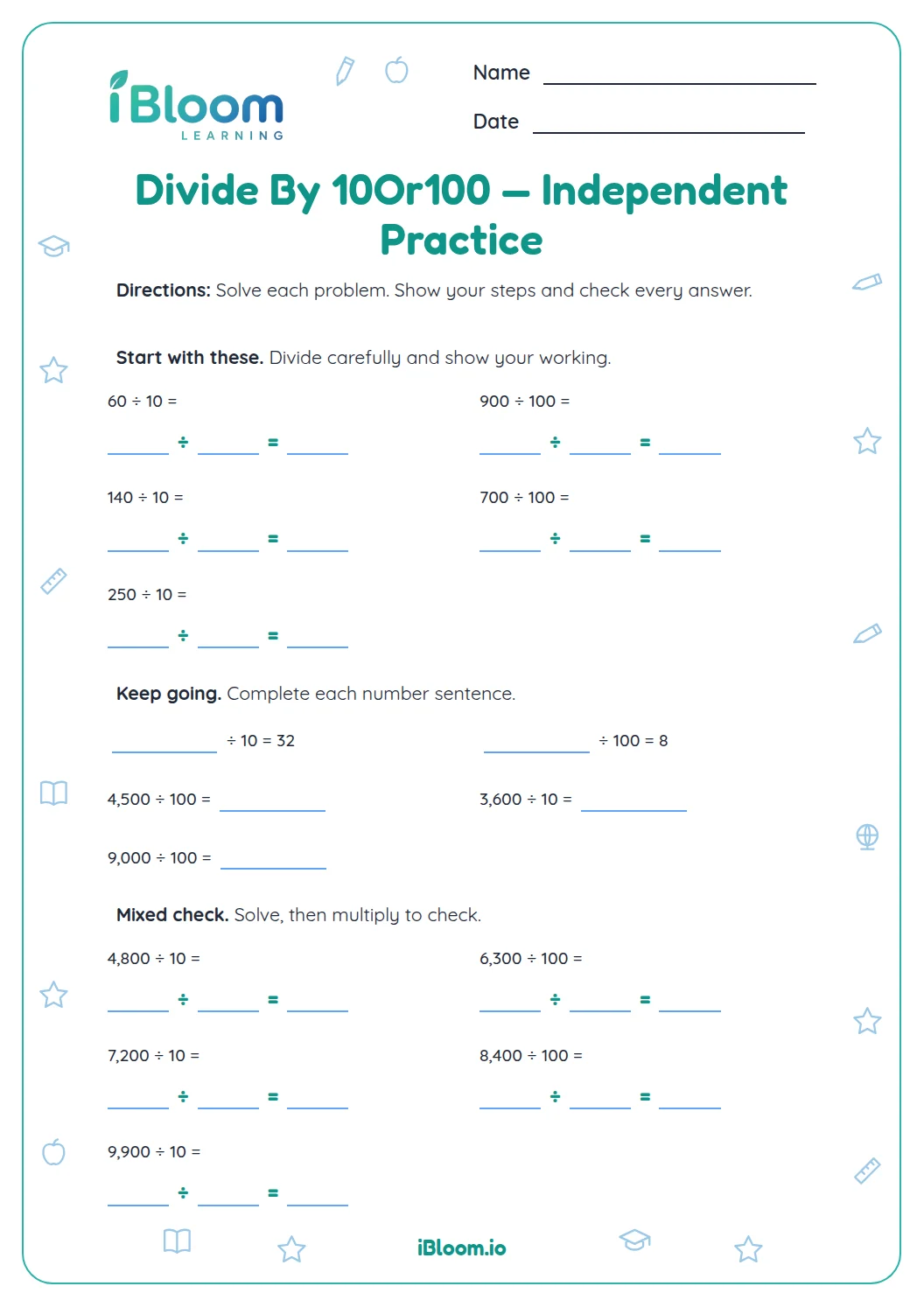
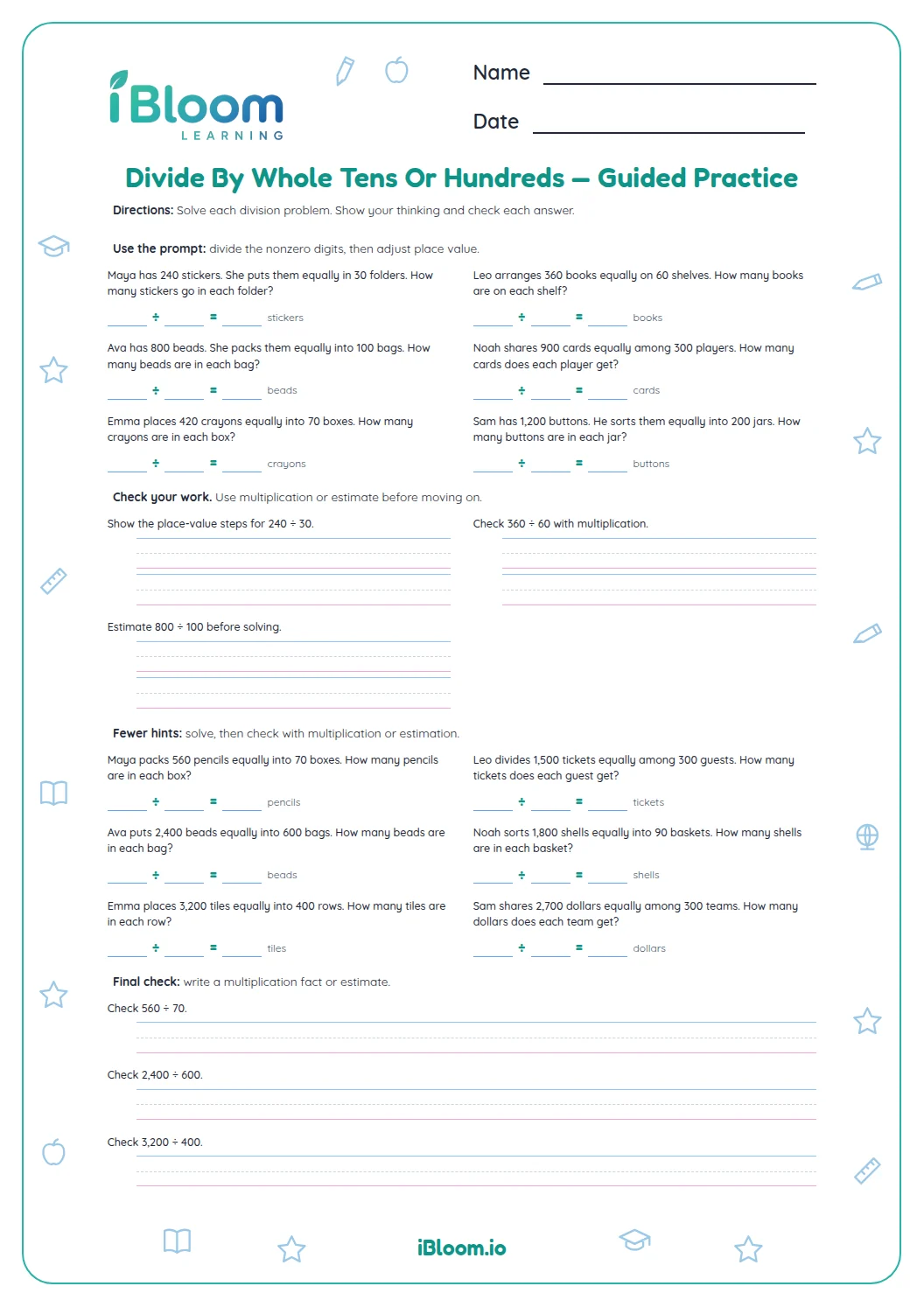
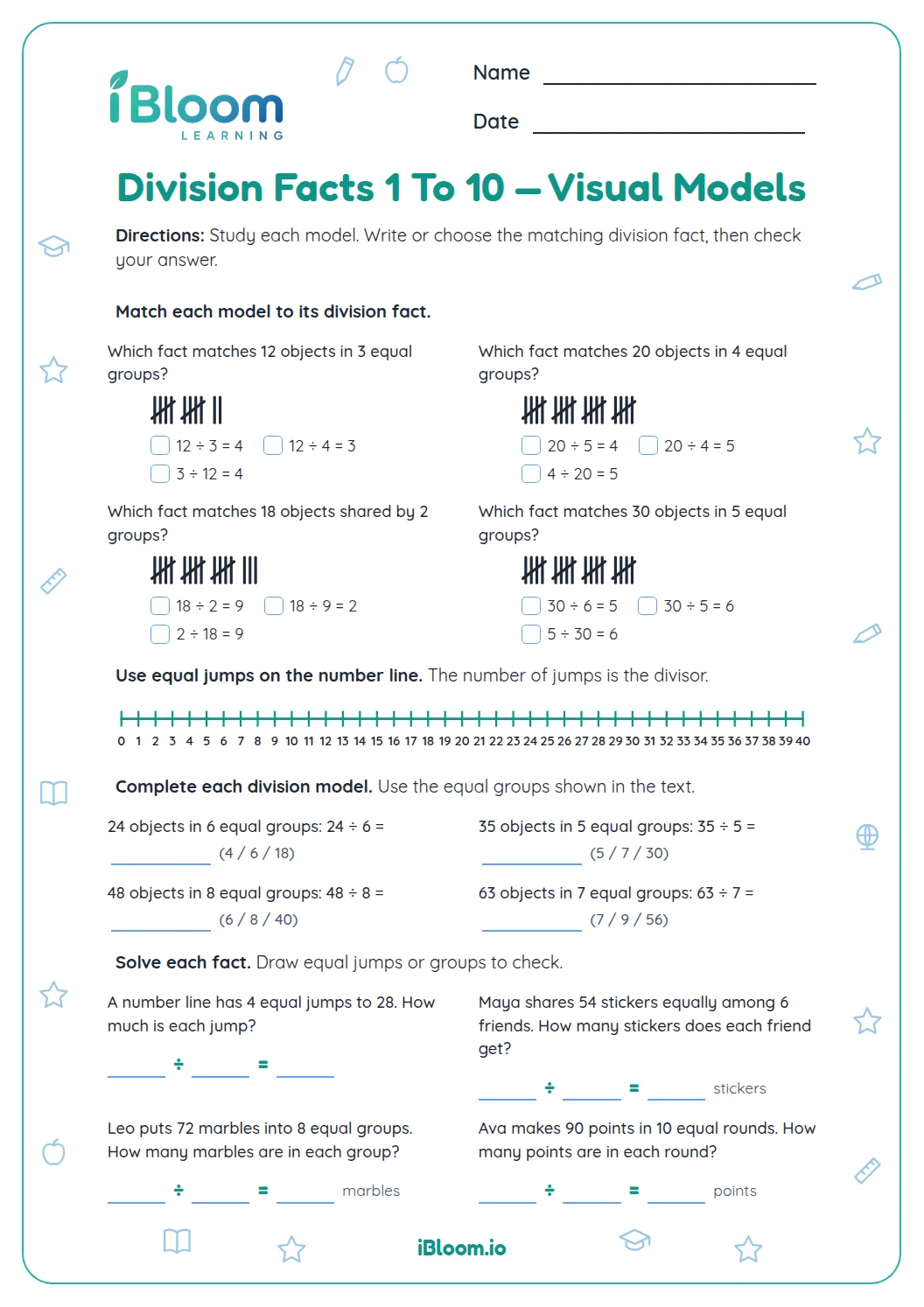
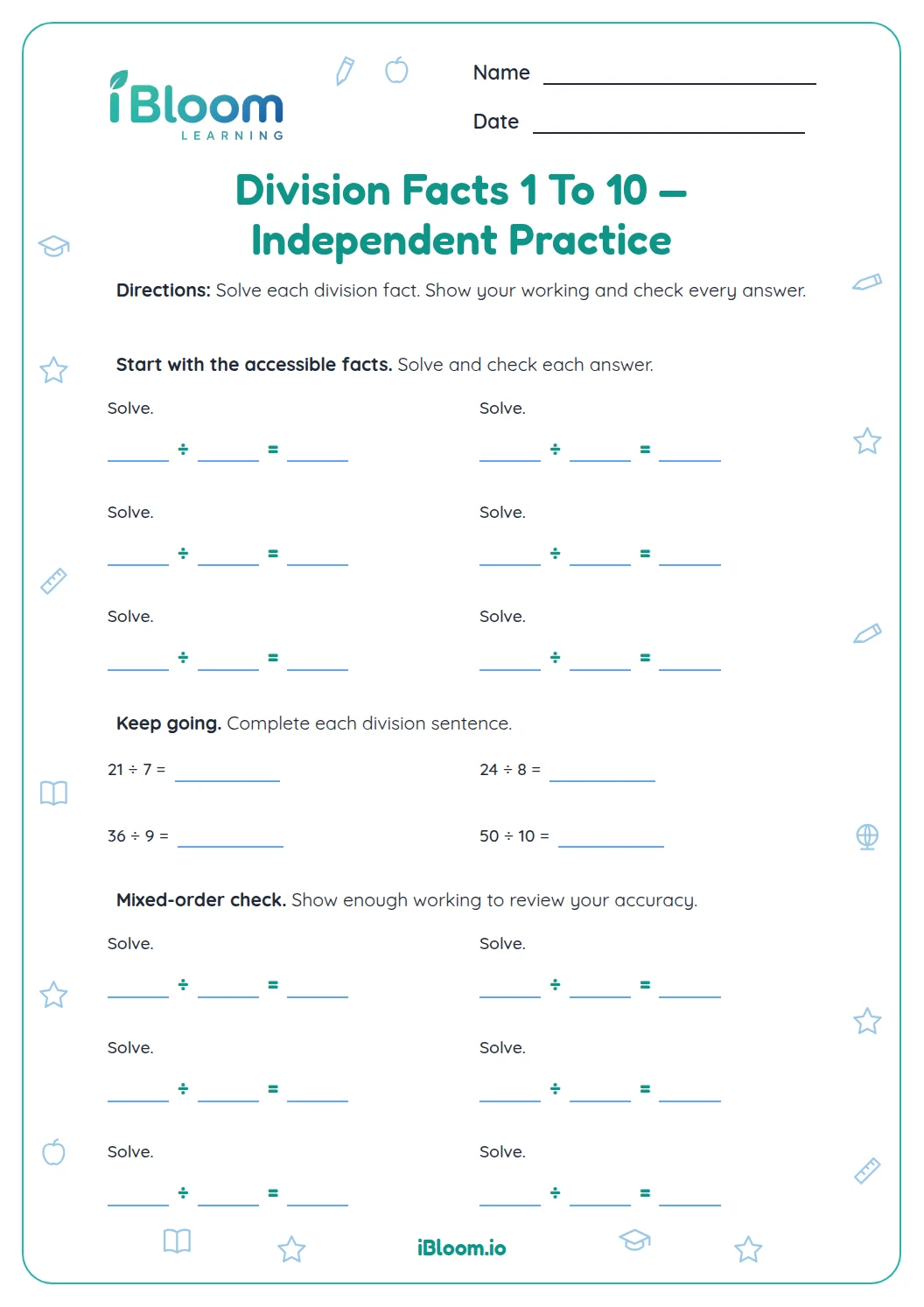
This Grade 4 worksheet gives students 14 single-digit division questions with no remainders. Four arrays and four number lines model equal groups and jumps; six compact equations extend the same facts. Students connect each model to a quotient and check with multiplication, practicing CCSS 4.NBT.B.6.
Aligned to 4.NBT.B.6
How do arrays show division?
Arrays show equal rows, and number lines show equal jumps. In question 1, 24 objects form 3 rows of 8, so 24 ÷ 3 = 8.
- 124 ÷ 3
- 2The array has 3 rows of 8.
- 324 ÷ 3 = 8
What does each number-line jump mean?
Each jump has the divisor as its length. Count the jumps needed to reach the dividend; that count is the quotient.
How can multiplication check a quotient?
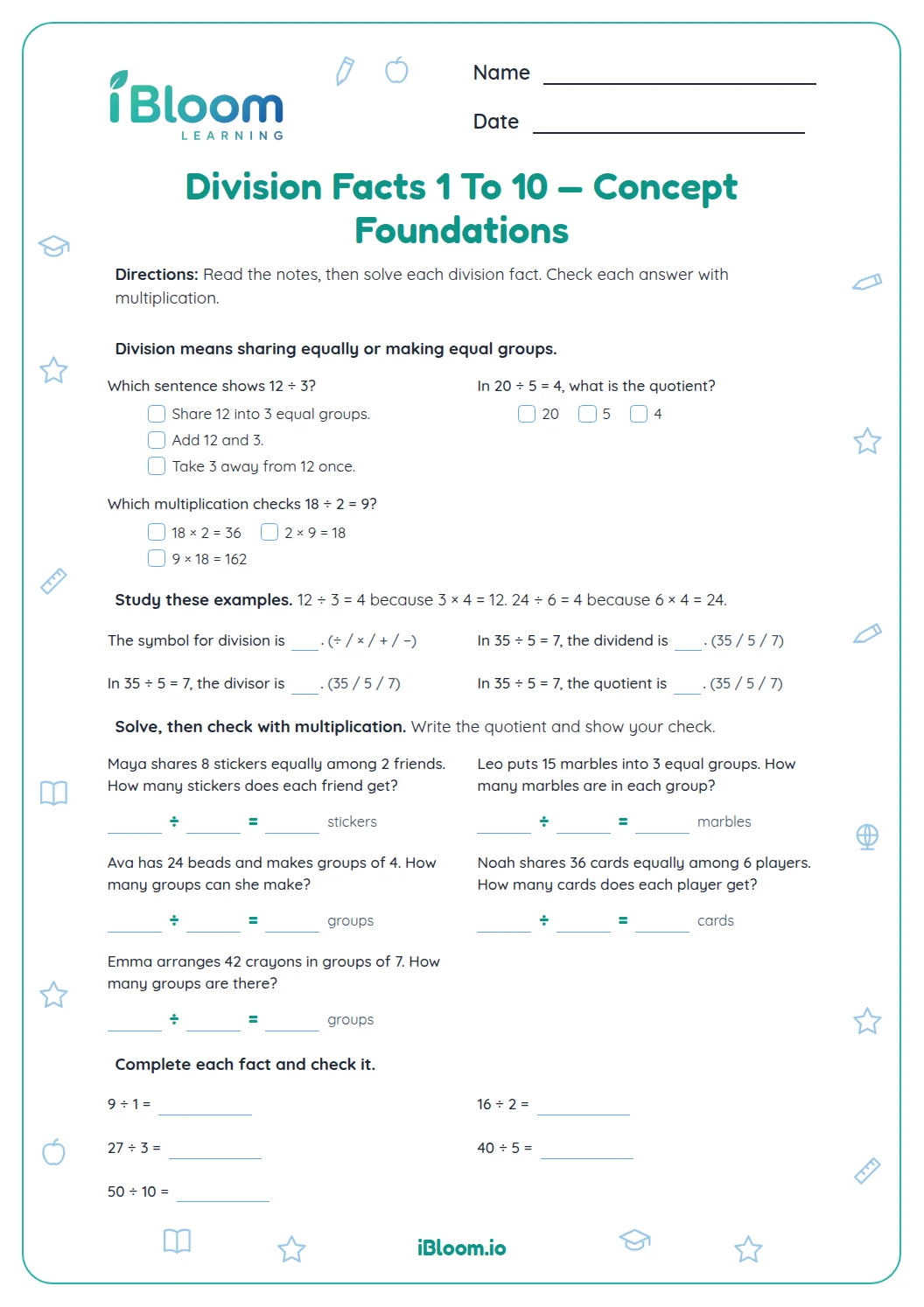
Multiply the quotient by the divisor. For example, 8 × 3 = 24 confirms that 24 ÷ 3 = 8.
How to use this worksheet
- 1For an array, count the rows before the columns.
- 2Read the equation to identify the total and the number of groups.
- 3Use a multiplication fact to find how many are in each group.
- 4For a story, write the division equation and label the quotient.
- 5Check by multiplying quotient by divisor to recover the total.
Check these common slips
The mistake
Reading the columns as the number of groups.
The fix
Match rows to the divisor shown in the equation; columns give the amount per row.
The mistake
Reversing divisor and quotient.
The fix
Use the related fact: divisor × quotient must equal the total.
The mistake
Leaving off the unit in a story answer.
The fix
Repeat the unit asked for, such as cones per team or chairs per row.
Curriculum alignment
This worksheet practices the standard below through its printed problems.
Find whole-number quotients using multiplication relationships and rectangular arrays.
On this sheet: Arrays and number lines model equal groups or jumps; the equations and stories use one-digit divisors and whole-number quotients.
Show the official wordingHide the official wording
Find whole-number quotients and remainders with up to four-digit dividends and one-digit divisors, using strategies based on place value, the properties of operations, and/or the relationship between multiplication and division. Illustrate and explain the calculation by using equations, rectangular arrays, and/or area models.
What to practice next
Make more practice
Further reading
Questions parents and teachers ask
How does a rectangular array show a division problem?
The array splits a total into equal rows. In question 1, 24 dots are arranged in 3 rows, so each row has 8. The equation 24 ÷ 3 = 8 describes the same groups shown by the array. Learners can solve the equation first, then use multiplication to verify the quotient.
What is the relationship between division and multiplication?
Division asks for a missing factor. For 72 ÷ 8, find the number that makes 8 times that number equal 72. Since 8 × 9 = 72, the quotient is 9. Multiplication provides a check for every division answer. Learners can solve the equation first, then use multiplication to verify the quotient.
Do any problems have remainders?
No. Each fact divides evenly into equal whole-number groups, so every quotient is a whole number. The separate answer key lists each quotient. Multiply the quotient by the divisor to confirm that the groups rebuild the original total.
Which Common Core standard does this page practice?
CCSS 4.NBT.B.6 asks students to find whole-number quotients and illustrate calculations with equations, arrays, or area models. Four rectangular arrays connect equal groups to their division facts. Learners can solve the equation first, then use multiplication to verify the quotient.
How many questions and pages are there?
There are 14 questions: four arrays show equal groups and ten compact equations extend the division practice. The separate key lists a whole-number quotient for each item and supports multiplication checks. Learners can solve the equation first, then use multiplication to verify the quotient.
How can my child check a division answer?
Multiply the quotient by the divisor. For example, 45 cones split among 5 teams gives 9 per team, and 9 × 5 returns 45. In the array questions, the row count, column count, and total should also match the printed equation. Learners can solve the equation first, then use multiplication to verify the quotient.