



About this worksheet
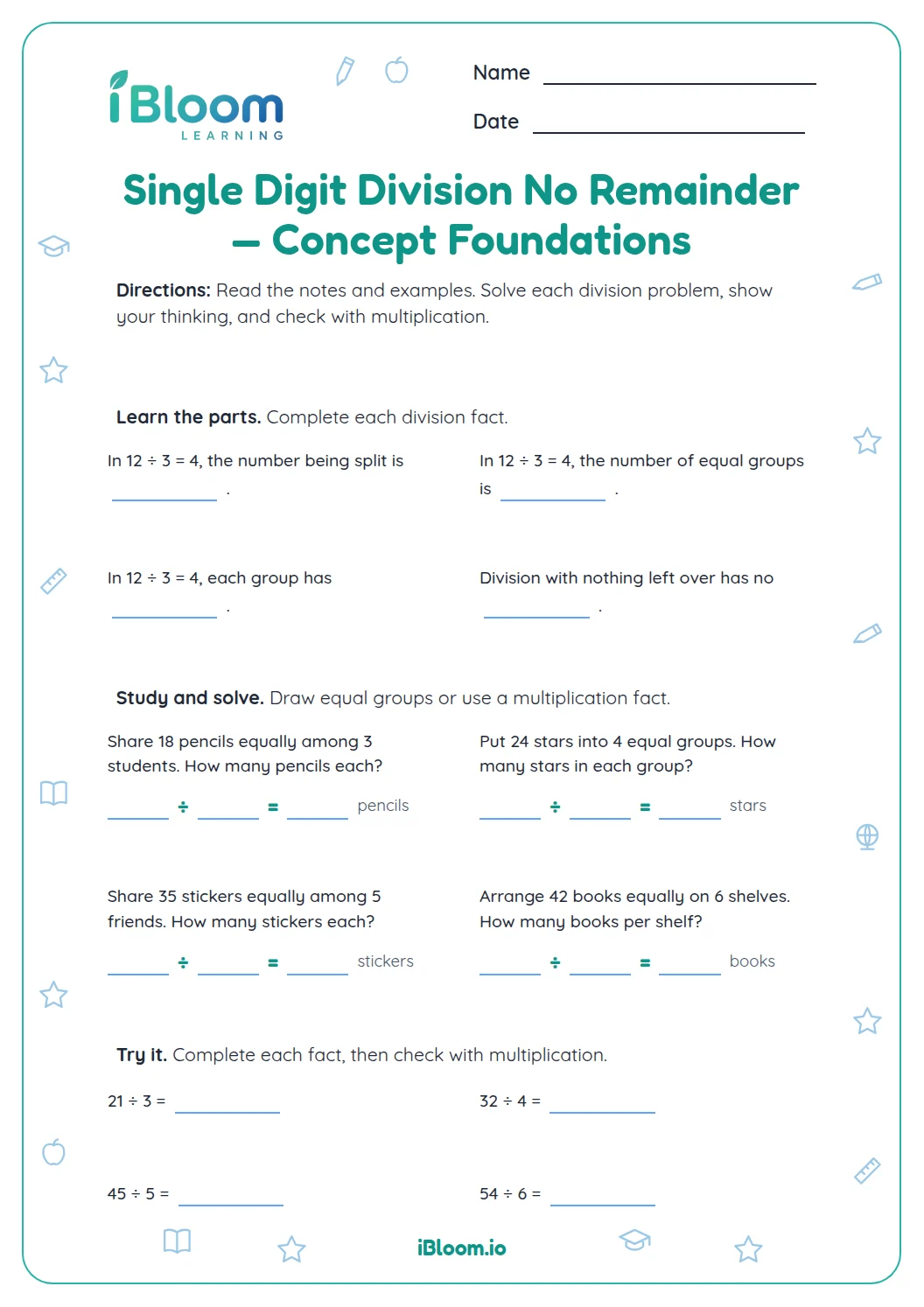
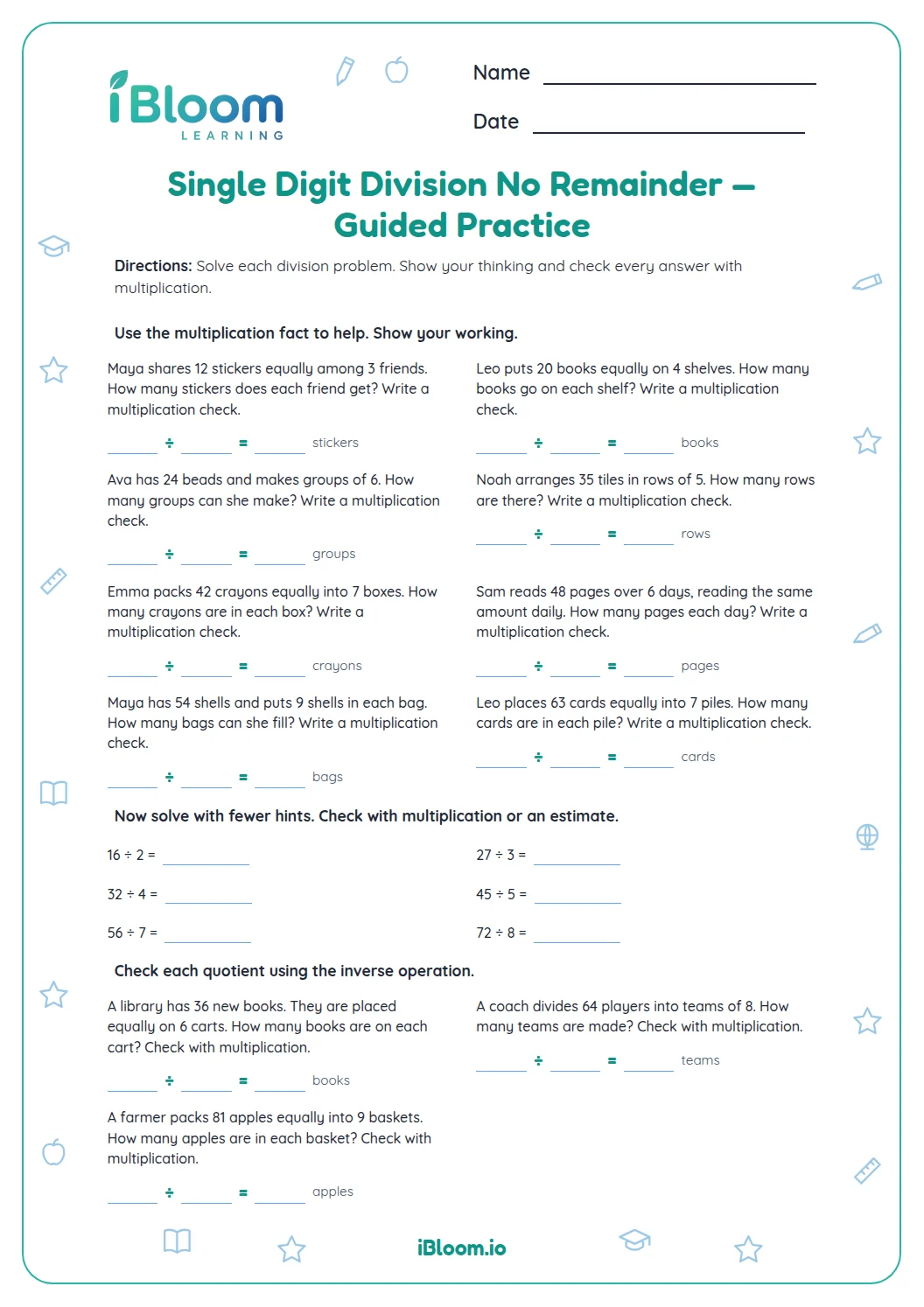
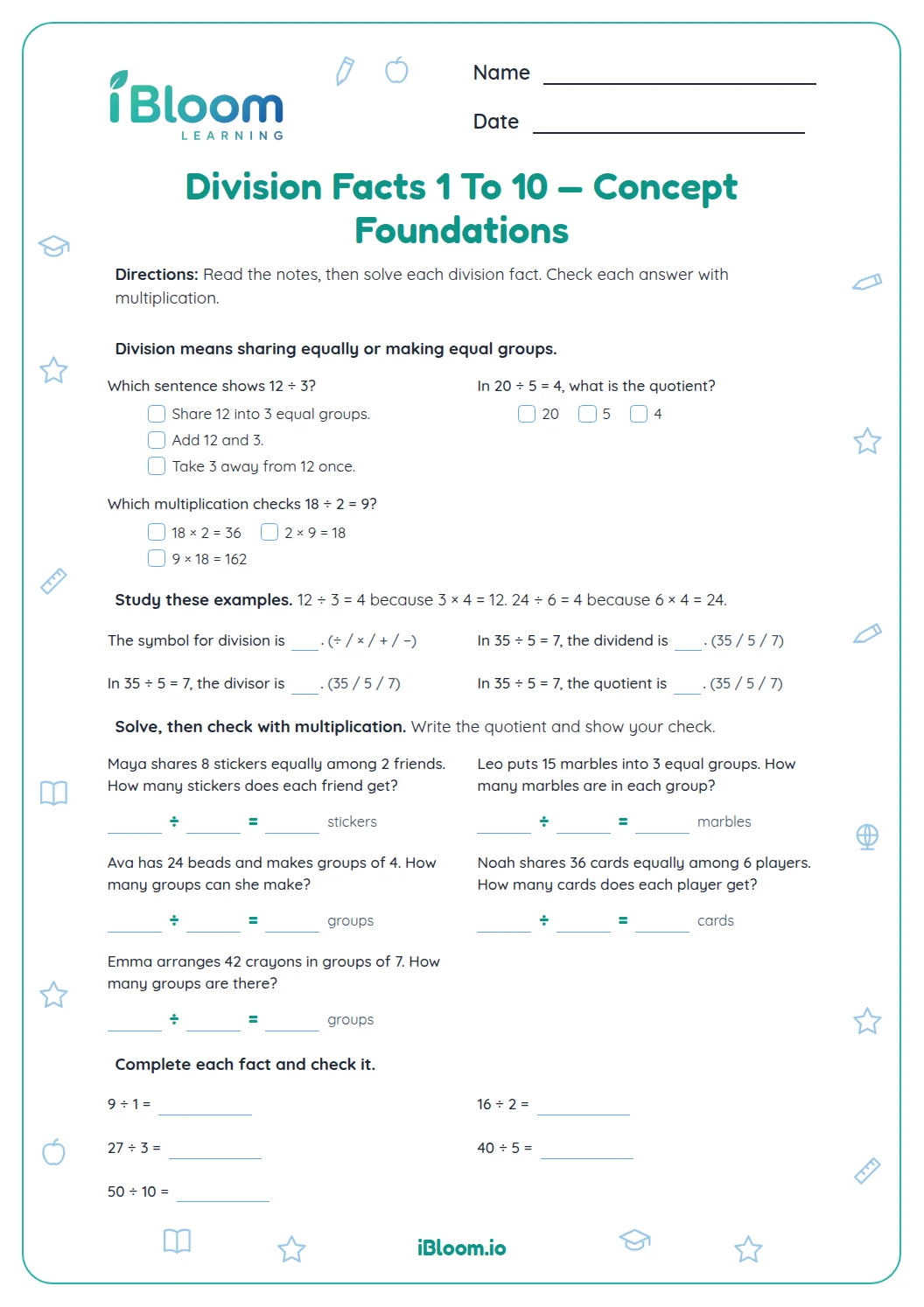
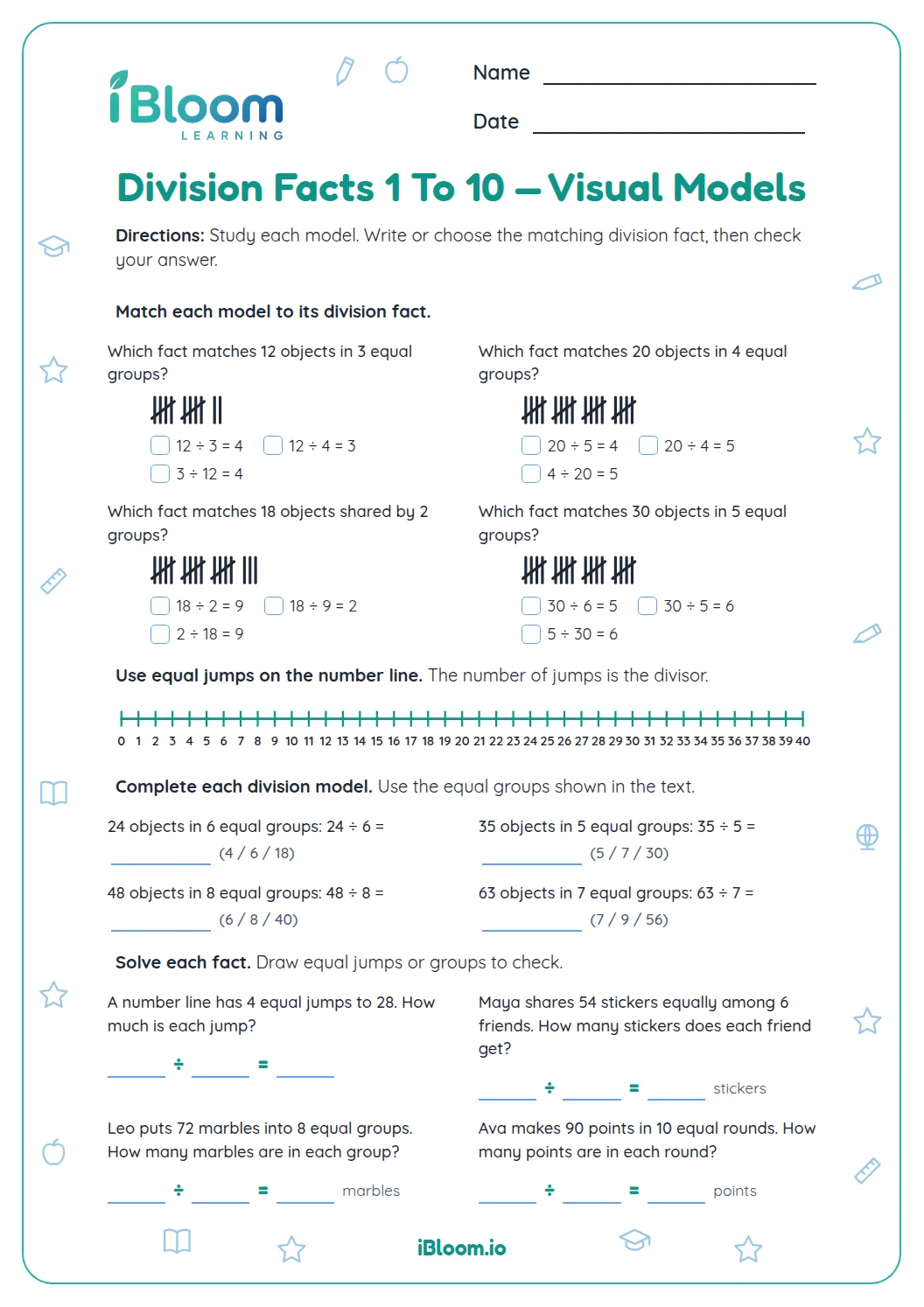
This free Grade 4 worksheet practices mental division through 12 real-world problems with one-digit divisors and no remainders. Students choose equations for sharing and grouping situations, solve four problems mentally, and write division equations with multiplication checks for two more. Two final choices check the answer’s number and unit. All totals are within 100, practicing Common Core 3.OA.A.3 through equal-group word problems. A separate answer key gives matching equations and labeled answers; students can check their written work against the worked example below.
Aligned to 3.OA.A.3
What does the divisor mean in these problems?
In a sharing problem, the divisor tells how many equal groups to make. In a grouping problem, it tells how many items go in each group. The quotient answers a different question in each case: items per group or number of groups.
Question 1 shares 24 stickers among 6 children. Question 2 packs 35 apples with 5 in each bag. Both use division, but the first answer counts stickers per child and the second counts bags.
How can multiplication check a division answer?
Multiply the quotient by the divisor to rebuild the total. Question 5 shares 42 books equally among 6 shelves. Thinking of the related multiplication fact gives the quotient without counting out every book.
- 142 ÷ 6 = 7
- 26 × 7 = 42
- 3Answer: 7 books on each shelf.
How does the practice become more independent?
Part A gives four sets of equations to choose from. Part B has four problems to solve mentally, with the answer units printed beside the blanks. Part C has two problems with working space for division and a multiplication check. Part D asks students to choose a complete answer with the right number and unit.
For question 10, 96 cans are shared among 8 teams. Split 96 into 80 and 16, divide each by 8, and combine 10 and 2. The answer is 12 cans per team; 8 × 12 = 96 checks it.
How to use this worksheet
- 1Underline the total and the information about equal groups.
- 2Read the question again to identify what the answer must count.
- 3Choose the matching equation in Part A.
- 4Solve Part B mentally, then check the unit beside each answer blank.
- 5For Part C, add a multiplication check in the working space.
- 6In Part D, check both the number and what it counts before choosing.
Mistakes to look for
The mistake
Subtracting 6 from 42 because the problem mentions 6 shelves.
The fix
The books are shared equally among 6 groups; use 42 ÷ 6.
The mistake
Reversing the numbers and writing 6 ÷ 24 for the stickers.
The fix
Start with the total of 24 stickers, then divide by 6 children.
The mistake
Labeling the answer to the apple problem as 7 apples.
The fix
The question asks how many bags can be filled, so the answer is 7 bags.
Common Core alignment
Solve division word problems within 100 using equal groups and equations.
On this sheet: Students translate equal sharing and grouping situations into division equations and solve them.
Show the official wordingHide the official wording
Use multiplication and division within 100 to solve word problems in situations involving equal groups, arrays, and measurement quantities, e.g., by using drawings and equations with a symbol for the unknown number to represent the problem.
What to practice next
Make more practice
Further reading
Questions parents and teachers ask
Are all the divisors one digit?
Yes, every divisor on this worksheet is a one-digit number. The totals range from 18 to 96, and each division gives a whole-number answer. Students can use known multiplication facts, with a split such as 80 plus 16 helping them handle 96 divided by 8.
When should students write out their division work?
Students write a division equation and a multiplication check in Part C. In Part B, they solve mentally and fill a number blank with the unit already printed beside it. This gives them practice finding quotients before they show their calculation and check on the working grid.
What is the difference between sharing and grouping?
Sharing tells how many equal groups to make; grouping tells how many items belong in each group. The sheet uses both situations. Sharing 24 stickers among 6 children asks for stickers per child, while packing 35 apples in bags of 5 asks for the number of bags.
How can a student solve 96 divided by 8?
Break 96 into two totals that divide easily by 8: 80 and 16. Eight groups receive 10 cans each from the first total and 2 more each from the second. That makes 12 cans per team, which students can check because 8 times 12 equals 96.
What should I check besides the quotient?
Check that each equation matches its situation and that the answer names the right unit. Seven bags and seven apples mean different things. Part B prints the units beside the blanks; Part C asks students to supply them, and Part D checks complete answers with numbers and units.