

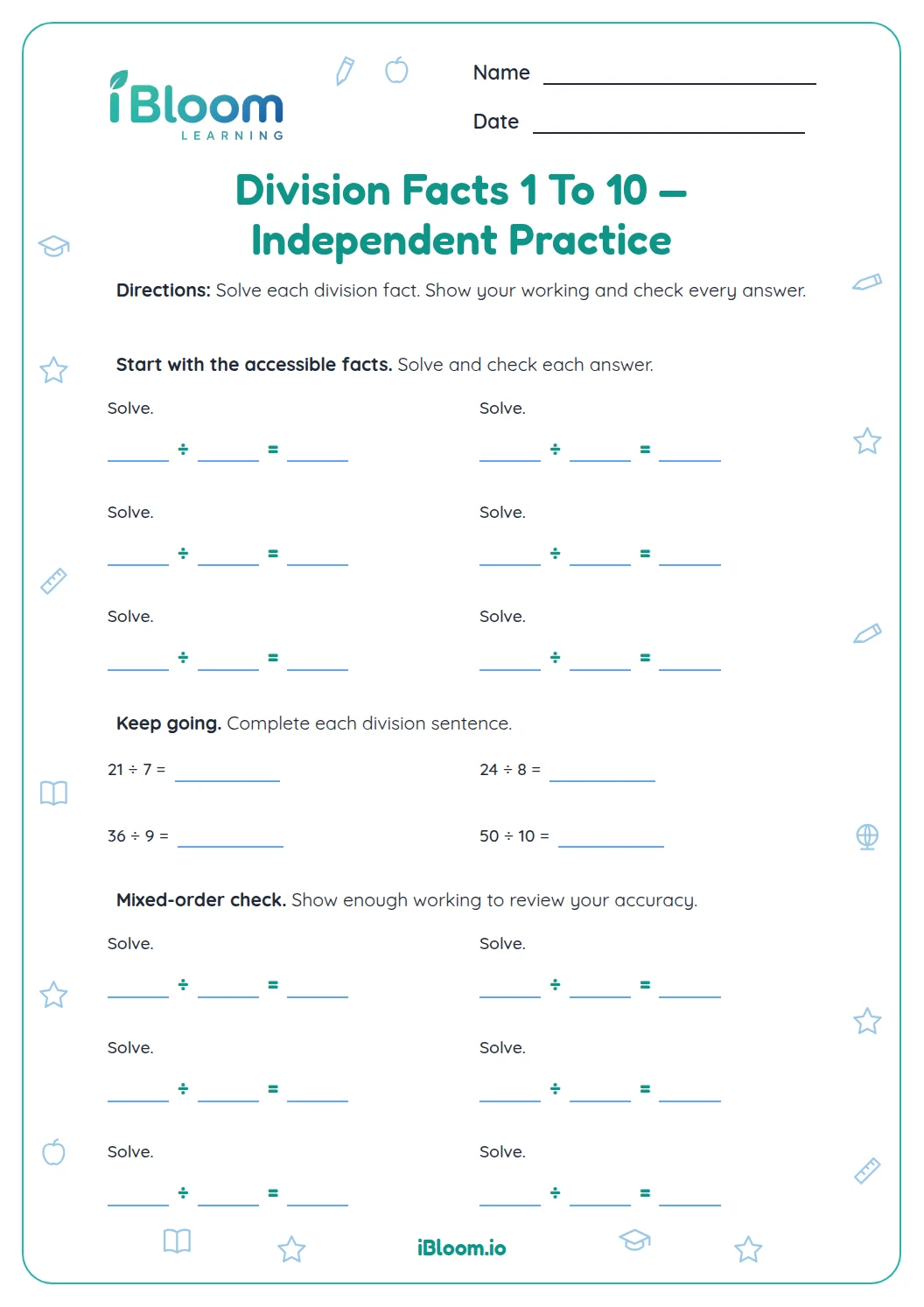

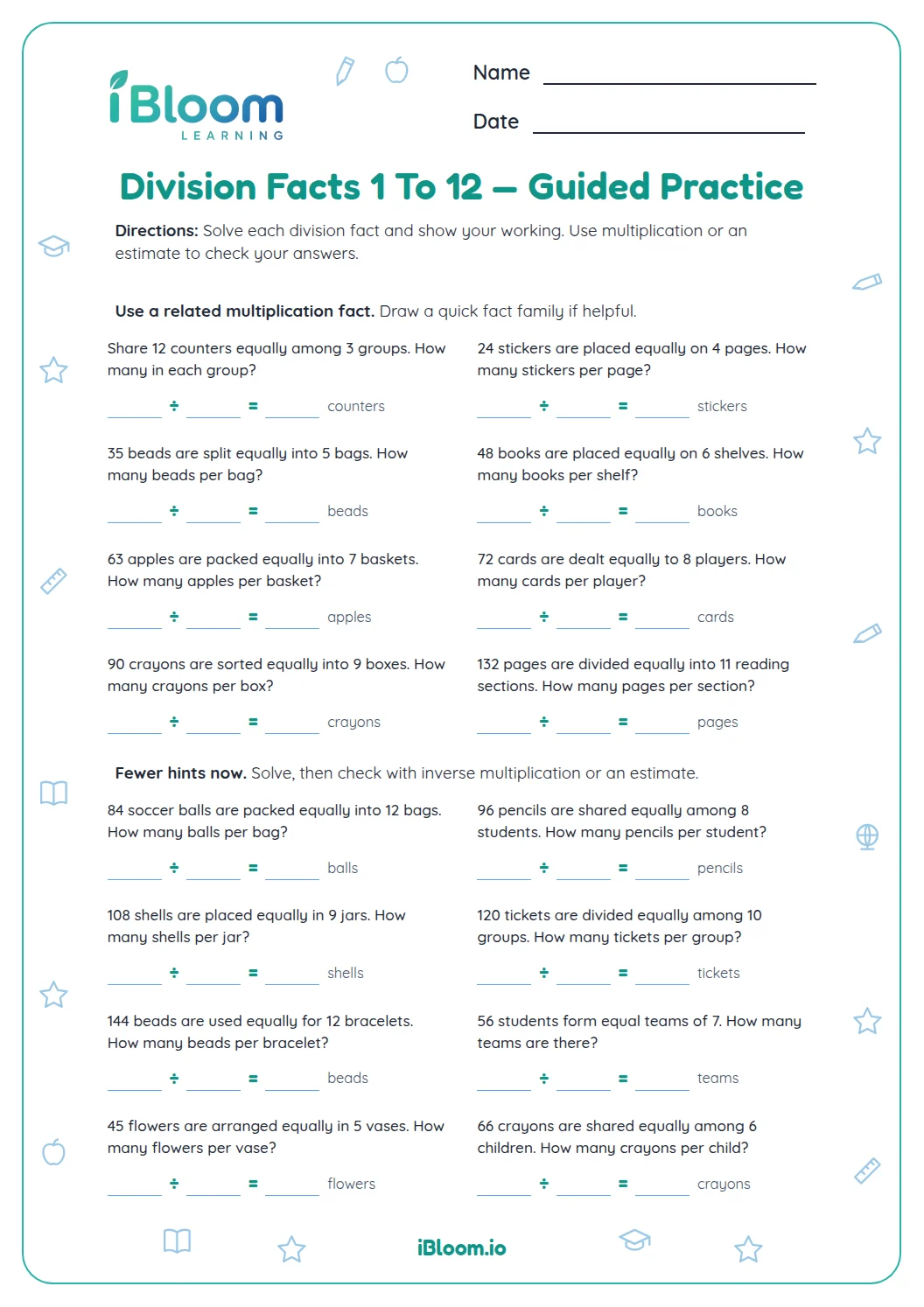

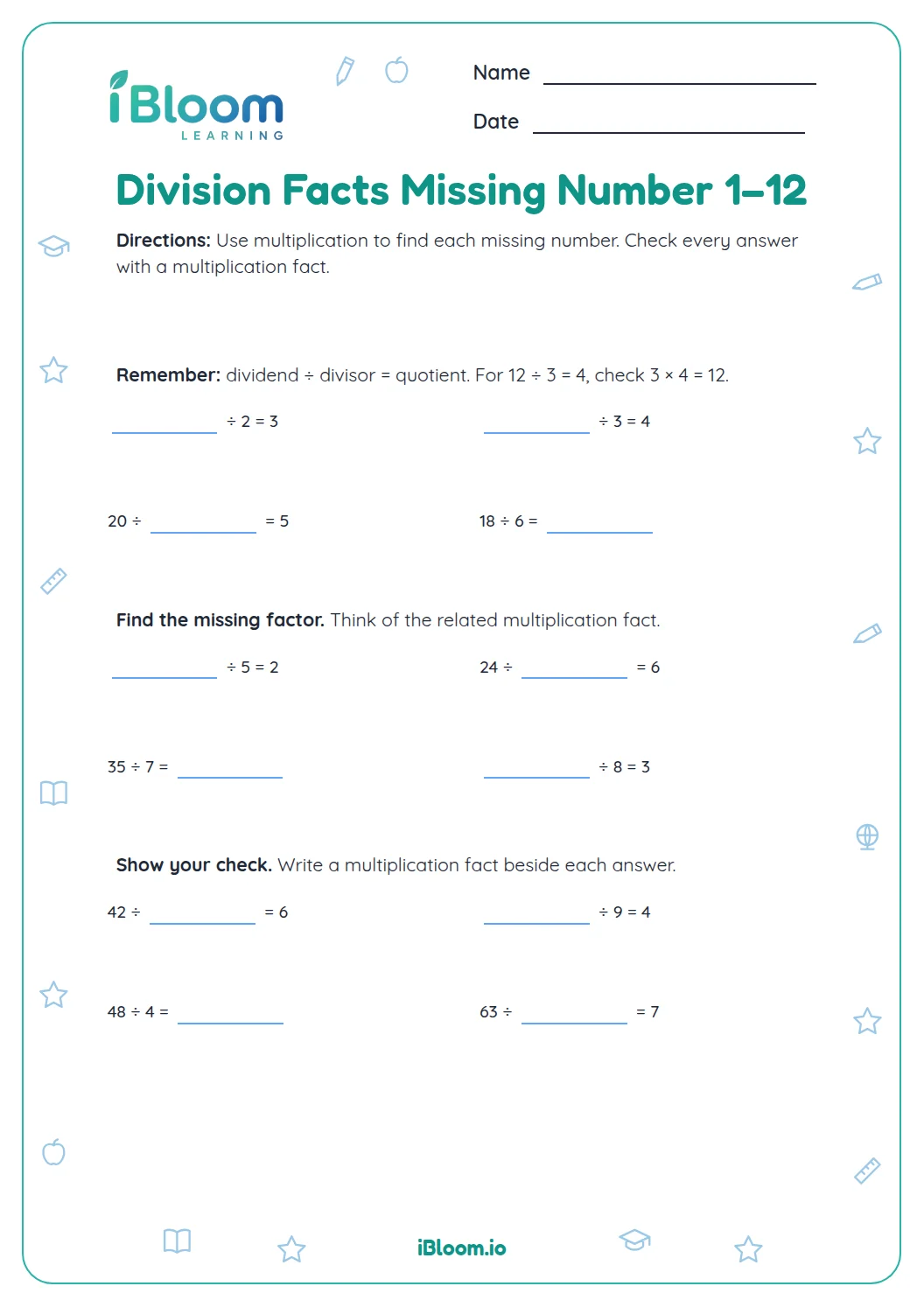

About this worksheet
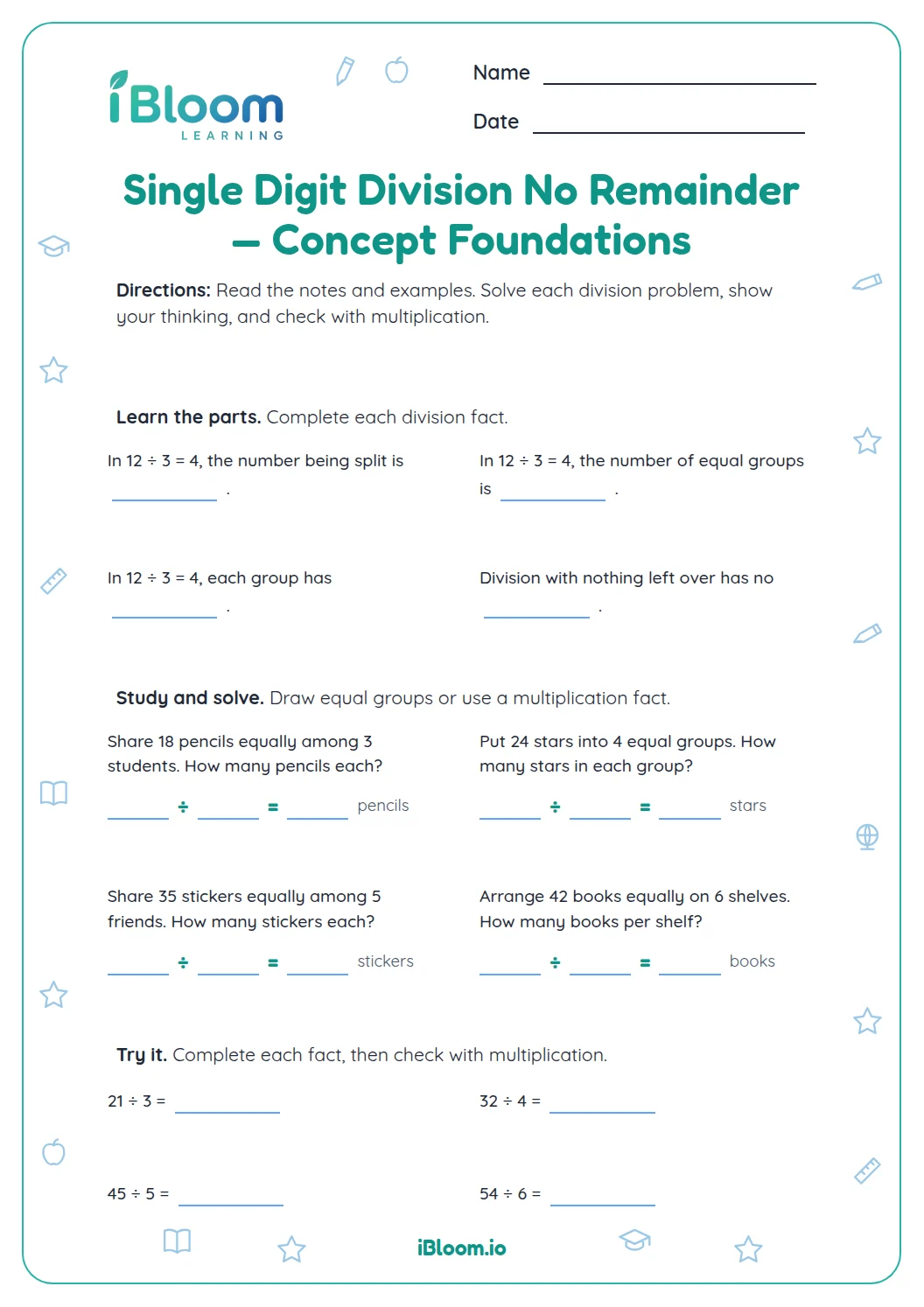
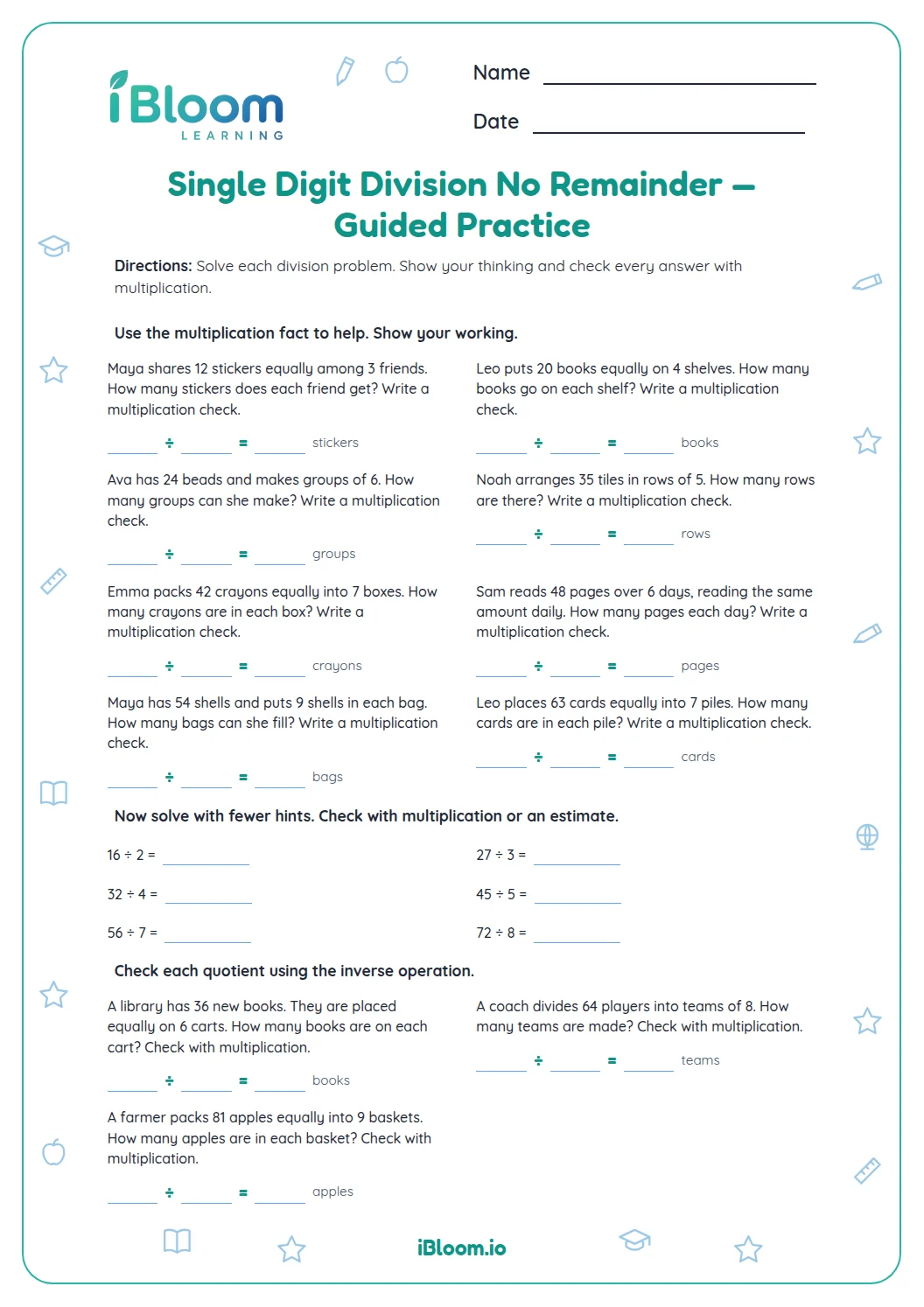
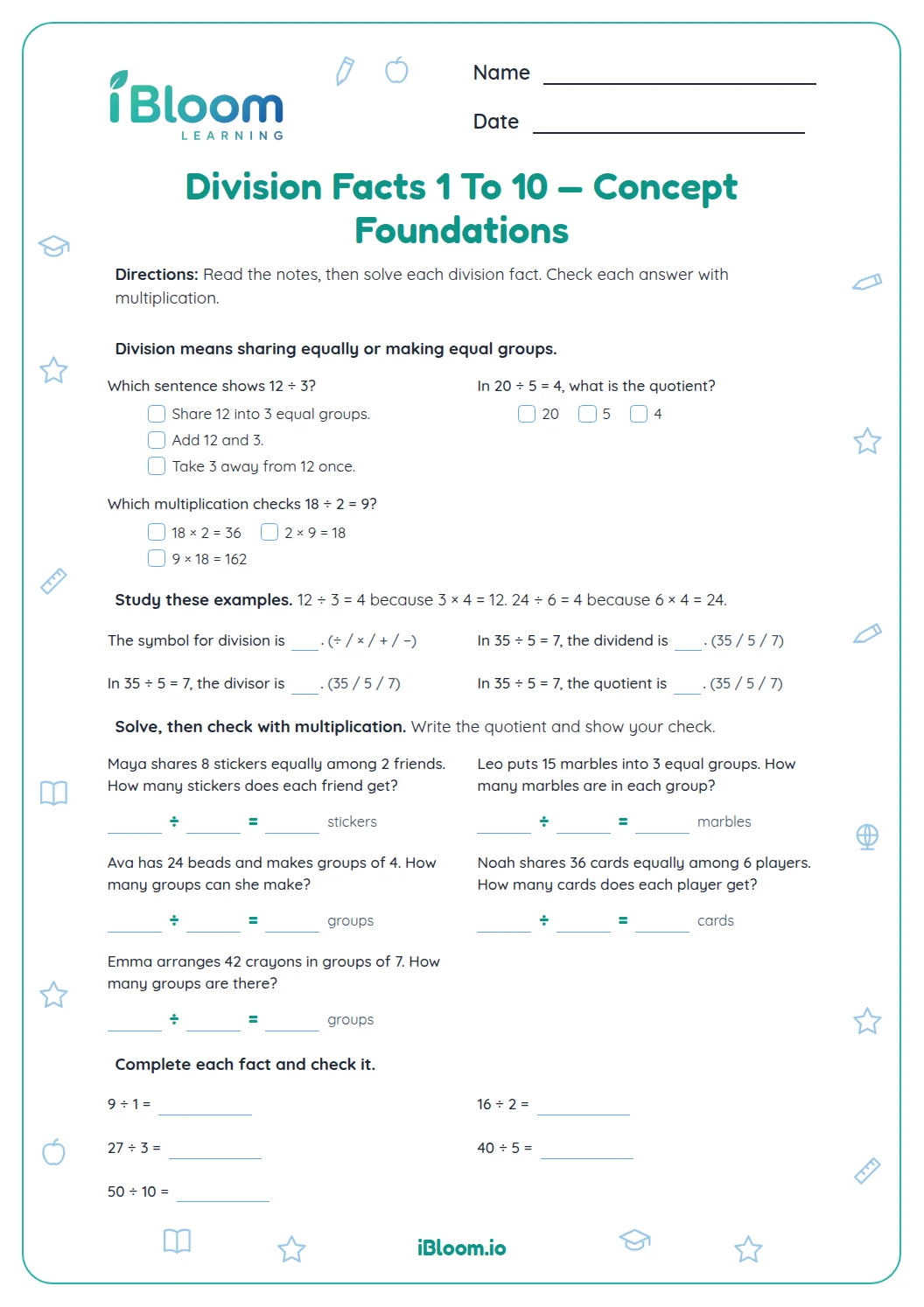
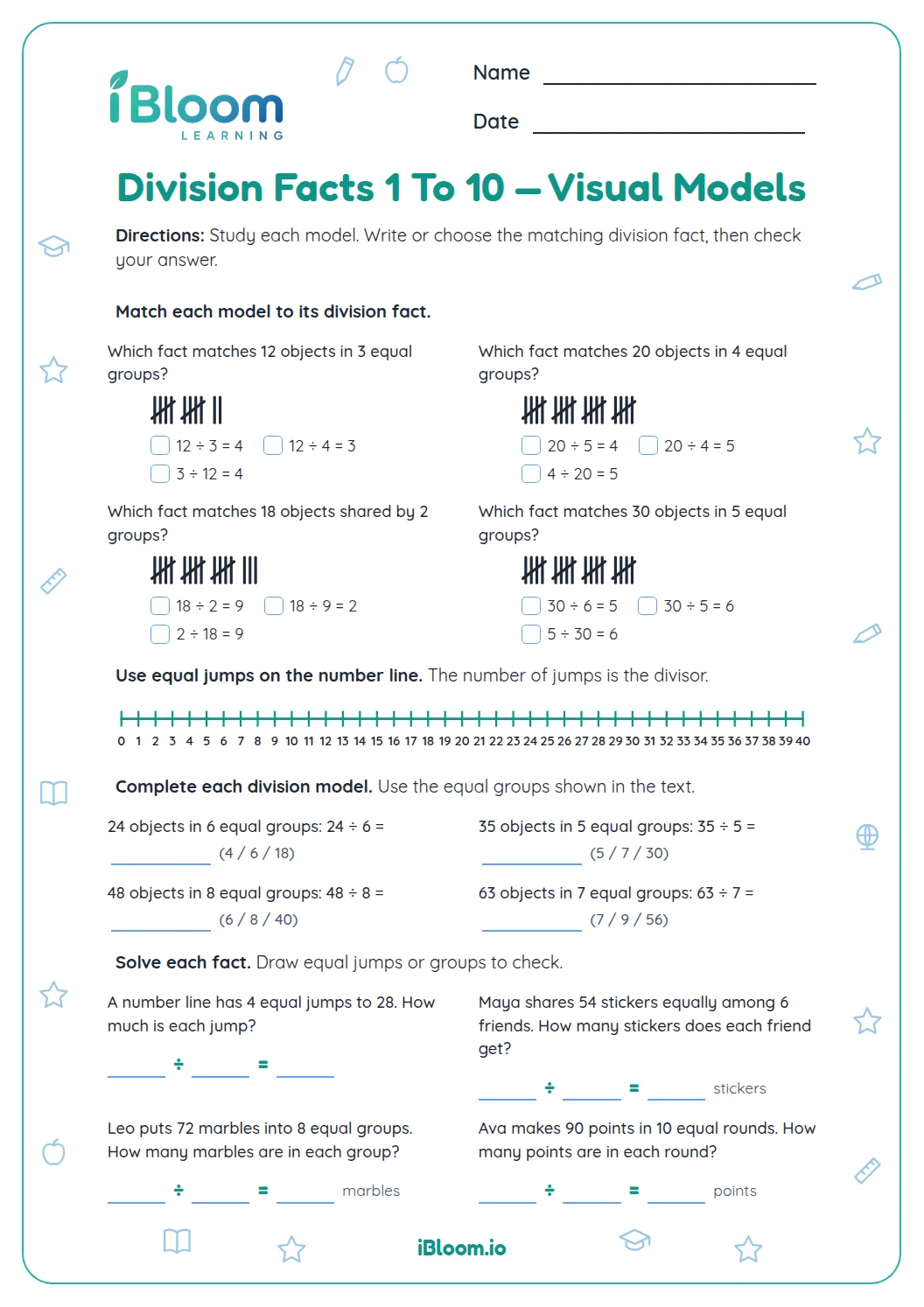
This Grade 4 worksheet gives students independent practice dividing whole numbers by one-digit divisors with no remainder. It begins with familiar division facts, then moves to larger quotients and six equal-sharing situations. Each story asks for an exact quotient, and the answer key includes units for those responses. The practice connects division to multiplication and to the Grade 4 standard 4.NBT.B.6.
Aligned to 4.NBT.B.6
How can multiplication help with division?
Division asks how many equal groups or how many in each group. A multiplication fact can check the quotient: if 24 ÷ 6 = 4, then 4 × 6 must equal 24.
- 124 ÷ 6 = 4
- 2Check: 4 × 6 = 24
What changes when the dividend gets larger?
The same relationship works for larger numbers. Think of 126 as 7 groups of 18, or use a known fact such as 7 × 18 = 126. Keep the divisor and quotient in the check so the product matches the dividend.
How do I choose the division equation in a story?
Look for equal groups: the story may tell how many groups there are, or how many items are shared. Divide the total by the number of groups to find the amount in each group. Add the item name to the answer.
- 1126 cones ÷ 7 bags = 18 cones per bag
- 2Check: 18 × 7 = 126
How to use this worksheet
- 1Read the divisor and dividend before choosing a fact.
- 2Solve the first four facts and check each product.
- 3For a larger quotient, find a multiplication fact with the same two factors.
- 4In a story, divide the total by the number of equal groups.
- 5Write the unit in each story answer and check the quotient by multiplying.
Common mistakes and quick fixes
The mistake
Using the divisor as the quotient, such as 96 ÷ 8 = 8.
The fix
Ask what number times 8 equals 96; 12 × 8 is 96.
The mistake
Dividing the numbers in a story in the wrong order.
The fix
Start with the total number of items, then divide by the number of equal groups.
The mistake
Leaving off the item name in a story answer.
The fix
Finish with the unit, such as “12 pencils,” and check that 12 × 8 returns 96.
Common Core alignment
This page practices exact division with one-digit divisors and uses multiplication to check quotients.
Find exact quotients with one-digit divisors and check them using multiplication.
On this sheet: Every quotient has a one-digit divisor; the story items connect division and multiplication.
Show the official wordingHide the official wording
Find whole-number quotients and remainders with up to four-digit dividends and one-digit divisors, using strategies based on place value, the properties of operations, and/or the relationship between multiplication and division. Illustrate and explain the calculation by using equations, rectangular arrays, and/or area models.
What to practice next
Make more practice
Further reading
Questions parents and teachers ask
How do students check a division answer?
Multiply the quotient by the divisor and see whether the product matches the dividend. For question 7, 72 divided by 6 gives 12; then 12 times 6 returns 72. This check works for each exact division fact and for the larger quotients on the page.
Do these problems have remainders?
No. Every dividend on this worksheet divides evenly by its one-digit divisor. Students can verify that by multiplying the quotient by the divisor and checking that the product equals the original dividend. The six story problems also have whole-number answers.
Why do the story answers include units?
The unit tells what is being shared, such as pencils per table or books per shelf. It makes the quotient answer the story question in a complete way. For example, “12” is the quotient, while “12 pencils per table” identifies what each group receives.
What should my child try next?
After these exact quotients feel comfortable, practice more division facts and then try guided problems with larger dividends. Ask your child to explain the multiplication check aloud. The linked division fact page gives more practice with familiar one-digit divisors.