





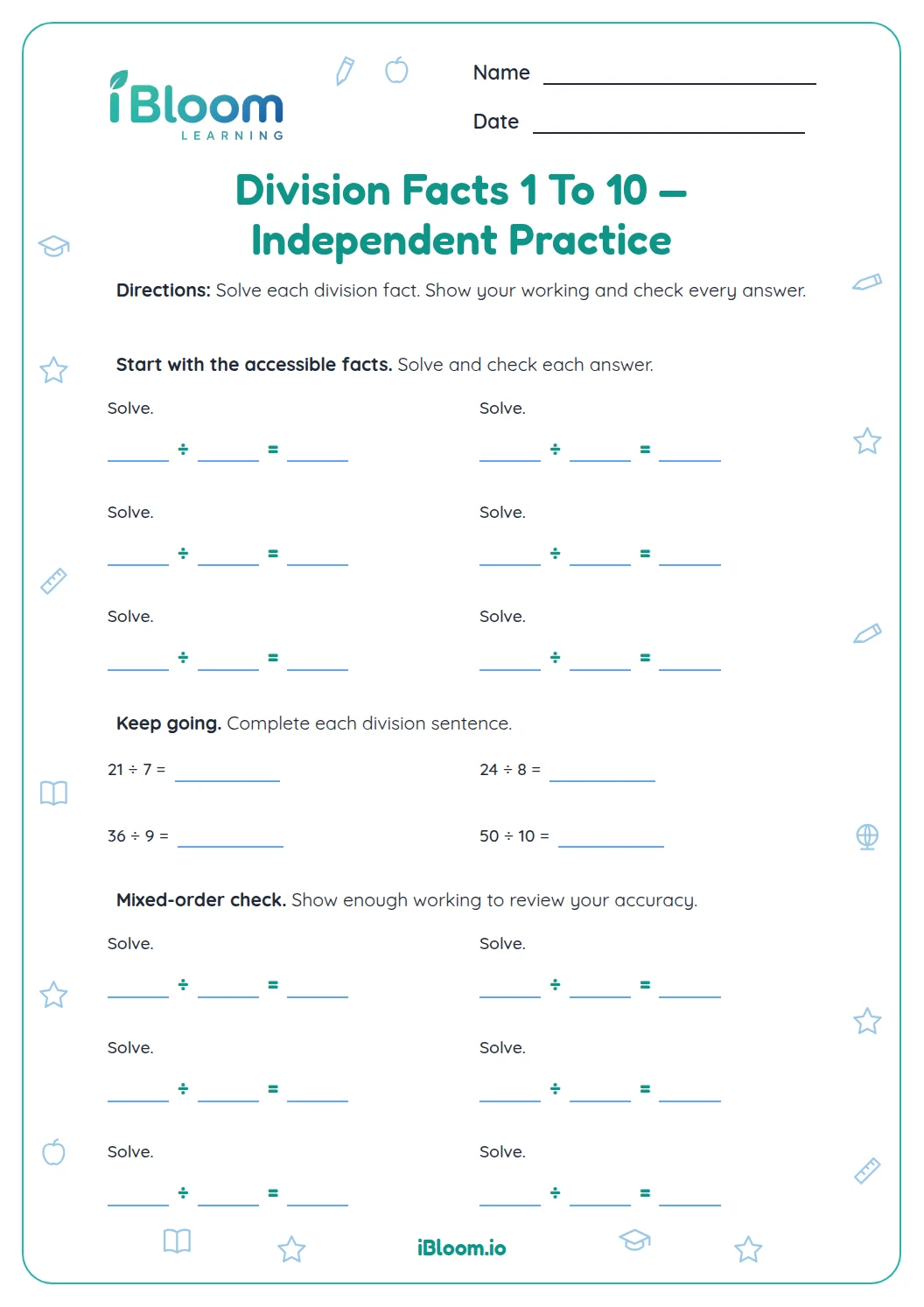
About this worksheet
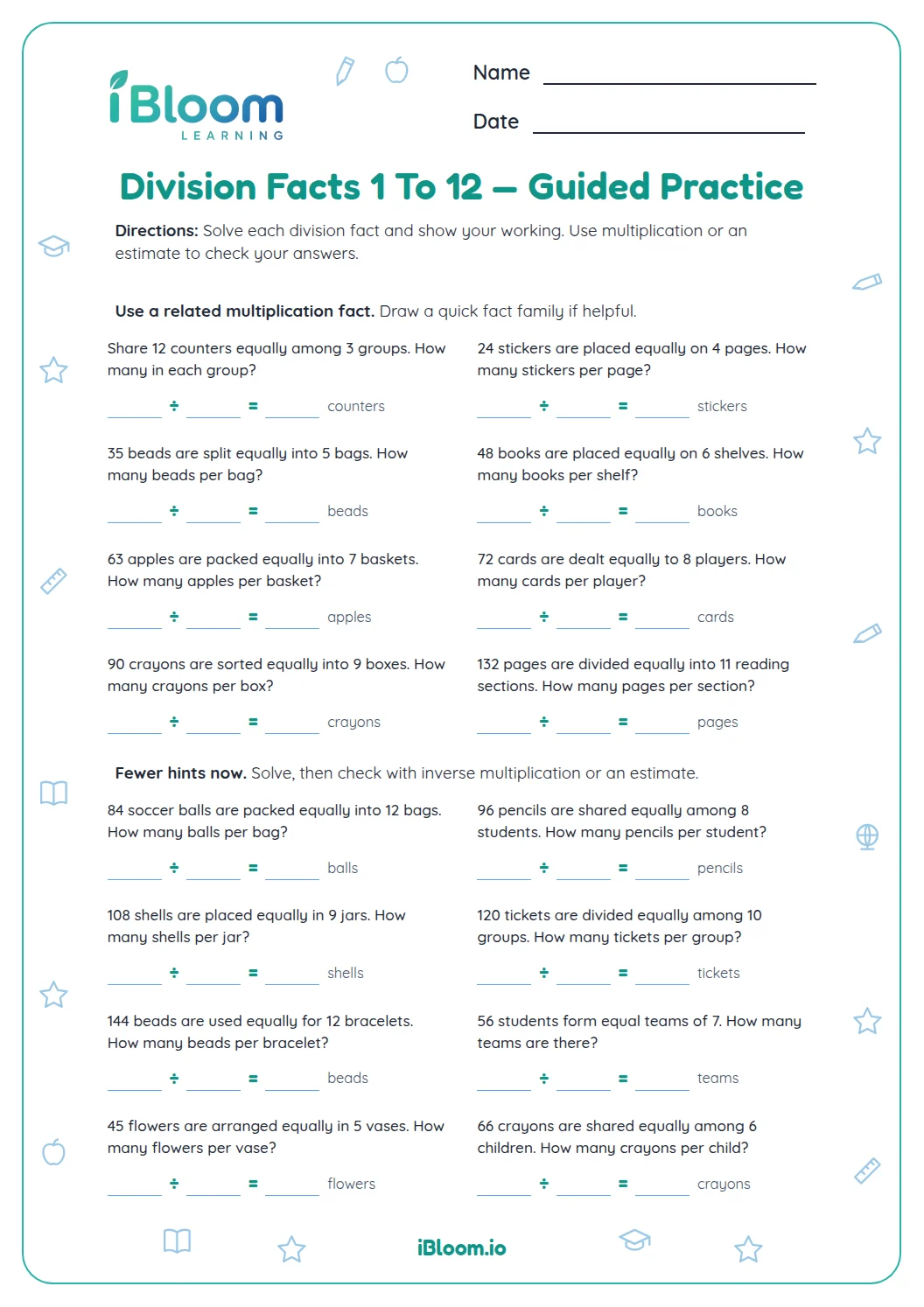
This Grade 4 worksheet contains 20 division facts with divisors from 1 through 12. Each dividend stays within 100, and learners can use multiplication to check each quotient. The page practices the relationship between multiplication and division described in CCSS 3.OA.C.7 and includes a separate answer key.
Aligned to 3.OA.C.7
How does multiplication help with division?
A division fact asks which factor is missing. For 72 ÷ 8, think of 8 × ? = 72; the missing factor is 9.
- 172 ÷ 8 = ___
- 2Answer: 9
- 3Check: 8 × 9 = 72.
How can a fact family make practice easier?
Keep the three numbers in the fact family together. If 11 × 6 = 66, then 66 ÷ 11 = 6. Multiplication can confirm the quotient.
How can multiplication check a quotient?
Multiply the quotient by the divisor. The product should equal the dividend; for example, 96 ÷ 12 = 8 because 12 × 8 = 96.
How to use this worksheet
- 1Read the dividend and divisor.
- 2Think of a multiplication fact with the divisor as one factor.
- 3Find the missing factor; that is the quotient.
- 4Write the quotient on the answer line.
- 5Multiply the quotient by the divisor to check.
Common mistakes and quick fixes
The mistake
Dividing the divisor by the dividend.
The fix
Read the expression as total ÷ number of groups.
The mistake
Confusing a factor with the quotient.
The fix
Use the multiplication equation to identify the missing factor.
The mistake
Skipping the multiplication check.
The fix
Multiply the quotient by the divisor to recover the dividend.
Common Core alignment
This worksheet practices multiplication and related division facts.
Use multiplication facts and related division facts to find each quotient.
On this sheet: The worksheet directly practices this skill.
Show the official wordingHide the official wording
Fluently multiply and divide within 100, using strategies such as the relationship between multiplication and division (e.g., knowing that 8 × 5 = 40, one knows 40 ÷ 5 = 8) or properties of operations. By the end of Grade 3, know from memory all products of two one-digit numbers.
What to practice next
Make more practice
Further reading
Questions parents and teachers ask
Are all divisors from 1 to 12 included?
Yes. Every divisor from 1 through 12 appears in the fact questions. Their dividends are within 100, and each answer can be checked by multiplying the quotient by its divisor. This gives practice with each divisor in the worksheet range.
How can multiplication help with division?
Turn division into a multiplication question. For 66 ÷ 11, ask what number times 11 equals 66. The missing factor is the quotient, and multiplying back checks the result. Ask the learner to explain how the text or numbers support that answer.
How can learners check each quotient?
Multiply the quotient by the divisor. The product should equal the dividend. For example, a quotient of 8 for 96 ÷ 12 checks because 12 × 8 = 96. Ask the learner to explain how the text or numbers support that answer. Ask the learner to explain how the text or numbers support that answer.
Is an answer key included?
Yes. The separate key lists the quotient for each fact and application. Learners can check a missed answer by writing the related multiplication equation. Ask the learner to explain how the text or numbers support that answer. Ask the learner to explain how the text or numbers support that answer.
Does the page include word problems?
This sheet focuses on bare division facts so learners can build quick recall across all the divisors in its range. Use the answer key after trying the problems to review any fact that needs another look. Ask the learner to explain how the text or numbers support that answer.