







About this worksheet
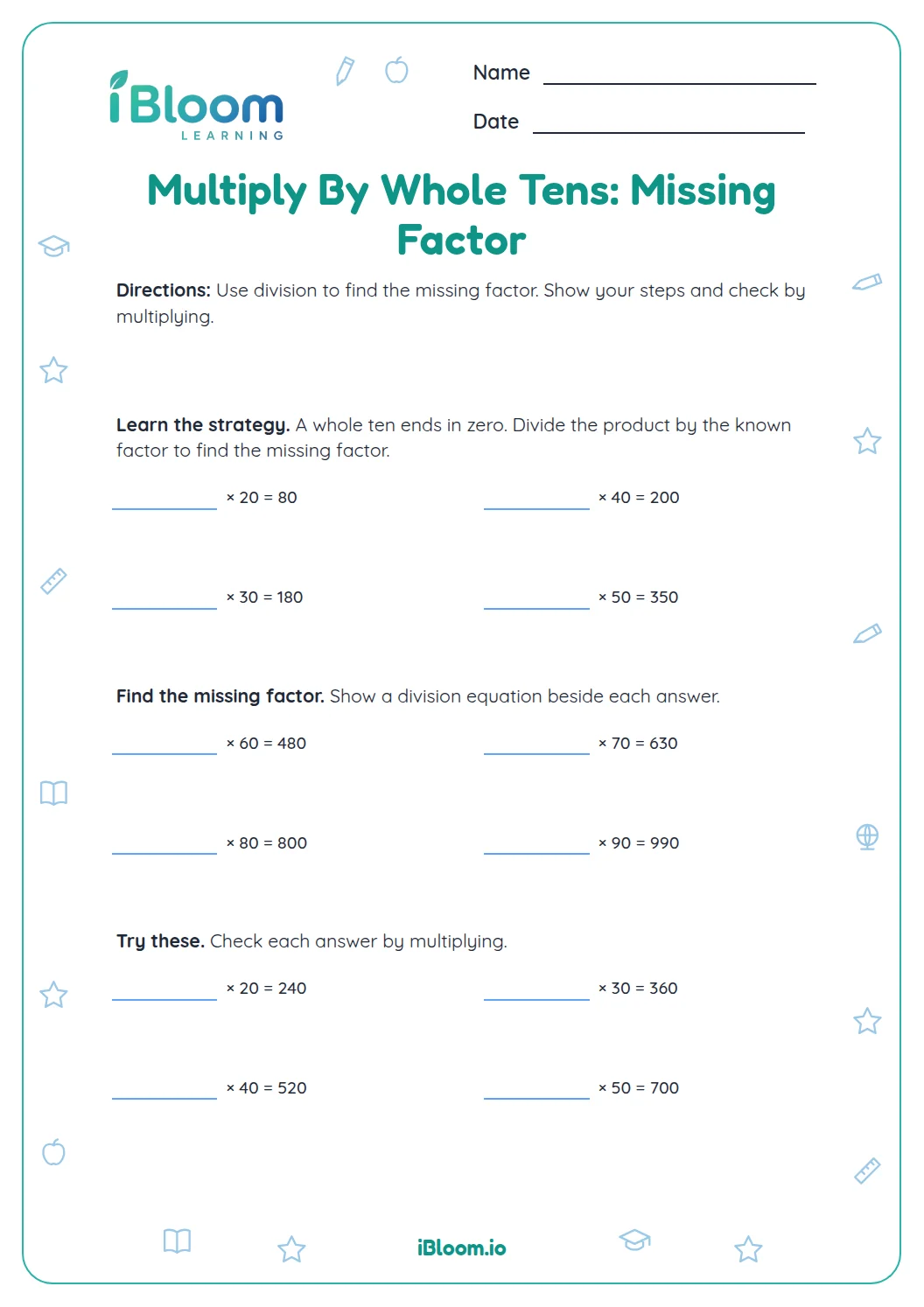
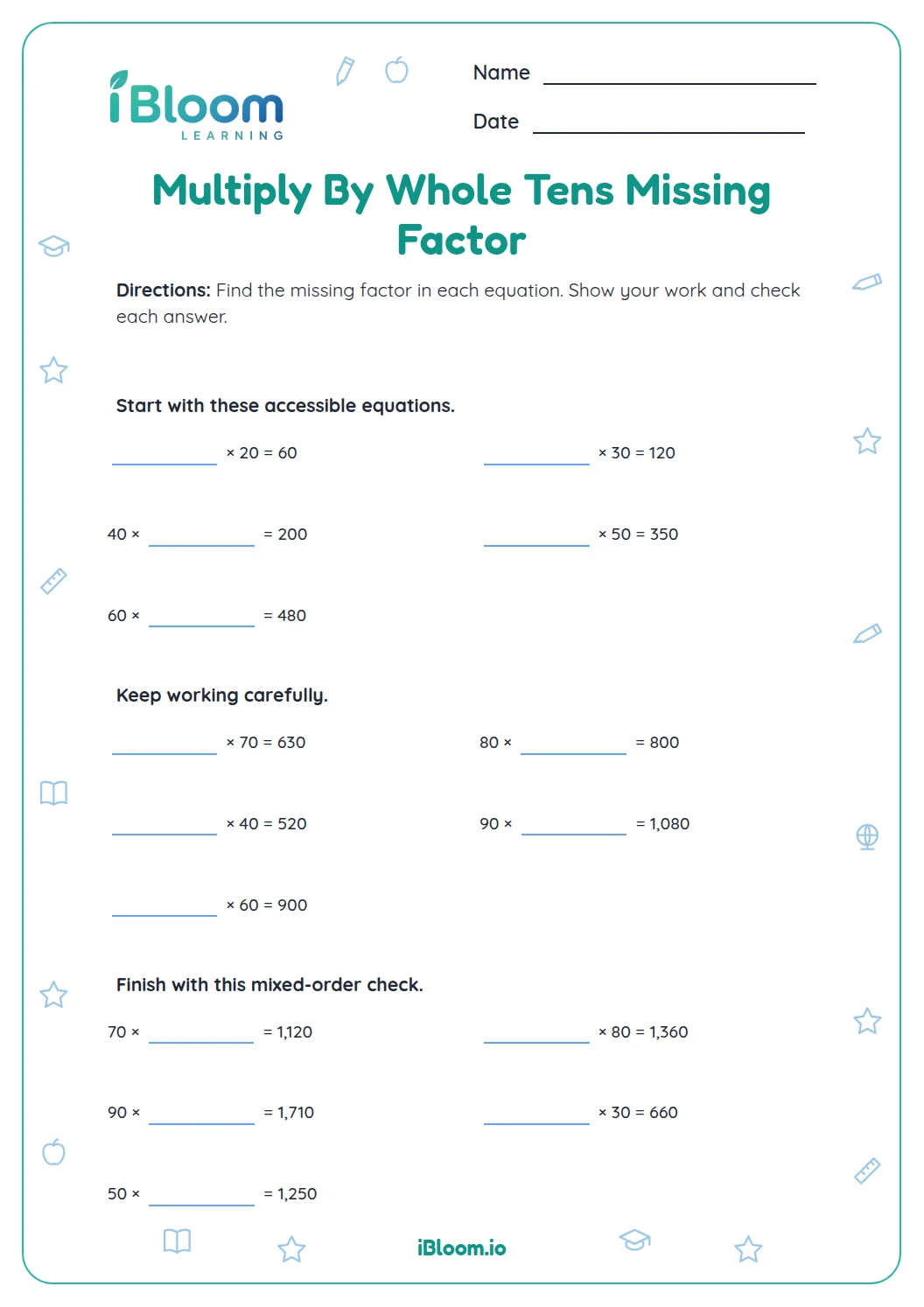
This Grade 4 printable gives students 12 missing-factor equations and two story problems involving whole tens. The unknown appears in different positions, so students use multiplication and related division facts to find it. Each story problem connects a familiar one-digit factor with a whole-ten factor. The sheet practices CCSS 4.NBT.B.5 and includes a separate answer key.
Aligned to 4.NBT.B.5
How do whole tens make multiplication easier?
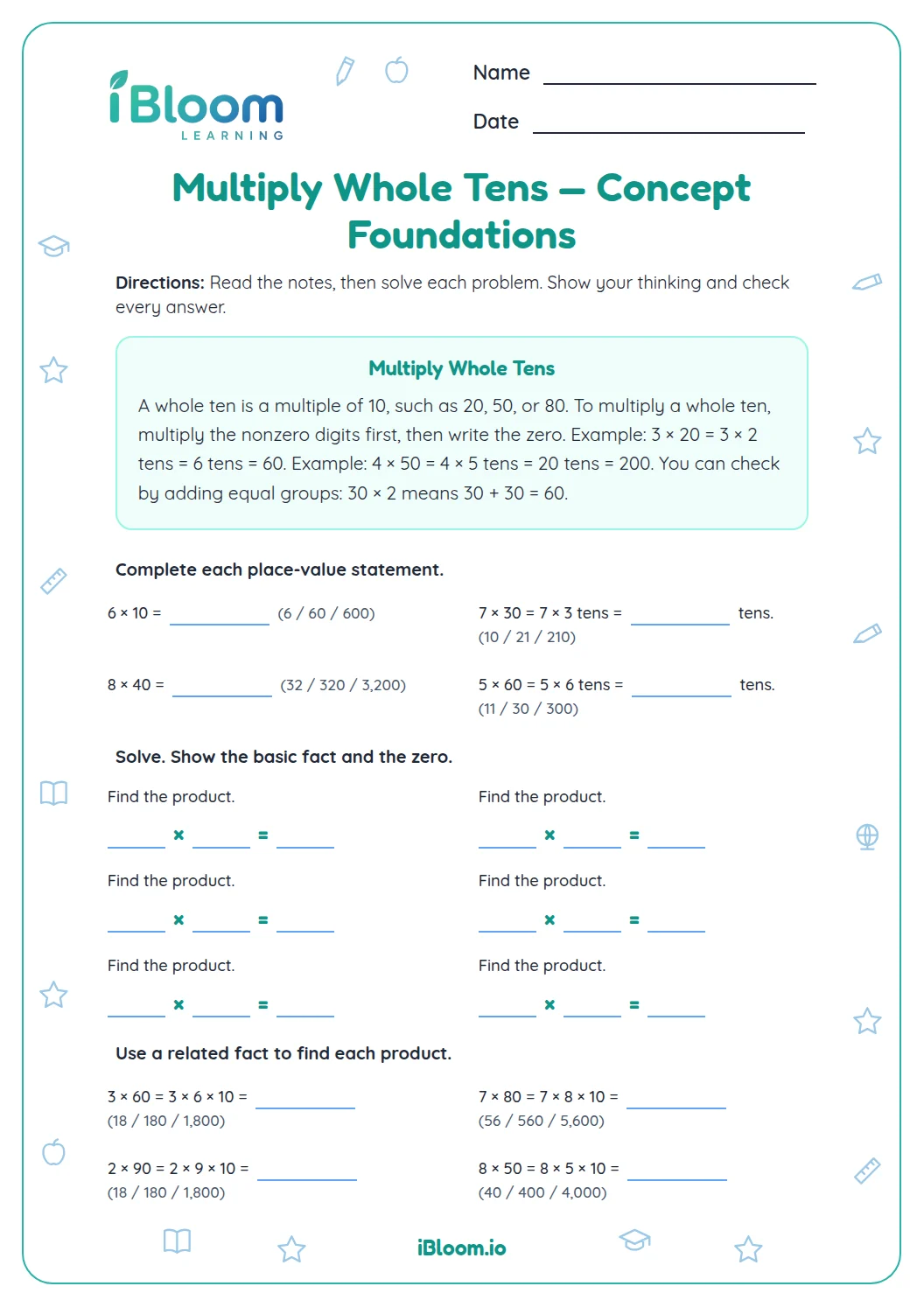
A whole-ten factor is a number of tens. For example, 30 is 3 tens, so a known one-digit factor can be multiplied by 3 first, then the result is read as tens.
- 14 × ___ = 120
- 2120 is 12 tens; 12 ÷ 4 = 3 tens.
- 3The missing factor is 30.
How can you check a missing factor?
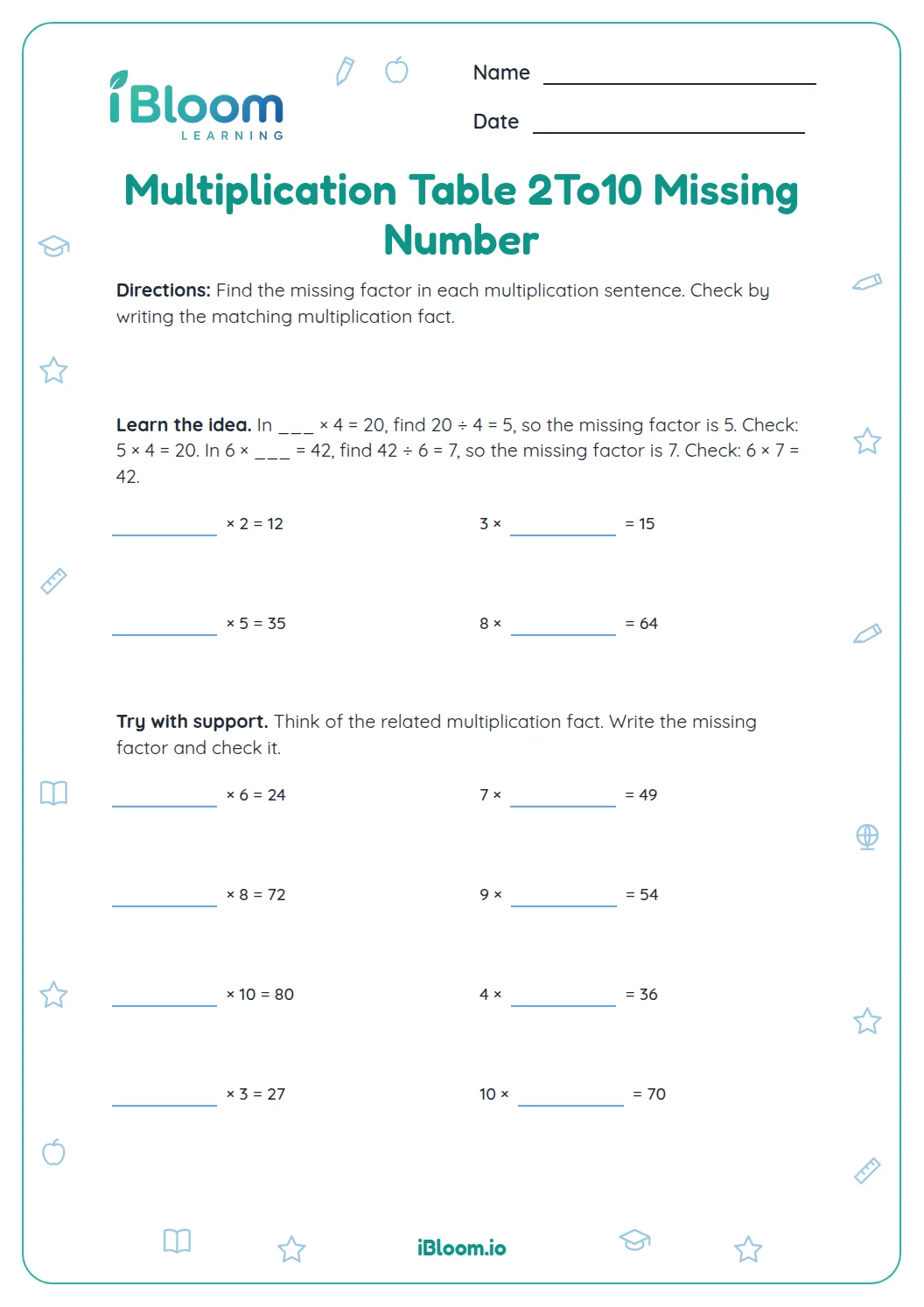
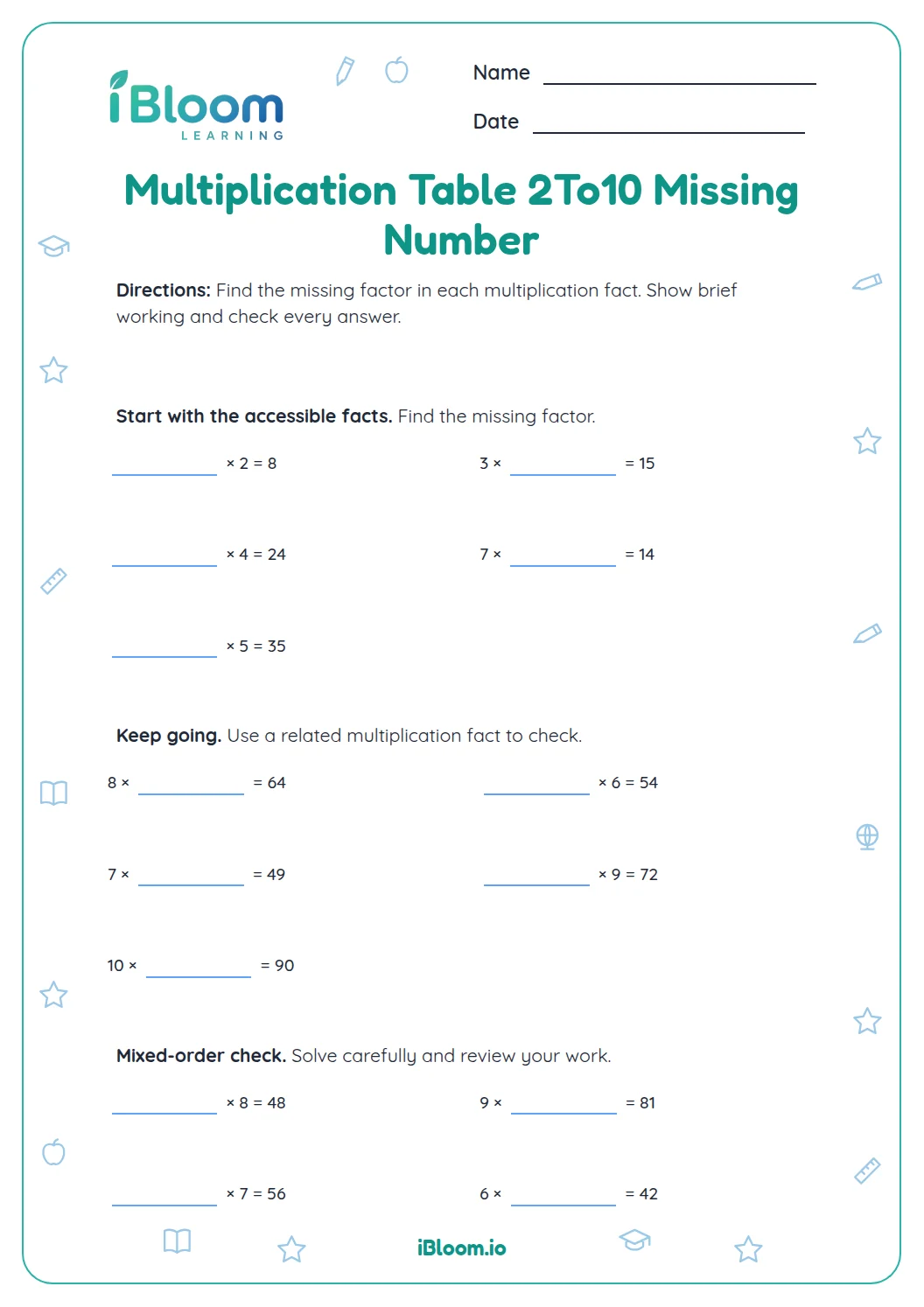
The missing factor can appear before or after the multiplication sign. Use the product and known factor to find the unknown, then multiply to check that the equation is true.
How do equal groups connect to the equations?
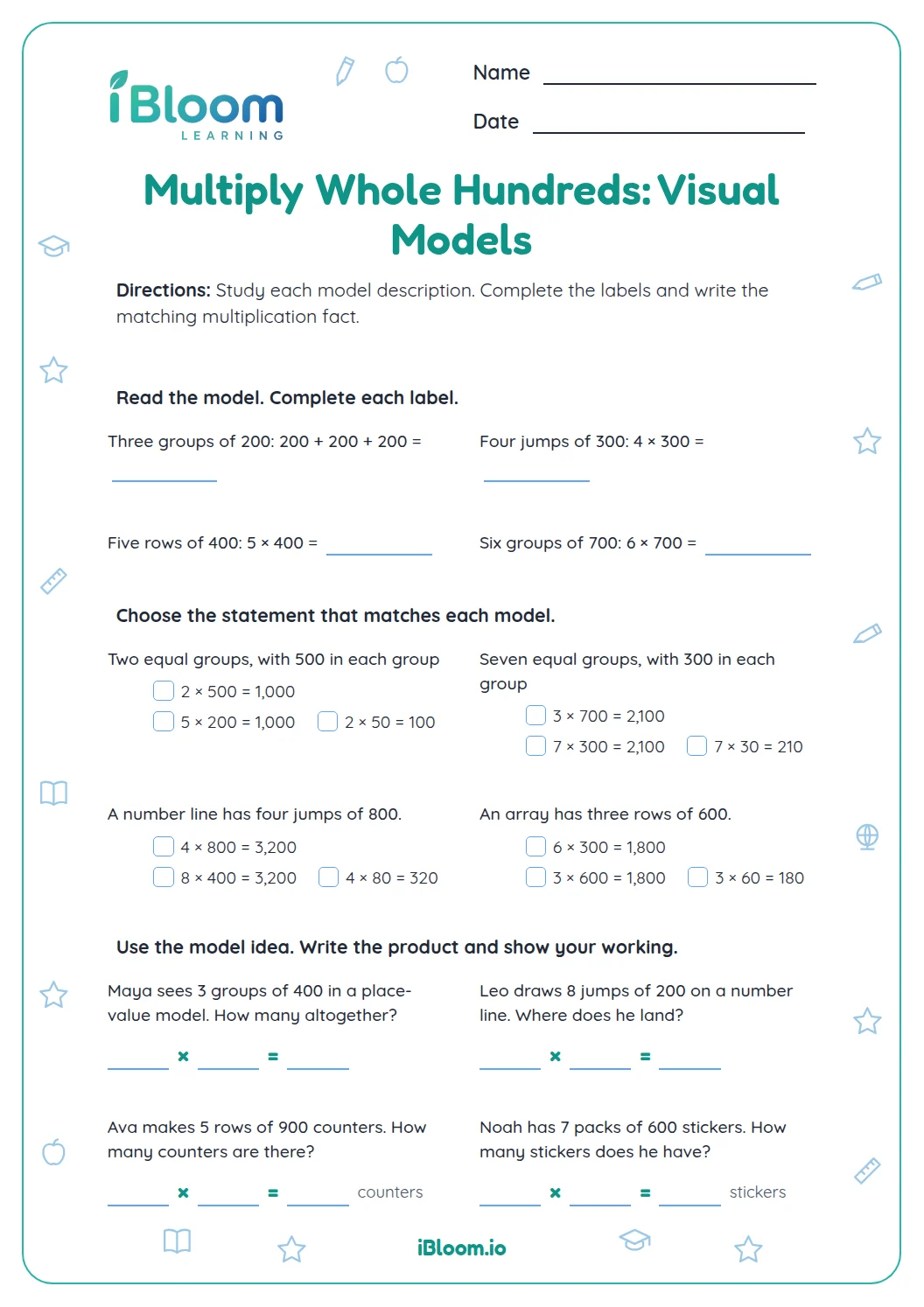
For a story problem, identify the number of groups and the amount in each group. Write a multiplication equation; for an unknown number of groups, divide the total by the group size.
How to use this worksheet
- 1Read the whole equation before choosing which factor is missing.
- 2Rewrite a whole ten as a number of tens, such as 50 = 5 tens.
- 3Use division or a known multiplication fact to find the unknown.
- 4For a story, identify the number of groups and the amount in each group.
- 5Multiply to check every answer.
Common mistakes and quick fixes
The mistake
Dropping the zero in a whole-ten factor.
The fix
Say 30 as 3 tens, then restore the value of the tens.
The mistake
Dividing the product by the wrong factor.
The fix
Use the factor that is already shown in the equation.
The mistake
Adding equal groups instead of multiplying.
The fix
Count the groups and the amount in each group, then multiply.
This worksheet gives focused practice with the reading and language skills named below.
Find whole-ten factors by using place value and one-digit multiplication facts.
On this sheet:
Show the official wordingHide the official wording
Multiply a whole number of up to four digits by a one-digit whole number, and multiply two two-digit numbers, using strategies based on place value and the properties of operations. Illustrate and explain the calculation by using equations, rectangular arrays, and/or area models.
What to practice next
Further reading
Questions parents and teachers ask
How do you solve 4 × ___ = 120?
Think of 120 as 12 tens. Since 12 divided by 4 is 3, the unknown factor is 3 tens, or 30. Check by multiplying 4 × 30; the product is 120. This is the first equation on the worksheet.
Why does 7 × 30 equal 210?
Thirty is 3 tens, so 7 × 30 means seven groups of 3 tens. Seven times 3 is 21, so the product is 21 tens, or 210. Thinking in tens helps students connect a familiar fact to multiplication by a whole-ten number.
How many equation and story questions are there?
The worksheet has 12 missing-factor equations and two story problems, for 14 questions total. The equations place the unknown in different positions. The stories use equal groups so students connect each multiplication equation to a situation and a whole-ten factor.
How can a student check a missing factor?
Multiply the known factor by the proposed missing factor. For example, if the equation is 7 × ___ = 420, test 60 because 7 × 60 equals 420. The answer key provides the intended factor, and the multiplication equation provides a quick check.
What does the sticker story ask students to find?
The sticker story says a shop packs 8 stickers on each sheet and has 560 stickers. Students find how many full groups of 8 are in 560, so they divide 560 by 8. The answer is 70 sheets.