






About this worksheet
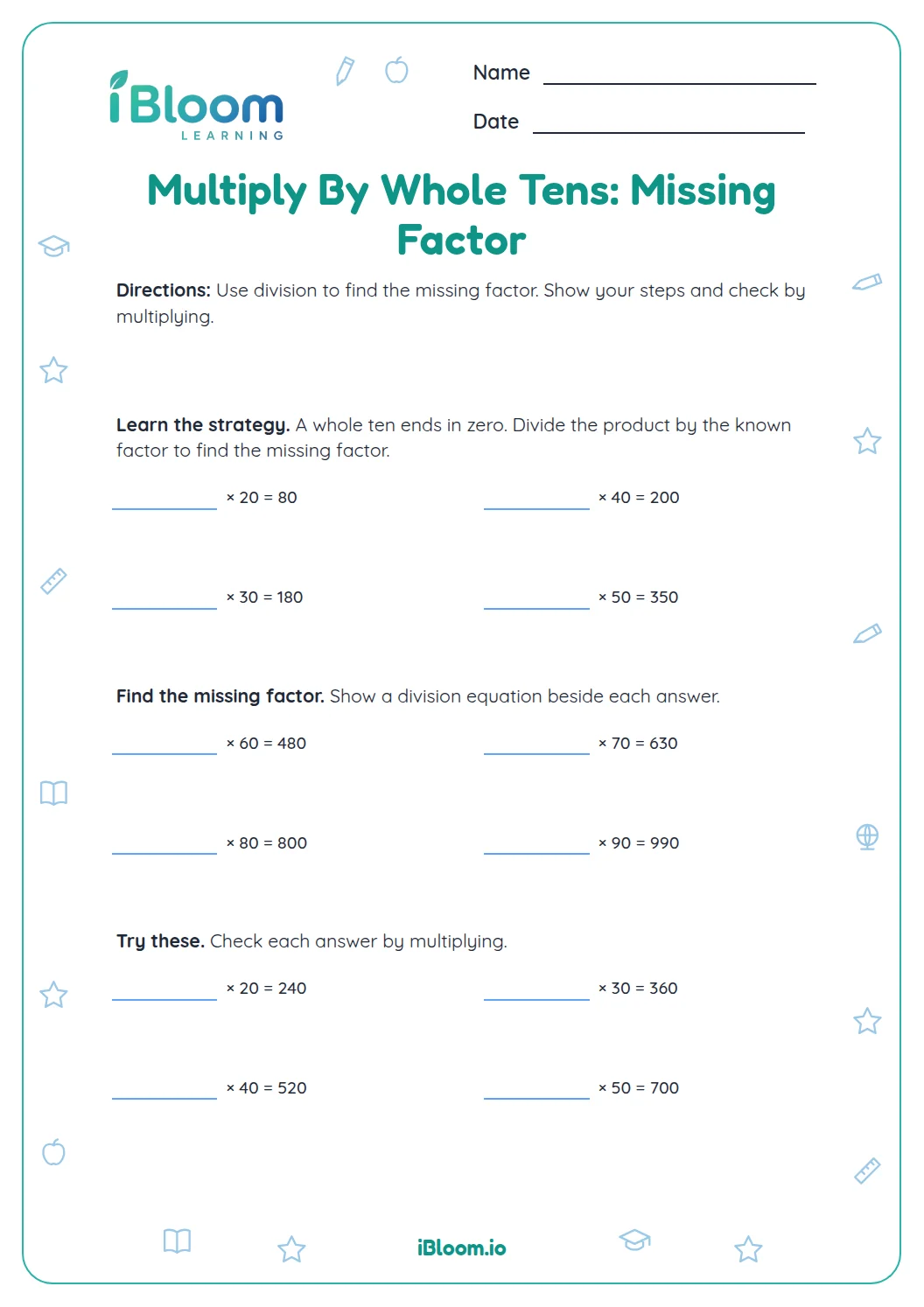
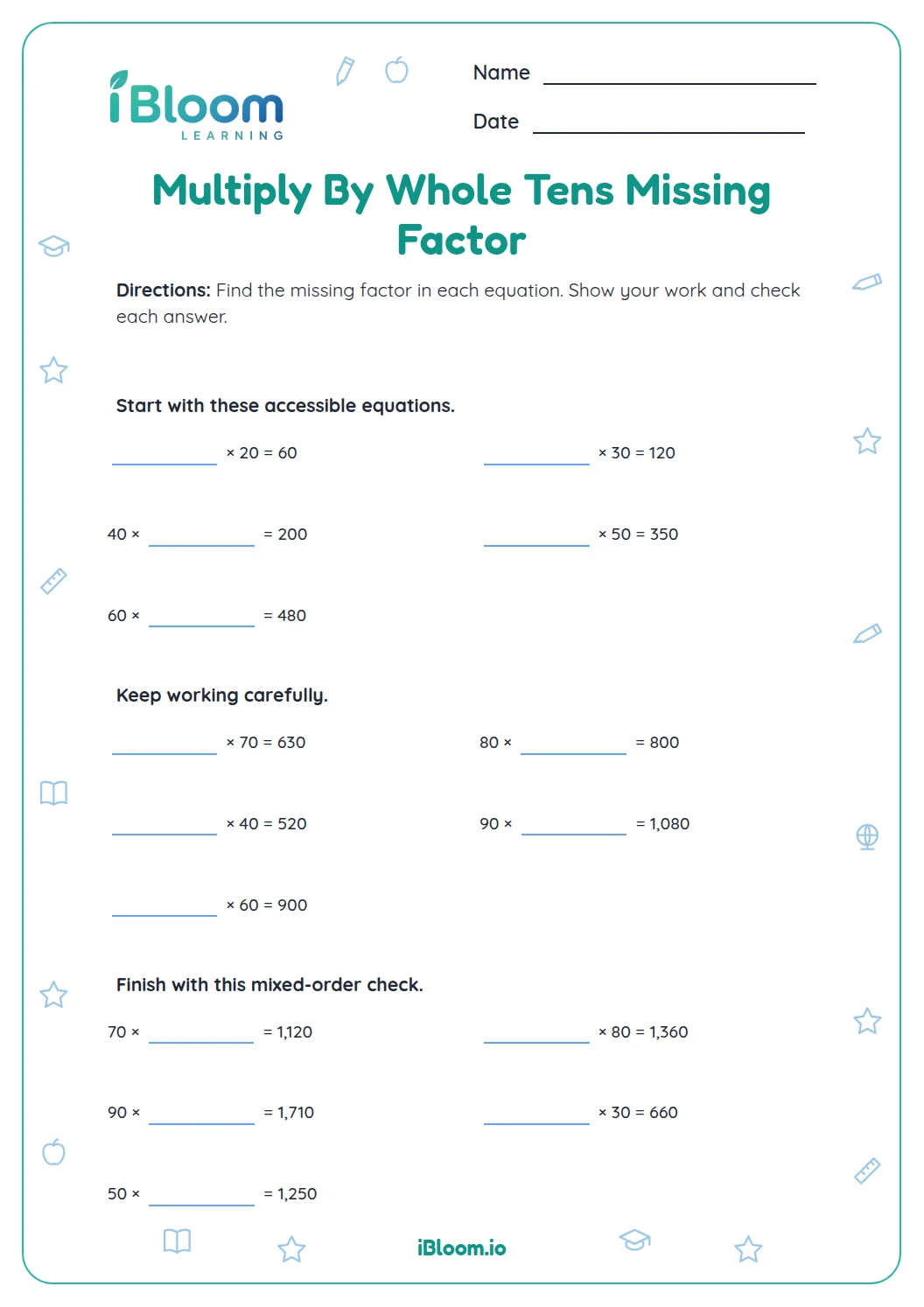
This free Grade 4 worksheet helps students find a missing factor when the known factor is a multiple of ten. Four questions use rectangular arrays, with each dot representing one ten; students count rows and dots per row to build an equation. Six more questions ask for missing factors in equations, and four use short real-world contexts. The work practices CCSS 4.NBT.B.5 by illustrating multiplication with rectangular arrays and equations. A separate answer key gives every answer.
Aligned to 4.NBT.B.5
How do you read an array of tens?
Count the rows to find the number of equal groups. Count the dots in each row to find the tens in one group. Since each dot represents 10, three dots in a row represent 30. Multiply the groups by that tens amount.
- 1The array has 2 rows and 3 dots in each row.
- 2Each dot is 10, so each row is 30.
- 32 × 30 = 60; the missing factor is 2.
How do you find the missing factor?
Use the array to identify the number of groups and the amount in each group. In question 5, two rows of four dots represent 2 × 40 = 80, so the missing factor is 2. Check by multiplying the factors.
What kinds of questions are included?
Part A uses arrays to read equal groups of tens. Part B asks students to complete whole-tens equations. Part C uses short contexts about paper stars, pencils, seedlings, and bookmarks.
- Part A: complete four equations using arrays
- Part B: solve six whole-tens equations
- Part C: find the number of equal groups in four stories
How can I support practice?
- 1Review that one dot represents ten before starting.
- 2For Part A, count the rows and dots in each row separately.
- 3In Part B, say the tens amount aloud before multiplying: 6 dots mean 60.
- 4Check a completed equation by multiplying the missing factor by the whole-tens factor.
- 5Read each Part C story and identify the number of equal groups.
Common mistakes and quick fixes
The mistake
Treating each dot as one instead of ten, so 3 rows of 8 dots becomes 24.
The fix
Write “8 tens = 80” beside one row, then count the three groups of 80.
The mistake
Using the dots per row as the number of groups. In question 2, that swaps 4 and 5.
The fix
Count rows for the missing factor; count columns or dots per row for the whole-tens factor.
The mistake
Finding the number of dots but forgetting each dot represents ten.
The fix
Multiply the dot count by ten first, then use that amount in the equation.
Common Core alignment
This worksheet connects place-value thinking to multiplication models.
Represent whole-number multiplication with rectangular arrays and equations.
On this sheet:
Show the official wordingHide the official wording
Multiply a whole number of up to four digits by a one-digit whole number, and multiply two two-digit numbers, using strategies based on place value and the properties of operations. Illustrate and explain the calculation by using equations, rectangular arrays, and/or area models.
What to practice next
Make more practice
Further reading
Questions parents and teachers ask
What does each dot represent in the arrays?
Each dot represents 10. In question 1, there are 3 dots in each row, so one row represents 30; two rows represent 2 × 30 = 60. The rows show the number of equal groups, which is the missing factor in this equation. The answer is 2.
How do I tell which factor is missing?
Count the rows to find the number of groups, then count the dots in each row to find the tens in one group. In question 2, three rows of four dots show 3 × 40 = 120. The missing factor is the number of rows: 3.
Why are the arrays made of dots instead of ten rods?
The direction assigns a value of 10 to each dot, so a compact array can show equal groups of tens. In question 4, two rows of five dots represent 2 × 50 = 100. Count rows for the number of groups and dots in a row for the tens in each group.
Should my child multiply the number of dots by ten first?
For an array, count the dots in one row and treat each as a ten. Then multiply that group value by the number of rows. Question 3 shows four rows of three dots, or 4 × 30 = 120. The missing factor is 4, and multiplying 4 by 30 checks the result.
What is included in the answer key?
The separate key gives the missing factor for all 14 questions. For the array questions, students can compare their answer with the number of rows and verify that rows times the value of each row equal the product. The equations and stories use the same equal-groups reasoning.