



About this worksheet
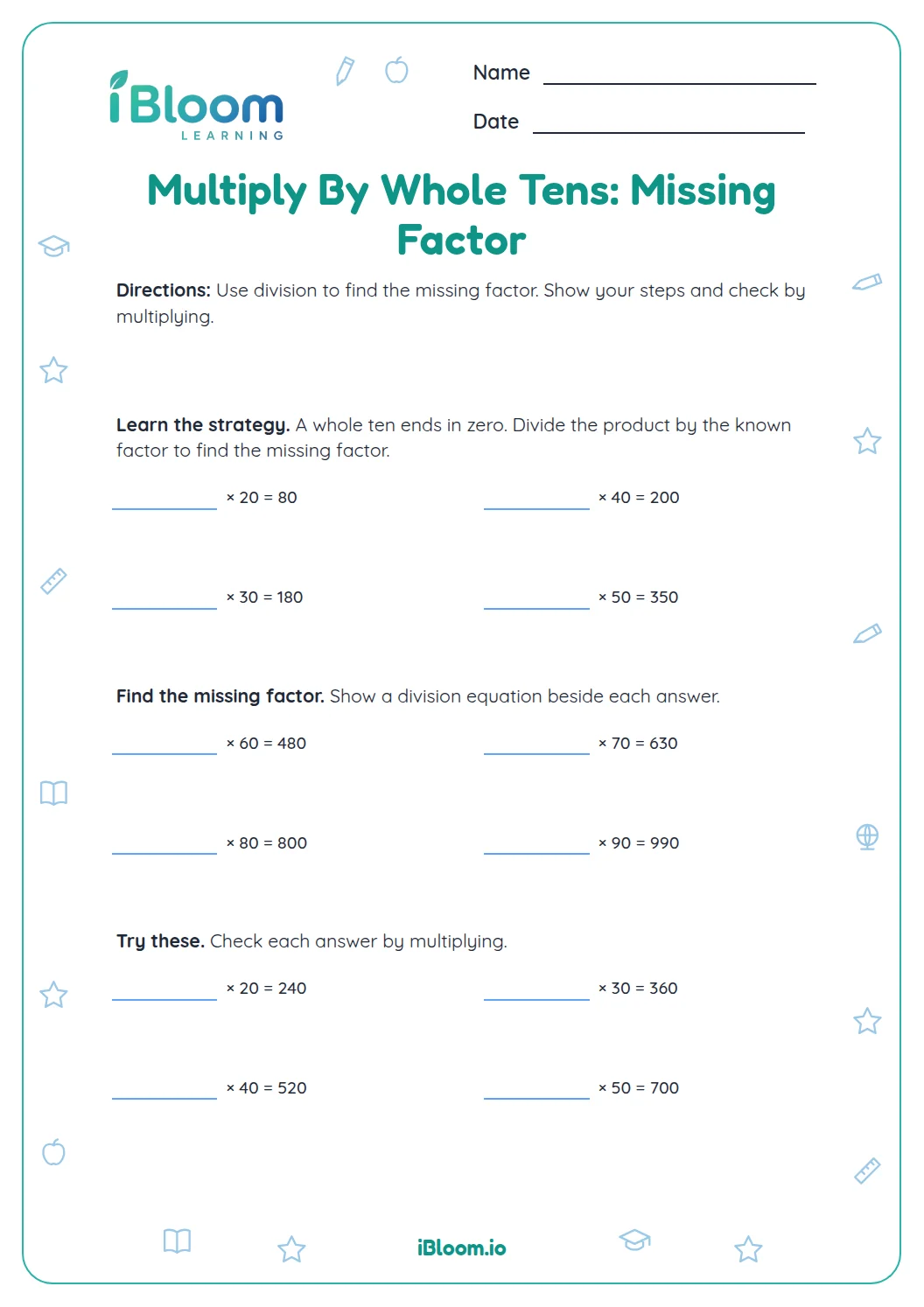
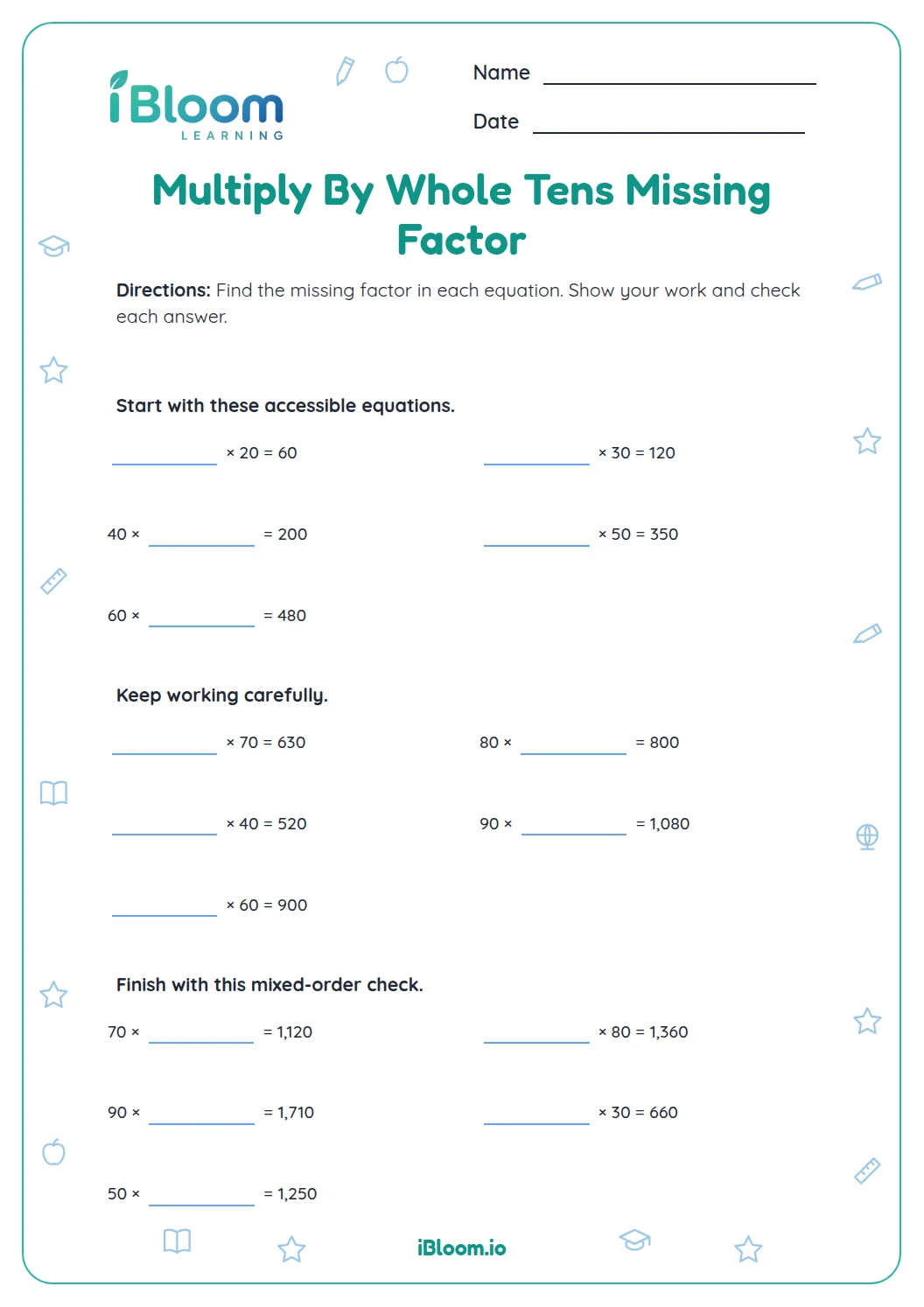
This Grade 4 printable helps learners solve missing-factor problems involving whole tens. They use basic facts and place value, choose equations for situations, and explain how a product can be checked. The work connects to Common Core 4.NBT.B.5, which uses place-value strategies and operation properties to multiply whole numbers. The sheet includes 16 questions in three parts and a separate answer key.
Aligned to 4.NBT.B.5
How can a basic fact reveal a missing tens factor?
In 6 × ___ = 240, ask what times 6 makes 24, then notice that 240 is ten times 24. That gives 40 as the missing factor.
The same reasoning works in reverse: 40 × 6 is 4 tens × 6, or 24 tens. Multiplication can be checked by dividing the product by the known factor.
- 16 × ___ = 240
- 2240 ÷ 6 = 40
- 3Check: 6 × 40 = 6 × 4 tens = 24 tens = 240
Why does place value matter when multiplying by 40 or 70?
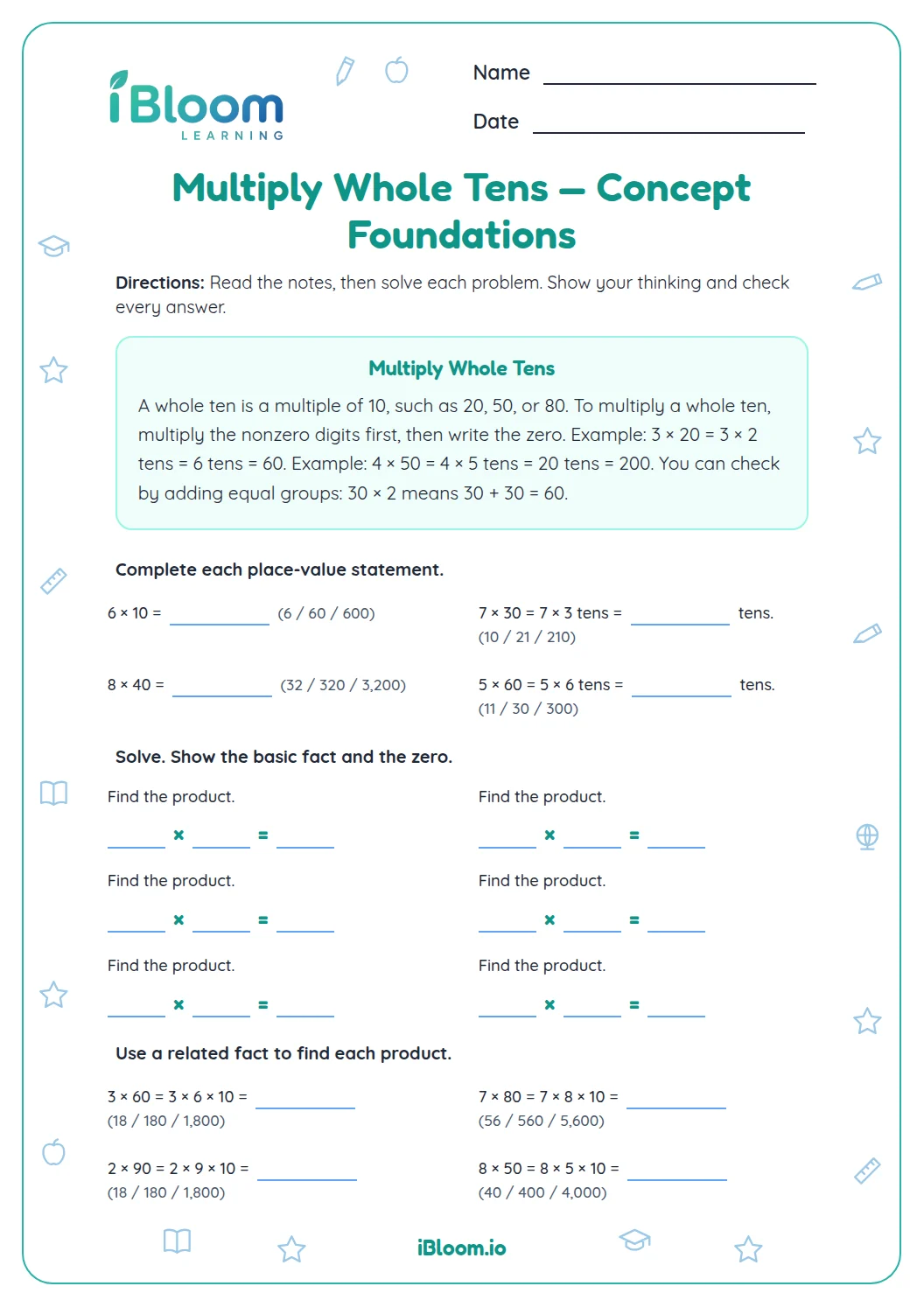
A whole ten is a number of tens. For example, 7 × 40 means 7 × 4 tens, which is 28 tens, or 280. The zero marks the tens place in the product.
What kinds of practice are on the page?
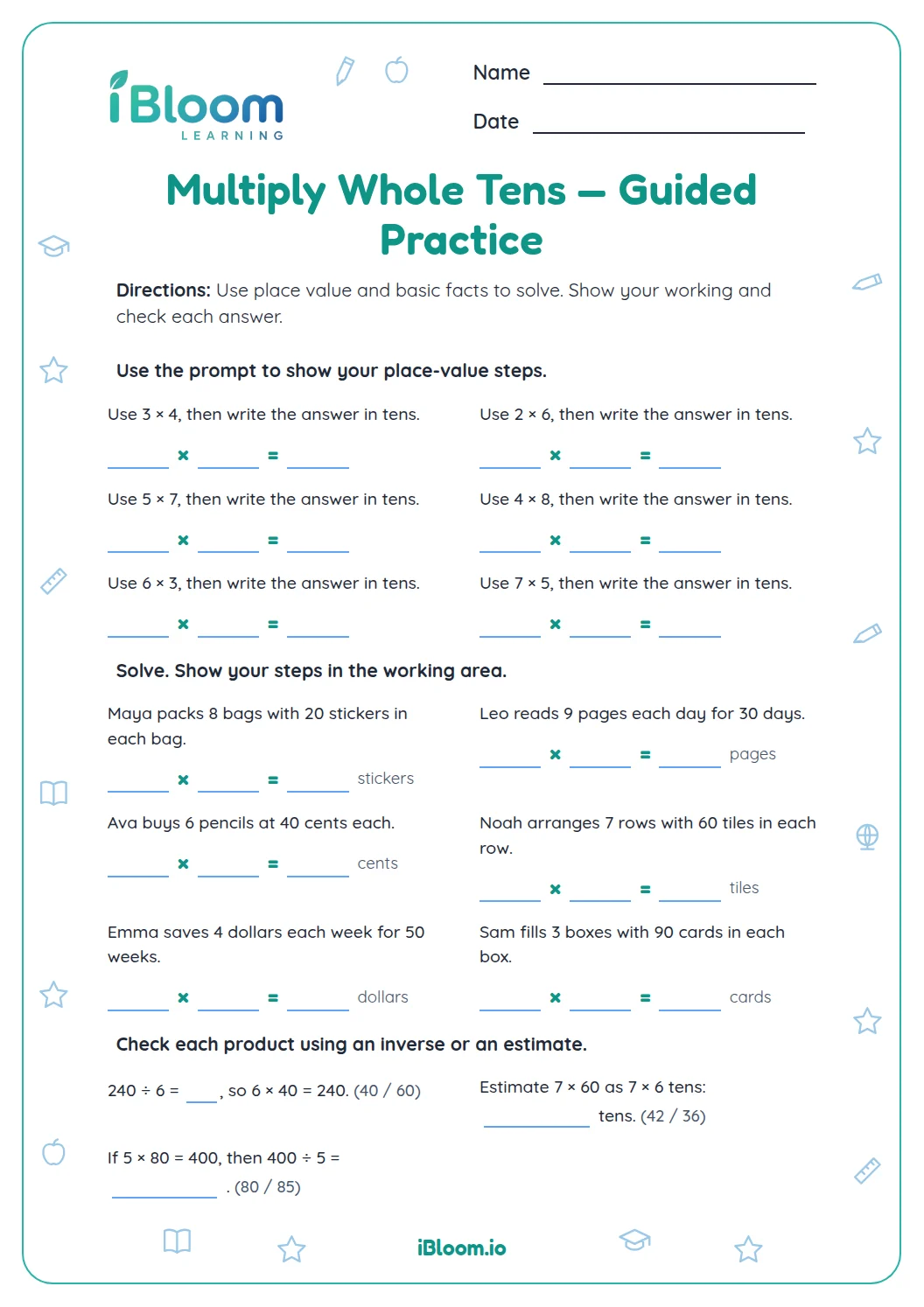
The 16 questions move from missing factors to choices and applications. Later prompts ask learners to explain or check their reasoning.
How to use this worksheet
- 1Read the equation and identify the known factor and product.
- 2Use division to find the unknown factor, or reverse a known multiplication fact.
- 3For a factor ending in zero, think in tens before writing the product.
- 4Read each situation carefully and choose the operation that matches equal groups.
- 5Check the result by multiplying the factors.
Common mistakes and quick fixes
The mistake
Forgetting the place value and writing 28 for 7 × 40.
The fix
Think 7 × 4 tens = 28 tens, so the product is 280.
The mistake
Adding the known factor to the product instead of dividing.
The fix
Ask what number times the known factor equals the product.
The mistake
Giving a product that is too small for two-digit tens.
The fix
Estimate in tens, then use multiplication to check.
Common Core alignment
This page uses place value and multiplication properties to reason about whole tens.
Use place value and properties to multiply whole numbers.
On this sheet: Children use facts such as 8 × 5 = 40 to reason that 8 × 50 = 400.
Show the official wordingHide the official wording
Multiply a whole number of up to four digits by a one-digit whole number, and multiply two two-digit numbers, using strategies based on place value and the properties of operations. Illustrate and explain the calculation by using equations, rectangular arrays, and/or area models.
What to practice next
Make more practice
Further reading
Questions parents and teachers ask
What does “missing factor” mean here?
A factor is one of the numbers multiplied to make a product. In 6 × ___ = 240, divide 240 by 6 to find 40, then check that 6 × 40 equals 240. The questions use whole tens so learners can connect a basic fact to place value.
How can a child solve 8 × ___ = 560 mentally?
Think of 560 as 56 tens. Since 56 ÷ 8 = 7, the missing number is 7 tens, or 70. Multiplying 8 by 70 gives 560, which checks the answer. A quick multiplication check confirms the relationship and catches a misplaced zero.
Why does multiplying by a whole ten add a zero?
A whole ten is a number of tens, so 8 × 50 means 8 groups of 5 tens. That is 40 tens, or 400. The zero records that the product is forty tens rather than forty ones. It connects the factor to the product by counting tens.
What kinds of questions are on this sheet?
The first eight questions ask for a missing whole-ten factor. Four multiple-choice items connect those facts to groups and products, and four final prompts ask children to explain or apply their reasoning. This keeps the place-value meaning clear while solving.
How should I support a learner who is stuck?
Ask the learner to replace the whole ten with a number of tens. For 6 × ___ = 240, first solve 6 × ___ = 24 tens. Then rename the answer as tens and multiply to check. The first eight items give repeated practice with that strategy.
Does the printable include an answer key?
Yes. The answer key lists the missing factors and selected choices, then gives sample explanations for the open-response items. Accept another explanation when it uses a correct basic fact and accounts accurately for the tens. Use the fact and place value to explain a different correct response.