


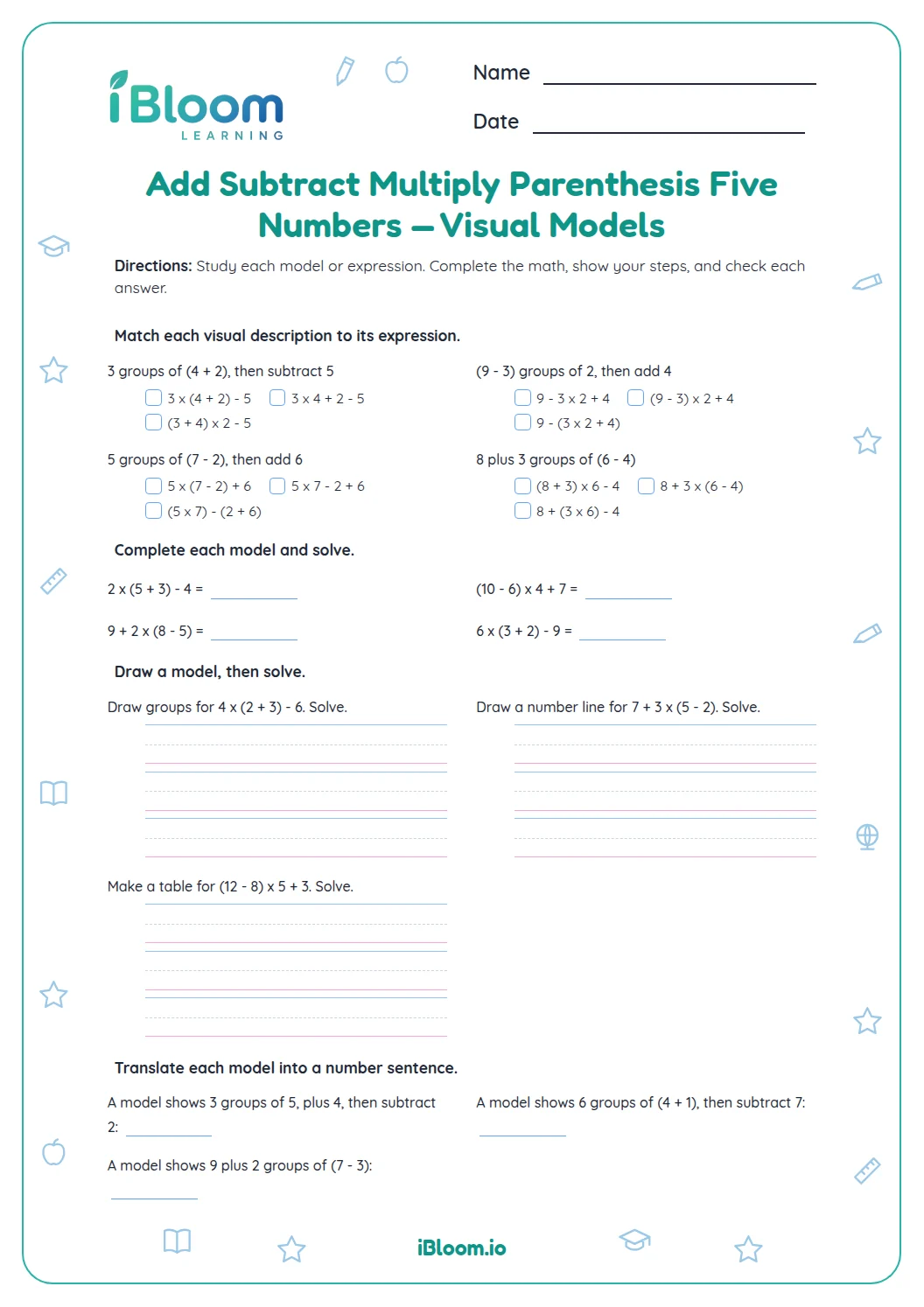
About this worksheet
This printable gives Grade 4 learners 14 expressions and short applications using parentheses, addition, subtraction, multiplication, and division. Children practice grouping first, then work multiplication and division from left to right before addition and subtraction. The page builds from direct evaluation to explaining a step and applying operations in context. A separate answer key supports quick checking. It connects to CCSS 5.OA.A.1, which names grouping symbols in numerical expressions.
Aligned to 5.OA.A.1
What order should I use to evaluate an expression?
Start inside parentheses. Then complete multiplication and division in the order they appear from left to right. Finish addition and subtraction from left to right.
For question 1, (6 + 2) × 3 − 4 + 5 − 1, first get 8 inside the parentheses. Then 8 × 3 = 24, followed by 24 − 4 + 5 − 1 = 24.
- 1(6 + 2) × 3 − 4 + 5 − 1
- 28 × 3 − 4 + 5 − 1
- 324 − 4 + 5 − 1 = 24
Why do multiplication and division come before addition?
The shared convention gives everyone the same value for an expression. In 8 + 2 × 5, multiply 2 × 5 first, then add 8, giving 18. A left-to-right pass through every symbol would produce a different result.
How does the practice build?
Part A gives six expressions with exactly six numbers each. Part B asks children to identify a first operation or an intermediate value. Part C includes two short situations, one more evaluation, and a parentheses challenge.
How to use this worksheet
- 1Read the whole expression once and mark the parentheses.
- 2Calculate only inside parentheses first.
- 3Circle multiplication and division; move left to right.
- 4Finish addition and subtraction from left to right.
- 5Substitute each result back into the expression.
- 6Use the key to find the first step that needs correcting.
Mistakes to watch for
The mistake
Doing every operation from left to right
The fix
Handle × and ÷ before + and −, while keeping left-to-right order within each level.
The mistake
Multiplying only after adding nearby numbers
The fix
Check whether parentheses explicitly group the addition.
The mistake
Changing the expression while copying it
The fix
Rewrite one operation at a time and keep every sign and number.
Common Core alignment
This page gives children focused practice with the skills named in these standards.
Use grouping symbols to evaluate expressions with the four operations.
On this sheet: Use grouping symbols to evaluate expressions with the four operations.
Show the official wordingHide the official wording
Use parentheses, brackets, or braces in numerical expressions, and evaluate expressions with these symbols.
What to practice next
Make more practice
Further reading
Questions parents and teachers ask
What is the order of operations?
Evaluate parentheses first. Then multiply and divide from left to right, followed by addition and subtraction from left to right. The worksheet practices this sequence in six expressions and asks learners to identify the first step in several more. Write each intermediate value on a new line so the order stays visible.
Do multiplication and division have different priority?
They share the same priority, so work whichever appears first when reading from left to right. In question 2, division appears before multiplication, so calculate 18 ÷ (2 + 4) before 5 × 3. Have the learner point to the parentheses or operation that determined the first step.
Why does 8 + 2 × 5 equal 18?
For 8 + 2 × 5 − 4 + 3 − 1, multiply 2 × 5 first, then finish addition and subtraction from left to right for 16. Question 7 asks children to identify that first operation after a student gets 48 by working from left to right. Check each sign as you rewrite.
What does the answer key show?
The key gives a concise answer for all 14 questions, including expression values, selected operations, and application answers. For the two situations, check both the operation order and the final count. A quick estimate can help catch an answer that is much too large or too small.
What should a child do if an answer is wrong?
Find the earliest line where the order or arithmetic changed. Recalculate that part while leaving the rest of the expression intact, then continue. This makes it easier to distinguish an order mistake from a computation slip. Keep the original signs in view while checking each step.