


About this worksheet
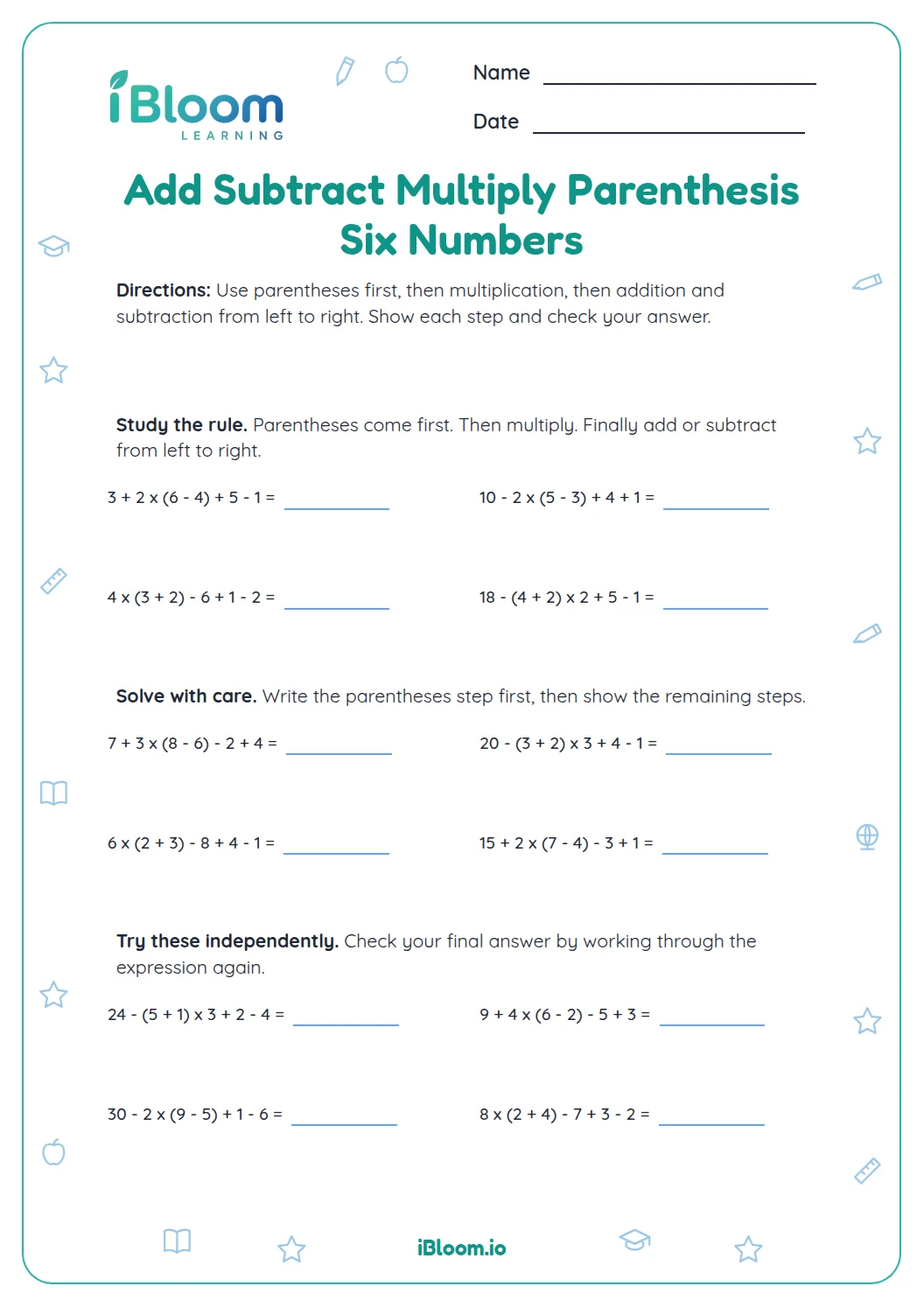
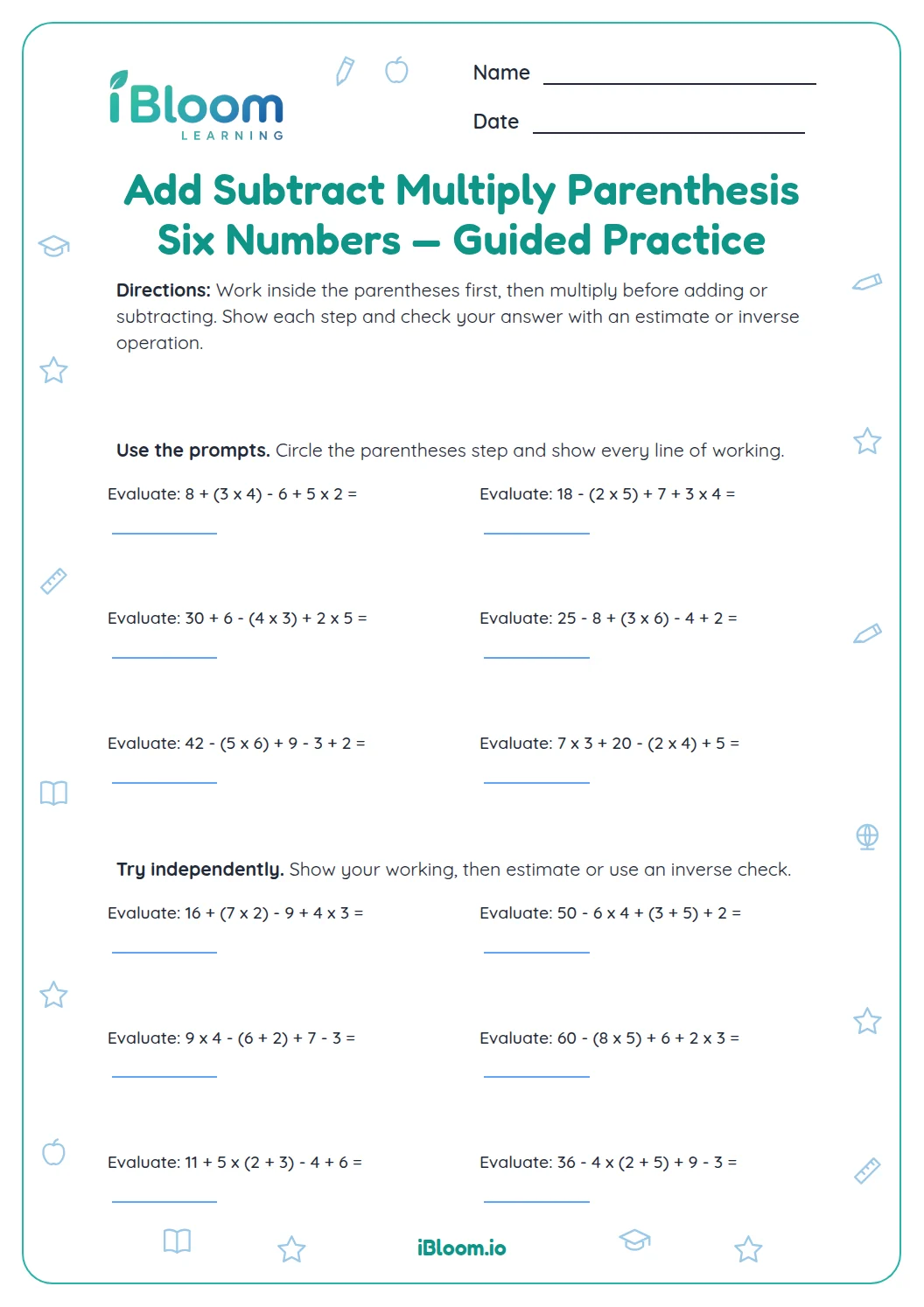
This Grade 4 worksheet gives learners 14 expressions with six numbers, parentheses, and all four operations. Each question pairs the expression with a three-stage table: parentheses first, multiplication or division from left to right, then addition or subtraction from left to right. Children use the visual organizer to decide the order and write the final value. Three worksheet pages and a separate answer key are included.
Aligned to 5.OA.A.1
Which operation comes first?
Start inside the parentheses. Next, scan from left to right and complete multiplication or division in the order it appears. Finish by working through addition and subtraction from left to right.
How does the step table help?
The table keeps the three stages visible while a child works through each expression. Use it to choose the next operation, then rewrite the expression on the worksheet’s work lines as needed.
How can I evaluate (8 + 2) × 3 − 4 + 6 ÷ 2?
First, 8 + 2 = 10. Then complete multiplication and division: 10 × 3 = 30 and 6 ÷ 2 = 3. Finish left to right: 30 − 4 + 3 = 29.
How to use this worksheet
- 1Find and evaluate the operation inside parentheses.
- 2Scan left to right for multiplication or division.
- 3Complete those operations in the order they appear.
- 4Scan the remaining expression from left to right.
- 5Use addition and subtraction to reach the final value.
Common mistakes and quick fixes
The mistake
Working from left to right before using the operation order.
The fix
Use the table’s parentheses stage before other operations.
The mistake
Always multiplying before dividing.
The fix
Multiplication and division have equal priority; do whichever comes first from the left.
The mistake
Always adding before subtracting.
The fix
Addition and subtraction also share a level; work from left to right.
Common Core alignment
This worksheet practices evaluating numerical expressions that use parentheses.
Use parentheses to group part of an expression and evaluate the expression in order.
On this sheet: Every expression includes parentheses and all four operations; the table supports evaluation.
Show the official wordingHide the official wording
Use parentheses, brackets, or braces in numerical expressions, and evaluate expressions with these symbols.
What to practice next
Make more practice
Further reading
Questions parents and teachers ask
Why are parentheses evaluated first?
Parentheses group numbers and operations that belong together, so that group is evaluated before the rest of the expression. The step table marks that as the first stage. In question 1, 8 + 2 becomes 10 before the multiplication outside the parentheses.
Do I multiply before I divide?
Multiplication and division have the same priority. Read the expression from left to right and do whichever appears first. In question 1, after the parentheses are evaluated, children multiply 10 by 3 and divide 6 by 2 before subtracting or adding.
Do I add before I subtract?
Addition and subtraction share a priority level. Once multiplication and division are complete, work through the remaining signs from left to right. In question 1, 30 − 4 is completed before adding 3, giving a final value of 29. The table names each priority level clearly.
What does the table show?
Each question has a small organizer listing the three stages: parentheses, multiplication or division, and addition or subtraction. It is a visual reminder of operation order; children still calculate and write the answer to each expression. The left-to-right rule is included in the worksheet directions.
How many problems and pages are included?
There are 14 six-number expressions across three worksheet pages, with a three-stage table beside every question. The separate answer key also spans three pages and gives the final value for each expression. Every expression uses parentheses and all four operations.
Are the expressions the same length?
Each expression contains six numbers and includes parentheses, addition, subtraction, multiplication, and division. The values were chosen so division is exact and the final answers are whole numbers, keeping attention on operation order. Children can use the table as a reminder before calculating.