





About this worksheet
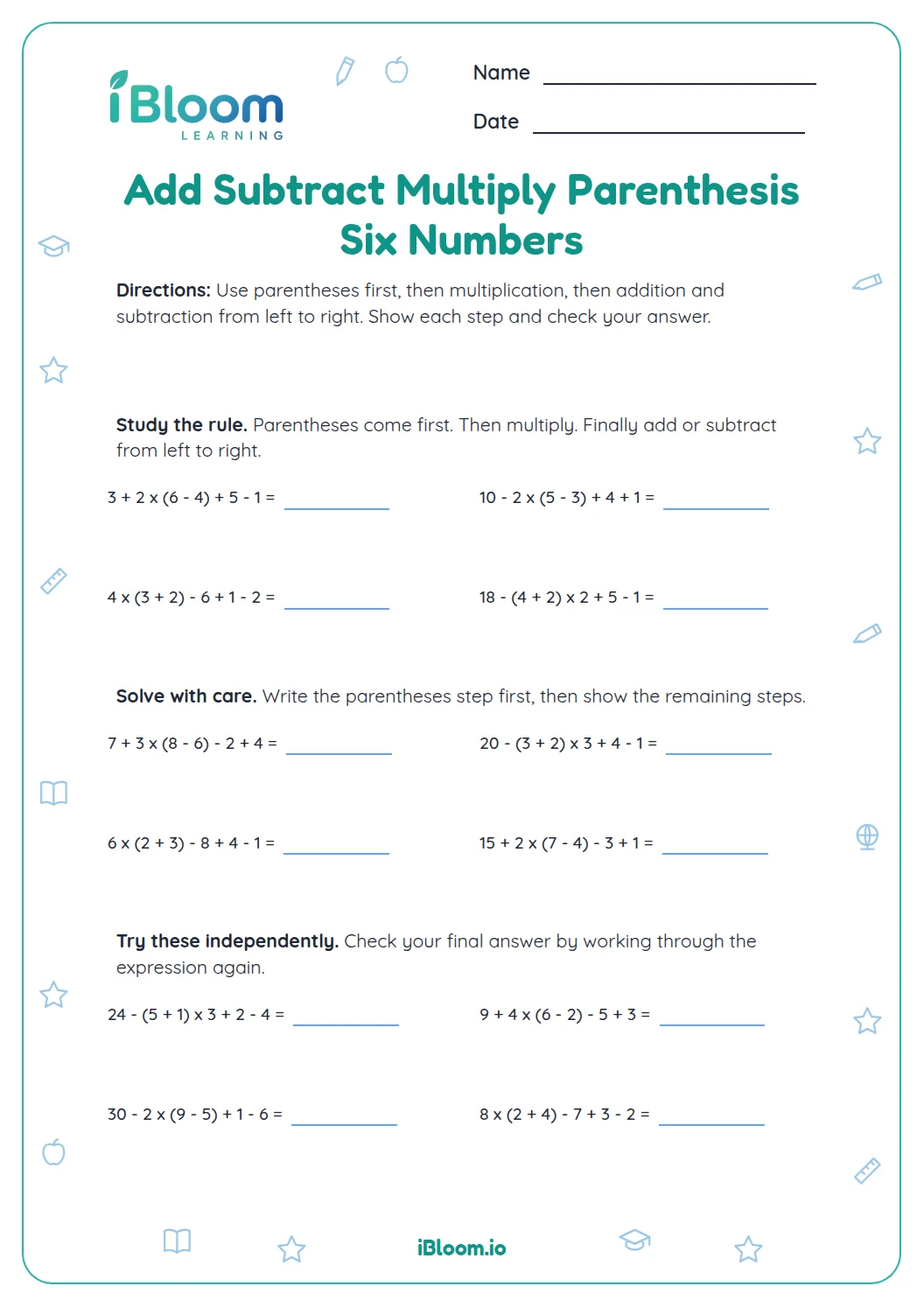
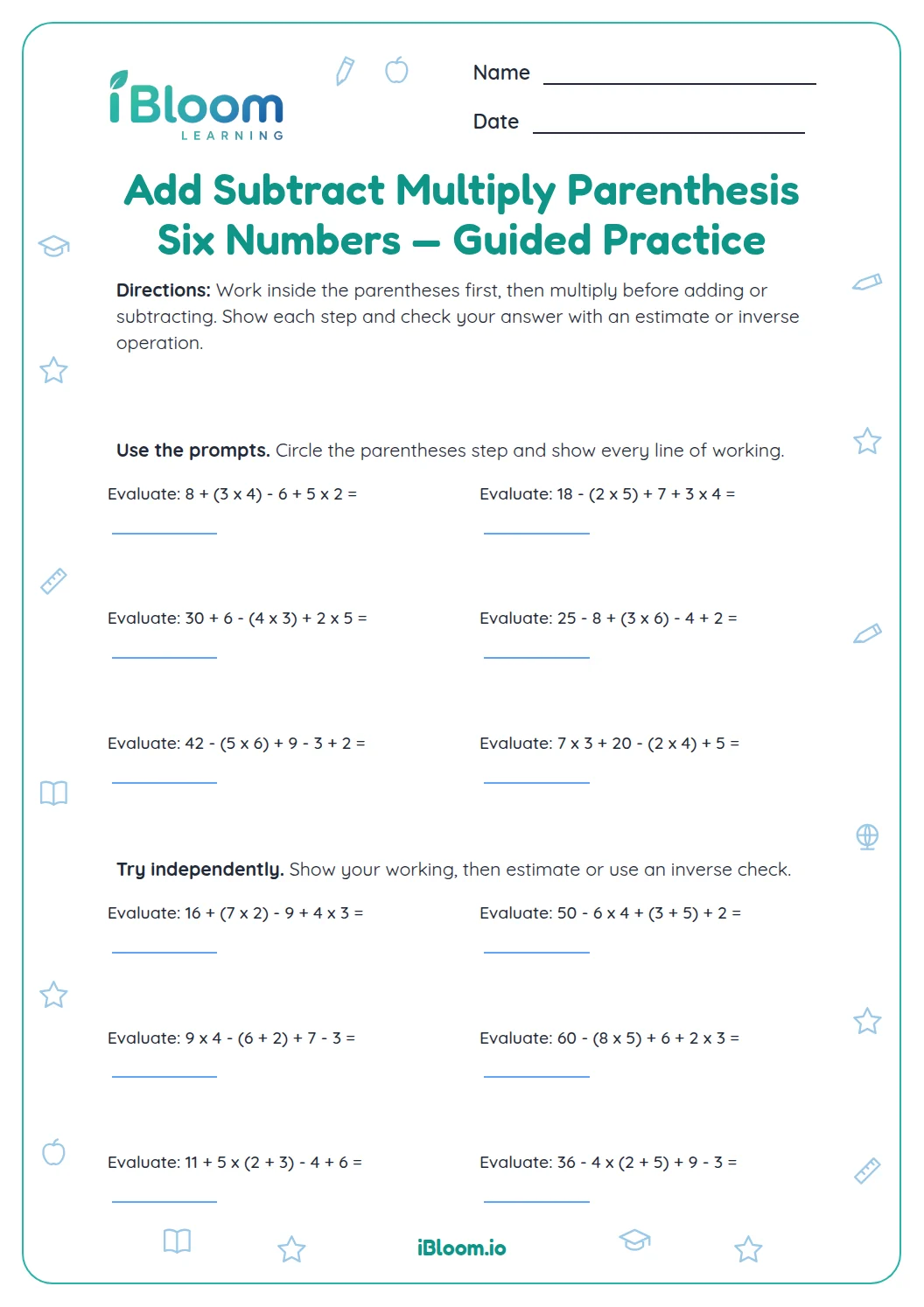
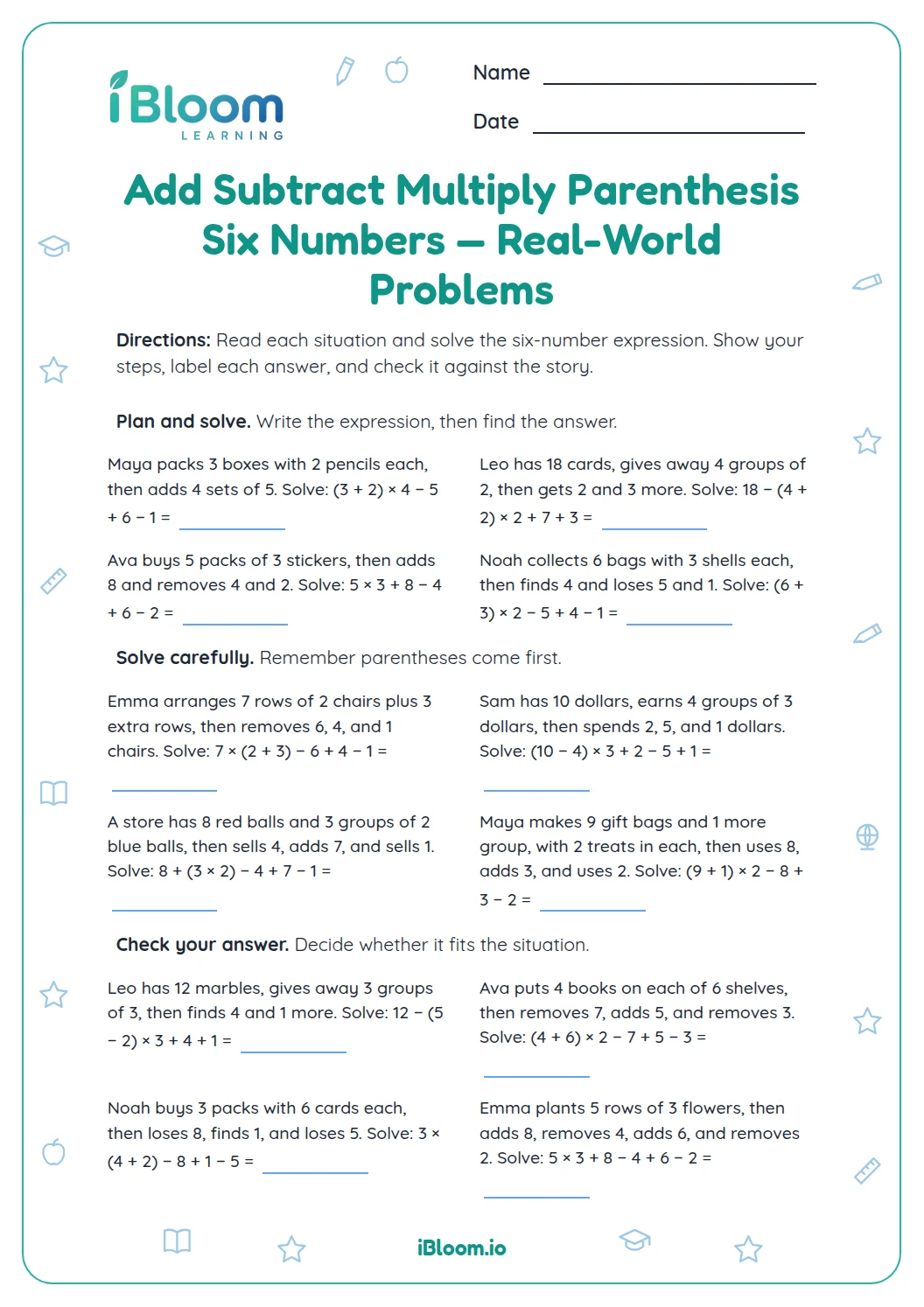
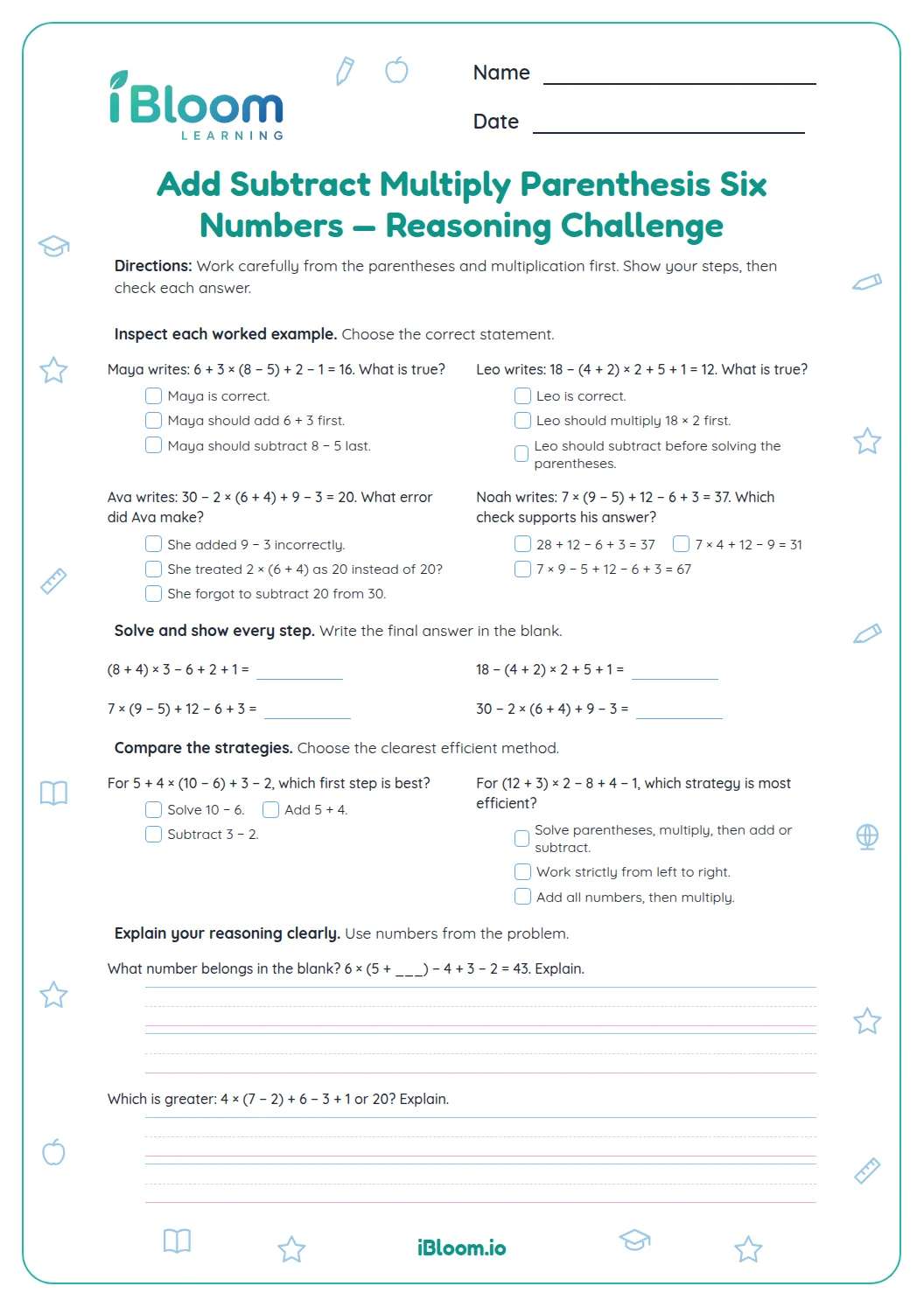
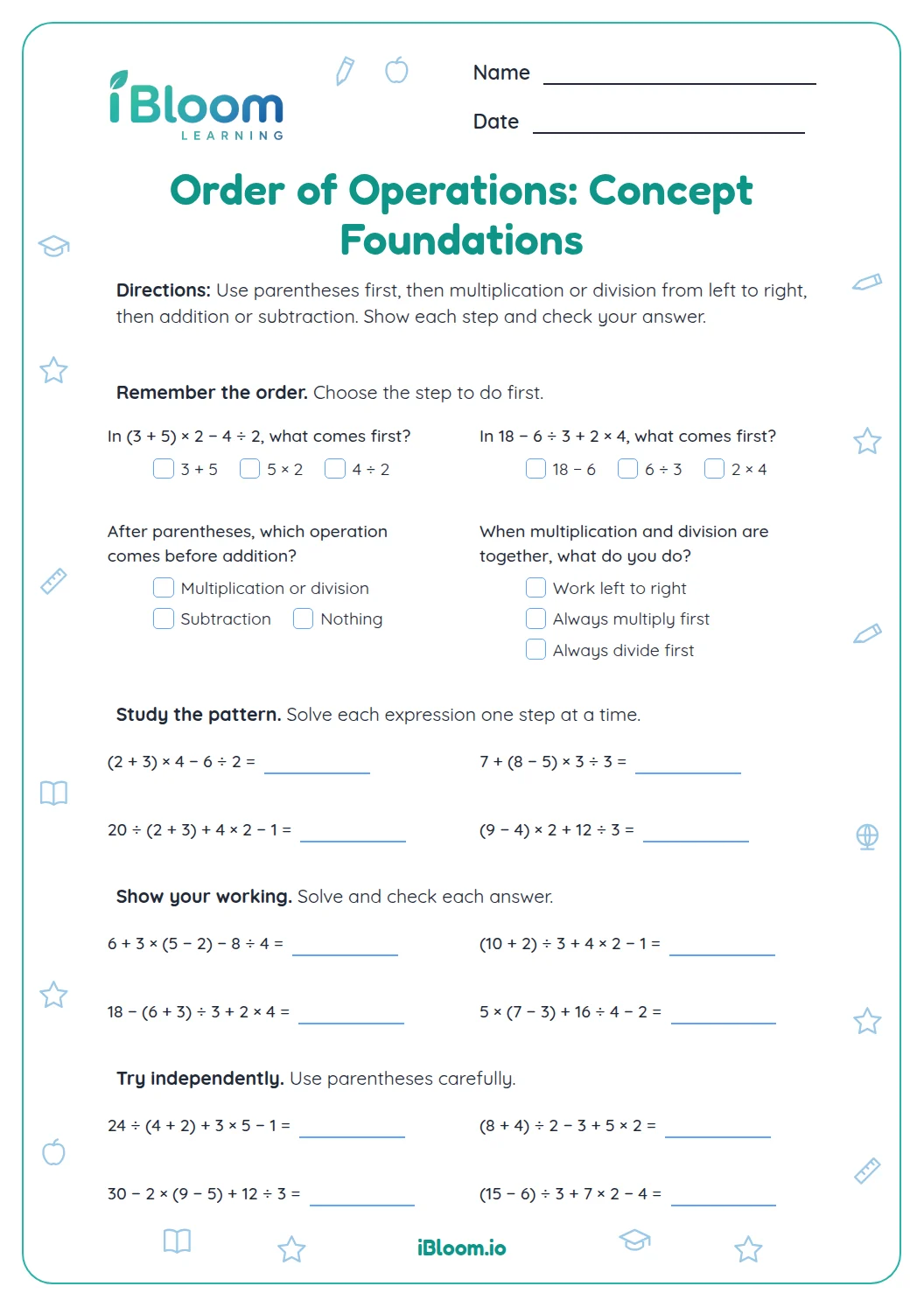
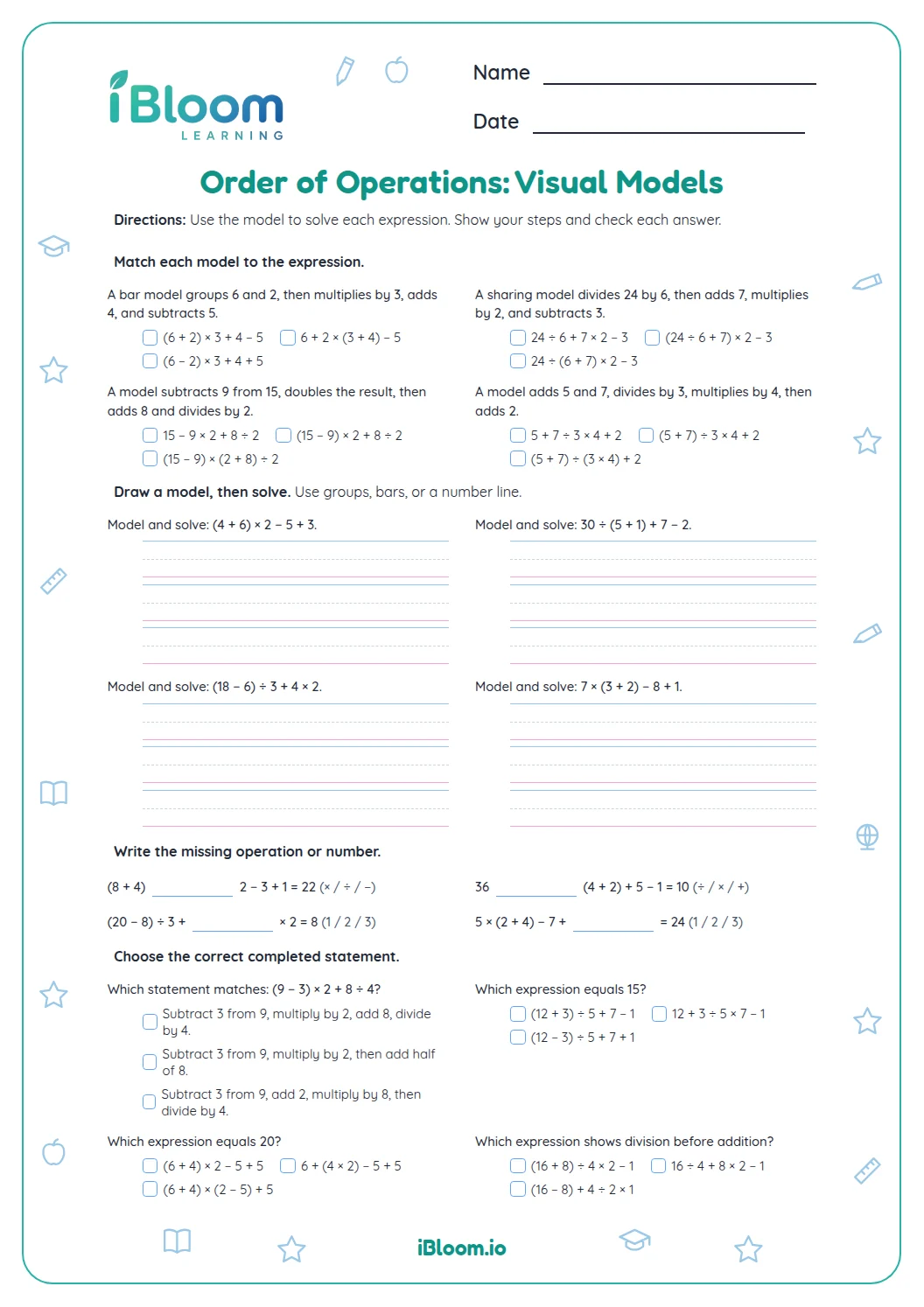
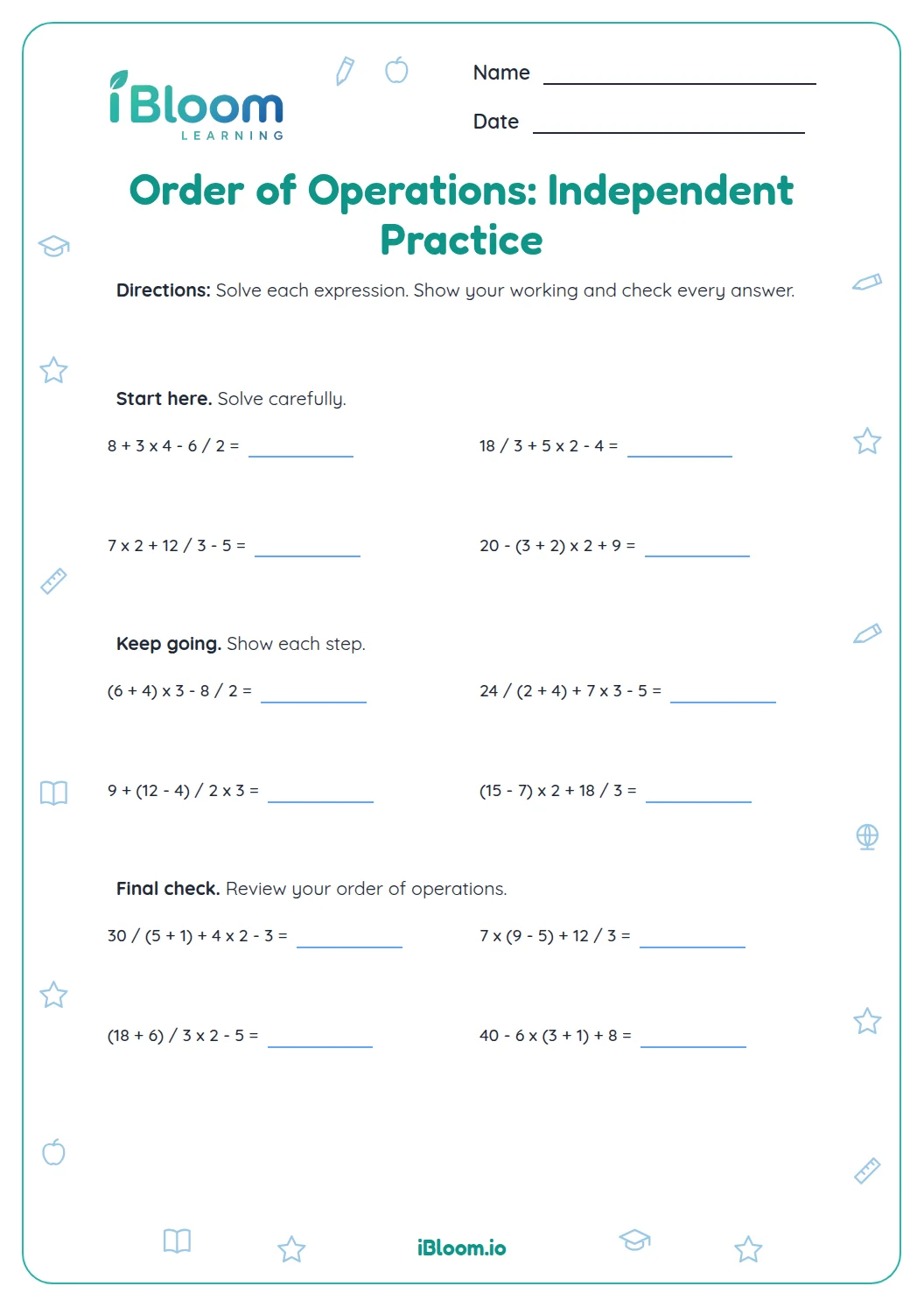
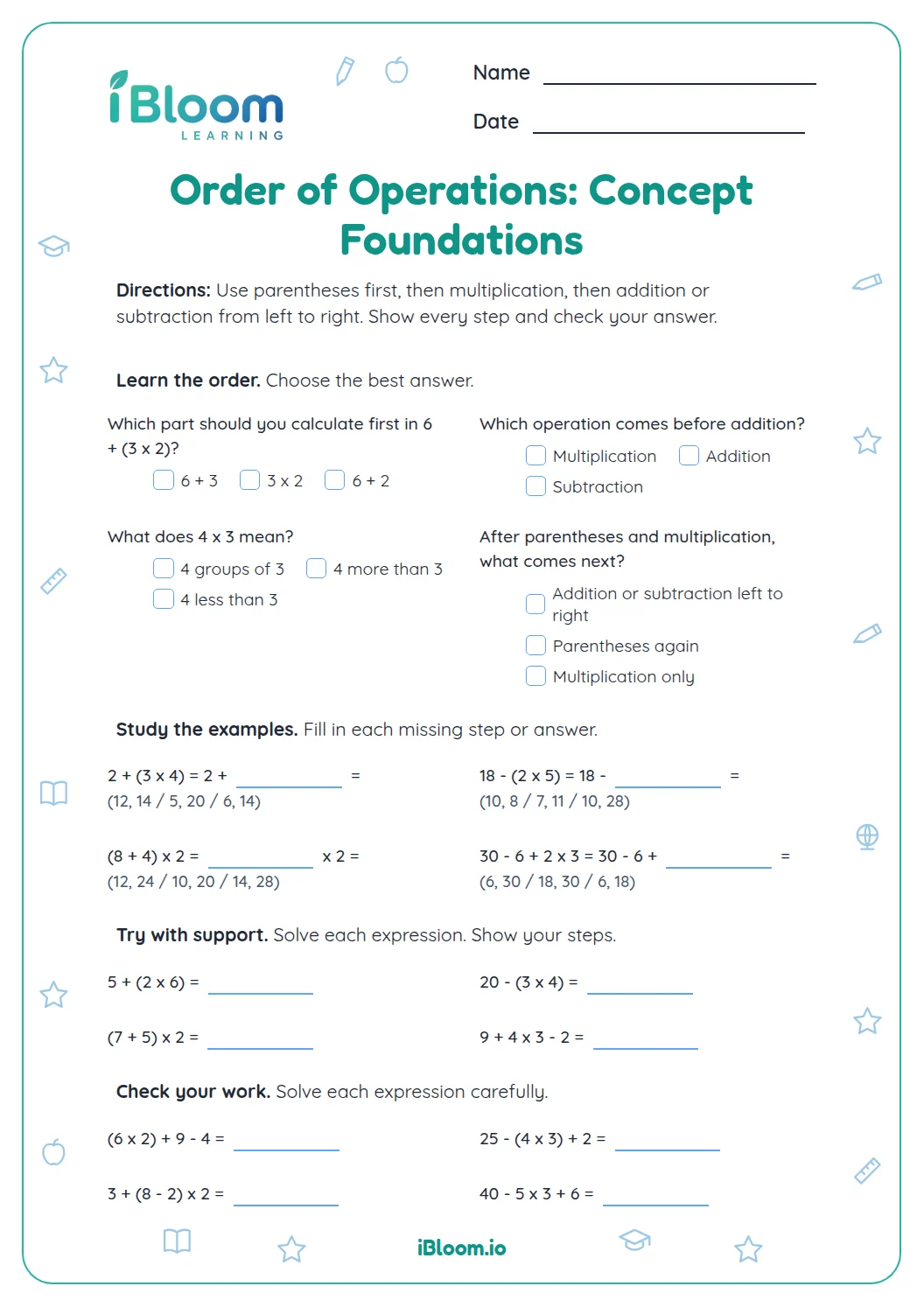
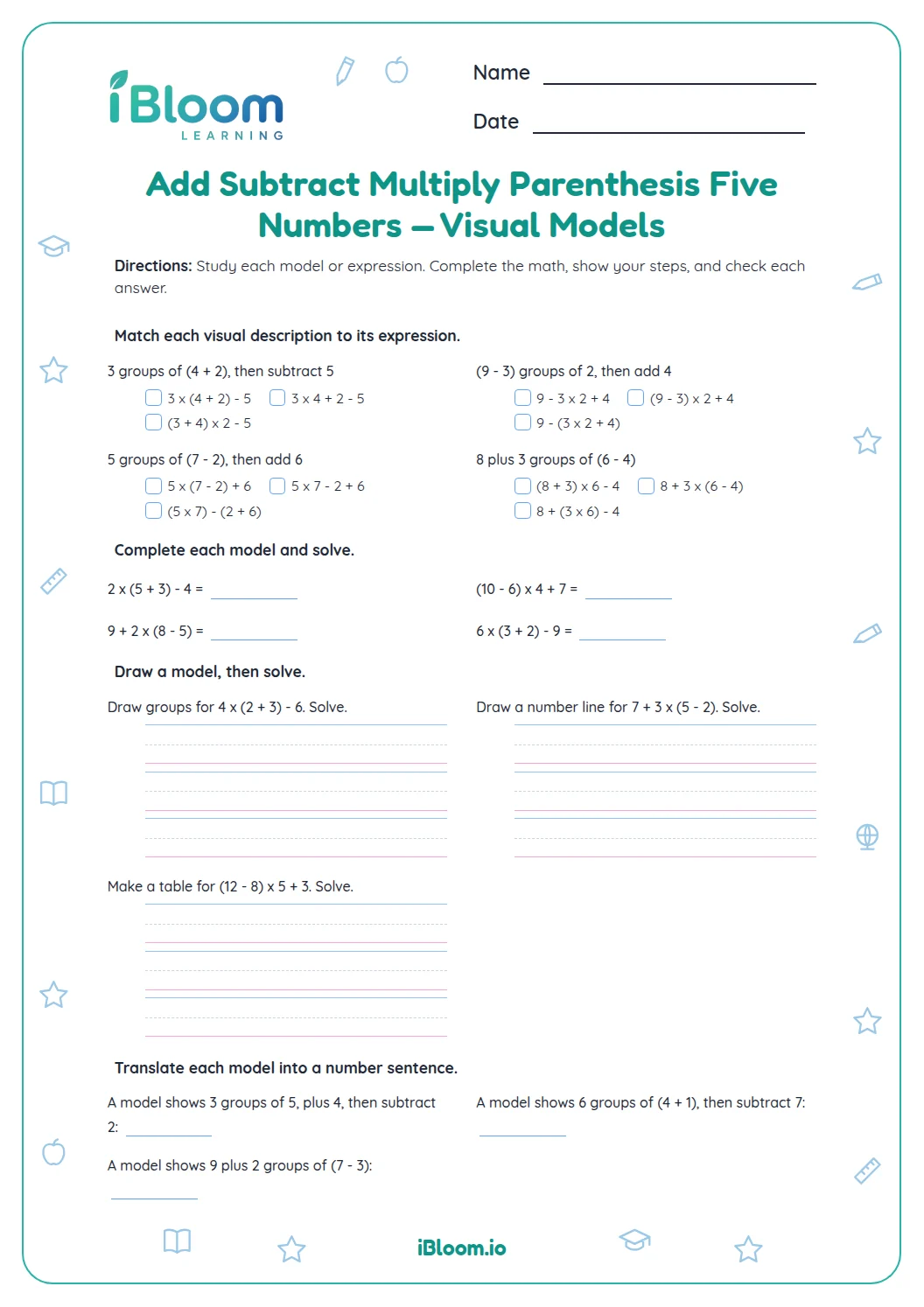
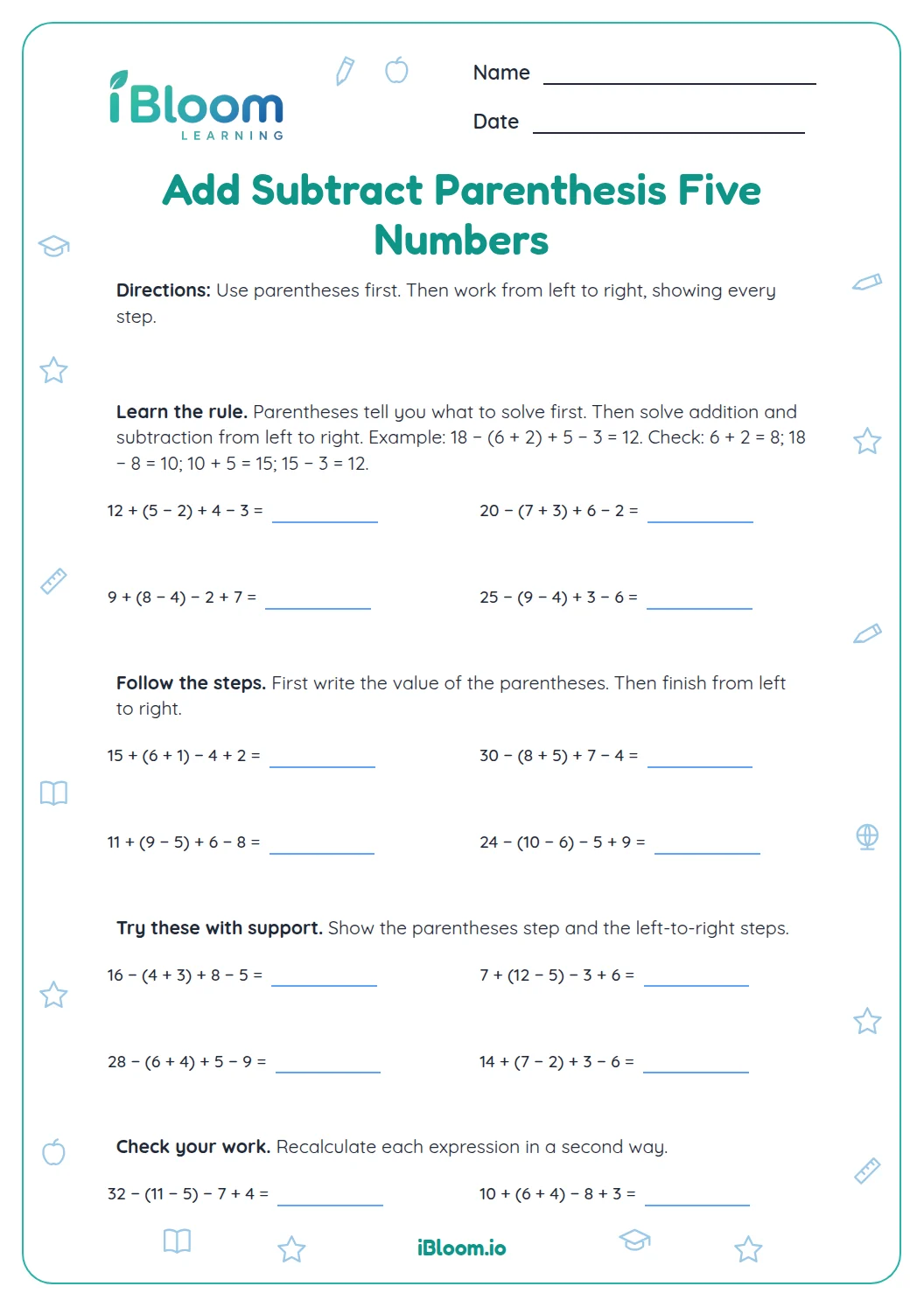
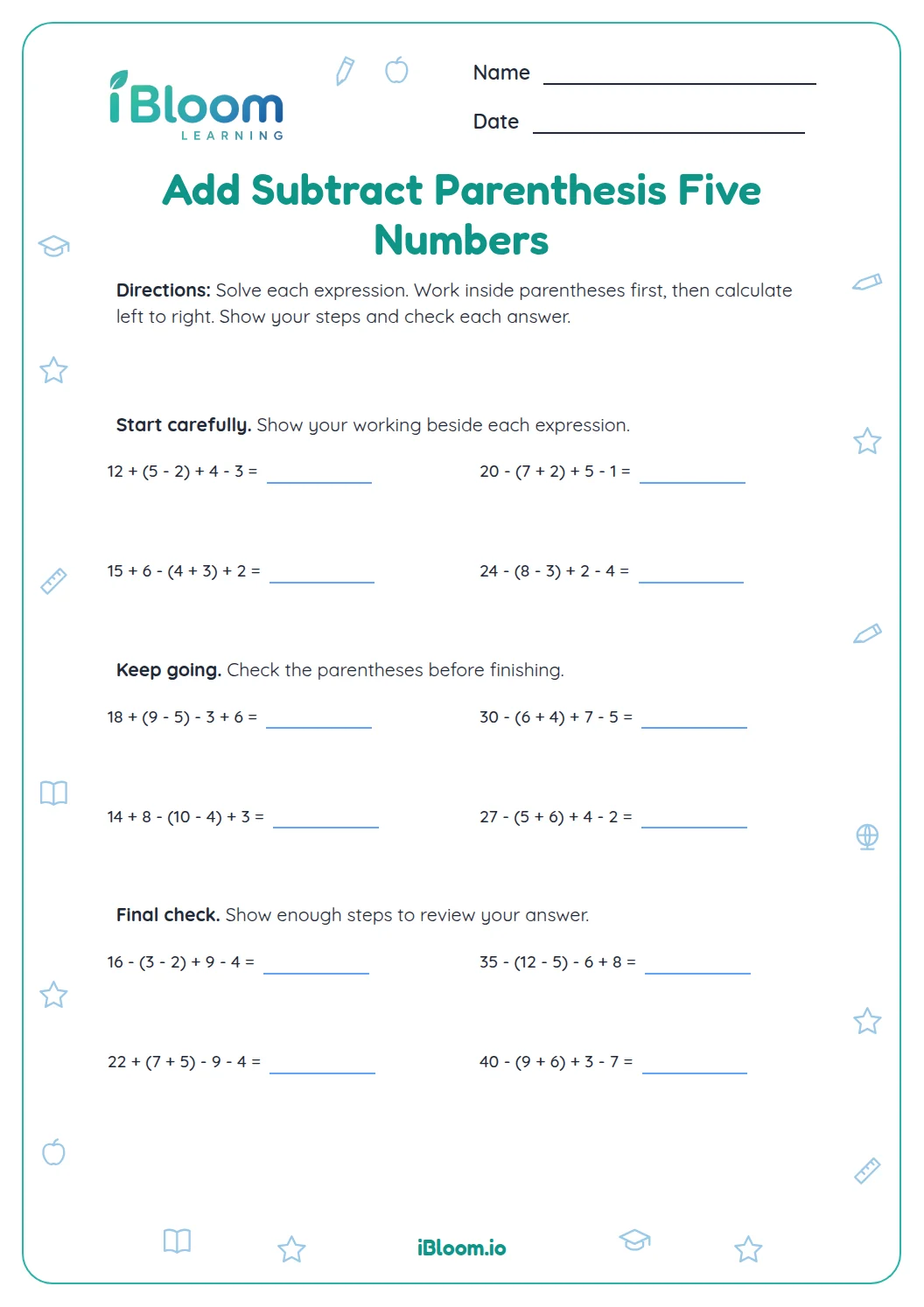
This free printable Grade 4 worksheet gives students 16 expressions to evaluate using parentheses, multiplication, addition, and subtraction. Each expression has six numbers. Students begin by evaluating, then compare expressions and solve a missing-value equation before completing more evaluations. The key idea is to work inside parentheses first, multiply next, and then add or subtract from left to right. The sheet practices CCSS 5.OA.A.1 and includes a separate answer key.
Aligned to 5.OA.A.1
What comes first in a six-number expression?
Evaluate the parentheses first. Then multiply before adding or subtracting. When only addition and subtraction remain, move from left to right. For question 1, 12 − 7 = 5, and 3 × 5 = 15; then calculate 8 + 15 + 4 + 2.
- 18 + 3 × (12 − 7) + 4 + 2
- 212 − 7 = 5
- 33 × 5 = 15
- 48 + 15 + 4 + 2 = 29
How do parentheses change the work?
Parentheses group the operation that must be completed first. In question 9, calculate the grouped difference before multiplying; compare that result with the expression on the right, where multiplication is done before subtraction.
How can a missing value be found?
Undo the operations around the blank while keeping the equation balanced. For question 10, 3 × (___ − 4) + 5 + 2 − 1 = 33: undo the addition and subtraction, divide by 3, then add 4 to find 13.
How to use this worksheet
- 1Start with the operation inside parentheses.
- 2Multiply the result by any factor beside it.
- 3Complete addition and subtraction from left to right.
- 4For a comparison, evaluate both sides before choosing a sign.
- 5For a missing value, undo the operations in reverse order.
- 6Check your result in the original expression.
Common mistakes and quick fixes
The mistake
Adding before multiplying.
The fix
Finish the multiplication before adding or subtracting outside the parentheses.
The mistake
Doing subtraction before multiplication when they appear in the same expression.
The fix
Multiply first; then work through addition and subtraction from left to right.
The mistake
Stopping after finding the value inside parentheses.
The fix
Continue through every operation until the full expression has one value.
Common Core alignment
This worksheet gives students practice with the standard below.
Evaluate and compare expressions with parentheses, multiplication, addition, and subtraction.
On this sheet: The items practice evaluating numerical expressions with parentheses and order of operations.
Show the official wordingHide the official wording
Use parentheses, brackets, or braces in numerical expressions, and evaluate expressions with these symbols.
What to practice next
Make more practice
Further reading
Questions parents and teachers ask
What should students calculate first?
Start with the expression inside parentheses. For question 1, 12 − 7 equals 5. Then multiply 3 × 5 and finish the addition from left to right, giving 29. The six values are evaluated in the order printed, rather than simply moving left to right.
Does multiplication always come before subtraction?
Yes, multiplication is completed before addition or subtraction unless parentheses group a different operation. Once only addition and subtraction remain, work from left to right. The worksheet asks students to apply this order in each six-number expression. Parentheses can change which subtraction happens before multiplication.
How do parentheses affect question 9?
They make the subtraction inside the parentheses happen before multiplication. Evaluate the left expression using that grouping, then evaluate the right expression using multiplication before subtraction. Comparing the two results tells which side is greater. This comparison checks how grouping changes the order of work.
How do I solve the missing number in question 10?
Undo the operations around the blank in reverse order. Subtract 5 and 2 from 33, add 1 back, and divide by 3 to get 9. Then add 4 to the blank inside the parentheses. The missing number is 13; substituting it gives 3 × 9 + 5 + 2 − 1 = 33.
How many questions are on the worksheet?
There are 16 questions on two worksheet pages, followed by a separate two-page answer key. The expressions use six numbers and practice parentheses with multiplication, addition, and subtraction. Students can pause after each part to compare their process with the worked example and key.