






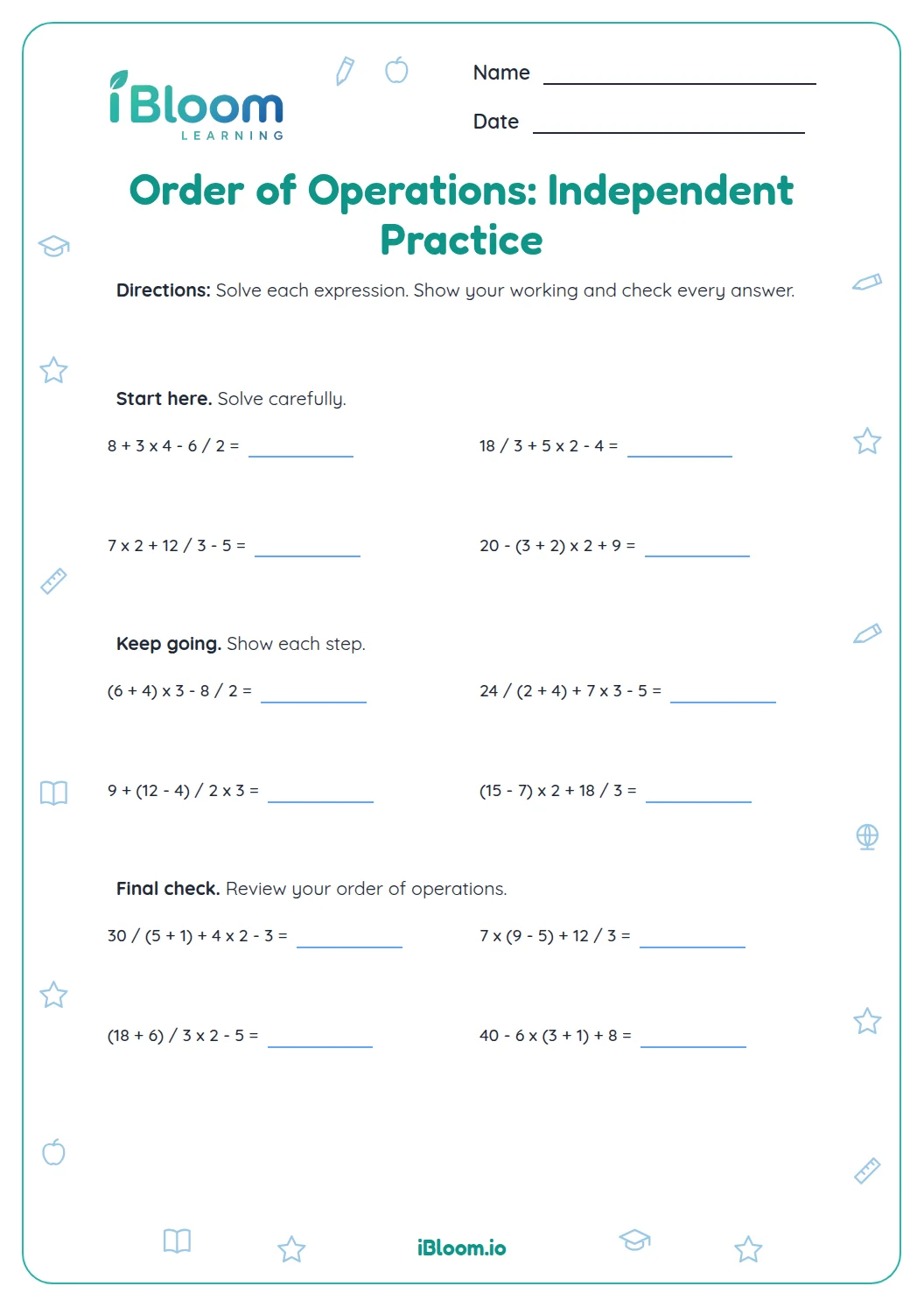
About this worksheet
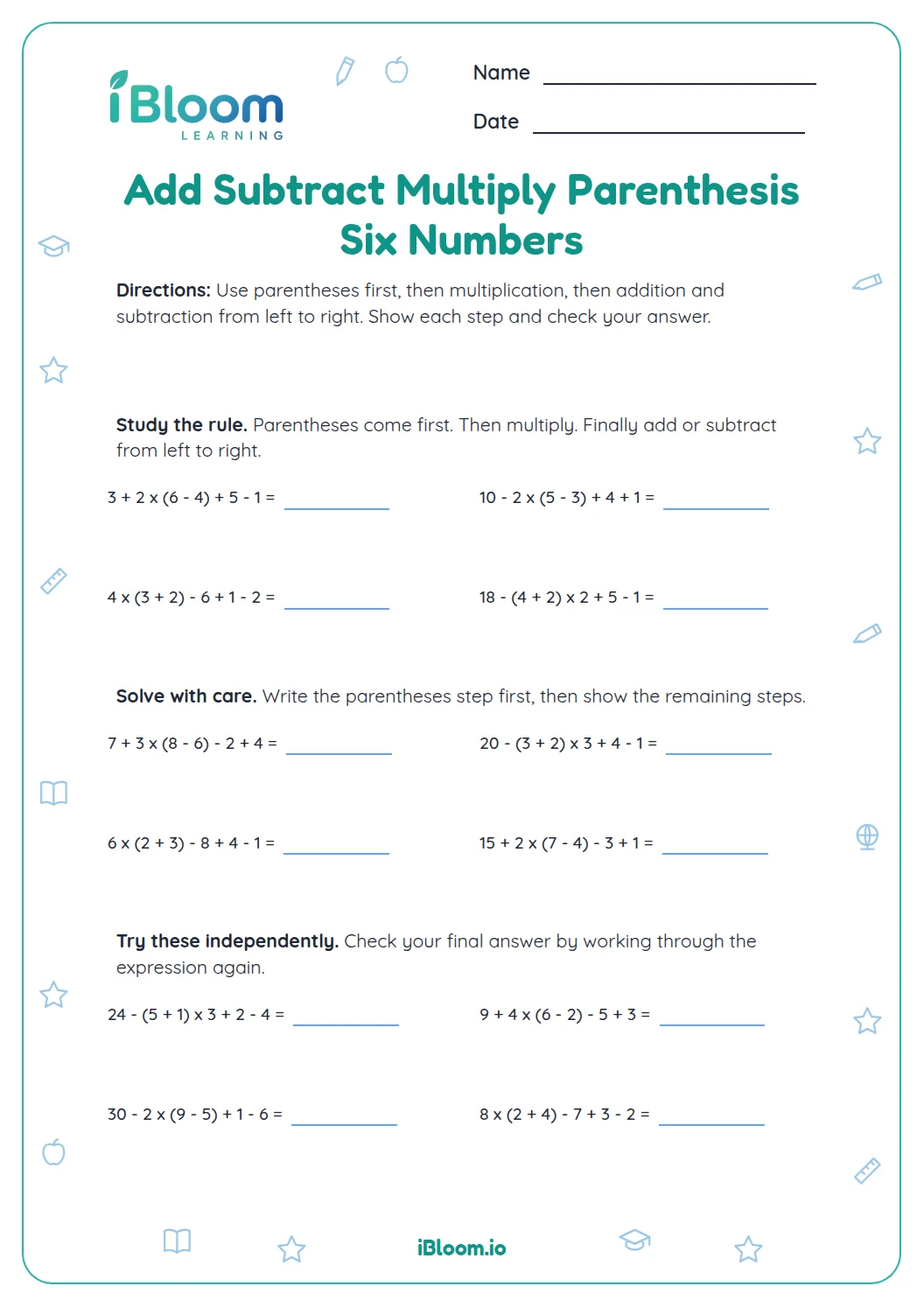
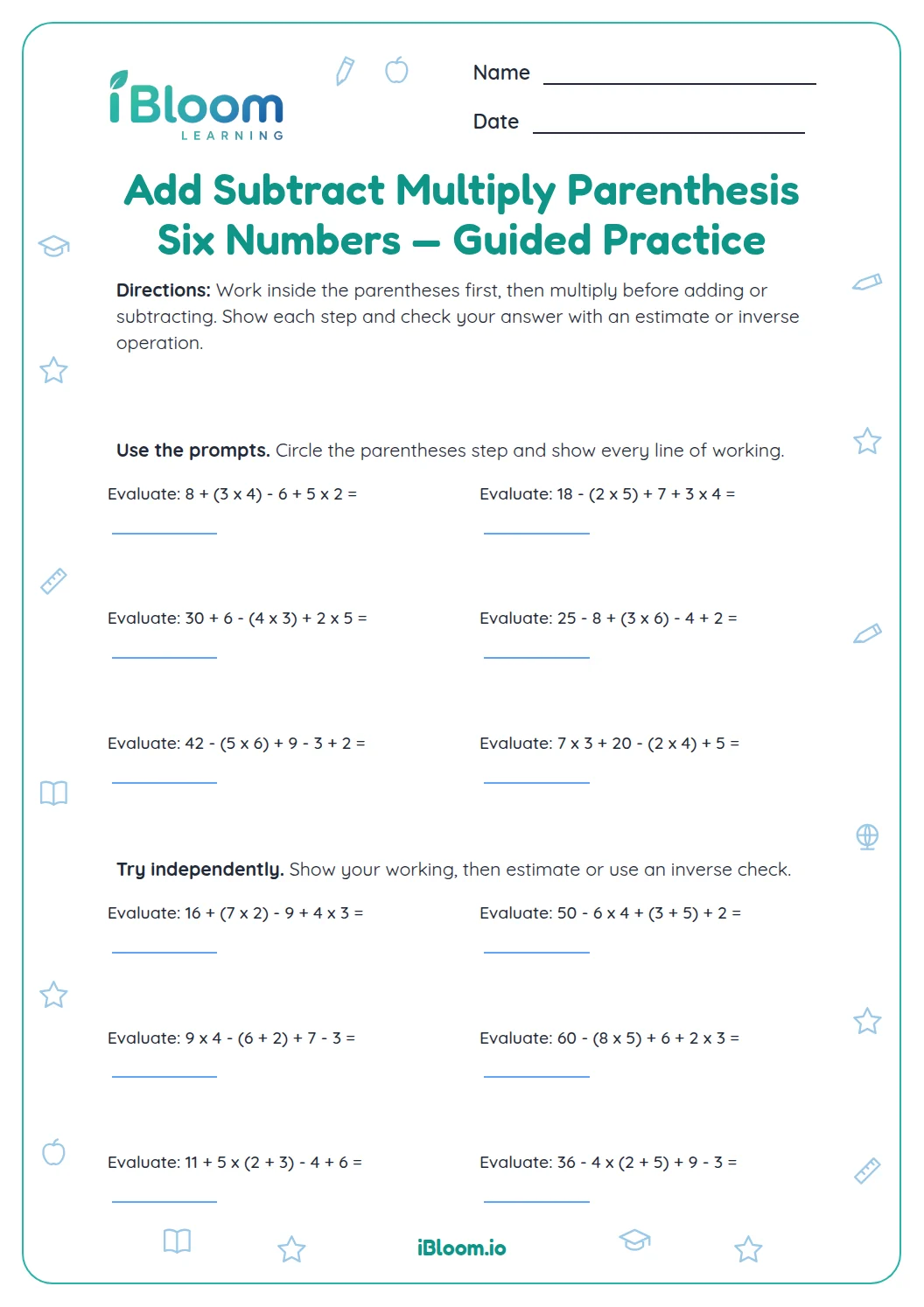
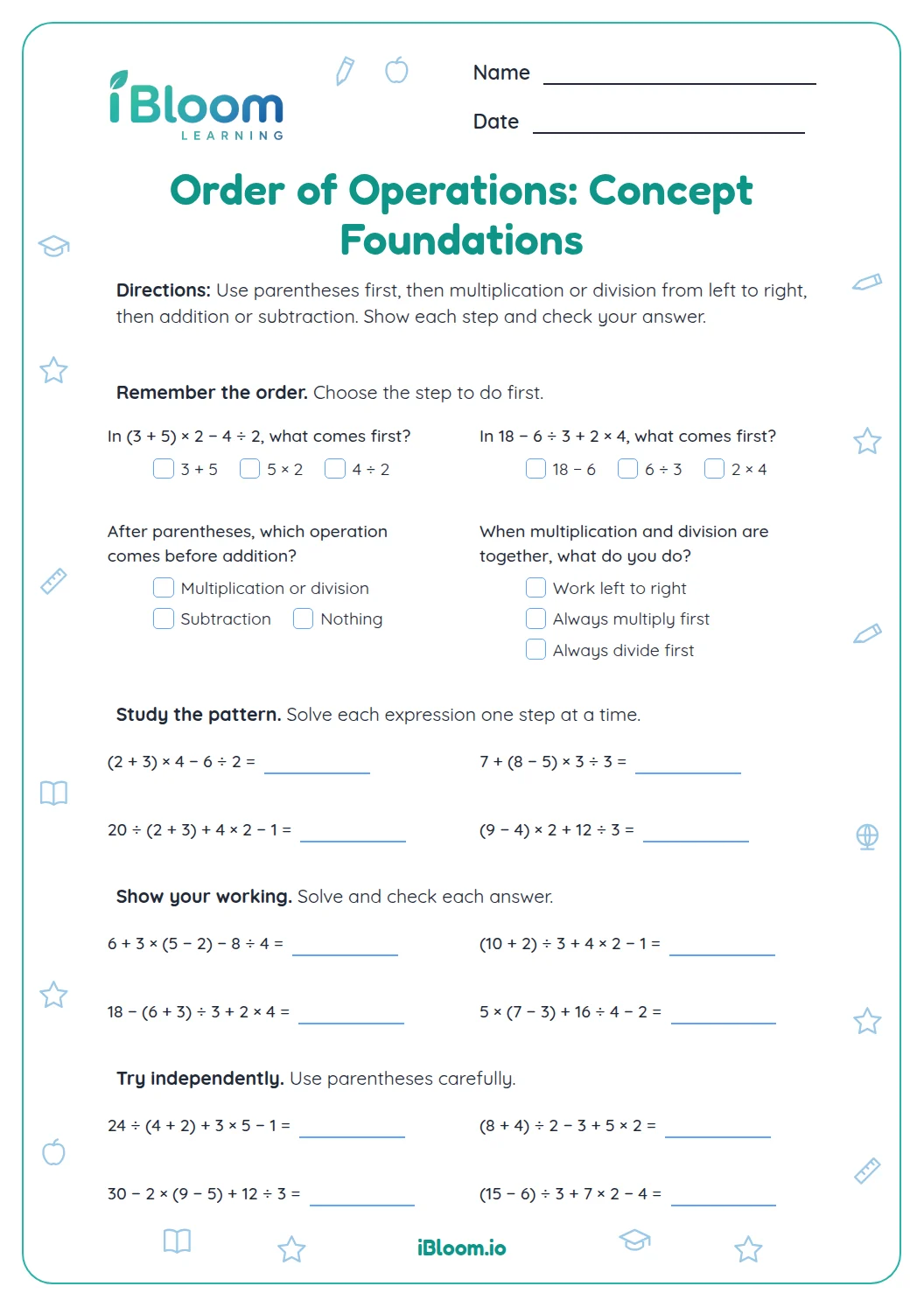
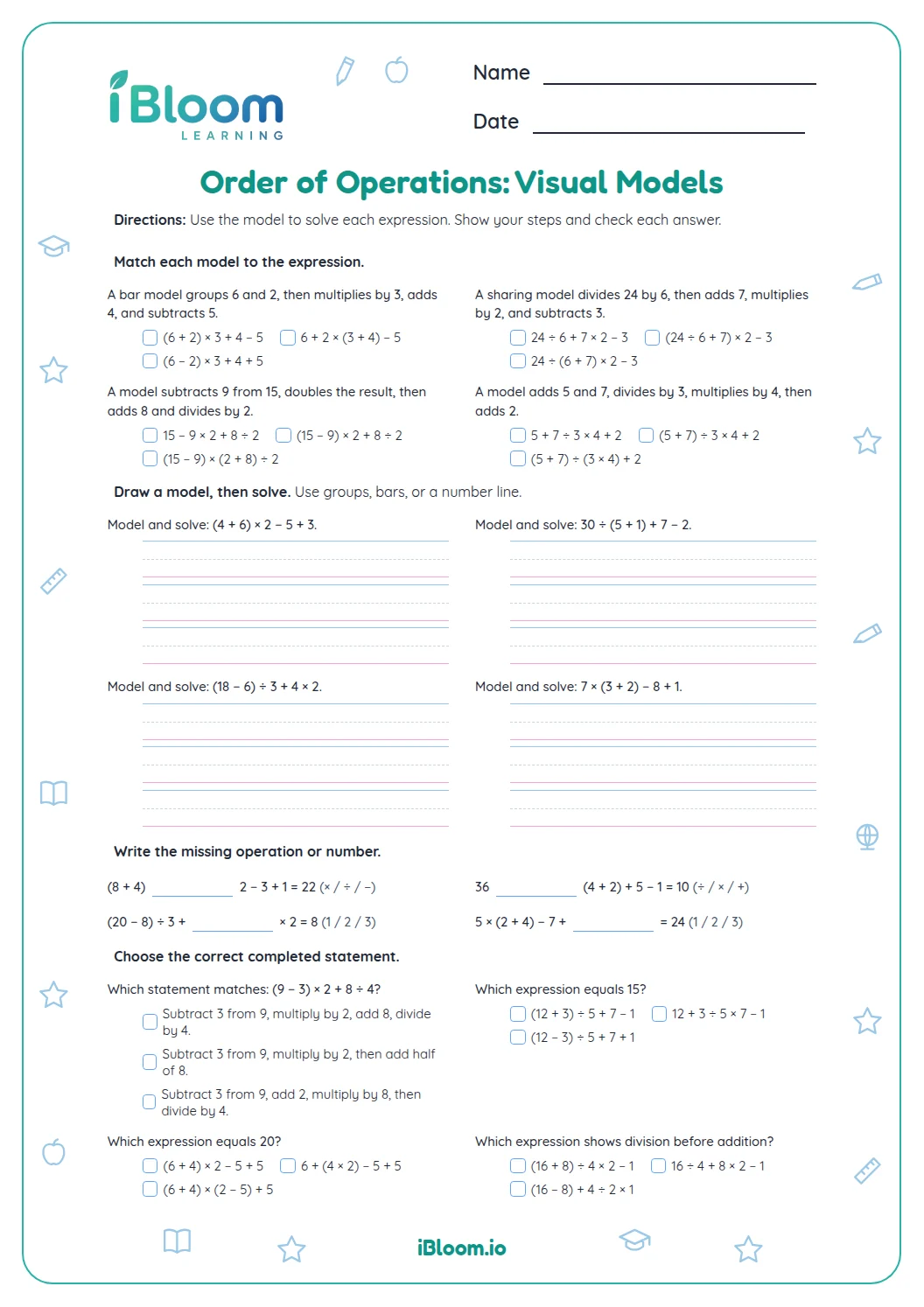
This free Grade 4 worksheet gives students 16 expressions to evaluate independently. Each uses exactly five numbers, parentheses, addition, subtraction and multiplication. Part A has one pair of parentheses; Part B has two pairs, so students must keep track of more than one grouped calculation. The problems practice Common Core 5.OA.A.1 through evaluating numerical expressions with grouping symbols. All results are whole numbers, and work space lets students record intermediate steps. A separate answer key gives the final value of every expression.
Aligned to 5.OA.A.1
Where does the calculation begin?
Find the parentheses before you do any arithmetic. In question 1, the grouped sum 8 + 4 becomes 12. Copy the rest of the expression in the same order so that no number or sign disappears.
After grouping, multiplication takes priority. The remaining addition and subtraction share a priority, so move from left to right.
- 1(8 + 4) × 3 − 5 + 2
- 212 × 3 − 5 + 2
- 336 − 5 + 2
- 431 + 2 = 33
How do two sets of parentheses change the work?
Part B gives two separate groups in each expression. Simplify each group, then copy the expression with those values in place. Question 8 becomes 40 − 5 × 6, so the product 30 comes before the final subtraction.
Question 11 places multiplication inside one group. The same operation rules apply both inside and outside parentheses. Students can put a small check above each completed group to avoid doing it twice.
How can students check their independent work?
Read each new line against the line before it. Only the calculation just completed should change; every untouched sign and number should stay in place.
If a final answer differs from the key, find the first line where the order changed. Rework from there. This shows whether the problem was a multiplication fact, a copied sign or the order of the operations.
How to use this worksheet
- 1Read the directions, then mark each pair of parentheses.
- 2Complete Part A independently, writing an intermediate line in each work area.
- 3In Part B, simplify both groups before combining them.
- 4Check the final values against the key after completing a part.
- 5For an error, identify the first incorrect step and recalculate from that line.
Mistakes to check and how to fix them
The mistake
Adding 7 + 3 first in question 3.
The fix
The expression is 7 + 3 × (9 − 5) − 2. Group to get 4, then multiply 3 × 4.
The mistake
Combining 5 + 2 in question 1 after multiplying.
The fix
Read 36 − 5 + 2 from left to right: 31 + 2 = 33.
The mistake
Subtracting 40 − 5 before multiplying in question 8.
The fix
After the groups, write 40 − 5 × 6. Multiply to get 30, then subtract to get 10.
Common Core alignment
Evaluate five-number expressions with parentheses and three operations.
On this sheet: Students evaluate all 12 expressions by respecting the grouping and operation order.
Show the official wordingHide the official wording
Use parentheses, brackets, or braces in numerical expressions, and evaluate expressions with these symbols.
What to practice next
Make more practice
Further reading
Questions parents and teachers ask
Does every question really use five numbers?
Yes, all 12 expressions contain exactly five numbers. Each also includes addition, subtraction, multiplication and at least one pair of parentheses. Part A uses one group in each problem, while Part B uses two groups to make the organization of the calculation more demanding.
Why does question 2 have an answer of 10?
Question 2 simplifies to 24 − 5 × 4 + 6, then 24 − 20 + 6. Multiplication comes before the subtraction outside parentheses. Finish from left to right: 24 − 20 is 4, and 4 + 6 is 10. Check each line against the original expression.
Should students add before subtracting?
Students should work addition and subtraction from left to right after finishing parentheses and multiplication. Those two operations have the same priority. In question 1, the last line is 36 − 5 + 2, which becomes 31 + 2. Adding 5 + 2 first would change the calculation.
How much work should students record?
Students should record enough intermediate steps to show the order they used. One line after simplifying parentheses and another after multiplication will make most answers easy to check. The work areas are for those calculations; students can use an extra sheet if they write large or want more space.
What does the answer key include?
The separate key gives the final value of each of the 12 expressions. Use it after a student finishes a part, then review any incorrect result together. Ask the student to explain the first operation they chose and compare their intermediate lines with the original expression.