






About this worksheet
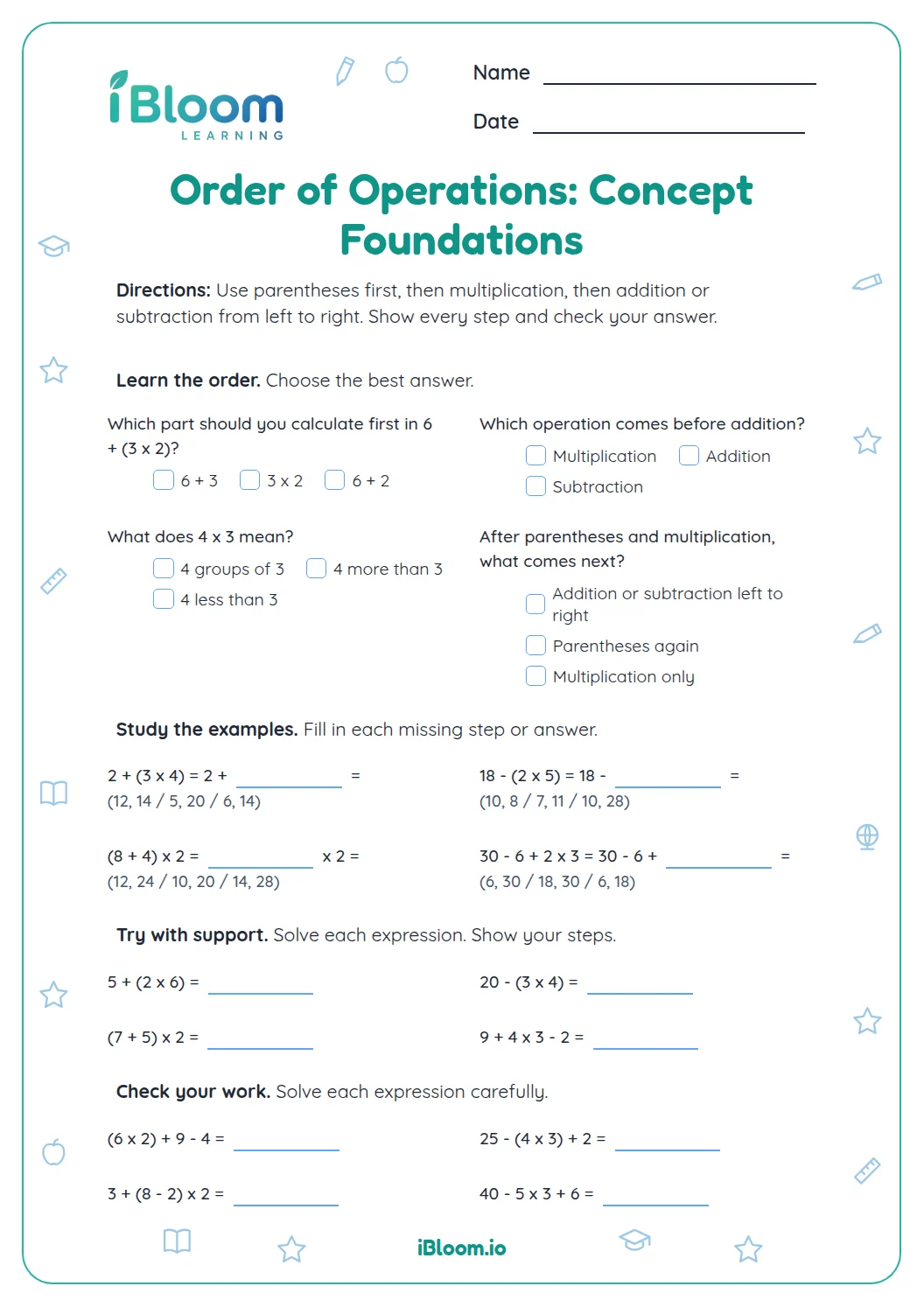
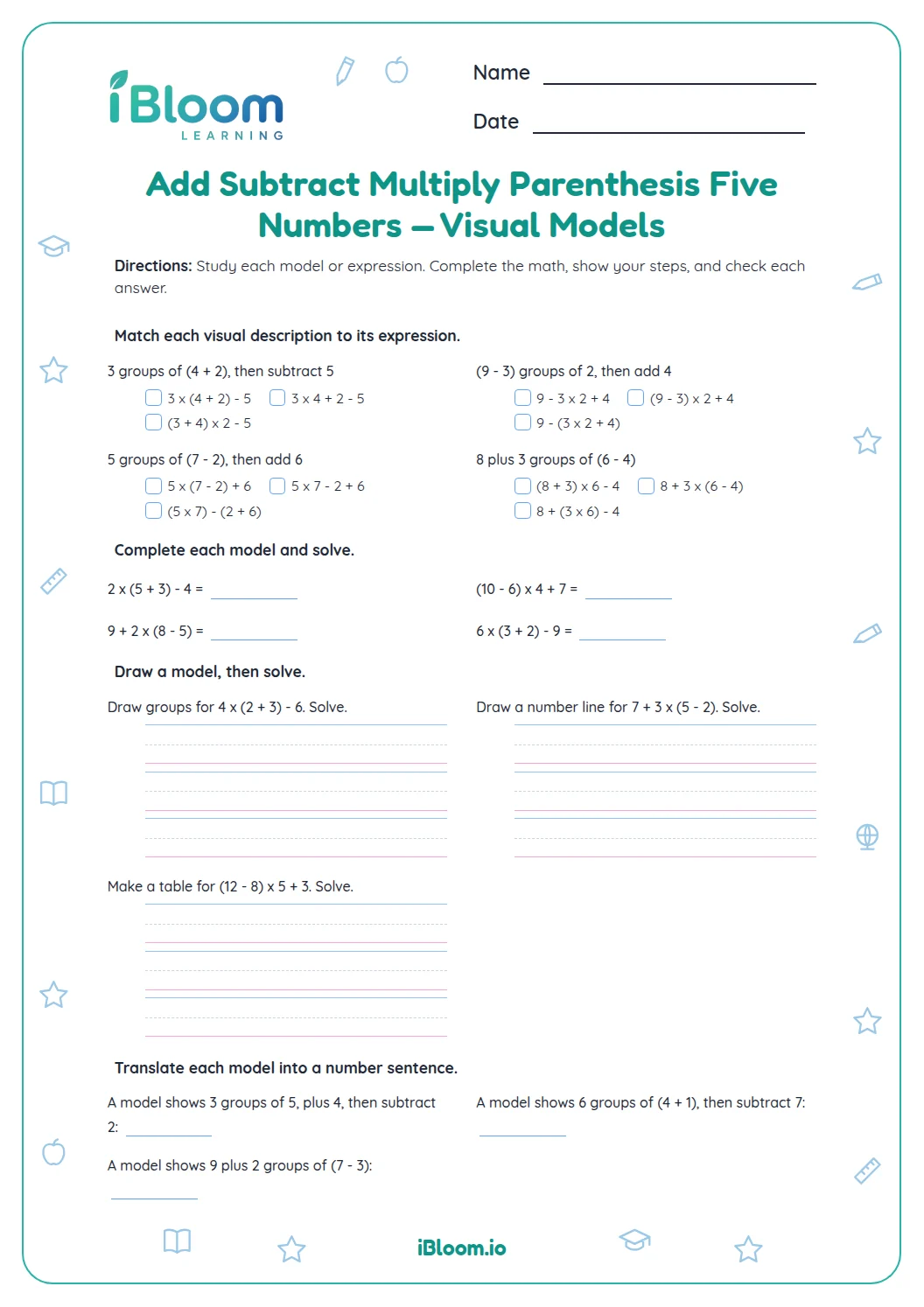
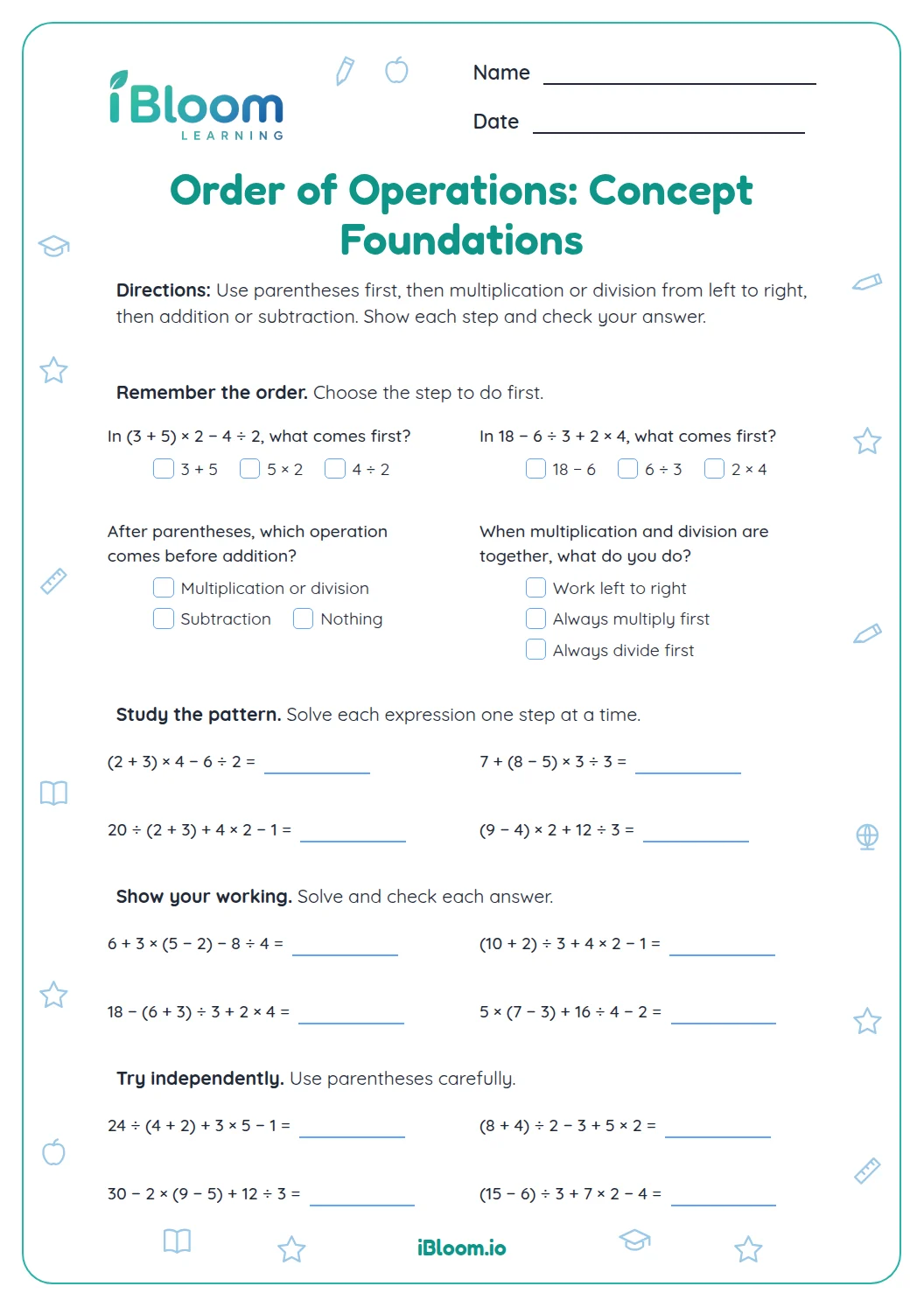
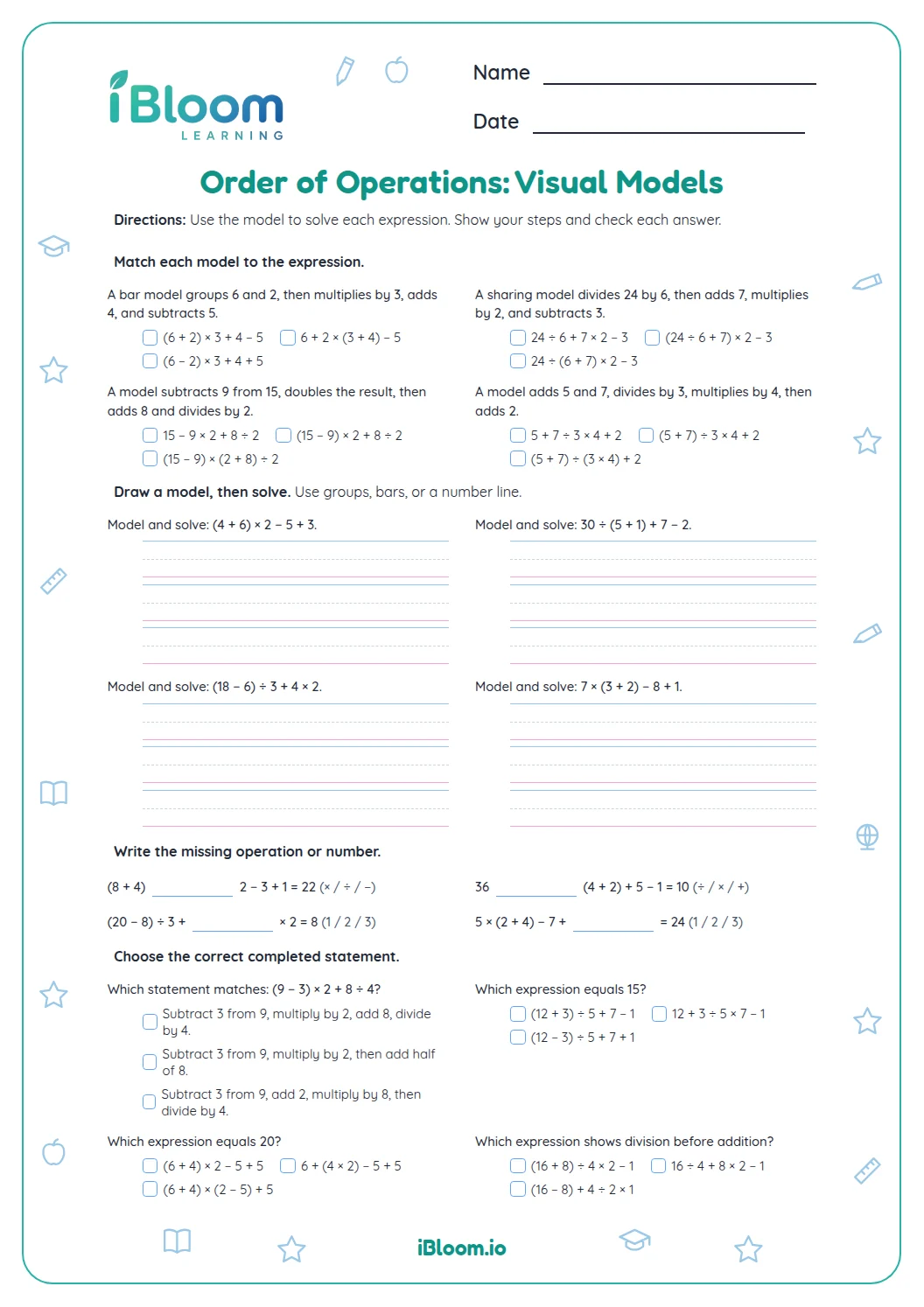
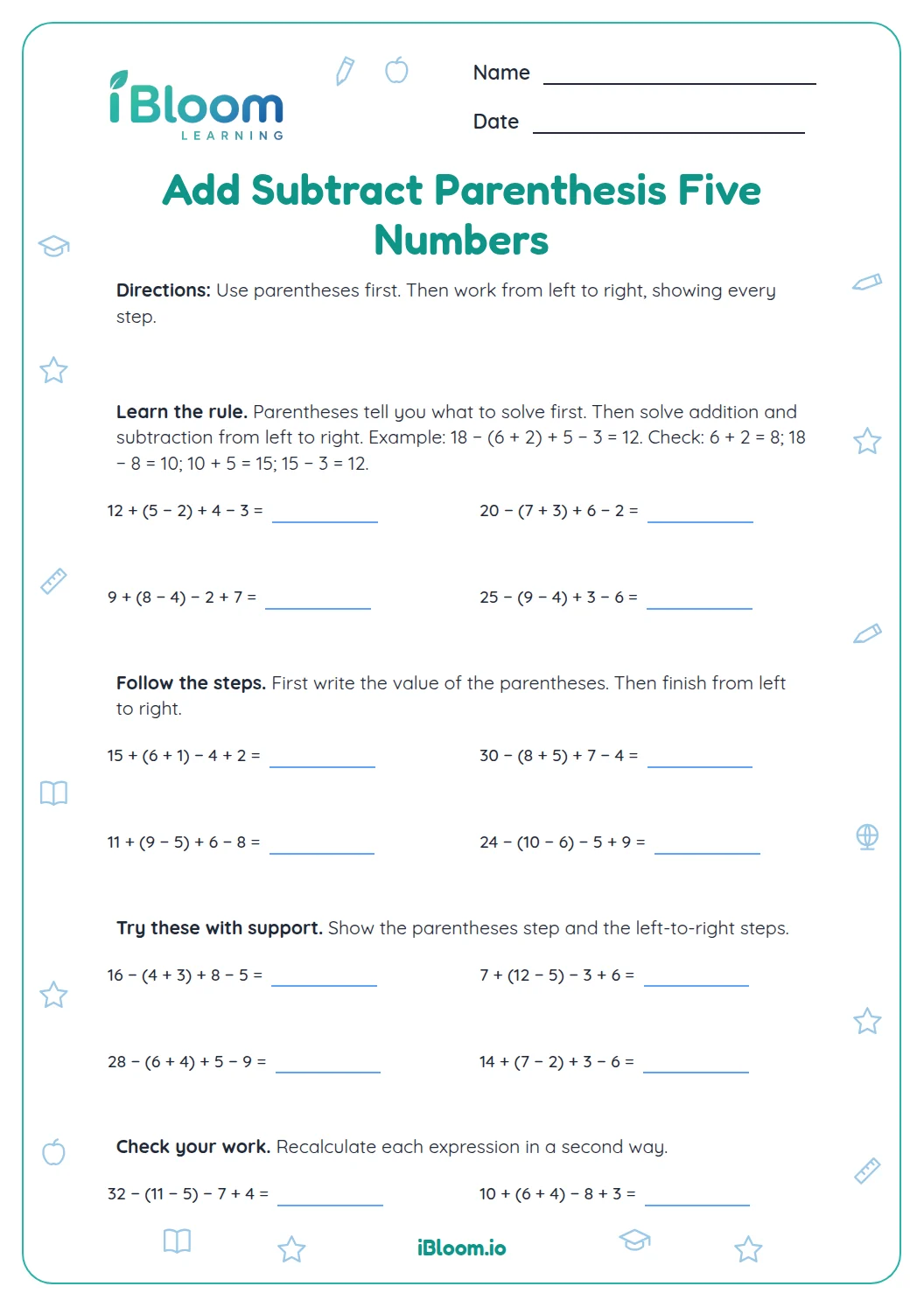
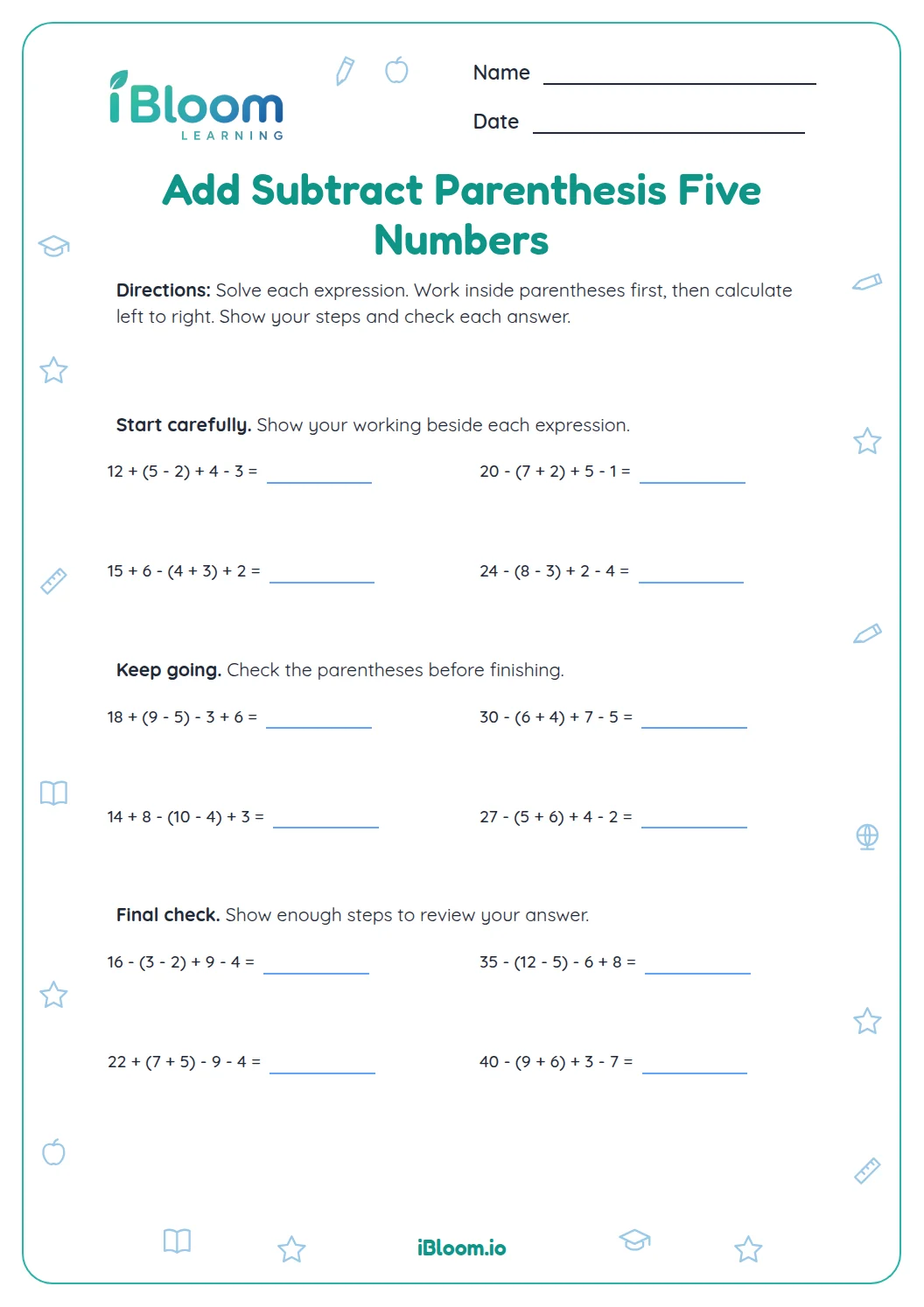
This Grade 4 worksheet challenges children to evaluate expressions using addition, subtraction, multiplication, and parentheses. Each expression uses five numbers; later questions compare expressions and ask children to explain a grouping error. The sheet has 14 questions and a separate answer key.
What do parentheses tell me to do first?
Evaluate inside the parentheses before multiplying or adding outside them. In (6 + 4) × 3 − 8 + 2, add 6 + 4, multiply by 3, then finish.
- 1(6 + 4) × 3 − 8 + 2
- 210 × 3 − 8 + 2
- 330 − 8 + 2 = 24
When do I multiply?
After parentheses, multiplication comes before addition and subtraction. In 7 + (5 × 4) − 6 + 3, calculate 5 × 4 first, then continue left to right.
How can I test a claim about expressions?
Evaluate each expression with its own grouping. (9 + 3) × 3 − 4 + 1 equals 33; 9 + 3 × 3 − 4 + 1 equals 15. Since the values differ, the expressions are not equal.
- 1(9 + 3) × 3 − 4 + 1 = 33
- 29 + 3 × 3 − 4 + 1 = 15
- 3The expressions are not equal.
What makes a clear explanation?
Name the first operation and show enough work to make the order visible. A short sequence explains how you reached the answer.
How to use this worksheet
- 1Copy the expression carefully.
- 2Evaluate parentheses first.
- 3Multiply before addition or subtraction.
- 4Complete addition and subtraction left to right.
- 5For reasoning questions, evaluate both expressions.
Common mistakes and quick fixes
The mistake
Multiplying before evaluating parentheses.
The fix
Finish the grouped operation first.
The mistake
Doing addition and subtraction from right to left.
The fix
After multiplication, move left to right.
The mistake
Assuming same numbers mean same value.
The fix
Evaluate each grouping as written.
What to practice next
Make more practice
Further reading
Questions parents and teachers ask
What does order of operations tell me?
It tells you which operation to do first so the expression has one consistent value. On this sheet, do parentheses first, multiplication next, then addition or subtraction from left to right. Show a short line of work at each step.
Does multiplication always come before addition?
Yes, unless parentheses change the grouping. In 7 + (5 × 4) − 6 + 3, multiplication is first. In (7 + 3) × 4, add inside the parentheses before multiplying. The parentheses determine whether the sum or product is handled first in each example.
How can I tell if two expressions are equal?
Evaluate each expression using its own grouping, then compare. (8 + 2) × 3 − 4 + 1 equals 27; 8 + 2 × 3 − 4 + 1 equals 11. Since the values differ, the expressions are not equal.
What is a common error?
A common slip is multiplying before evaluating a sum inside parentheses, such as changing (6 + 4) × 3 into 6 + 4 × 3. Keep the grouped amount together first: 6 + 4 is 10, then 10 × 3 is 30. Check each choice against this order.
How much work should a child show?
A few clear steps are enough: evaluate the parentheses, multiply if needed, then finish addition or subtraction from left to right. For a comparison, calculate both expressions and show the two values so the conclusion can be checked.