
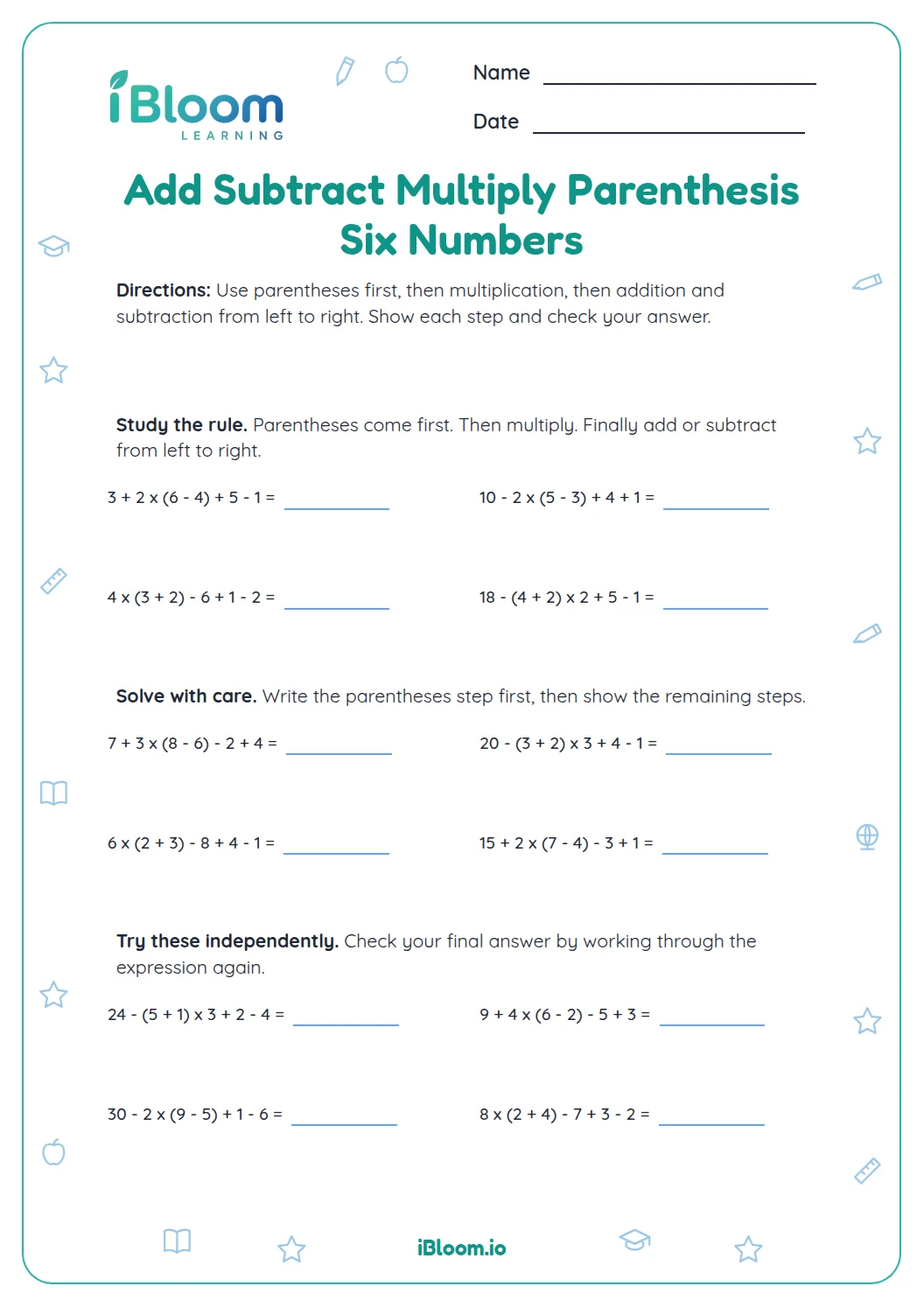
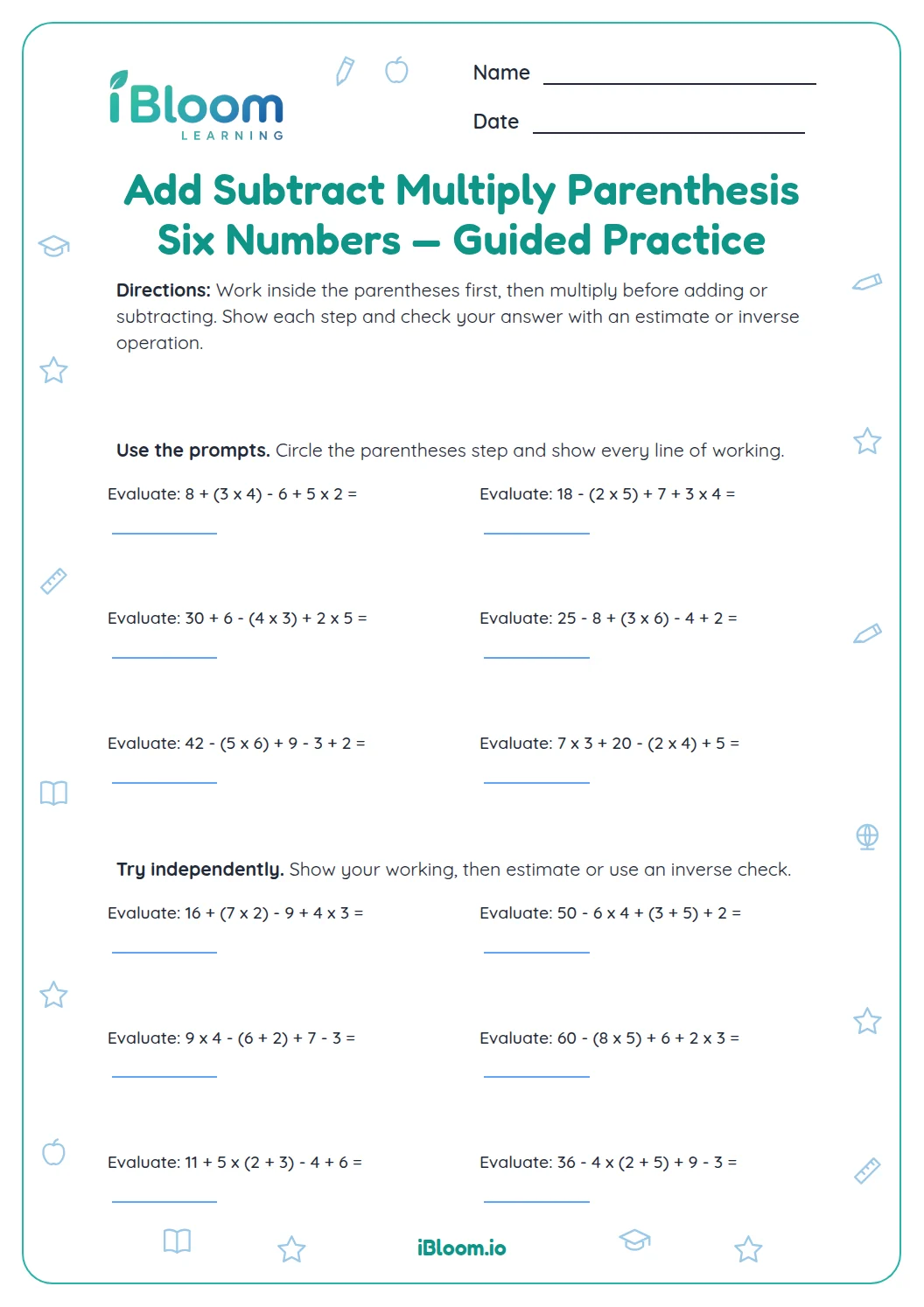

About this worksheet
This Grade 4 worksheet practices evaluating six-number expressions with parentheses and all four operations. Learners complete parentheses first, then multiplication and division from left to right, followed by addition and subtraction from left to right. It includes 15 expressions, work space, and an answer key. The practice aligns with CCSS 5.OA.A.1.
Aligned to 5.OA.A.1
A reliable order for operations
First simplify what is inside parentheses. Next do multiplication and division in the order they appear from left to right. Finish with addition and subtraction from left to right.
In (6 + 4) × 3 − 8 + 12 ÷ 4, the parentheses make 10. Then 10 × 3 = 30 and 12 ÷ 4 = 3. Finally 30 − 8 + 3 = 25. Keep each line organized to avoid changing the order.
Build the steps gradually
The expressions use six numbers and include parentheses, all four operations, and exact whole-number division. The parts focus on the sequence of steps before combining them.
- Part A: begin with the parentheses
- Part B: multiply and divide in order
- Part C: complete full expressions and check the result
How to use this worksheet
- 1Copy the expression carefully.
- 2Evaluate the expression inside parentheses first.
- 3Multiply and divide in the order they appear.
- 4Add and subtract in the order they appear.
- 5Compare the final value with the separate answer key.
Common mistakes and quick fixes
The mistake
Adding before completing multiplication.
The fix
Finish multiplication and division before addition and subtraction.
The mistake
Grouping multiplication and division in a new order.
The fix
Work from left to right when operations share priority.
The mistake
Skipping a parentheses calculation.
The fix
Write the value inside parentheses before continuing.
Curriculum alignment
The expressions practice evaluating numerical expressions with parentheses.
Evaluate numerical expressions by using parentheses and operation conventions.
On this sheet: Each expression uses parentheses and requires learners to follow operation order.
Show the official wordingHide the official wording
Use parentheses, brackets, or braces in numerical expressions, and evaluate expressions with these symbols.
What to practice next
Make more practice
Further reading
Questions parents and teachers ask
What operation comes first?
Evaluate the expression inside parentheses first. For example, in (6 + 4) × 3 − 8 + 12 ÷ 4, begin by finding 6 + 4, then continue with multiplication and division. Write each intermediate value so the next operation is easy to follow.
How do learners handle multiplication and division together?
Complete multiplication and division in the order they appear from left to right. After those steps, complete addition and subtraction from left to right. Write each intermediate value so the next operation is easy to follow. Write each intermediate value so the next operation is easy to follow.
Is an answer key included?
Yes. The answer key lists the result for all 15 expressions. Learners can use it to check their final values after showing the order of their calculations. Write each intermediate value so the next operation is easy to follow. Write each intermediate value so the next operation is easy to follow.
Why are there parentheses in every part?
Parentheses identify a calculation to complete before the surrounding operations. This worksheet begins with that step and then builds practice with the remaining operations. Write each intermediate value so the next operation is easy to follow. Write each intermediate value so the next operation is easy to follow.
How many numbers are in each expression?
Each expression contains six numbers. Learners practice the same operation order with different combinations of parentheses, multiplication, division, addition, and subtraction. Write each intermediate value so the next operation is easy to follow. Write each intermediate value so the next operation is easy to follow.