



About this worksheet
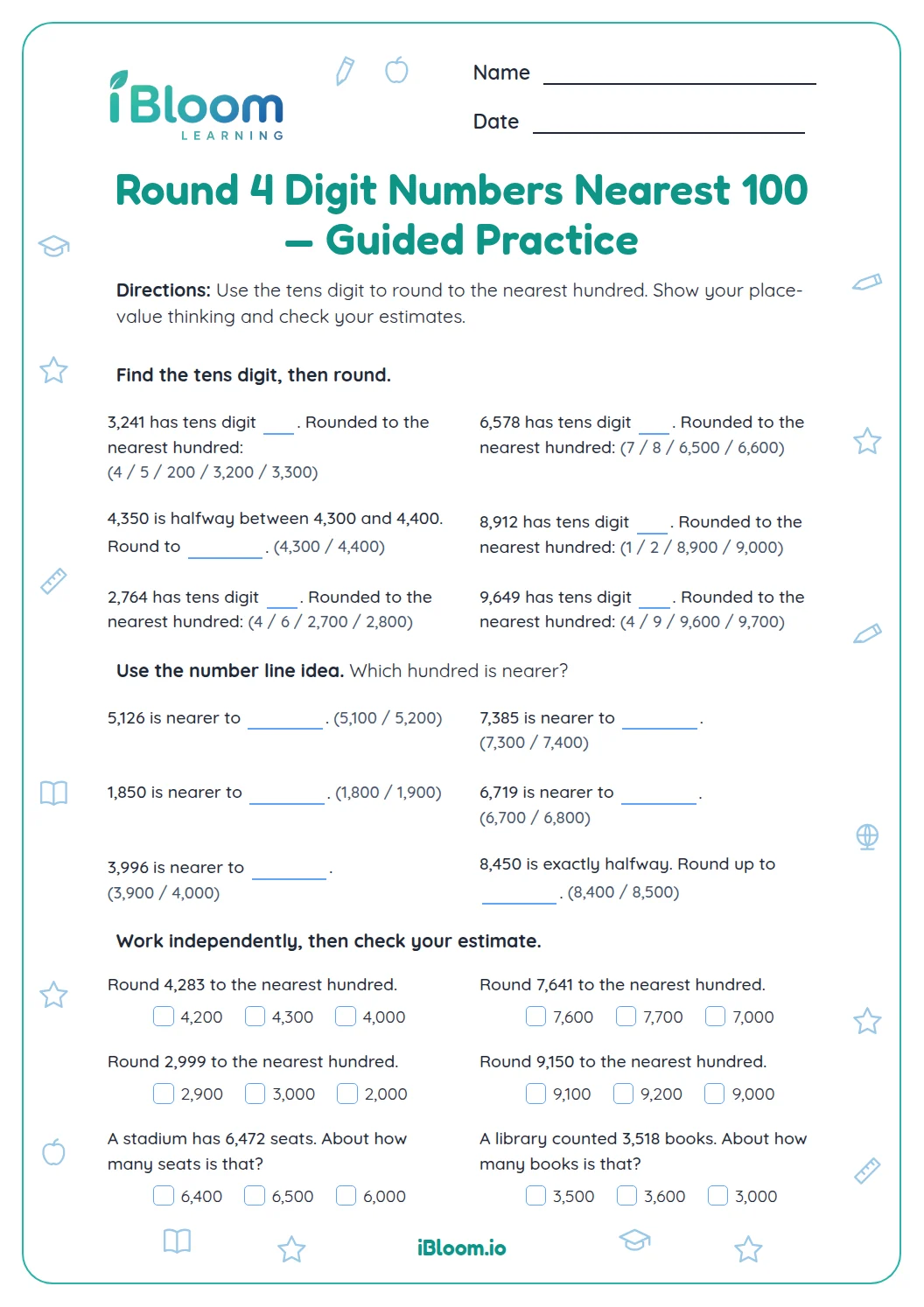
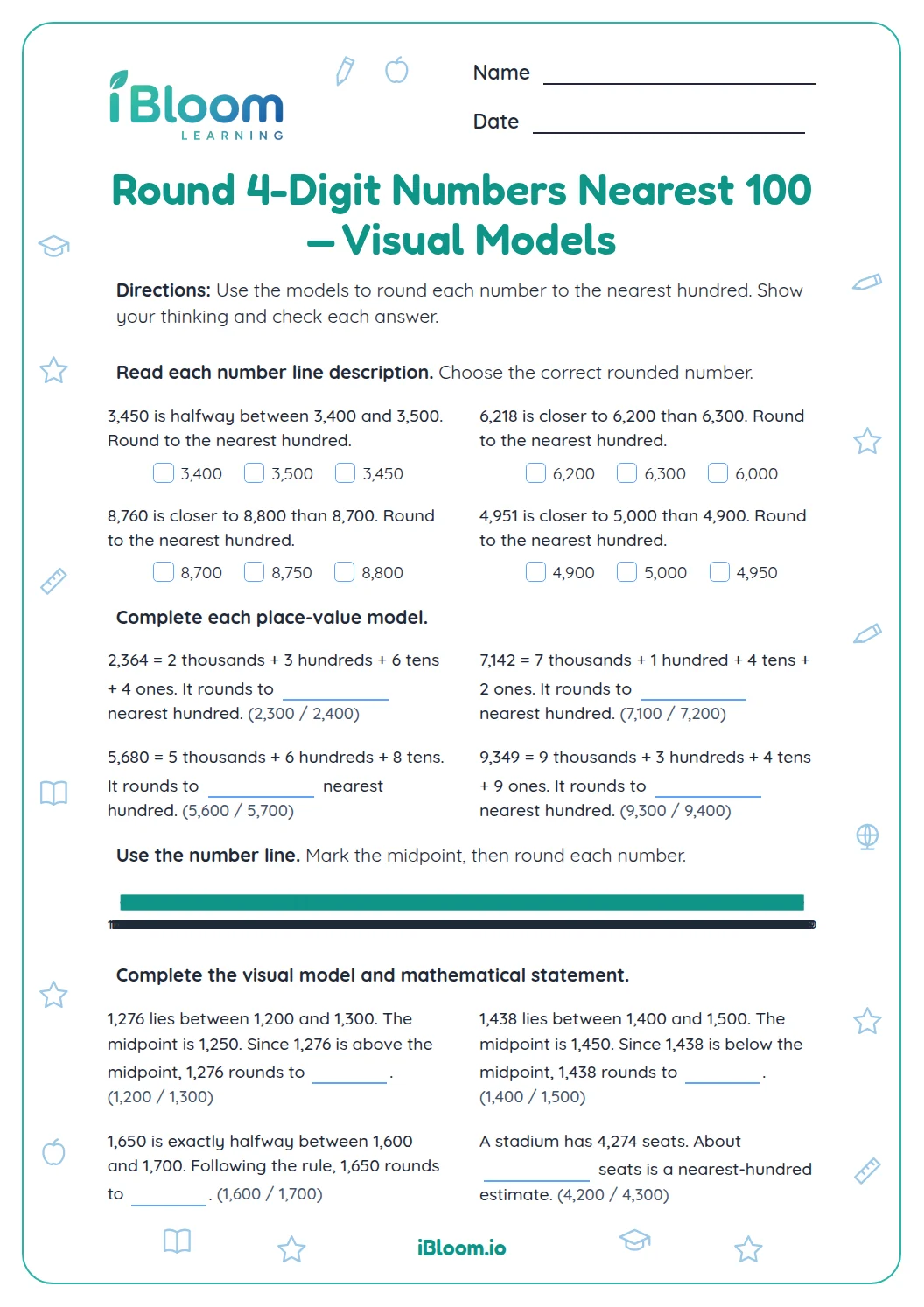
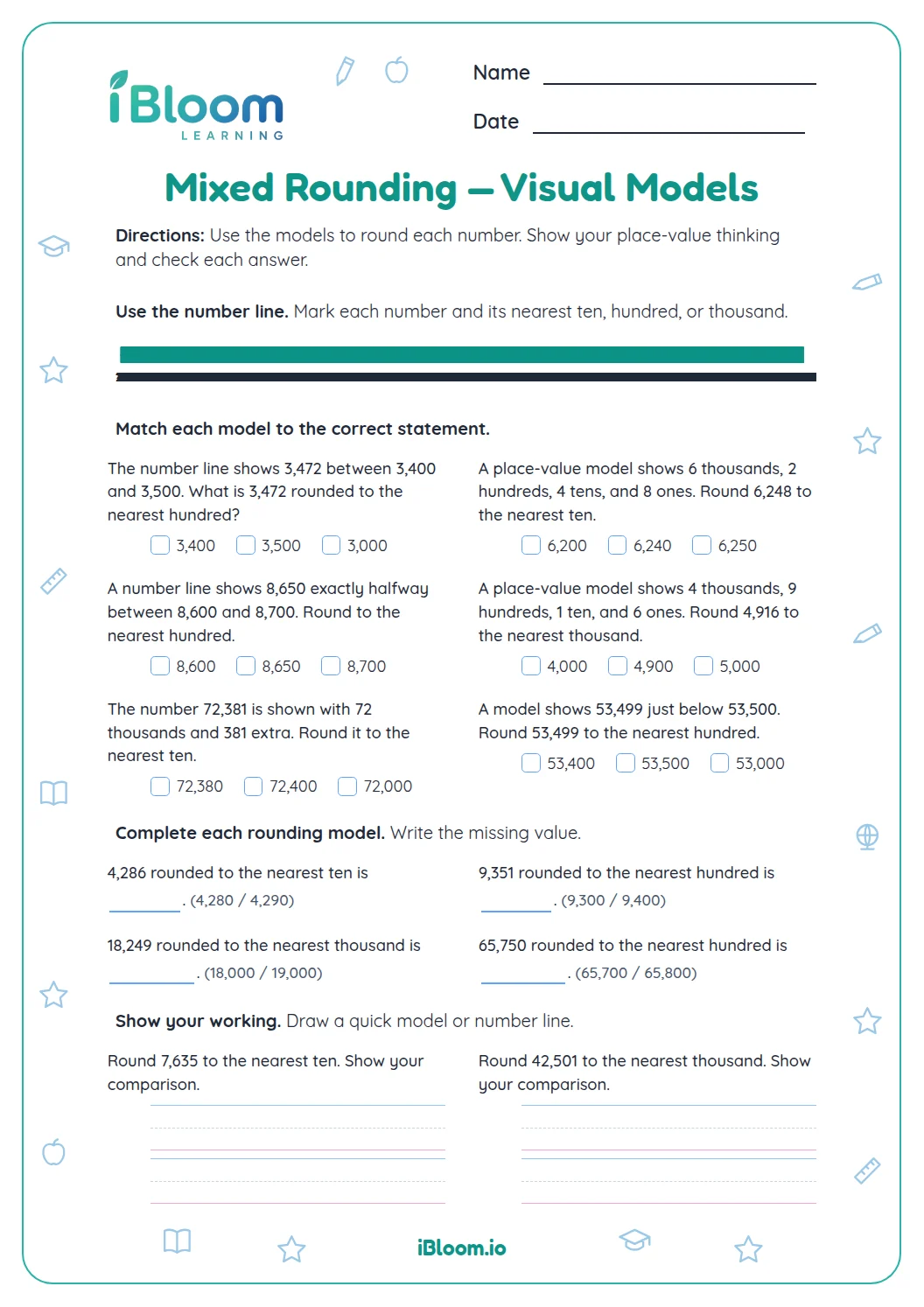
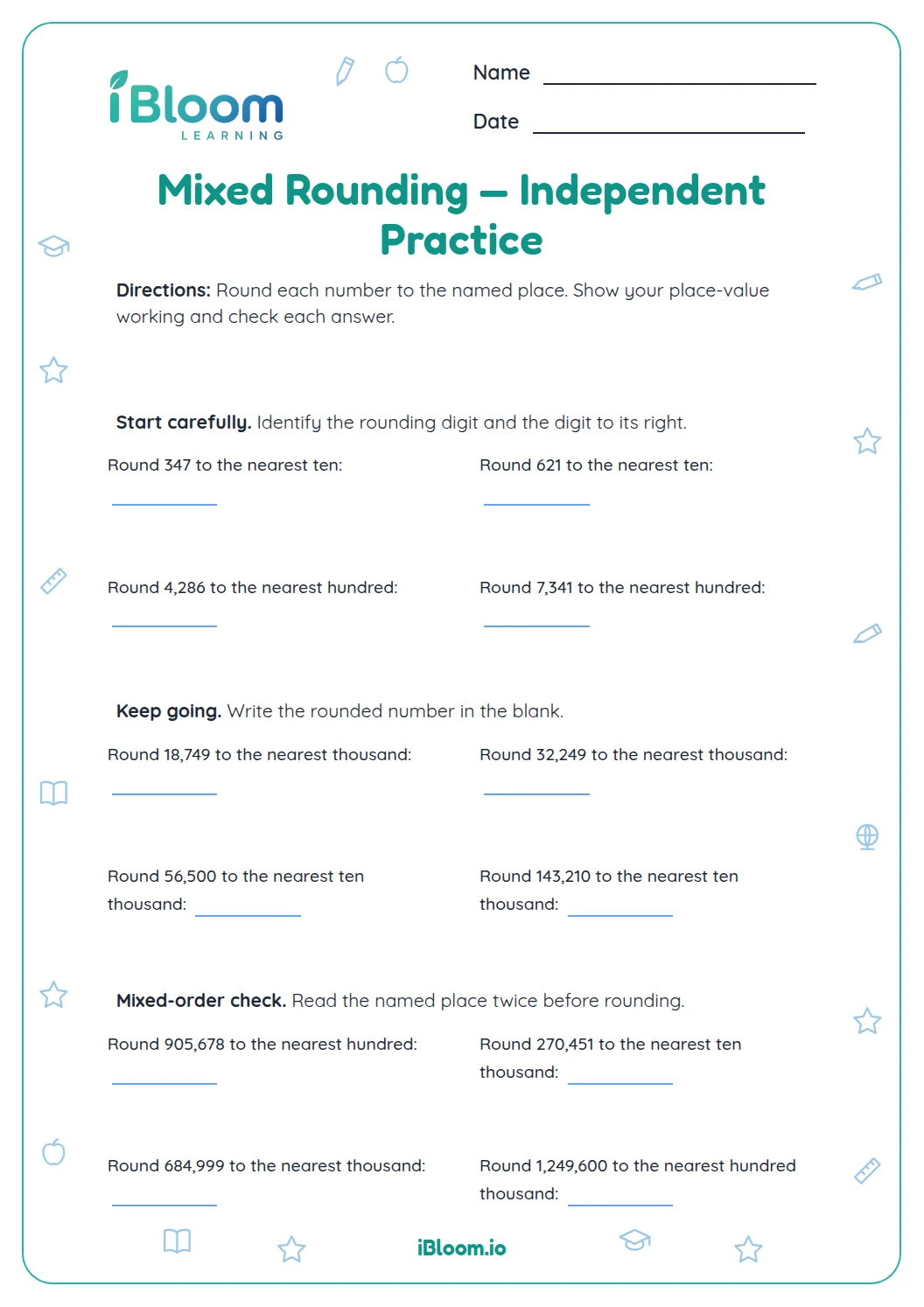
This free Grade 4 rounding worksheet gives students sixteen chances to round four-digit numbers to the nearest hundred. Part A builds fluency with direct rounding, and Part B asks students to choose among nearby hundreds. The answer key gives each rounded value. The page aligns with CCSS 4.NBT.A.3: use place-value understanding to round multi-digit whole numbers.
Aligned to 4.NBT.A.3
Which digit helps decide the nearest hundred?
For nearest-hundred rounding, look at the tens digit, the digit immediately to the right of the hundreds place. A 0, 1, 2, 3 or 4 keeps the hundreds digit. A 5, 6, 7, 8 or 9 raises it by one. Then replace the tens and ones with zeros.
Question 1 rounds 4,251 to 4,300 because the tens digit is 5. The number is at the midpoint between 4,200 and 4,300, so it rounds up.
- 1Question 1: 4,251 → 4,300
- 2Tens digit 5: round the hundreds digit up.
How can you check a choice among nearby hundreds?
Find the two hundreds that surround the original number. Then use the tens digit to see which one is closer. In question 14, 5,632 lies between 5,600 and 5,700; its tens digit is 3, so 5,600 is nearer.
A number ending in 50 is halfway between hundreds. The rule used here rounds that midpoint up, as in question 15.
How can you check a rounded answer?
Place the number between the two hundreds around it, then use the tens digit to pick the closer one. A midpoint rounds up under the rule used on this page.
Question 15 rounds 7,050 to 7,100. The tens digit is 5, so the answer moves from 7,000 to the next hundred.
How to use this worksheet
- 1Underline the place named in the question: nearest 100.
- 2Find the tens digit immediately to the right of the hundreds digit.
- 3Keep the hundreds digit for 0–4; increase it for 5–9.
- 4Change all digits to the right of the hundreds place to zero.
- 5For a midpoint, apply the rule and round up.
Common mistakes and quick fixes
The mistake
Looking at the ones digit to round to the nearest 100.
The fix
Use the tens digit; it is the first digit to the right of the hundreds place.
The mistake
Changing only the tens digit and leaving a nonzero ones digit.
The fix
After rounding, set both tens and ones to zero.
The mistake
Rounding 7,350 down because it is exactly halfway.
The fix
A 5 in the tens place rounds up, so 7,350 becomes 7,400.
Common Core alignment
The questions use place value to round multi-digit whole numbers.
Use the hundreds and tens digits to round four-digit whole numbers to the nearest hundred.
On this sheet: Every item rounds a multi-digit whole number to the nearest hundred using place value.
Show the official wordingHide the official wording
Use place value understanding to round multi-digit whole numbers to any place.
What to practice next
Make more practice
Further reading
Questions parents and teachers ask
Which digit matters when rounding to the nearest 100?
Look at the tens digit. It tells whether the number is closer to the lower hundred or the next hundred: 0 through 4 round down, and 5 through 9 round up. The tens and ones digits become zeros in the rounded answer.
Why does 4,251 round to 4,300?
The hundreds around 4,251 are 4,200 and 4,300. Its tens digit is 5, so the halfway value rounds up to 4,300. Question 1 uses this midpoint case to make the rounding rule visible. Ask the student to name both hundreds before deciding.
What happens when the tens digit is zero?
A tens digit of zero means the number is only a few units above its hundred, so it rounds down to that hundred. For example, 2,901 rounds to 2,900. The ones digit does not change the choice when rounding to the nearest hundred.
What should students write after rounding?
Write the nearest hundred, with zeros in the tens and ones places. For example, 7,651 rounds to 7,700 because the tens digit is 5. These questions ask for the rounded number itself, so no extra calculation or unit is needed.
How can a student check a rounded answer?
Name the two hundreds the original number sits between, then check which is closer using the tens digit. For a midpoint such as 7,350, apply the class rule to round up. The answer key gives the nearest hundred for all sixteen questions.