


About this worksheet
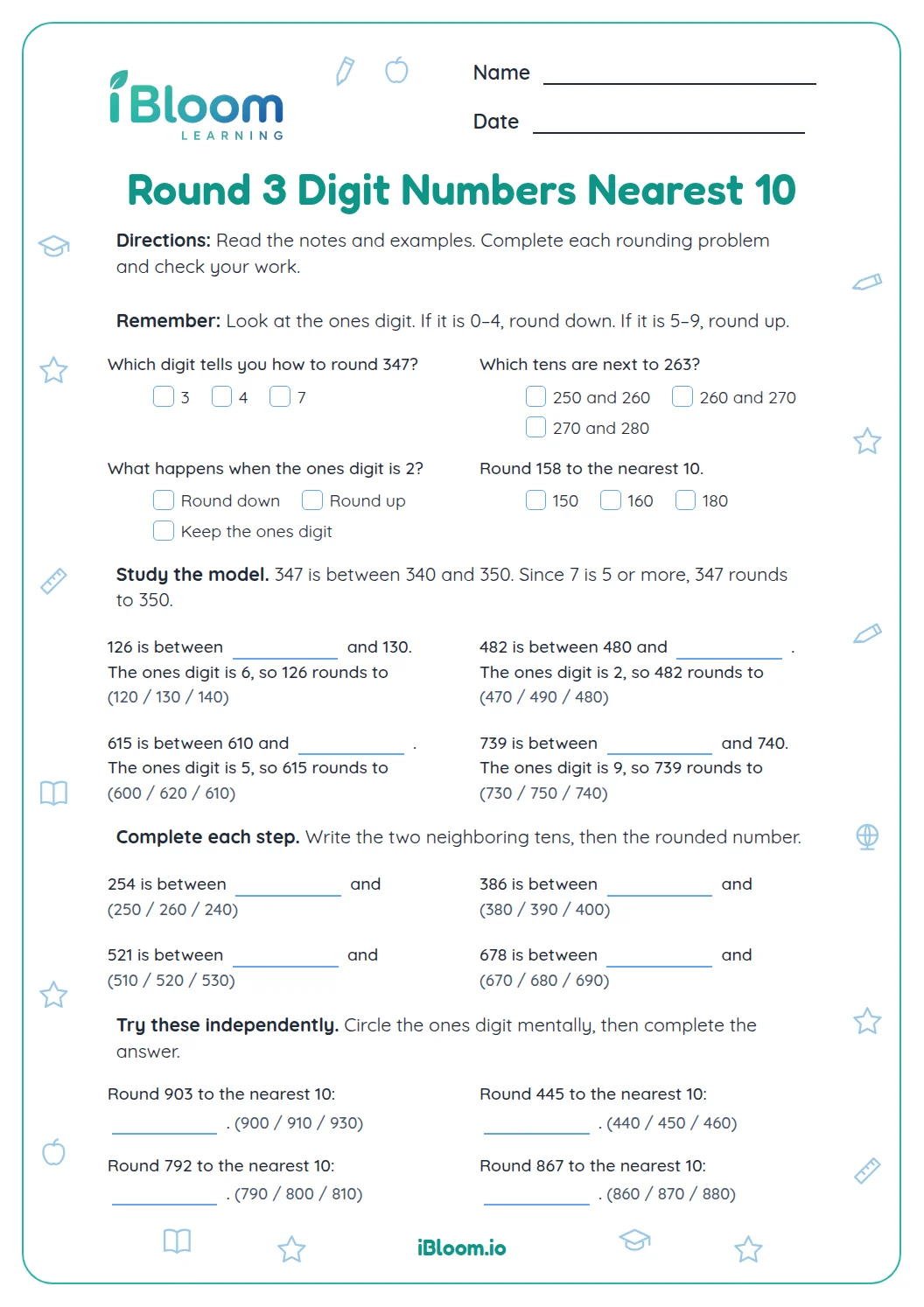
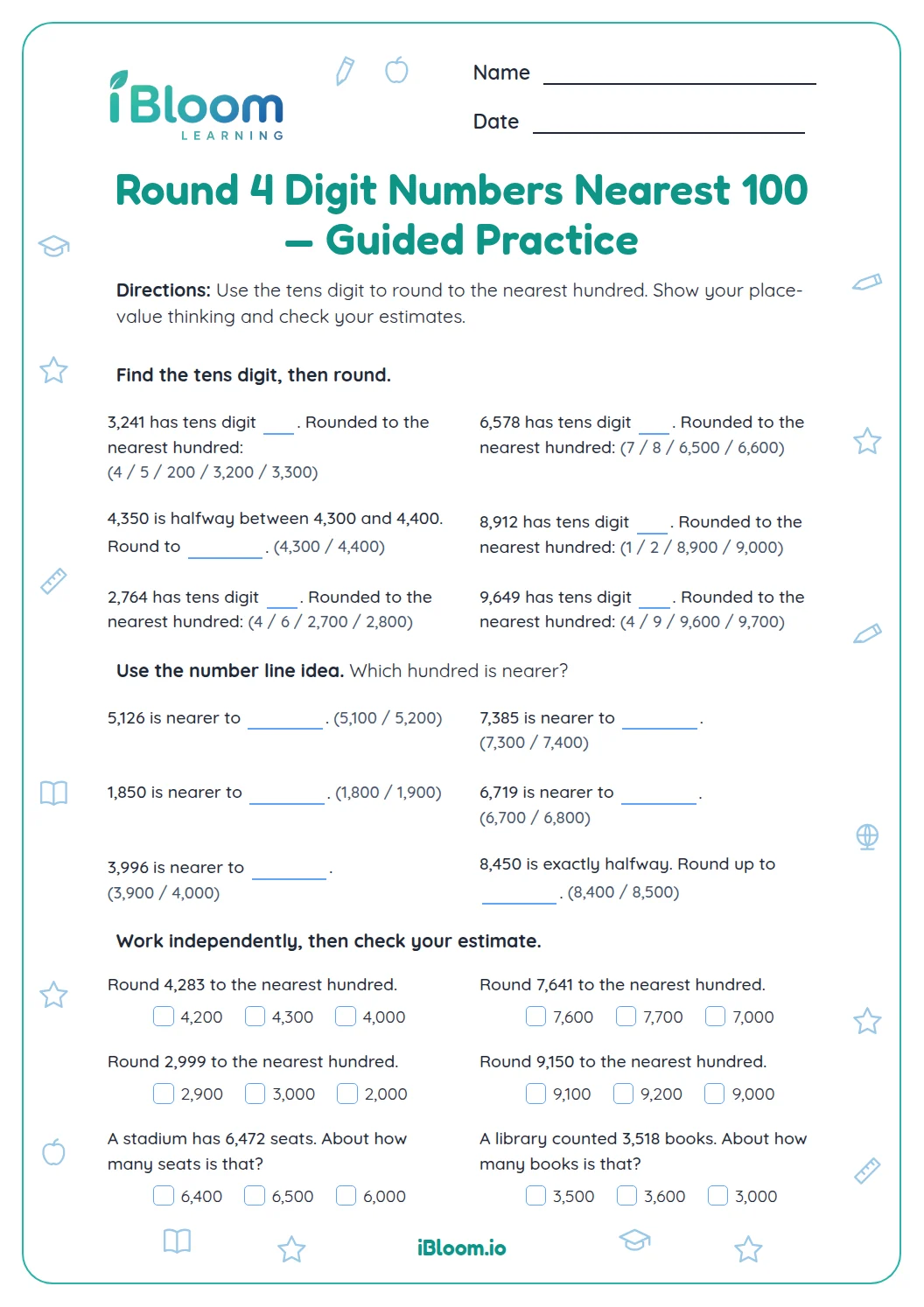
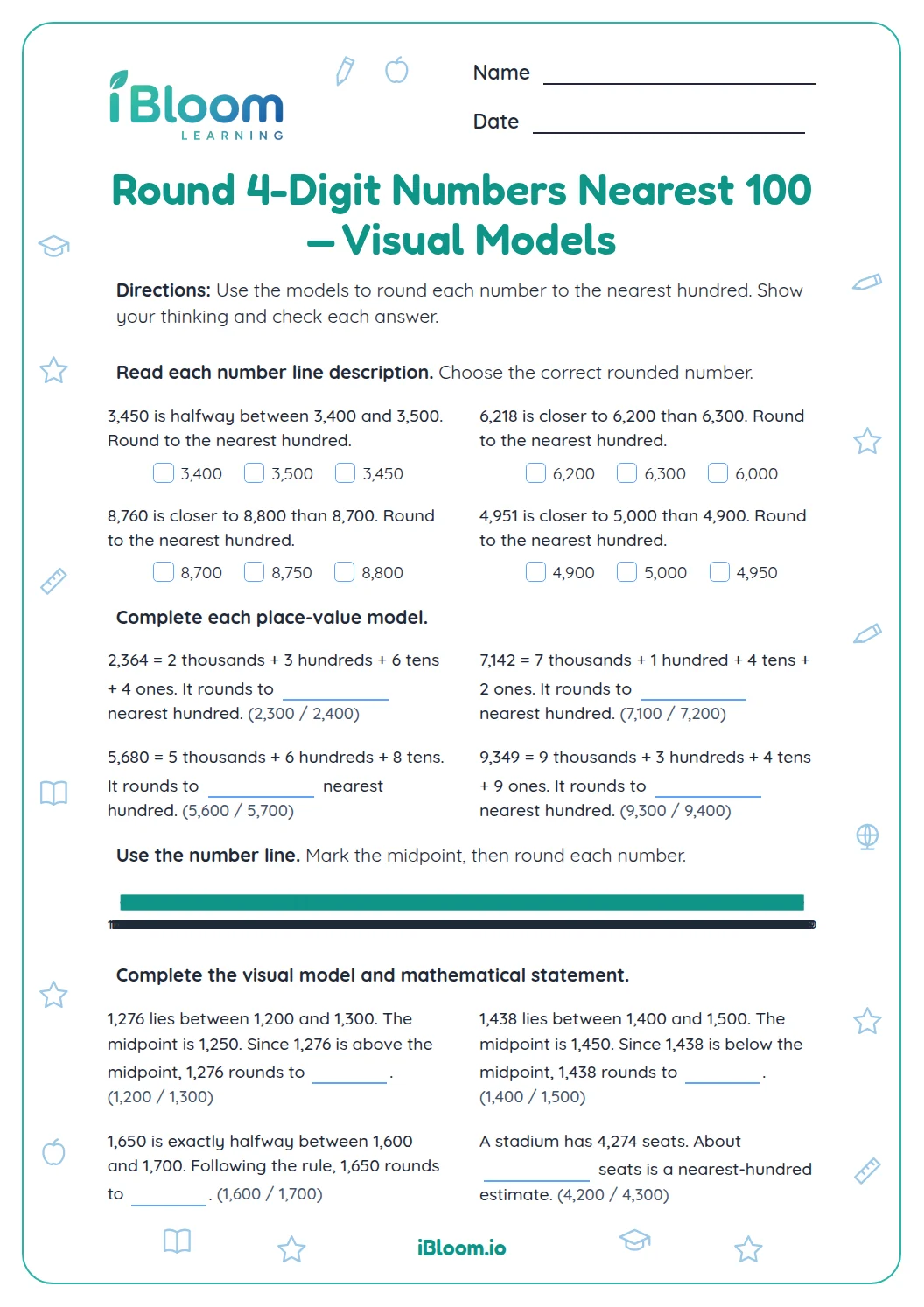
This worksheet gives Grade 4 students focused practice rounding three-digit whole numbers to the nearest ten. Part A moves through numbers with different ones digits, including values just below and above a midpoint. Part B applies rounding to counts and lengths, then asks students to identify a number that rounds to a stated ten. The examples avoid exact halfway cases so each rounding decision has one clear nearest ten.
Aligned to 4.NBT.A.3
What does nearest ten mean?
A multiple of ten ends in 0, such as 140, 150, or 160. To round a three-digit number to the nearest ten, compare it with the tens on either side. The ones digit is a quick clue: 0–4 means round down to the lower ten, and 5–9 means round up to the next ten.
For 157, the neighboring tens are 150 and 160. Since the ones digit is 7, 157 is closer to 160. In a number such as 698, rounding up crosses into the next hundred, giving 700.
What is included?
Part A has ten direct rounding questions with varied hundreds, tens, and ones digits. Part B asks students to round quantities in context, select which number rounds to a given ten, and give one possible number for a rounded result.
The last question has several valid examples. The key shows one number; any three-digit number from 715 through 724 rounds to 720 under the usual Grade 4 rule.
How to use this worksheet
- 1Name the tens immediately below and above the number.
- 2Find the ones digit and use it to decide which ten is nearer.
- 3Write 0 in the ones place after rounding.
- 4For a context problem, include the unit in the rounded answer.
- 5For the final question, test your example by applying the rounding rule.
Common mistakes and quick fixes
The mistake
Changing only the ones digit even when the number rounds up.
The fix
If the ones digit is 5–9, increase the tens place before writing 0 in the ones place.
The mistake
Writing 690 for 698 because the student focuses on the 9 in the tens place.
The fix
Use the ones digit, 8, to decide to round up to 700.
The mistake
Giving a rounded quantity without its unit.
The fix
Copy the unit from the question after rounding the number.
Common Core alignment
This page connects the worksheet practice to the stated Common Core skill.
Use place value understanding to round multi-digit whole numbers to any place.
On this sheet: Every direct and applied question rounds a whole number to the tens place.
Show the official wordingHide the official wording
Use place value understanding to round multi-digit whole numbers to any place.
What to practice next
Make more practice
Further reading
Questions parents and teachers ask
Which digit decides how a number rounds to the nearest ten?
Look at the ones digit. If it is 0, 1, 2, 3, or 4, round down to the previous ten. If it is 5, 6, 7, 8, or 9, round up to the next ten. Then write zero in the ones place.
Why can rounding a number near 1,000 change the hundreds digit?
If the number is close to the next hundred, rounding up may move into that new hundred. For instance, 998 rounds to 1,000. This is still rounding to the nearest ten; the carry simply changes the hundreds and thousands places.
How do students check a rounding answer?
Find the tens immediately below and above the original number. Compare the ones digit with the midpoint between those tens. The nearest ten should be the closer one. You can also check that the rounded result ends in zero.
Can several numbers round to the same ten?
Yes. With the usual nearest-ten rule, a range of whole numbers rounds to the same multiple of ten. For example, numbers from 715 through 724 round to 720. The last question asks students to provide one possible three-digit number from that range.
How does a student round a three-digit number to the nearest ten?
Look at the ones digit. If it is 0 through 4, keep the tens digit and round down; if it is 5 through 9, increase the tens digit by one. Then write zero in the ones place. The sheet includes direct practice and two questions in context.