


About this worksheet
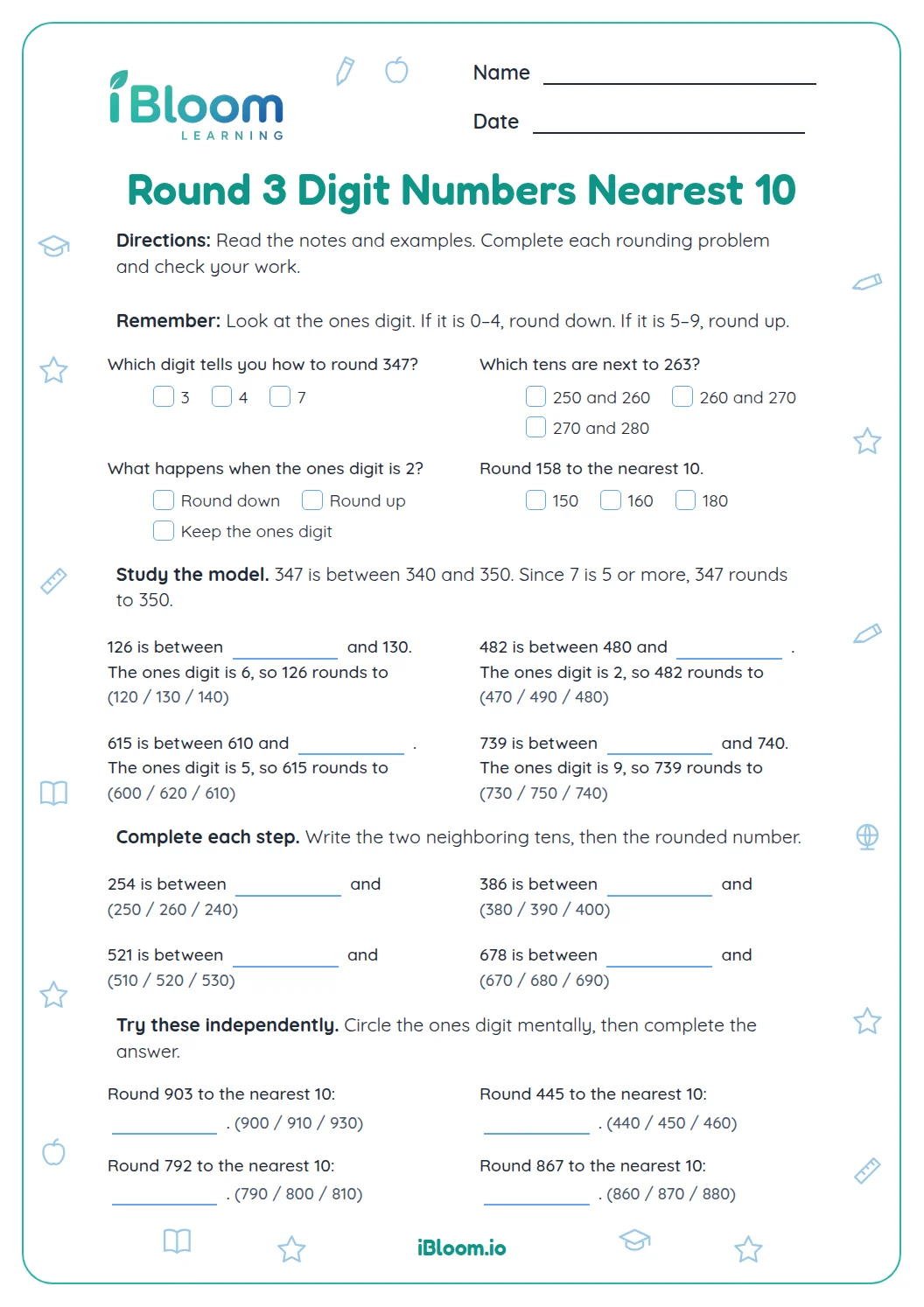
This Grade 4 printable gives children practice rounding three-digit numbers to the nearest ten and explaining place-value reasoning. It includes multiple-choice reasoning, strategy comparisons, missing-number choices and written explanations, followed by a separate answer key. The questions practice CCSS 4.NBT.A.3.
Aligned to 4.NBT.A.3
How do you round to the nearest ten?
Look at the ones digit. A digit from 0 through 4 means the tens digit stays; a digit from 5 through 9 means the tens digit increases by one. In question 1, 246 rounds to 250 because its ones digit is 6.
- 1246
- 2Ones digit: 6
- 36 is at least 5, so round up.
- 4246 rounds to 250.
What kinds of rounding questions are here?
The first part checks explanations. The next part compares strategies, and the last part asks for missing values and written reasoning. Each answer uses the nearest ten.
How can I use this worksheet?
- 1Read the ones digit in each number before deciding how the tens change.
- 2For a number ending in 0–4, keep the tens digit; for 5–9, increase it by one.
- 3Compare the original number with the two neighboring tens when checking a choice.
- 4Use the answer key to check both the rounded value and the reason.
Common mistakes and quick fixes
The mistake
Rounding up because the tens digit is large.
The fix
Use the ones digit to decide; the tens digit changes only after that check.
The mistake
Treating 5 like a digit that rounds down.
The fix
A ones digit of 5 begins the round-up group.
The mistake
Rounding to a neighboring ten without checking the distance.
The fix
Compare the number with its lower and upper tens.
Common Core alignment
Round three-digit numbers to the nearest ten by using the ones digit.
On this sheet: Round three-digit numbers to the nearest ten by using the ones digit.
Show the official wordingHide the official wording
Use place value understanding to round multi-digit whole numbers to any place.
What to practice next
Make more practice
Further reading
Questions parents and teachers ask
Who is this worksheet for?
This worksheet is for Grade 4 learners practicing nearest-ten rounding. It has 14 questions across the printed practice pages and a separate answer key. A parent or teacher can review one example, then let the learner work through the parts.
How many questions are included?
There are 14 questions. The worksheet moves from rounding explanations to strategy comparisons, missing values, and written reasoning. Learners apply the nearest-ten rule in each part, then use the separate answer key to check both rounded values and explanations.
Does it include an answer key?
Yes. A separate answer key follows the practice pages. Use it to check selected or computed answers after the learner finishes. For questions where the wording can vary, the key provides a sample response that shows the expected idea and reasoning.
How can I help with a missed answer?
Ask the learner to point to the part of the question that determines the answer, then work through that step together. Compare the result with the answer key and have the learner explain any correction in their own words.
Can I print the worksheet and key separately?
Yes. The worksheet and answer key are arranged on separate pages, so you can print the practice pages for the learner and keep the answers for checking. The learner can write directly on the worksheet, then review missed items with an adult.
Should children round 5 up?
Yes. When the ones digit is 5, 6, 7, 8, or 9, round to the next ten. For example, 246 rounds to 250 because its ones digit is 6. The first part asks learners to explain how the digit guides the decision.
How can a child check a nearest-ten answer?
Compare the answer with the two tens on either side of the starting number. The correct rounded ten is the closer one; at a midpoint ending in 5, use the next ten. The worksheet asks learners to identify the ones digit and explain selected answers.