
About this worksheet
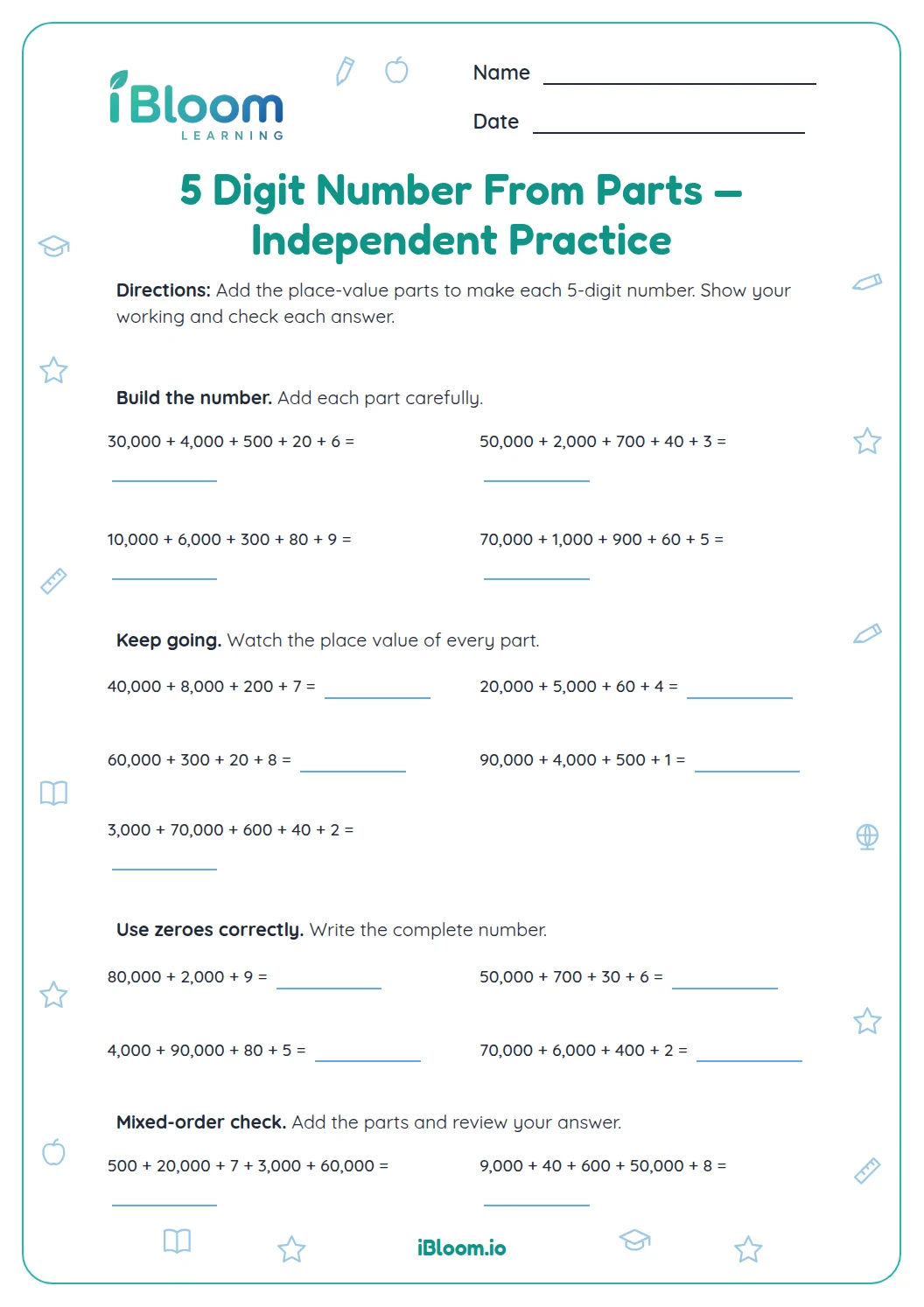
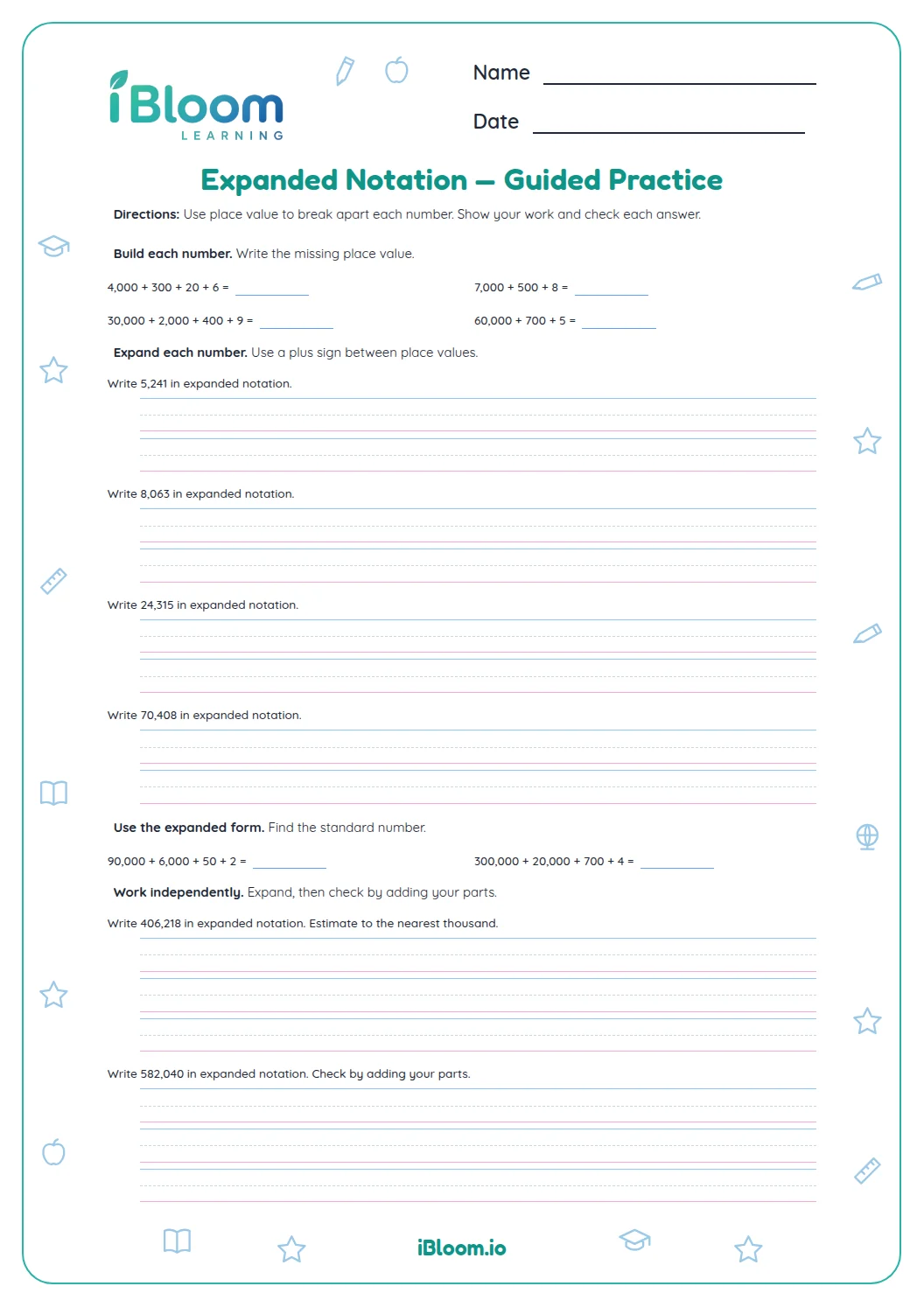
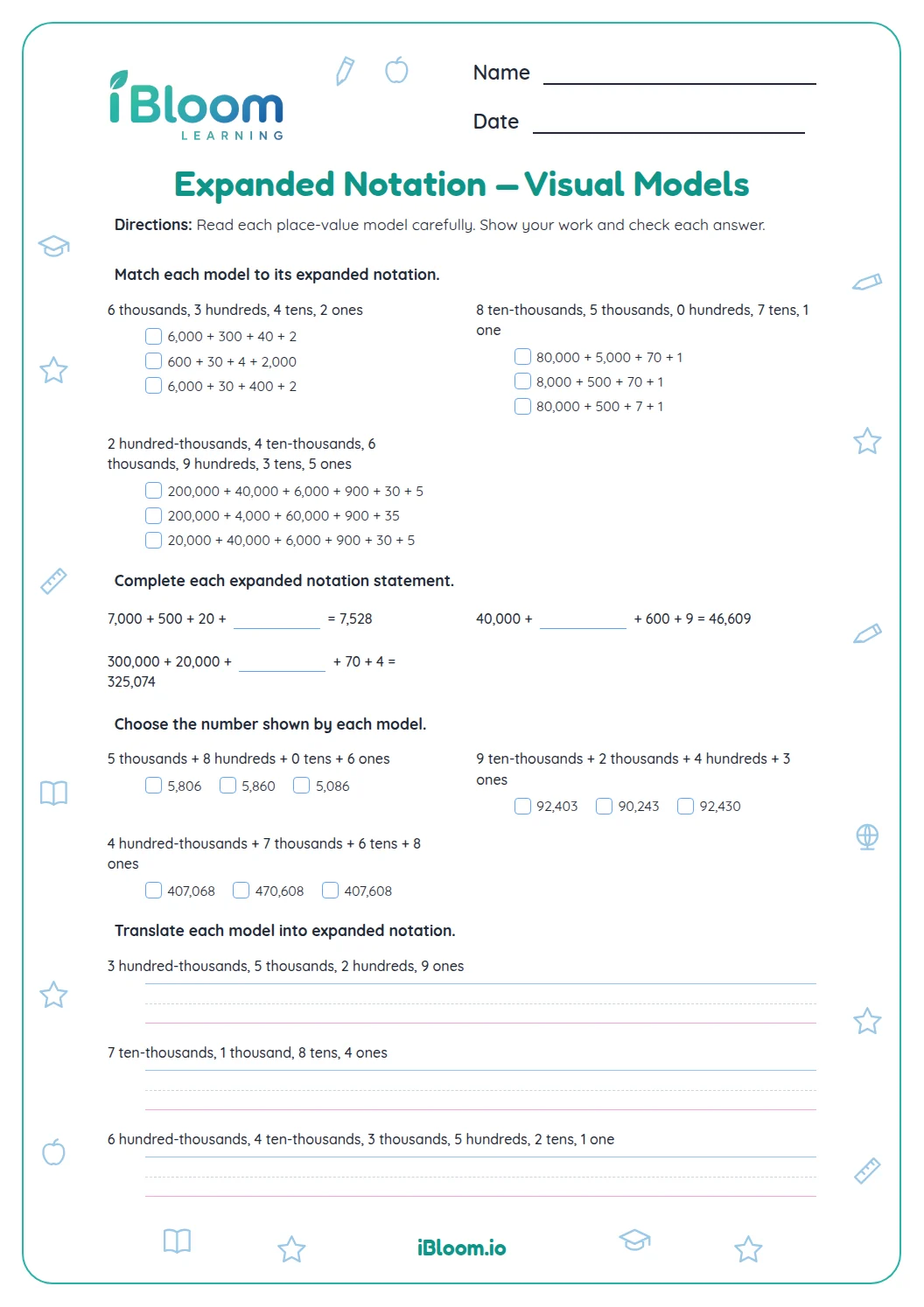
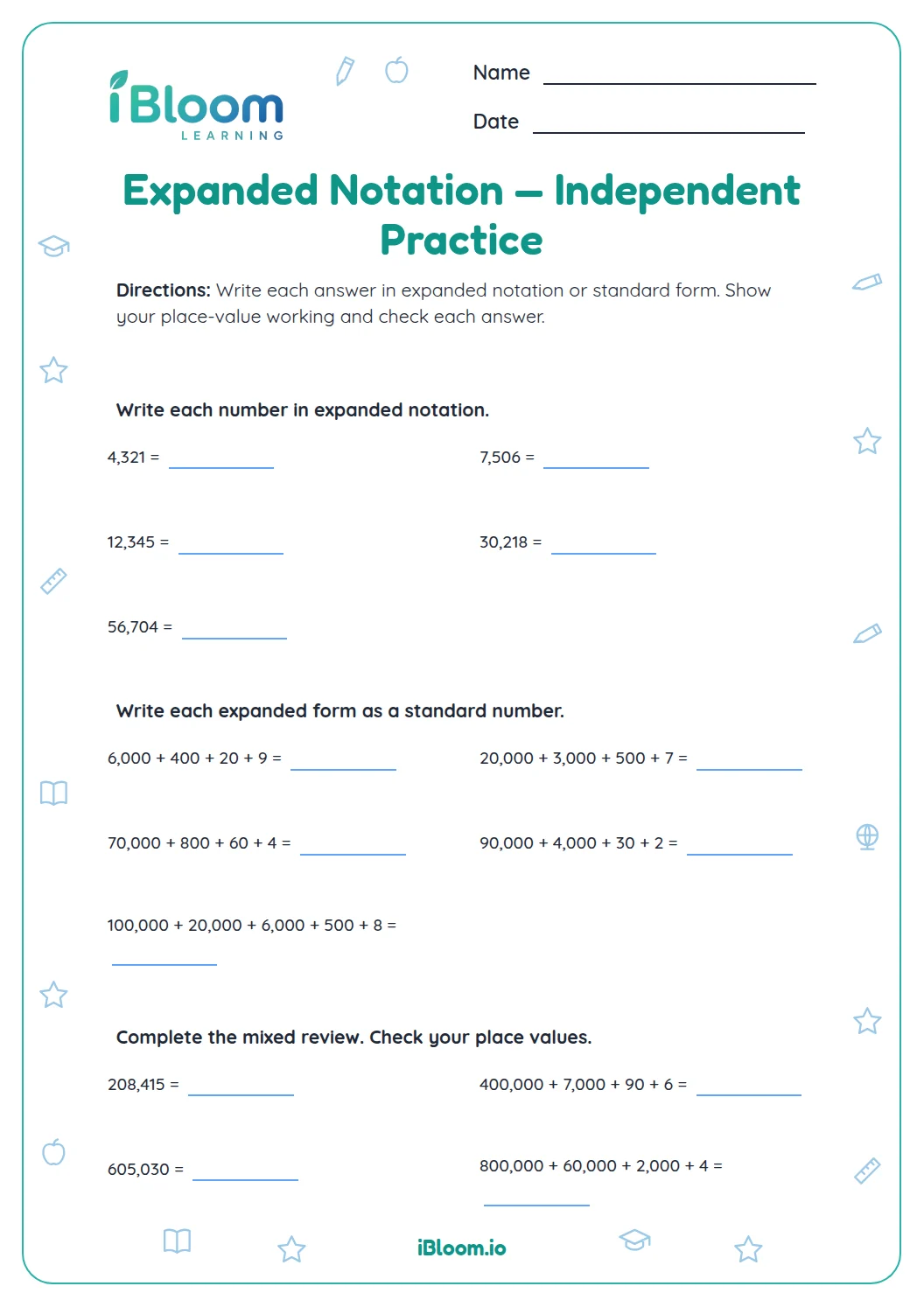
This free printable Grade 4 worksheet helps students practice six-digit place value. It aligns with Common Core 4.NBT.A.2 and 4.NBT.A.3: read and write six-digit whole numbers in standard and expanded forms. The sheet moves from supported models into independent practice and applied problems. A separate answer key gives concise answers for checking each item.
Aligned to 4.NBT.A.2 and 4.NBT.A.3
How do you build a number from its parts?
Each entry names the value of a place. In question 1, the table shows 342 thousands and 615 ones: 342,000 + 615 = 342,615. When a place is empty, keep its zero placeholder.
- 1342 thousands = 342,000
- 2615 ones = 615
- 3342,000 + 615 = 342,615
Which digit helps you round?
Look one place to the right of the place named. A digit from 5 through 9 means increase the rounding digit by one; a digit from 0 through 4 means keep it. Then replace following places with zeros.
How can you check a six-digit answer?
Write the value of each nonzero digit as an expanded sum and combine it. For a rounded answer, check that the named place changed by at most one and that all places to its right are zero.
How to use this worksheet
- 1Read the part heading and directions before starting.
- 2Work through Part A slowly, naming the place or operation involved.
- 3Use Part B to explain or check a strategy before writing an answer.
- 4Finish Part C independently and show calculations where space is provided.
- 5Compare each result with the answer key and correct the first step that changed the answer.
Common mistakes and quick fixes
The mistake
Leaving out a zero placeholder, such as writing 620,904 as 62,904.
The fix
Say each place aloud and keep a zero wherever no value is named.
The mistake
Rounding by looking at the rounding digit itself.
The fix
Use the digit immediately to its right to decide.
The mistake
Increasing a digit but keeping smaller place digits.
The fix
After rounding, replace every place to the right with zero.
Common Core alignment
This practice connects each question to a concrete grade-level math skill.
Read and write six-digit whole numbers in standard and expanded forms.
On this sheet: Part A writes six-digit numbers in standard form; Part C writes expanded form.
Show the official wordingHide the official wording
Read and write multi-digit whole numbers using base-ten numerals, number names, and expanded form. Compare two multi-digit numbers based on meanings of the digits in each place, using >, =, and < symbols to record the results.
Round multi-digit whole numbers by using place value.
On this sheet: Part B rounds six-digit numbers to the nearest thousand or ten thousand.
Show the official wordingHide the official wording
Use place value understanding to round multi-digit whole numbers to any place.
What to practice next
Make more practice
Further reading
Questions parents and teachers ask
How do you build a six-digit number from parts?
Treat each addend as the value of a place, then combine the values. In question 1, 342 thousands and 615 ones make 342,615. Keep a zero in any place with no value, as in 620,904. Matching question numbers make checking each response straightforward.
How many questions are on this worksheet?
The worksheet has 14 questions in three parts. Eight ask students to build a six-digit number from a place-value table or expanded form, and six ask them to round to the nearest thousand or ten thousand. Matching question numbers make checking each response straightforward.
What is the first step when rounding?
Find the place named in the direction, then look one place to its right. In question 7, rounding 342,615 to the nearest thousand means checking the hundreds digit, 6, so the thousands digit rounds up to 343,000. Matching question numbers make checking each response straightforward.
Does the table show the full number?
Yes. In question 1, the table gives 342 in the thousands column and 615 in the ones column. Read those as 342,000 and 615, then combine them to write 342,615 in standard form. Matching question numbers make checking each response straightforward.
Is an answer key included?
Yes. A separate key gives the standard-form numbers and rounded results for all 14 questions. Students can compare one response at a time and check the place value that determined each answer. Matching question numbers make checking each response straightforward.