
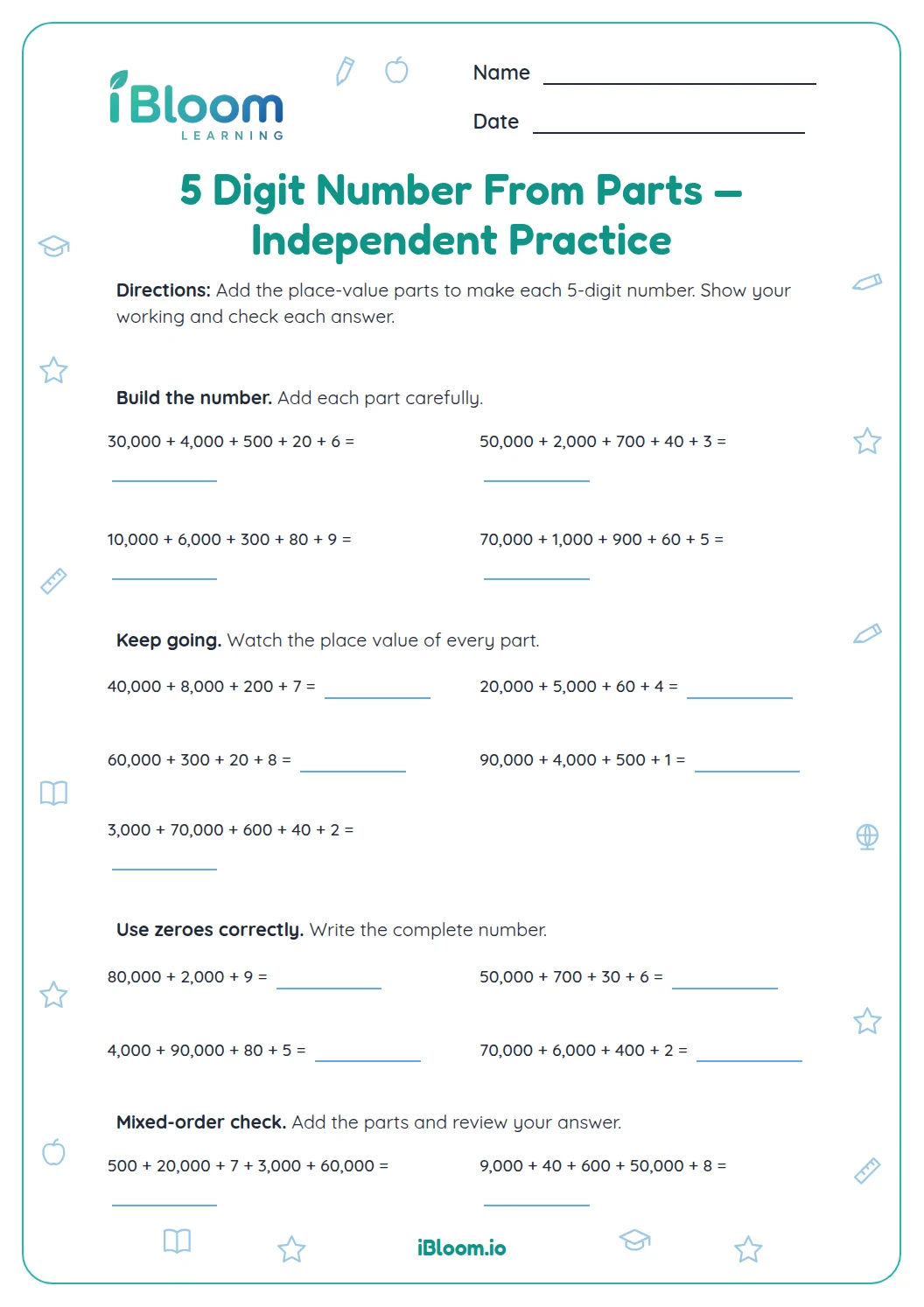
About this worksheet
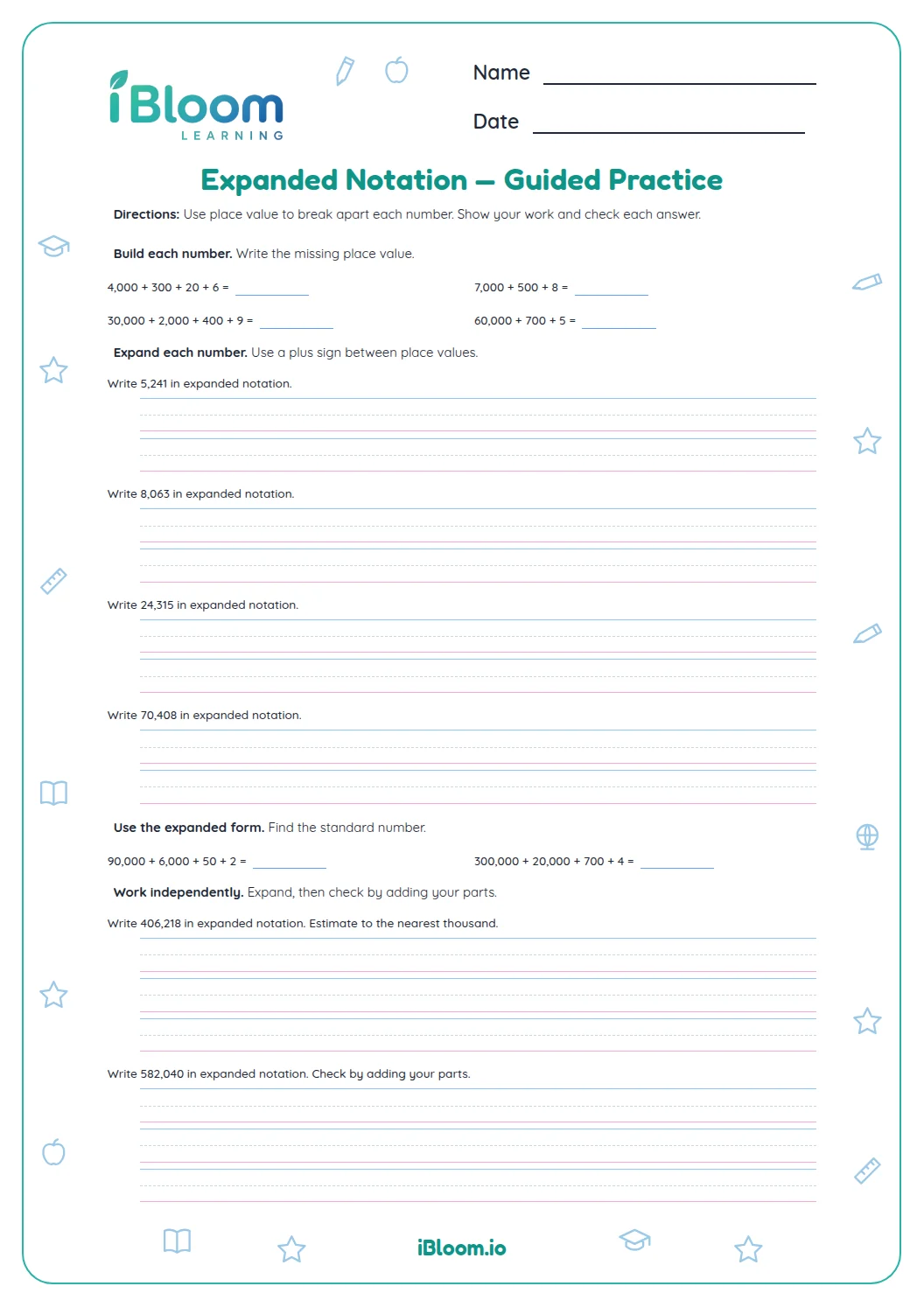
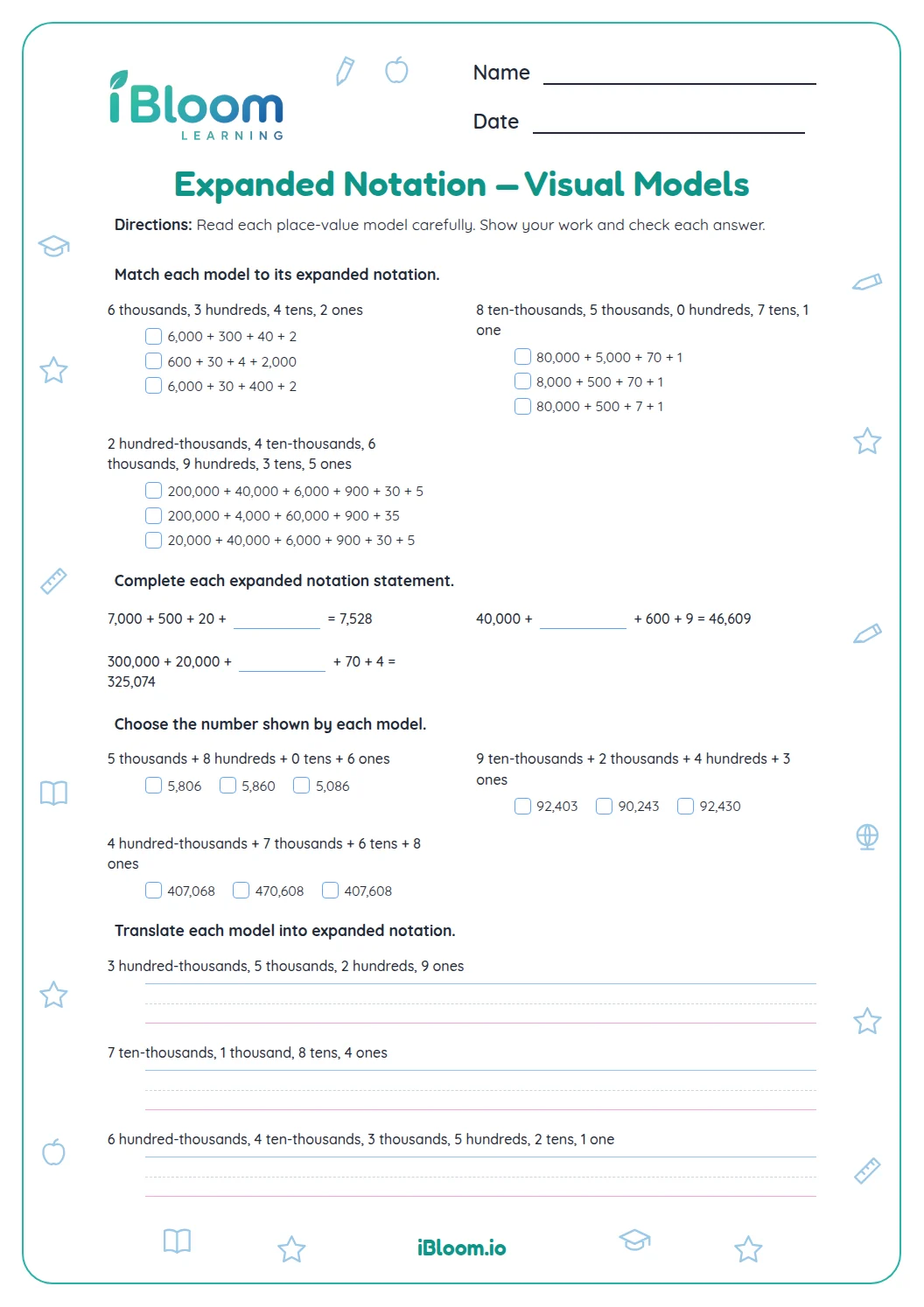
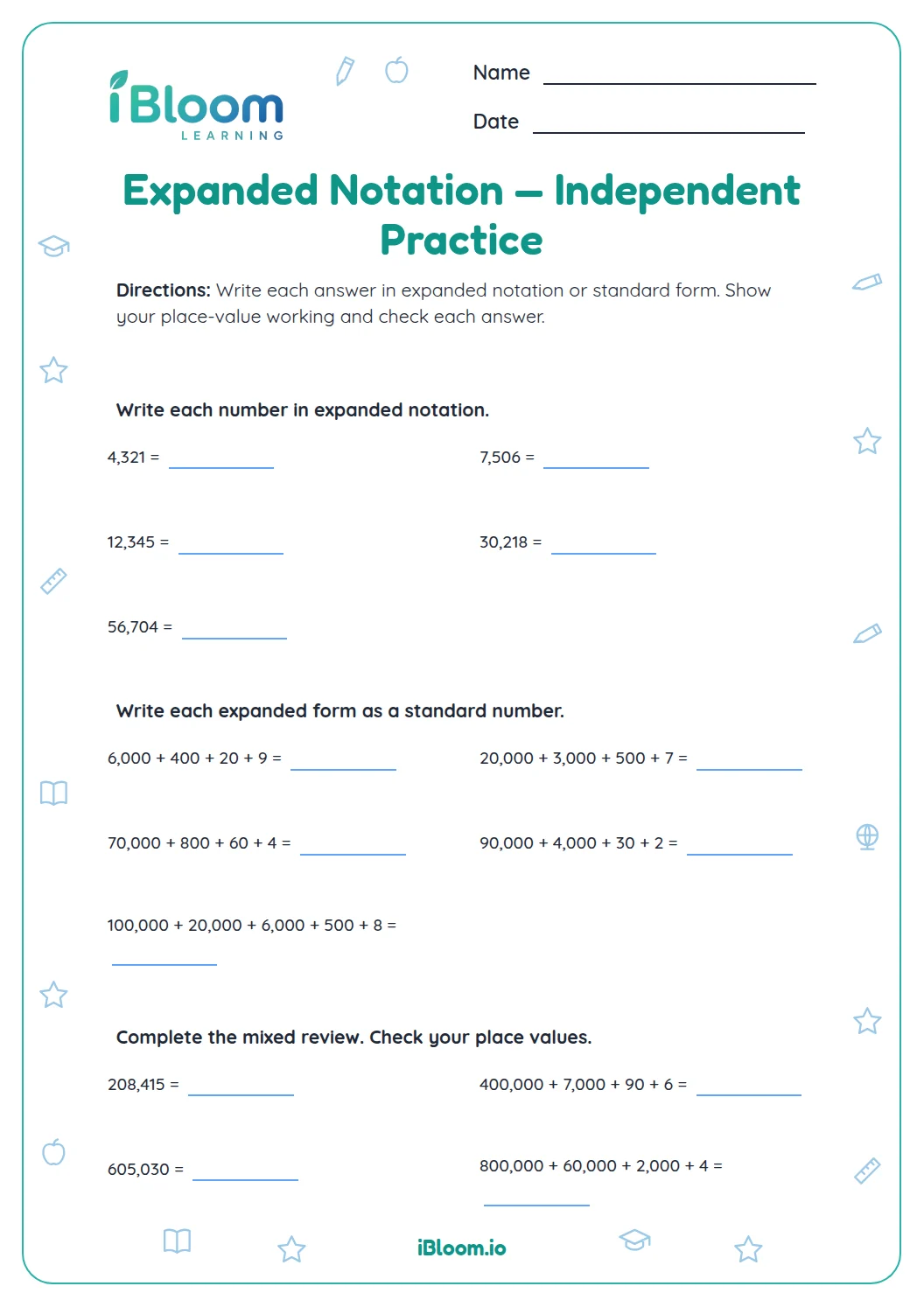
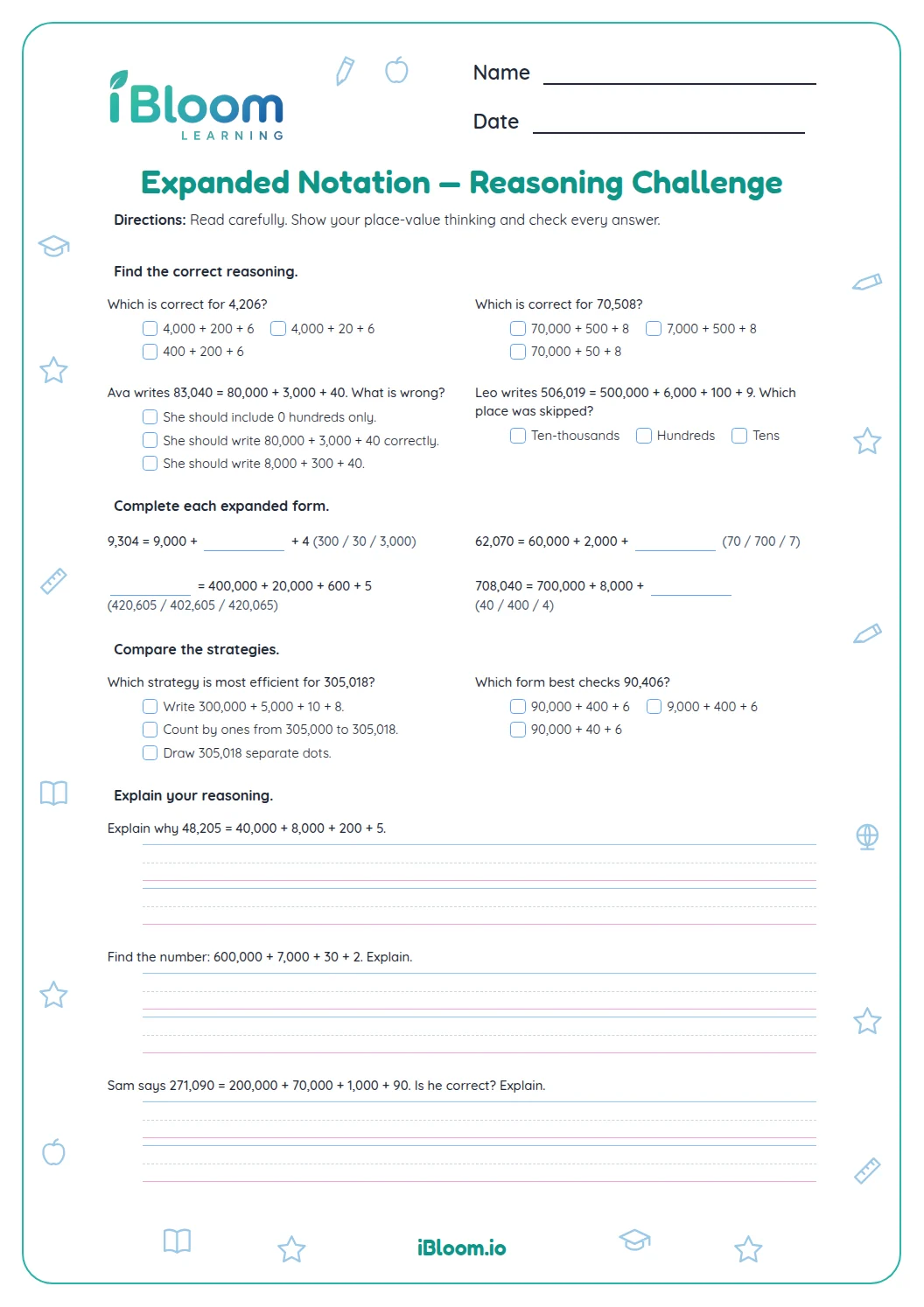
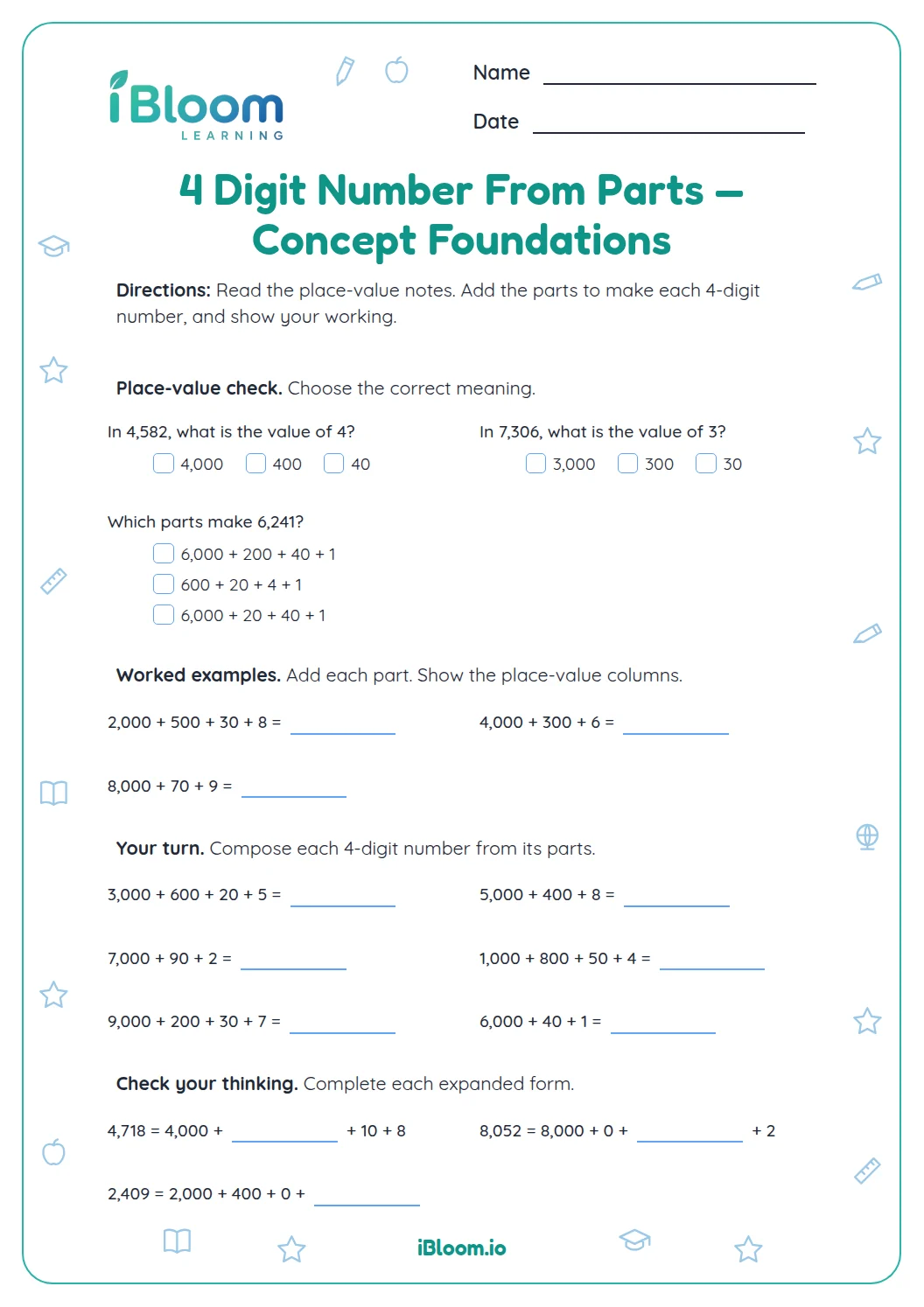
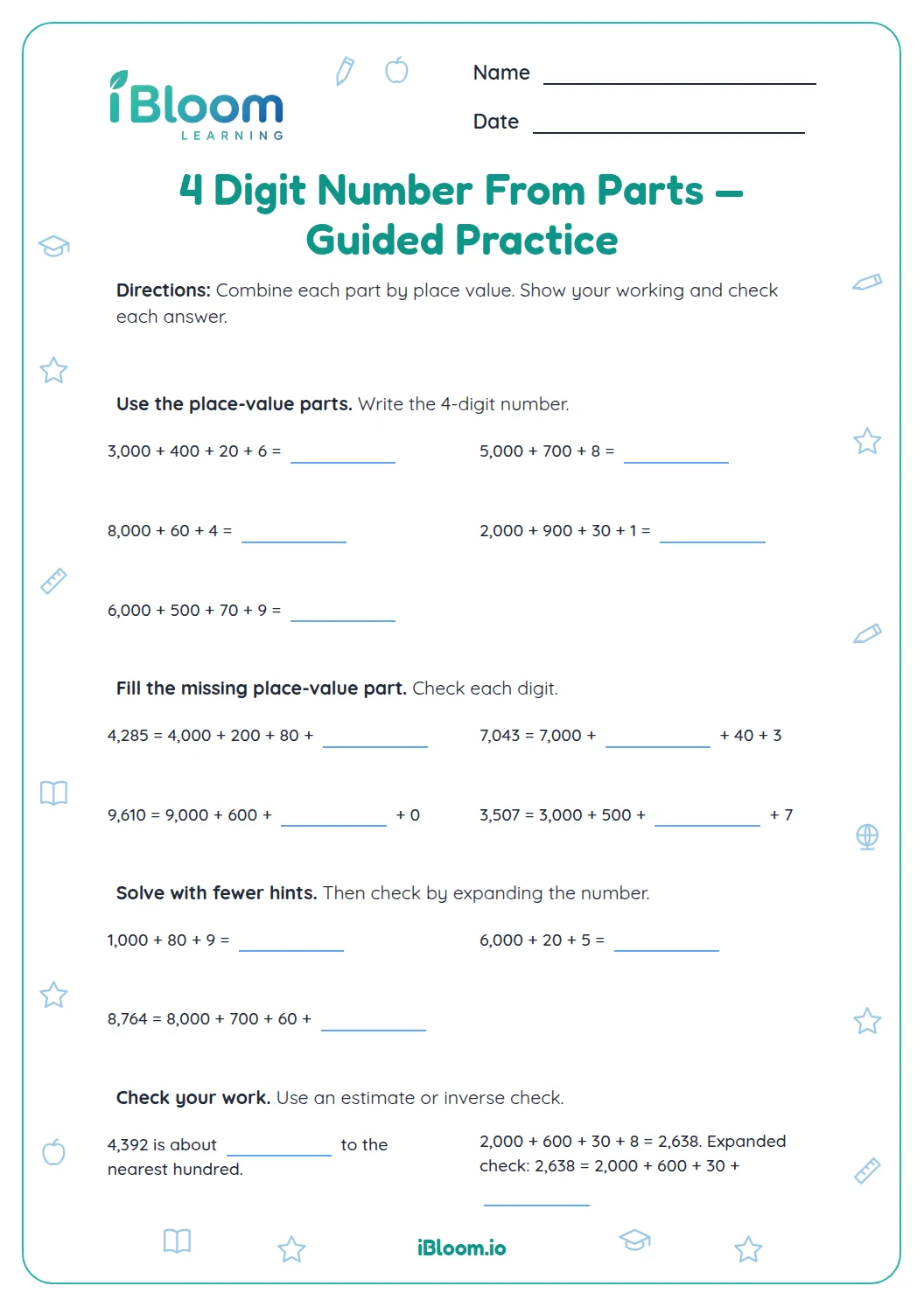
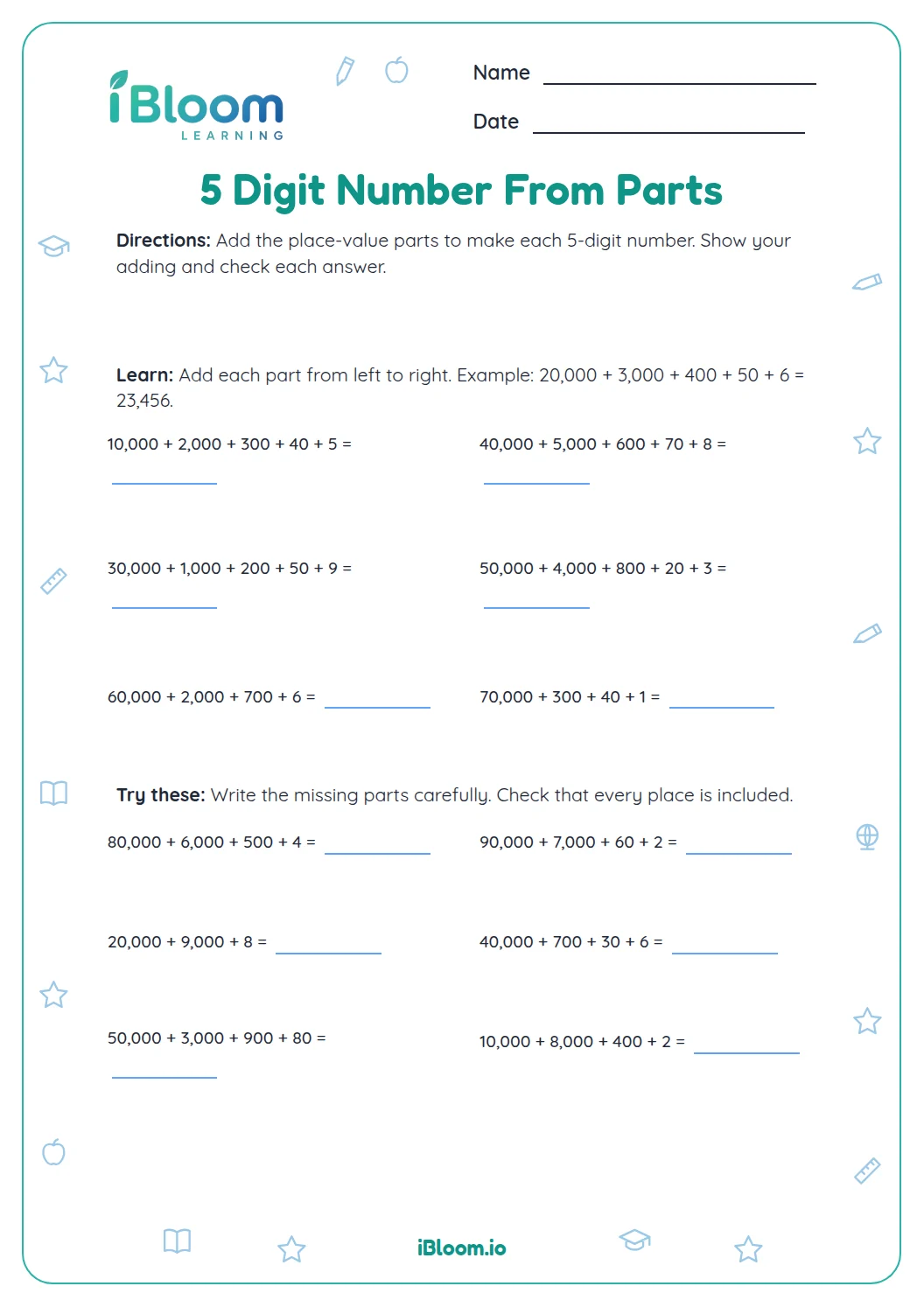
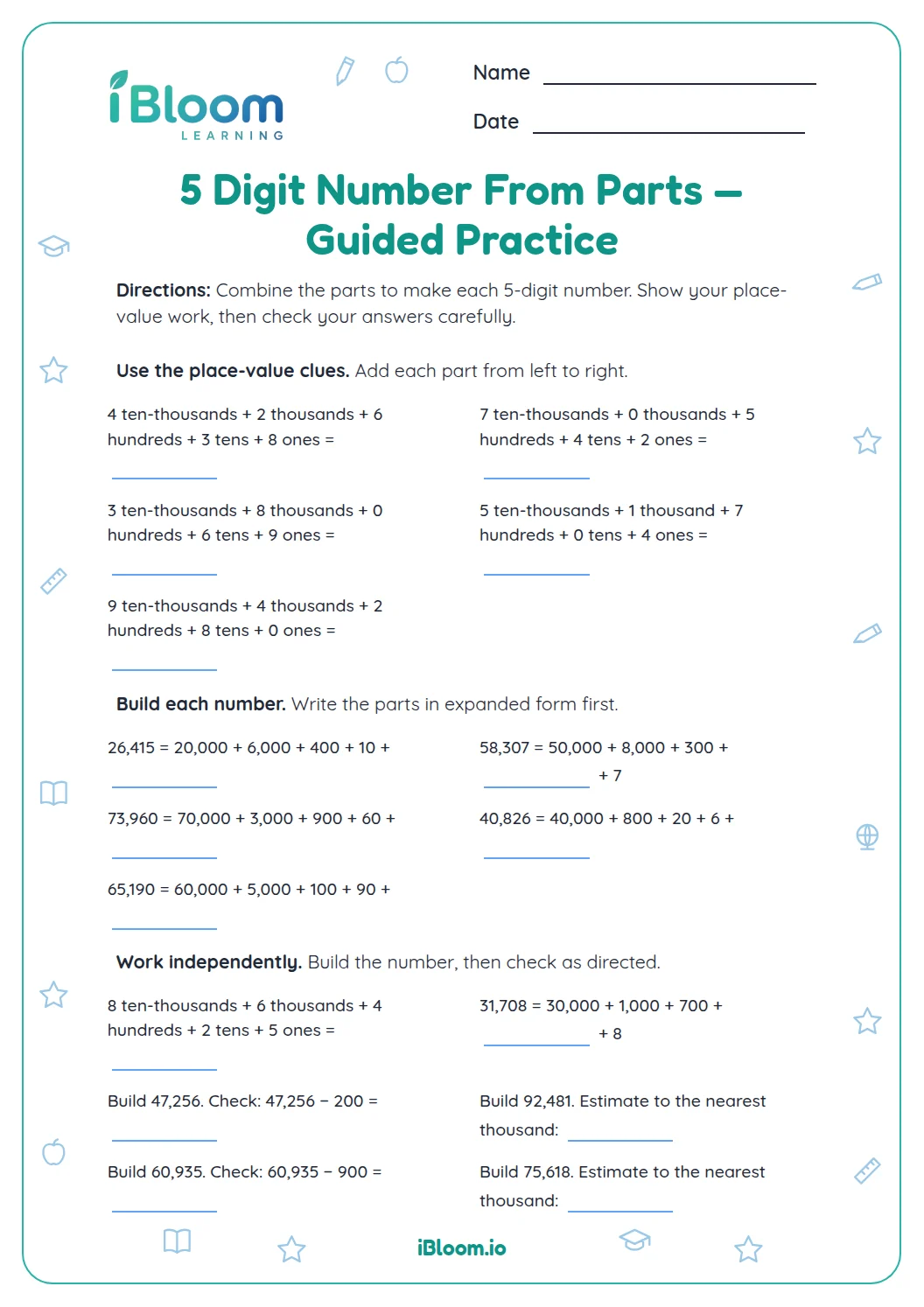
This printable expanded notation sheet is for Grade 4 learners. It has 15 questions in 3 parts, with practice moving from supported examples to independent use. The separate answer key gives a way to check each response.
Aligned to 4.NBT.A.2
How does expanded notation work?
Reading, writing, and comparing multi-digit numbers in expanded form. Work through each part in order, using the stated unit, place, or feature in the prompt.
Part A starts with supported practice; the later parts ask learners to apply the same idea with less support.
- 1Write 4,000 + 300 + 20 + 6 in standard form.
- 2Combine the thousands, hundreds, tens, and ones: 4,326.
What will learners practice on this sheet?
The 15 items include reading, writing, and comparing multi-digit numbers in expanded form. The key lists the expected response for each item.
How can a learner check the answers?
After finishing a part, use the answer key to check it. For a missed item, name the relationship or operation, solve it again, and compare.
How to use this worksheet
- 1Read the whole prompt and underline the quantity, unit, or feature it names.
- 2Complete Part A, showing the relationship used for each answer.
- 3Continue through the remaining parts and write units where they belong.
- 4Check each response with the answer key after finishing the sheet.
- 5Redo missed items and explain the step that changed the result.
Common mistakes and quick fixes
The mistake
Leaving out a zero place in a number such as 7,059.
The fix
Keep each digit in its place when writing the standard form.
The mistake
Writing a zero-value place as a nonzero addend.
The fix
Include only the nonzero place values in expanded form.
The mistake
Rounding 6,482 down because the tens digit is 8.
The fix
For the nearest hundred, check the tens digit; 8 rounds 6,482 up to 6,500.
Common Core alignment
This worksheet practices the following Common Core skill.
Read, write, and compare multi-digit whole numbers using base-ten numerals, number names, and expanded form.
On this sheet: Learners write expanded forms and compare multi-digit numbers by place value.
Show the official wordingHide the official wording
Read and write multi-digit whole numbers using base-ten numerals, number names, and expanded form. Compare two multi-digit numbers based on meanings of the digits in each place, using >, =, and < symbols to record the results of comparisons.
What to practice next
Make more practice
Further reading
Questions parents and teachers ask
What does expanded notation show?
Expanded notation writes a number as the sum of the value of each nonzero digit. For example, 6,281 is 6,000 + 200 + 80 + 1. The worksheet asks learners to move between standard and expanded forms and use place value to reason about the digits.
How many questions are on the sheet?
There are 15 questions in three parts. Early items build and read numbers, the middle set focuses on place value, and the final set connects the skill to rounding, comparison, and explanation. A separate answer key is included. Ask the learner to point to the clue in the prompt and explain how it supports the answer.
Does the worksheet include rounding?
Yes. One question asks learners to round 6,482 to the nearest hundred. The main practice is expanded notation and place value, so rounding appears as a short connection to the same digits. Ask the learner to point to the clue in the prompt and explain how it supports the answer.
Is there an answer key?
Yes. The answer key gives responses for all 15 questions, including a sample explanation for why zero matters in 4,062. Learners can first try a question independently, then use the key to check and correct it. Ask the learner to point to the clue in the prompt and explain how it supports the answer.
How can I help with a missed answer?
Ask which digit or place the prompt names, then have the learner say that digit’s value before writing the answer. For expanded form, check that the addends sum to the original number and that zero-value places have not shifted the other digits.