


About this worksheet
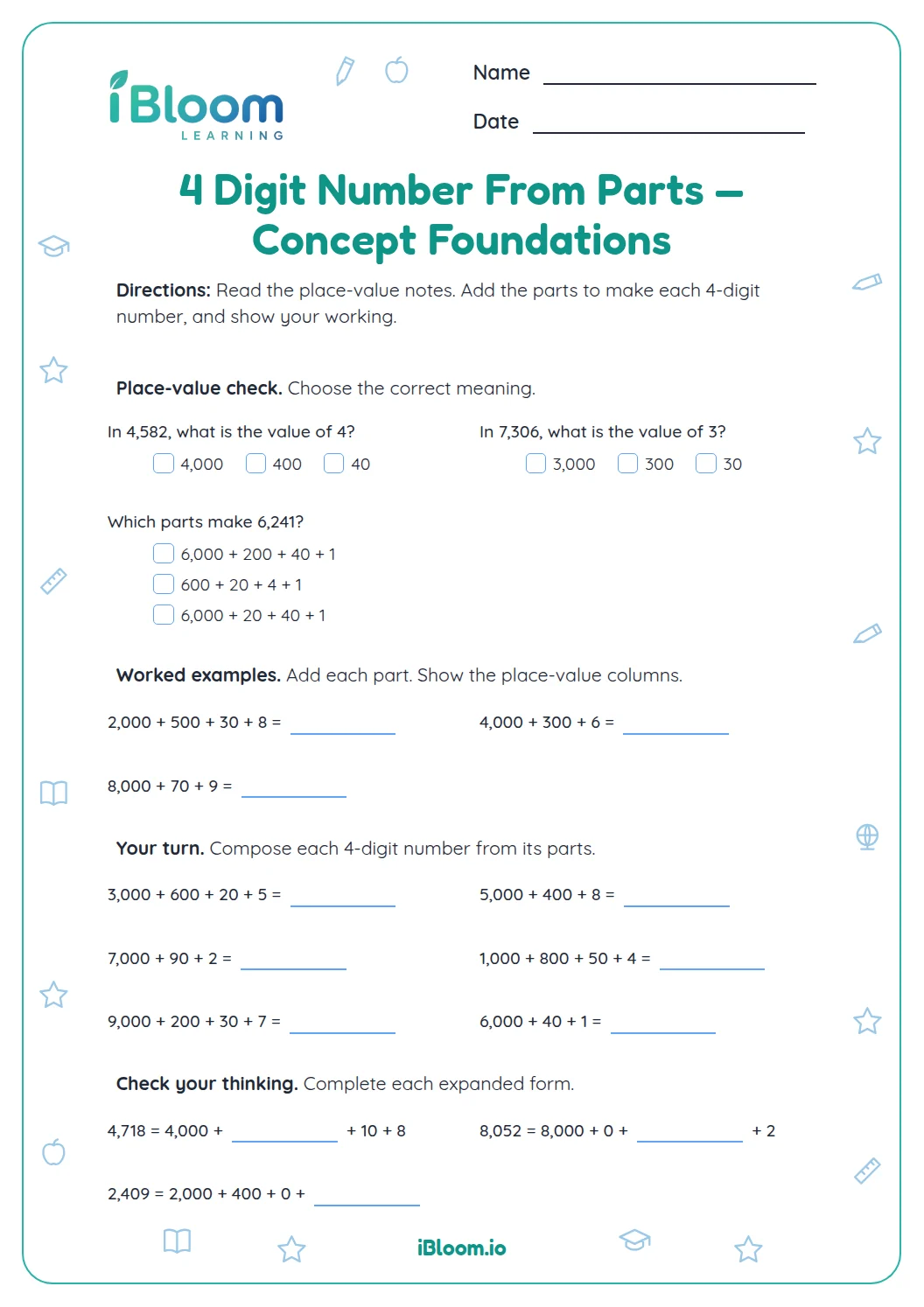
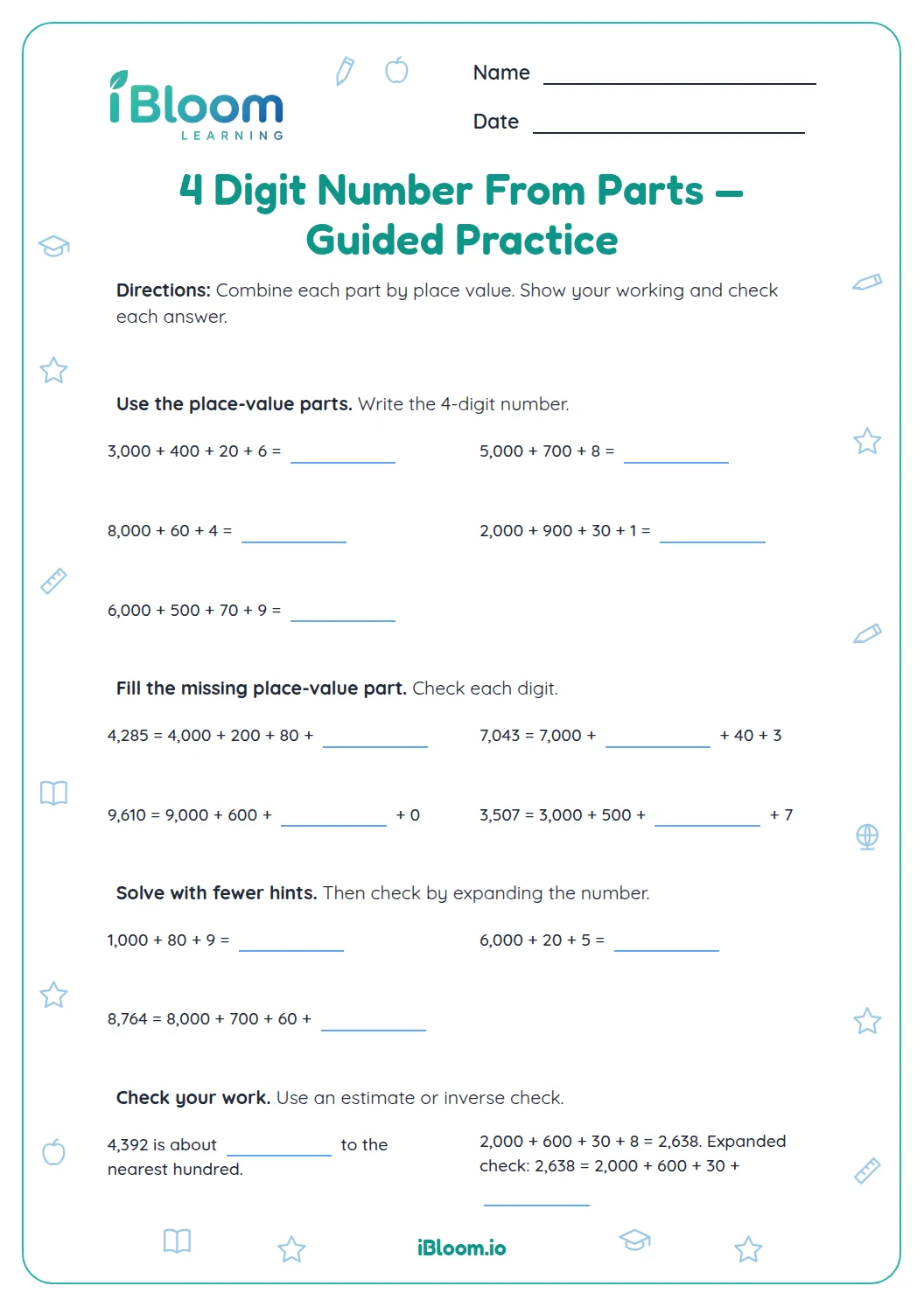
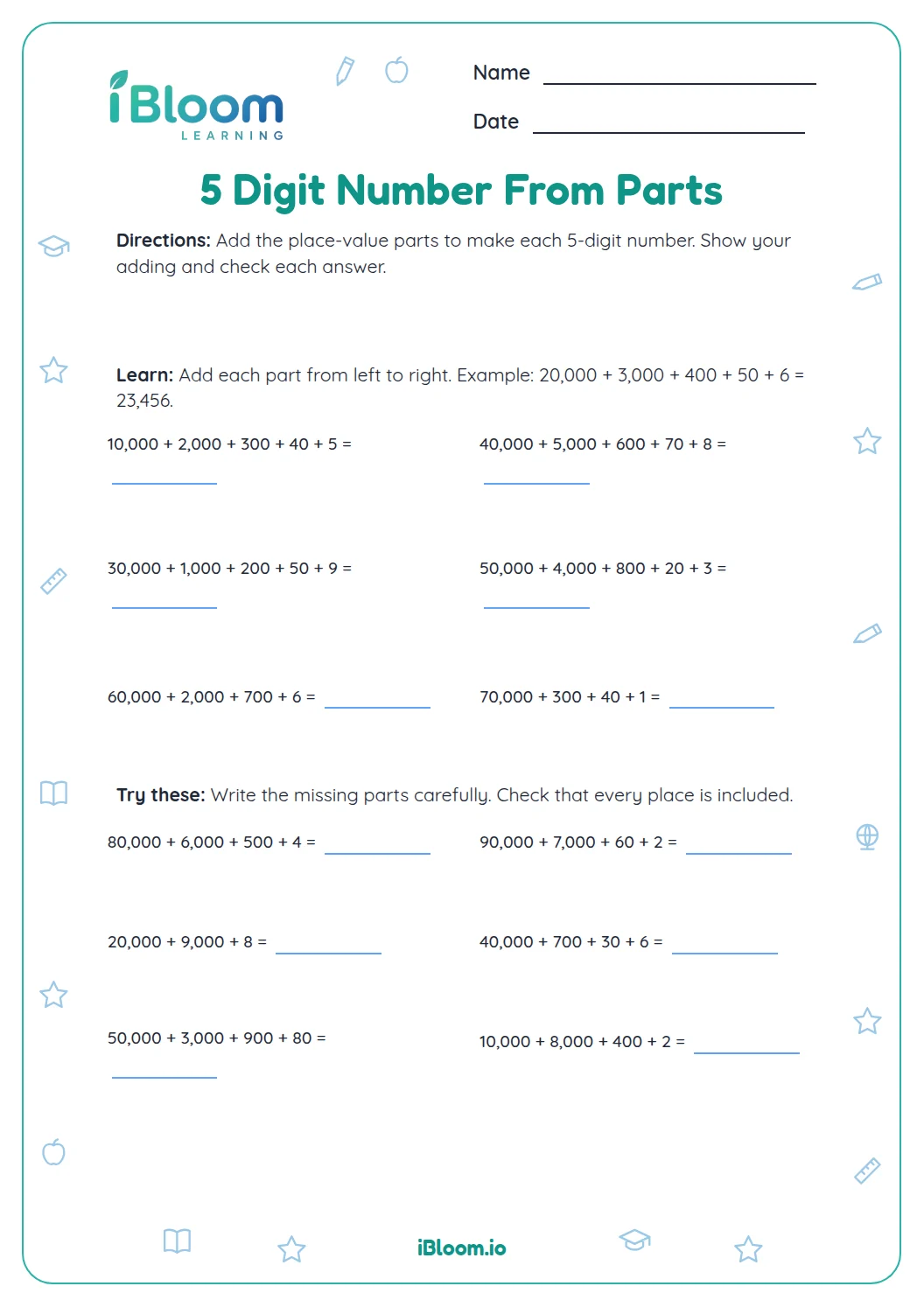
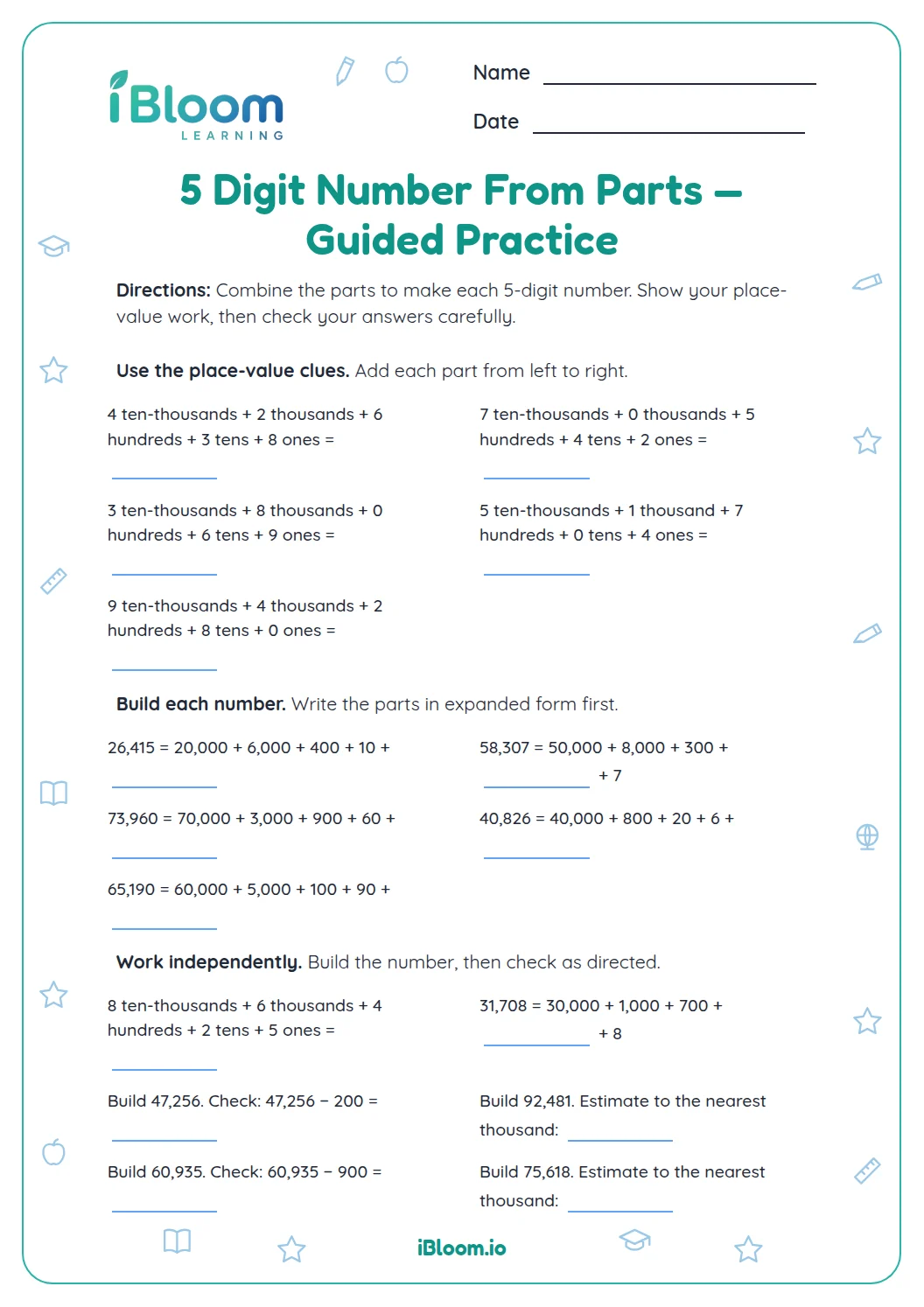
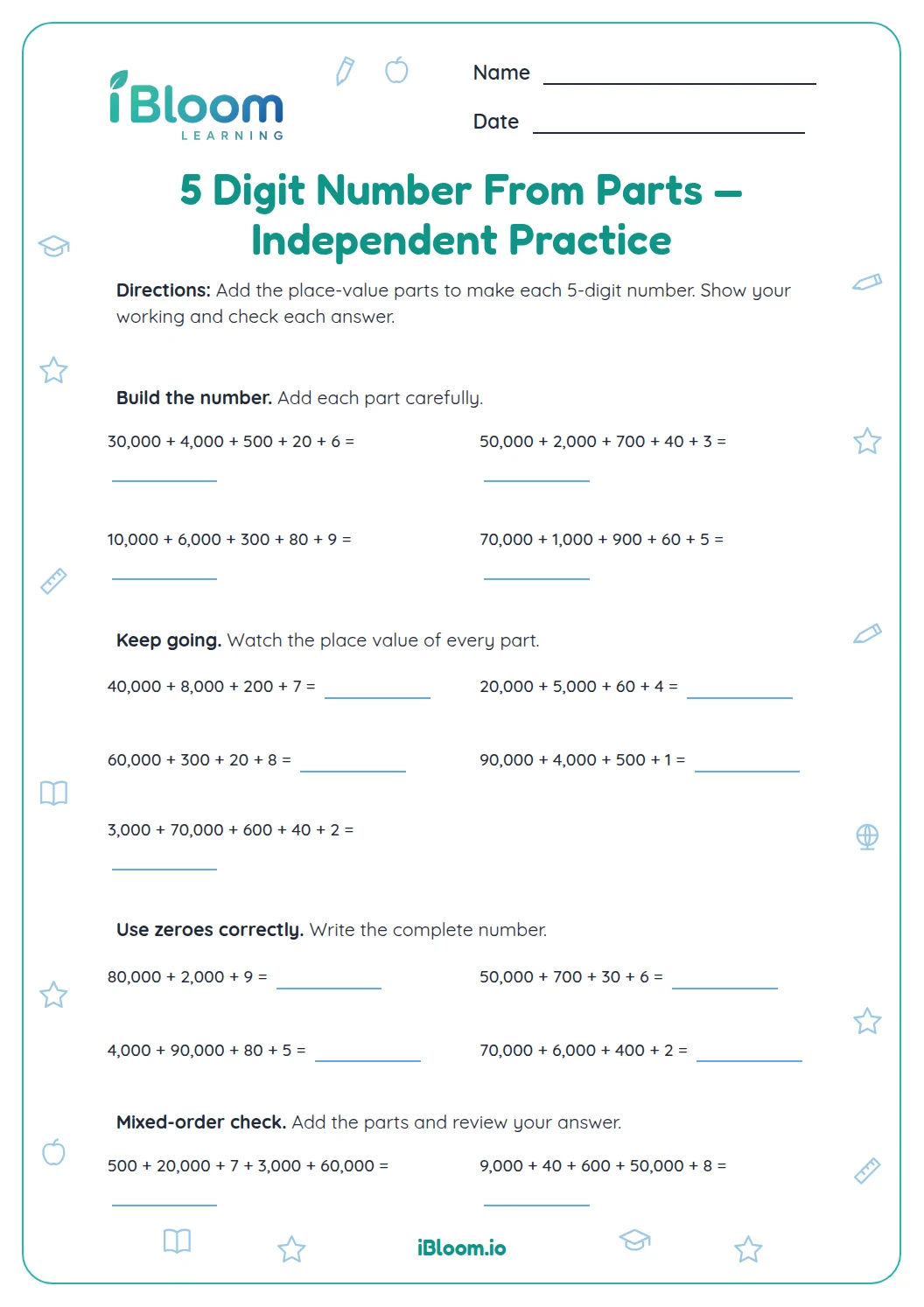
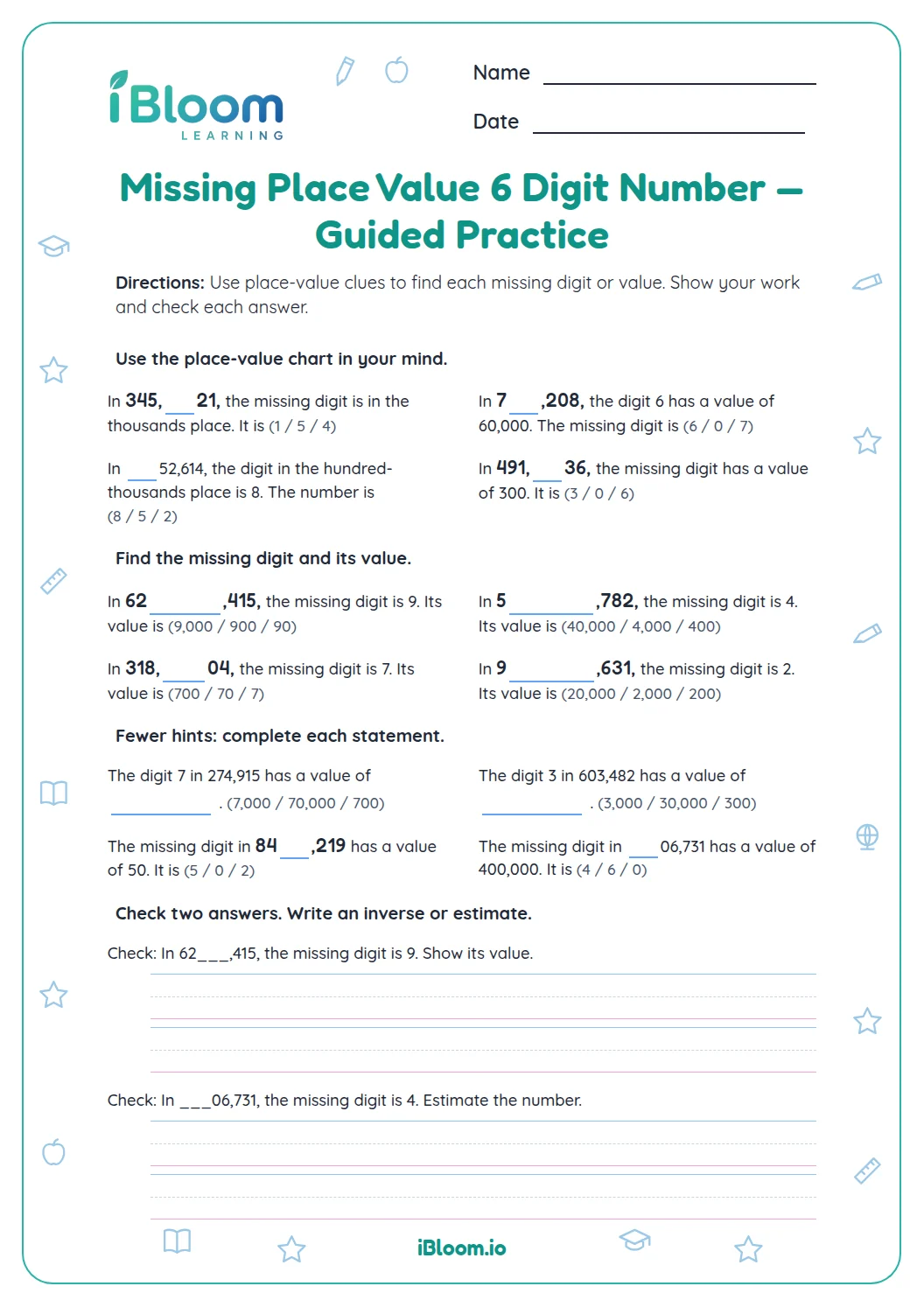
This free printable is for Grade 4 learners composing six-digit numbers from expanded form. Twelve prompts ask learners to write standard numerals from place-value addends, including examples with missing places. Three final questions check digit placement and expanded notation. The answer key lists every numeral and selected response. This practice builds the read-and-write portion of CCSS 4.NBT.A.2 by connecting each addend to the value of a digit.
Aligned to 4.NBT.A.2
How do expanded parts become one number?
Read each addend by its place name, then place its digit in the matching position from hundred-thousands to ones. Question 1 combines six parts to make 432,567.
- 1For 400,000 + 30,000 + 2,000 + 500 + 60 + 7, place the digits in order.
- 2The standard form is 432,567.
What should go in a missing place?
Use zero when no addend names a place. In 500,000 + 40,000 + 700 + 8, the thousands and tens digits are zero, so the number is 540,708.
How can each digit be checked?
Expand a written numeral back into its place-value parts. Each nonzero digit should match one addend, and each zero should mark a place with no addend.
How to use this worksheet
- 1Read each addend and name its place value.
- 2Place the digit in the matching position from hundred-thousands to ones.
- 3Write zero in any position without an addend.
- 4Read the resulting six-digit numeral aloud or by place.
- 5Expand it again to check that each part matches.
Common mistakes and quick fixes
The mistake
Leaving out a place with no addend.
The fix
Write a zero so digits to its left and right stay in their correct positions.
The mistake
Moving a digit into the neighboring place.
The fix
Match each addend to its place name before writing the numeral.
The mistake
Treating 700 as 70 or 7.
The fix
Read the whole addend and place its digit in the hundreds column.
Curriculum alignment
The questions build and read multi-digit numbers from expanded place-value parts.
Learners write six-digit numerals from expanded form and check the value of each place.
On this sheet: Learners translate expanded place-value addends into six-digit base-ten numerals, including zeros in empty places.
Show the official wordingHide the official wording
Read and write multi-digit whole numbers using base-ten numerals, number names, and expanded form. Compare two multi-digit numbers based on meanings of the digits in each place, using >, =, and < symbols to record the results of comparisons.
What to practice next
Make more practice
Further reading
Questions parents and teachers ask
What is expanded form?
Expanded form shows a number as the sum of the value of each digit, such as 400,000 + 30,000 + 2,000 + 500 + 60 + 7. Combine those parts by place to write the standard numeral 432,567.
Why do some answers need zeroes?
A missing addend means that place has a value of zero. In 500,000 + 40,000 + 700 + 8, the thousands and tens places have no addend, so both digits are zero and the six-digit number is 540,708.
How many questions ask learners to write numbers?
Twelve prompts ask learners to write standard form directly from expanded parts. Three final questions check whether they can recognize a correct six-digit number or identify the expanded expression that matches one. The separate key lists all composed numerals and choices.
How can a learner check a six-digit answer?
Read the digits from hundred-thousands through ones and match each one to its addend. Then expand the written number again; each nonzero digit should recreate a part, while each zero marks an empty place in the six-digit numeral.
What does the answer key include?
The separate key lists the twelve composed numbers and the three place-value choices. If an answer differs, locate the place that needs attention, revise that digit, then expand the corrected numeral to confirm that every addend is represented.