

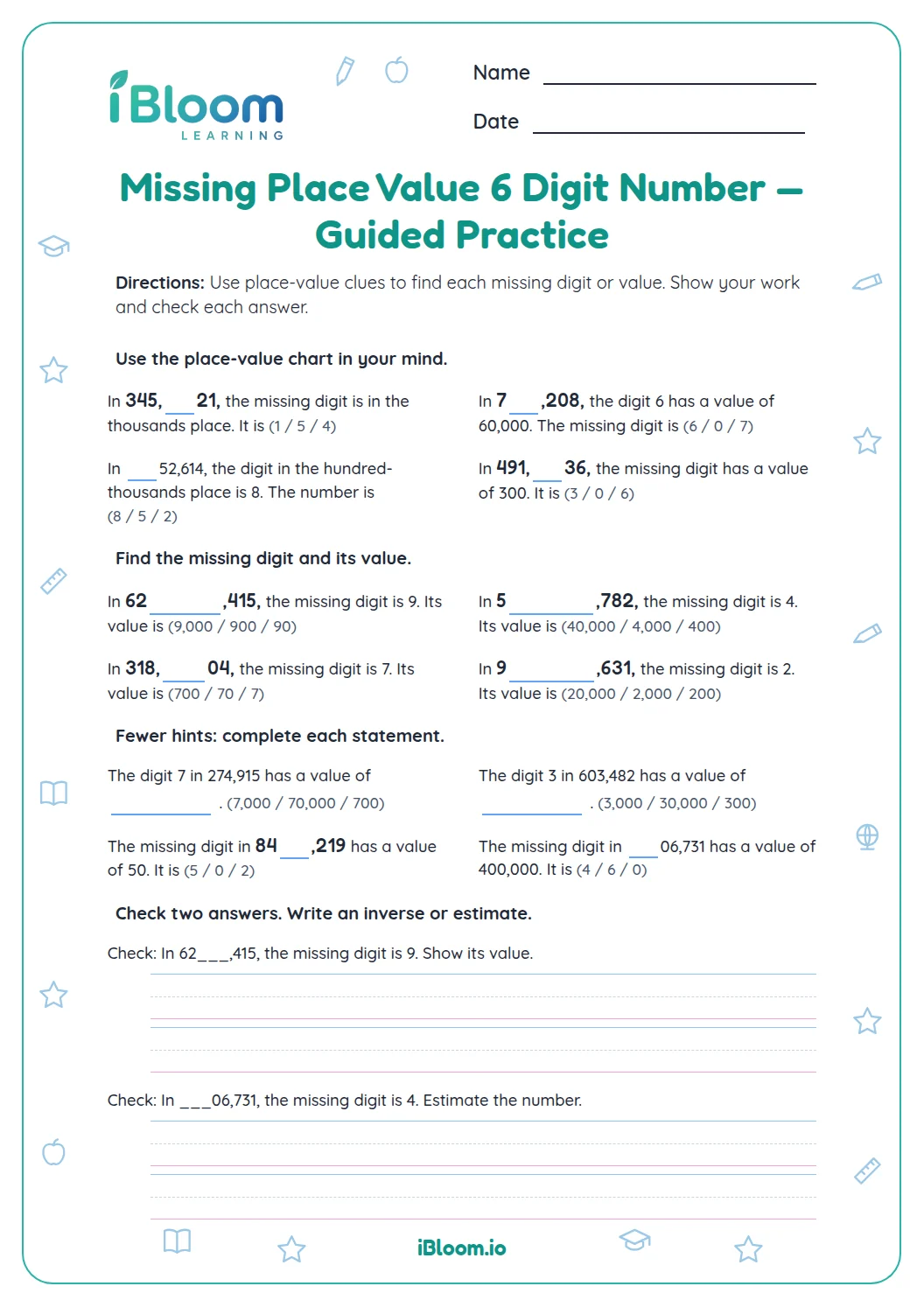

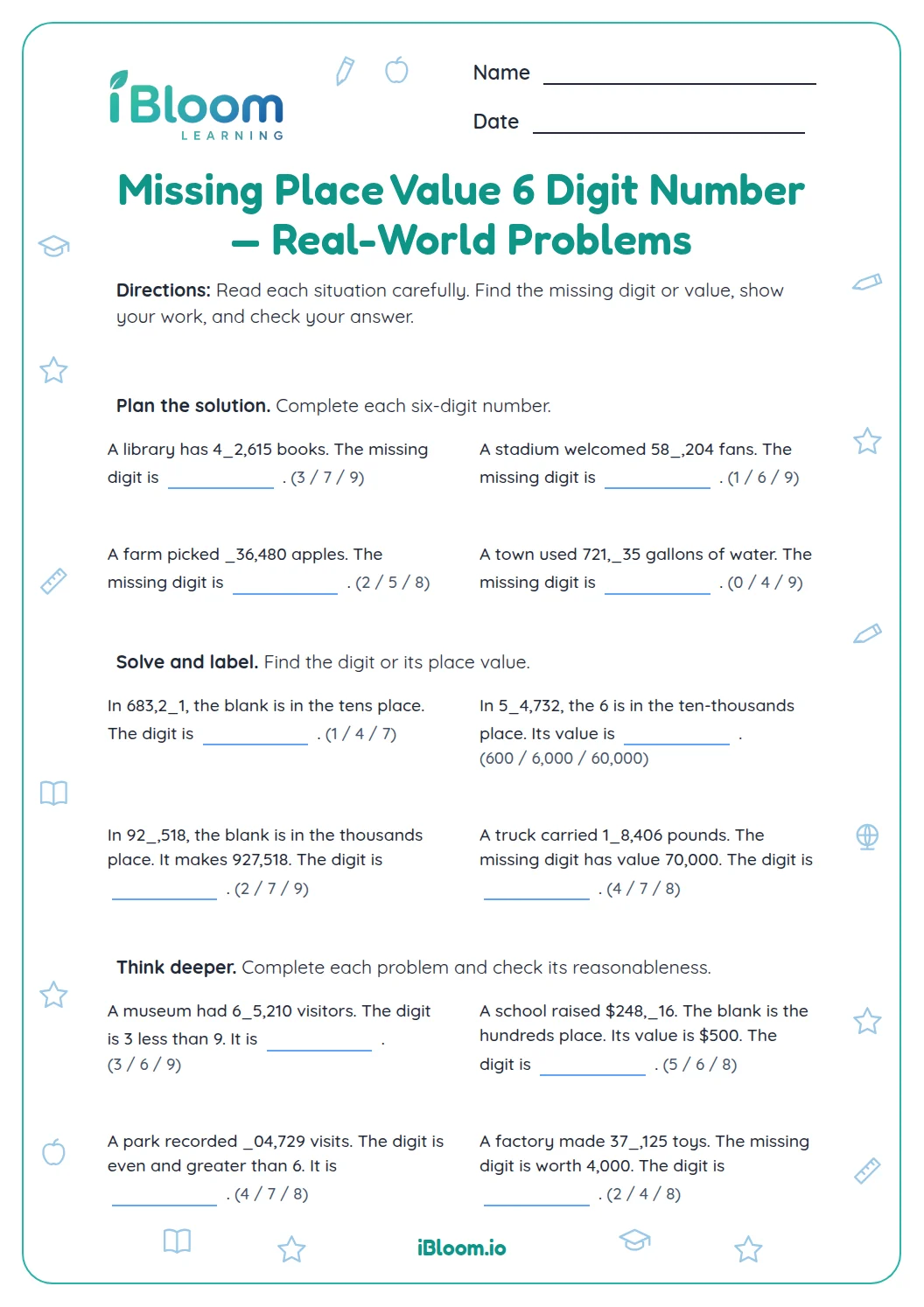
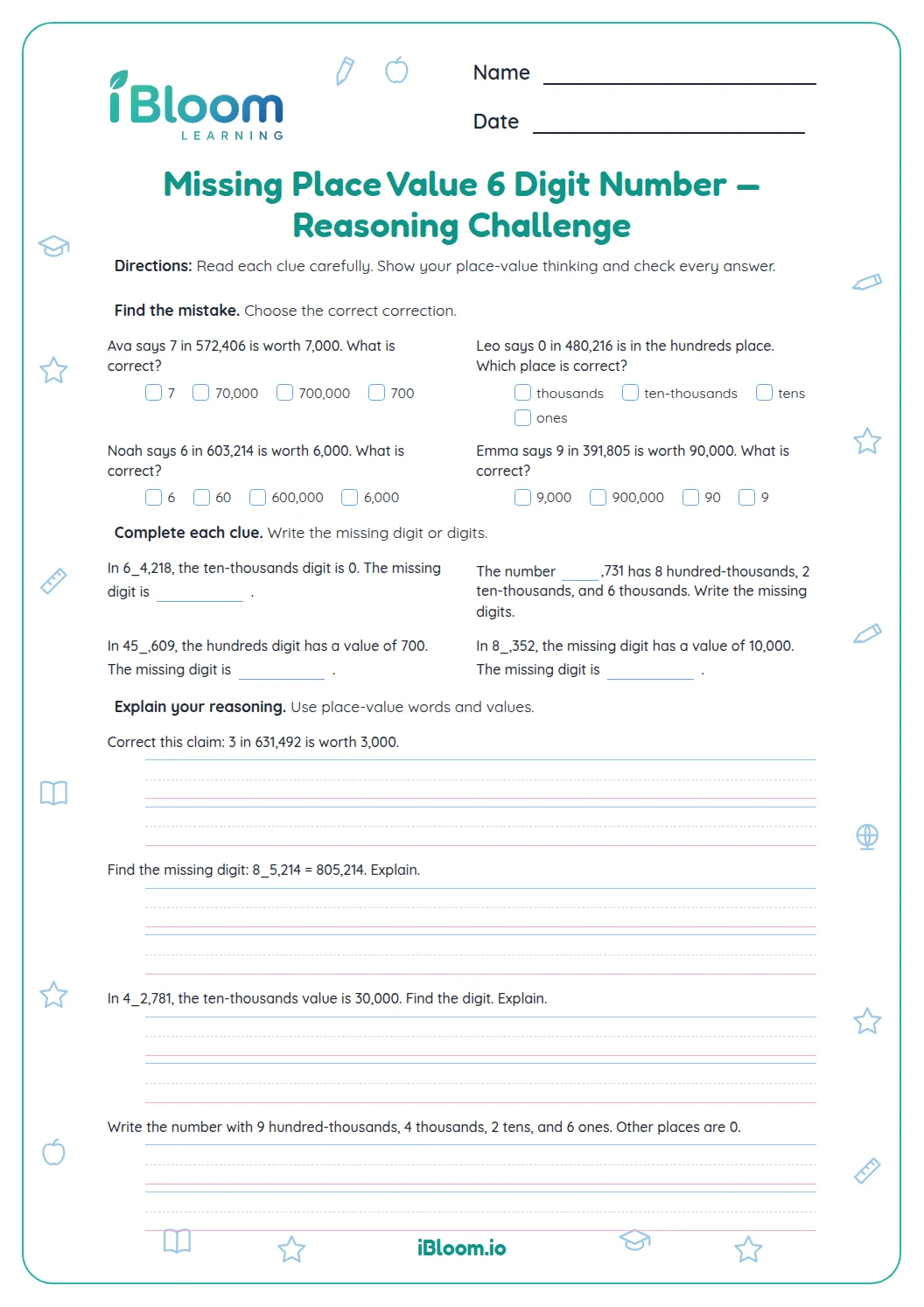
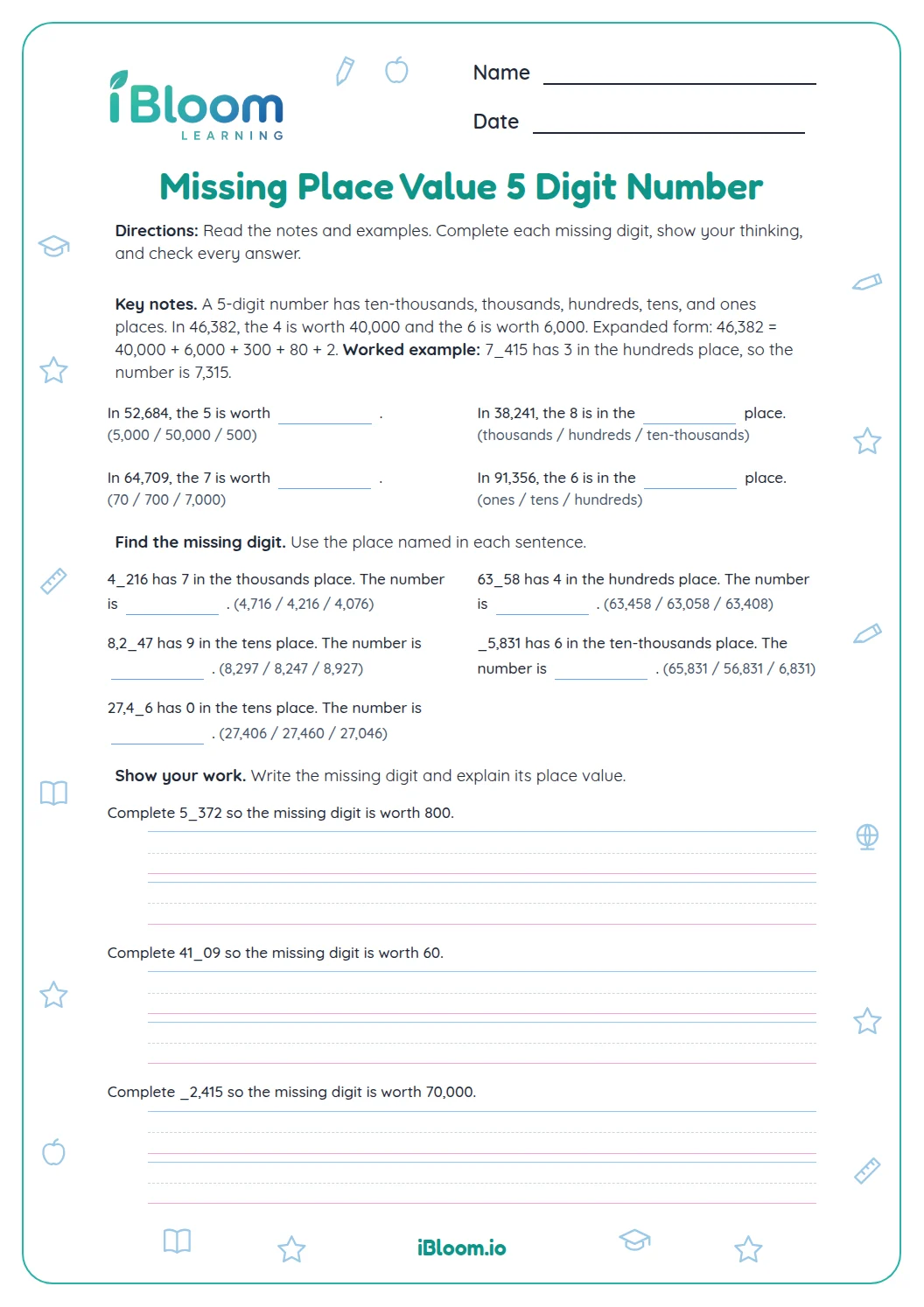


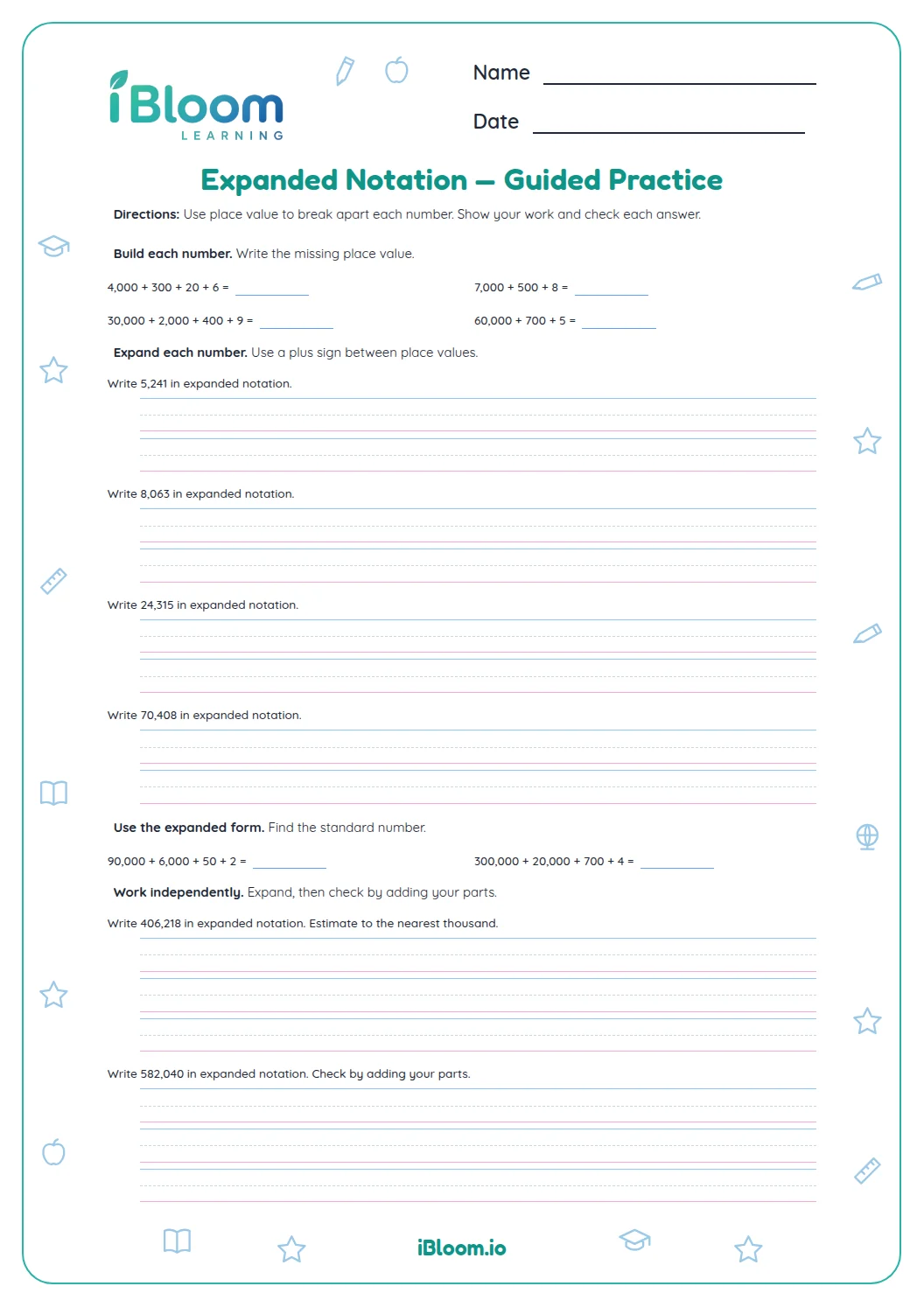
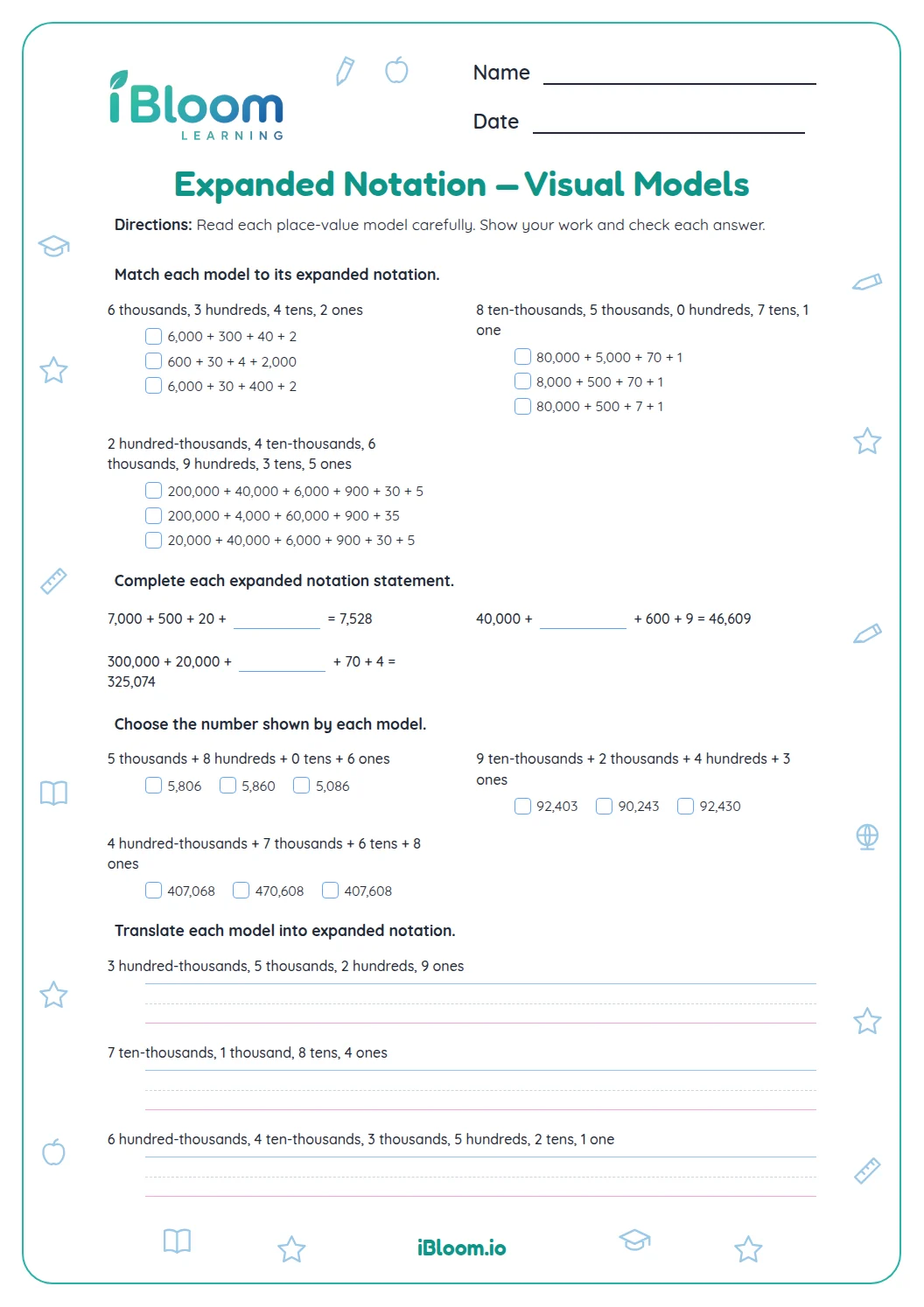
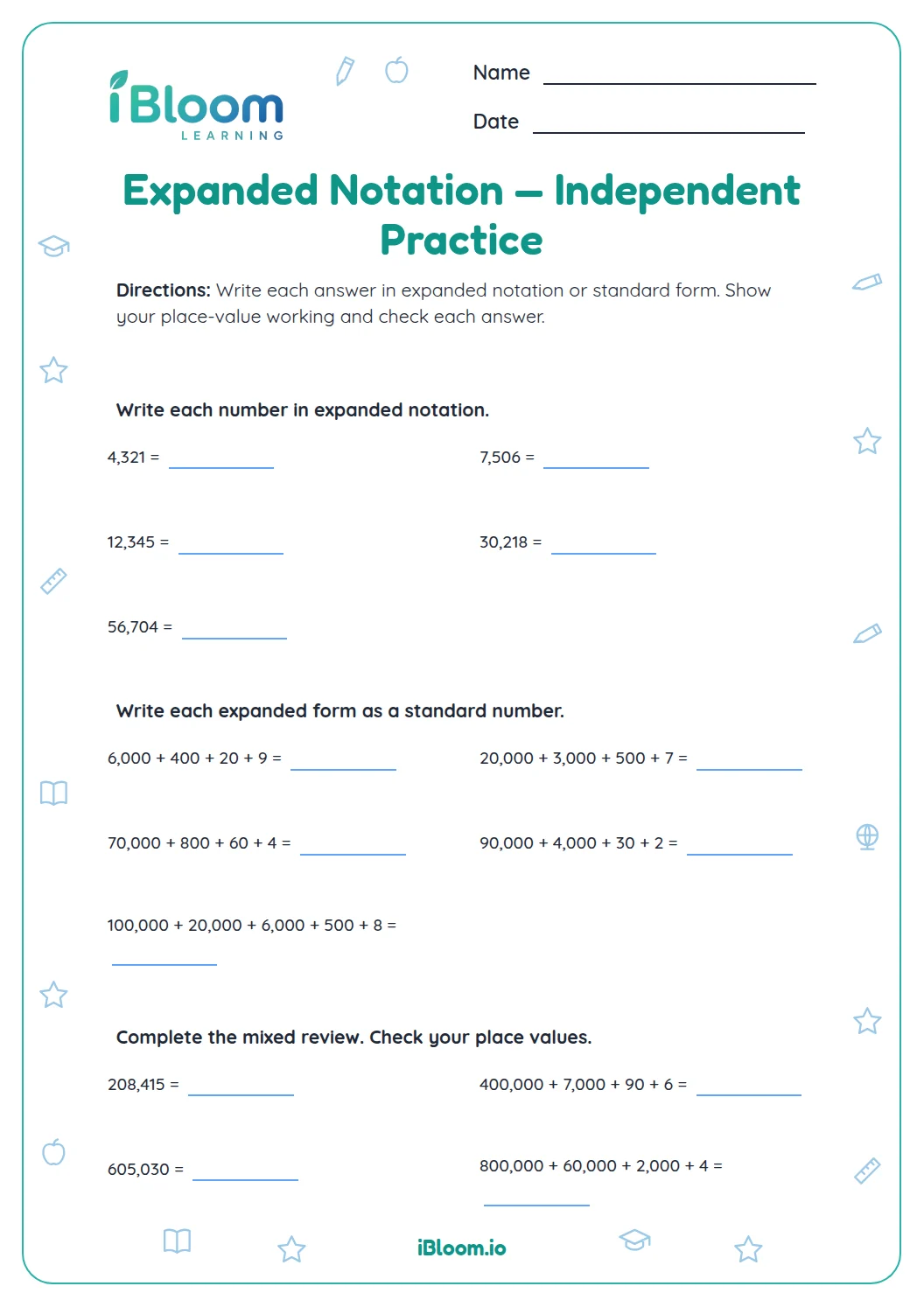
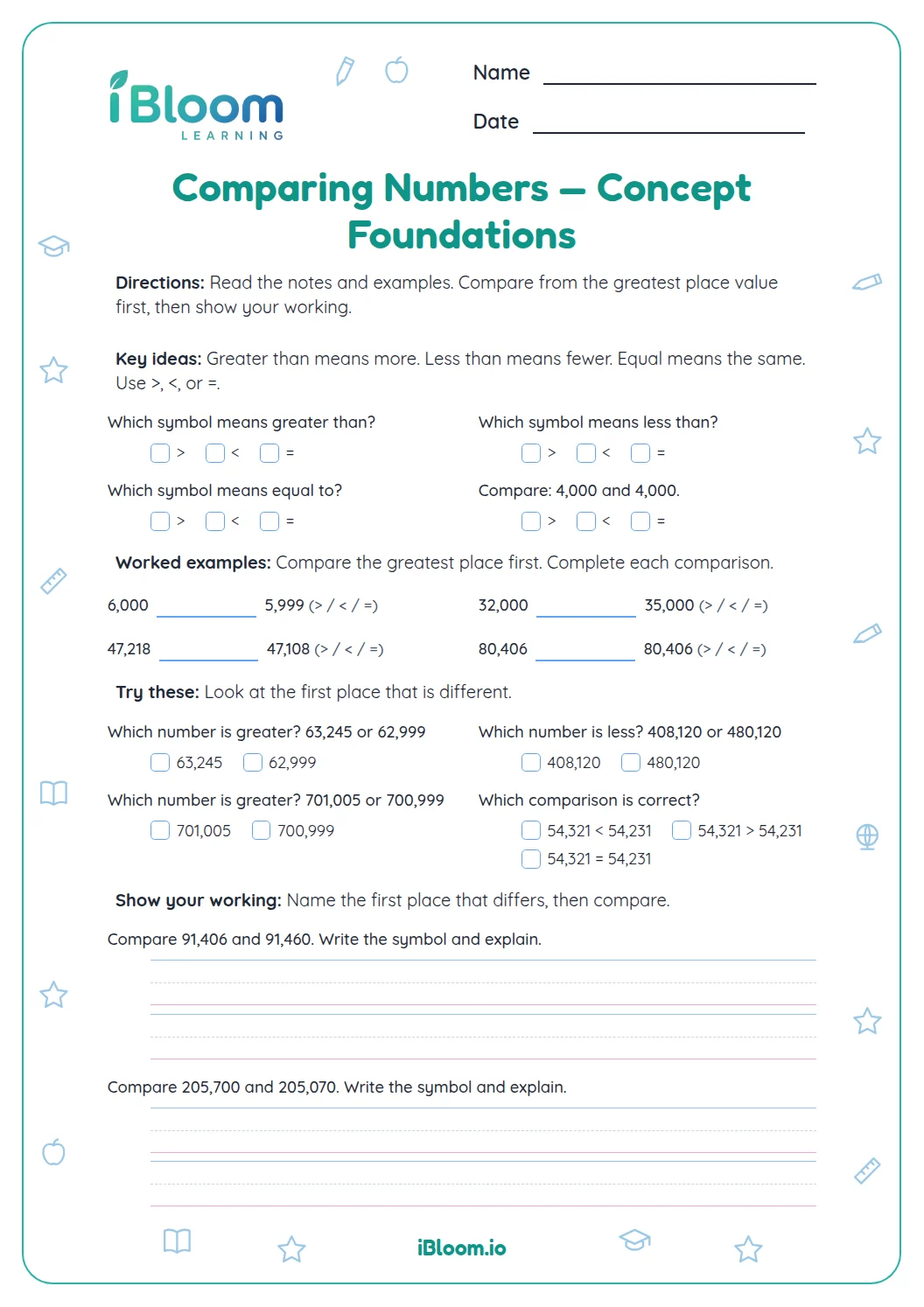
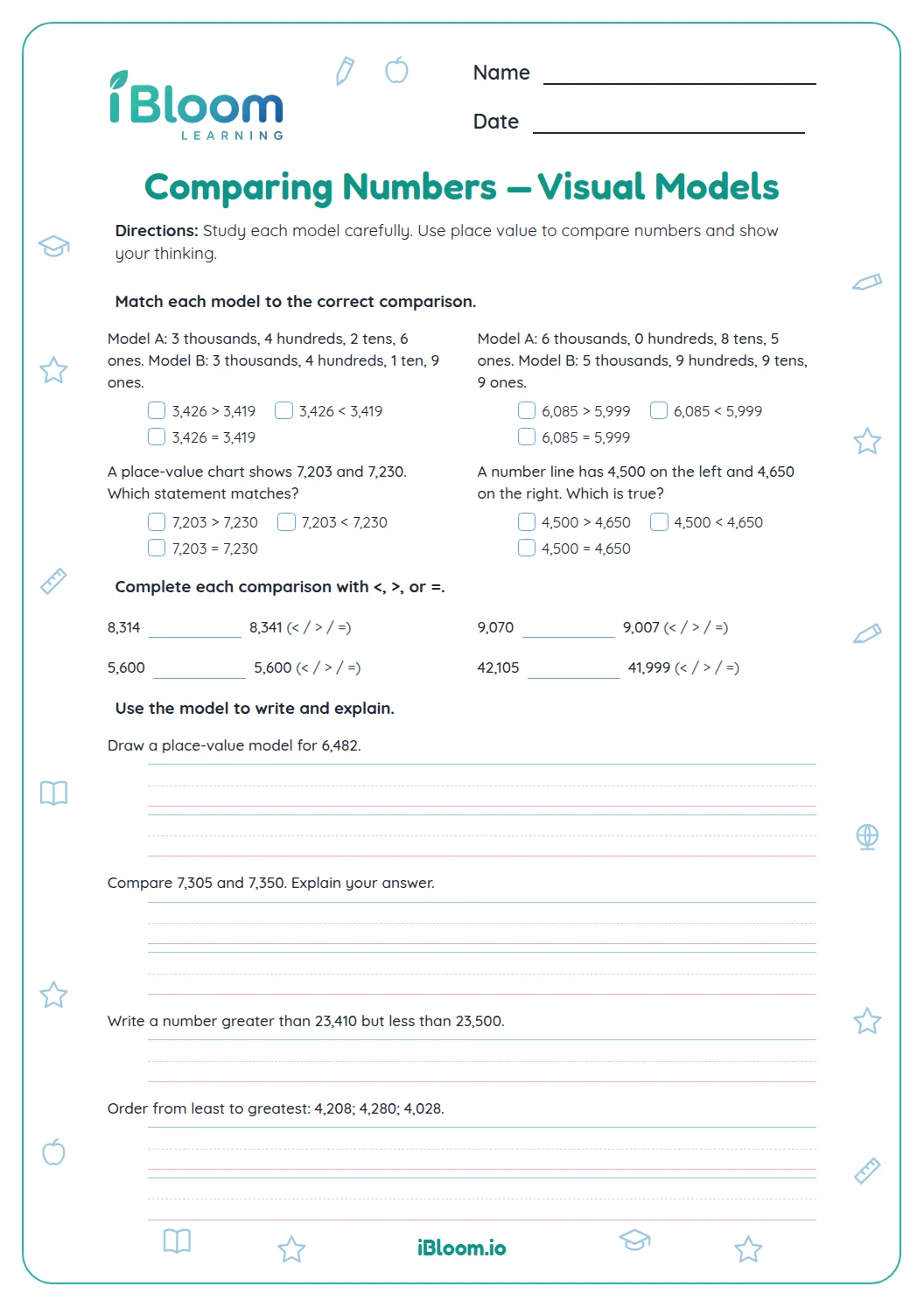
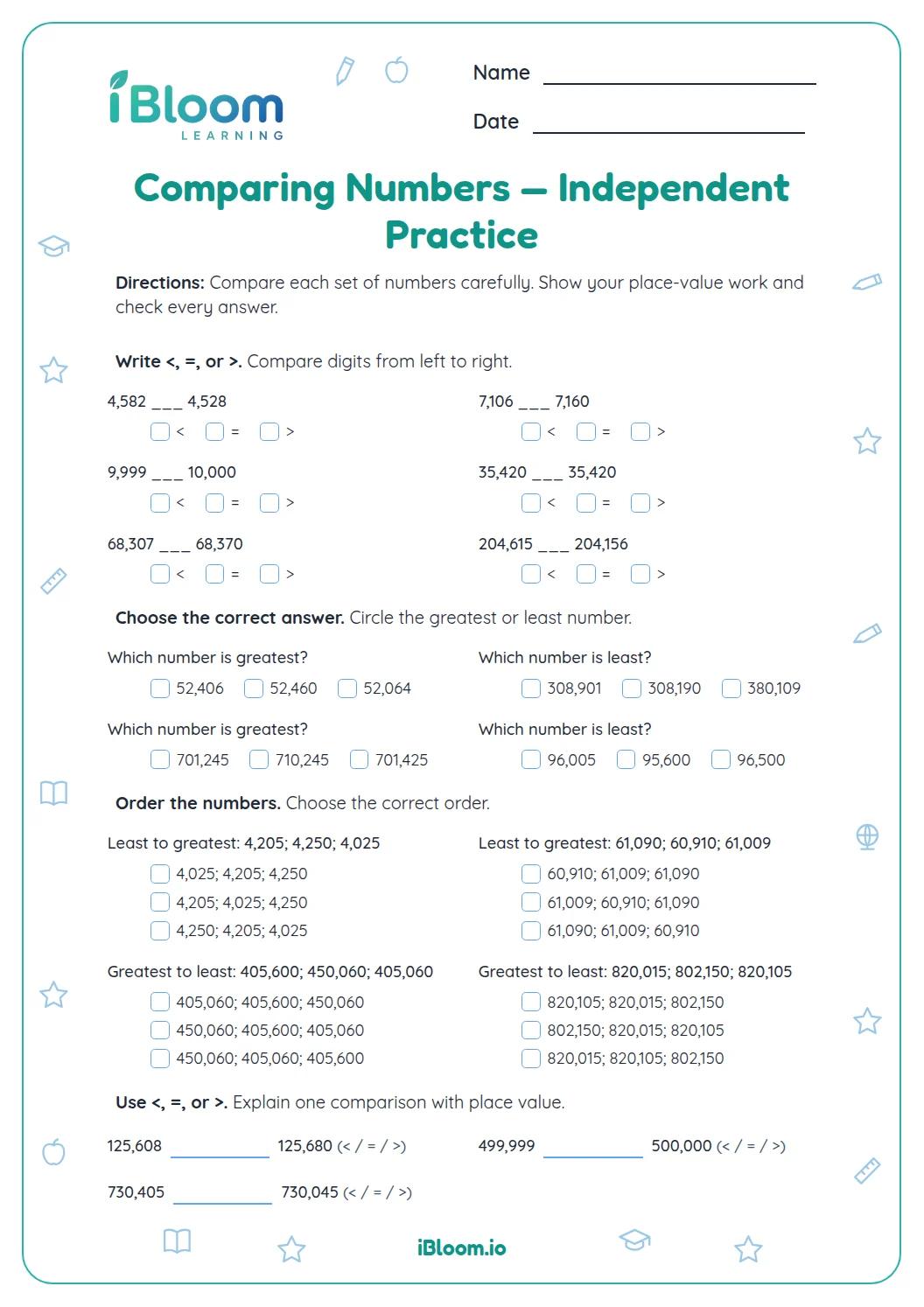
About this worksheet
This free Grade 4 worksheet connects six-digit numbers to number lines and expanded form. Children first read four marked numbers using jumps of 1,000, 10, or 1. They then fill eight missing values in expanded forms and finish with two digit clues. The 14 questions include numbers with zero placeholders, such as 904,017, so every position matters. The sheet practices Common Core 4.NBT.A.2 through reading and writing multi-digit numbers. A separate answer key provides each whole number, missing value, and digit.
Aligned to 4.NBT.A.2
How do the number lines show place value?
The four lines show small intervals within six-digit numbers. Their jumps change from thousands to tens to ones. Read both endpoints and the step named in the question before counting to A, B, C, or D.
Part A asks for the full number at each letter. Part B revisits those numbers in expanded form, letting children connect the location of a number with the values of its digits.
How do children complete an expanded form?
Each amount belongs to one place. The missing value is the part needed to rebuild the number on the right. A zero in a place contributes zero, as in the hundreds place of 702,036.
- 1The first line starts at 230,000 and jumps by 1,000.
- 2A is four jumps from the start: 234,000.
- 3200,000 + 30,000 + ___ = 234,000
- 4The missing value is 4,000.
What is the difference between a digit and its value?
A digit is one symbol from 0 to 9. Its value depends on its position: in 482,615, the digit 8 has a value of 80,000. Part C gives the value and asks children to recover the digit.
Have children name the place aloud before writing. This keeps a response such as 80,000 separate from the one-digit response 8.
How to use this worksheet
- 1Read the first line’s endpoints and identify the size of one jump.
- 2Count intervals to each letter and write the complete six-digit number.
- 3For each Part B blank, match the remaining digits to their places.
- 4Check each expanded form by adding its parts.
- 5Finish the digit clues, then compare answers with the key.
Mistakes to check together
The mistake
Counting the starting tick as the first jump.
The fix
Begin at zero jumps; move to the next tick for one jump.
The mistake
Writing 4 instead of 4,000 in an expanded form.
The fix
Read the whole number aloud and name the thousands place before filling the blank.
The mistake
Moving digits left when a place contains zero.
The fix
Keep all six places; in 702,036, the hundreds digit stays 0.
Common Core alignment
Read six-digit numbers and complete their expanded forms.
On this sheet: Students read six-digit numbers on scaled lines and fill missing place values in expanded forms.
Show the official wordingHide the official wording
Read and write multi-digit whole numbers using base-ten numerals, number names, and expanded form. Compare two multi-digit numbers based on meanings of the digits in each place, using >, =, and < symbols to record the results of comparisons.
What to practice next
Make more practice
Further reading
Questions parents and teachers ask
What visual models are on this worksheet?
There are four number lines with lettered points and labeled endpoints. Two lines use jumps of 1,000, one uses jumps of 10, and one uses jumps of 1. Children read the marked numbers, then work with those same numbers again in expanded-form questions in Part B.
Does a blank ask for a digit or a whole value?
Part B asks for a whole place value, while Part C asks for a digit. For example, a blank in 200,000 + 30,000 + ___ = 234,000 needs 4,000. A clue asking which digit has a value of 80,000 needs just the digit 8.
How are zeros practiced?
Zeros appear inside several six-digit numbers and in one missing expanded value. In 702,036, the hundreds place contributes 0, so the missing hundreds amount is zero. Ask children to keep the six places in order even when a place adds nothing to the total.
Can my child use a place-value chart alongside the sheet?
Yes, a chart labeled hundred thousands through ones can support the expanded-form questions. Have your child place each digit in its column, then read its value. For the number-line questions, keep attention on the endpoints and jump size so the marked position still determines the answer.
How do I check the number-line answers?
Check each answer by counting equal jumps from the left endpoint. The first two marked numbers are 234,000 and 567,000. The next two are 381,260 and 904,017. If a response is one jump too large, check whether the child counted the starting tick as a jump.