

About this worksheet
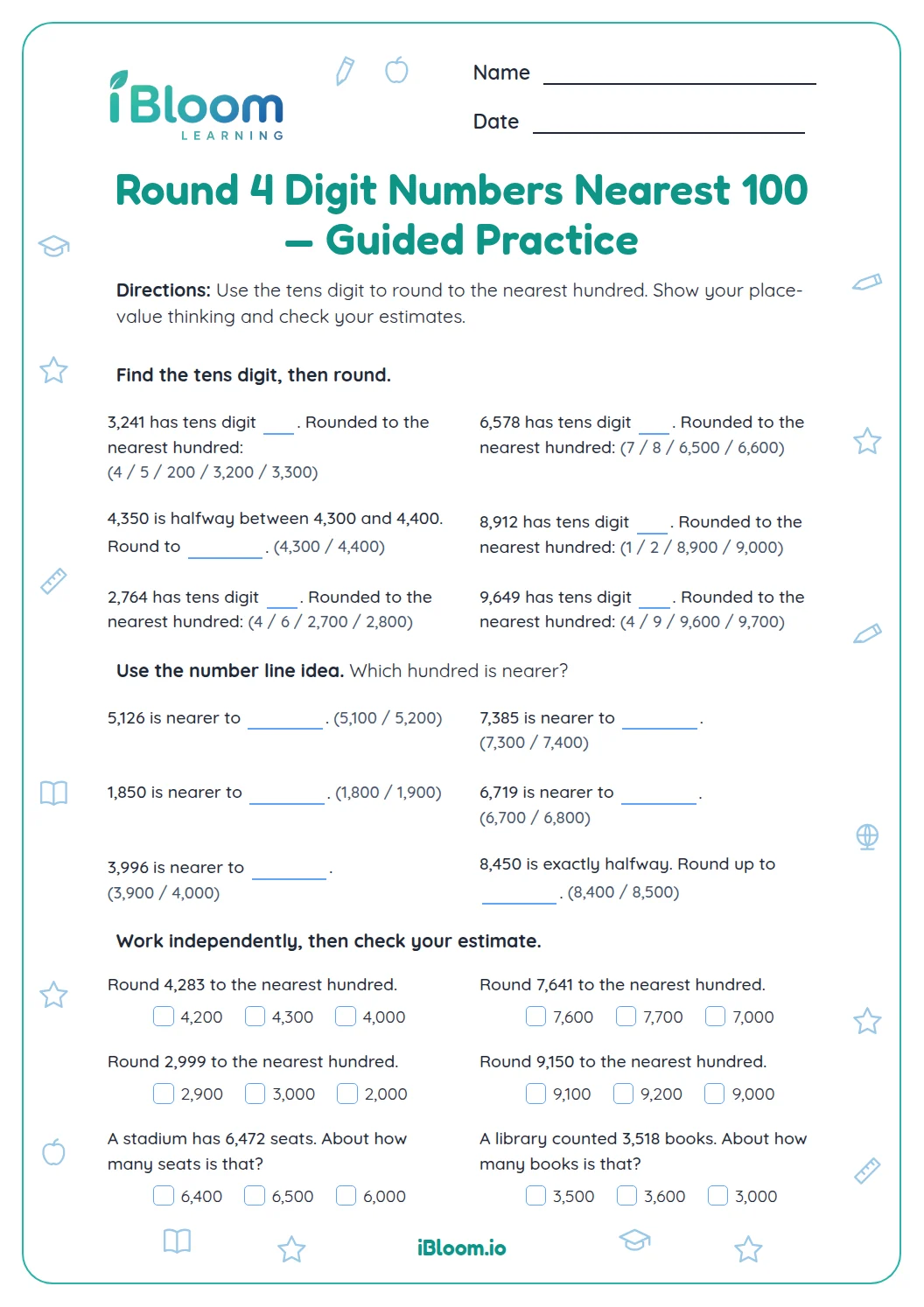
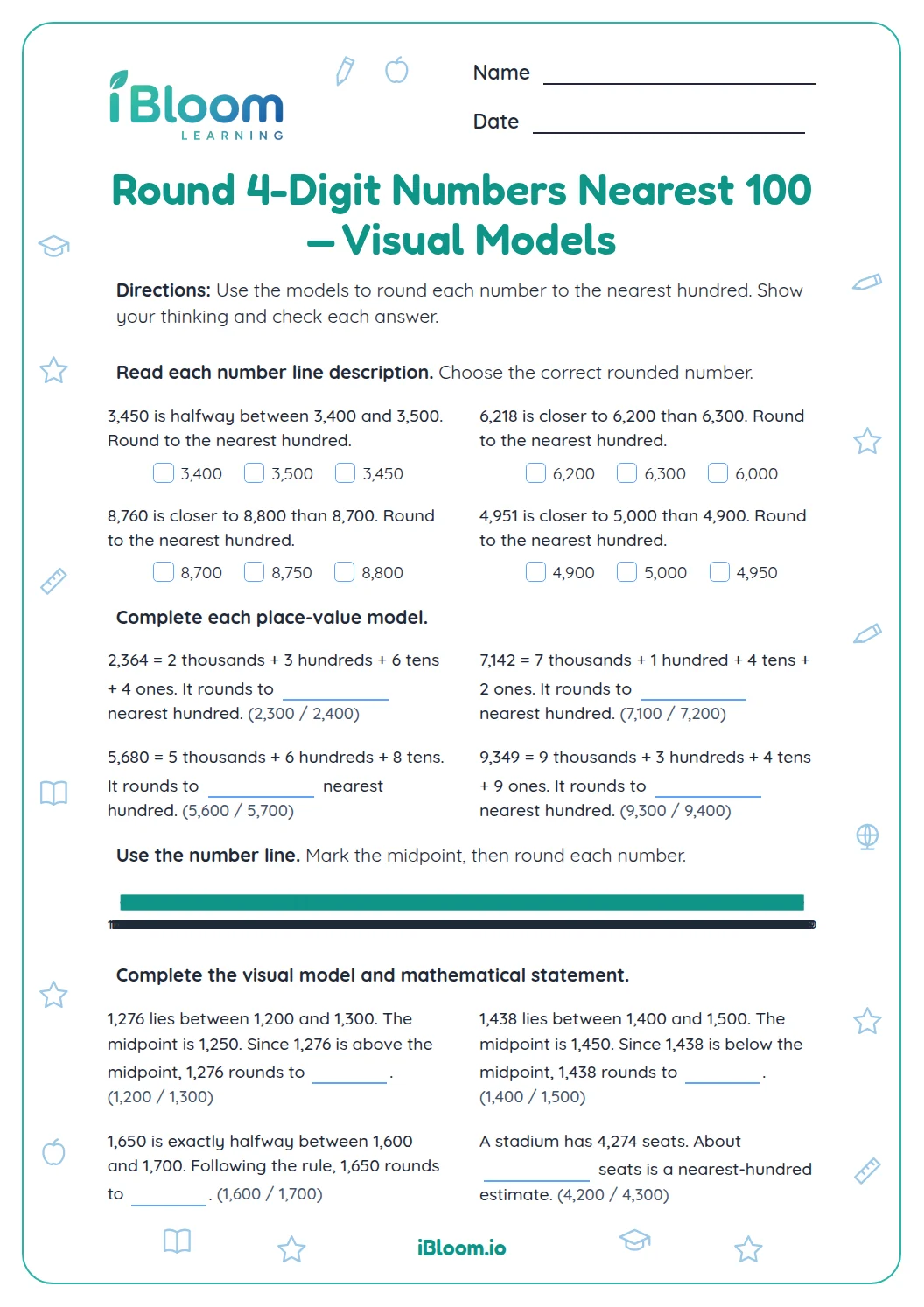
This free printable Grade 4 worksheet builds a clear routine for rounding four-digit numbers to the nearest hundred. Students round numbers directly, estimate in familiar contexts, and reason about the tens digit and nearby hundreds. All 16 questions use four-digit starting numbers, including halfway cases. A separate answer key is included. The worksheet practices CCSS 4.NBT.A.3.
Aligned to 4.NBT.A.3
Which digit tells you how to round to a hundred?
Find the hundreds place, then look one place to its right: the tens digit. If it is 0, 1, 2, 3, or 4, keep the hundreds digit and change tens and ones to zero. If it is 5 through 9, increase the hundreds digit by one and change tens and ones to zero.
For question 1, 3,482 has a tens digit of 8. The hundreds digit rounds up, so 3,482 rounds to 3,500.
- 13,482
- 2Tens digit: 8, so round up
- 3Nearest hundred: 3,500
How does rounding help estimate a real amount?
A rounded amount is close to the original and easier to use mentally. A park trail of 2,648 feet rounds to 2,600 feet because the tens digit is 4.
How can you check a rounded answer?
Compare the original number with the two hundreds around it. The answer should be one of those hundreds, and it should be the closer one. At an exact halfway value, round up.
How to use this worksheet
- 1Circle the hundreds place in the number.
- 2Look at the tens digit immediately to its right.
- 3Keep the hundred when the tens digit is 0 through 4.
- 4Increase the hundred when the tens digit is 5 through 9.
- 5Replace the tens and ones with zeros, then check the nearby hundreds.
Common mistakes and quick fixes
The mistake
Looking at the ones digit instead of the tens digit.
The fix
For nearest hundred, the tens digit decides whether the hundreds digit changes.
The mistake
Changing only the tens digit.
The fix
After rounding, both tens and ones become zero.
The mistake
Rounding an exact halfway value down.
The fix
When the tens digit is 5, round to the next hundred.
Common Core alignment
Round four-digit whole numbers to the nearest hundred.
On this sheet: Round four-digit whole numbers to the nearest hundred
Show the official wordingHide the official wording
Use place value understanding to round multi-digit whole numbers to any place.
What to practice next
Make more practice
Further reading
Questions parents and teachers ask
Which digit determines rounding to the nearest hundred?
Look at the tens digit, immediately to the right of the hundreds place. A tens digit from 0 through 4 keeps the current hundred; a digit from 5 through 9 rounds to the next hundred. The tens and ones digits become zero.
How many questions are included?
The worksheet has 16 questions on two student pages, with two answer-key pages. Students round four-digit numbers directly, apply rounding to short contexts, and answer questions about nearby hundreds and rounding choices. Use the separate key to review the reasoning and result.
How does the worksheet handle a halfway number?
A number exactly halfway between two hundreds has a 5 in the tens place. The sheet follows the usual whole-number rounding rule and rounds up. For example, 8,750 rounds to 8,800. Use the separate key to review the reasoning and result.
Why does 9,995 round to 10,000?
The tens digit is 9, so the hundreds place rounds up. Carrying that increase through 9,900 produces 10,000. The answer can have five digits even though the starting value has four. Use the separate key to review the reasoning and result.
What should a student check after rounding?
Check that the result is a hundred, with zeros in the tens and ones places. Then compare it with the two neighboring hundreds: the chosen hundred should be the closer one, with exact halfway values rounded up. Use the separate key to review the reasoning and result.