





About this worksheet
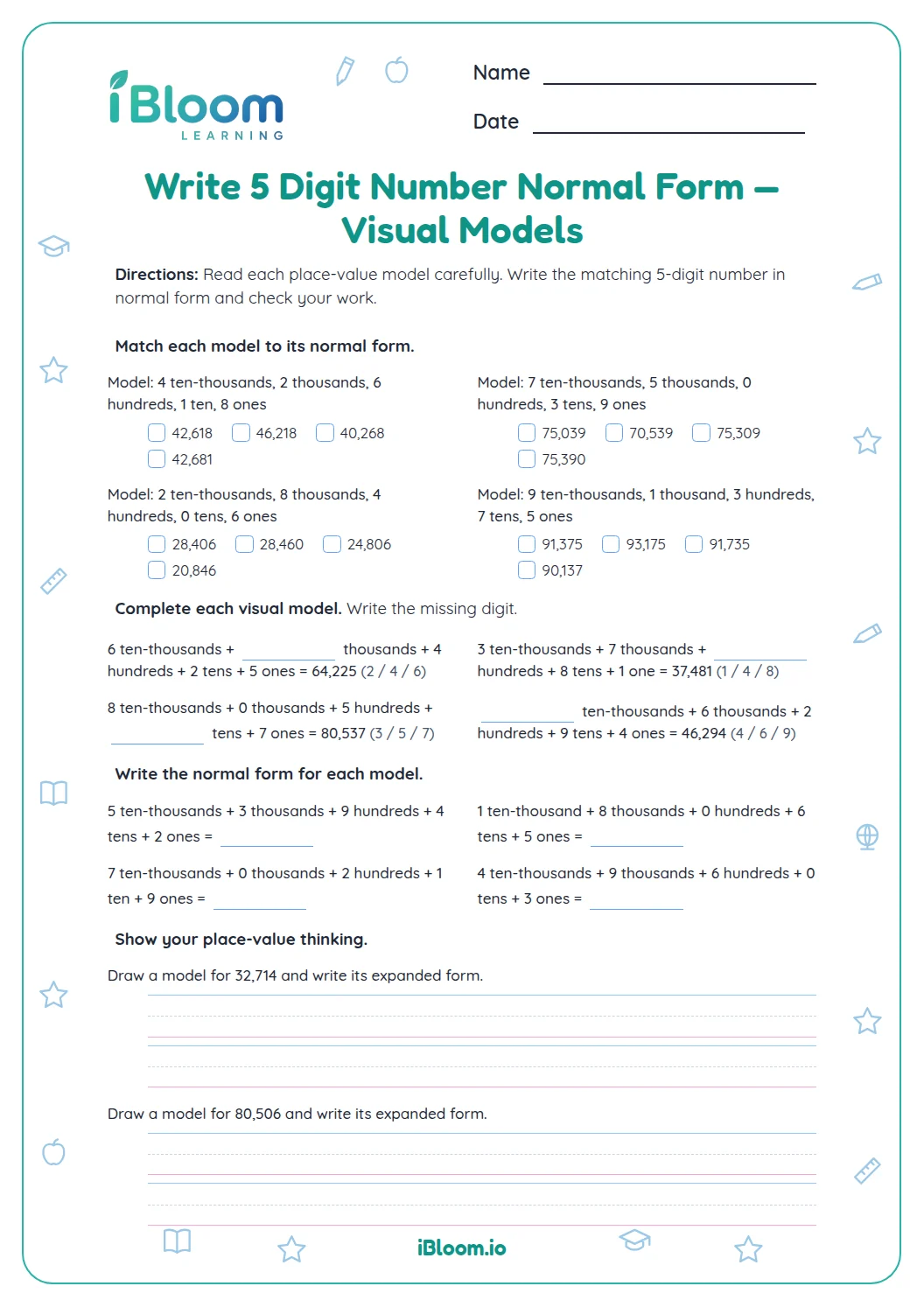
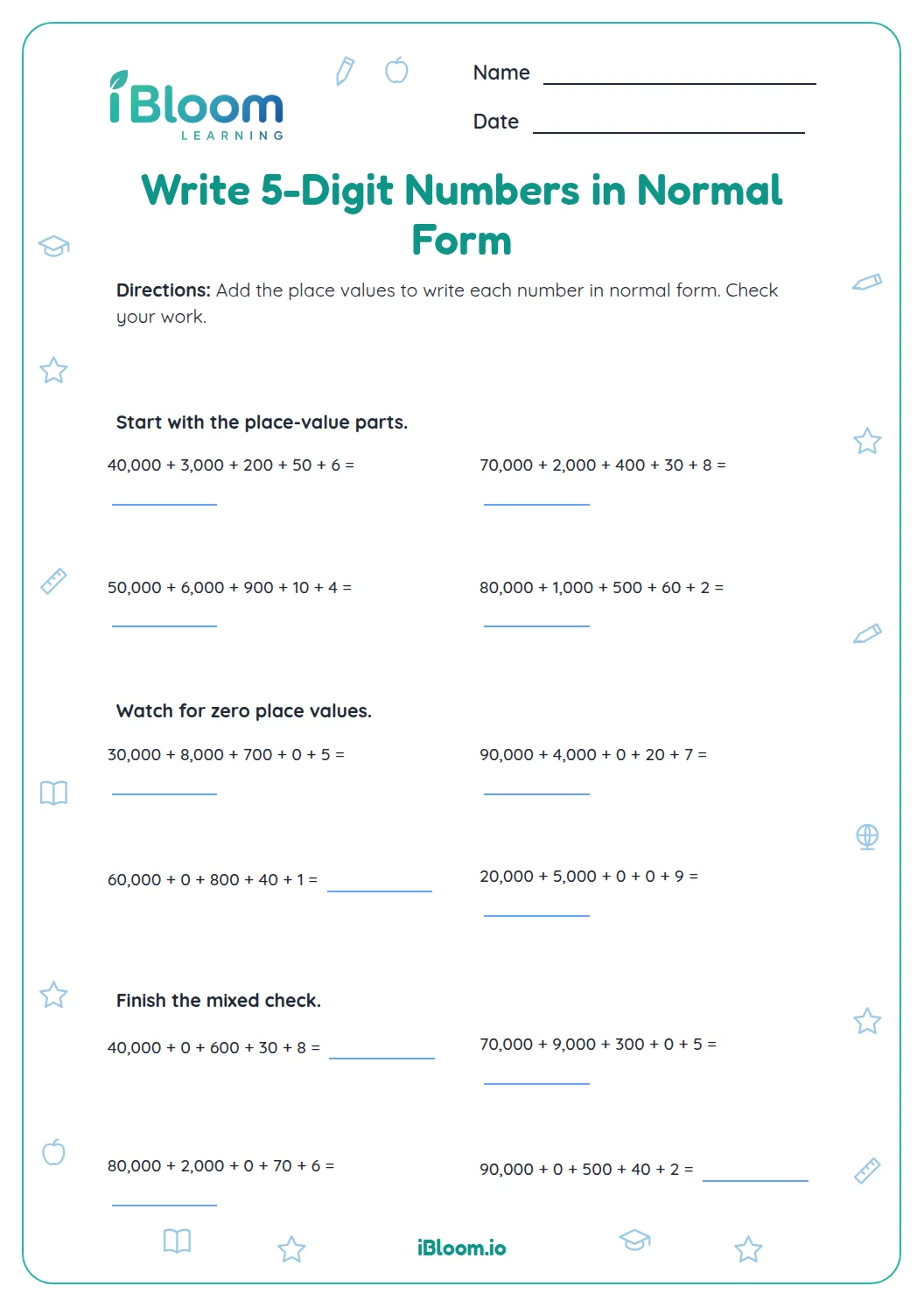
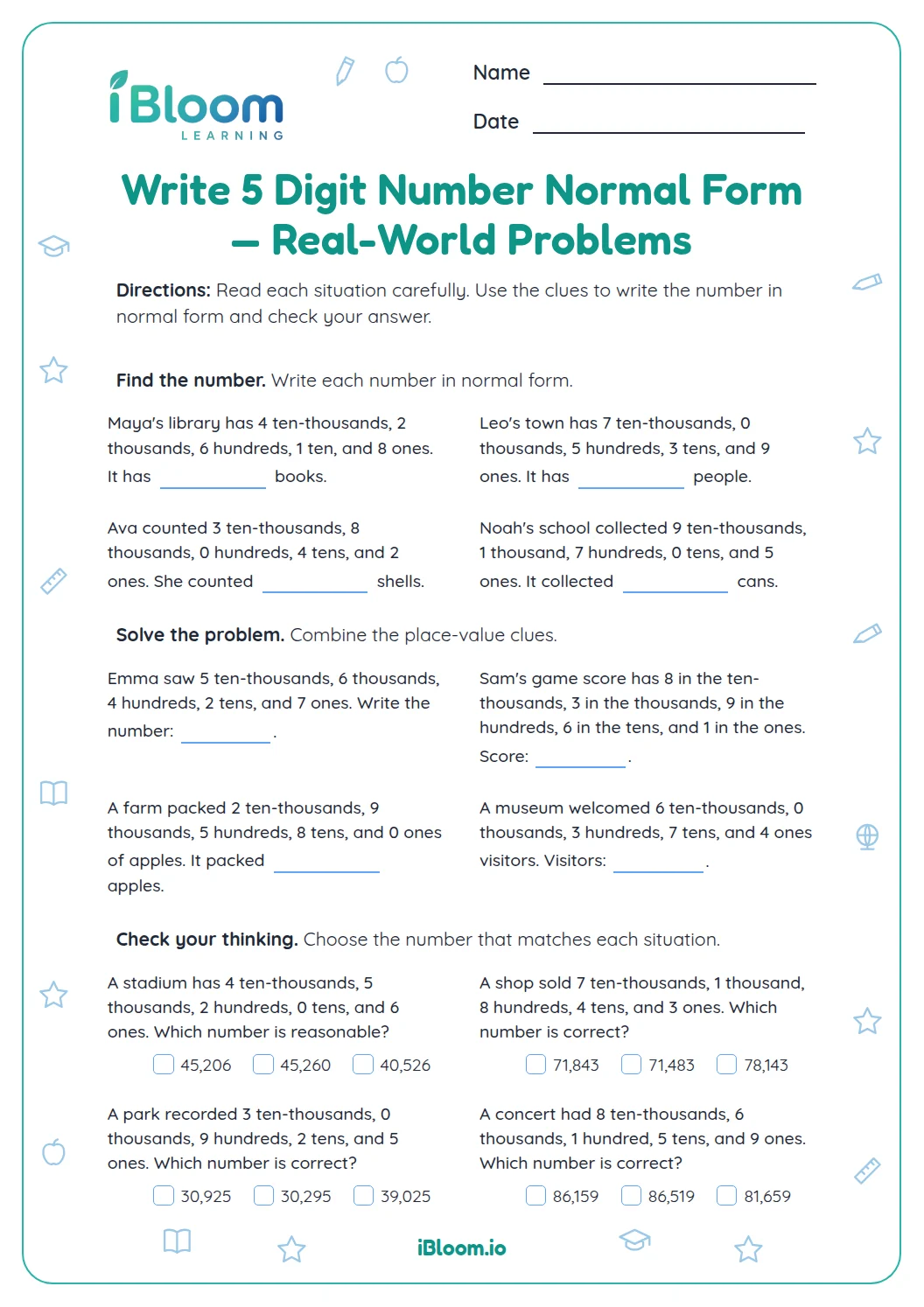
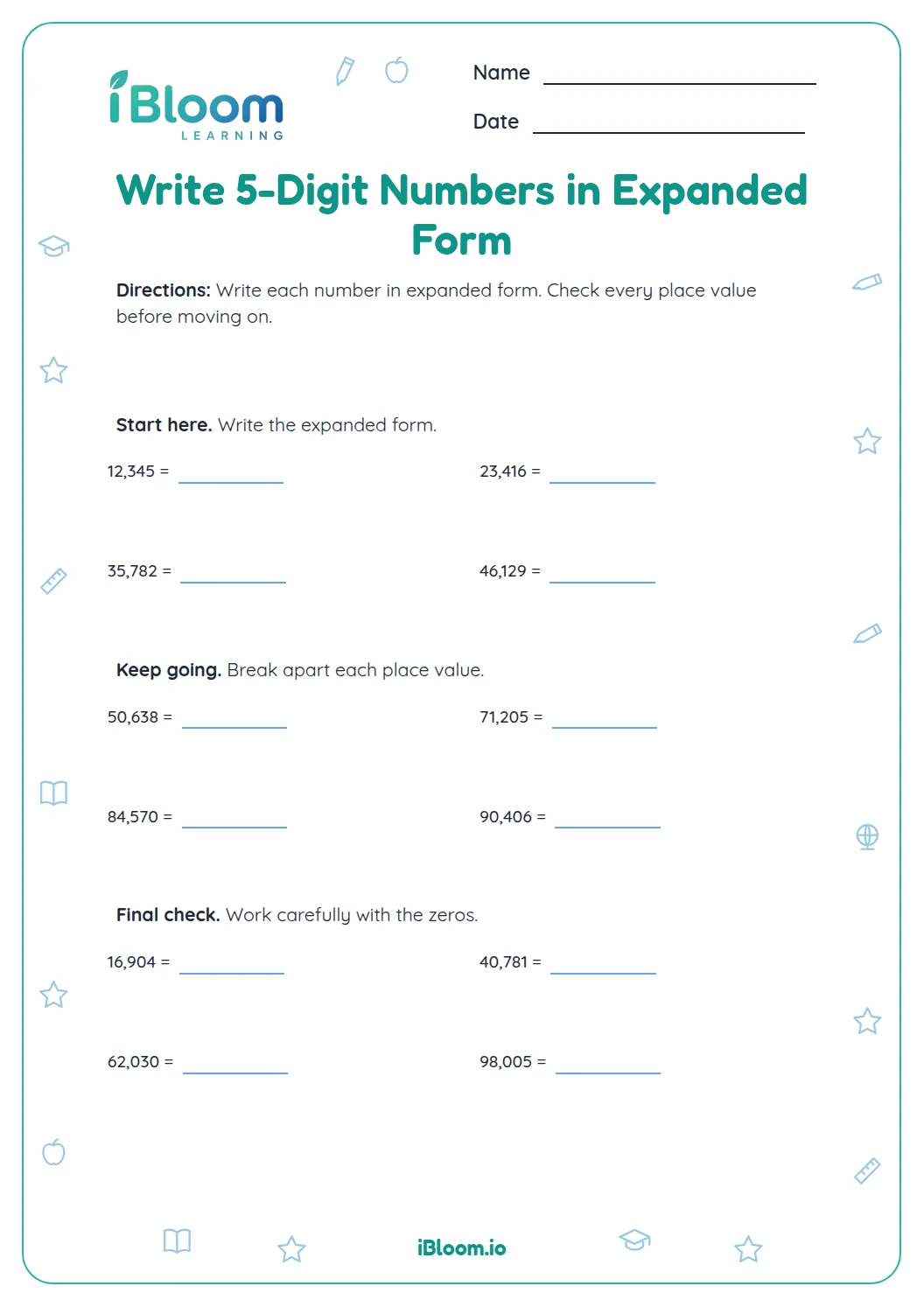
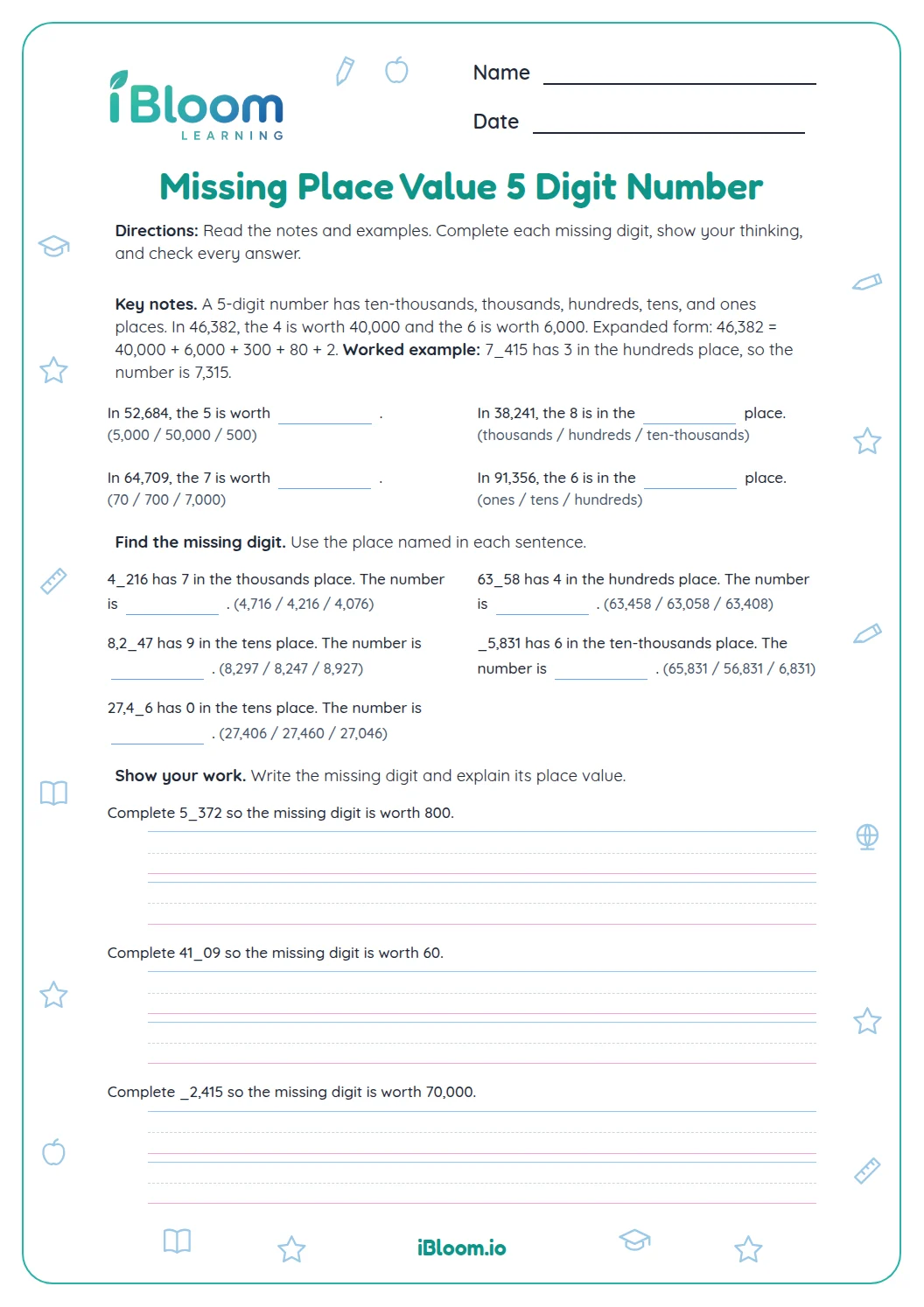
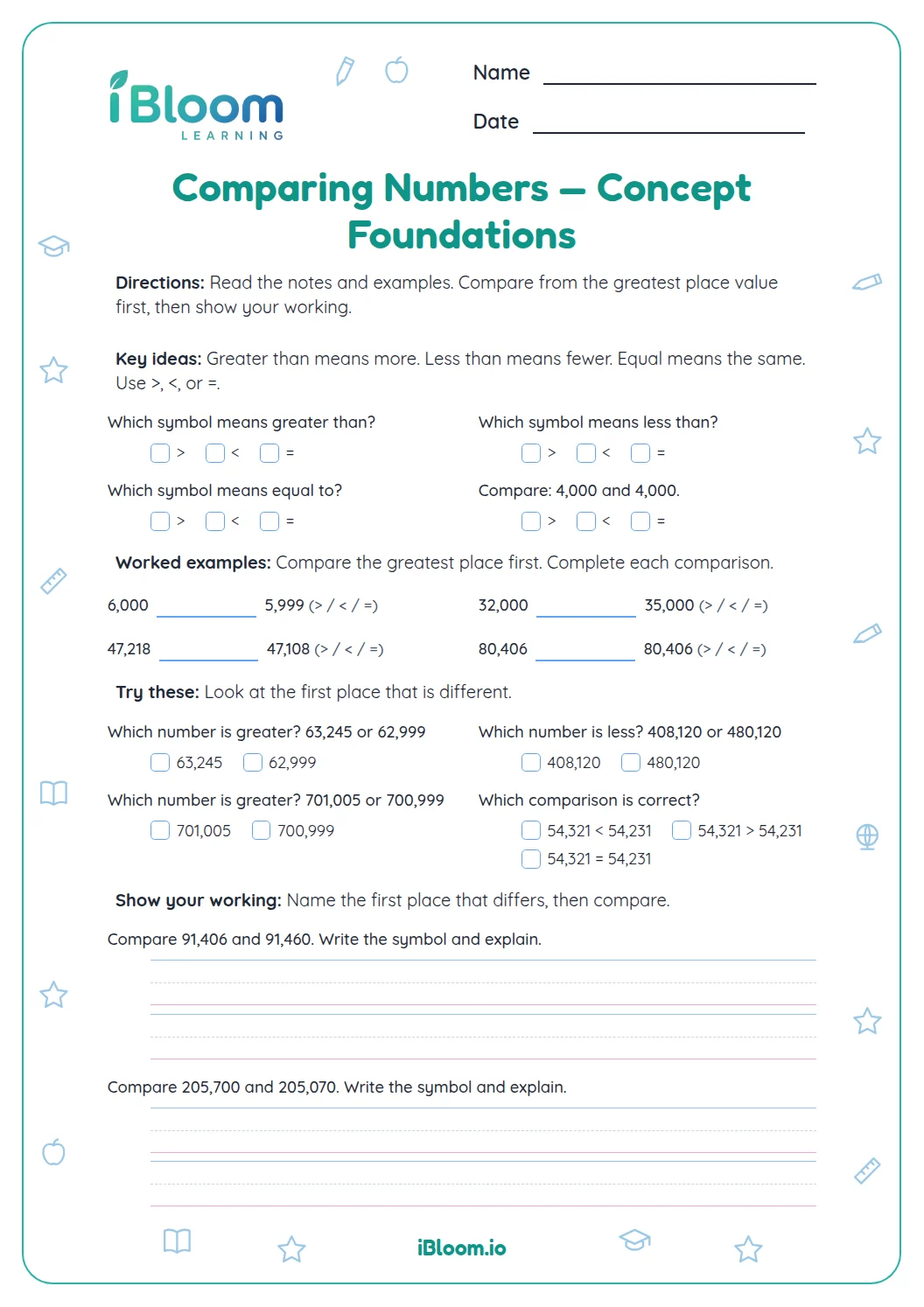
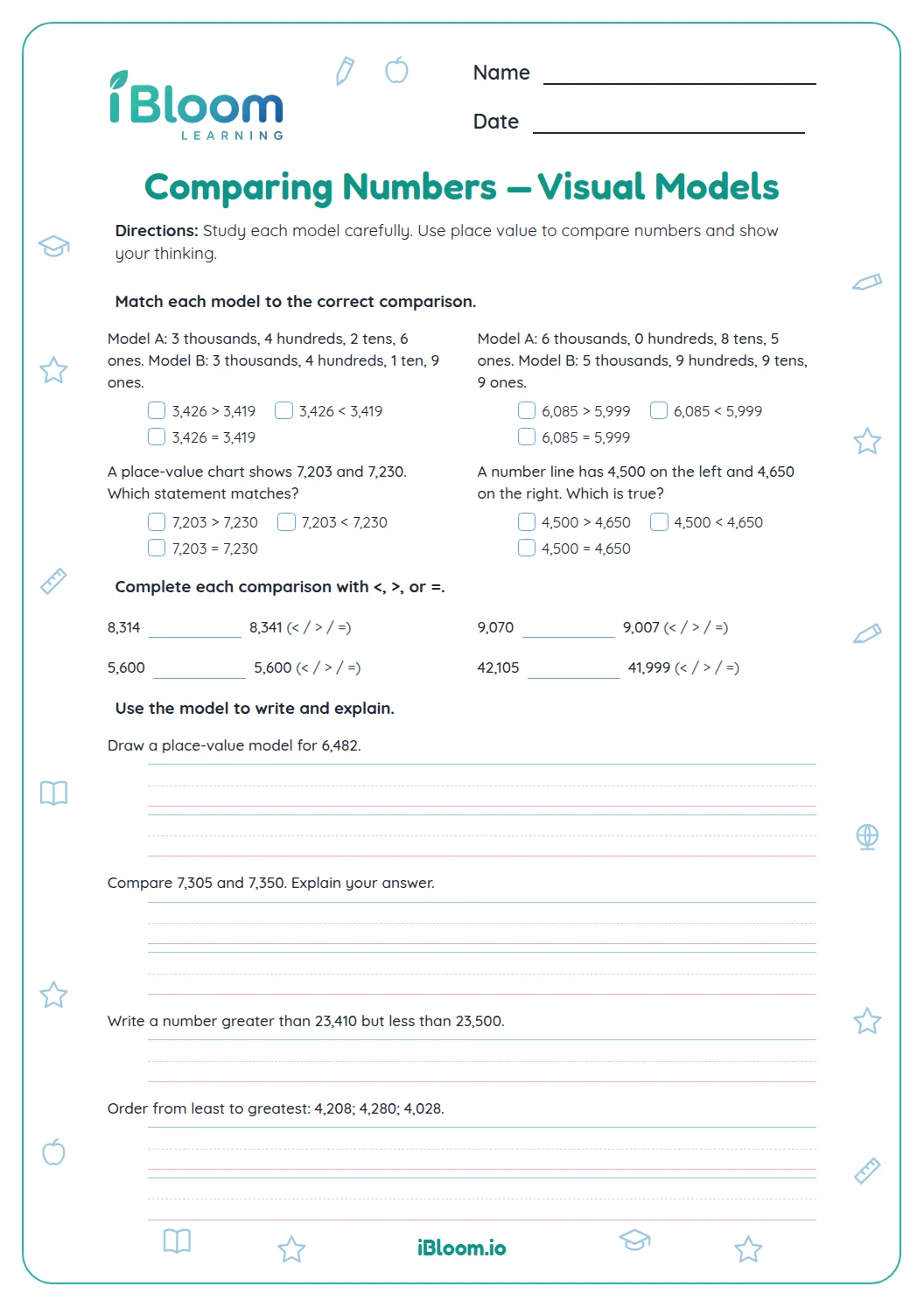
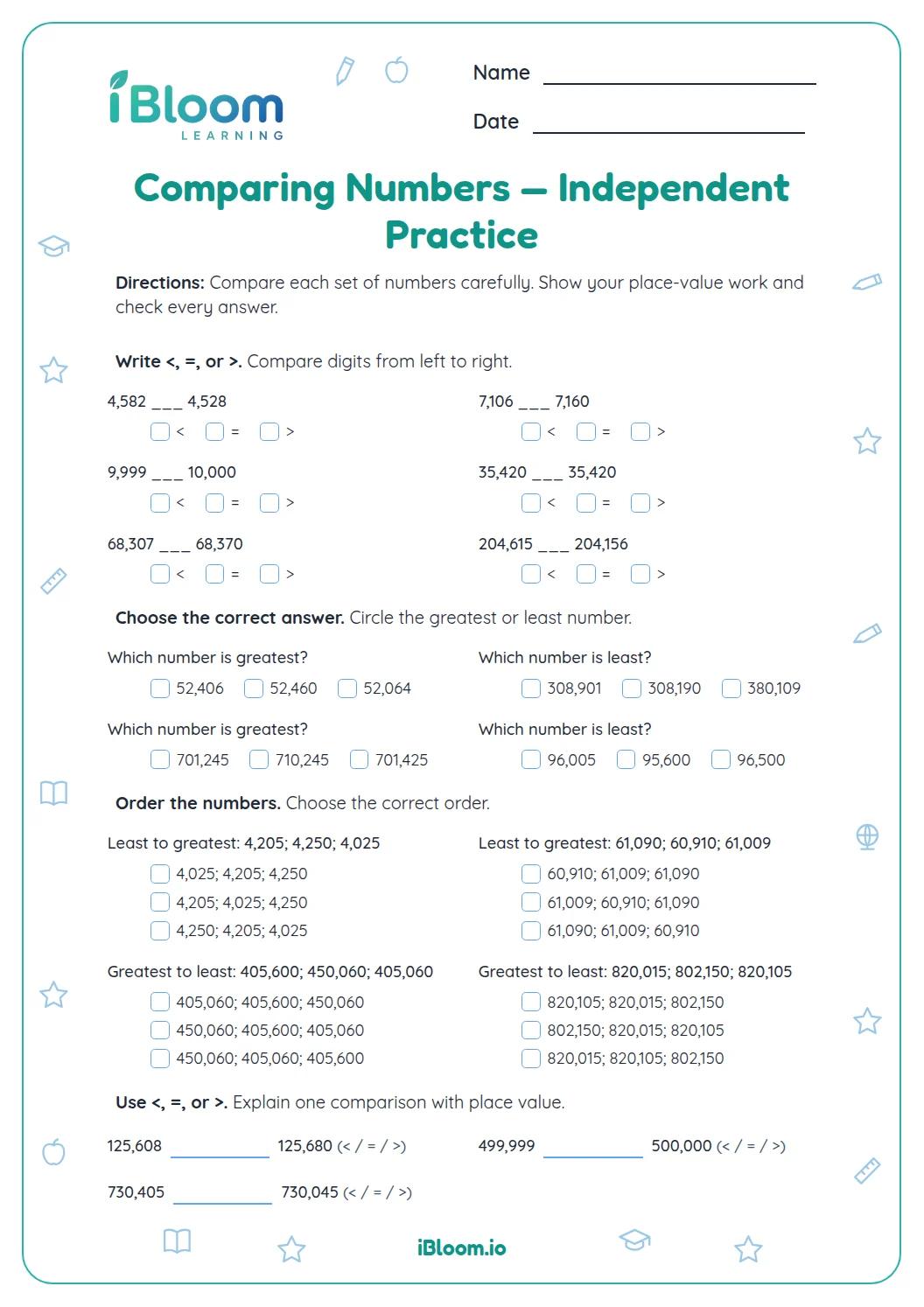
This printable Grade 4 worksheet asks learners to write five-digit numbers from expanded form and place-value clues. They also identify digit values, compare close numerals, and check how changing a place changes a number. The sheet has 16 questions in three parts and a separate answer key. Its numeral-reading, writing, and comparison work practices CCSS 4.NBT.A.2.
Aligned to 4.NBT.A.2
How does place value build a five-digit number?
Each digit marks a place: ten-thousands, thousands, hundreds, tens or ones. A zero can hold a place without adding value. Keep the position clear when you combine the parts.
- 140,000 + 3,000 + 200 + 8
- 24 ten-thousands, 3 thousands, 2 hundreds and 8 ones
- 3Write the digits in order: 43,208
What will children practice?
Part A builds and expands five-digit numerals. Part B asks learners to identify digit value and compare close numbers. Part C mixes place-value clues with two short calculations. The two-page answer key gives the completed numerals and comparisons.
How can an adult support the practice?
For a question such as 70,000 + 500 + 30 + 4, name the empty places before writing: there are no thousands or hundreds beyond the 500, and the tens and ones are 3 and 4. This helps preserve the zero placeholders in 70,534.
How to use this worksheet
- 1Name the places from left to right before writing.
- 2Combine each addend by its place; keep zero placeholders.
- 3For digit value, name the place as well as the digit.
- 4Compare from the leftmost place, stopping at the first difference.
- 5Use addition or subtraction to check “more than” clues.
Mistakes to watch for
The mistake
Dropping a placeholder zero, as in 70,305 becoming 7,305.
The fix
Write all five places in a place-value chart, including zero entries.
The mistake
Reading the digit 6 in 56,318 as 600.
The fix
Point to its thousands place: its value is 6,000.
The mistake
Comparing only the last digits.
The fix
Compare from the ten-thousands place until the first unequal digits.
Common Core alignment
This worksheet practices the place-value and operations ideas described below.
Read and write multi-digit numerals and compare them by digit value.
On this sheet: The questions build five-digit numerals from place values, expand numerals, and compare numbers.
Show the official wordingHide the official wording
Read and write multi-digit whole numbers using base-ten numerals, number names, and expanded form. Compare two multi-digit numbers based on meanings of the digits in each place, using >, =, and < symbols to record the results of comparisons.
What to practice next
Make more practice
Further reading
Questions parents and teachers ask
What does standard form mean?
Standard form writes a whole number as one numeral, such as 43,208. On this sheet, learners combine expanded sums and place-value descriptions into standard form, then use numerals to compare and reason about digit values. The answer key shows each completed number.
Why do some five-digit numbers have zeros?
A zero holds an empty place. In 70,305, it keeps the 7 in the ten-thousands place and the 3 in the hundreds place; without those zero placeholders, the numeral would have a different value. Several questions ask learners to preserve empty places while building a number.
How do I find the value of a digit?
Read the place holding the digit, then name the amount it represents. In 56,318, the 6 is in the thousands place, so its value is 6,000. Question 8 asks for that value, and question 16 compares the value of 6 in two different places.
How should learners compare two five-digit numbers?
Start at the ten-thousands place and move right until the digits differ. In question 9, both numbers begin with 42,9; compare the tens: 0 tens is less than 5 tens, so 42,905 is smaller than 42,950. The worksheet uses the symbols <, >, or = to record a comparison.
How many questions are included?
There are 16 questions in three parts. They include numeral writing from expanded form and place-value clues, a comparison, digit-value items, and two calculations that change a numeral by one place value. A separate two-page answer key lists the answers.