


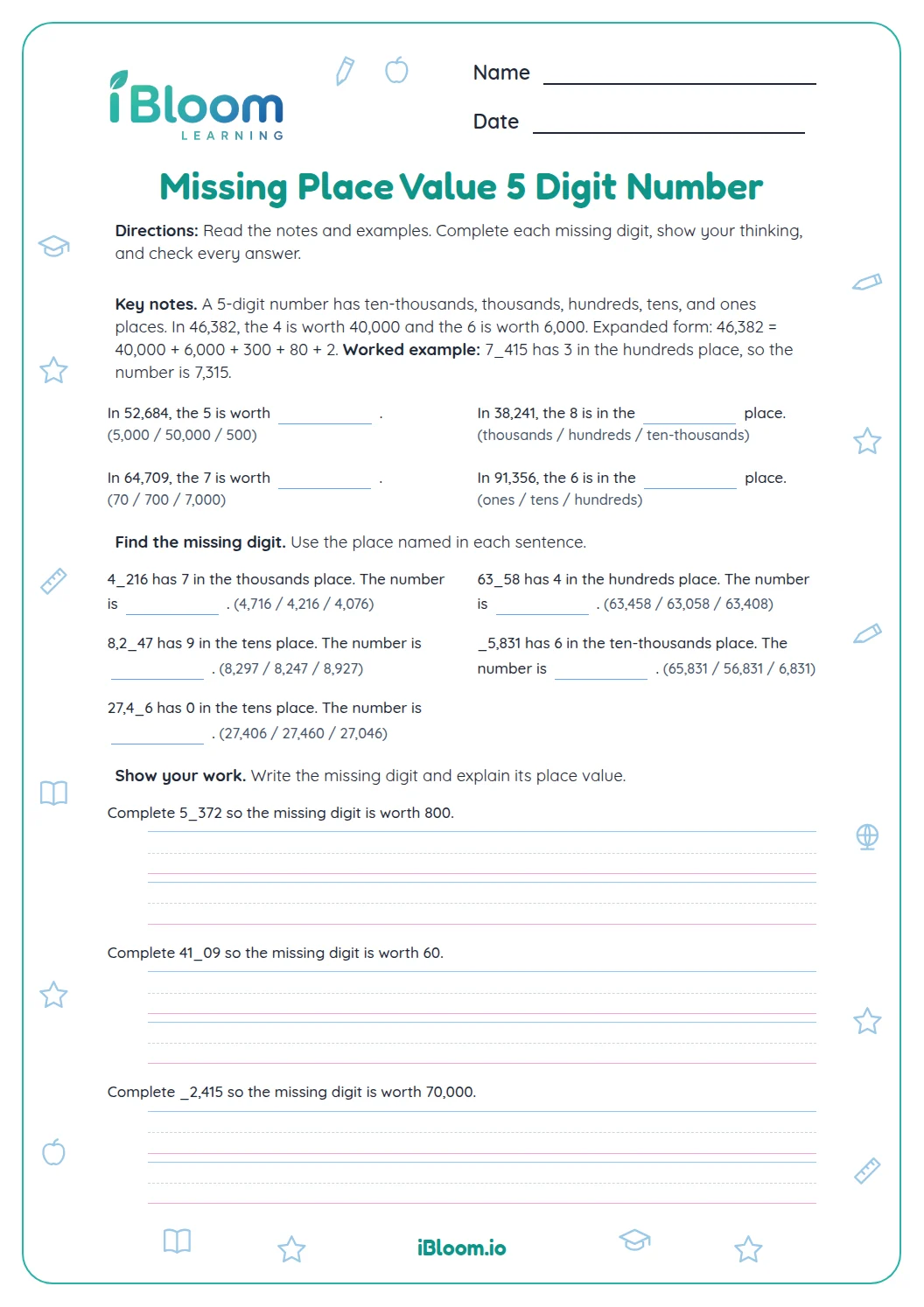


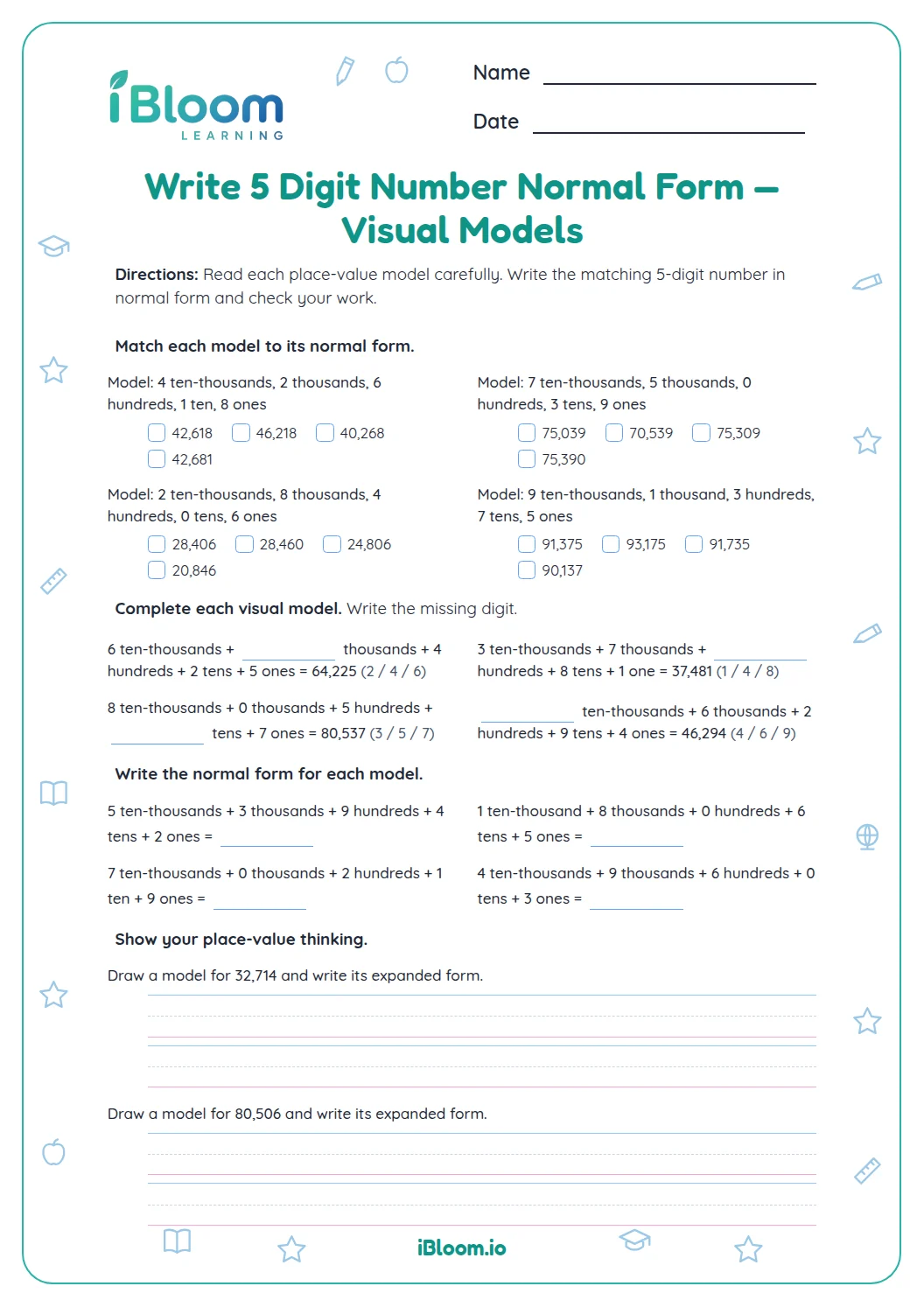
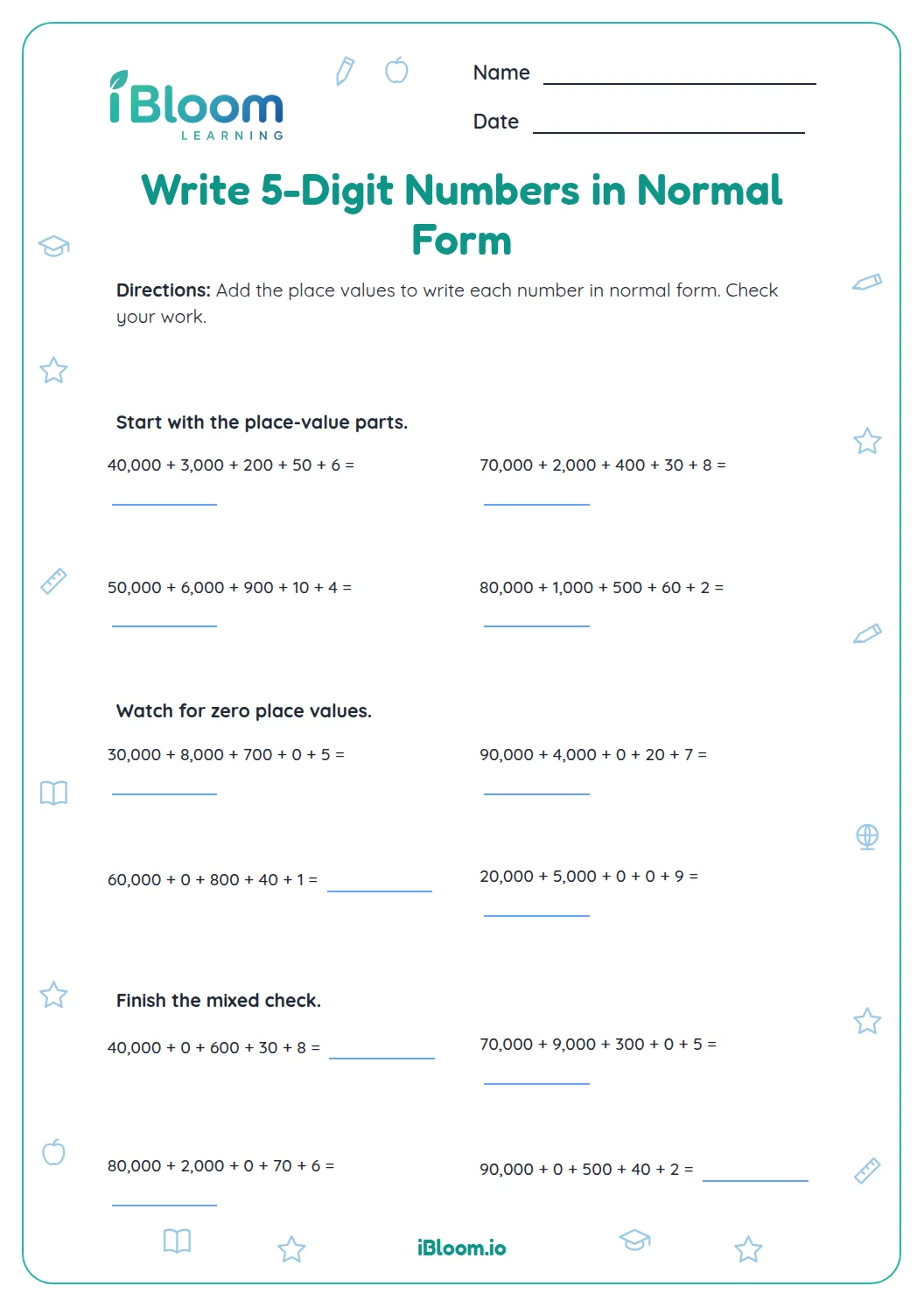
About this worksheet
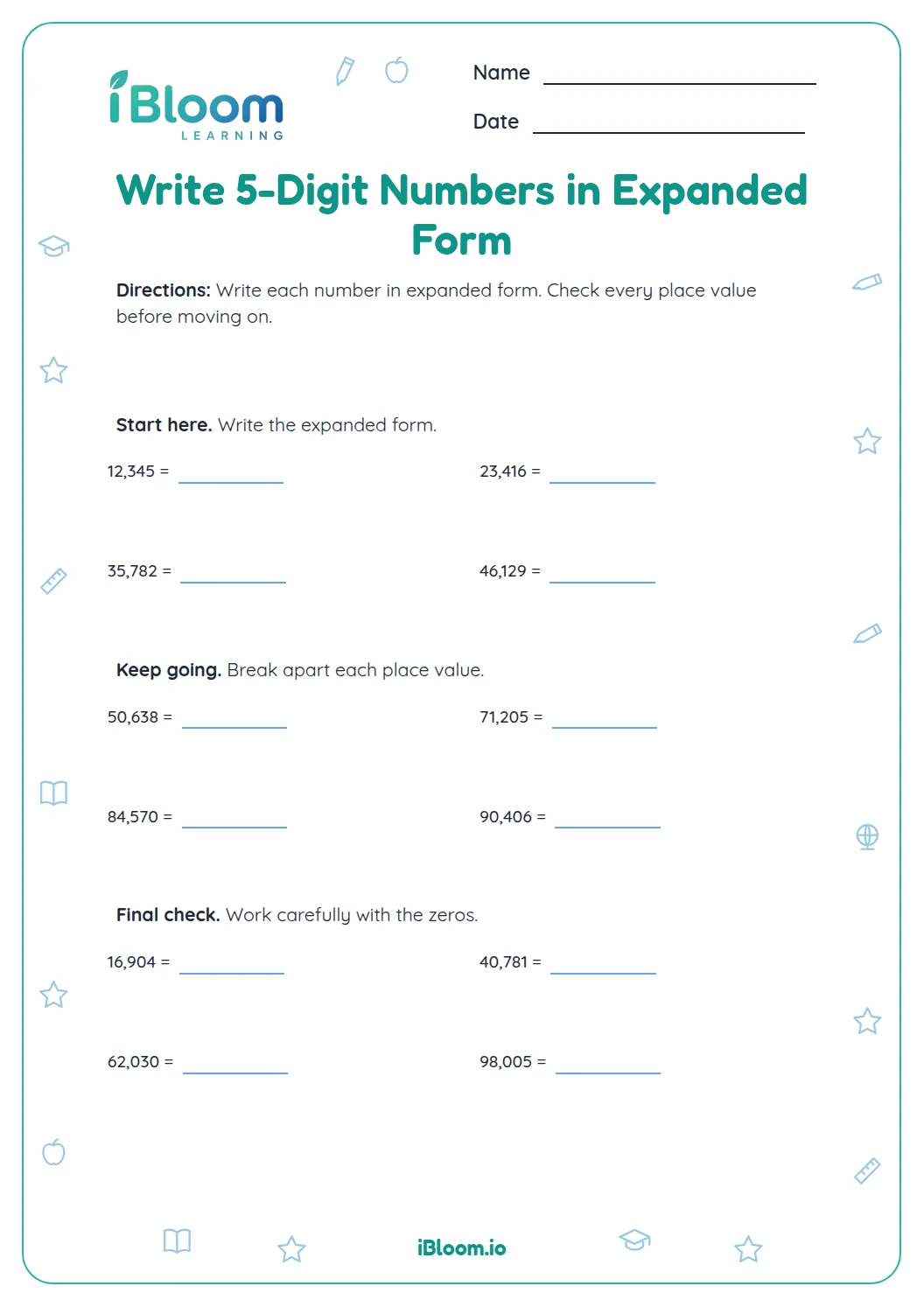
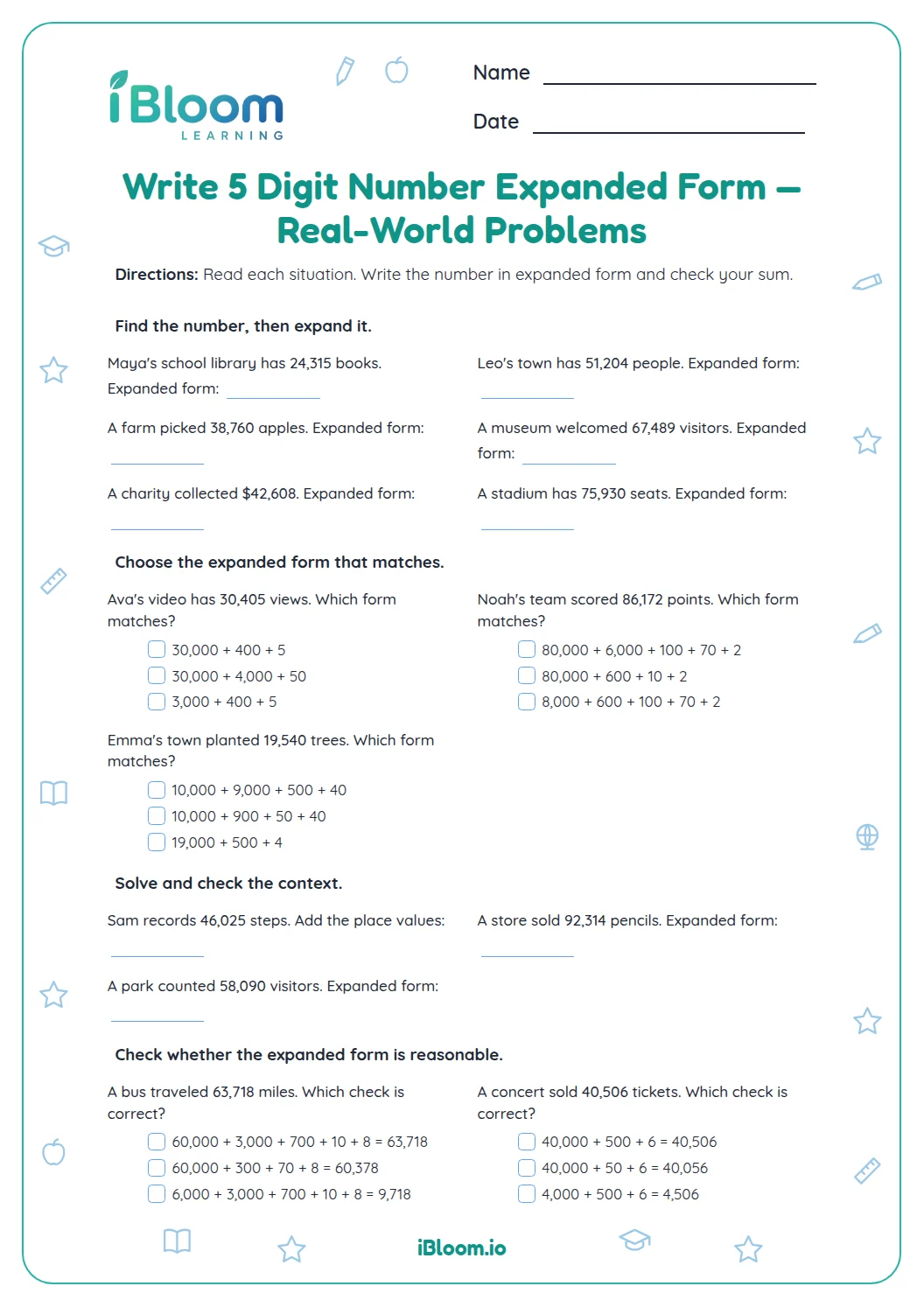
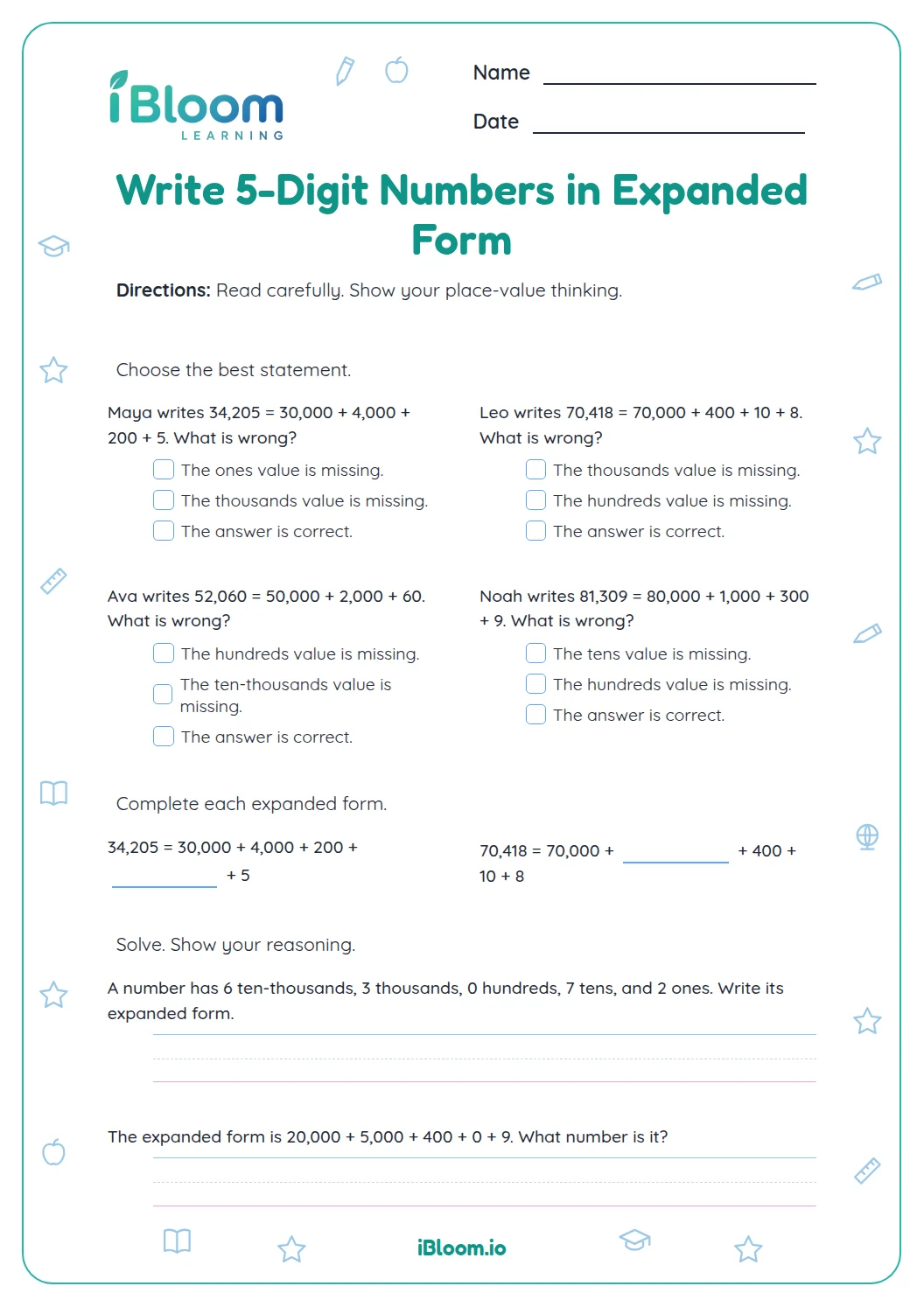
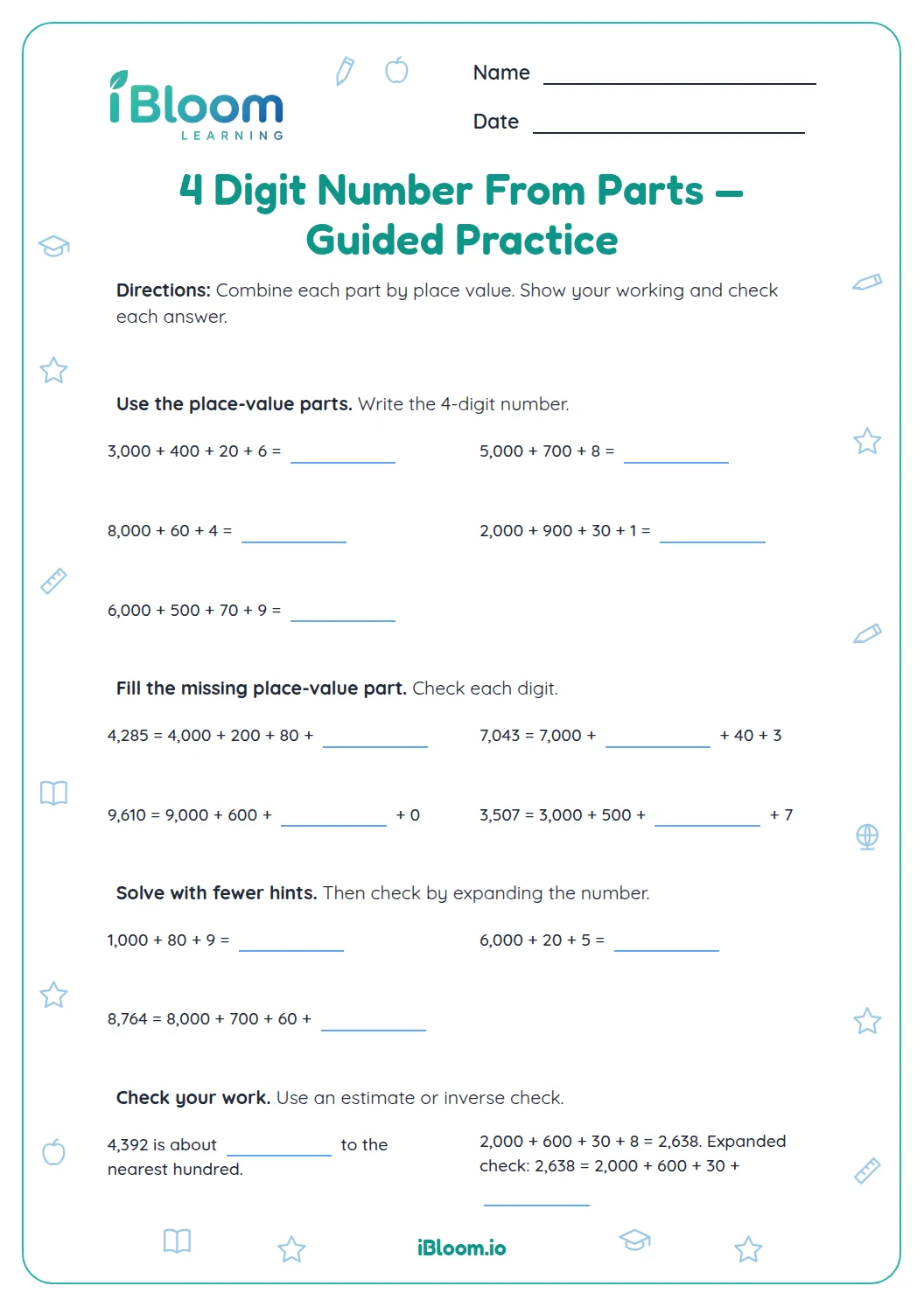
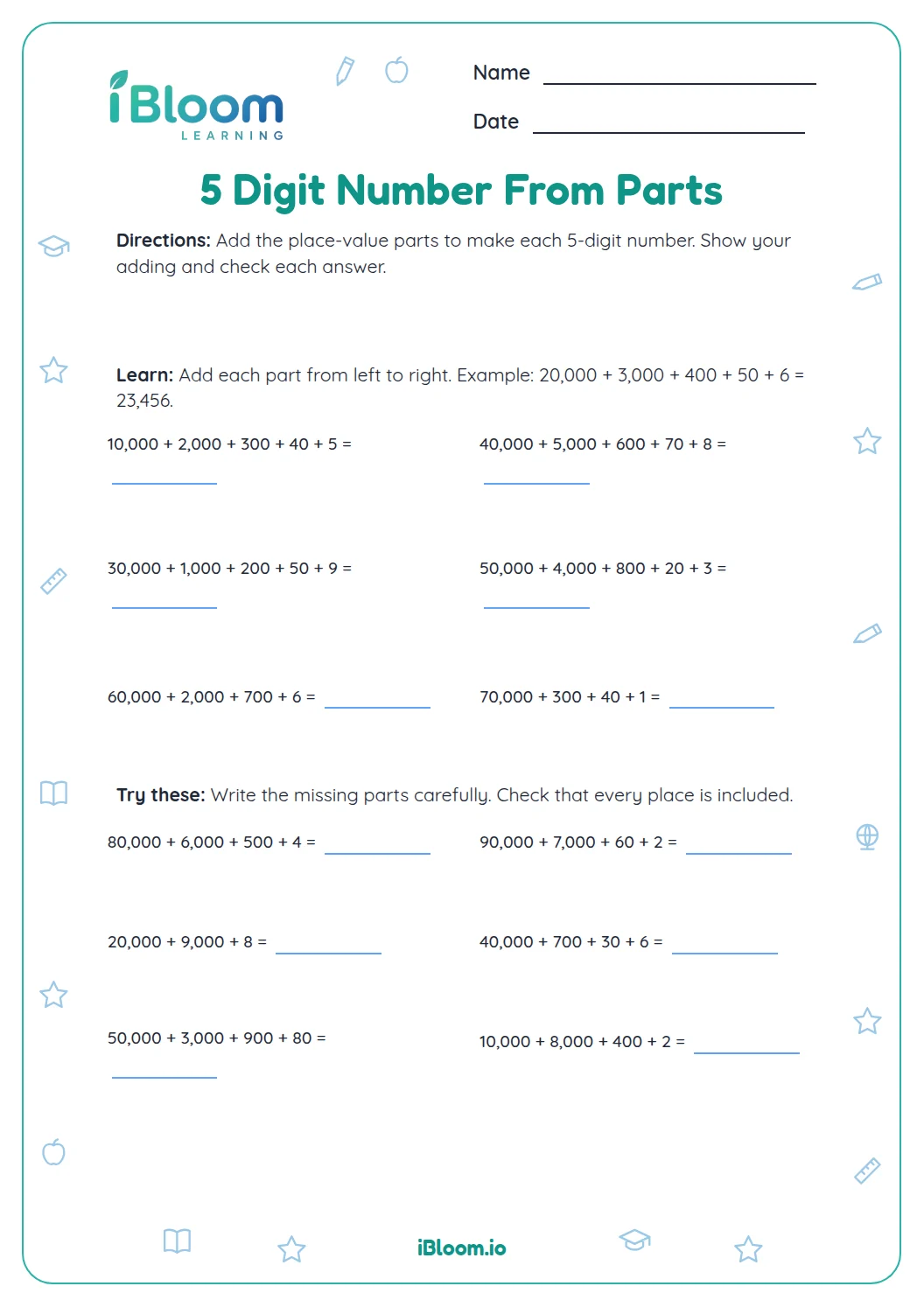
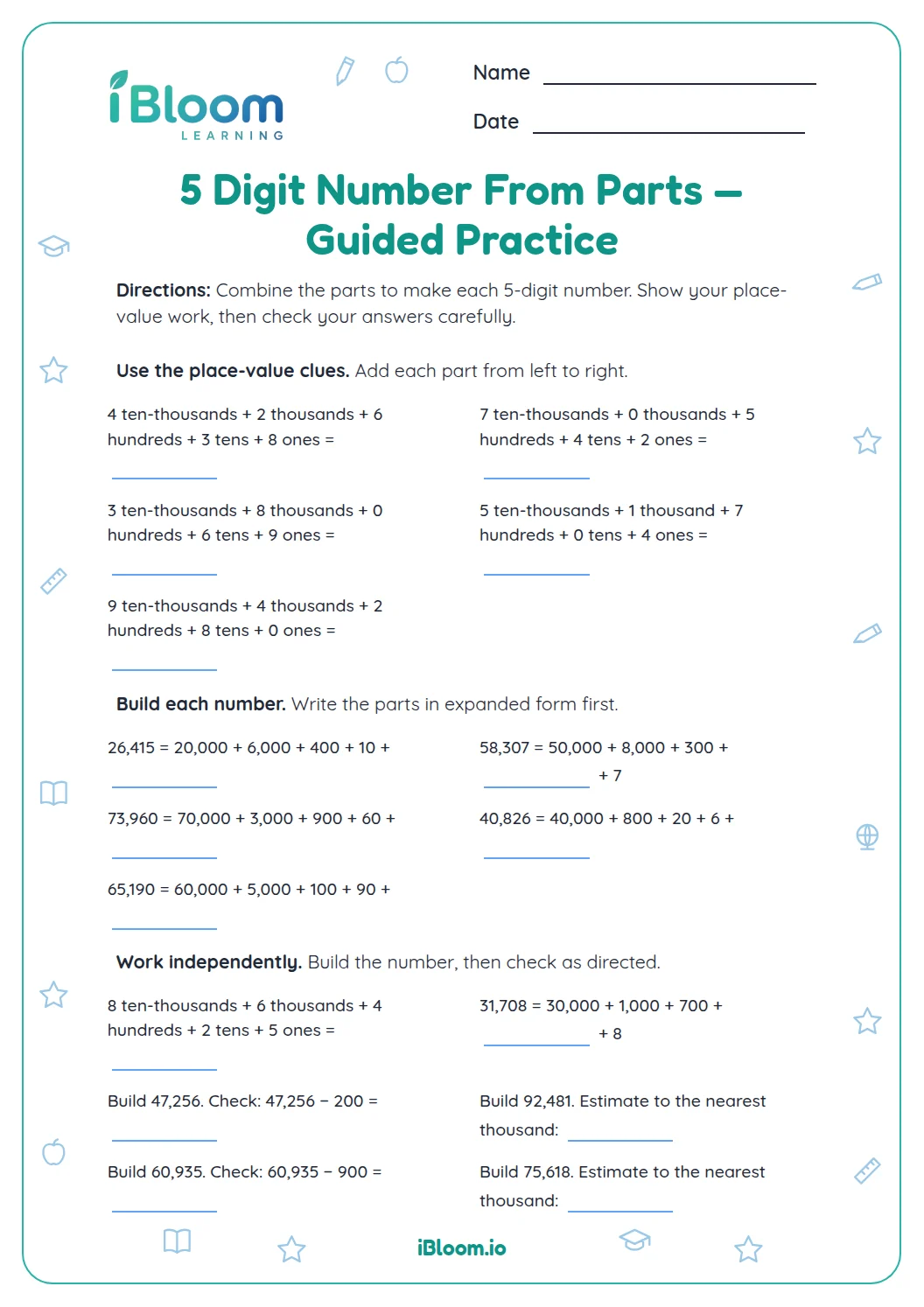
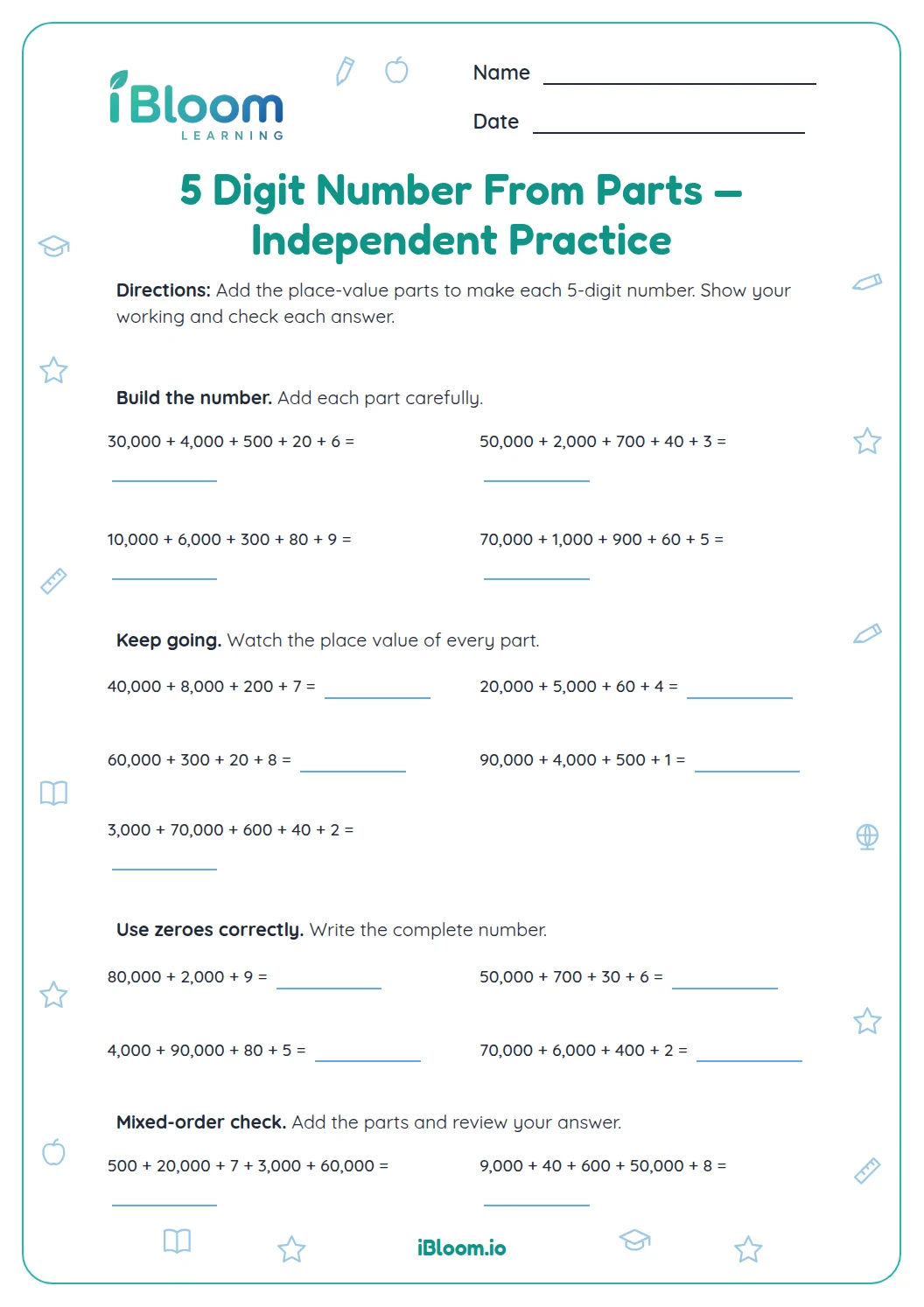
This free Grade 4 worksheet connects place-value charts with five-digit expanded form. Children begin by reading four charts, then write twelve five-digit numerals as sums of their nonzero place values. Several numbers contain a zero place, so students preserve the digit positions without adding a zero-valued term.
Aligned to 4.NBT.A.2
How do children read the place-value charts?
Read each digit with its column. In q1, 1 is in the ten-thousands place, 2 in the thousands place, 4 in the hundreds place, and 8 in the ones place. So 12,408 is 10,000 + 2,000 + 400 + 8.
The first four questions show a chart. Use each column heading to identify the value of that digit before writing the expanded sum.
How do you write a five-digit number in expanded form?
Write the value of every nonzero digit as an addend. In q5, 23,046 has 2 ten-thousands, 3 thousands, 4 tens and 6 ones.
Expanded form: 23,046 = 20,000 + 3,000 + 40 + 6. Add the terms to check that they rebuild 23,046.
- 1Read the digits in 23,046 by place.
- 2Write the nonzero values: 20,000 + 3,000 + 40 + 6.
- 3Add the terms to check: 23,046.
What should happen to zero places?
Leave out any place with a zero digit. For q11, 25,408 is 20,000 + 5,000 + 400 + 8. There are no tens, so the expanded form does not need a zero term.
How to use this worksheet
- 1Read each digit in its place-value column.
- 2Say the value of each digit, from ten-thousands through ones.
- 3Write each nonzero value as an addend.
- 4Leave out places with zero digits.
- 5Add the terms to check that they rebuild the original number.
Mistakes to notice and fix
The mistake
Writing the digit instead of its place value.
The fix
For 4 in the hundreds column, write 400, not 4.
The mistake
Writing 23,046 as 20,000 + 3,000 + 400 + 6.
The fix
The 4 is in the tens place, so its value is 40.
The mistake
Adding a zero-valued term for an empty place.
The fix
Skip zero digits; 25,408 is 20,000 + 5,000 + 400 + 8.
Common Core alignment
Read five-digit numbers on place-value charts and write each as a sum of place values.
On this sheet: Every question asks children to translate a number in the chart into expanded form.
Show the official wordingHide the official wording
Read and write multi-digit whole numbers using base-ten numerals, number names, and expanded form. Compare two multi-digit numbers based on meanings of the digits in each place, using >, =, and < symbols to record the results of comparisons.
What to practice next
Make more practice
Further reading
Questions parents and teachers ask
How does a place-value chart help with expanded form?
Each column names a place, so children can read a digit’s value before writing it as an addend. In q1, the chart shows 1 ten-thousand, 2 thousands, 4 hundreds and 8 ones. Those values make 10,000 + 2,000 + 400 + 8.
Should my child write the ordinary number too?
The first four questions give a number in a place-value chart. For the other questions, the number is printed directly. In both cases, the requested response is its expanded sum; saying the number aloud first can help children keep the digits in order.
Are zero terms needed in the answers?
No. The directions ask children to write nonzero place values. For 50,070, the answer is 50,000 + 70. If a child includes zero terms, discuss why those terms do not change the value, then rewrite the sum in the shorter form requested.
How can I check whether the place values are right?
Add the expanded parts to rebuild the original number. For q7, 70,000 + 200 + 9 makes 70,209. If the total matches the printed number, each addend has the right value and the zero places have been handled correctly. Check each place carefully.
What is included in the printable and key?
The printable has 16 questions in two parts: four place-value charts and twelve five-digit numbers to write in expanded form. The answer key repeats the charts and lists each sum. Use it to check the value of every place, especially when a number has zeros between nonzero digits.