





About this worksheet
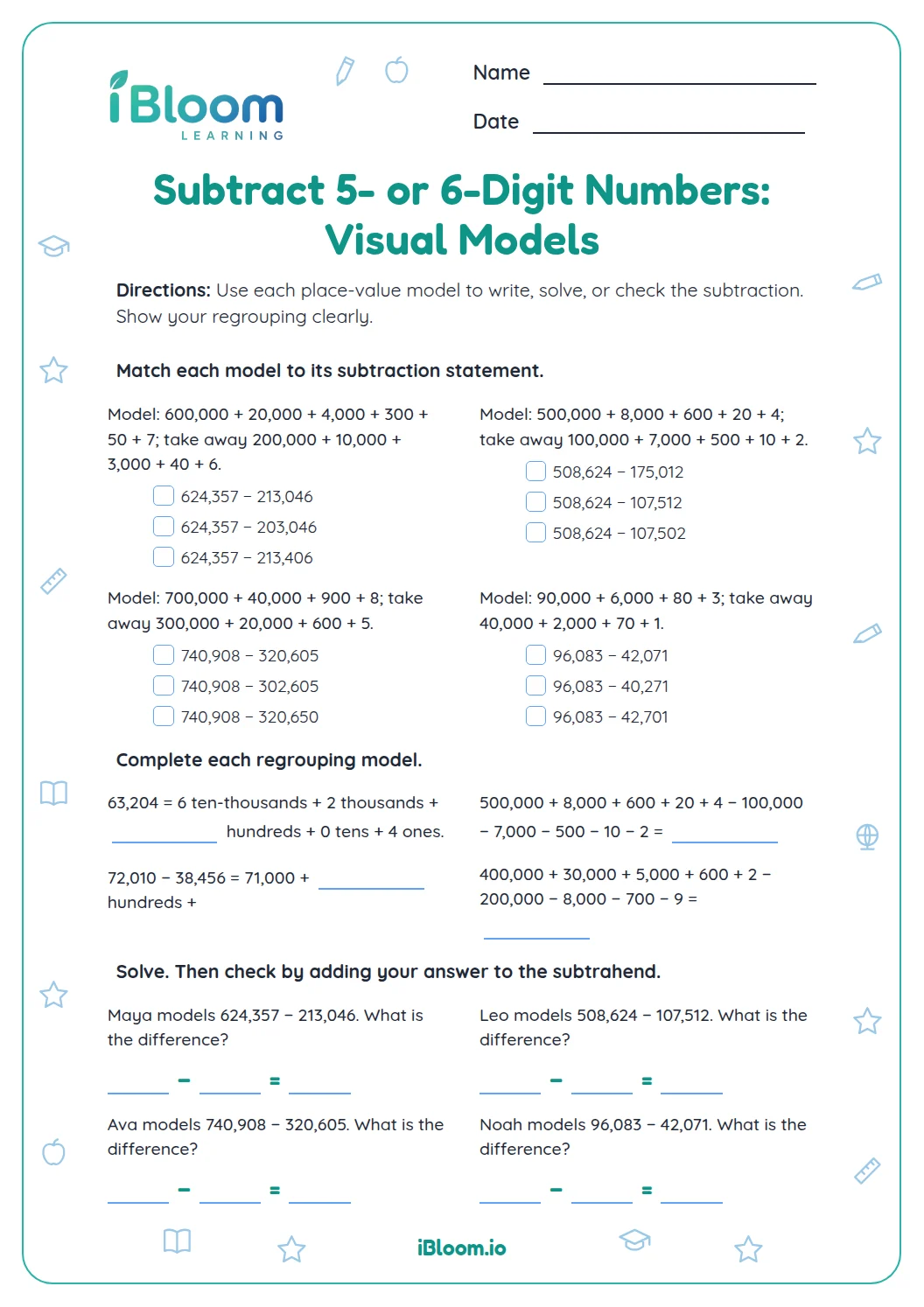
This free Grade 4 worksheet builds reasoning with subtraction of five- and six-digit whole numbers. Students diagnose a regrouping error, choose a valid addition check, estimate a difference, solve multi-digit subtraction, and find missing numbers in equations. Two short word problems apply the same computation to books and stadium seats. The work practices Common Core 4.NBT.B.4, fluently subtracting multi-digit whole numbers with the standard algorithm. A separate answer key gives each result.
Aligned to 4.NBT.B.4
What kinds of reasoning are included?
Part A asks students to spot a regrouping mistake, select an addition check, identify where regrouping begins, compare estimates, and use a subtraction shortcut.
- 1For 700,000 − 299,998, subtract 300,000 to get 400,000.
- 2Add back 2, so the exact difference is 400,002.
How should students organize the computation?
Line up digits by place value, subtract from ones to the left, and regroup when a top digit is too small. Each computation gives room to show the column method and write the difference.
How do the final questions use inverse operations?
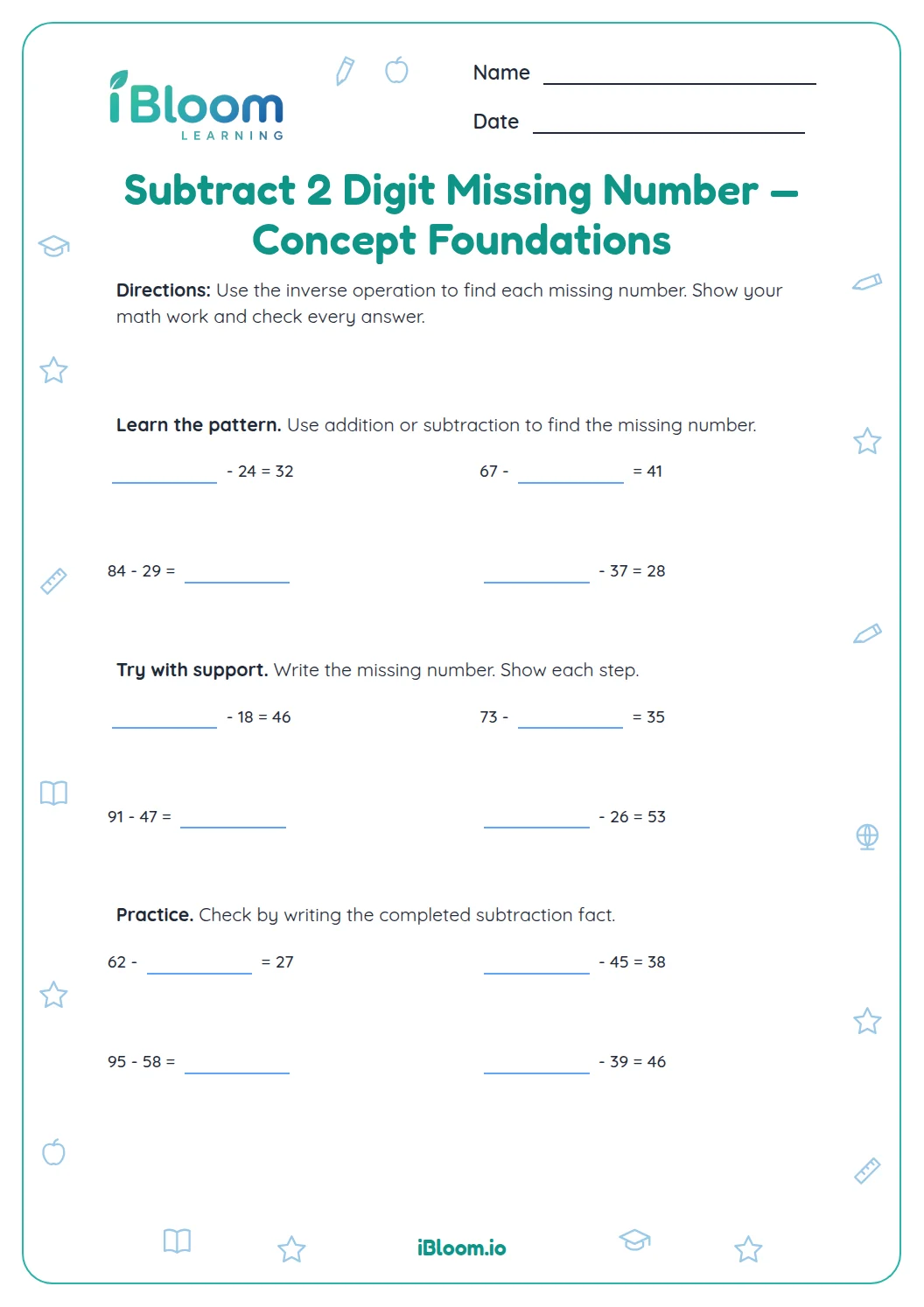
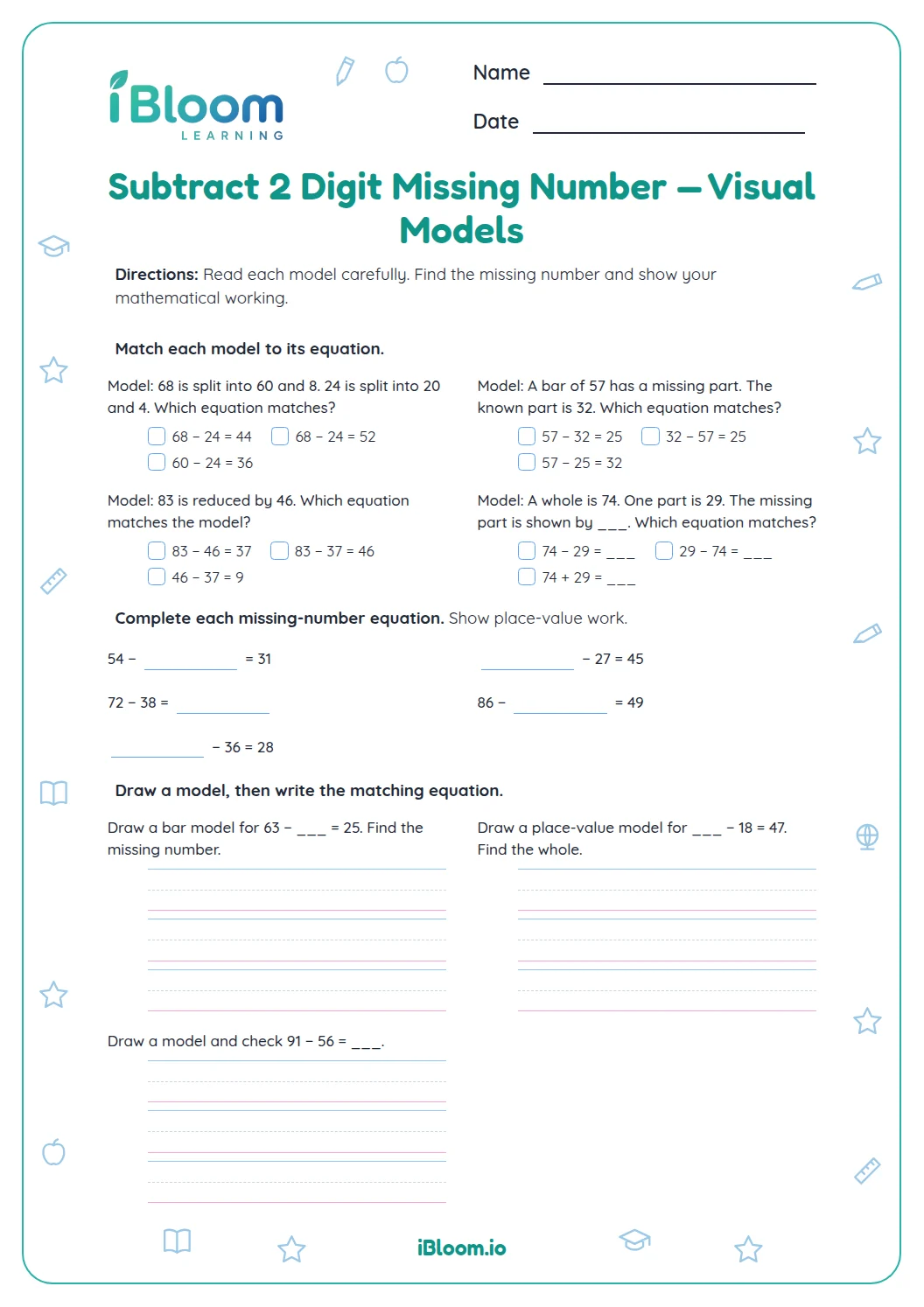
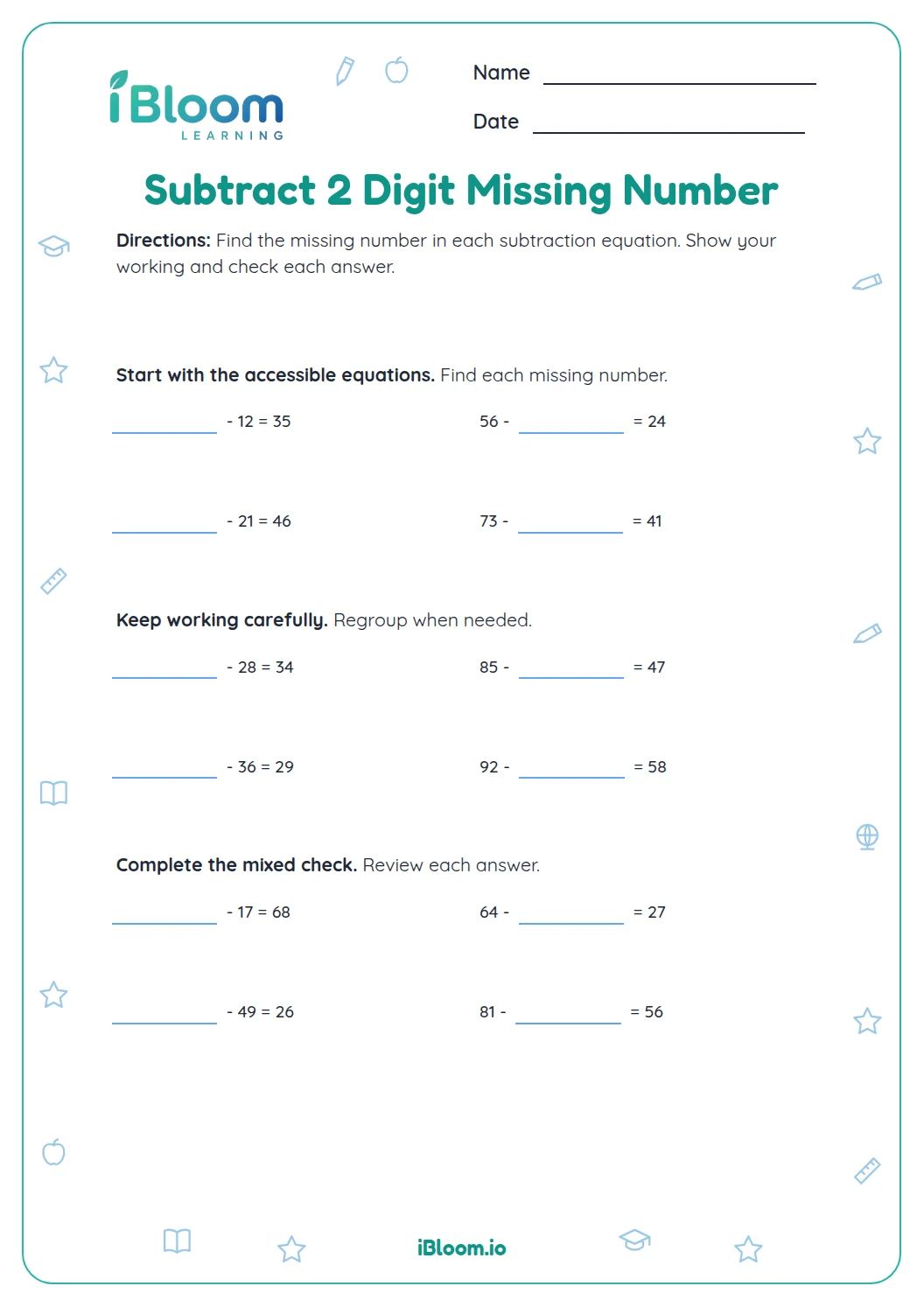
A missing starting number or subtrahend can be found by reversing the subtraction relationship. Addition reconstructs the whole, while a quick subtraction check confirms the result.
How can you use this worksheet?
- 1Read the reasoning choices before computing.
- 2Estimate the size of the difference when asked.
- 3Line up each number by place value and subtract from right to left.
- 4Regroup across zeros carefully, recording the new values.
- 5Add the difference back to check the result.
What slips should you watch for?
The mistake
Subtracting each smaller digit from the larger digit without regrouping.
The fix
Regroup across places and then subtract the top digit minus the bottom digit in each column.
The mistake
Choosing a check that repeats the original subtraction.
The fix
Use addition: difference plus subtrahend should equal the starting number.
The mistake
Ignoring zeros when regrouping across them.
The fix
Track the value passed through each place so the final regrouped digits still represent the same number.
Common Core alignment
This practice connects directly to the skills described in the Common Core standards.
Subtract multi-digit whole numbers with the standard algorithm.
On this sheet: Subtract multi-digit whole numbers with the standard algorithm.
Show the official wordingHide the official wording
Fluently add and subtract multi-digit whole numbers using the standard algorithm.
What to practice next
Make more practice
Further reading
Questions parents and teachers ask
What strategies does the challenge include?
Students identify a regrouping error, check a subtraction equation with addition, estimate a difference, and solve multi-digit subtraction problems. The last items ask them to use addition to recover a missing starting number or subtrahend. Ask the learner to explain the clue or operation used, then compare the completed response with the separate answer key.
How many problems are on the worksheet?
There are 16 questions: six reasoning choices, six multi-digit subtraction computations, two word problems, and two missing-number equations. The answer key lists the correct choices and exact numerical results. Ask the learner to explain the clue or operation used, then compare the completed response with the separate answer key.
Why use addition to check subtraction?
Addition reverses subtraction. If a difference is correct, adding it to the number that was subtracted returns the starting number. This check is useful for both standard subtraction and missing-number questions. Ask the learner to explain the clue or operation used, then compare the completed response with the separate answer key.
What does “regrouping across zeros” mean?
When a place has zero, a student may need to regroup from a higher place across several places before subtracting. In 90,000 − 47,208, regrouping crosses the zeros so each place has enough value to subtract. Ask the learner to explain the clue or operation used, then compare the completed response with the separate answer key.
Does the page include column work space?
The computation and word-problem items use working-space response areas so students can show their method. For best results, line up ones, tens, hundreds, and higher places before subtracting. Ask the learner to explain the clue or operation used, then compare the completed response with the separate answer key.