



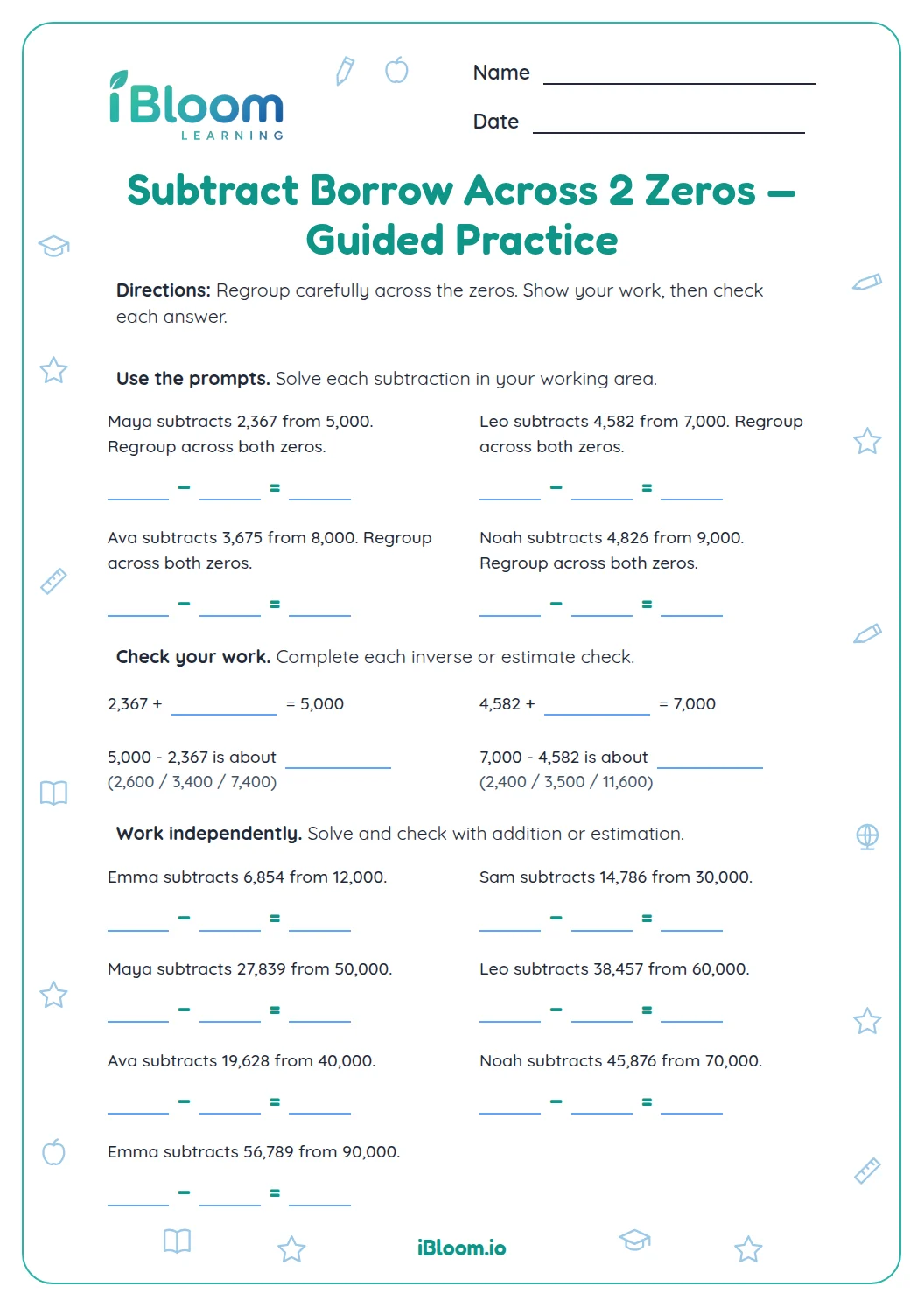
About this worksheet
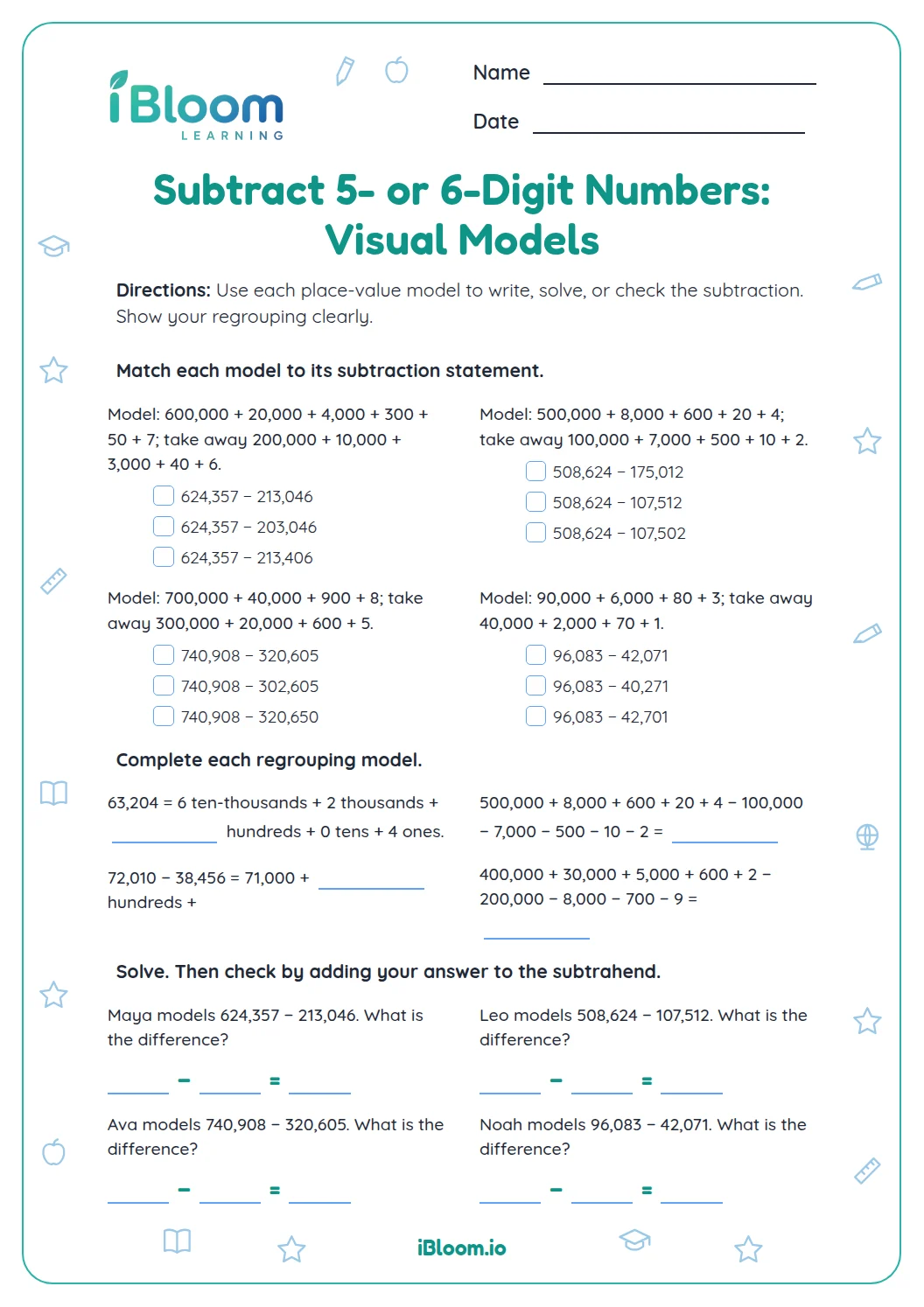
Learners solve subtraction situations about visitors, supplies, distances, and totals. The values range from five digits through one million, so children must align place values and regroup across zeros where needed. The sheet includes 14 story problems with room to show an equation and a separate key. It practices 4.NBT.B.4.
Aligned to 4.NBT.B.4
How to solve a multi-digit subtraction story
First decide which amount is the starting total and which amount is taken away or compared. Write the larger starting amount first, line up ones with ones and tens with tens, then subtract from right to left.
Some problems cross a zero. In the library problem, 502,840 − 126,475, regroup across the hundreds and thousands before subtracting. Check by adding 376,365 + 126,475 to get back to 502,840.
- 1502,840 − 126,475 = 376,365
- 2376,365 + 126,475 = 502,840
What does the worksheet practice?
The stories use a mix of five- and six-digit amounts. Several require regrouping, including across zeros, while each asks for one clear difference.
- Read each story and identify the starting amount and amount removed.
- Write a subtraction equation and solve with place value.
- Check the difference by adding it to the amount subtracted.
How to use this worksheet
- 1Read the story twice and mark the starting total and the amount removed.
- 2Write the larger starting amount above the smaller amount, with digits aligned by place.
- 3Regroup only when a top digit is too small to subtract the digit below it.
- 4Add your difference to the amount removed to check.
- 5Use the key to review any answer that does not return the starting amount.
Common mistakes and quick fixes
The mistake
Subtracting the smaller digit from the larger digit in every column, regardless of which is on top.
The fix
Keep the starting amount on top. Regroup from the next place when the top digit is too small.
The mistake
Skipping a zero during regrouping and leaving the place values unchanged.
The fix
Trade one unit from the next nonzero place across the zero, then update each place you passed.
The mistake
Forgetting to reduce the starting amount by the amount removed.
The fix
Use the story to decide what is left or how many more, then subtract in that order.
Curriculum alignment
This worksheet focuses on the skill named in its title. The standard below describes the work children practice.
Fluently add and subtract multi-digit whole numbers using the standard algorithm.
On this sheet: Every story requires subtracting multi-digit whole numbers, including regrouping.
Show the official wordingHide the official wording
Fluently add and subtract multi-digit whole numbers using the standard algorithm.
What to practice next
Make more practice
Further reading
Questions parents and teachers ask
What should a learner do first in a subtraction story?
Identify the starting amount and the amount that is removed or compared. Then write the starting amount first in a subtraction equation. For example, the park problem starts with last year’s attendance and removes this year’s attendance to find the difference. This same comparison structure appears alongside remaining-total stories.
How can a child check a difference?
Add the difference to the amount subtracted. The result should match the starting amount. For example, in the library question, add the number of donated books to the answer. The sum should return to the original collection of 502,840 books.
Does this sheet include regrouping?
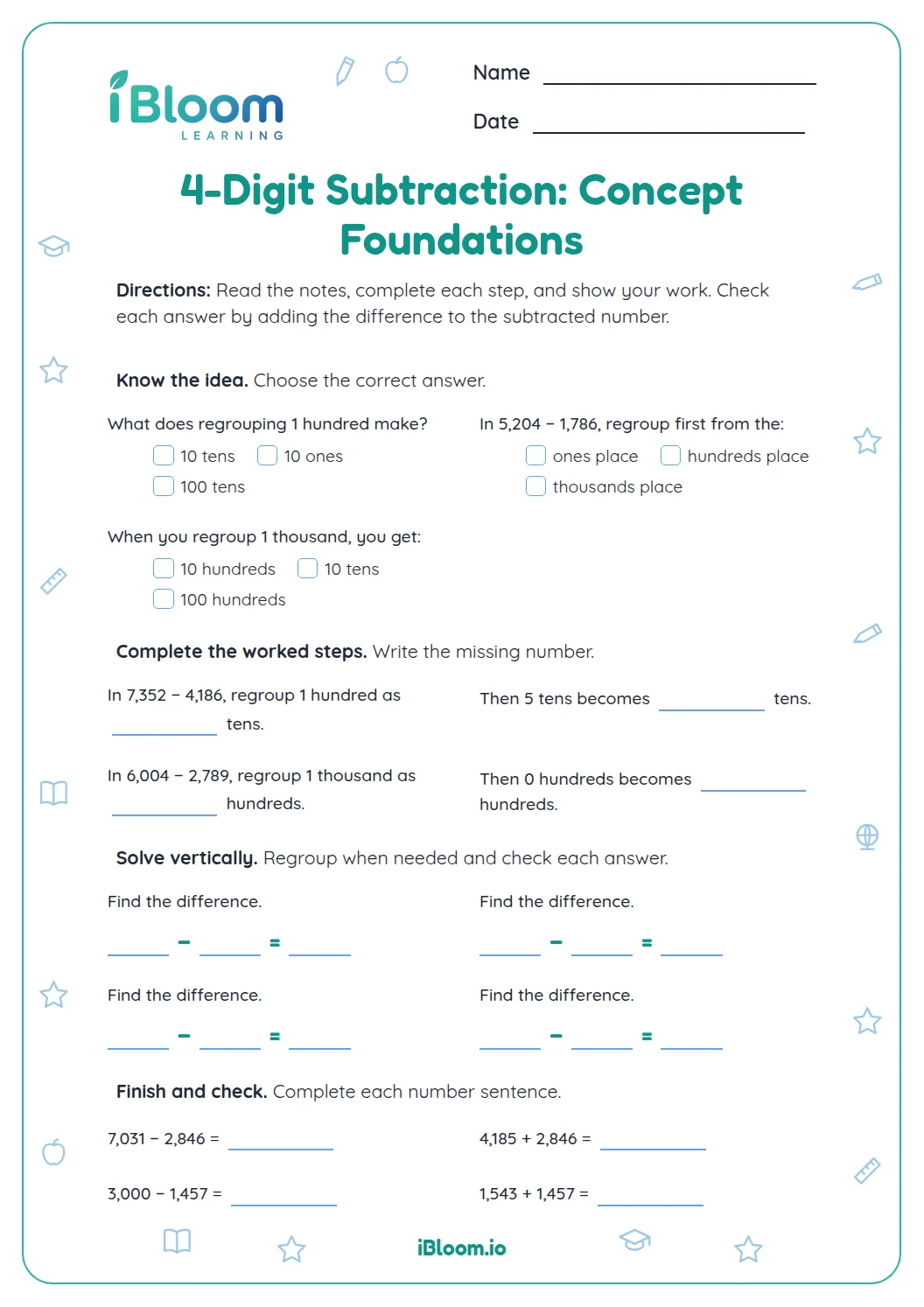
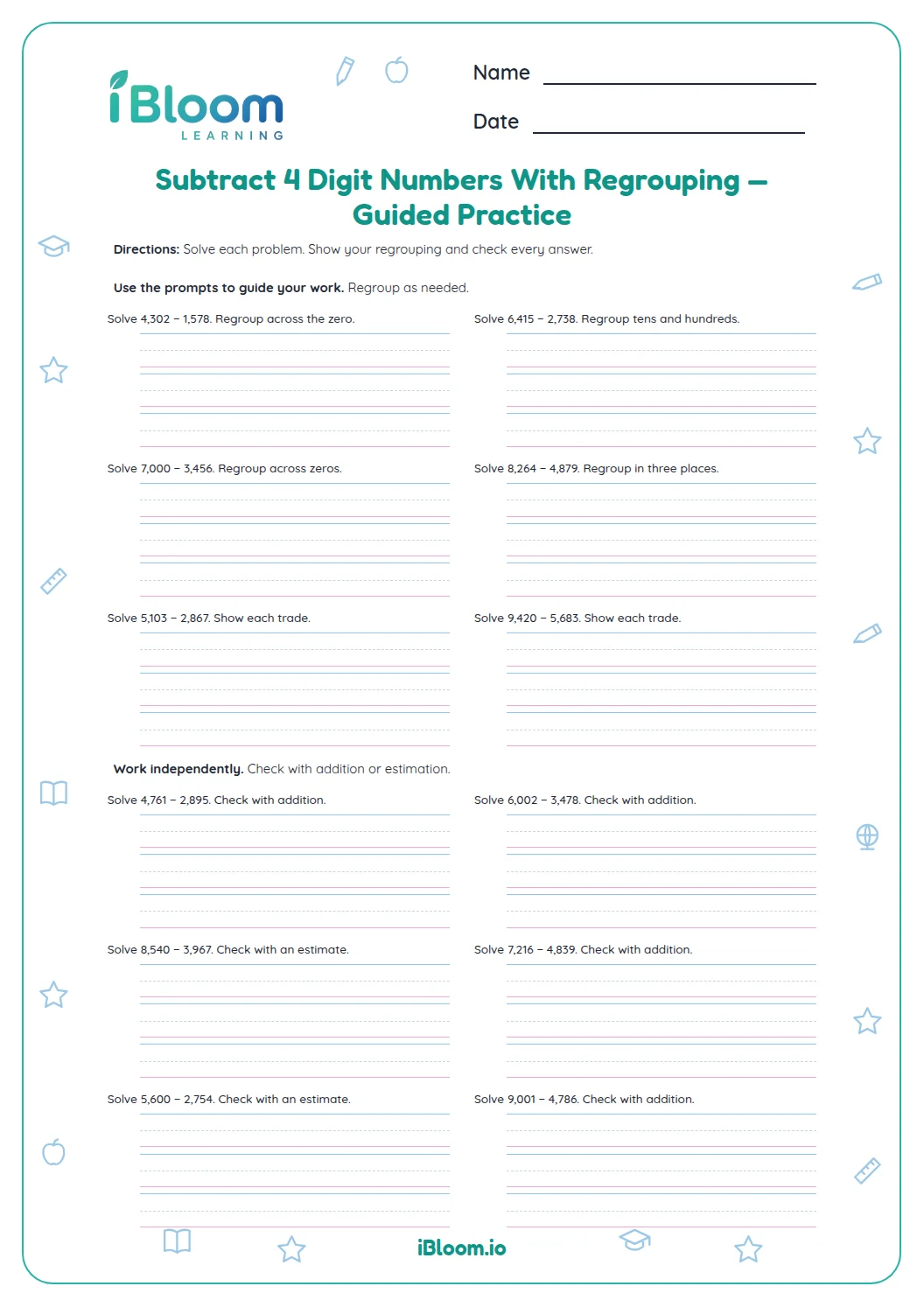
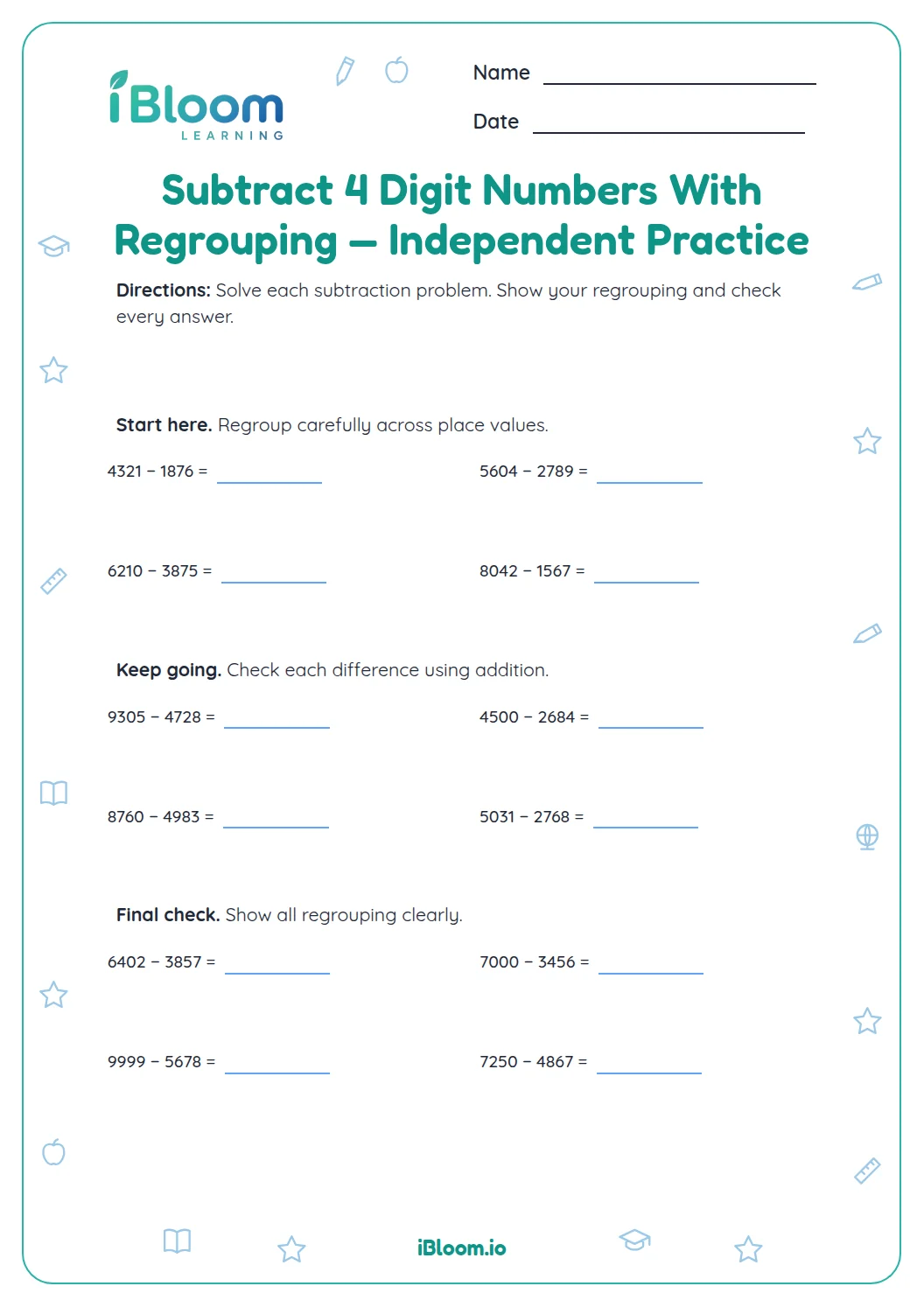
Yes. The problems include regrouping in different place values, including exchanges across zeros. The values include five- and six-digit numbers, and some problems require regrouping across zero places. Learners should keep every digit aligned with its place value.
Is an answer key included?
Yes. A separate answer key lists the difference for each story. Print the worksheet pages for practice and use the separate key to check each result. The key lists one numeric difference for every story problem. Recheck place values when an answer differs.
How can a student check a subtraction answer?
Add the difference to the amount subtracted. The total should return to the starting amount. For example, add the answer to the number of books donated in the library story and check that the sum is 502,840. This inverse check can catch a place-value error.