




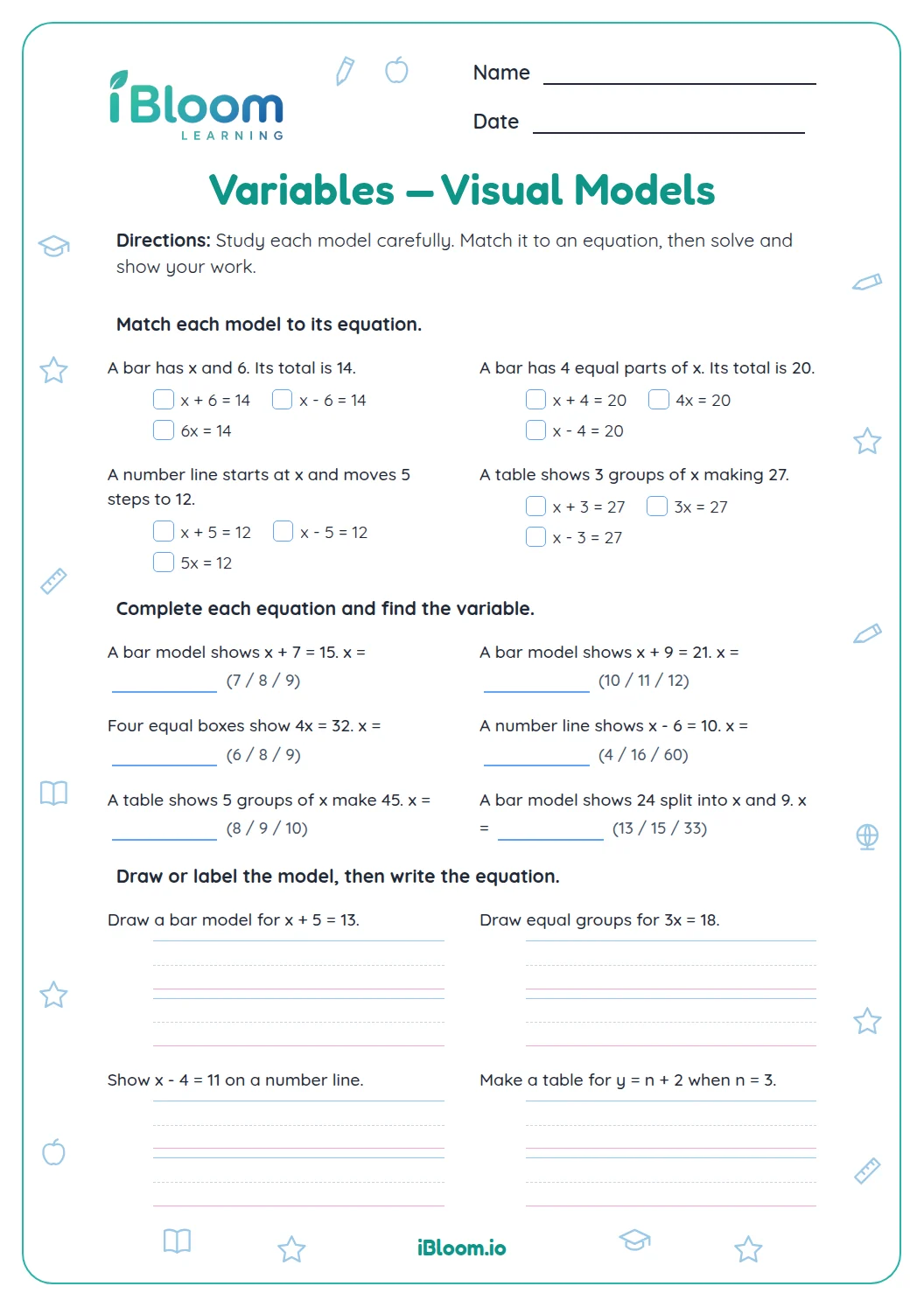


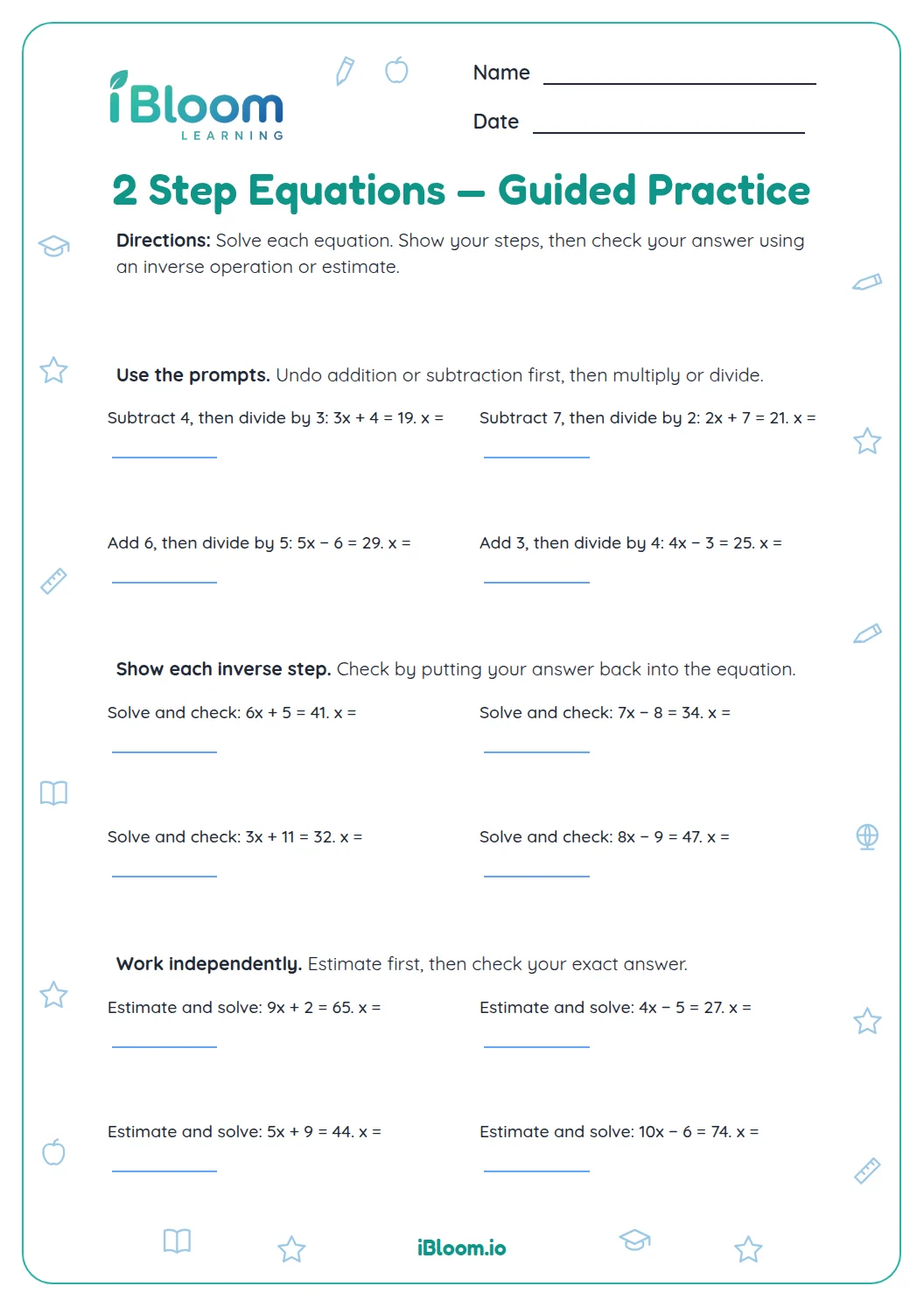

About this worksheet
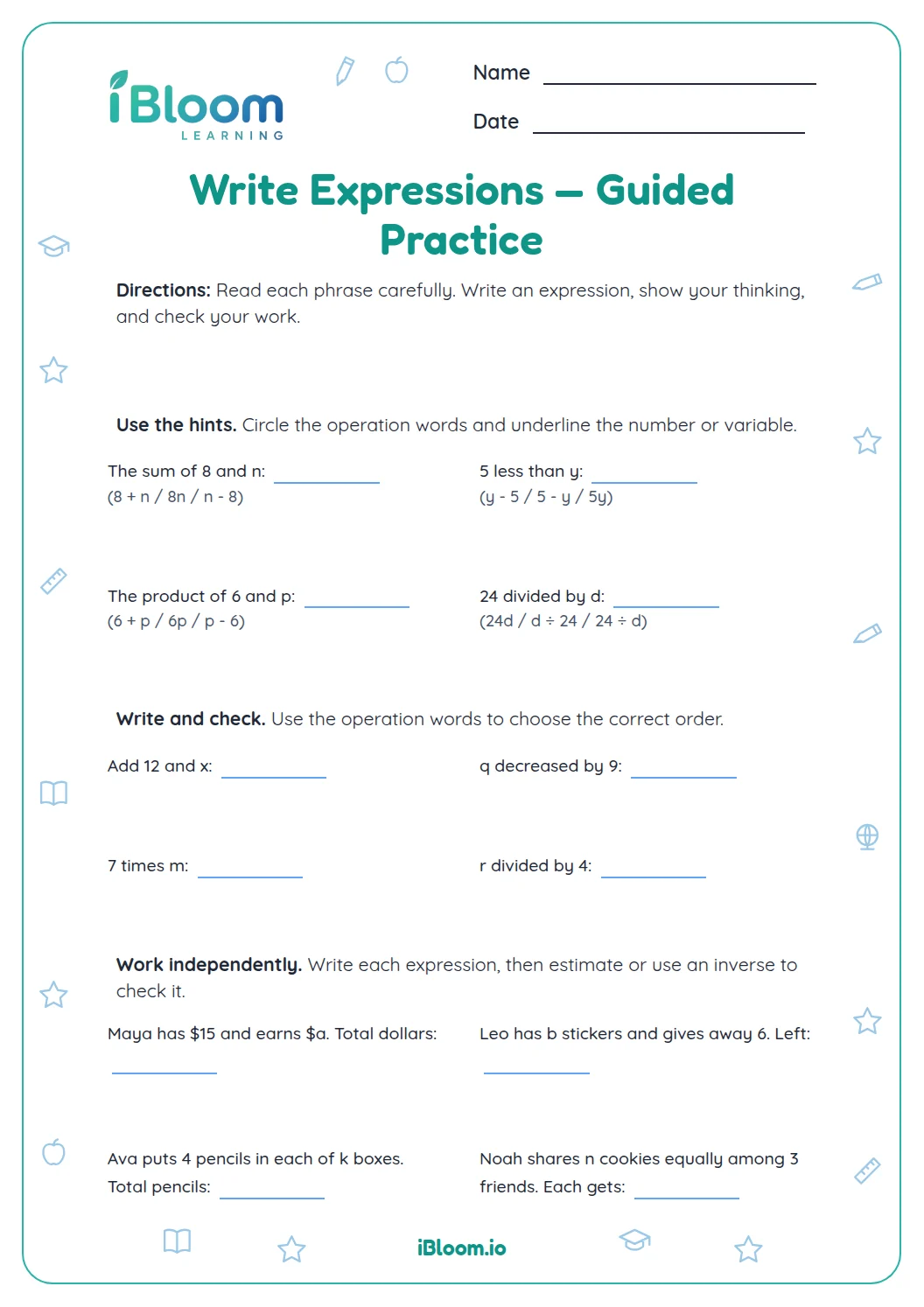
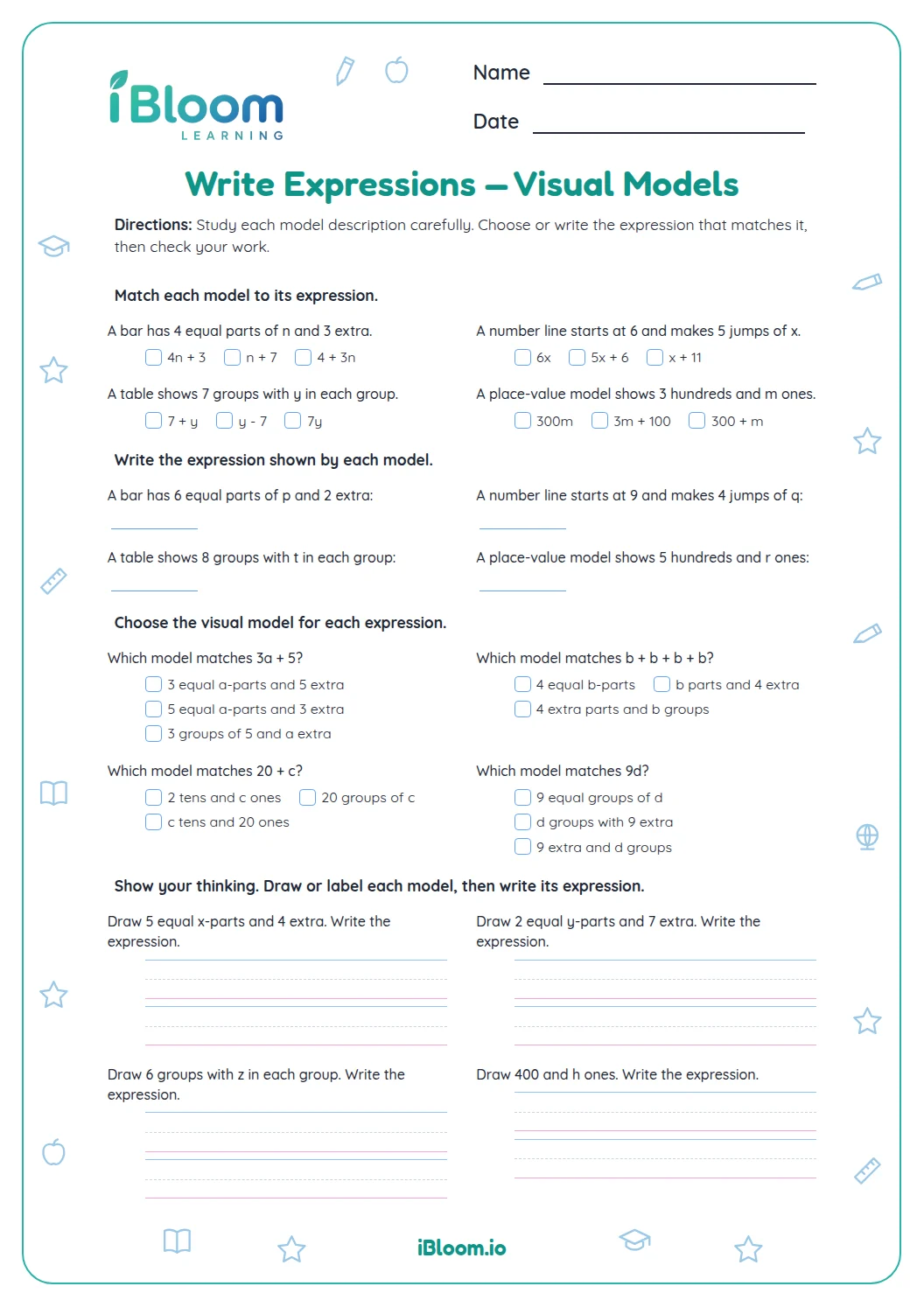
This free Grade 5 worksheet asks students to represent everyday situations with variable expressions. Four multiple-choice items introduce adding, subtracting, and multiplying with a letter. Five short responses ask students to write an expression and name what its variable represents. The final three problems add substitution: write an expression, then find its value for a given number. The writing tasks practice Common Core 6.EE.A.2a. A separate answer key gives expressions, variable meanings, and the three evaluated results.
Aligned to 6.EE.A.2a
What does the letter in each problem mean?
A variable is a letter that represents a number. Its meaning comes from the situation. In question 2, n is the cost in dollars of one notebook, so four notebooks cost 4 × n dollars.
Part B asks students to name the quantity represented by the letter as well as write an expression. For question 5, a means the number of apples bought. Naming the quantity helps distinguish adding more apples from making equal groups.
How do students choose the operations?
Read how the quantities relate before choosing a symbol. Equal groups call for multiplication. Giving away items calls for subtraction. In question 9, students must multiply to count all the pencils before subtracting the four given away.
- 1Leo has 3 packs of p pencils and gives away 4 pencils.
- 2p = number of pencils in each pack
- 3Pencils before giving any away: 3 × p
- 4Pencils left: 3 × p − 4
How does Part C check an expression?
Replace the variable with the number given in the prompt, then calculate. In question 11, two movie tickets cost m dollars each and one snack costs $5. The total is 2 × m + 5. When m = 8, it is 2 × 8 + 5 = 21 dollars.
Part C asks for both the expression and its value. Accept an equivalent expression when it describes the same quantities. For the tickets, m + m + 5 works too; 2 × (m + 5) would charge for two snacks.
How to use this worksheet
- 1Read the situation and identify what the letter represents.
- 2Choose the matching expression in Part A, checking the order of subtraction.
- 3In Part B, write each expression and explain the variable in a few words.
- 4For Part C, write an expression before replacing its variable with the given number.
- 5Calculate multiplication before addition or subtraction, then check expressions and values with the key.
Mistakes to discuss and fix
The mistake
Writing n + 4 for four notebooks costing n dollars each.
The fix
There are four equal costs, so use 4 × n or n + n + n + n.
The mistake
Writing s − 25 when Ava gives away s of her 25 stickers.
The fix
Start with the 25 stickers and subtract the number given away: 25 − s.
The mistake
Writing 2 × (m + 5) for two movie tickets and one $5 snack.
The fix
Multiply only the ticket price by two, then add the cost of one snack: 2 × m + 5.
Common Core alignment
Write expressions using letters for quantities in everyday situations.
On this sheet: Students choose and write variable expressions for purchases, collections, equal groups, and amounts left.
Show the official wordingHide the official wording
Write expressions that record operations with numbers and with letters standing for numbers. For example, express the calculation “Subtract y from 5” as 5 − y.
What to practice next
Make more practice
Further reading
Questions parents and teachers ask
Are students writing numerical or variable expressions?
Students write expressions with variables, such as 3 × p − 4 for three packs of pencils with four pencils given away. The letter represents a quantity named in the situation. Part B also asks students to explain that meaning, and Part C supplies values to substitute.
Should my child calculate every expression?
Calculate only the three expressions in Part C, where each variable has a given value. Parts A and B ask for expressions that keep the letter. In Part C, students write both an expression and its numerical value so you can check the setup and the calculation separately.
Are answers different from the key ever correct?
Yes; accept equivalent expressions that represent the same quantities. Four notebooks costing n dollars each can be written as 4 × n, 4n, or n + n + n + n. Ask the student to explain what each part means before deciding whether the expression matches the story.
How should students define a variable in Part B?
Name the quantity represented by the letter in a few words. For question 5, a is the number of apples bought; for question 6, b is the number of bags. A useful definition names what is being counted or measured, rather than simply saying that the letter is unknown.
How does the ticket problem check order of operations?
The ticket problem uses 2 × m + 5, with m = 8. Students replace m with 8, multiply 2 × 8, then add 5 to get $21. The two tickets share the same price, while the snack is a single extra cost added after the multiplication.