




About this worksheet
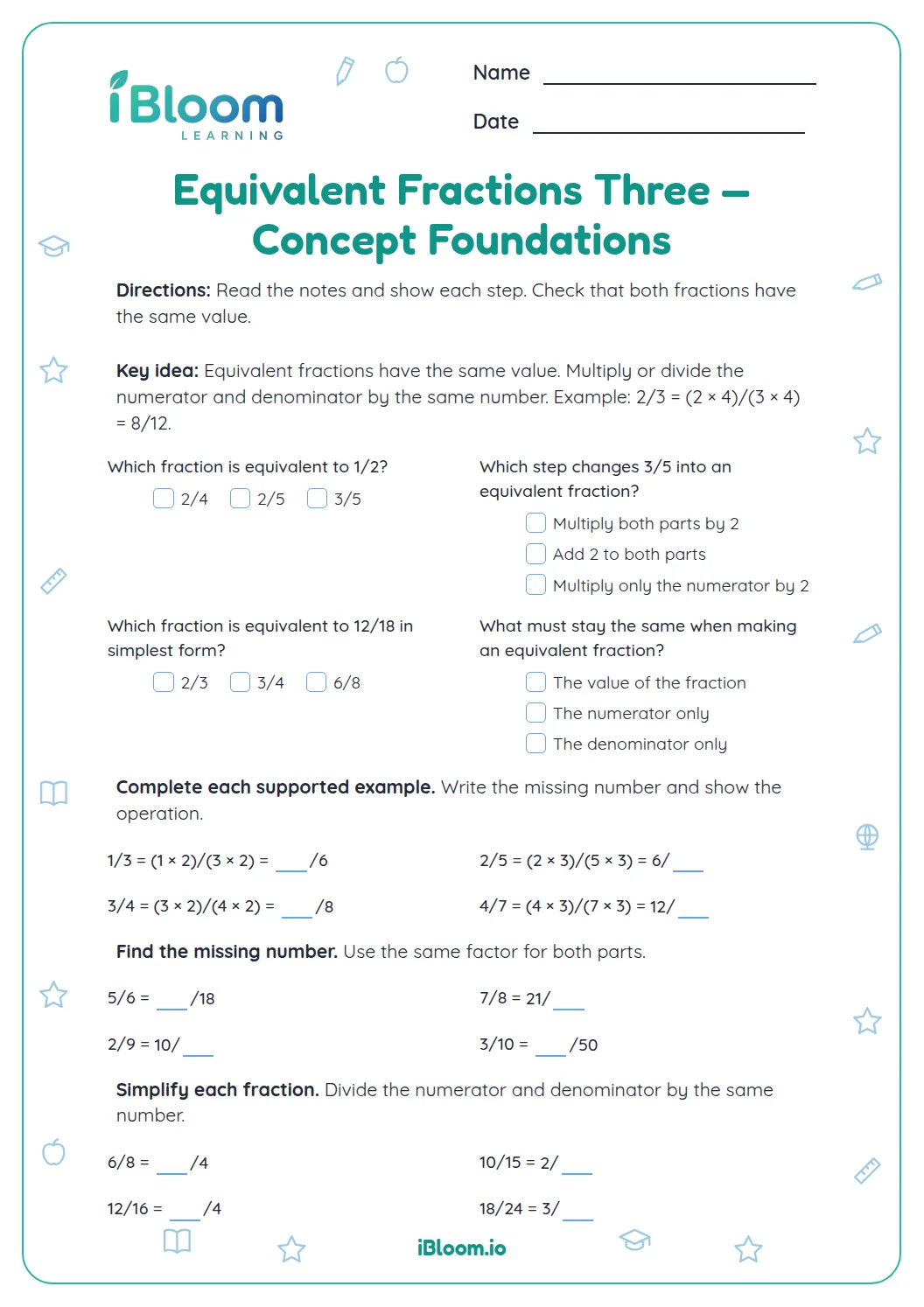
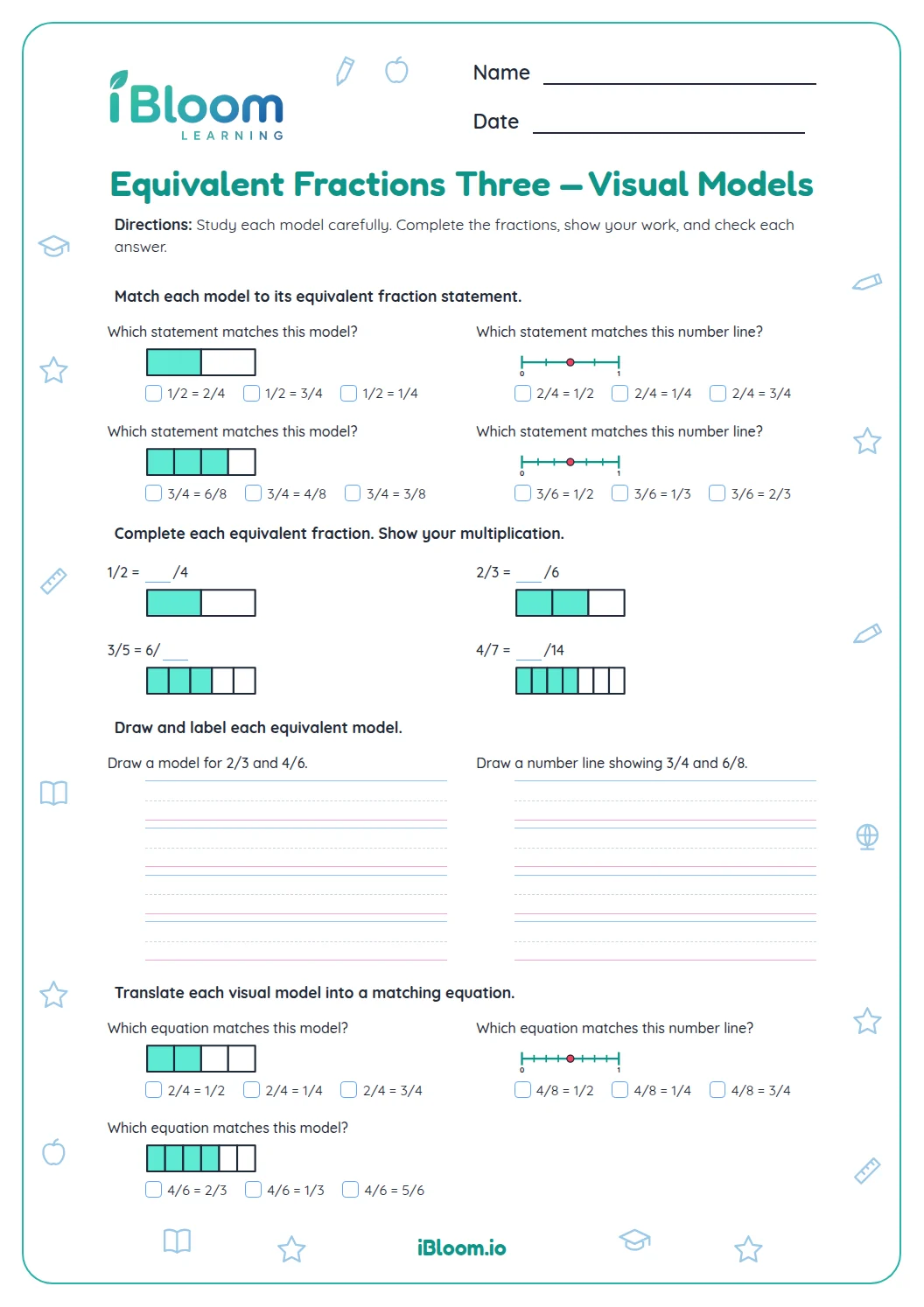
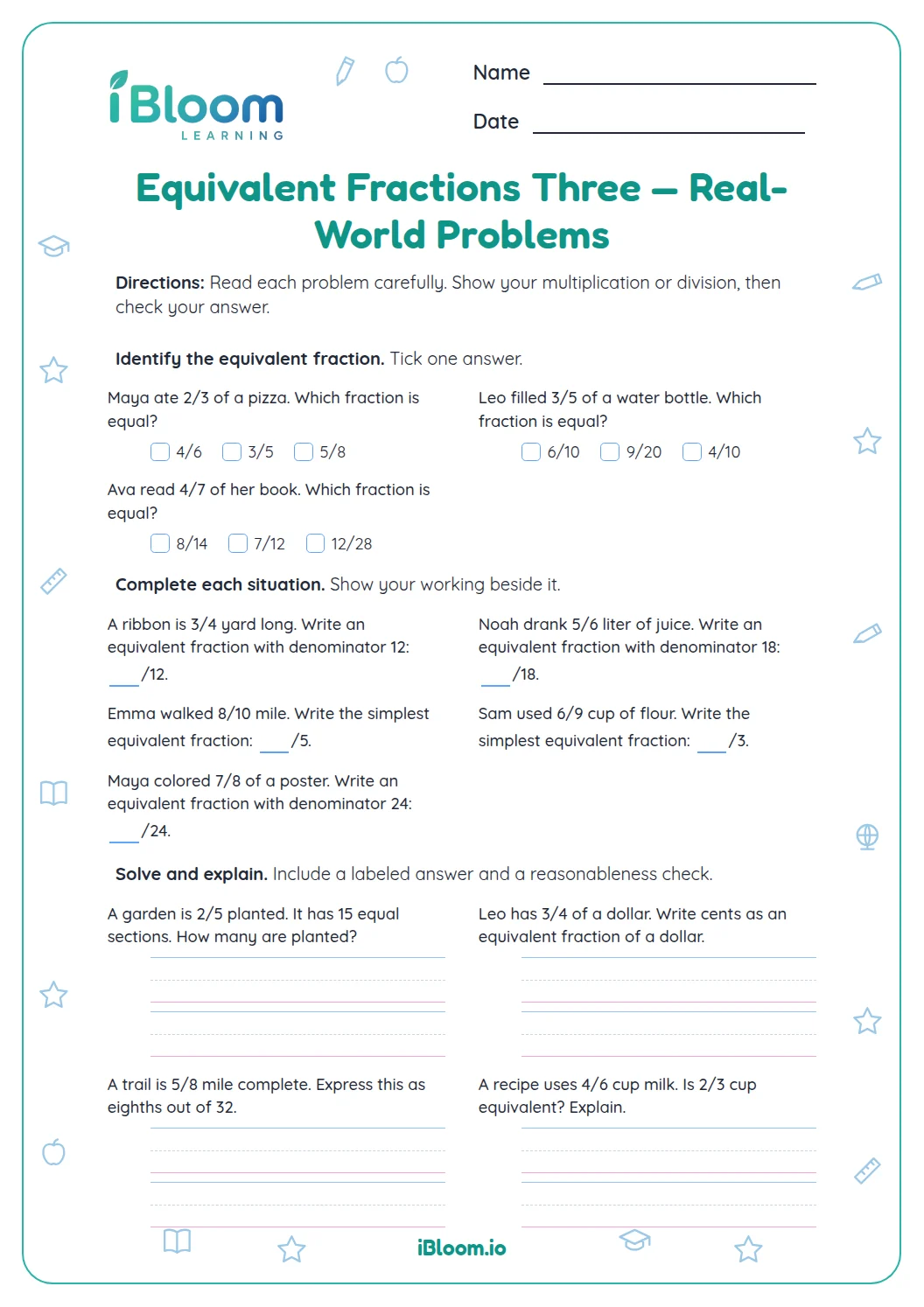
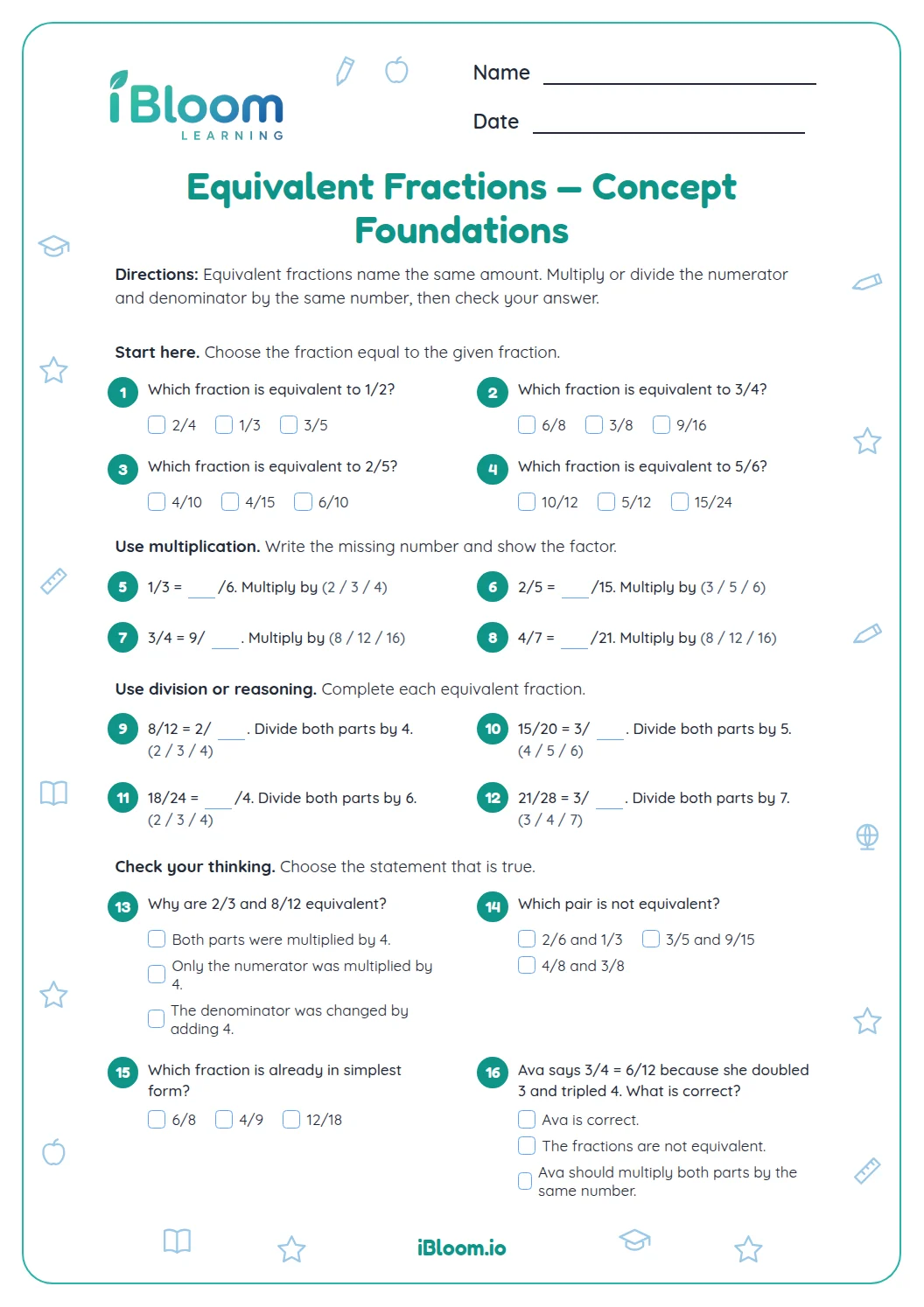
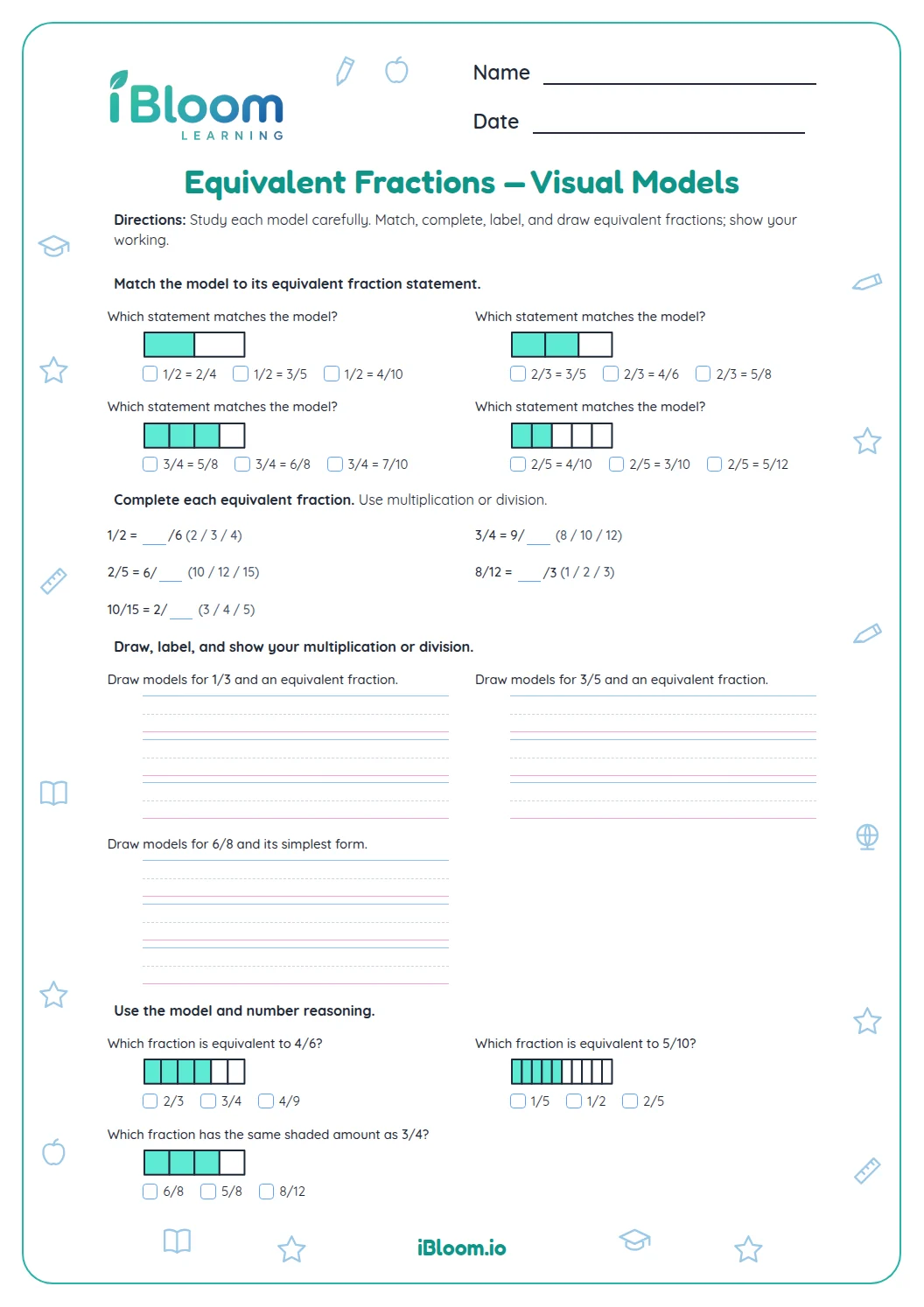
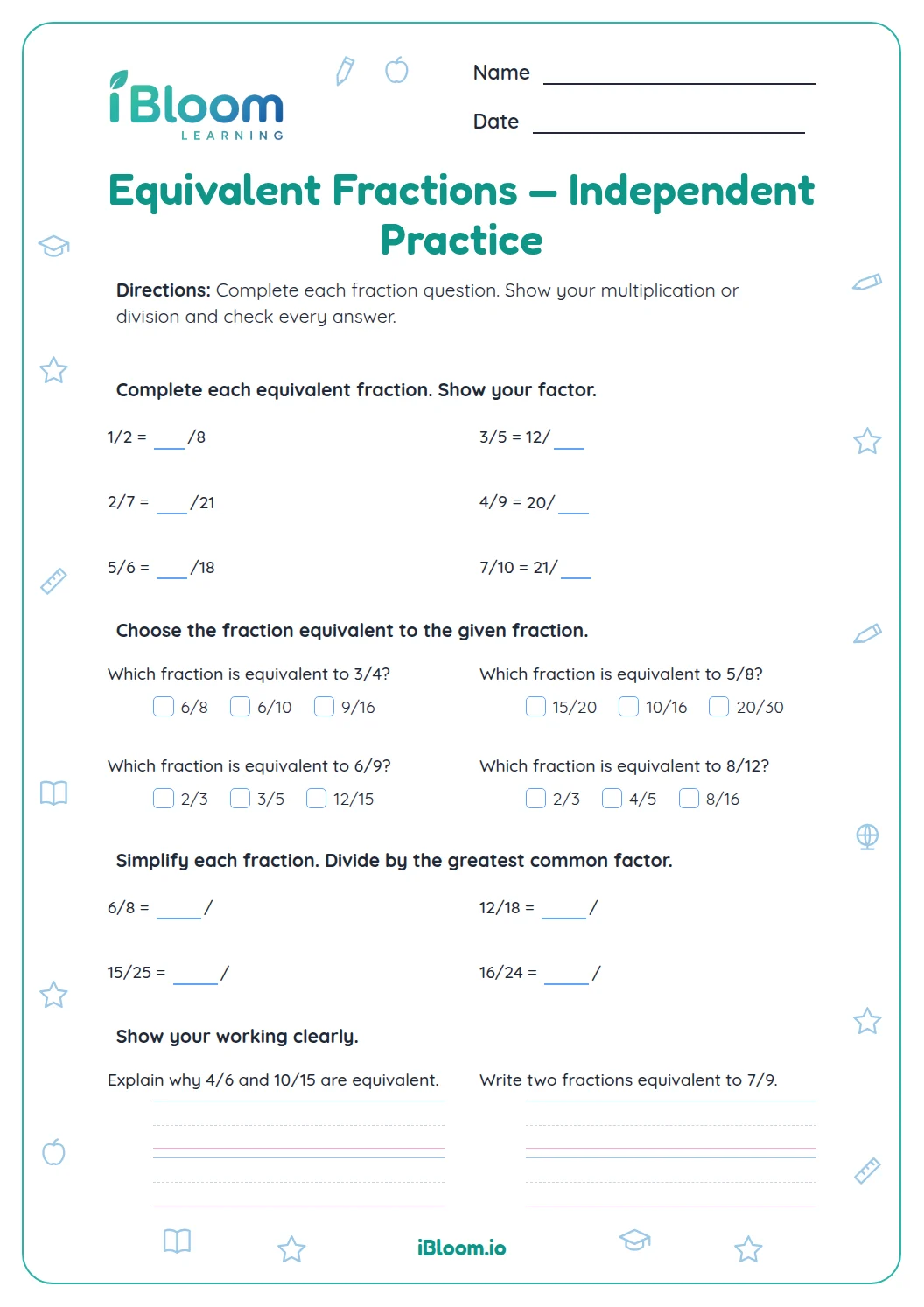
This Grade 5 printable builds fluency with equivalent fractions and asks students to justify their reasoning. Students complete missing numerators and denominators, identify a non-equivalent fraction, and explain why multiplying or dividing both terms by the same factor preserves the value. The answer key includes sample explanations for open responses.
Aligned to 4.NF.A.1
What changes when a fraction is scaled?
The numerator and denominator are multiplied or divided by the same factor. The fraction names a different number of parts, but the size of each part changes in a matching way.
- 12/3 = ___/12
- 23 becomes 12 by multiplying by 4; 2 × 4 = 8.
How can you test a proposed equivalent fraction?
Compare the factors used on the top and bottom. If both terms are multiplied by 3, the fraction keeps its value. If one term changes by a different factor, the value generally changes.
How should a student explain equivalence?
Name the operation and factor applied to both terms. For example, 5/8 and 15/24 are equivalent because multiplying 5 and 8 by 3 produces 15/24.
How can students work through the page?
- 1Identify the numerator and denominator.
- 2Find the factor connecting the known terms.
- 3Apply the same factor to the other term.
- 4Check by simplifying or comparing both scale factors.
- 5Explain the factor in a complete sentence.
Common mistakes and quick fixes
The mistake
Changing only the denominator.
The fix
Apply the same multiplier or divisor to numerator and denominator.
The mistake
Adding the same number to both terms.
The fix
Use multiplication or division by a common factor, not addition.
The mistake
Using different scale factors.
The fix
Write the factor beside both terms and check that it matches.
Students generate equivalent fractions by scaling both terms by the same factor.
On this sheet:
Show the official wordingHide the official wording
Explain why a fraction a/b is equivalent to a fraction (n × a)/(n × b) by using visual fraction models, with attention to how the number and size of the parts differ even though the two fractions themselves are the same size. Use this principle to recognize and generate equivalent fractions.
What to practice next
Make more practice
Further reading
Questions parents and teachers ask
Why is 2/3 equal to 8/12?
Multiplying both terms of 2/3 by 4 gives 8/12. The numerator and denominator grow by the same factor, so the fraction still describes the same amount. Question 1 uses this relationship to find the missing numerator. Invite your child to point to the exact question or sentence that supports the answer before checking the key.
Can I add the same number to the top and bottom?
No. Equivalent fractions are generated by multiplying or dividing both terms by the same nonzero factor. Adding the same number usually changes the fraction’s value, so the two results are not equivalent. The key follows the same question order as the printable, making it easy to review one answer at a time.
How many problems are on the worksheet?
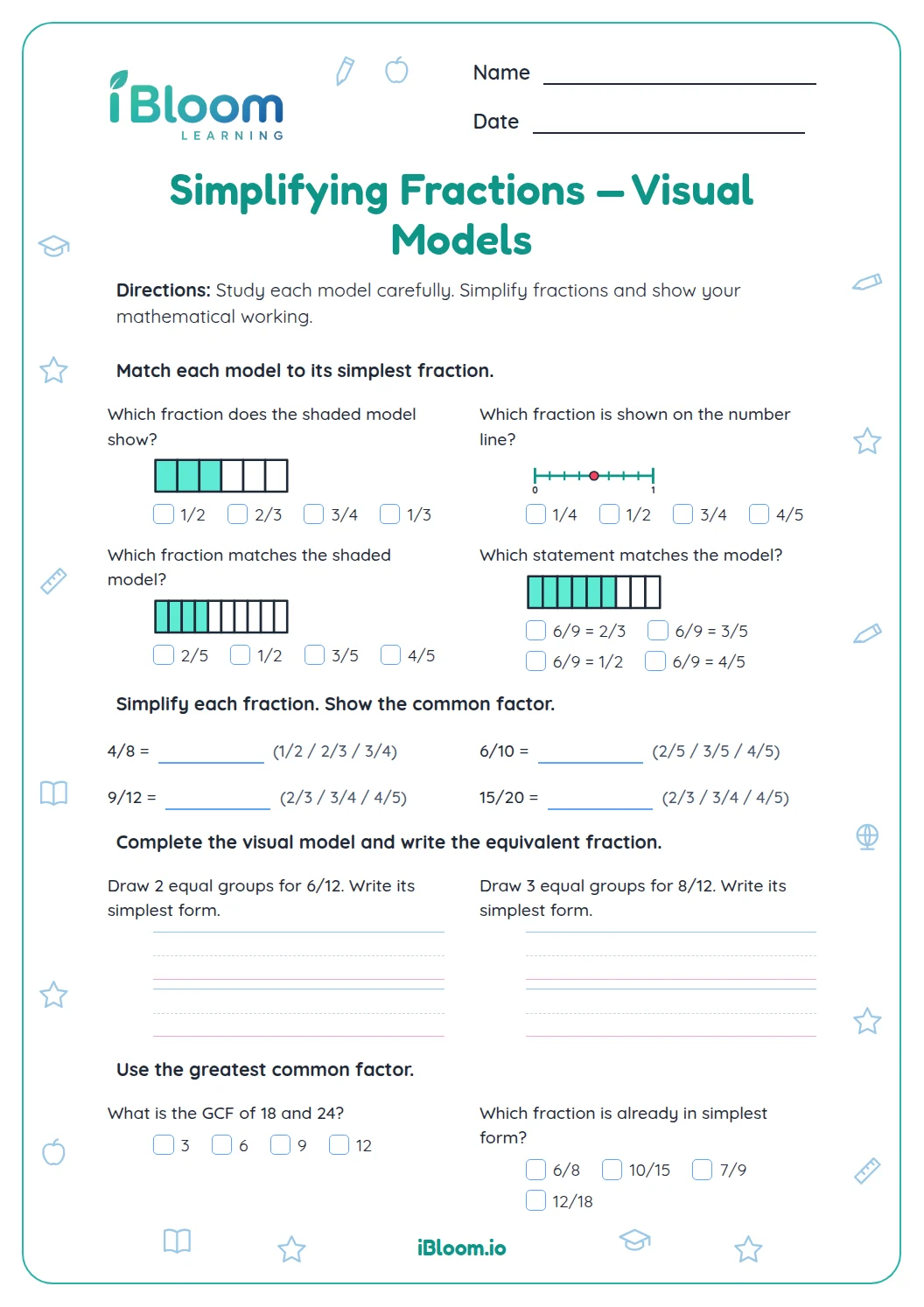
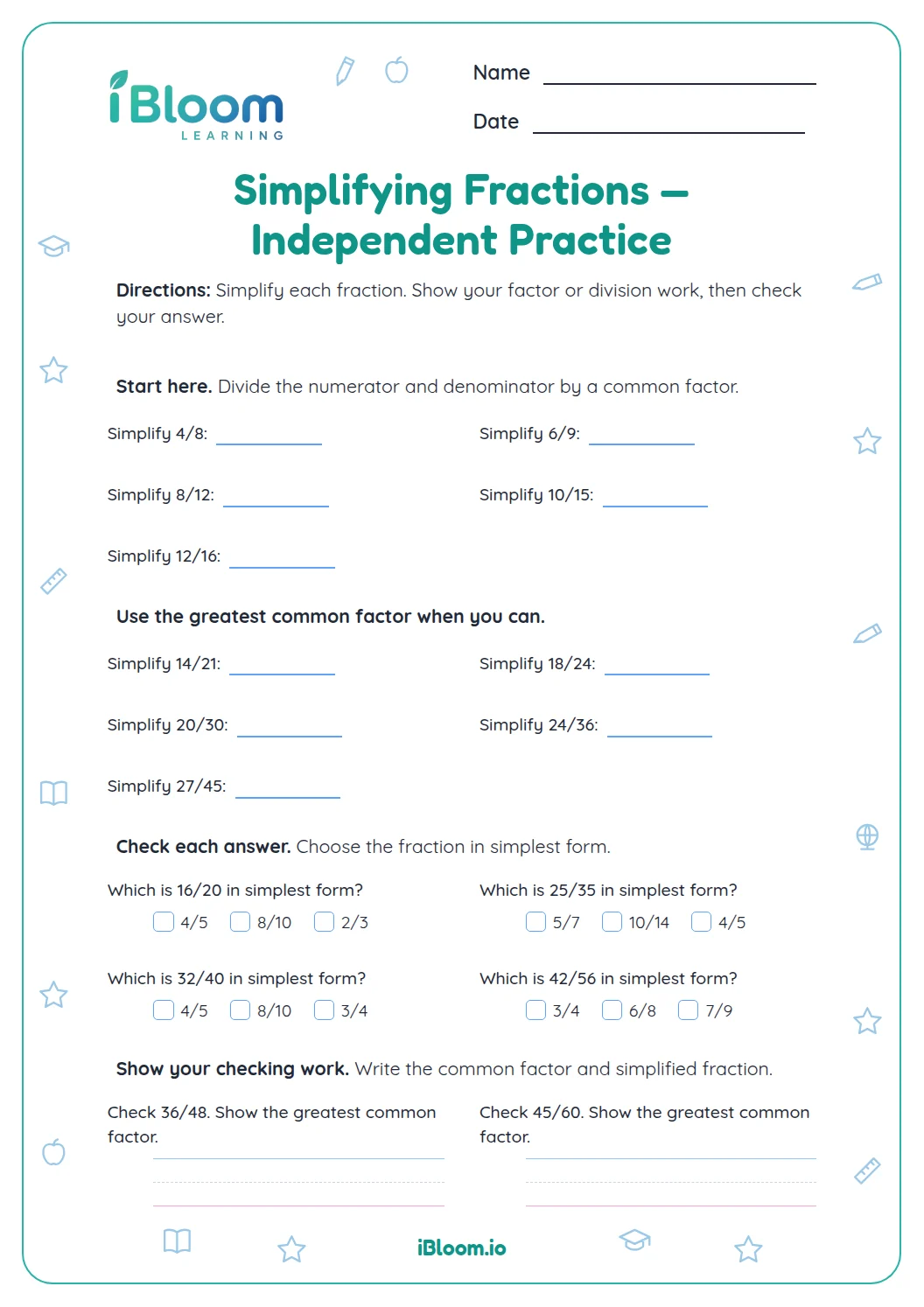
There are 18 questions across three worksheet pages, followed by an answer key. Students complete equivalent fractions, check claims, compare strategies, and explain how scaling both terms preserves a fraction’s value. The key gives sample wording for explanations.
What if the fraction can be simplified?
Simplifying is one way to check equivalence. If both fractions reduce to the same fraction, they name the same value. Students can also compare the multiplication or division factor used on the numerator and denominator. If an answer is unclear, reread the instructions for that part and compare the worked example on this page.
Which standard does this worksheet practice?
The page cites CCSS 4.NF.A.1, which asks students to recognize and generate equivalent fractions and explain the relationship using fraction models. This worksheet emphasizes generating fractions and describing the common scale factor. Students can then use the linked related worksheet to build on the same skill with a new set of examples.