




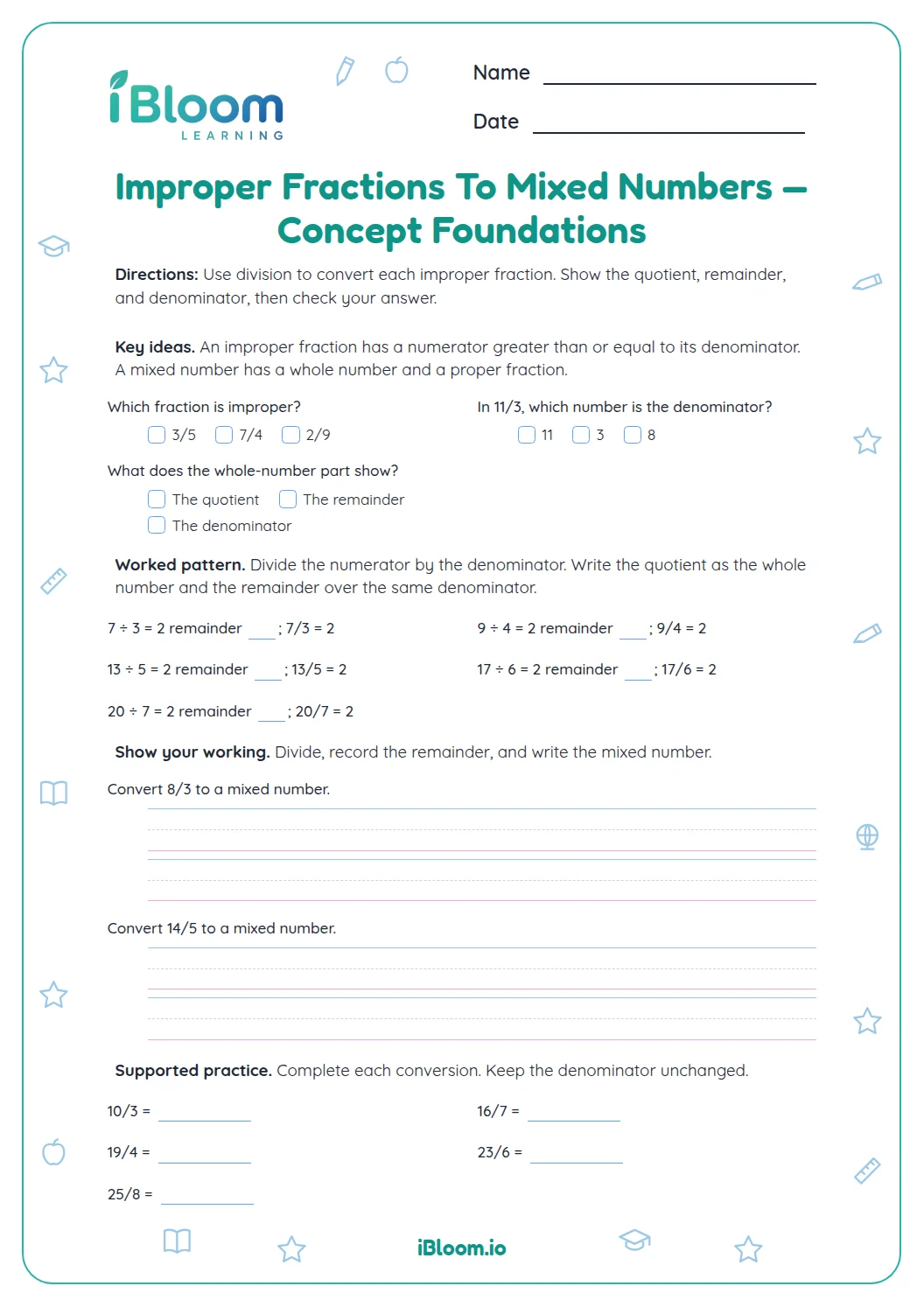
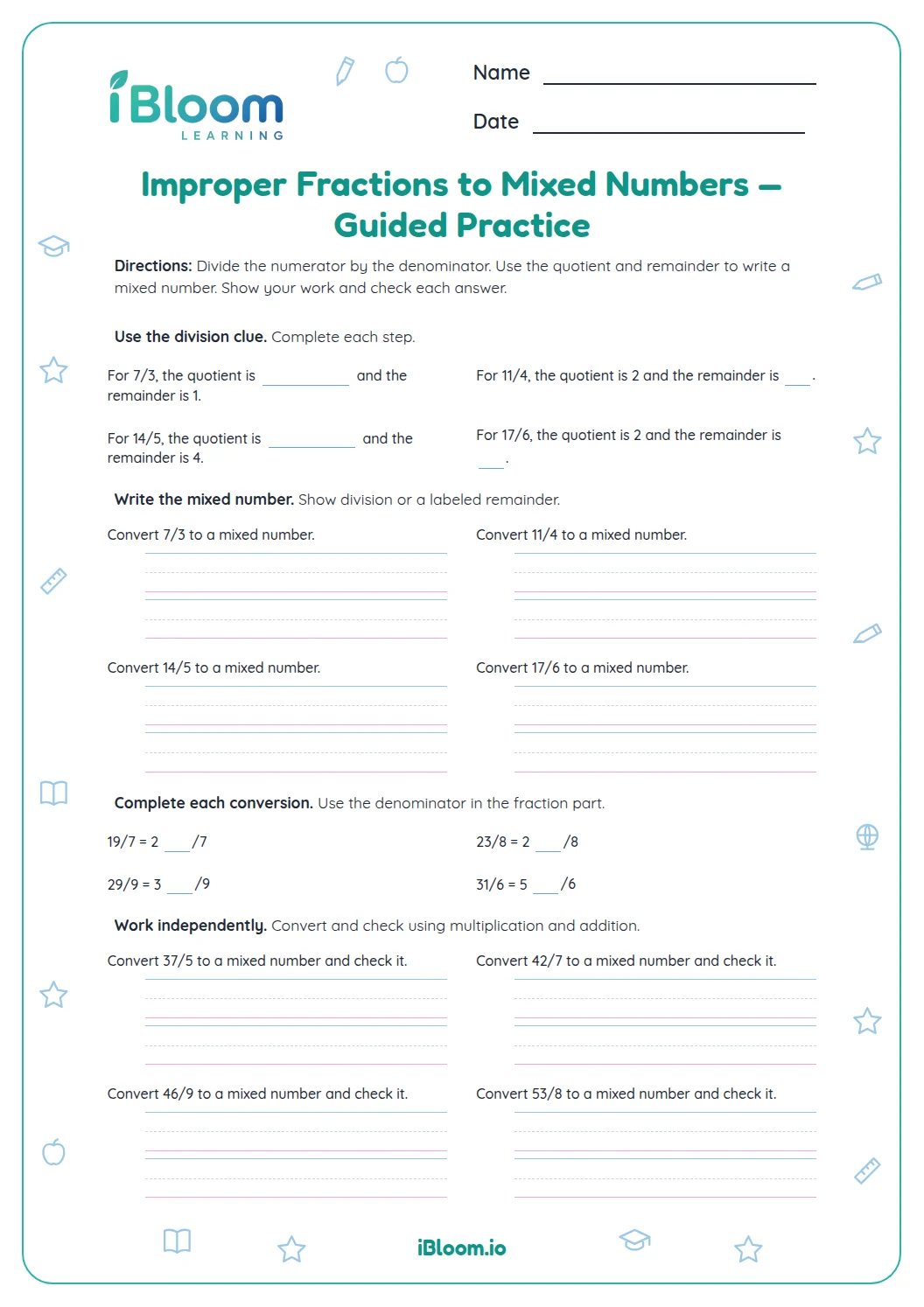
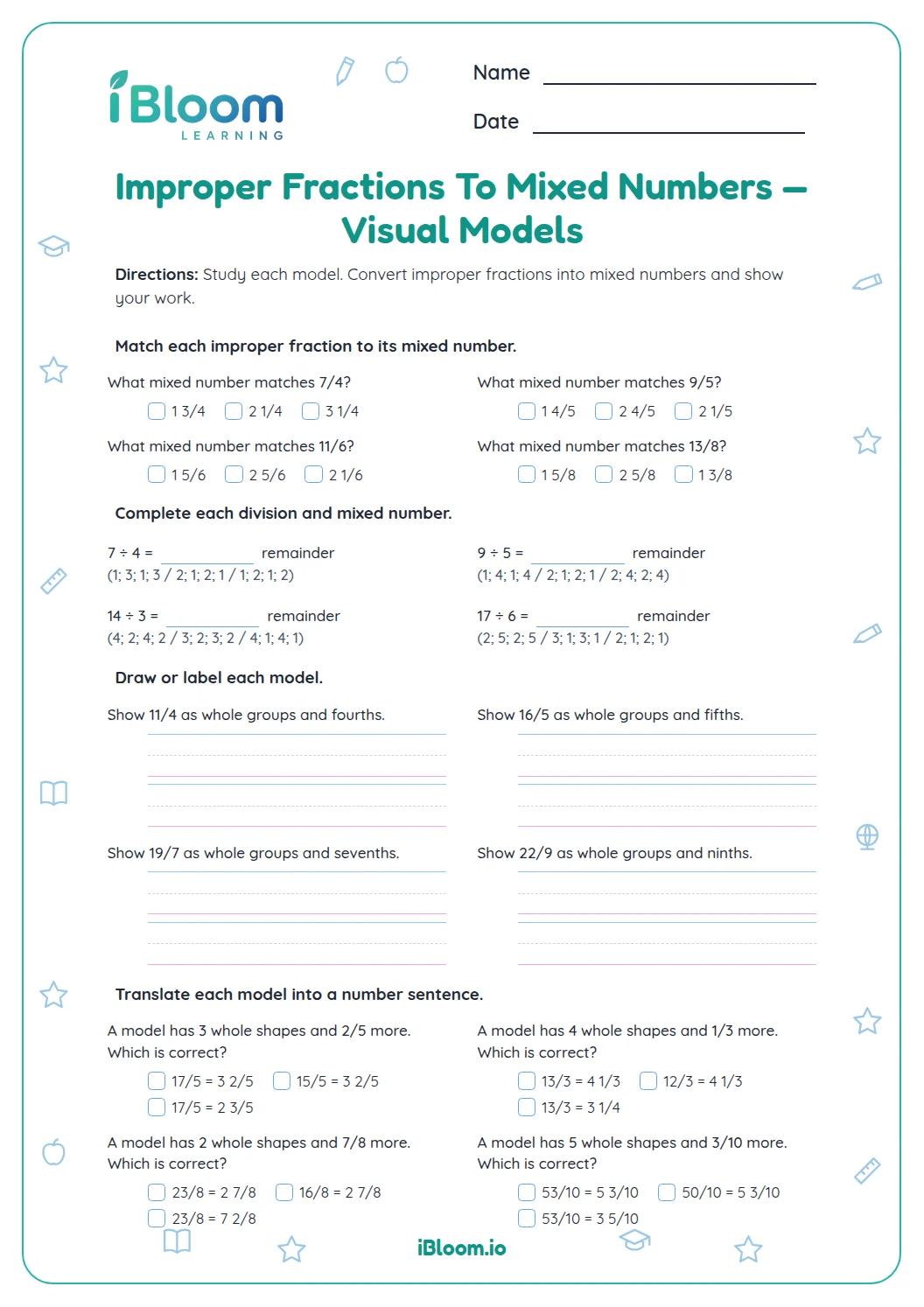
About this worksheet
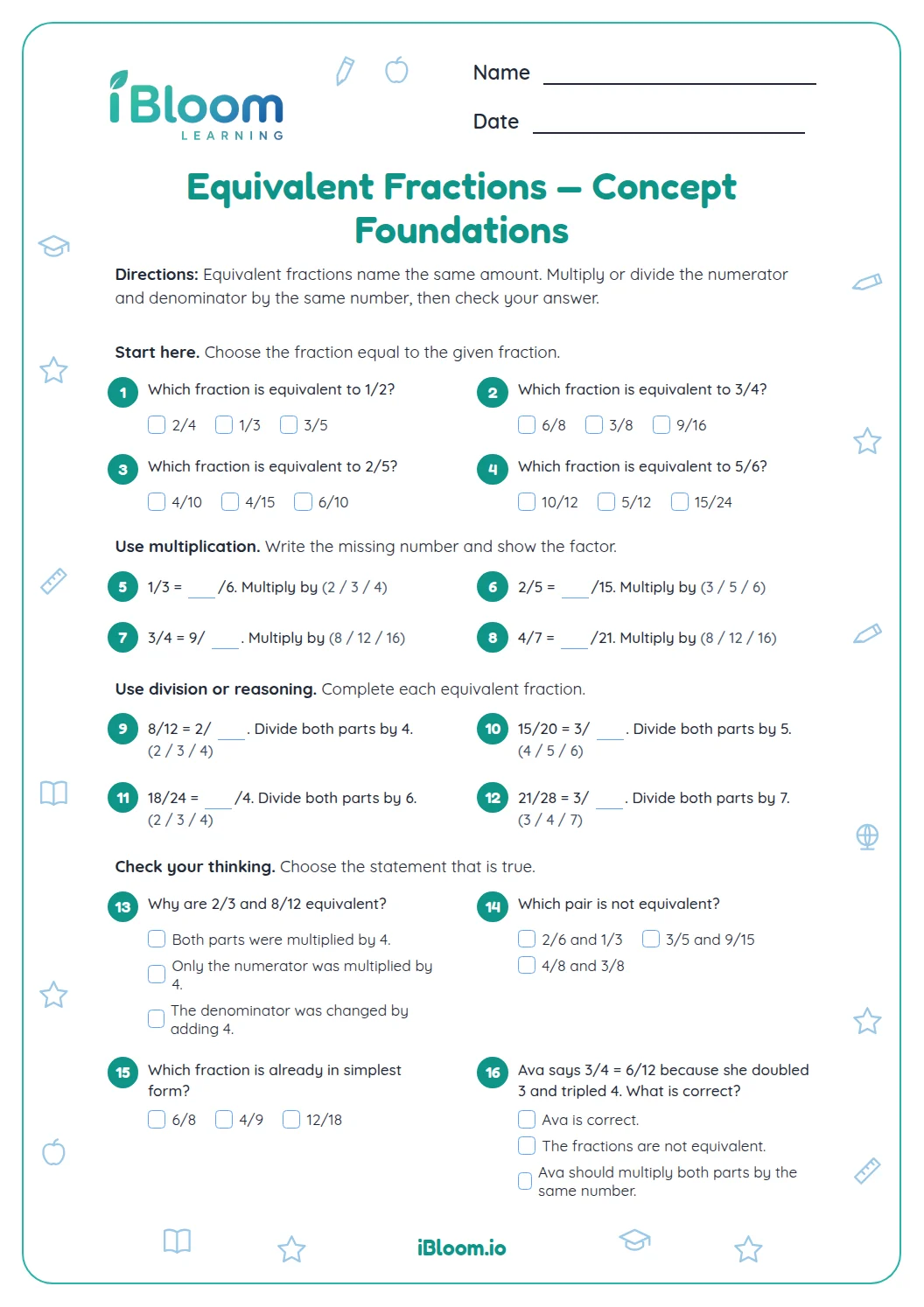
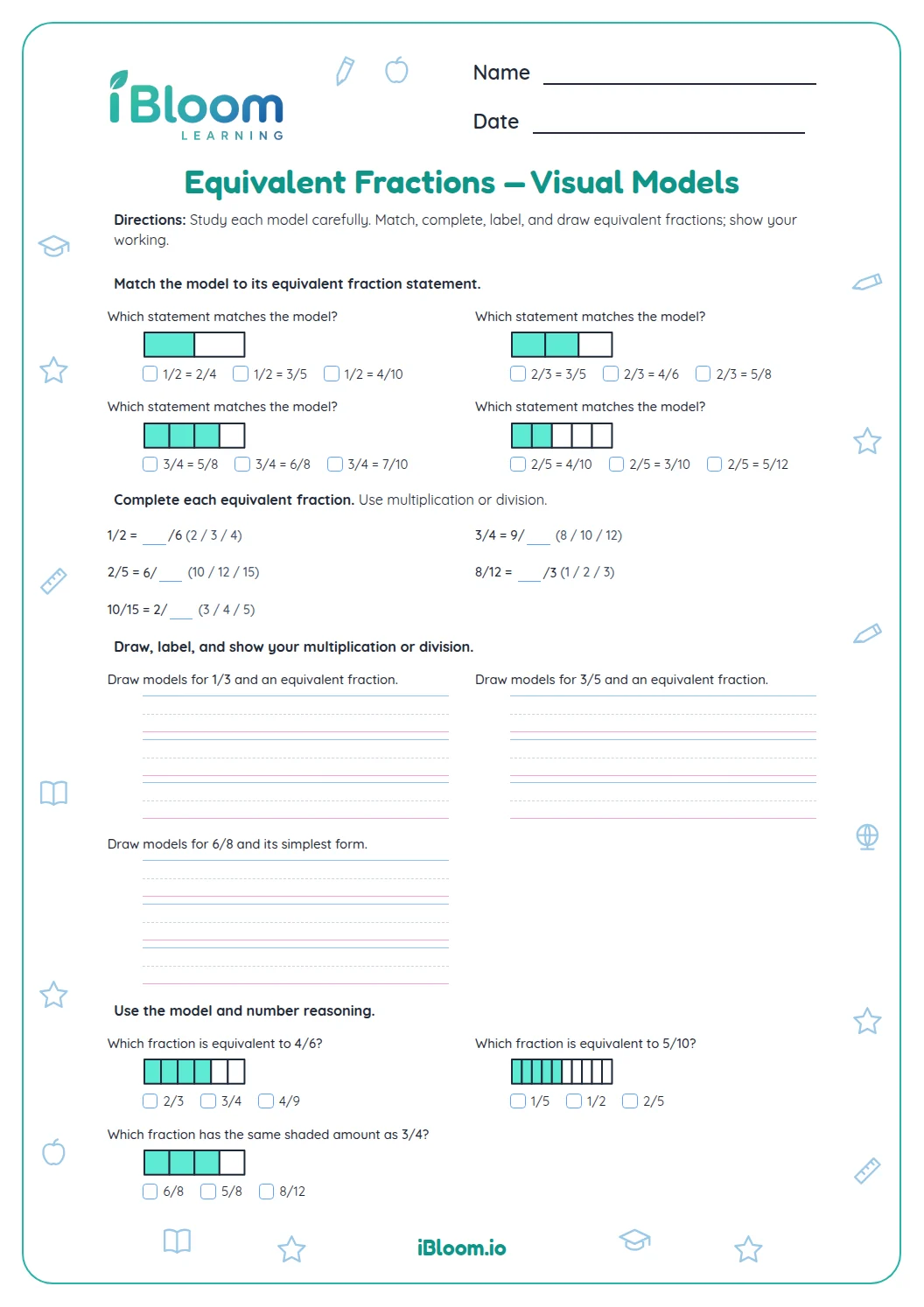
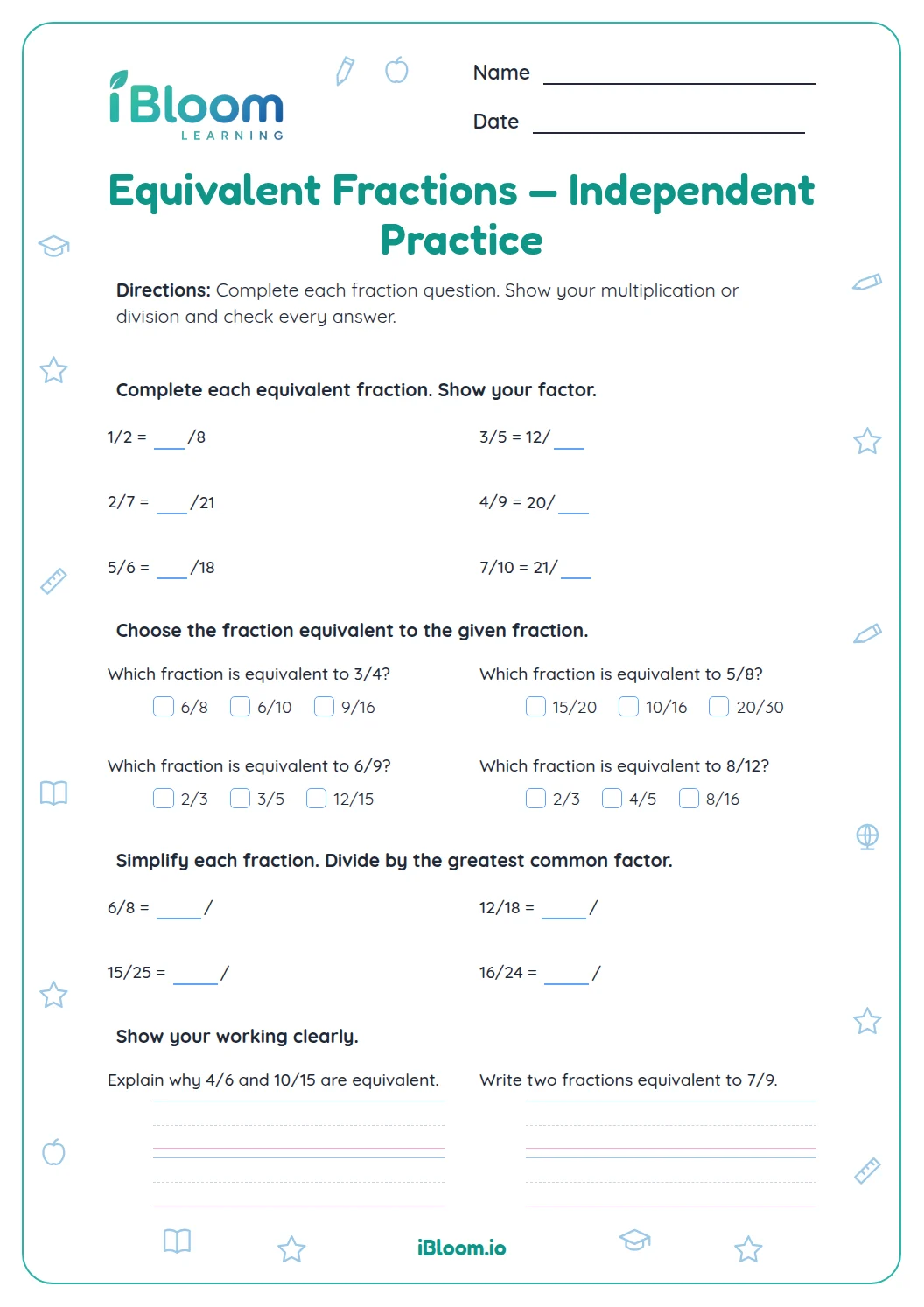
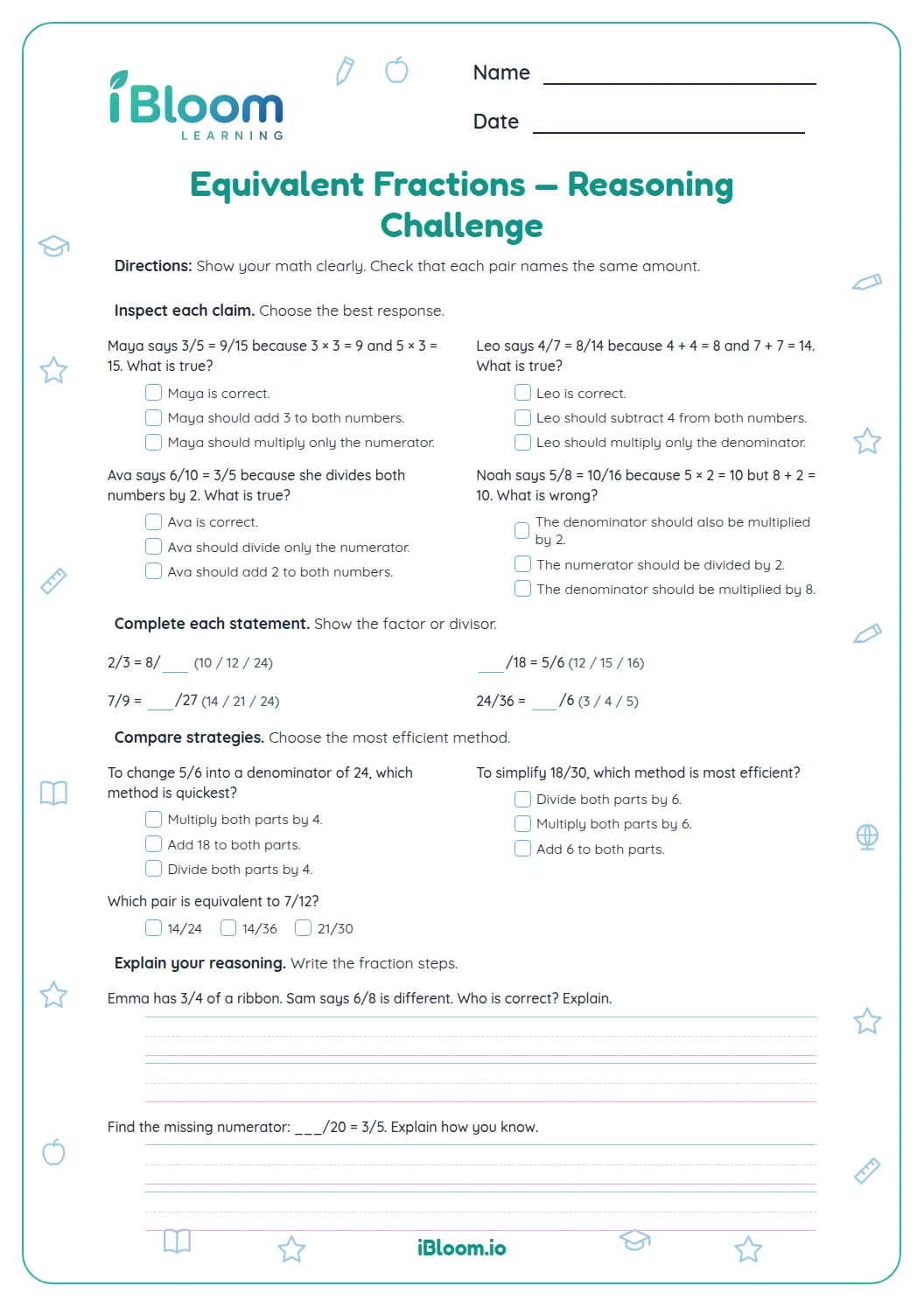
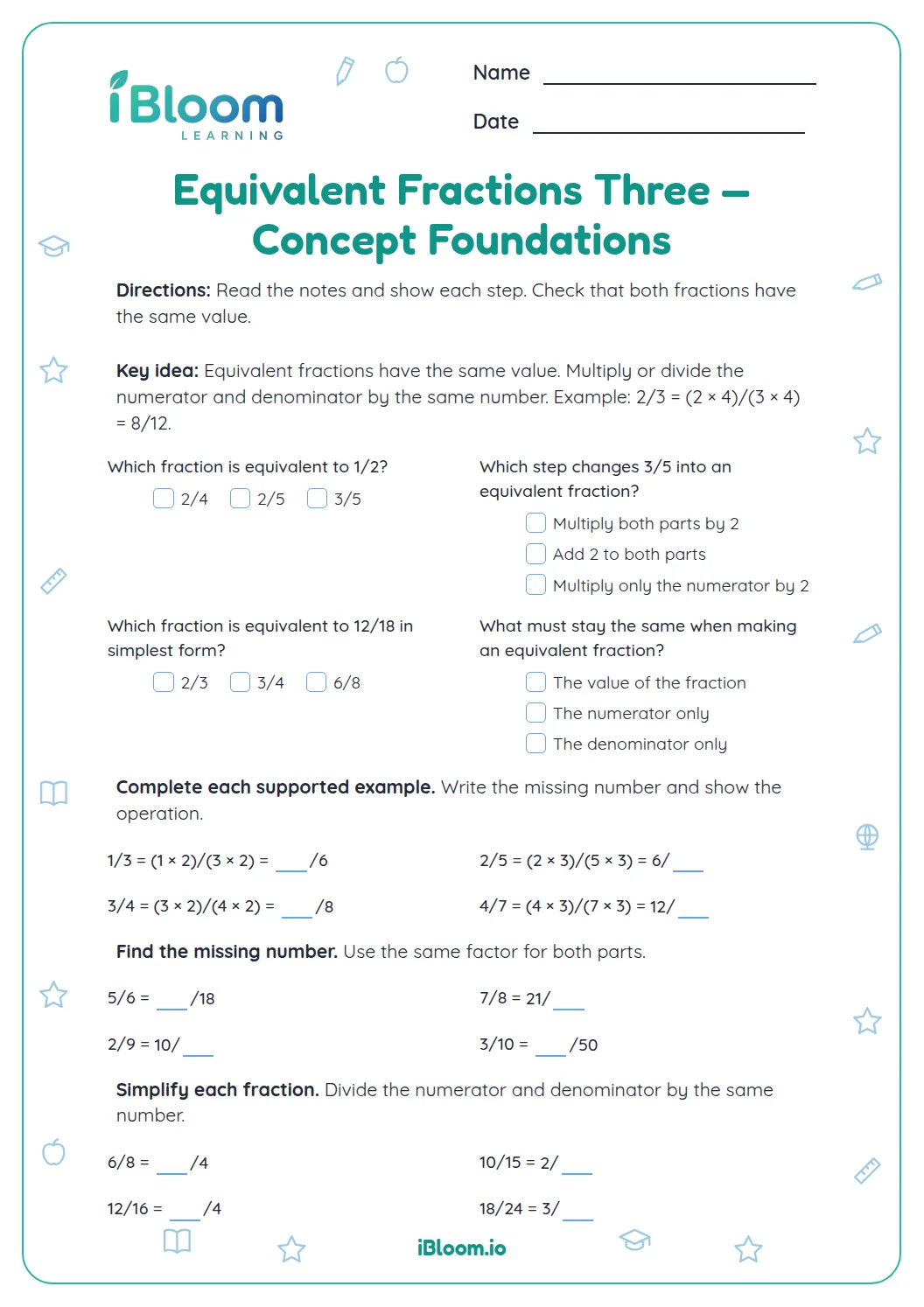
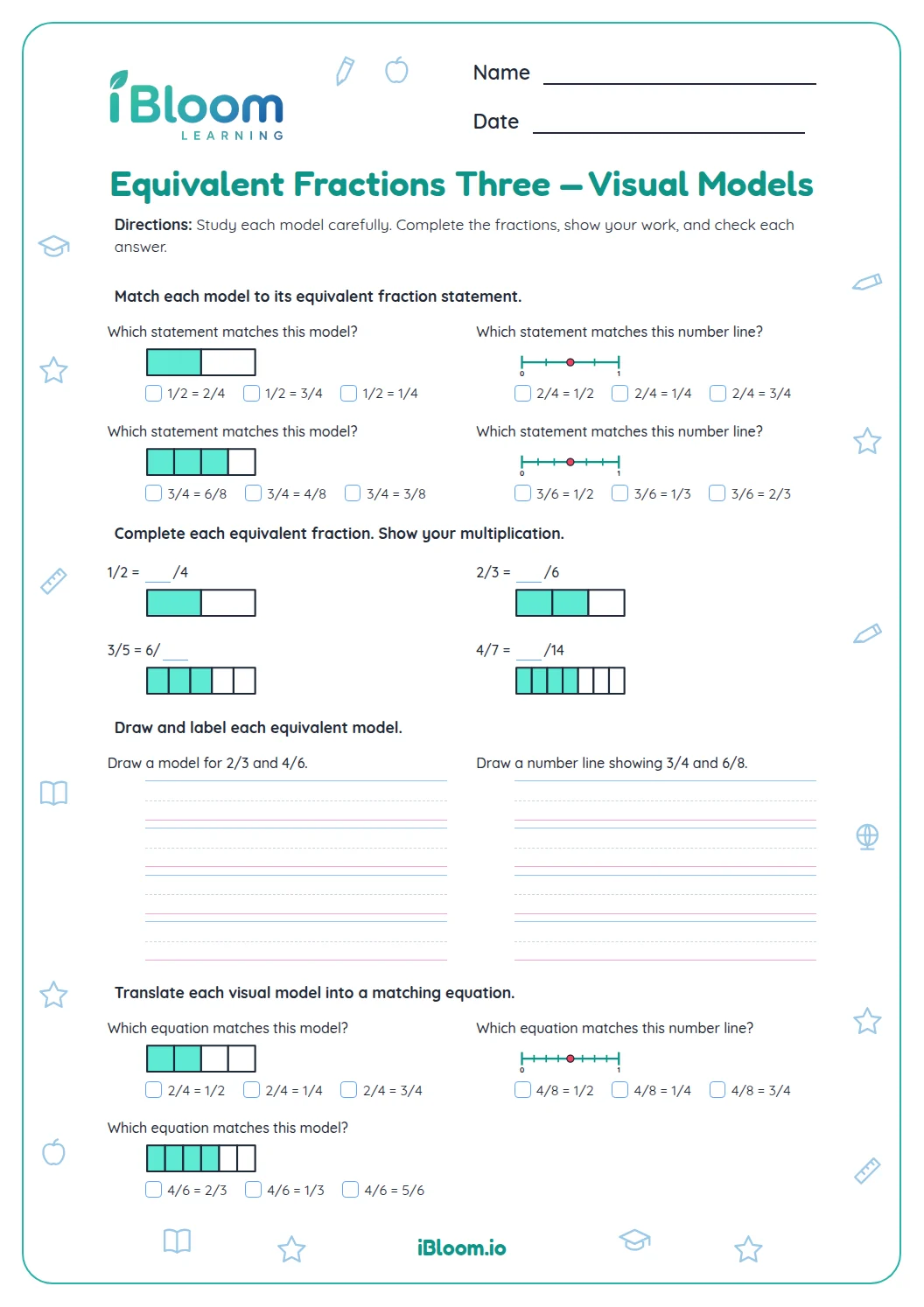
This Grade 5 printable gives 14 questions in four parts: recognize equivalent fractions, multiply or divide both parts by the same factor, apply the rule to measurement contexts, and explain or correct two claims. The sequence moves from selecting equal fractions to completing and justifying equivalent forms. It practices Common Core 4.NF.A.1. A separate answer key includes results and sample reasoning.
Aligned to 4.NF.A.1
How can you recognize equivalent fractions?
Equivalent fractions name the same amount even when their numerators and denominators differ. Question 1 asks which fraction equals 1/2; multiplying both parts by 2 gives 2/4.
- 11 × 2 = 2
- 22 × 2 = 4
- 31/2 = 2/4
How do you find a missing numerator or denominator?
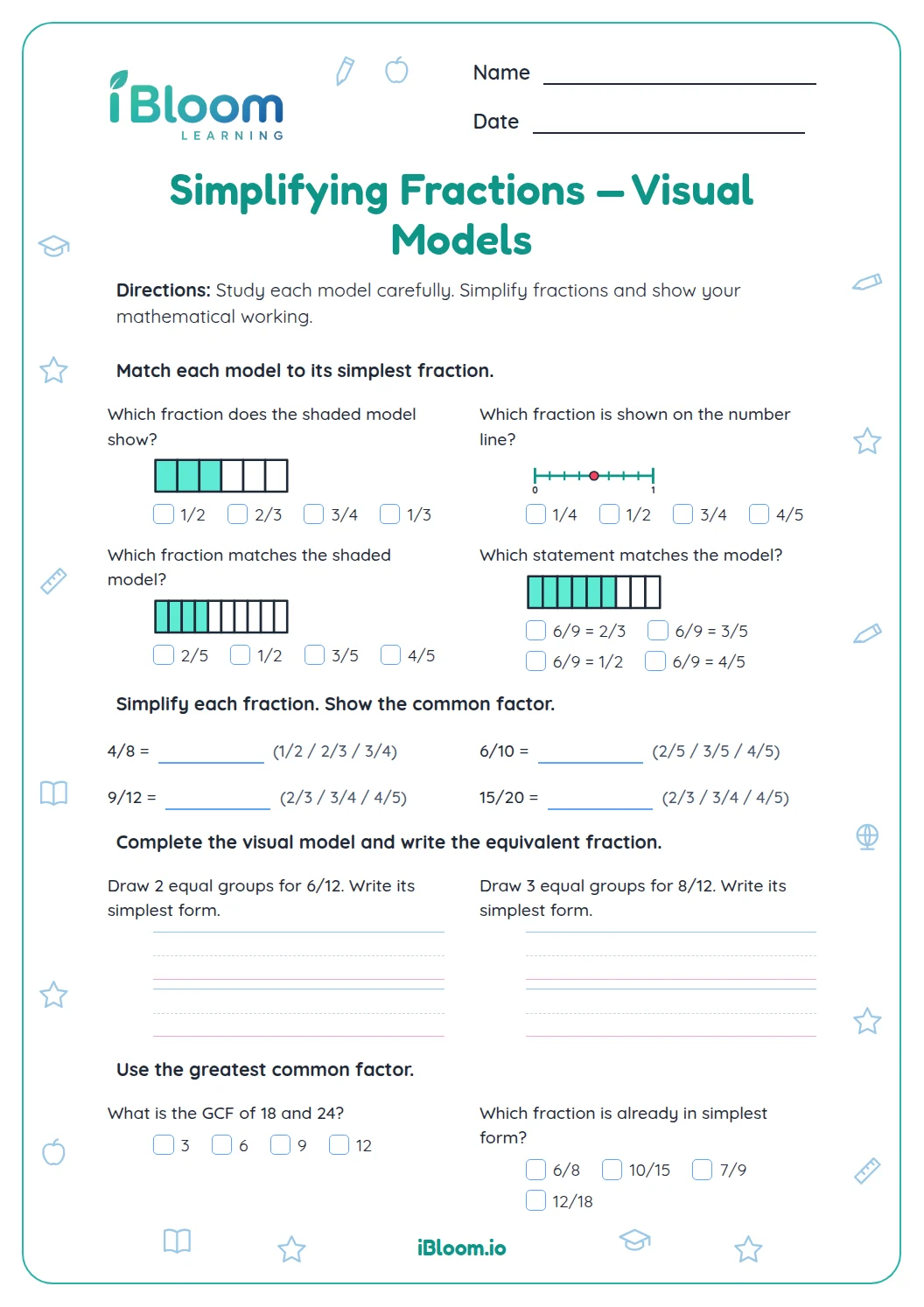
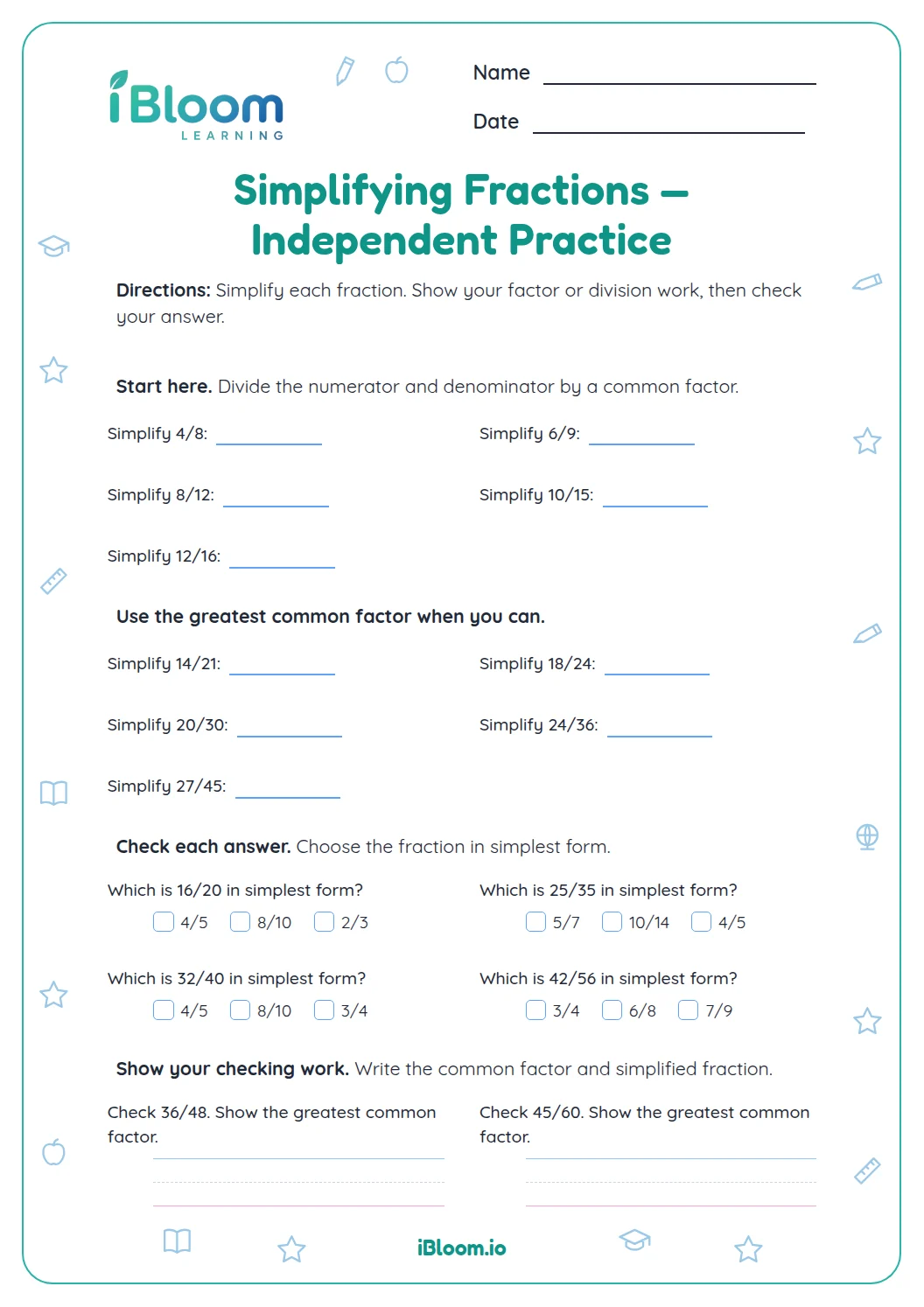
Use the same factor on top and bottom to make an equivalent fraction. You can also divide both parts by the same factor to simplify. In question 6, dividing 6 and 8 by 2 gives 3/4.
How does the same rule work in a situation?
Keep the fraction value the same when changing its name. For question 11, 3/4 yard becomes 9/12 yard because both parts are multiplied by 3.
How can you check a fraction claim?
Compare the scale factors in both parts. For question 14, 3/4 becomes 12/16 when both parts are multiplied by 4, so 12/20 is not equivalent.
How to use this worksheet
- 1Compare the known numerators or denominators to find a factor.
- 2Apply the same factor to the other part of the fraction.
- 3To simplify, divide both parts by the same factor.
- 4Keep units and values unchanged in context questions.
- 5Check a claim by comparing the factors or simplifying both fractions.
Common mistakes and quick fixes
The mistake
Changing only the denominator.
The fix
Use one factor on both the numerator and denominator.
The mistake
Adding the same number to top and bottom.
The fix
Equivalent fractions come from multiplying or dividing both parts by a common factor.
The mistake
Stopping at the scale factor.
The fix
After finding the factor, multiply the other numerator or denominator too.
Common Core alignment
This worksheet gives children focused practice with the listed skill.
Explain and generate equivalent fractions by scaling both parts.
On this sheet: The questions recognize and generate equivalent fractions by multiplying both parts by equal factors.
Show the official wordingHide the official wording
Explain why a fraction a/b is equivalent to a fraction ( n × a )/( n × b ) by using visual fraction models, with attention to how the number and size of the parts differ even though the two fractions themselves are the same size. Use this principle to recognize and generate equivalent fractions.
What to practice next
Make more practice
Further reading
Questions parents and teachers ask
What does this equivalent fractions worksheet practice?
Children answer 14 questions in four parts. They recognize equal fractions, multiply or divide both parts by one factor, use the rule in two measurement contexts, and explain or correct two fraction claims. These provide guided steps and a separate answer key.
How can a child check an equivalent fraction?
Multiply or divide the numerator and denominator by the same nonzero factor. For question 5, the denominator changes from 5 to 20, so the numerator 3 also gets multiplied by 4 to make 12. Invite the learner to say which detail, number, or clue in the prompt helped them choose, then check the result together with the key.
Is an answer key included?
Yes. The answer key is printed separately and follows the worksheet question order. It lets an adult check the selected equivalent fractions and the missing-number answers after the learner has finished. Invite the learner to say which detail, number, or clue in the prompt helped them choose, then check the result together with the key.
How long does the practice take?
Plan for about 20 minutes for these 14 questions. A learner can take extra time to show the factor used for each fraction or to explain why multiplying both parts keeps the value equal. Invite the learner to say which detail, number, or clue in the prompt helped them choose, then check the result together with the key.
What is the difference between questions 1–7 and 8–14?
Questions 1–4 ask learners to recognize equivalent fractions. Questions 5–9 use multiplication or division to complete a fraction, questions 10–12 recognize or apply the rule, and questions 13–14 ask for reasoning about claims. Learners can show their thinking in the final two responses.
What should I do if the two fractions do not seem equal?
Ask the learner to compare the scale factor in the numerator and denominator. If the same factor was not applied to both, revise the work and check whether the resulting fractions name the same amount. Invite the learner to say which detail, number, or clue in the prompt helped them choose, then check the result together with the key.