





About this worksheet
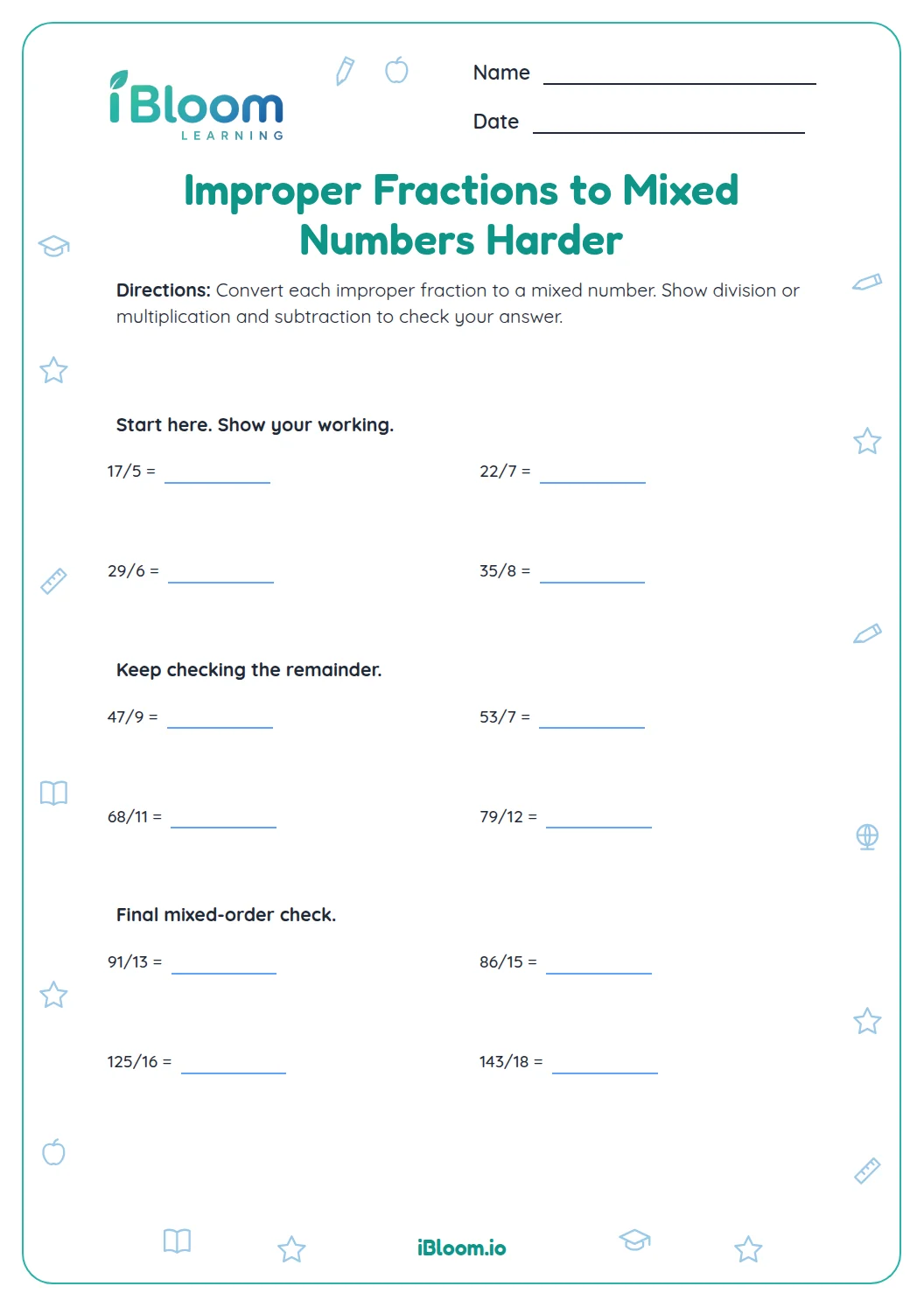
This free Grade 5 worksheet gives students independent practice converting improper fractions to mixed numbers. Part A has eight conversions, including two whole-number answers. Part B has eight conversions whose fractional parts need simplifying. Part C uses two equal-sharing situations to connect a fraction with division, practicing Common Core 5.NF.B.3. Students divide, record each answer in simplest form, and check that it equals the starting fraction. All eighteen questions have fixed answers on the separate key, including units for the two word problems.
Aligned to 5.NF.B.3
Where do the whole number and fraction come from?
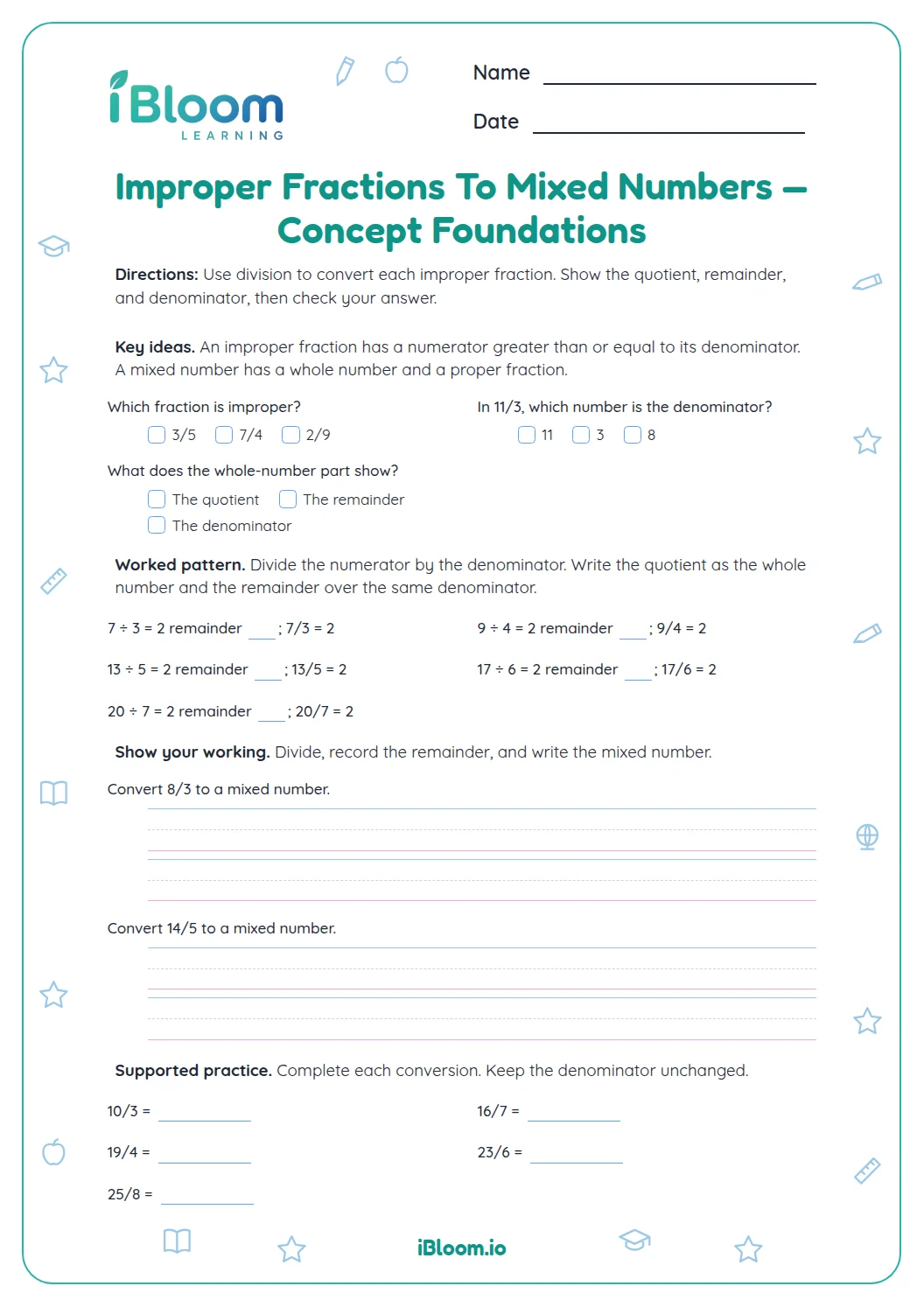
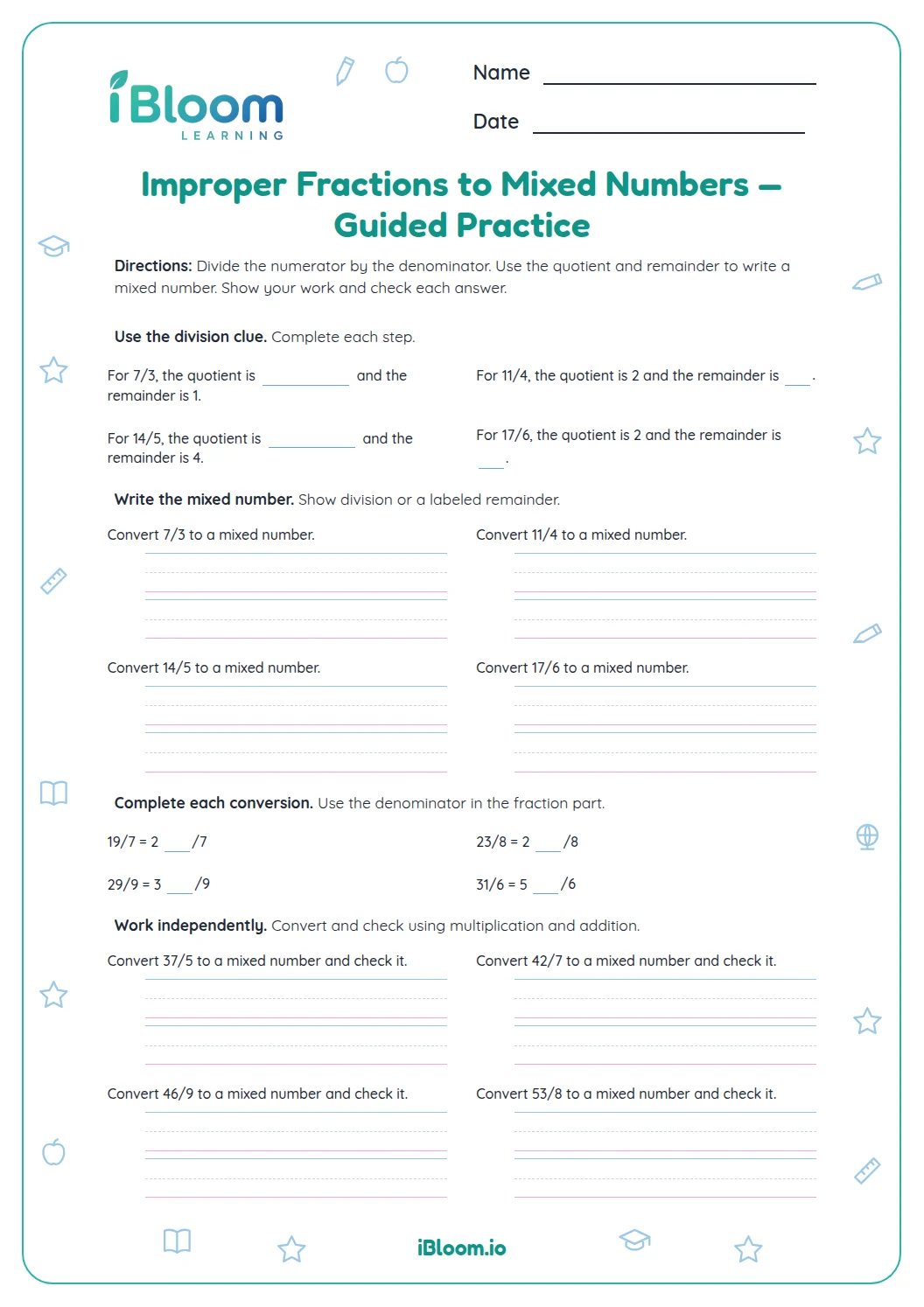
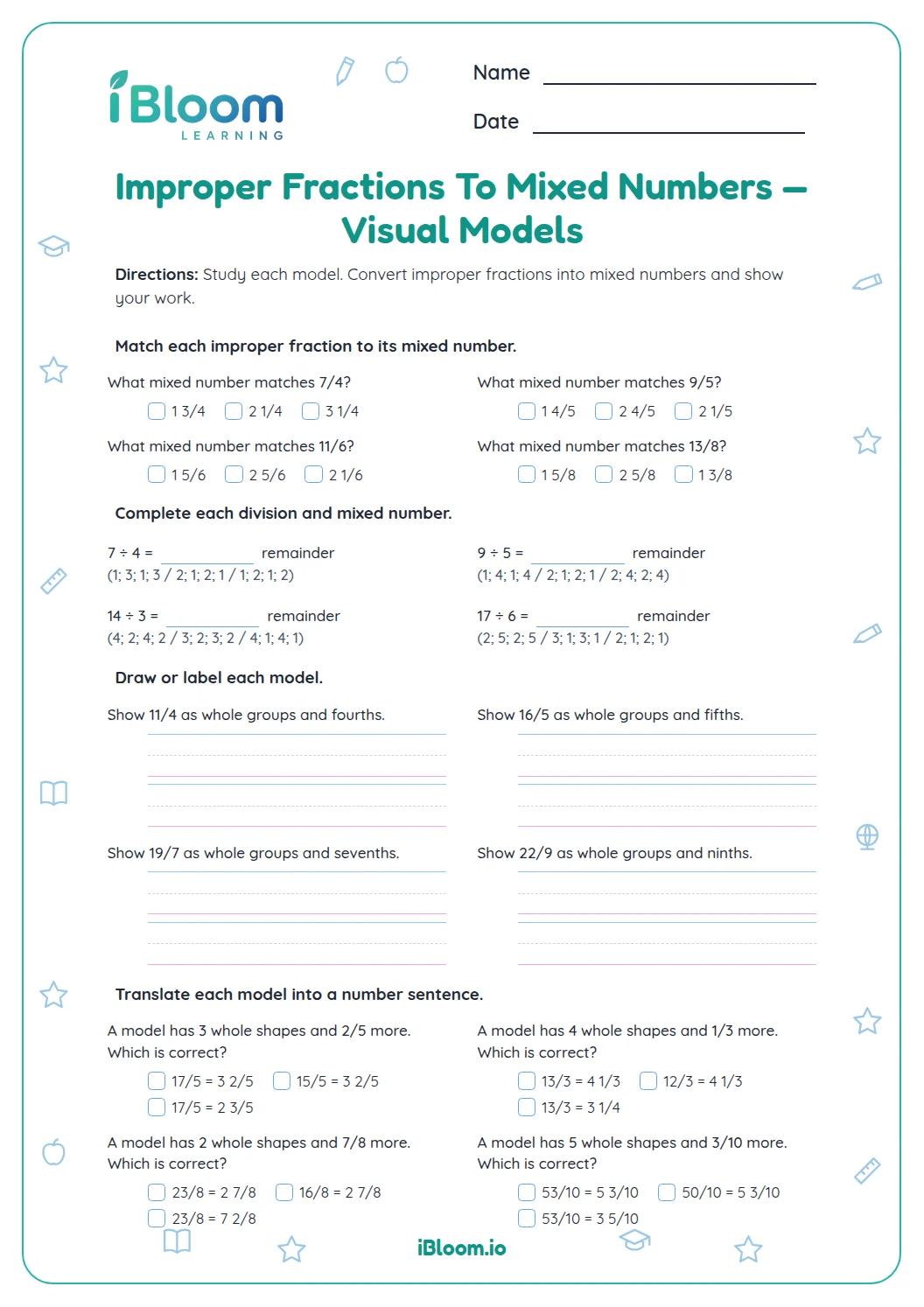
Each full group of denominator-sized parts makes one whole. For 17/5, there are three groups of five fifths with two fifths left over, so 17/5 = 3 2/5. The division quotient counts the wholes, and the remainder counts the remaining parts.
Keep the denominator when first writing the remainder as a fraction. It still tells the size of each piece. The remainder must be smaller than the denominator because another full group would make another whole.
If the division has no remainder, write only the whole number. For question 7, 24 ÷ 4 = 6 exactly, so 24/4 = 6. There is no fractional part to include.
When should students simplify the fractional part?
After dividing, look for a common factor in the remainder and denominator. Divide both by the same factor, keeping the whole-number part unchanged. Part B gives eight opportunities to complete this extra step.
- 122 ÷ 8 = 2 remainder 6
- 222/8 = 2 6/8
- 36/8 = 3/4
- 422/8 = 2 3/4
- 5Check: 2 × 4 + 3 = 11, so 2 3/4 = 11/4 = 22/8.
How do the sharing problems use improper fractions?
Question 17 shares 17 yards of ribbon equally among five teams. Each share is 17 ÷ 5 yards, or 17/5 yards, which is 3 2/5 yards. The word problem makes the division meaning of a fraction visible.
Question 18 divides 22 liters of juice equally among eight containers. Each receives 22/8 liters, so the answer matches the conversion in question 9 with a unit added. Students can compare the two problems to see the same mathematics in different forms.
How to use this worksheet
- 1Review how the numerator and denominator describe equal-sized parts.
- 2Have students divide the numerator by the denominator in each Part A question.
- 3Write the quotient, then the remainder over the original denominator; omit the fraction if the remainder is zero.
- 4In Part B, simplify each fractional part by dividing its numerator and denominator by a common factor.
- 5For Part C, write the total divided by the number of equal shares and include the unit.
- 6Check answers by multiplying the whole-number part by the denominator and adding the numerator.
Mistakes to check and how to fix them
The mistake
Writing 22/8 as 2 6/22.
The fix
The parts are eighths, so the first mixed form is 2 6/8; then simplify to 2 3/4.
The mistake
Writing only the remainder fraction for 17/5.
The fix
Keep the three full groups of five: the complete answer is 3 2/5.
The mistake
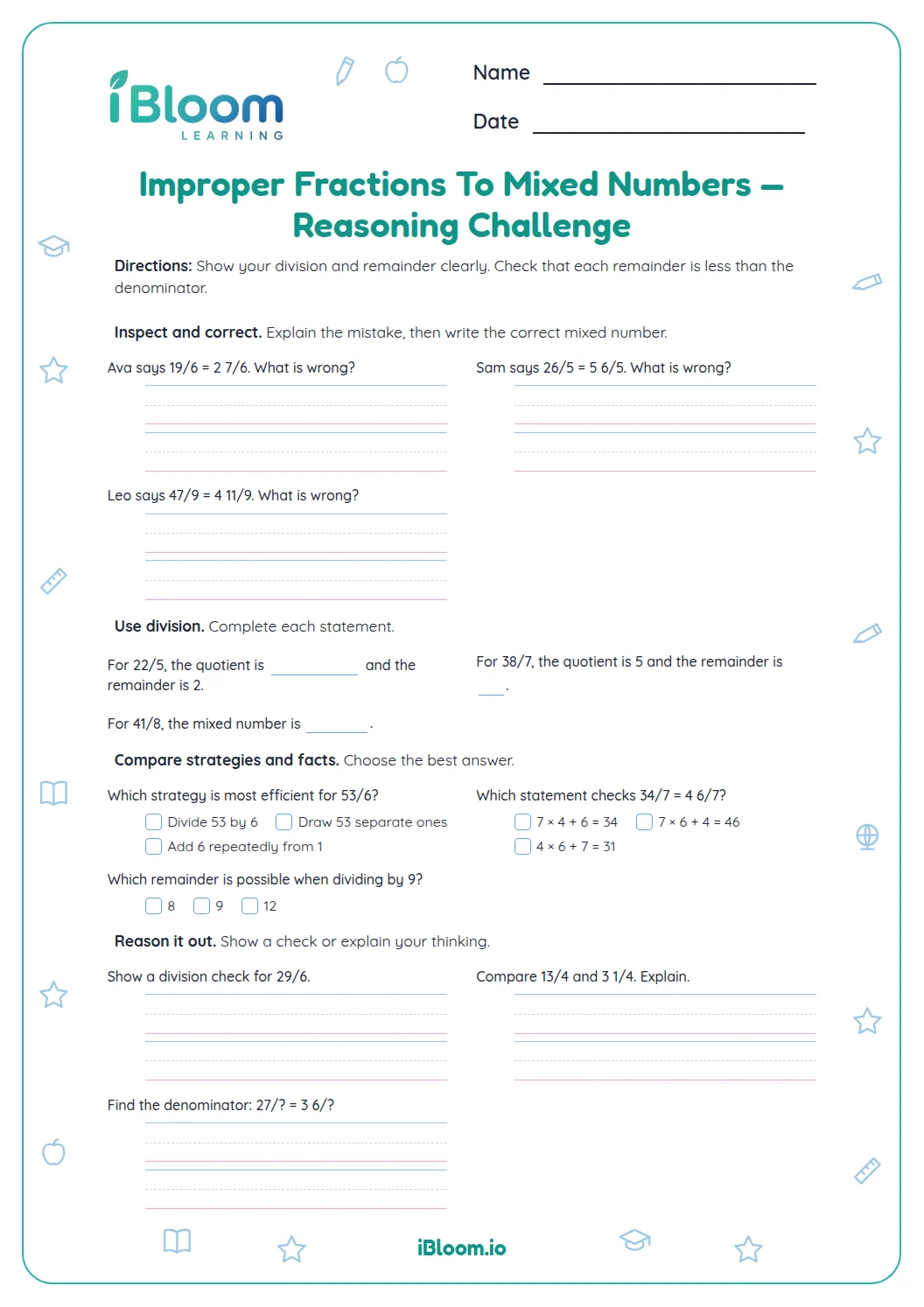
Leaving 34/12 as 2 10/12 when simplest form is requested.
The fix
Reduce 10/12 to 5/6 by dividing both numbers by 2; write 2 5/6.
Common Core alignment
Interpret improper fractions as division and write equal shares as mixed numbers.
On this sheet: Students divide numerators by denominators and solve two equal-sharing problems with mixed-number answers.
Show the official wordingHide the official wording
Interpret a fraction as division of the numerator by the denominator (a/b = a ÷ b). Solve word problems involving division of whole numbers leading to answers in the form of fractions or mixed numbers, e.g., by using visual fraction models or equations to represent the problem. For example, interpret 3/4 as the result of dividing 3 by 4, noting that 3/4 multiplied by 4 equals 3, and that when 3 wholes are shared equally among 4 people each person has a share of size 3/4. If 9 people want to share a 50-pound sack of rice equally by weight, how many pounds of rice should each person get? Between what two whole numbers does your answer lie?
What to practice next
Make more practice
Further reading
Questions parents and teachers ask
How many conversions are on this worksheet?
There are sixteen direct conversions and two equal-sharing word problems. Part A includes six mixed-number answers and two whole-number answers. Part B adds eight conversions that require simplifying the fractional part. The sharing problems then apply conversion to ribbon lengths and amounts of juice.
Why does the denominator stay the same after division?
The denominator still names the size of the fraction’s parts. In 17/5, each part is one fifth. After making three wholes from fifteen fifths, two fifths remain, so the mixed number is 3 2/5. Simplification may later change an equivalent fraction’s written denominator.
Must every answer be in simplest form?
Yes. Simplify the fractional part whenever its numerator and denominator share a factor greater than one. For example, 22/8 becomes 2 6/8, then 2 3/4. If division has no remainder, write only the whole number, as in 24/4 = 6. The key gives these final forms.
How can my child check a mixed-number answer?
Convert the mixed number back to an improper fraction and compare its value with the original. For 3 2/5, calculate 3 × 5 + 2 = 17, giving 17/5. If the fractional part was reduced, the check may produce an equivalent fraction with a smaller denominator.
What answers should students give for the sharing problems?
Each team receives 3 2/5 yards of ribbon, and each container receives 2 3/4 liters of juice. Students should show the total divided by the number of equal shares before converting. The answer key includes the measurement unit so families can check both the number and its meaning.