



About this worksheet
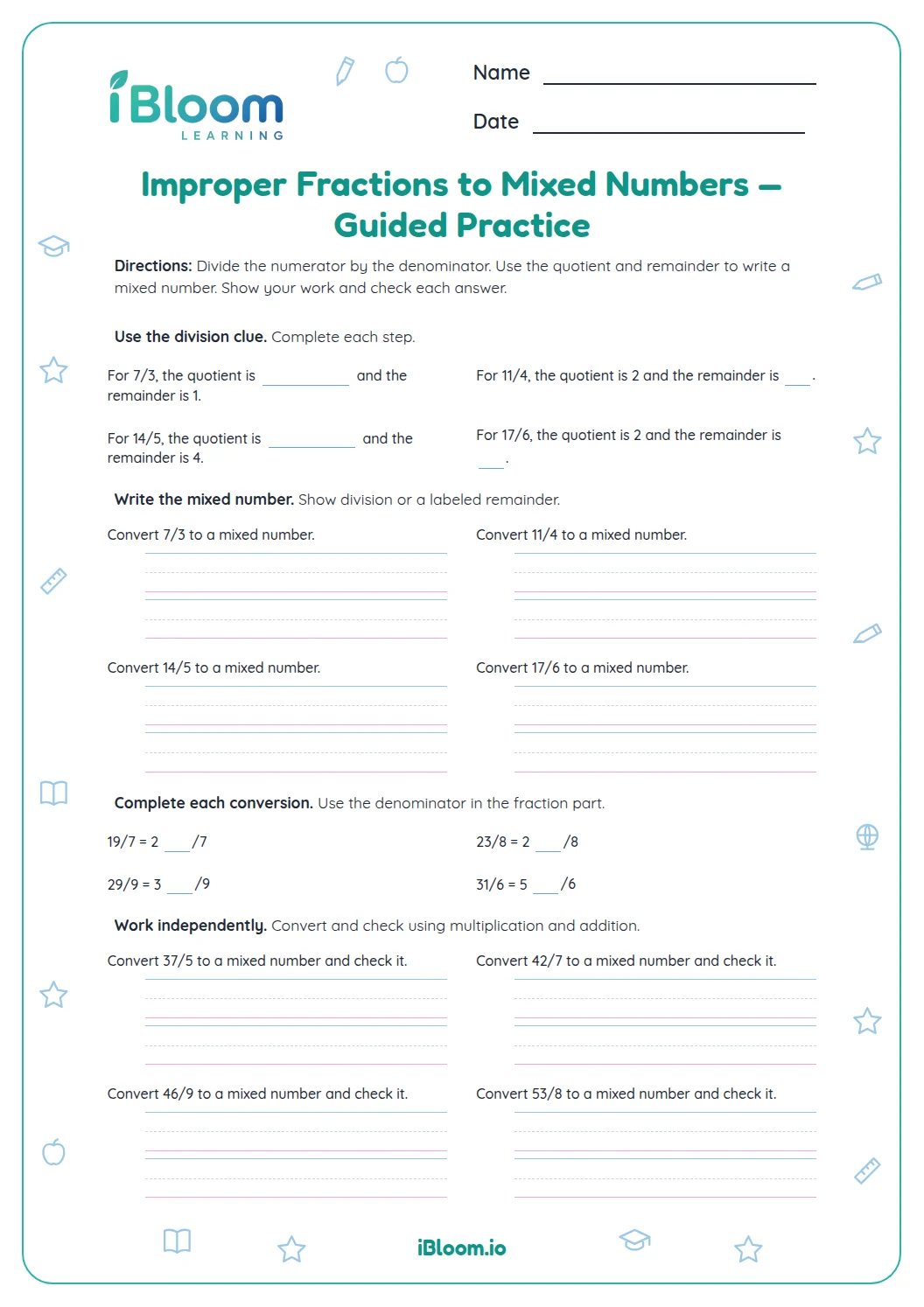
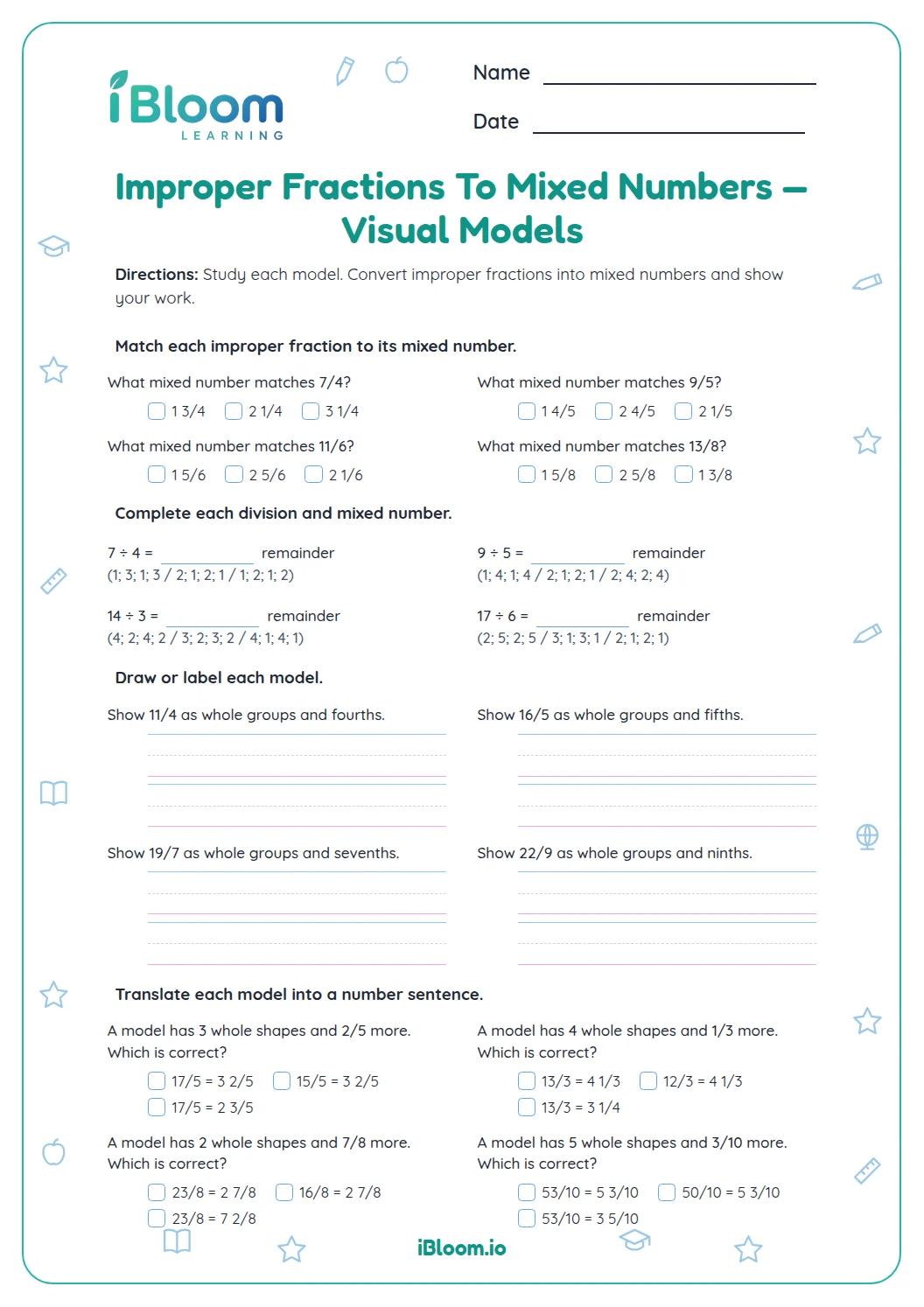
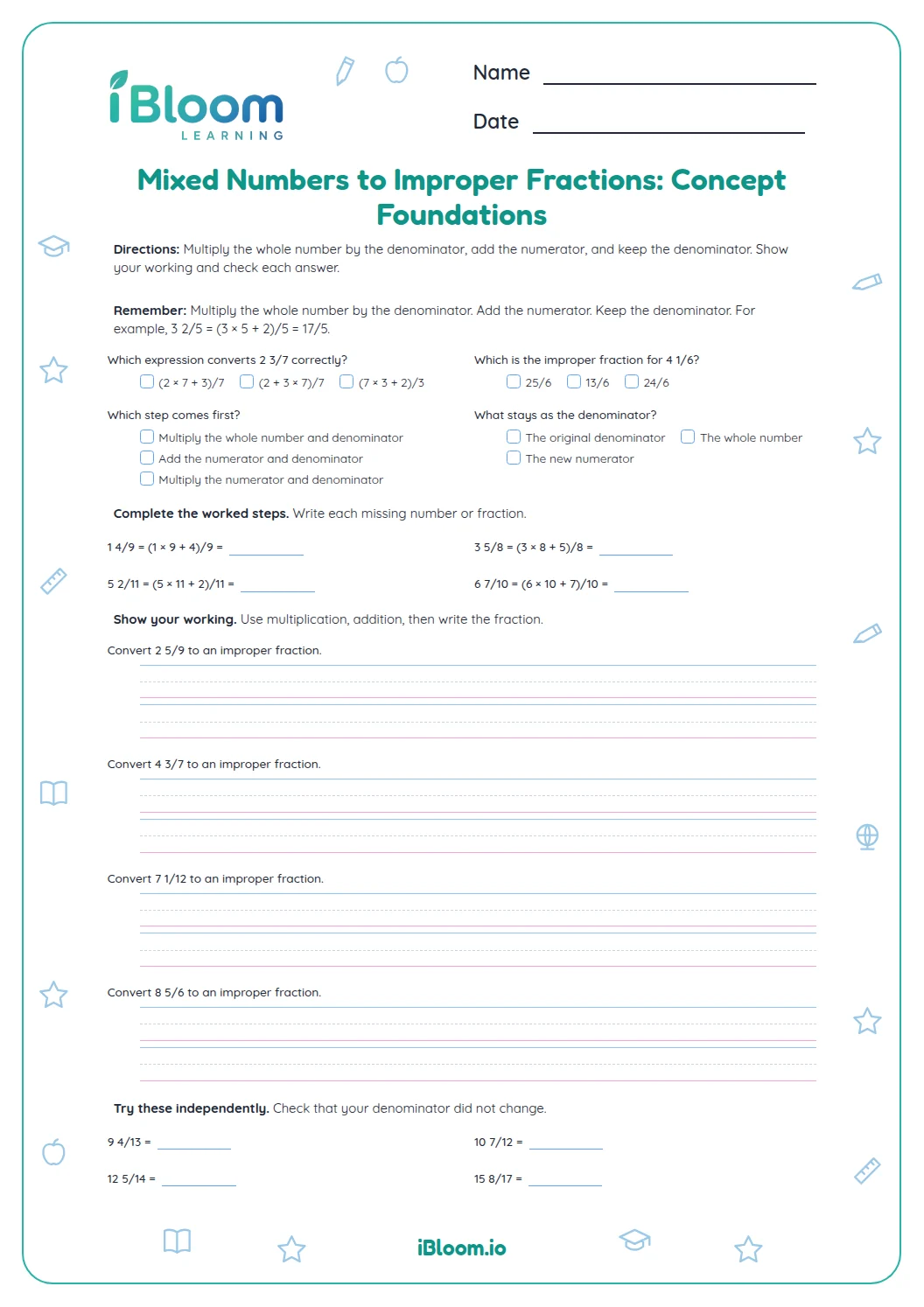
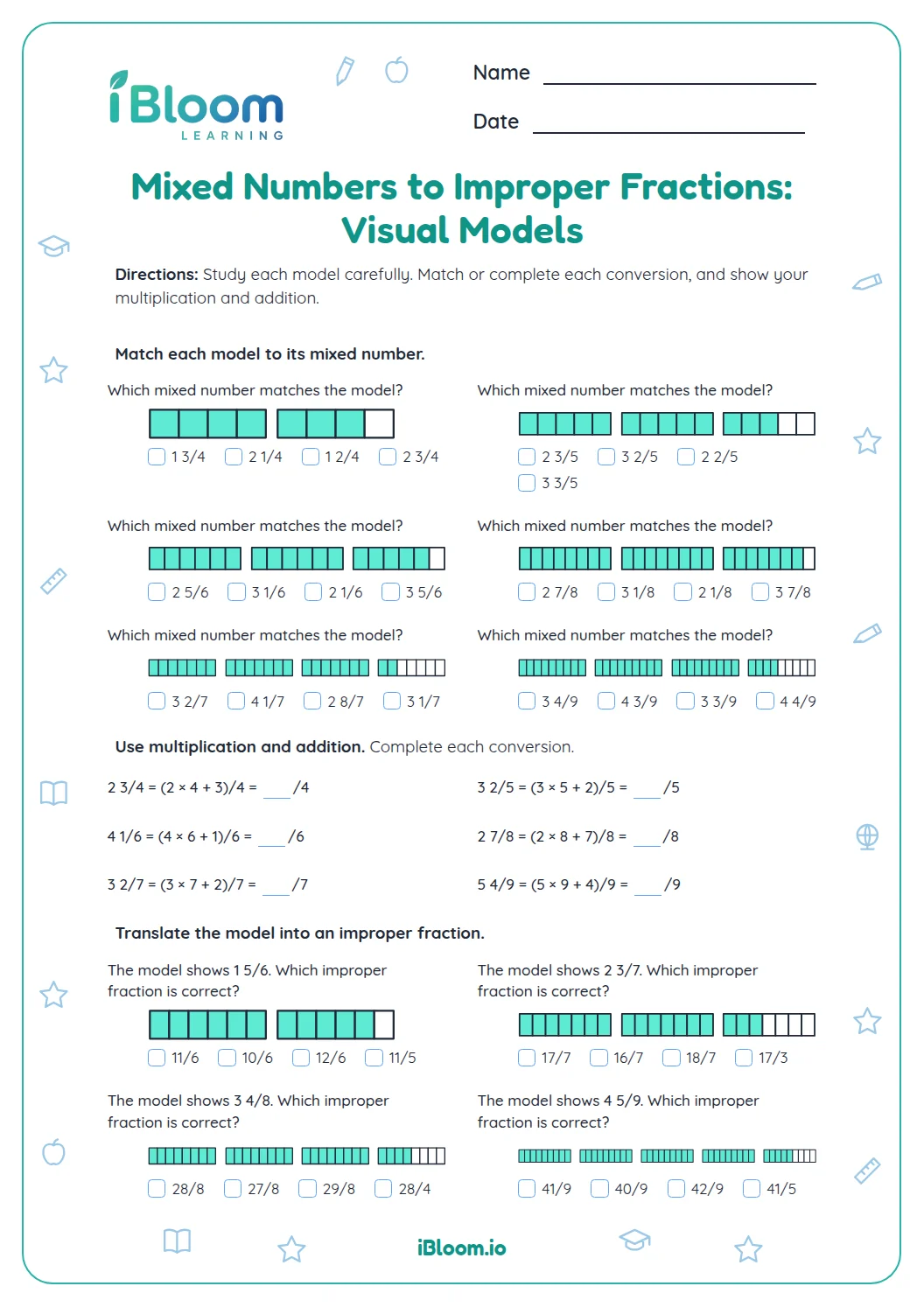
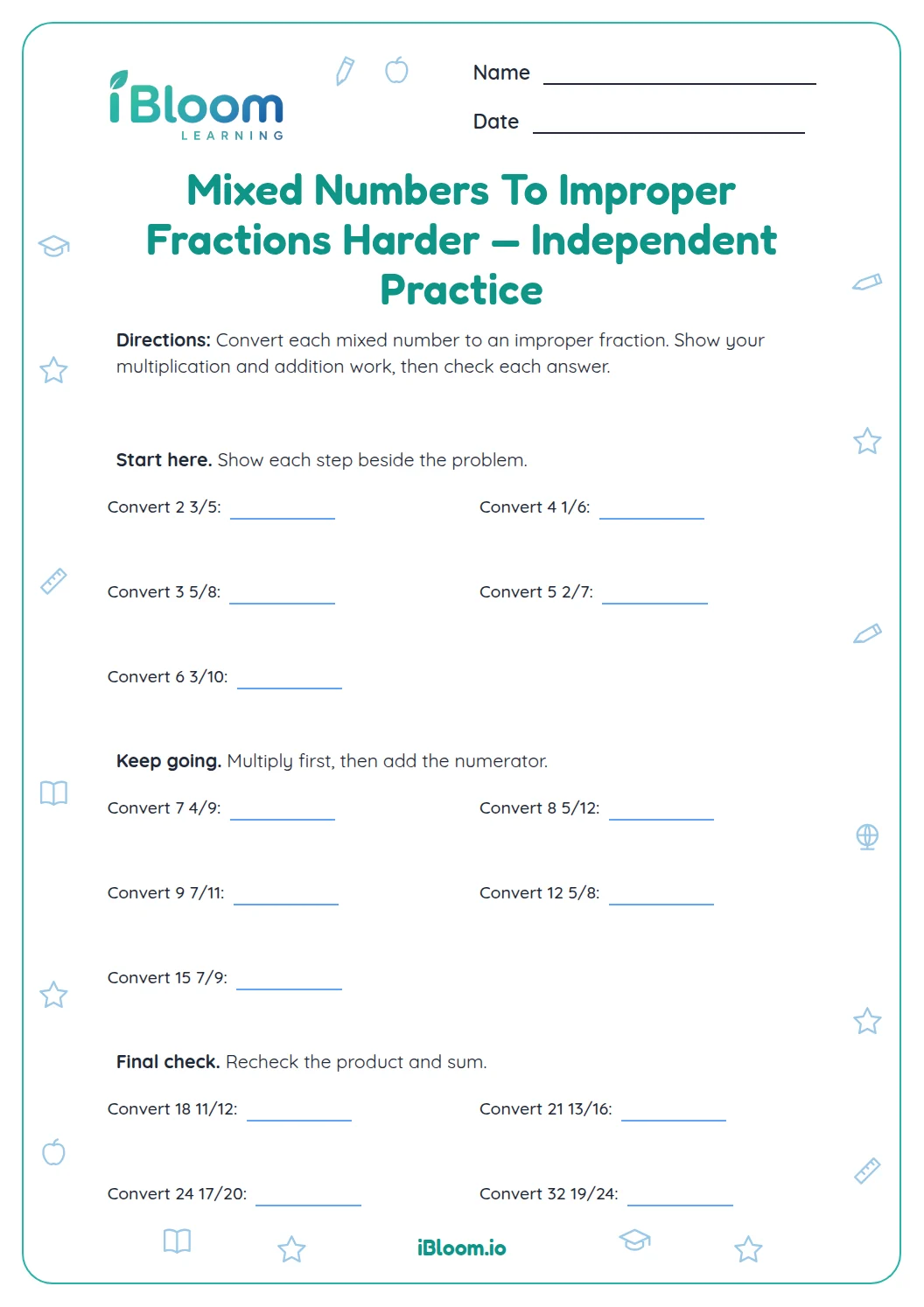
This Grade 5 worksheet gives students 14 opportunities to express mixed numbers as improper fractions. Ten questions use shaded fraction models to count equal parts; the remaining questions practice the conversion rule and use it with familiar measures. Denominators stay visible so students can see that the size of each part does not change when the whole number is converted.
How do the shaded parts become a fraction?
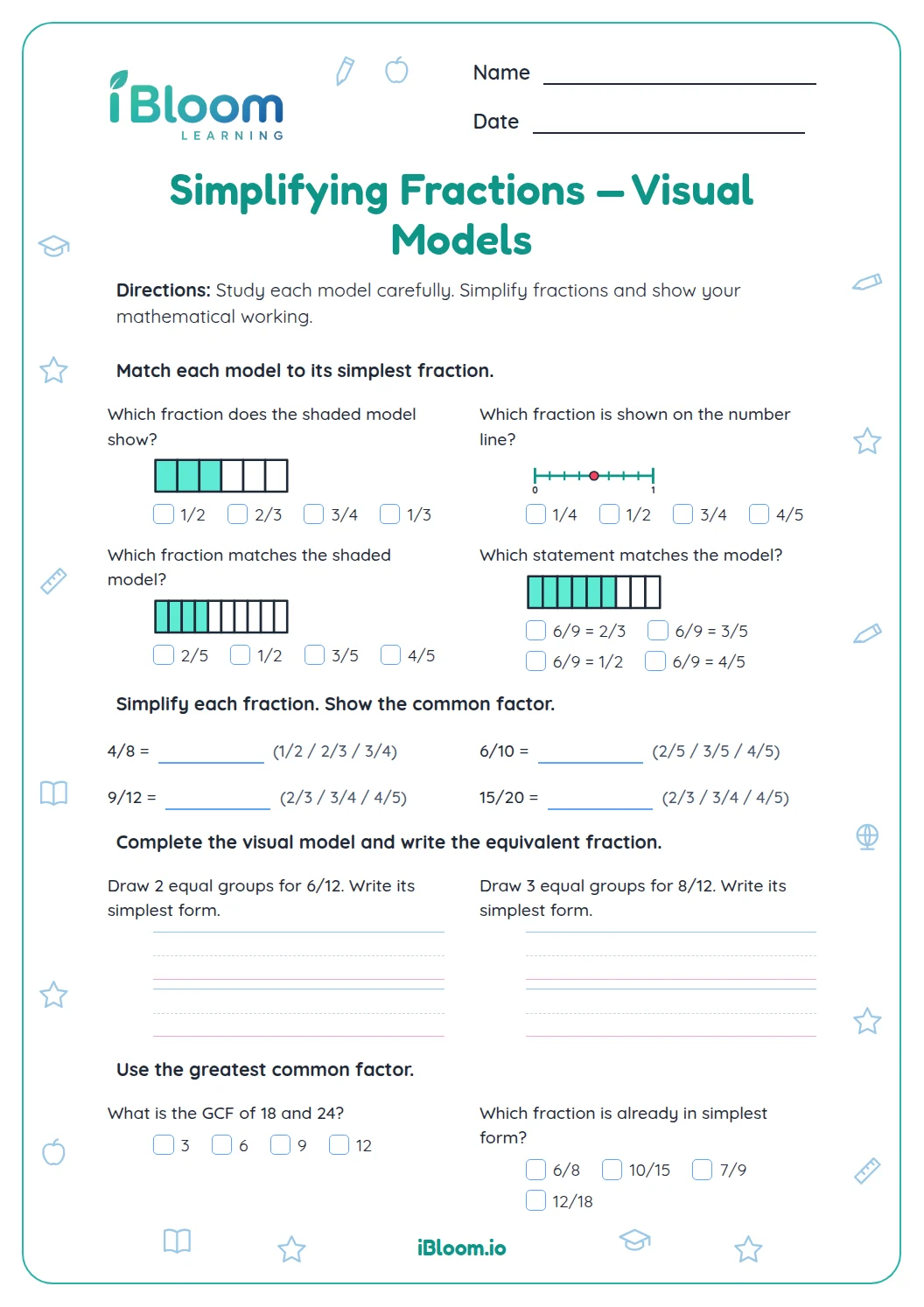
Count every equal part across the full shapes, including the parts in each whole. Two wholes split into thirds contain six thirds; one more third makes seven thirds, or 7/3.
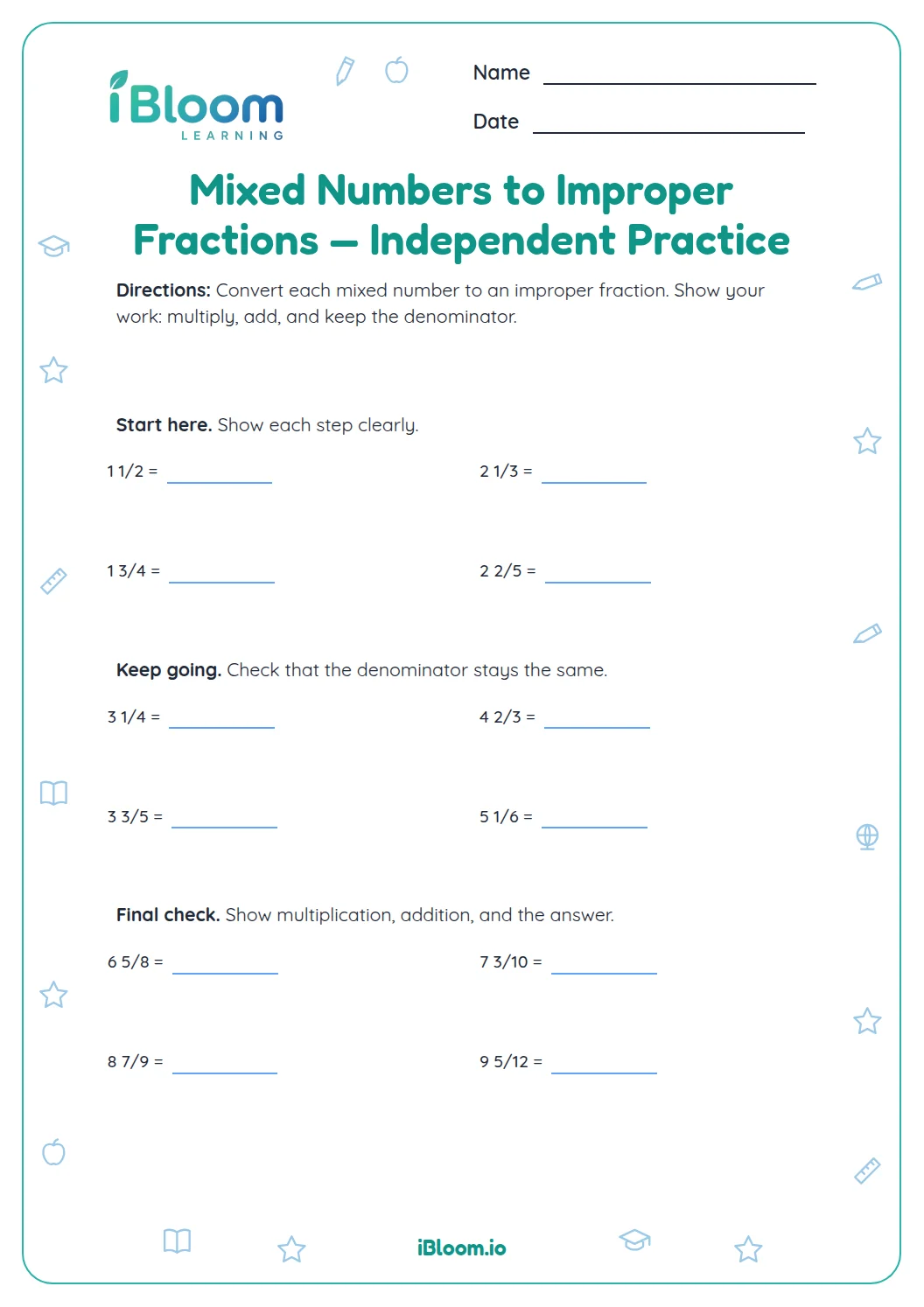
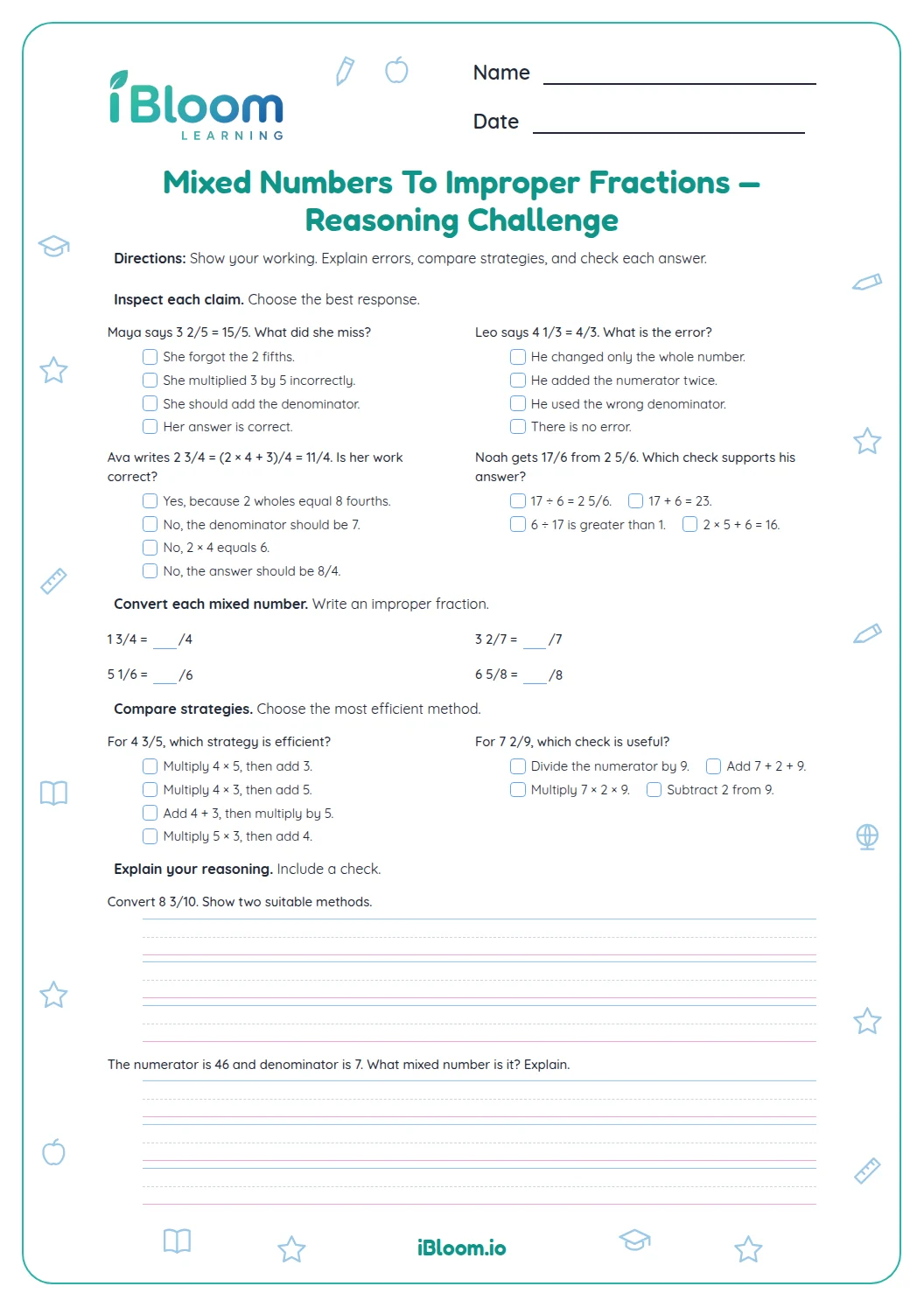
For any mixed number, multiply the whole number by the denominator and add the numerator. Keep the denominator because each part keeps the same size.
- Part A: read shaded fraction models
- Part B: convert mixed numbers
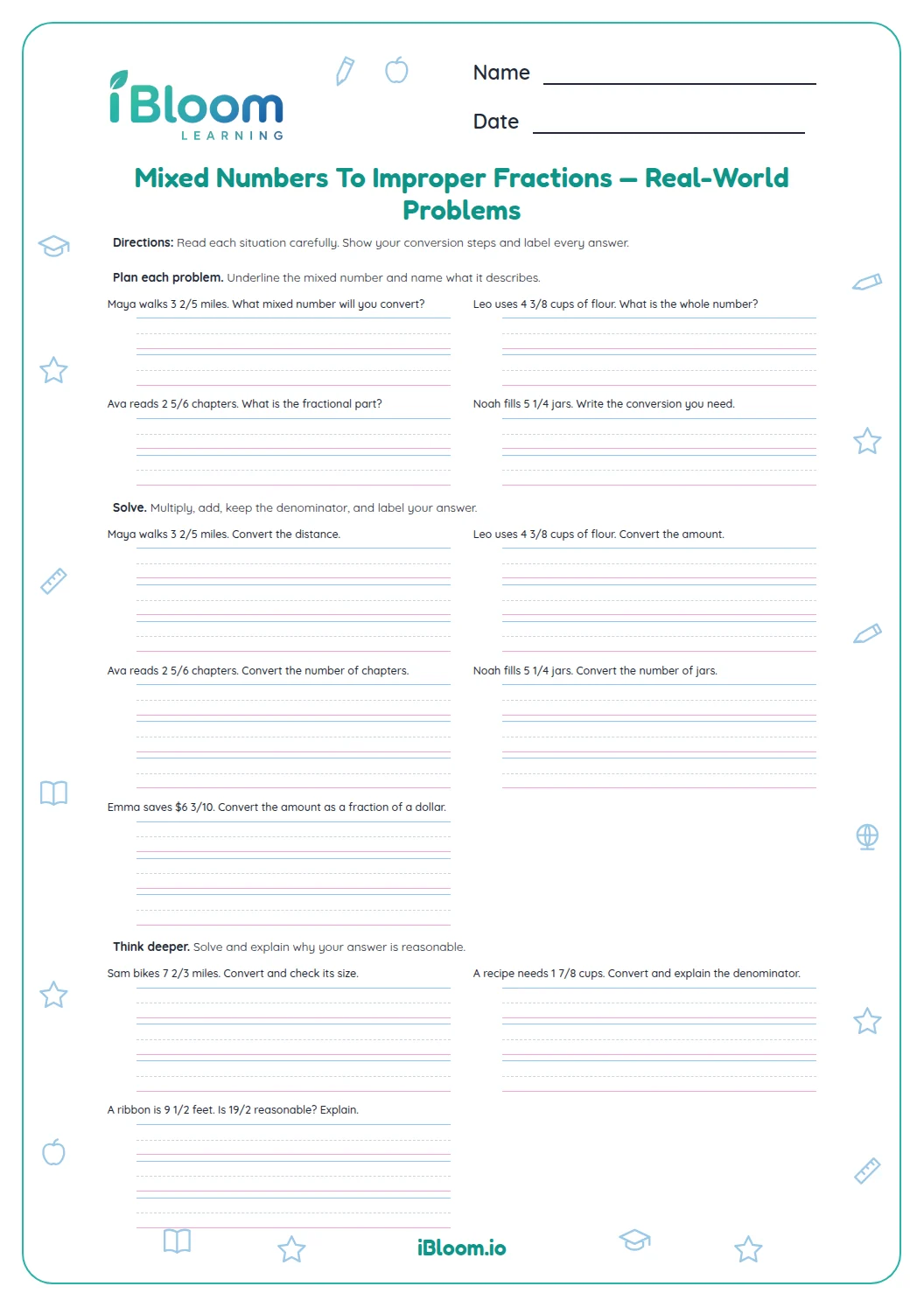
- Part C: use the conversion with measures
How to use this worksheet
- 1Read the direction at the start of each part before answering.
- 2Work through the questions in order and write each missing value clearly.
- 3Use the answer key to discuss any item that needs another try.
Common mistakes and quick fixes
The mistake
Guessing from one word instead of checking how the sentence or number pattern works.
The fix
Read the whole prompt and test the answer in context.
The mistake
Skipping a check after filling a blank.
The fix
Substitute the answer or continue the pattern to verify it.
What to practice next
Make more practice
Further reading
Questions parents and teachers ask
How many visual models are on the worksheet?
Three questions show shaded fraction models. Students count the equal parts across complete wholes and partial wholes, then write the total as an improper fraction. The remaining questions practice the same conversion with number sentences and measures, building from models to the conversion rule.
What is the conversion rule?
Multiply the whole number by the denominator, add the numerator, and keep the same denominator. For example, 2 3/4 becomes (2 × 4 + 3)/4, or 11/4. The model shows why the numerator counts all the equal parts. Read each prompt carefully, write one response in every blank, and use the included key after attempting the problem independently.
What does an improper fraction mean?
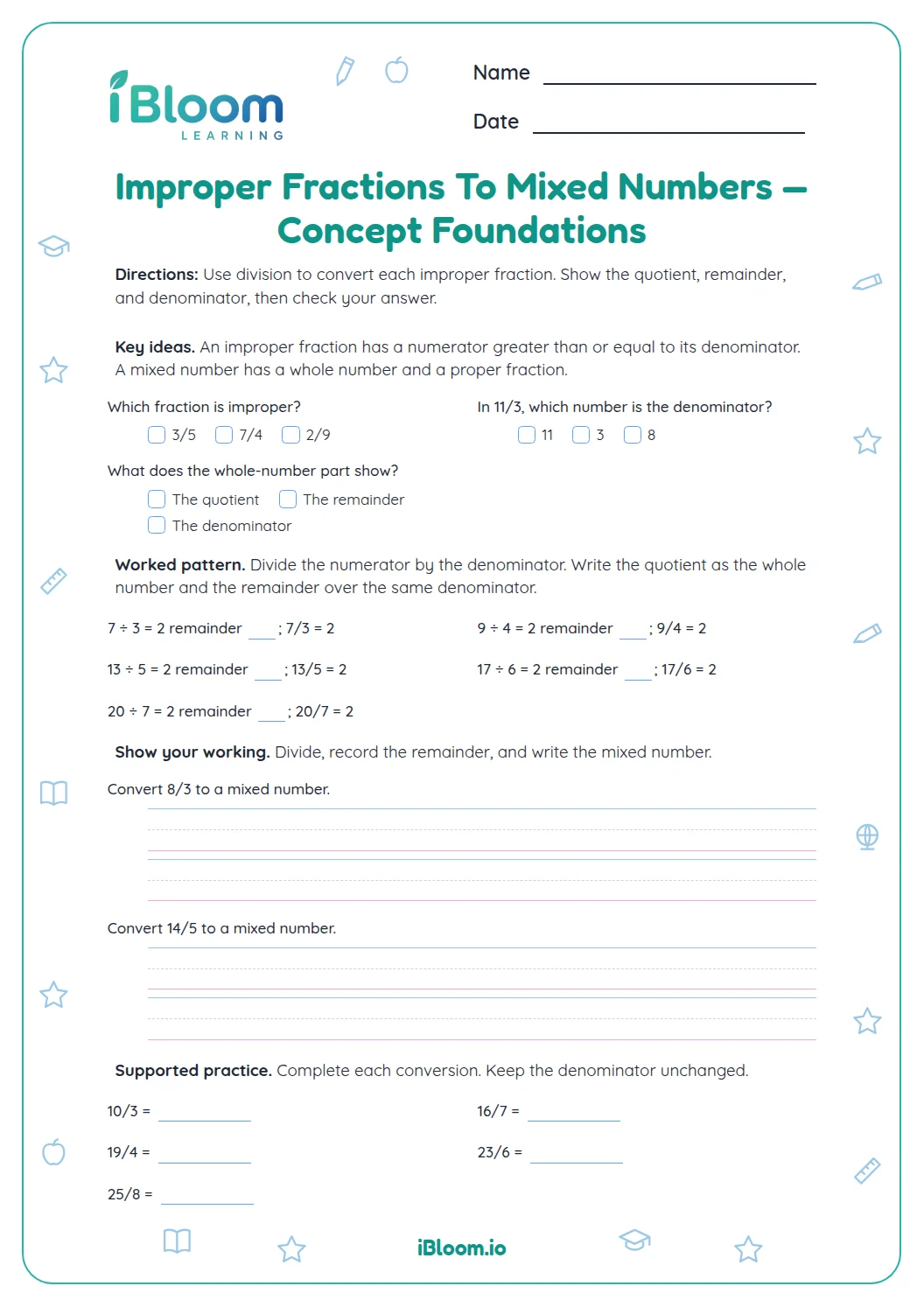
An improper fraction has a numerator greater than or equal to its denominator. It can describe one or more whole units made from equal fractional parts. This sheet asks students to express mixed-number amounts in that form. Read each prompt carefully, write one response in every blank, and use the included key after attempting the problem independently.
Can a student use the models to check an answer?
Yes. Count the shaded parts in every fully shaded bar, then add the shaded parts in the final partial bar. The total is the numerator; the number of equal parts in one whole remains the denominator. Read each prompt carefully, write one response in every blank, and use the included key after attempting the problem independently.
How should the answer key be used?
Students can complete one part before checking the separate key. When an answer differs, compare the total shaded parts with the numerator and confirm that the denominator matches the number of equal parts in each whole. Read each prompt carefully, write one response in every blank, and use the included key after attempting the problem independently.