



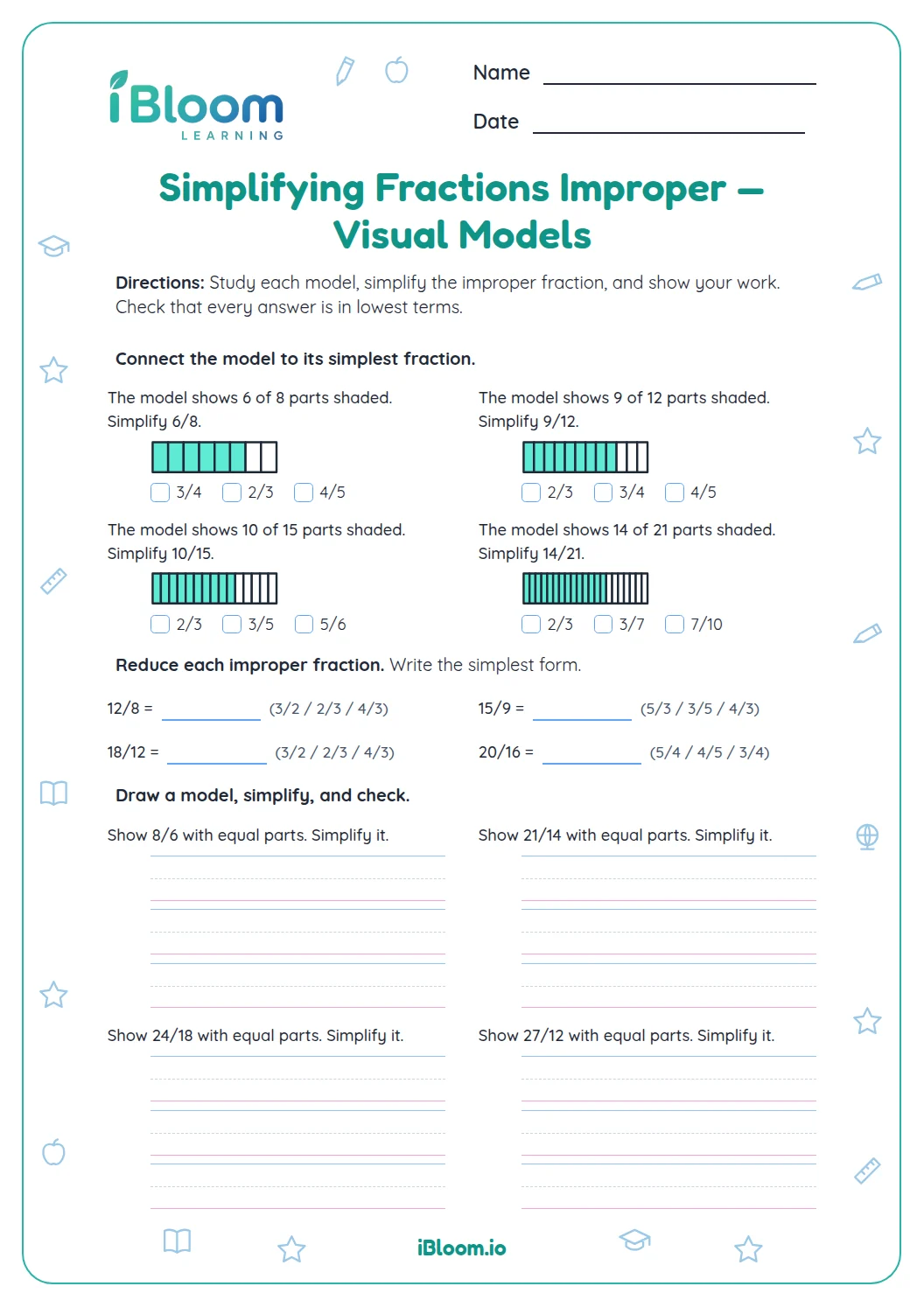
About this worksheet
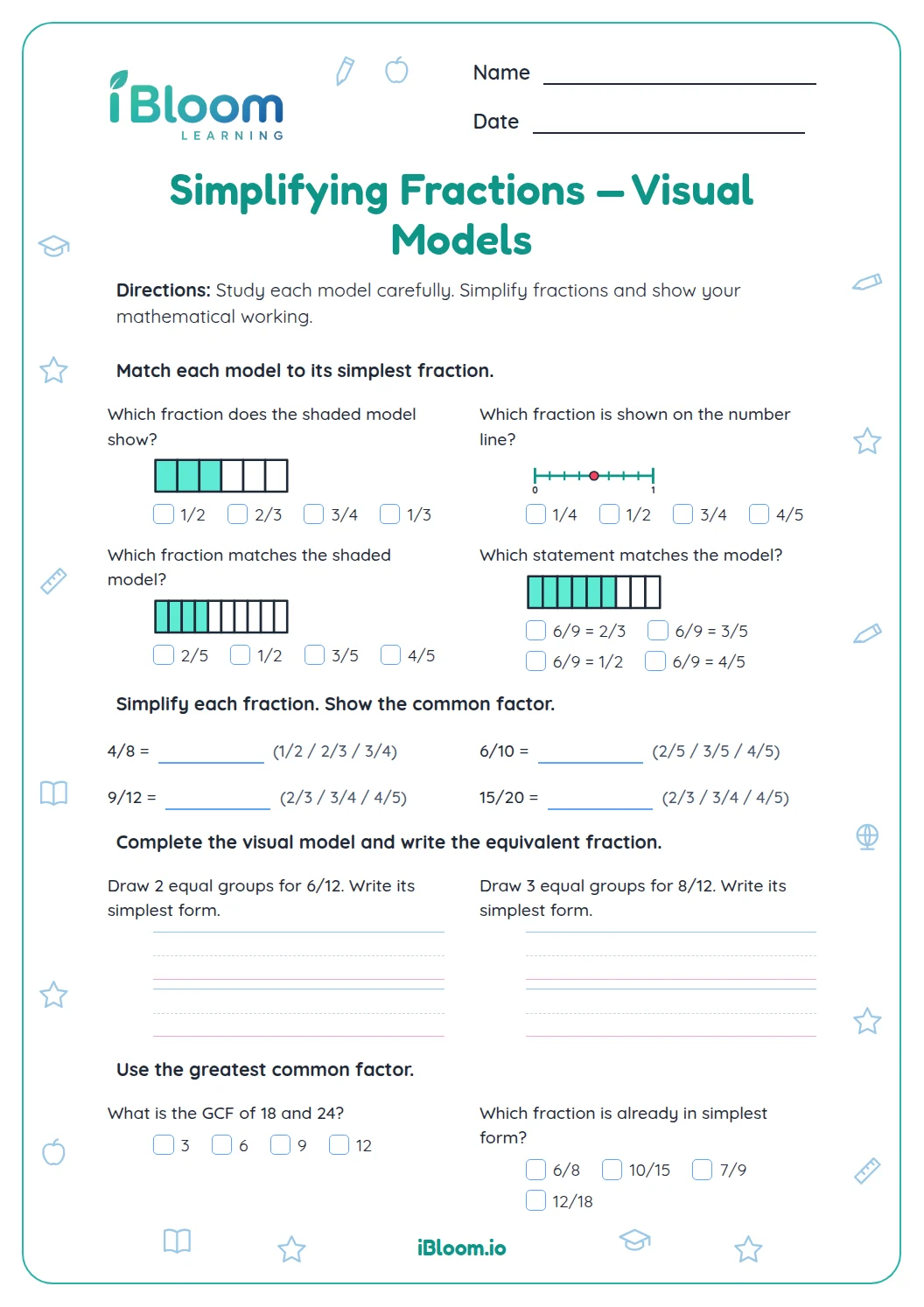
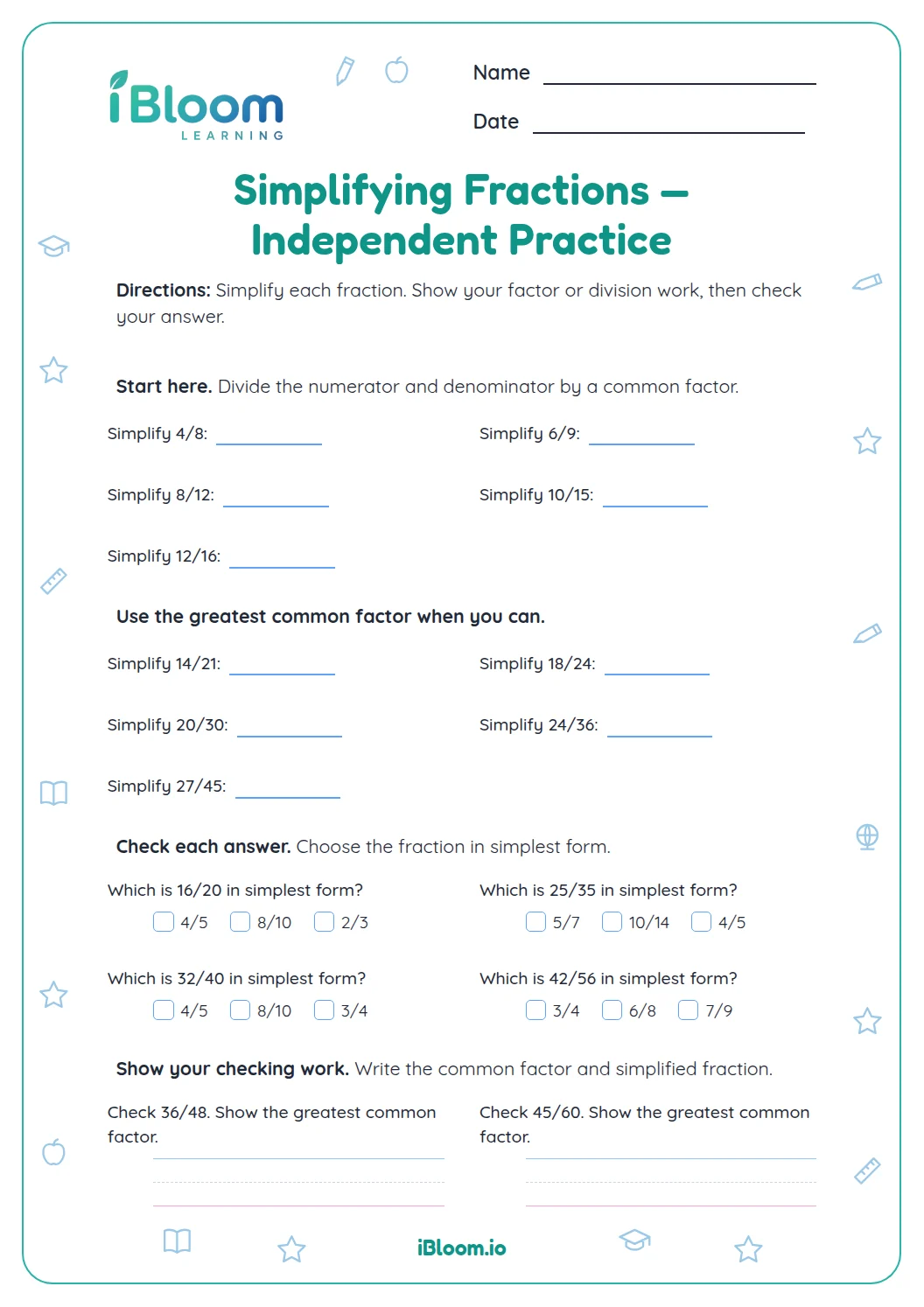
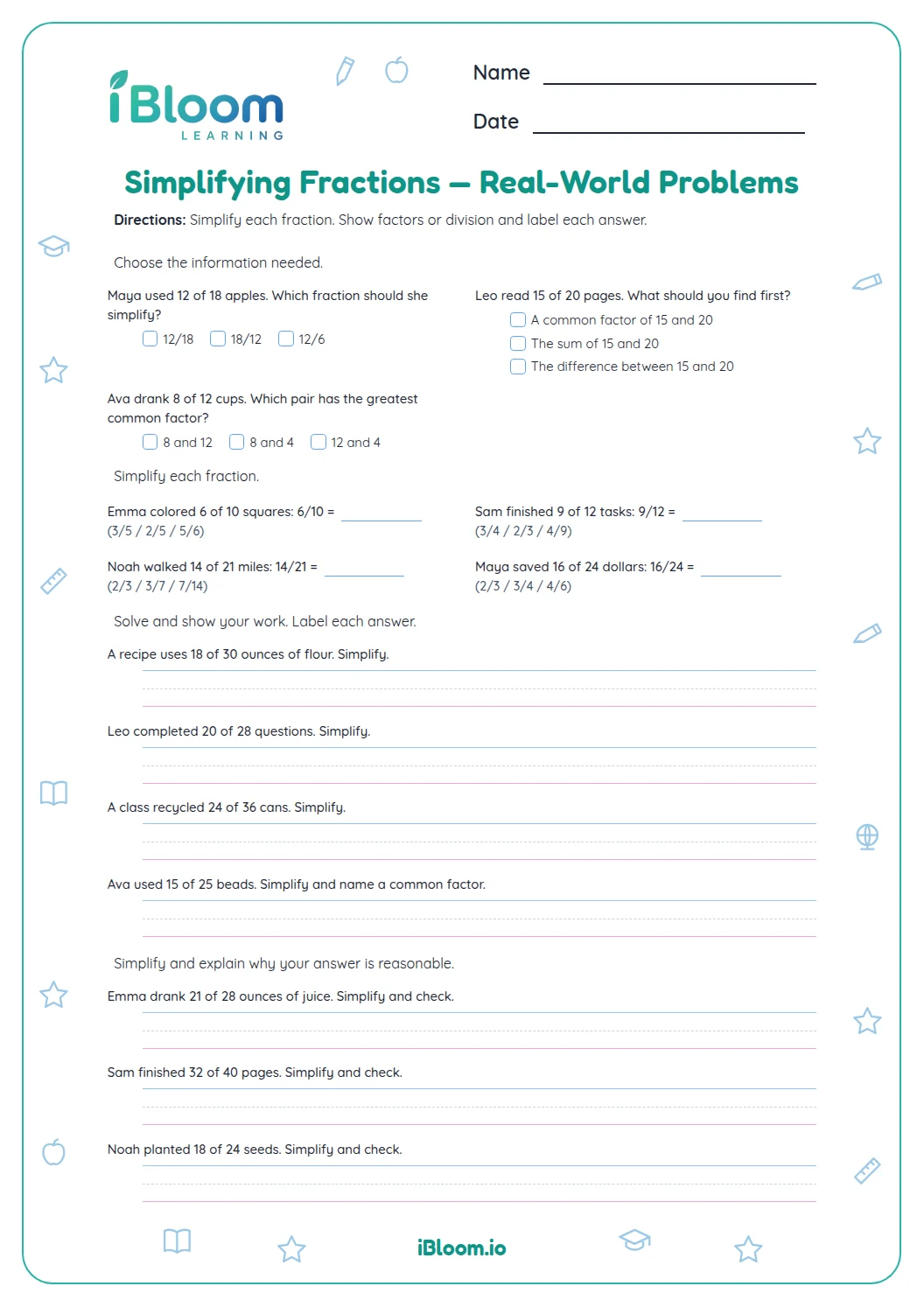
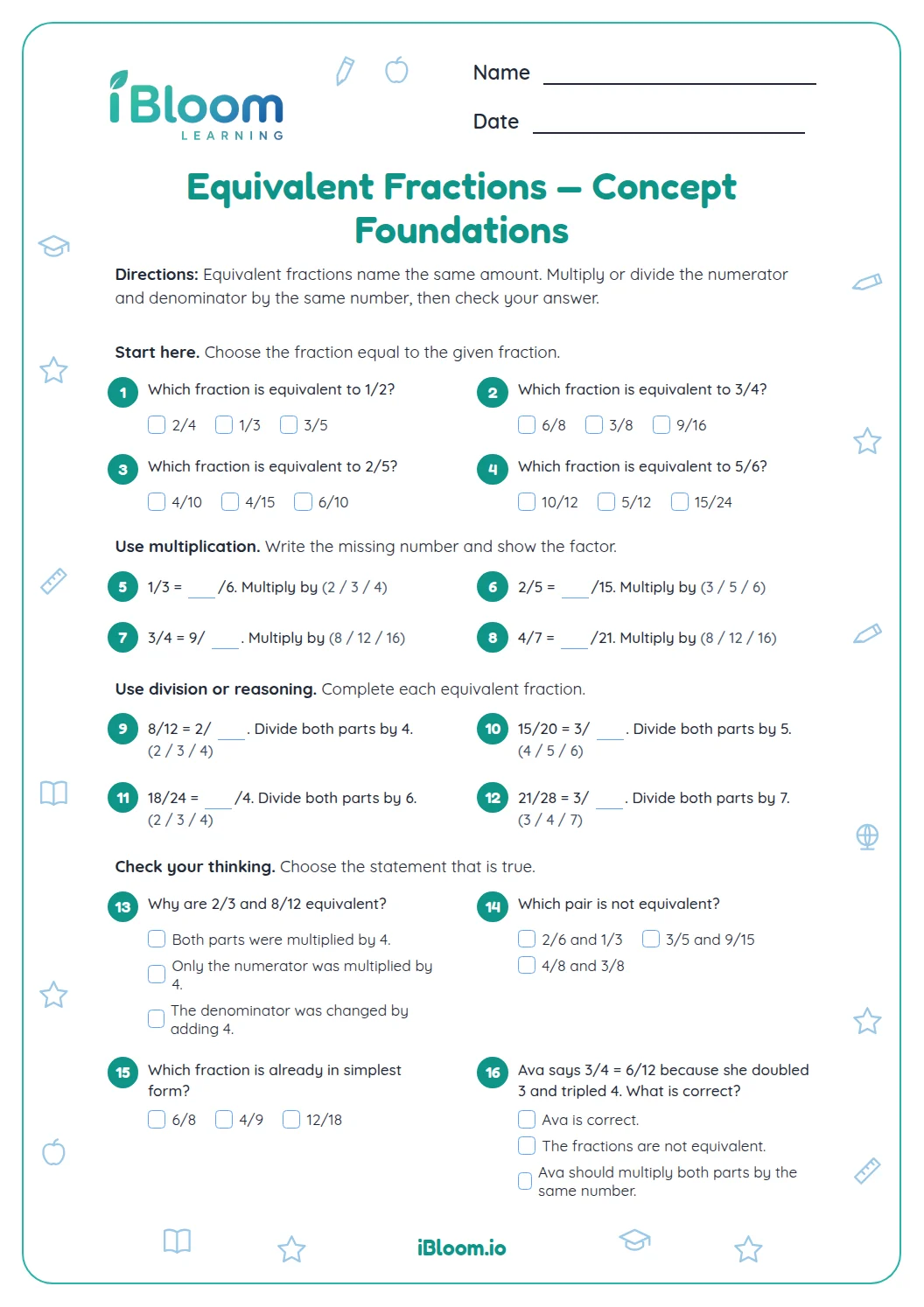
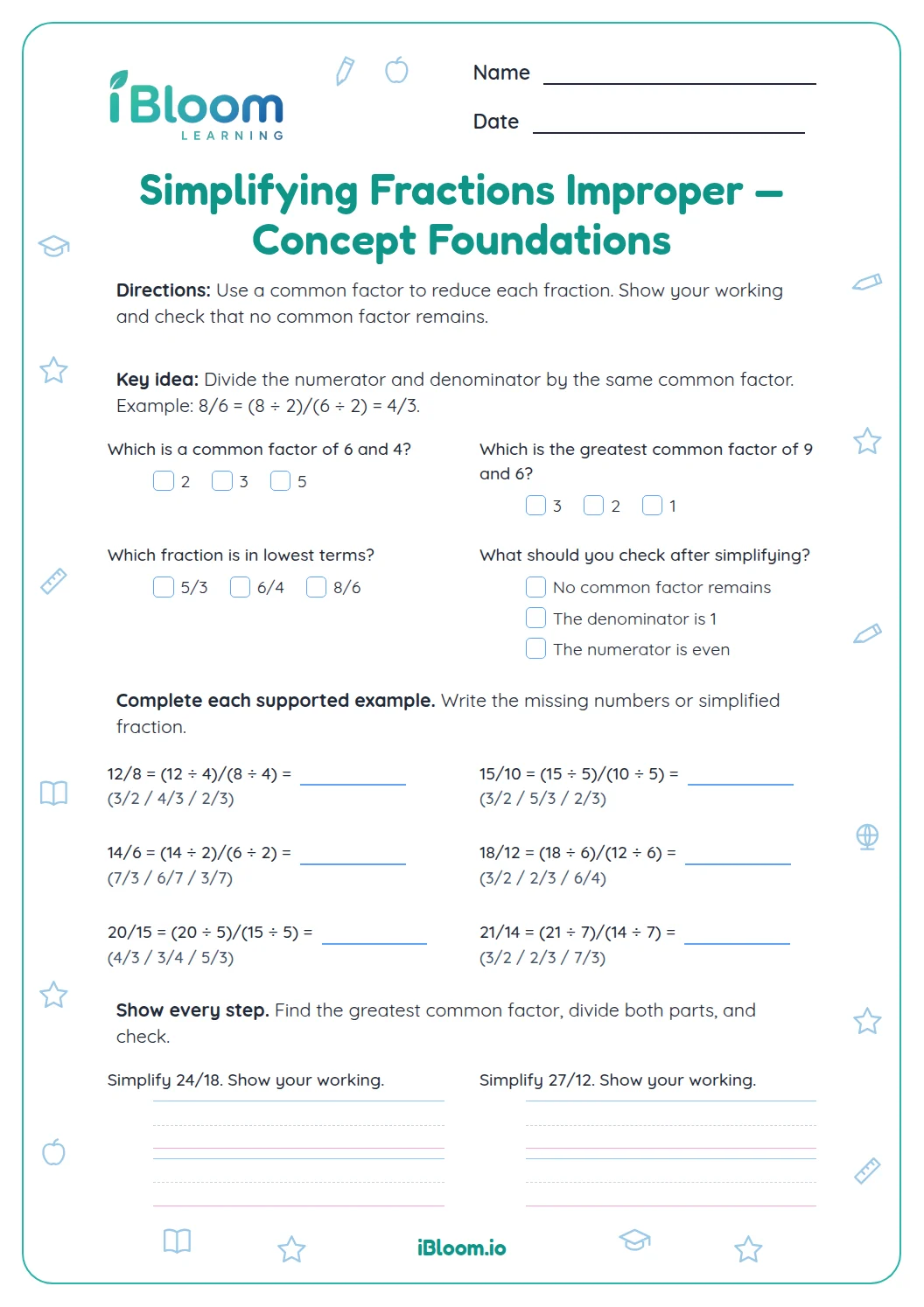
This Grade 5 printable gives learners 18 problems on simplifying fractions. They reduce fractions, complete equivalent-fraction equations, and explain why the numerator and denominator must be divided by the same factor. Four parts build from routine practice to application, with a separate answer key. The sheet supports work with equivalent fractions (4.NF.A.1).
Aligned to 4.NF.A.1
How can you simplify a fraction?
Part A gives six fractions to reduce. Part B has five equivalent-fraction equations with a missing number. Part C applies the idea to a ribbon length and asks learners to check claims and explain their reasoning. Part D asks learners to explain why dividing top and bottom by the same factor preserves value.
- 1Question 7: 8/12 = ___/3
- 2Divide 12 by 4 to get 3. Divide 8 by the same 4 to get 2.
- 3So 8/12 = 2/3, and the blank is 2.
What does the worksheet ask learners to do?
Part A gives six fractions to reduce. Part B has five equivalent-fraction equations with a missing number. Part C applies the idea to a ribbon length and asks learners to check claims and explain their reasoning. Part D asks learners to explain why dividing top and bottom by the same factor preserves value.
How can you check a simplified answer?
Multiply the numerator and denominator of the reduced fraction by the same factor. If that recreates the original fraction, the value stayed the same. The answer is in simplest form when no common factor greater than 1 remains.
How to use this simplifying fractions worksheet
- 1Read the directions and identify the skill Part A asks you to use.
- 2Work through Part A and check each simplified fraction.
- 3Complete the equivalent-fraction blanks in Part B.
- 4Apply and explain the idea in Parts C and D.
- 5Check the separate answer key and revisit any answer that needs another look.
Common simplifying fractions slips and fixes
The mistake
Dividing only the numerator or only the denominator.
The fix
Use one common factor on both numbers; the fraction value must stay equal.
The mistake
Stopping before simplest form.
The fix
Check whether the new numerator and denominator still share a factor.
The mistake
Using different factors on top and bottom.
The fix
Name one common divisor first, then divide both parts by it.
Common Core alignment
These questions practice the listed Common Core skill.
Generate and recognize equivalent fractions while simplifying each given fraction.
On this sheet: Generate and recognize equivalent fractions while simplifying each given fraction.
Show the official wordingHide the official wording
Explain why a fraction a/b is equivalent to a fraction (n × a)/(n × b) by using visual fraction models, with attention to how the number and size of the parts differ even though the two fractions themselves are the same size. Use this principle to recognize and generate equivalent fractions.
What to practice next
Make more practice
Further reading
Questions parents and teachers ask
What does it mean to simplify a fraction?
Simplifying rewrites a fraction with smaller numbers while keeping the same value. For example, divide 6/8 by 2 on both top and bottom to get 3/4. The first six questions ask learners to reduce fractions, then later questions use the same idea in equations and explanations.
How do you solve 8/12 = ___/3?
The denominator 12 becomes 3 when divided by 4. Divide the numerator 8 by 4 as well, so the missing number is 2. This keeps the fractions equivalent, and 2/3 is already in simplest form. Question 7 practices this same-factor relationship.
Why must both numbers be divided by the same factor?
A fraction names a division relationship, so changing only one number changes its value. Dividing the numerator and denominator by the same nonzero factor makes an equivalent fraction. Question 18 asks learners to explain this rule using 12/18.
How many problems and pages are included?
There are 18 questions in four parts. The printable worksheet uses three pages, followed by a three-page answer key. Learners reduce fractions, fill equivalent-fraction blanks, apply the rule in a ribbon problem, and explain why the same factor must divide both numerator and denominator.
What should I do if the fraction can still be reduced?
Look for another factor shared by the numerator and denominator. For 12/18, both numbers divide by 6 to make 2/3; neither 2 nor 3 can be divided by a shared whole-number factor greater than 1. The key gives answers for checking.
Is this worksheet suitable for independent practice?
Yes, once a learner knows that equivalent fractions have the same value. The first section offers direct reduction practice, and the later prompts ask learners to apply or explain the rule. An adult can review one example, then use the separate key after the learner finishes.