

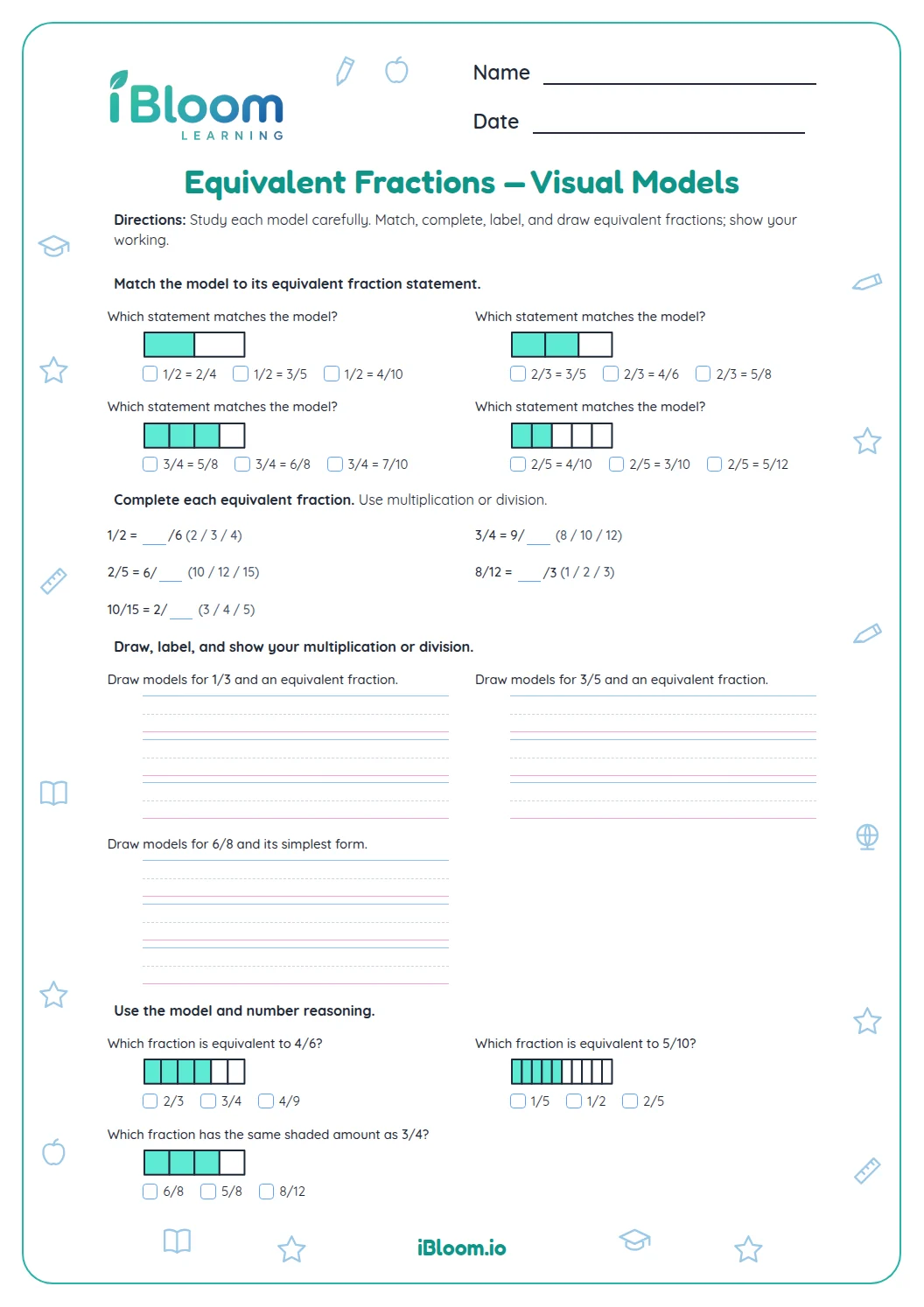
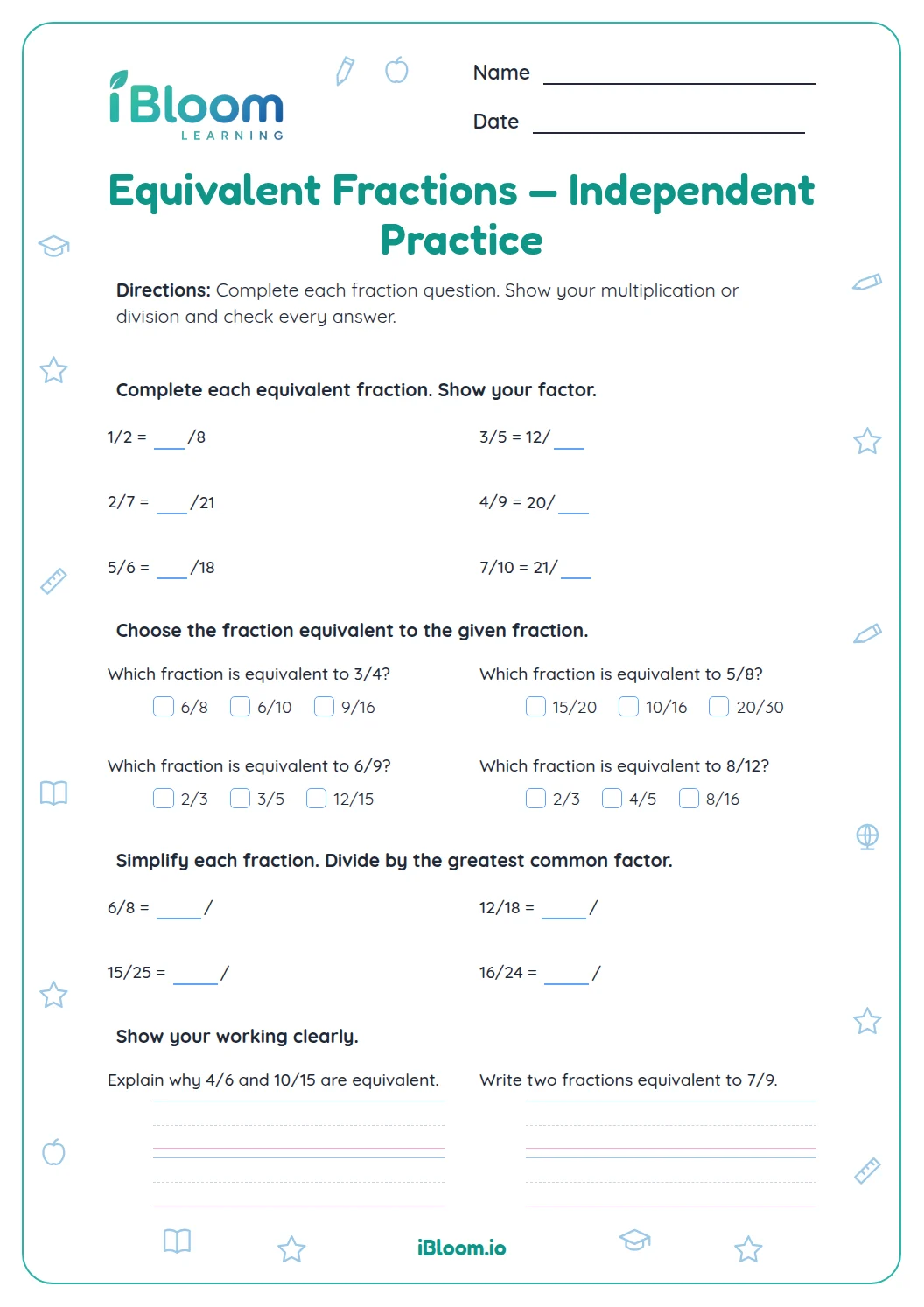
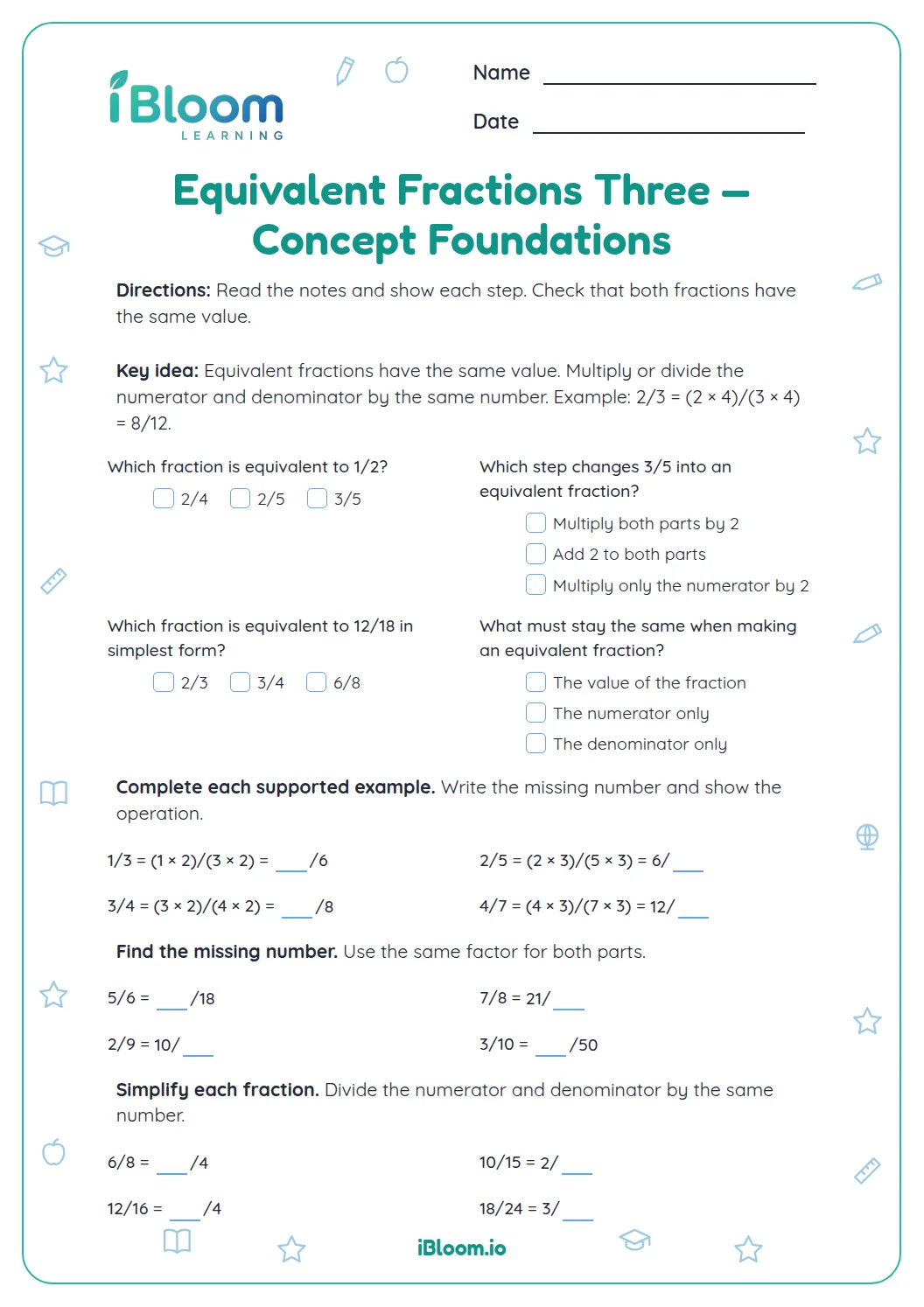

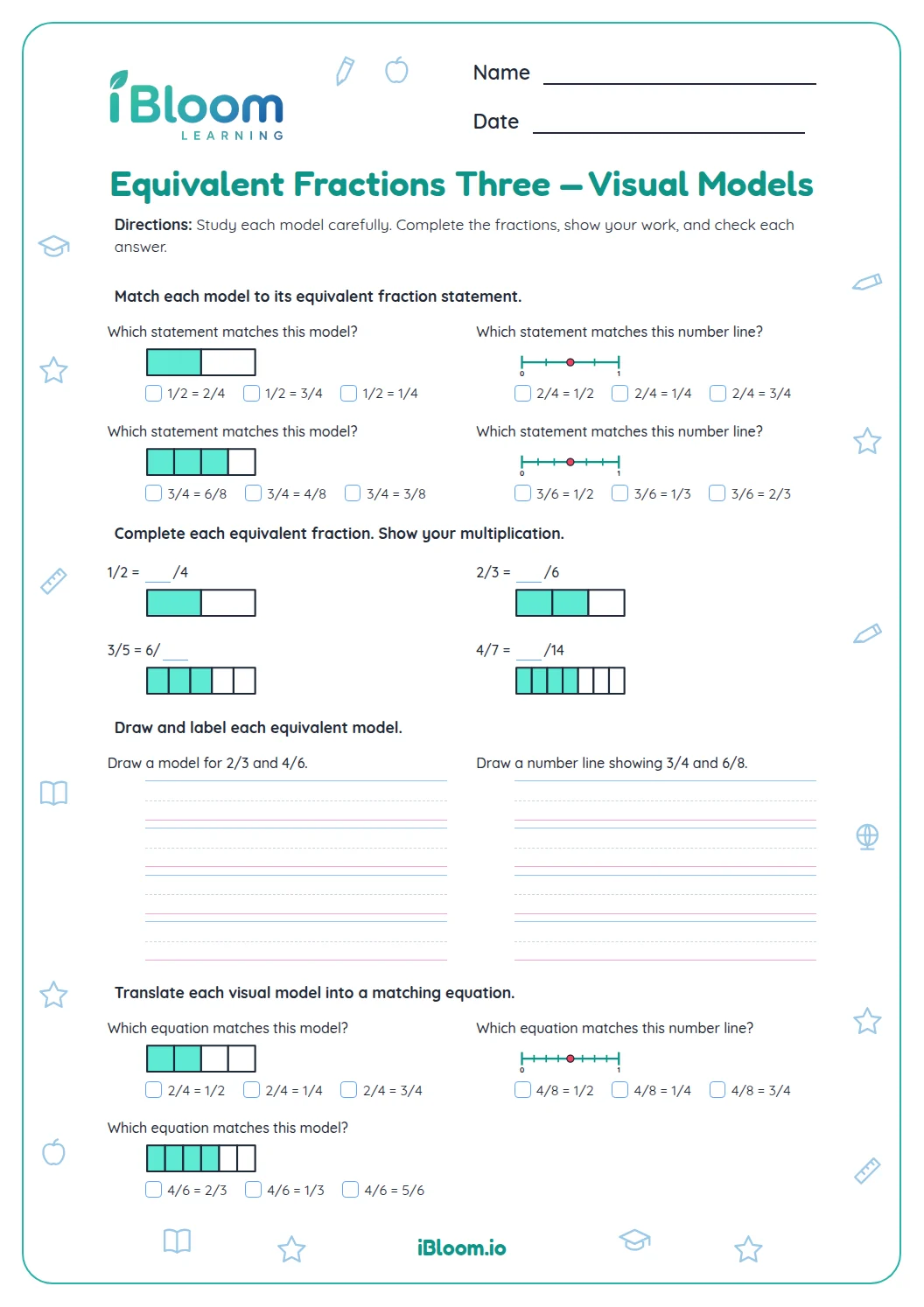



About this worksheet
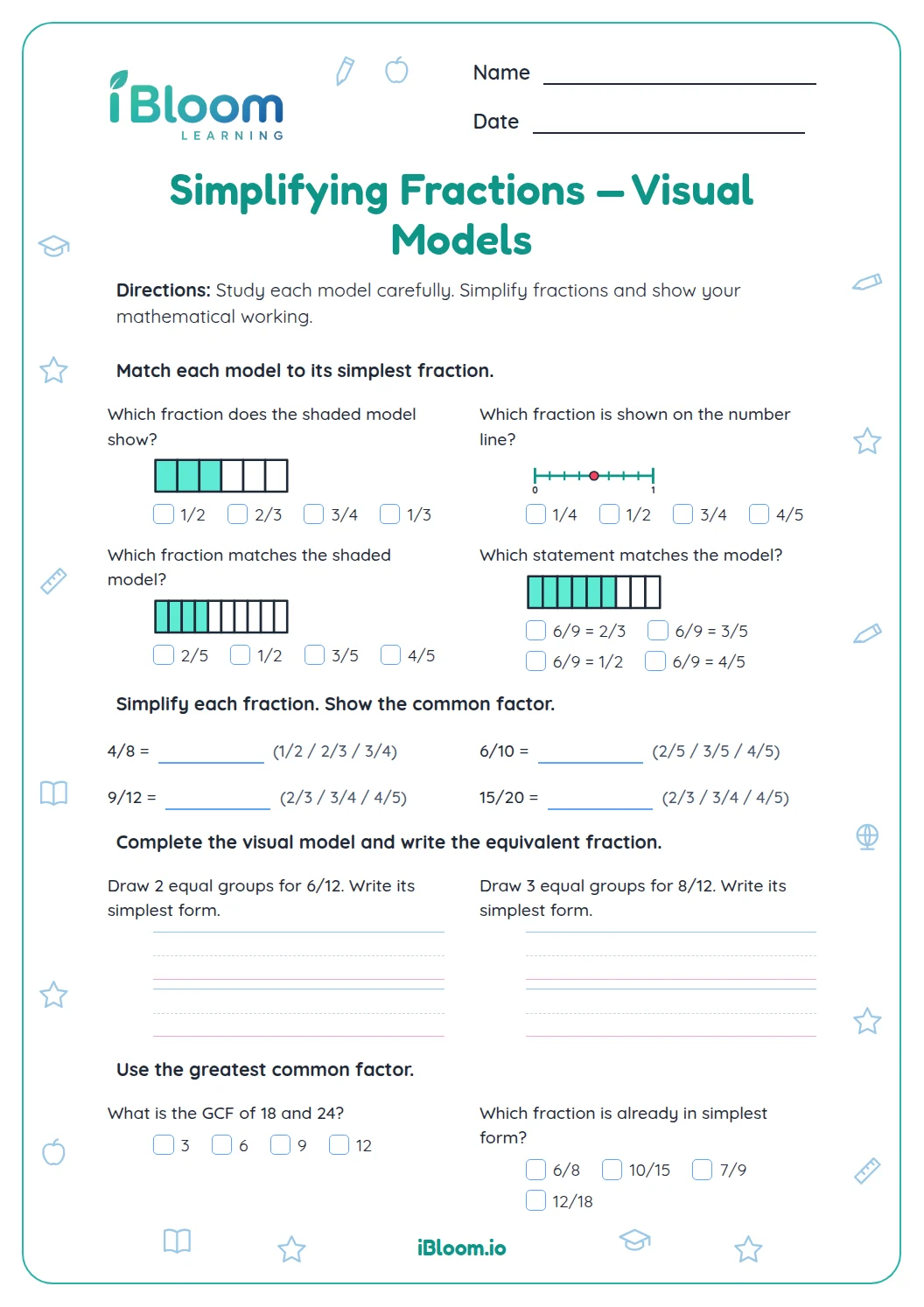
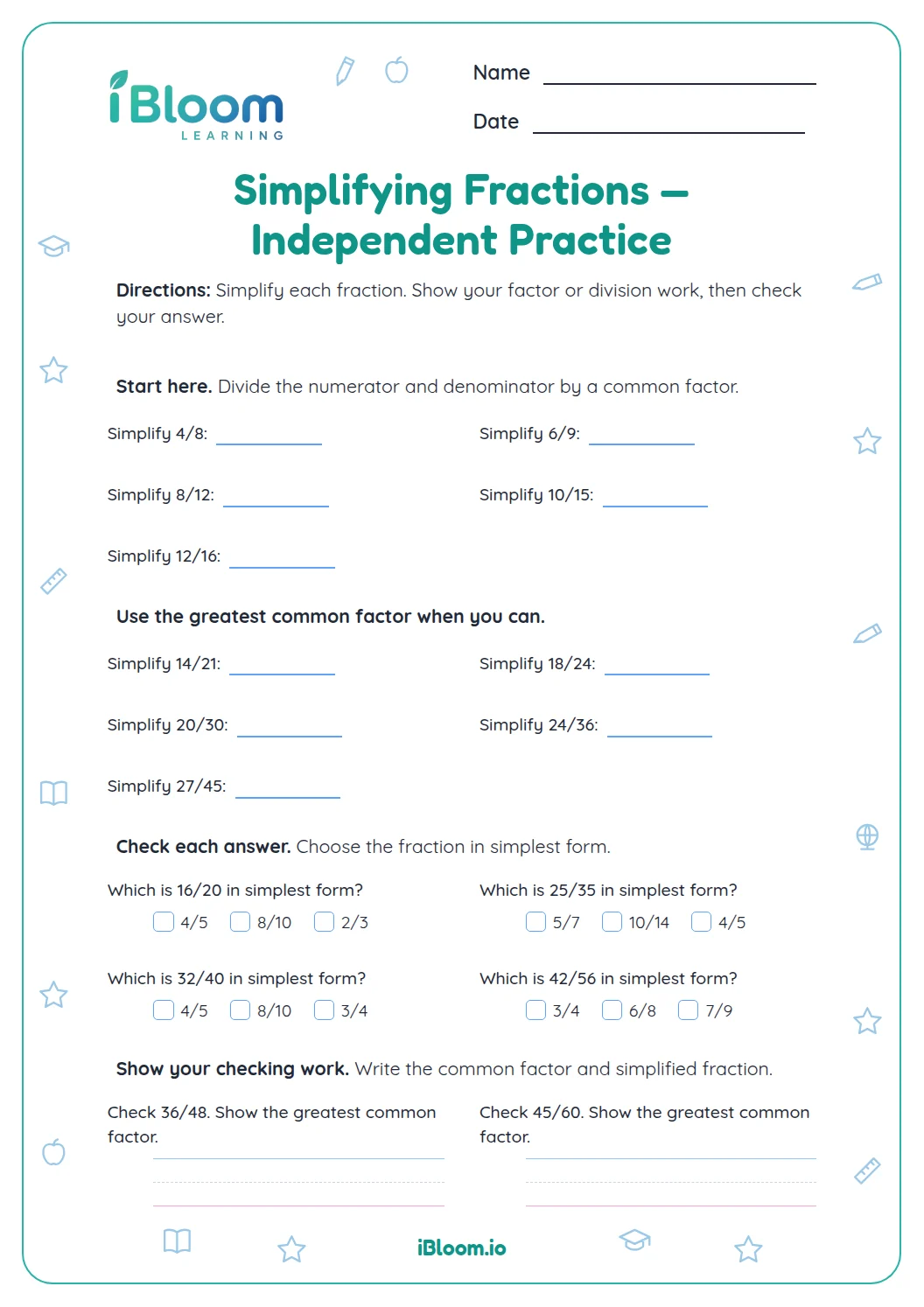
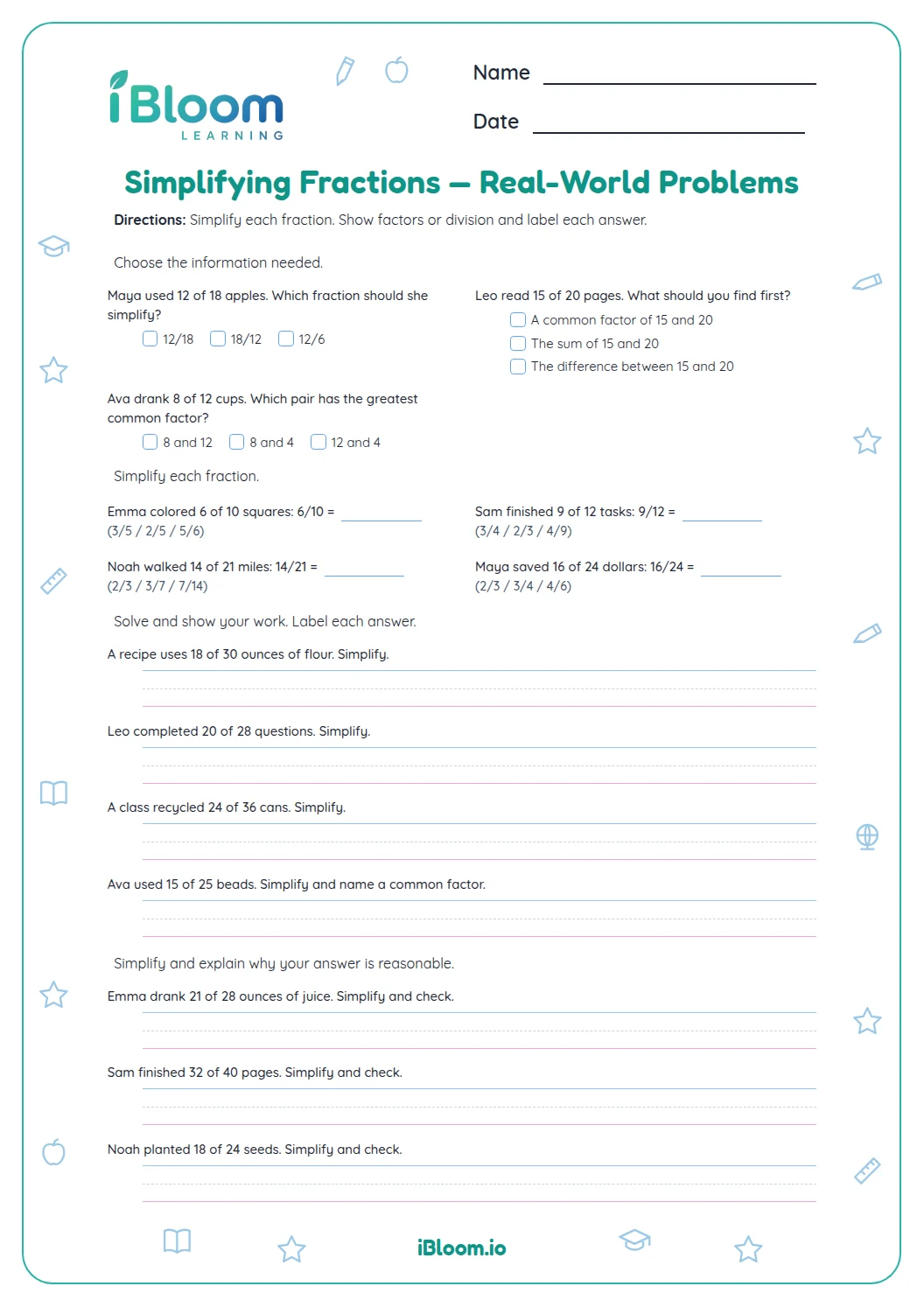
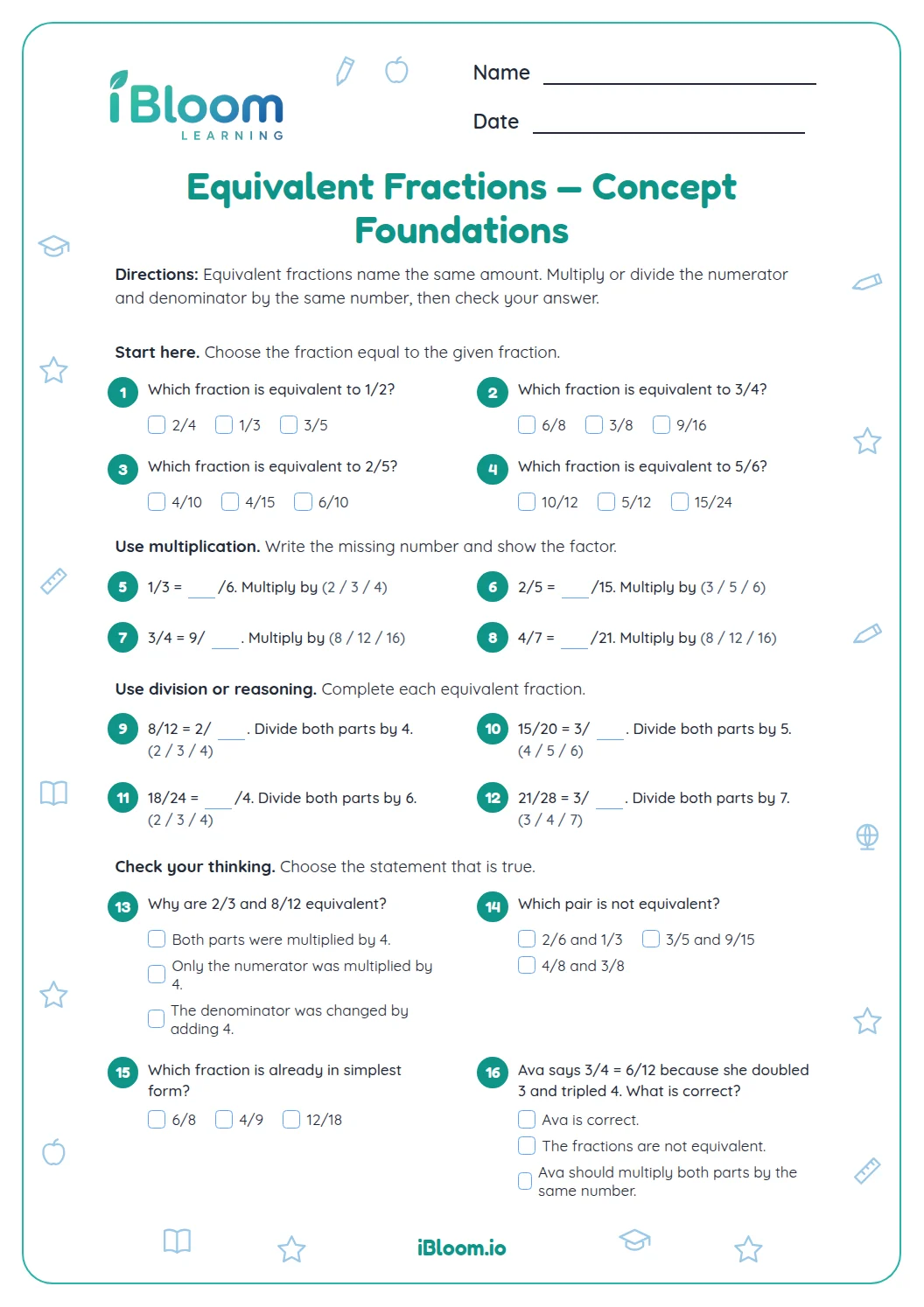
This Grade 5 fraction worksheet asks students to reduce fractions to simplest form and reason about equivalent fractions. It includes reducing 18/24, comparing 4/6 and 5/8, generating equivalent fractions, and checking a fraction of a cup. The work practices CCSS 4.NF.A.1 by generating and recognizing equivalent fractions; a separate answer key shows simplified forms and sample reasoning.
Aligned to 4.NF.A.1
How can 18/24 be reduced to simplest form?
Find a factor shared by 18 and 24. Both divide by 6: 18 ÷ 6 = 3 and 24 ÷ 6 = 4, so 18/24 = 3/4. Dividing top and bottom by the same number keeps the value unchanged.
- 118/24
- 218 ÷ 6 = 3 and 24 ÷ 6 = 4
- 318/24 = 3/4
How can you tell whether two fractions are equivalent?
Equivalent fractions represent the same value even when their numerators and denominators differ. To make an equivalent fraction from 7/9, multiply both parts by 4: 7 × 4 = 28 and 9 × 4 = 36, so 7/9 = 28/36.
How can you compare 4/6 and 5/8?
Rewrite 3/4 as 6/8, then compare 6/8 with 5/8. Since 6/8 is greater than 5/8, the greater fraction is 3/4. Compare values rather than looking only at the numerators.
A reliable fraction-checking routine
- 1Look for a common factor of the numerator and denominator.
- 2Divide both by the same factor.
- 3Repeat until the fraction is in simplest form.
- 4To make an equivalent fraction, multiply or divide top and bottom by the same number.
- 5For comparisons, rewrite fractions in a form that makes their values easier to compare.
- 6Check that simplifying did not change the value.
Fraction slips and quick checks
The mistake
Dividing only the numerator when simplifying.
The fix
Use the same factor on both numerator and denominator so the value stays equal.
The mistake
Stopping at 6/9 for 12/18.
The fix
Check whether 6 and 9 still share a factor; divide both by 3 to get 2/3.
The mistake
Comparing fractions by looking only at the numerators.
The fix
Use equivalent forms or a common denominator to compare the amounts.
Curriculum alignment
This worksheet practices equivalent fractions by generating and recognizing equal values.
Generate and recognize equivalent fractions by multiplying or dividing both terms by the same number.
On this sheet: Generate equivalent fractions and recognize equal values while simplifying and comparing fractions.
Show the official wordingHide the official wording
Explain why a fraction a/b is equivalent to a fraction (n × a)/(n × b) by using visual fraction models, with attention to how the number and size of the parts differ even though the two fractions themselves are the same size. Use this principle to recognize and generate equivalent fractions.
What to practice next
Make more practice
Further reading
Questions parents and teachers ask
What is the simplest form of 18/24?
The simplest form is 3/4. Divide both 18 and 24 by 6, their greatest common factor: 18 ÷ 6 = 3 and 24 ÷ 6 = 4. The resulting numerator and denominator share no factor greater than 1.
Why is 6/9 not the simplest form of 12/18?
Six and nine still share a factor of 3, so the fraction can be reduced again. Divide both by 3 to get 2/3. Simplest form means the numerator and denominator have no common factor greater than 1. This final reduction is what makes it simplest.
How do you make an equivalent fraction with denominator 36?
Multiply both the numerator and denominator of 7/9 by 4. The numerator becomes 28 and the denominator becomes 36, so 7/9 = 28/36. Using the same factor on both parts keeps the fraction value unchanged. The numerator and denominator must always be scaled together.
Which fraction is greater, 3/4 or 5/8?
Three fourths is greater. Rewrite 3/4 as 6/8, then compare 6/8 with 5/8. The denominators now match, so the larger numerator names the greater fraction. The worksheet asks students to use equivalent forms to make a comparison clear.
Does the key show how the fractions were simplified?
Yes. The separate two-page key lists each simplest form and gives examples for the reasoning questions. For a different valid method, such as dividing by a smaller common factor more than once, check that the final fraction is equivalent and fully simplified.