

About this worksheet
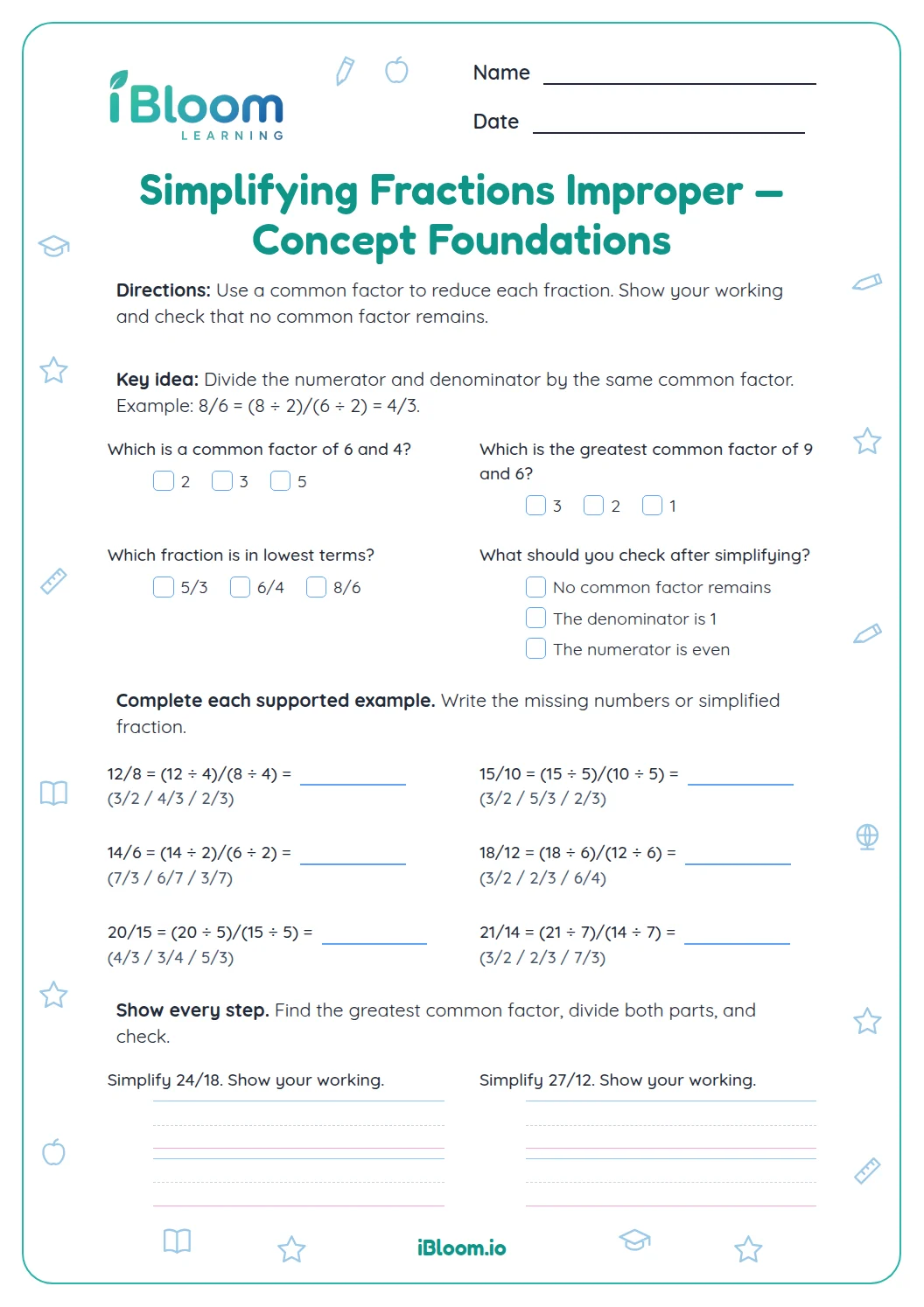
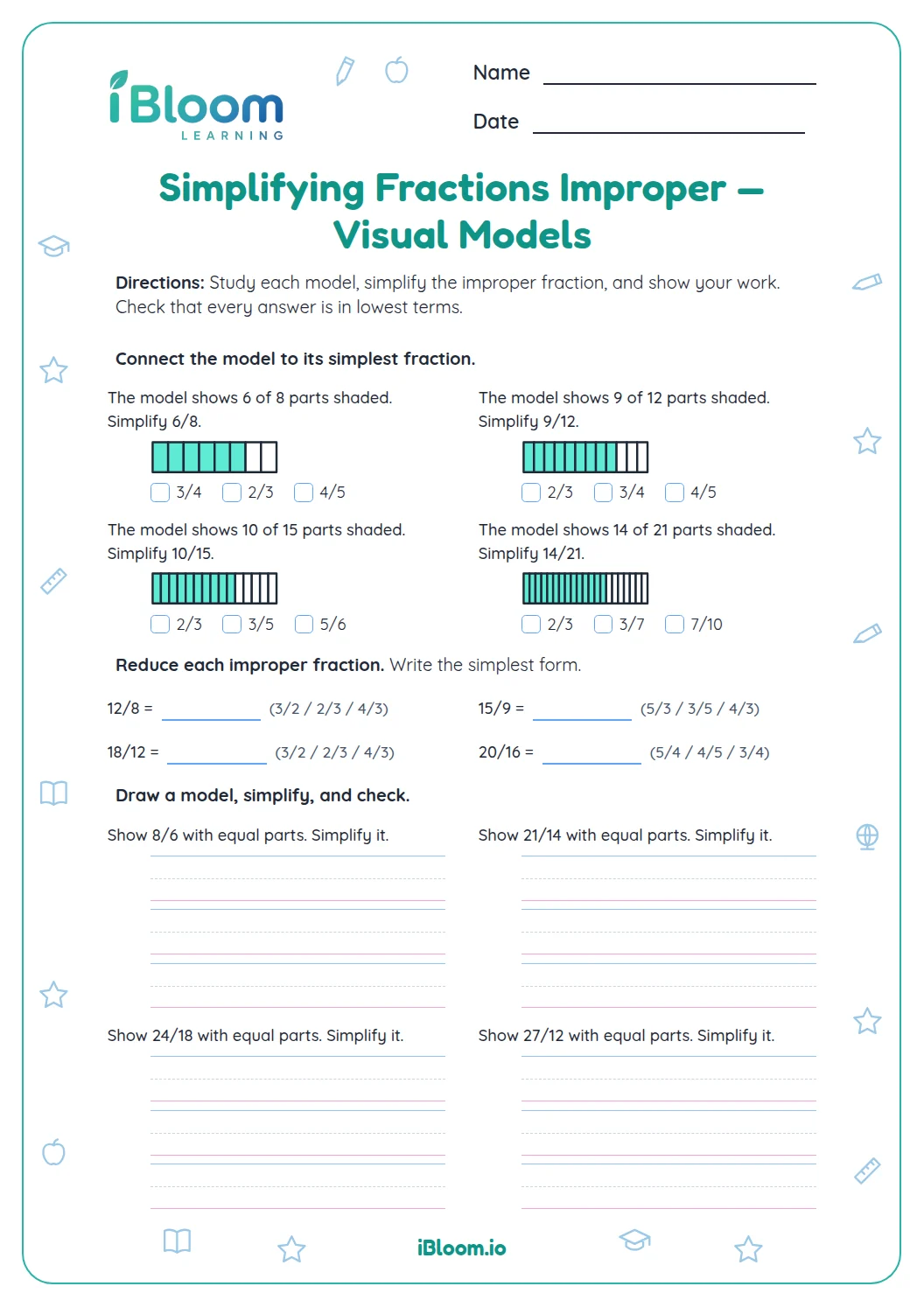
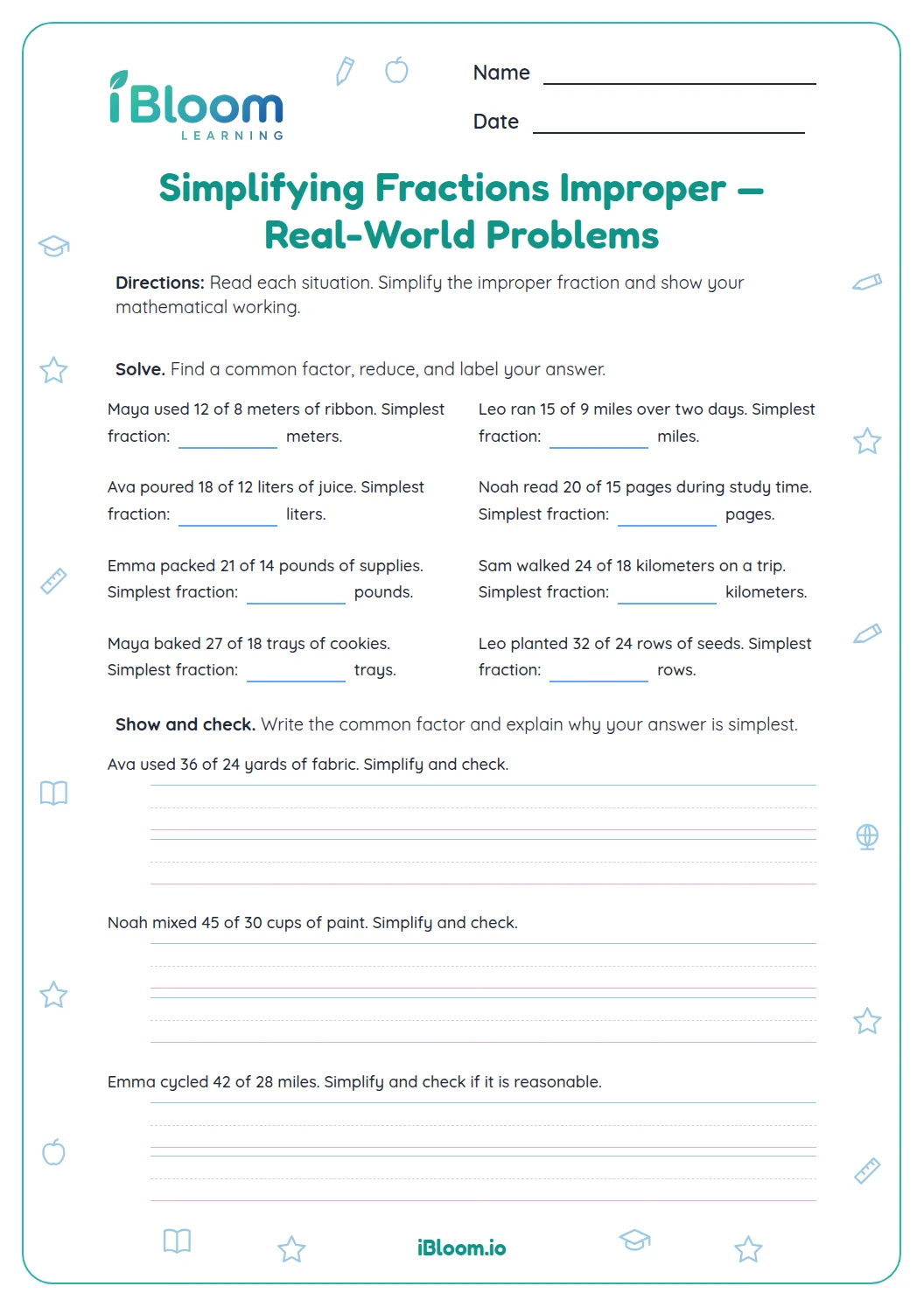
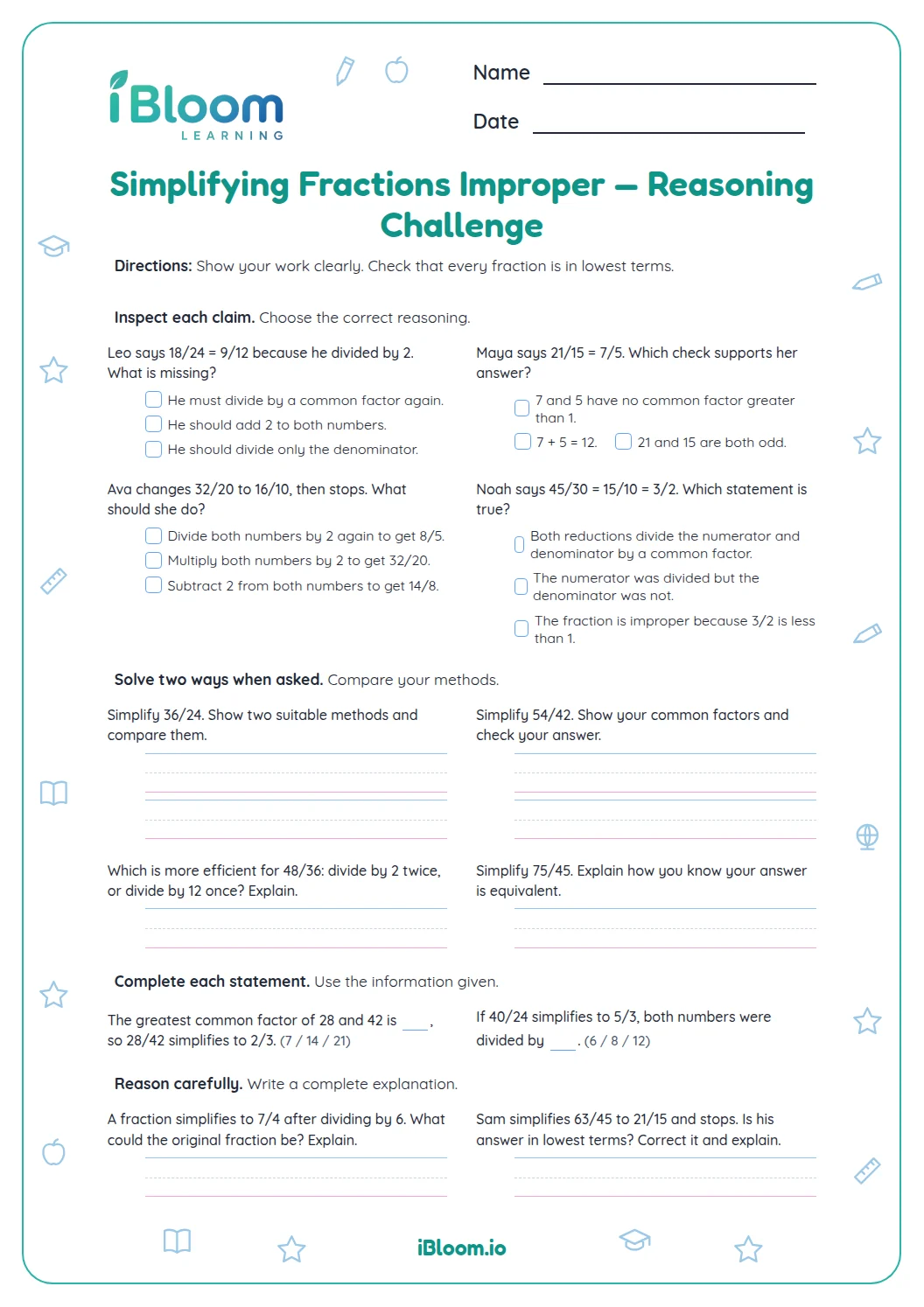
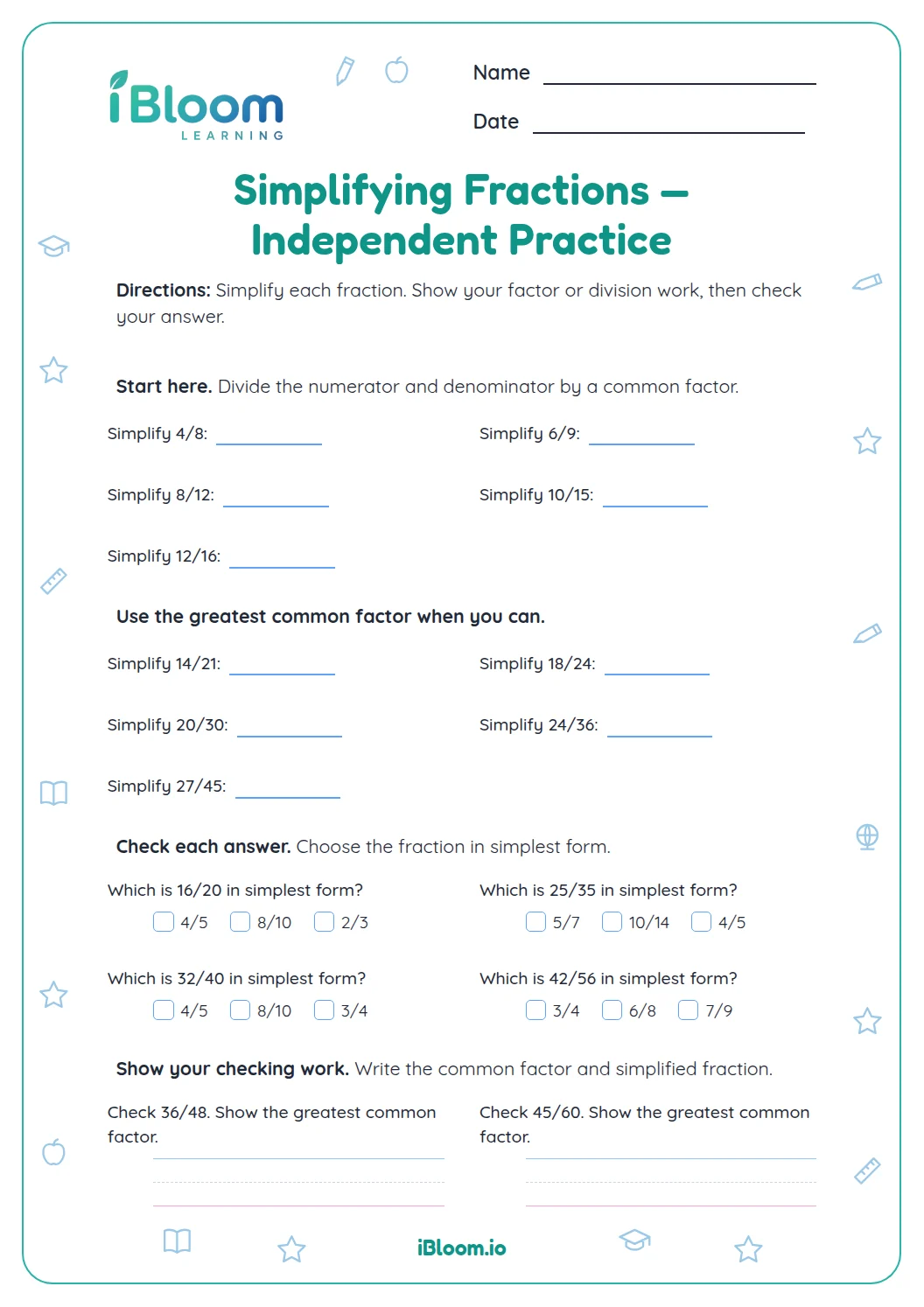
This Grade 5 printable gives learners 16 improper fractions to simplify. Early questions use visible common factors; later groups ask students to keep reducing until the numerator and denominator share no factor besides 1. A worked example shows why dividing both terms by the same number preserves value. Children can check each equivalent fraction against the separate answer key.
What does it mean to simplify an improper fraction?
An improper fraction has a numerator that is at least as large as its denominator. Simplifying means writing an equivalent fraction with smaller terms and no common factor other than 1. The value stays the same even though the numerator and denominator change.
For example, 36/24 can be simplified by dividing both numbers by 12: 36 ÷ 12 = 3 and 24 ÷ 12 = 2, so 36/24 = 3/2.
How do you choose a factor to divide by?
Look for a number that divides evenly into both the numerator and denominator. A large shared factor can finish the problem in one step; a smaller shared factor may take several steps. Always divide both terms by the same number.
How can you tell the fraction is still equivalent?
Multiplying or dividing the numerator and denominator by the same nonzero number preserves the fraction’s value. A quick check is to multiply the simplified numerator by the original denominator and compare it with the original numerator times the simplified denominator.
- 136/24
- 2The greatest common factor of 36 and 24 is 12.
- 336 ÷ 12 = 3; 24 ÷ 12 = 2.
- 4Answer: 3/2
- 5Check: 3/2 and 36/24 name the same amount.
How to use this worksheet
- 1Check that the numerator is at least as large as the denominator.
- 2Find a number that divides evenly into both terms.
- 3Divide numerator and denominator by that same number.
- 4Repeat until the reduced terms have no common factor besides 1.
- 5Compare the answer with the key and verify the equivalent value.
Common mistakes and quick fixes
The mistake
Dividing only the numerator or only the denominator.
The fix
Use the same divisor on both terms so the fraction keeps its value.
The mistake
Stopping after one step when the terms still share a factor.
The fix
Check the reduced numerator and denominator again for a common factor.
The mistake
Subtracting the same number from top and bottom.
The fix
Equivalent fractions are made by multiplying or dividing both terms by the same factor.
What to practice next
Make more practice
Questions parents and teachers ask
Can an improper fraction be simplified?
Yes. “Improper” describes a fraction whose numerator is at least its denominator; it does not mean the fraction cannot be reduced. For example, 36/24 divides by 12 to make 3/2. The worksheet practices this same reduction process with 16 improper fractions, and every answer keeps the value while using smaller terms.
Why divide both numbers by the same factor?
A fraction names a division relationship. Dividing its numerator and denominator by the same factor creates an equivalent fraction, because both quantities shrink by the same scale. Changing only one term changes the value. The same divisor keeps the ratio between the two terms unchanged.
How do I know when to stop simplifying?
Stop when the numerator and denominator have no common factor greater than 1. For example, 3 and 4 share only 1, so 3/4 is in simplest form. Check both terms for a shared factor greater than one before you stop.
What is the answer to the first worked example?
Question 1 is 36/24. Both terms divide evenly by 12, giving 3/2. The fractions name the same value, and 3/2 cannot be reduced further. This first item models the steps children use throughout the practice set, and the separate key confirms the simplest form.
Is the worksheet only for improper fractions?
Yes. Each prompt presents an improper fraction for simplification, so children practice reducing fractions whose numerator is at least as large as the denominator. The answer key gives the simplest equivalent form for all 16. For instance, 36 is at least 24, so the first item is improper.