
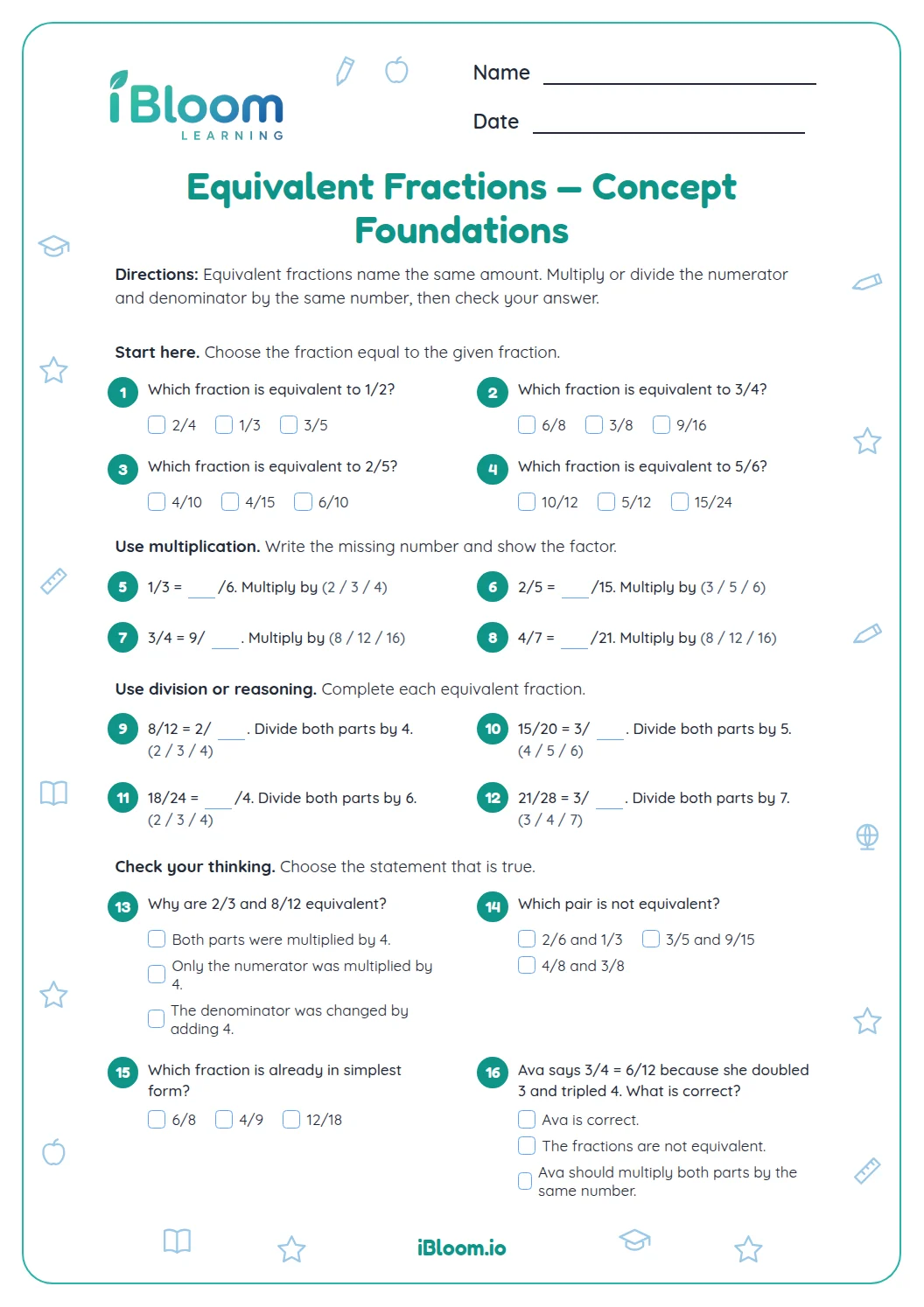
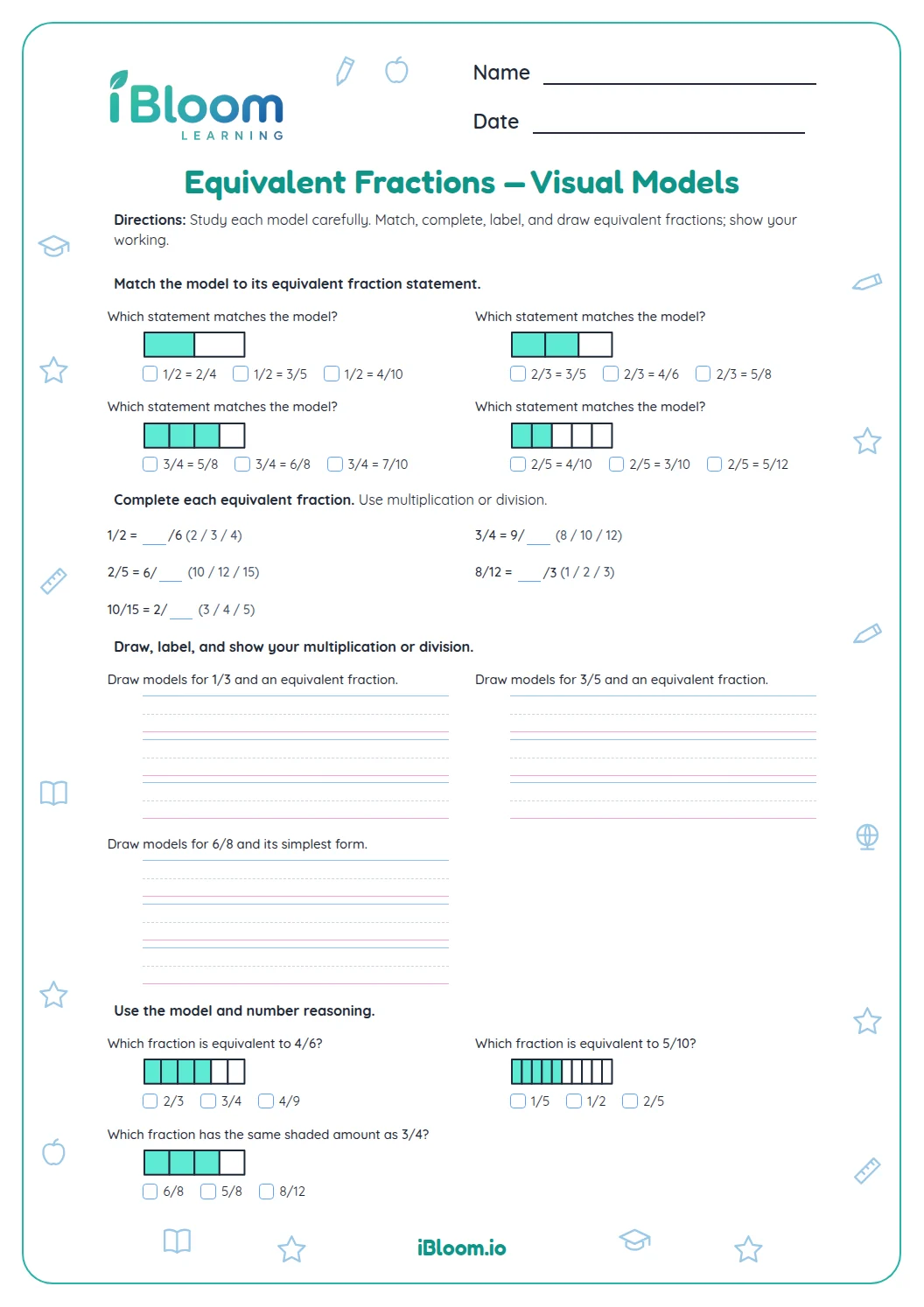
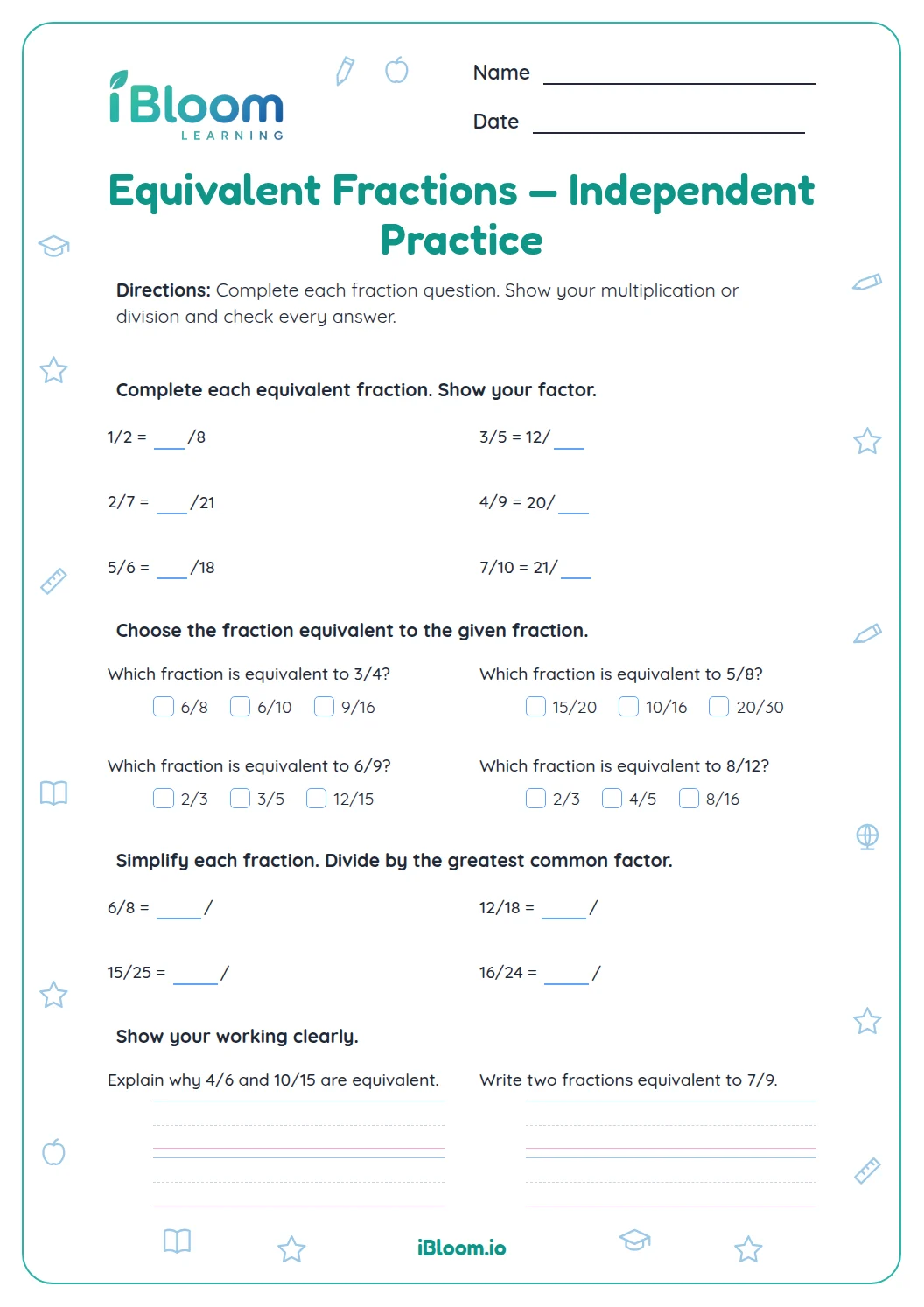

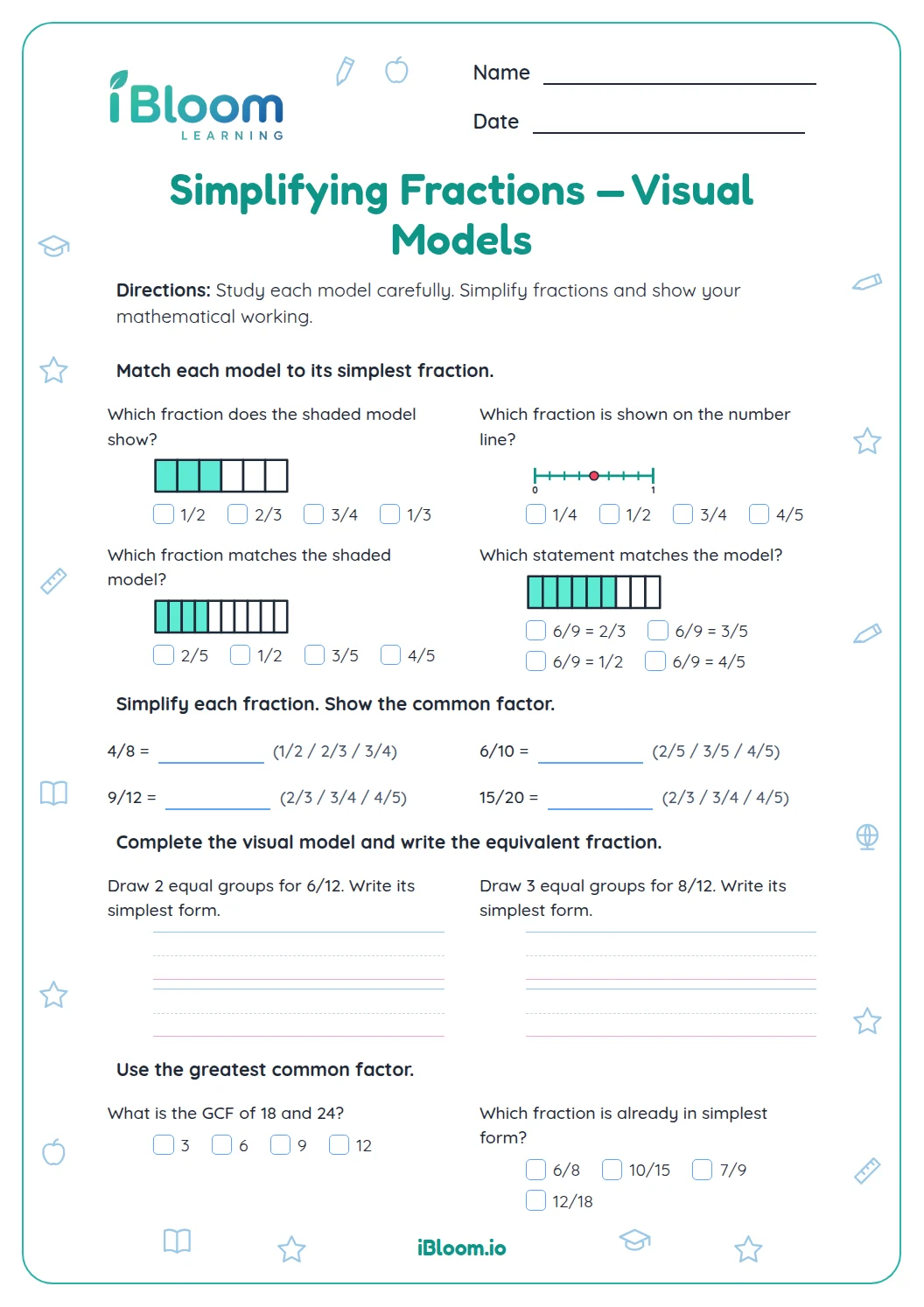


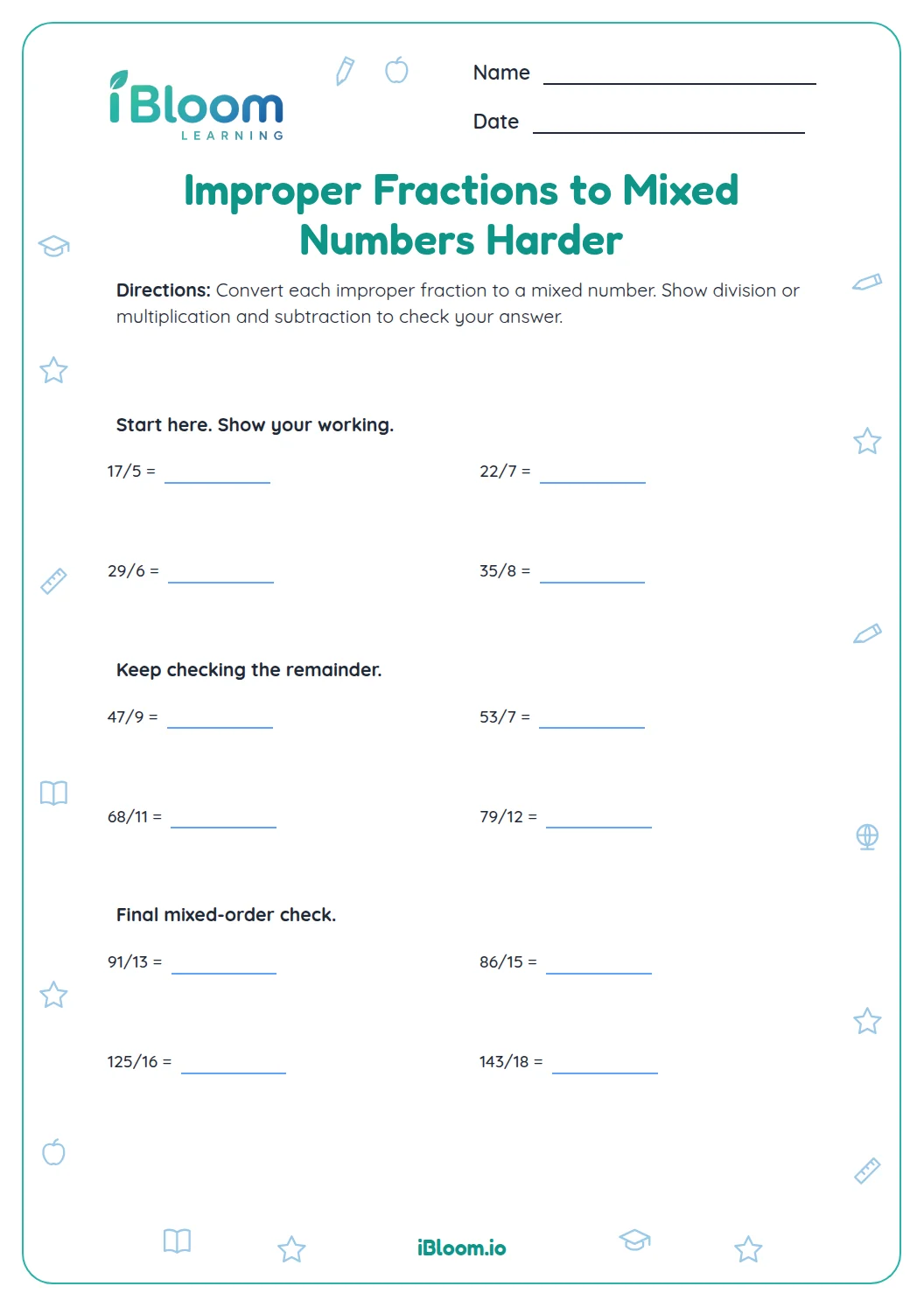
About this worksheet
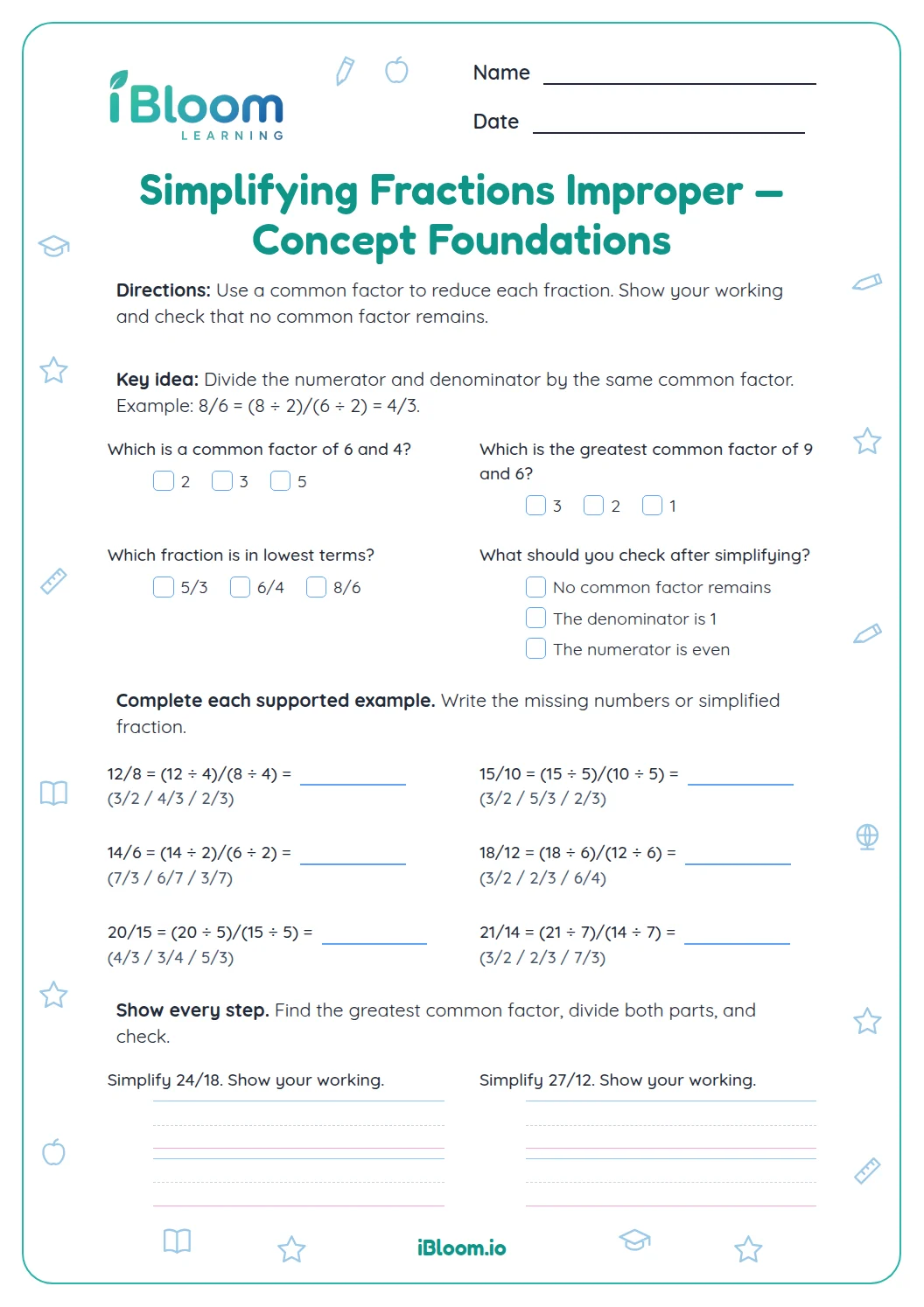
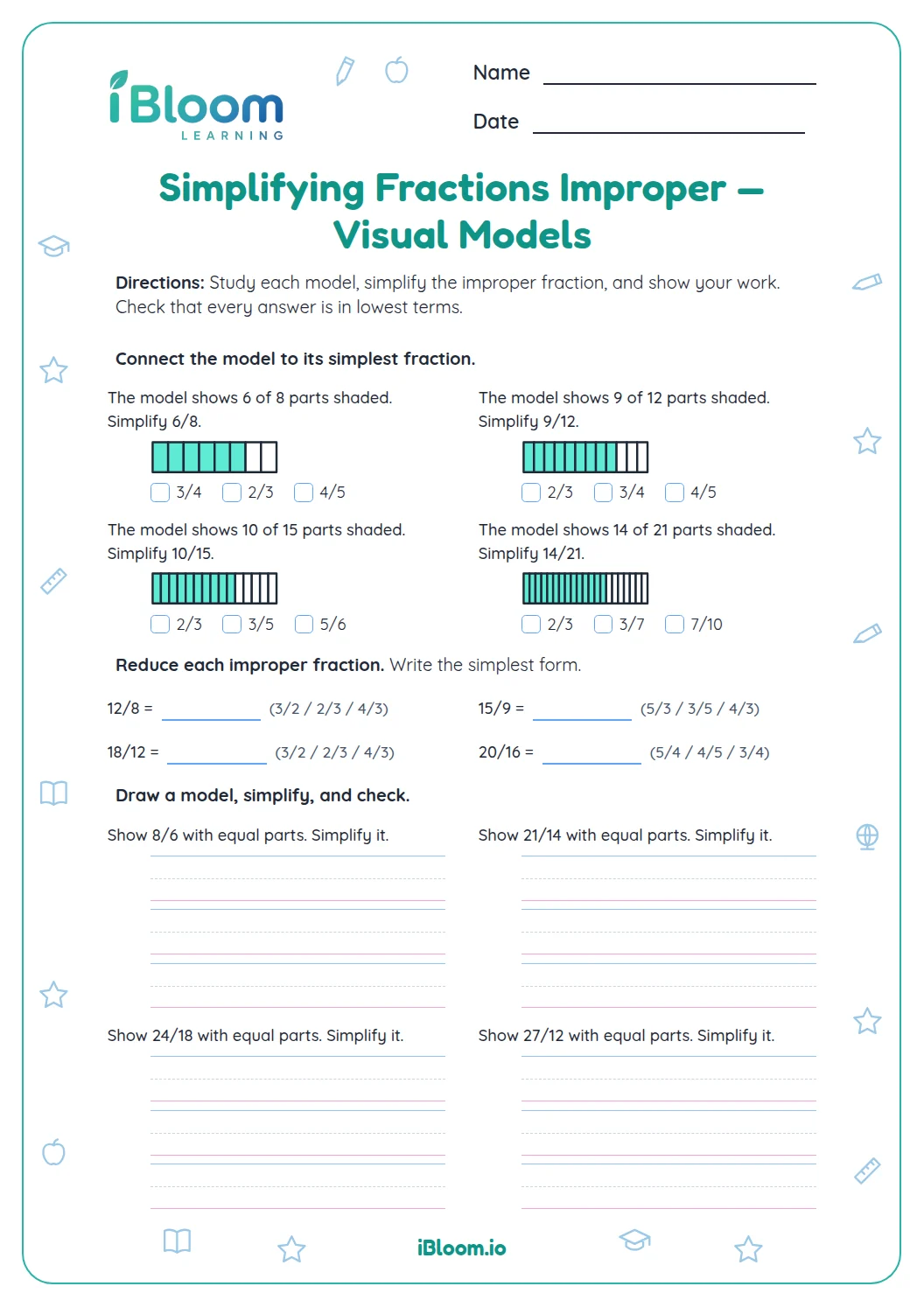
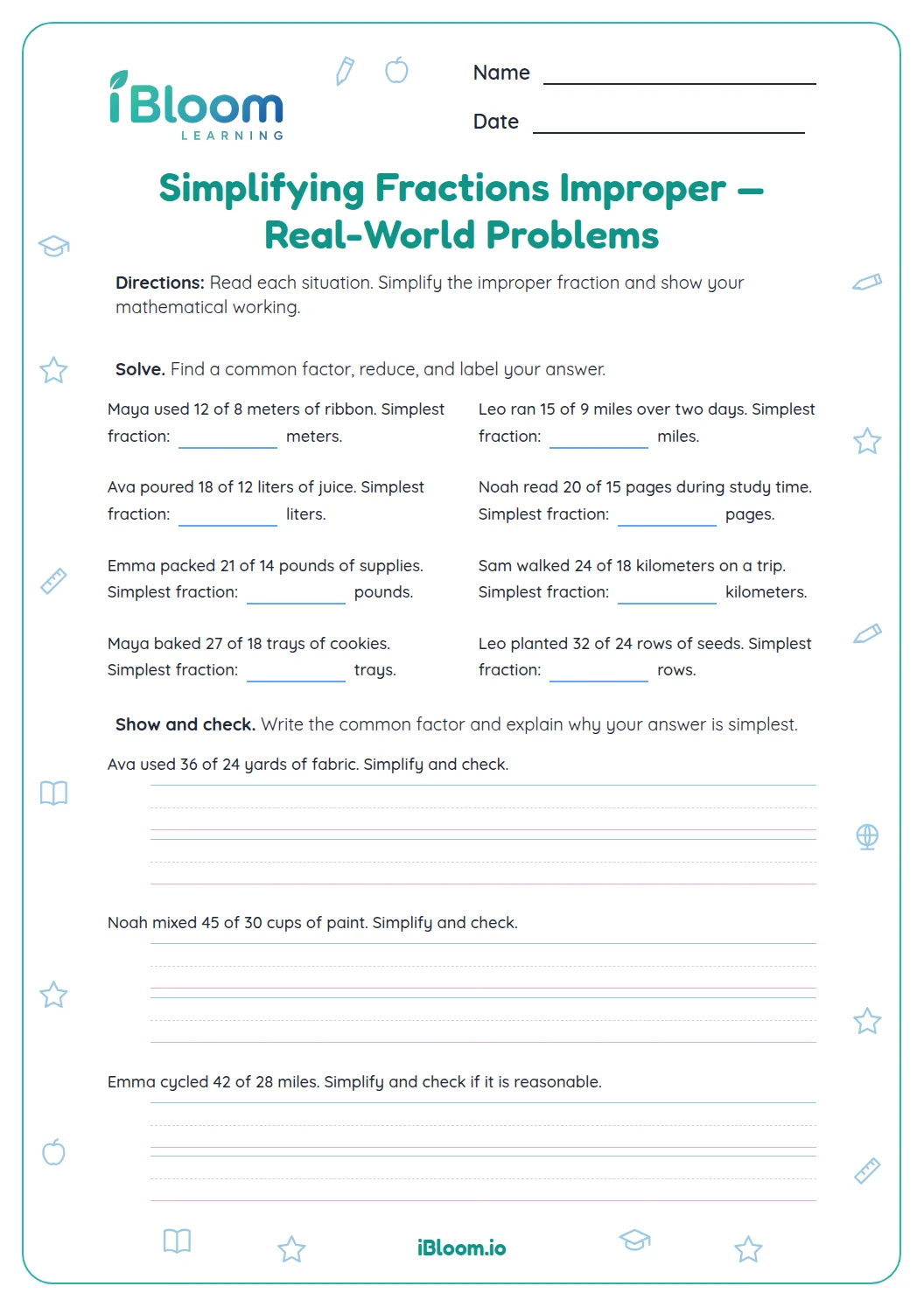
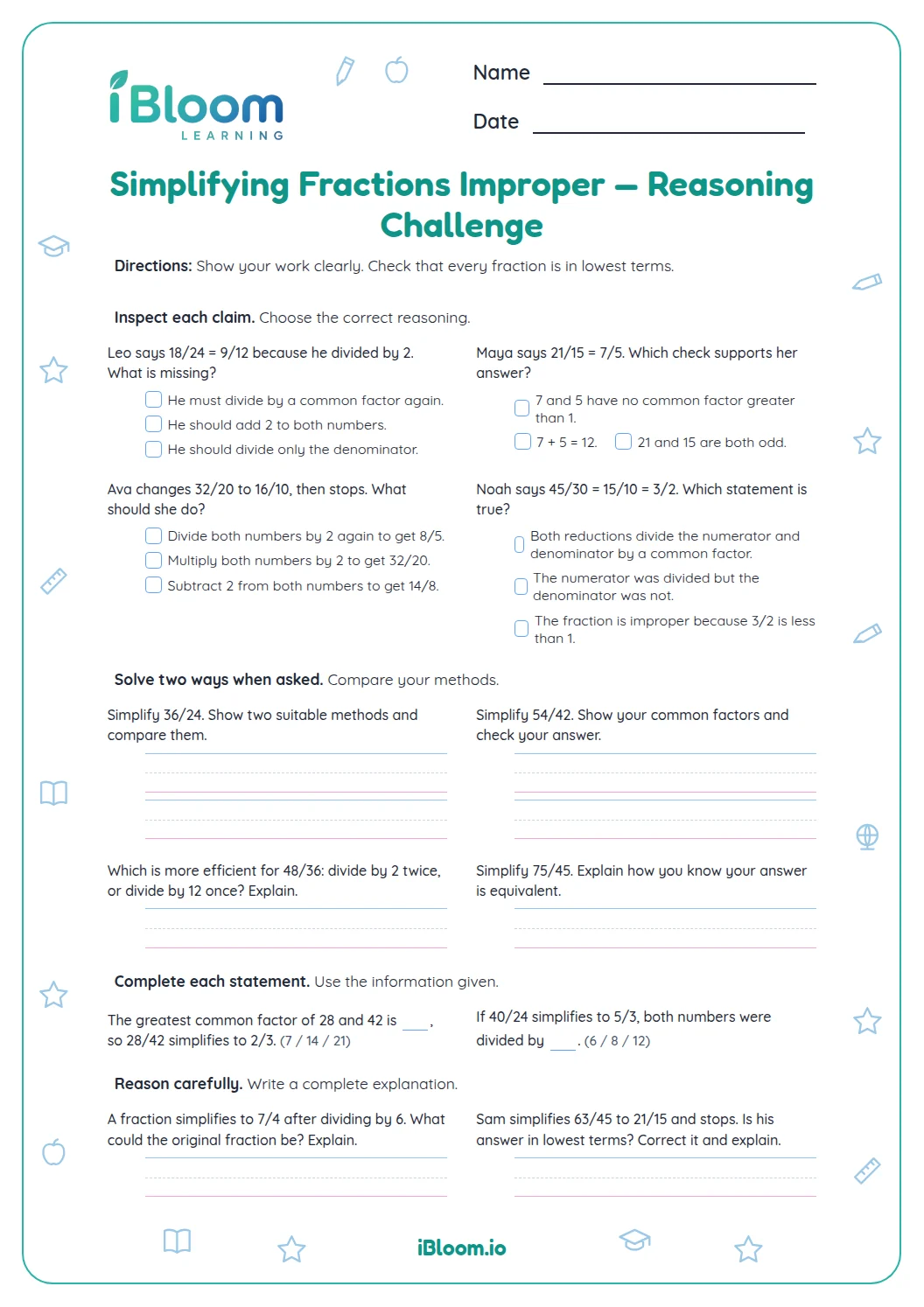
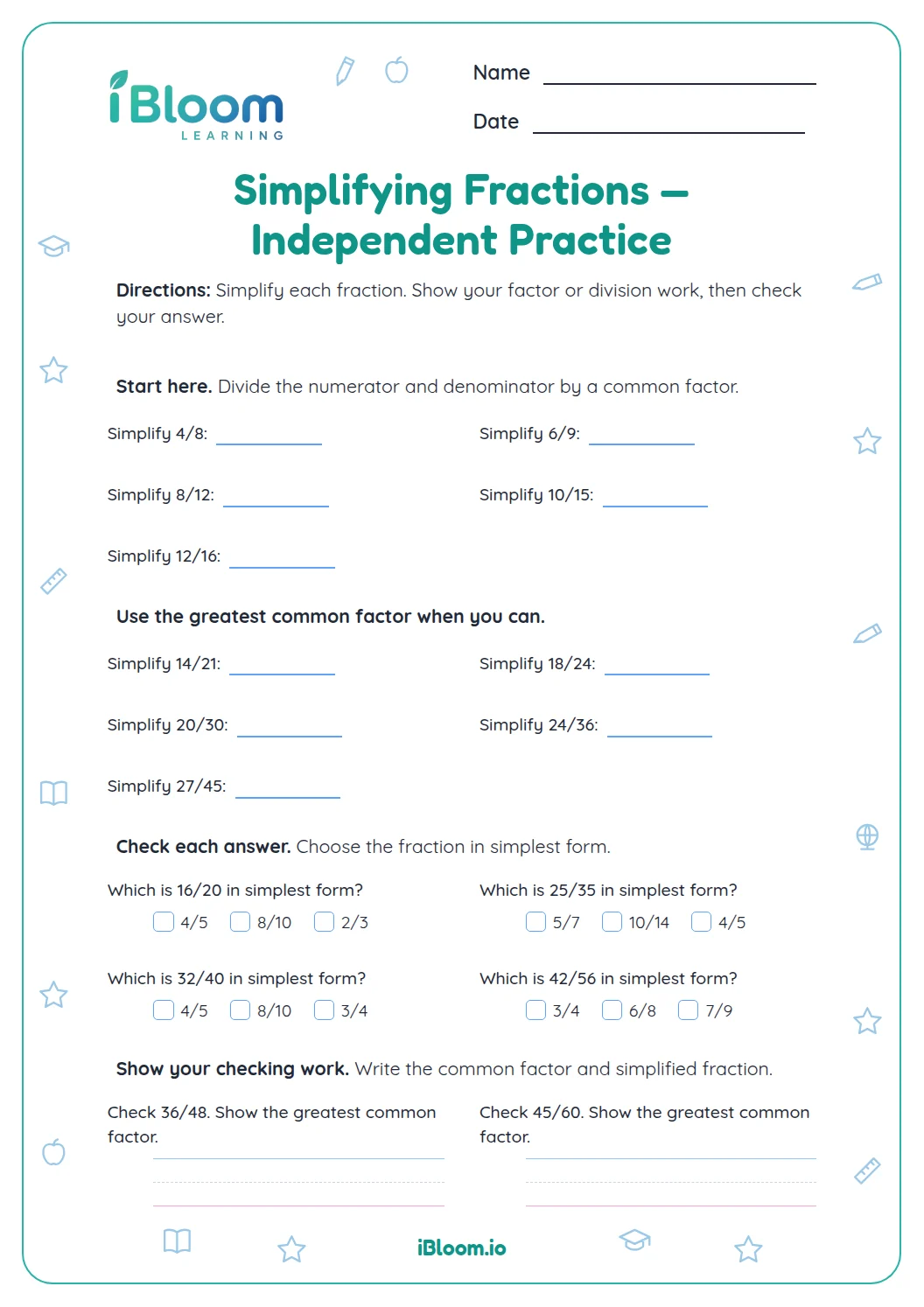
This free printable worksheet gives Grade 5 students independent practice simplifying improper fractions. Part A contains six fractions with familiar common factors. Part B adds six fractions with larger numbers, including two that simplify to whole numbers. Students divide the numerator and denominator by a shared factor until no common factor greater than 1 remains. They keep non-whole answers as improper fractions. The 12 questions apply Common Core 4.NF.A.1 by generating equivalent fractions with smaller numerator and denominator values. A separate answer key lists the simplified results, and each problem has space to record factor divisions.
Aligned to 4.NF.A.1
What does lowest terms mean for an improper fraction?
A fraction is in lowest terms when its numerator and denominator have no common factor greater than 1. The numerator can still be greater than the denominator. For example, 9/4 is in lowest terms because 9 and 4 share no factor except 1.
An improper fraction has a numerator greater than or equal to its denominator. Simplifying changes the way that amount is written. It does not change how much the fraction represents.
How do students choose a common factor?
Look for a number that divides both the numerator and denominator evenly. Using the greatest common factor finishes the reduction in one step, but repeated divisions by smaller common factors also work. After each step, inspect both numbers again.
- 142/18
- 242 and 18 share a greatest common factor of 6.
- 342 ÷ 6 = 7; 18 ÷ 6 = 3
- 442/18 = 7/3
- 57 and 3 share no common factor greater than 1.
Should the final answer be a fraction or a whole number?
The directions ask students to keep fractional answers improper. For 42/18, write 7/3. This makes it easy to see that both original numbers were divided by the same factor.
When the reduced denominator is 1, write the result as a whole number. In question 11, 48/16 reduces to 3/1, which is 3. Question 12 also has a whole-number result. The other ten answers remain improper fractions.
How to use this worksheet
- 1Read the answer-format directions before starting Part A.
- 2Find a common factor of the numerator and denominator in each question.
- 3Divide both numbers by that factor and record the equivalent fraction.
- 4Check whether the new numerator and denominator still share a factor greater than 1.
- 5Keep fractional answers improper; write a whole number if the denominator becomes 1.
- 6Reverse each factor division by multiplying both fraction parts by that factor; check lowest terms separately.
Mistakes to check together
The mistake
Dividing only the numerator: 42/18 becomes 7/18.
The fix
Divide both numbers by 6 to keep the value unchanged: 7/3.
The mistake
Stopping at 21/9 after simplifying 42/18 by 2.
The fix
21 and 9 still share a factor of 3. Divide again to reach 7/3.
The mistake
Subtracting 6 from both parts of 42/18 to get 36/12.
The fix
Use division by a common factor: 42 ÷ 6 = 7 and 18 ÷ 6 = 3. Subtracting changes the value.
Common Core alignment
Generate equivalent fractions by dividing the numerator and denominator by a common factor.
On this sheet: Students apply fraction equivalence to reduce improper fractions while keeping their values equal.
Show the official wordingHide the official wording
Explain why a fraction a/b is equivalent to a fraction (n × a)/(n × b) by using visual fraction models, with attention to how the number and size of the parts differ even though the two fractions themselves are the same size. Use this principle to recognize and generate equivalent fractions.
What to practice next
Make more practice
Further reading
Questions parents and teachers ask
Should students convert the answers to mixed numbers?
Keep fractional answers as improper fractions on this sheet. For question 8, the requested answer is 7/3, even though 2 1/3 represents the same amount. This answer format keeps attention on common factors. Write a whole number when the fraction divides evenly, as in the last two questions.
Can my child simplify in more than one step?
Yes, repeated division by common factors is valid. For 42/18, dividing both numbers by 2 gives 21/9, and then dividing both by 3 gives 7/3. Using the greatest common factor, 6, reaches the same result in one step. Check that each division applies to both numbers.
How can an improper fraction already be in lowest terms?
The size of the numerator does not decide whether a fraction can be reduced. Only shared factors matter. After simplifying 18/8 to 9/4, the numerator is still larger, but 9 and 4 share no factor greater than 1. That makes 9/4 a finished answer for this worksheet.
Why do the last two answers become whole numbers?
Their numerators are exact multiples of their denominators. Question 11 gives 48/16, so three groups of 16 make 48 and the result is 3. Question 12 gives 100/25, which equals 4. Both follow the same common-factor rule as the other fractions on the sheet.
How can I check that a reduced fraction is equivalent?
Reverse each reduction by multiplying both fraction parts by the factor used in that step. For 7/3, multiplying by 6 recovers 42/18. If your child reduced in several steps, reverse each one. Then check that the final numerator and denominator share no factor greater than 1.