
About this worksheet
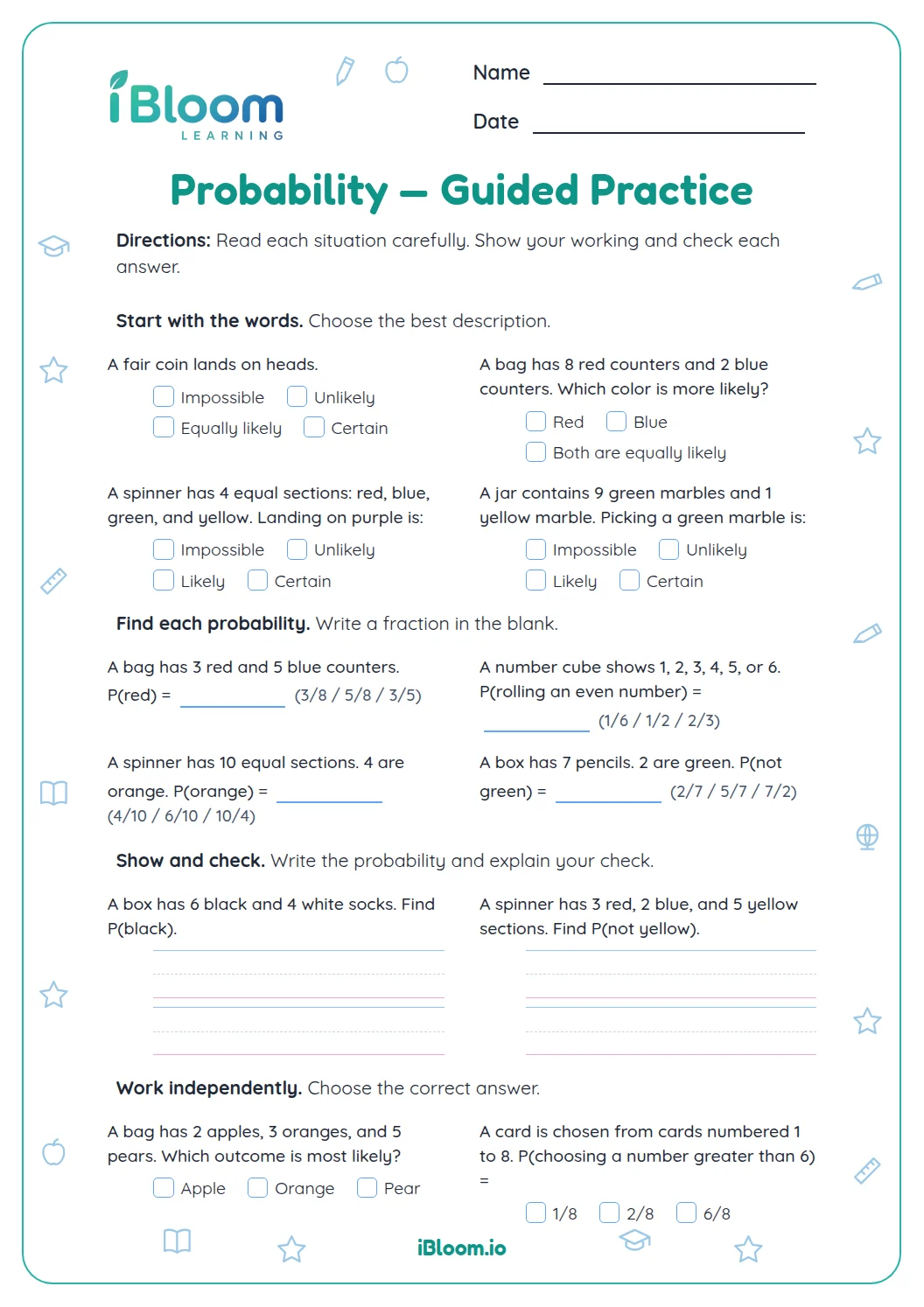
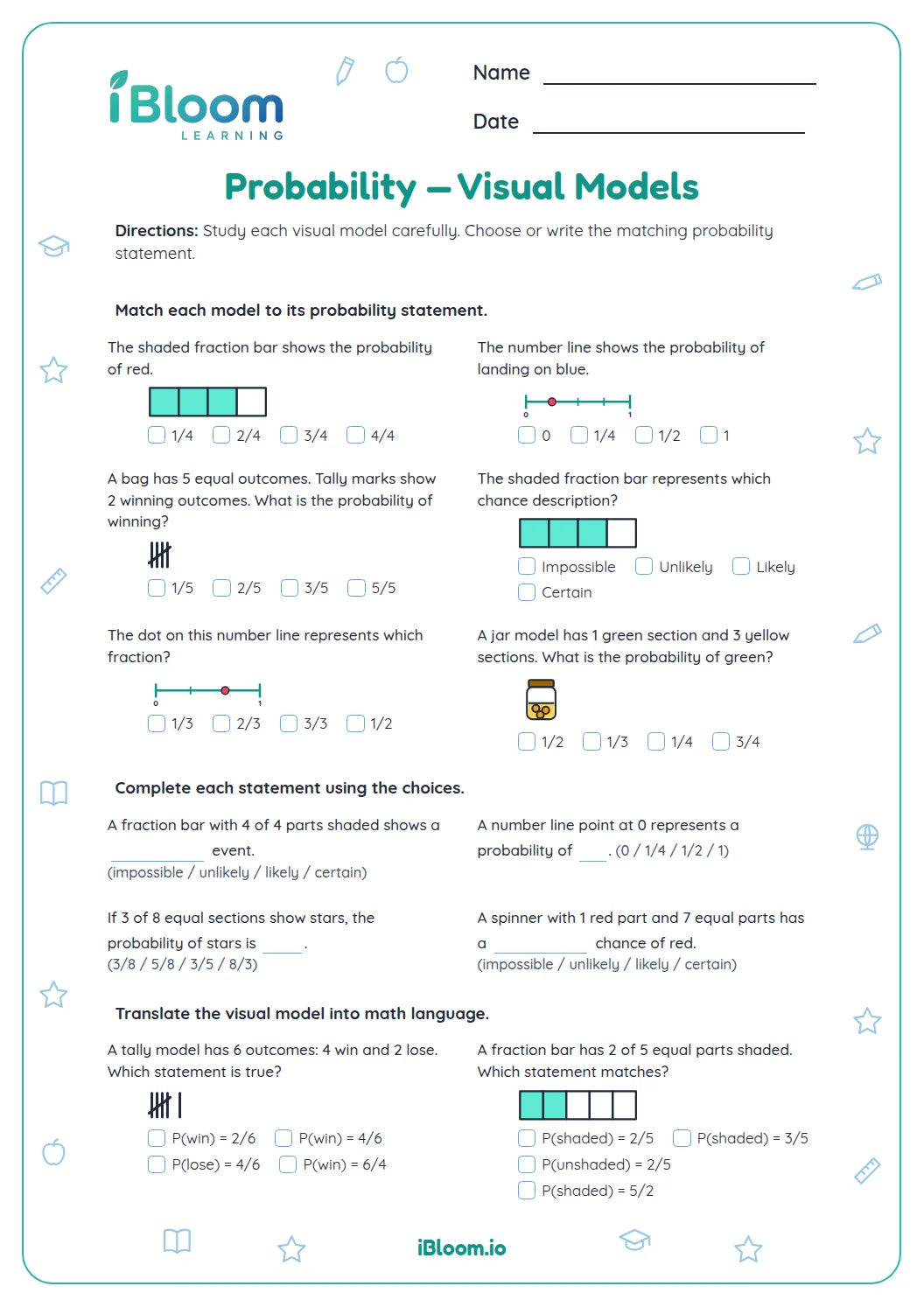
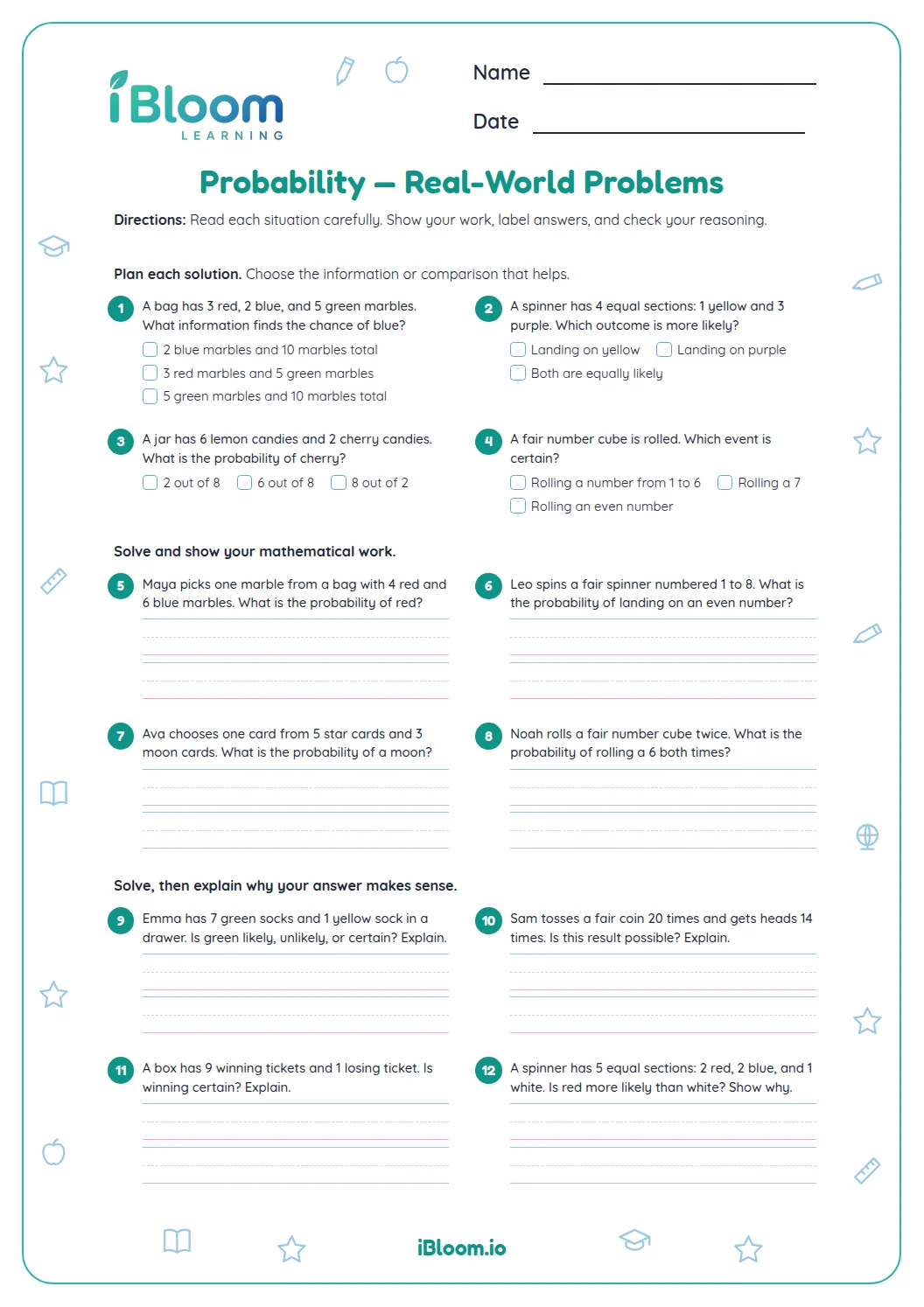
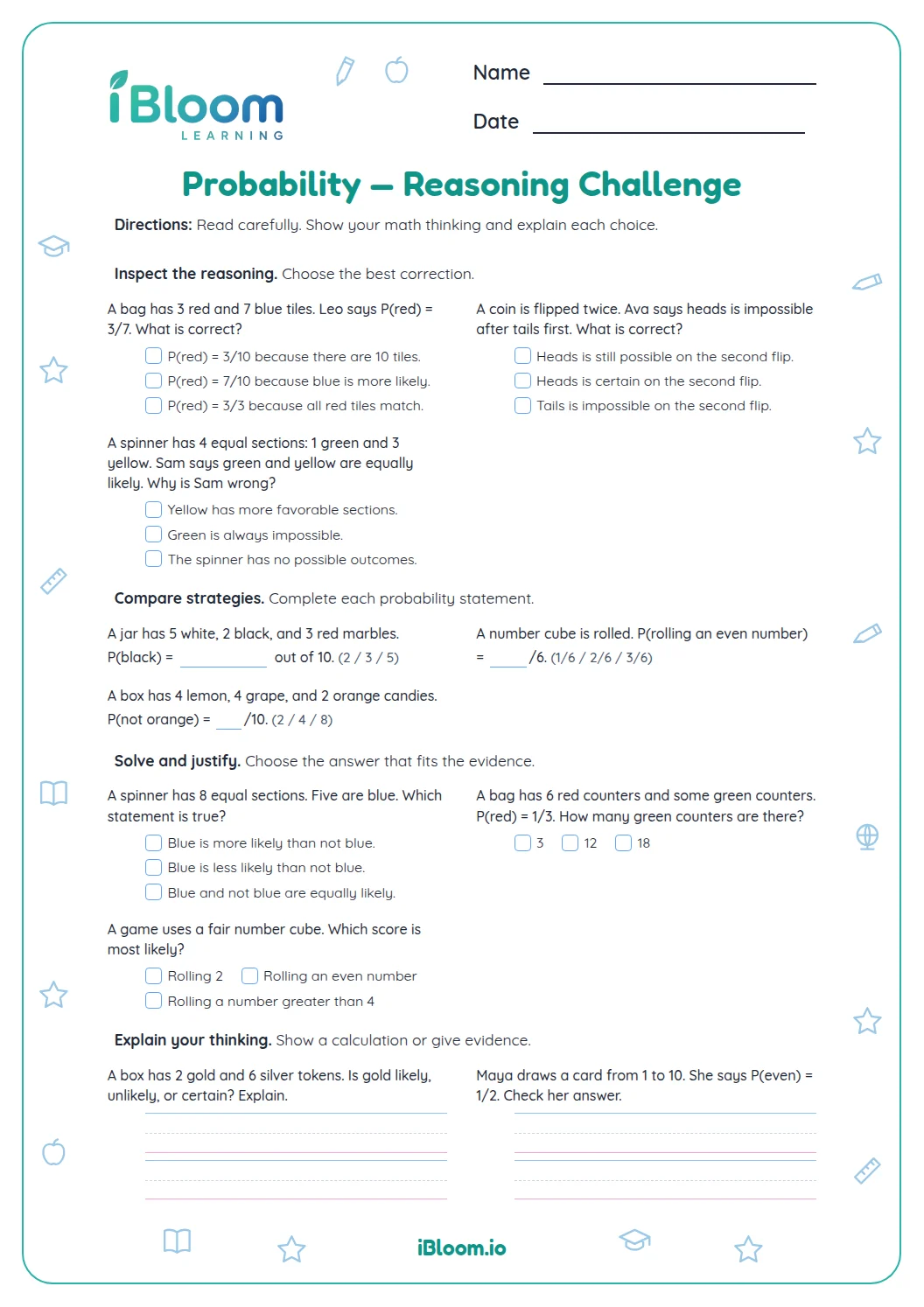
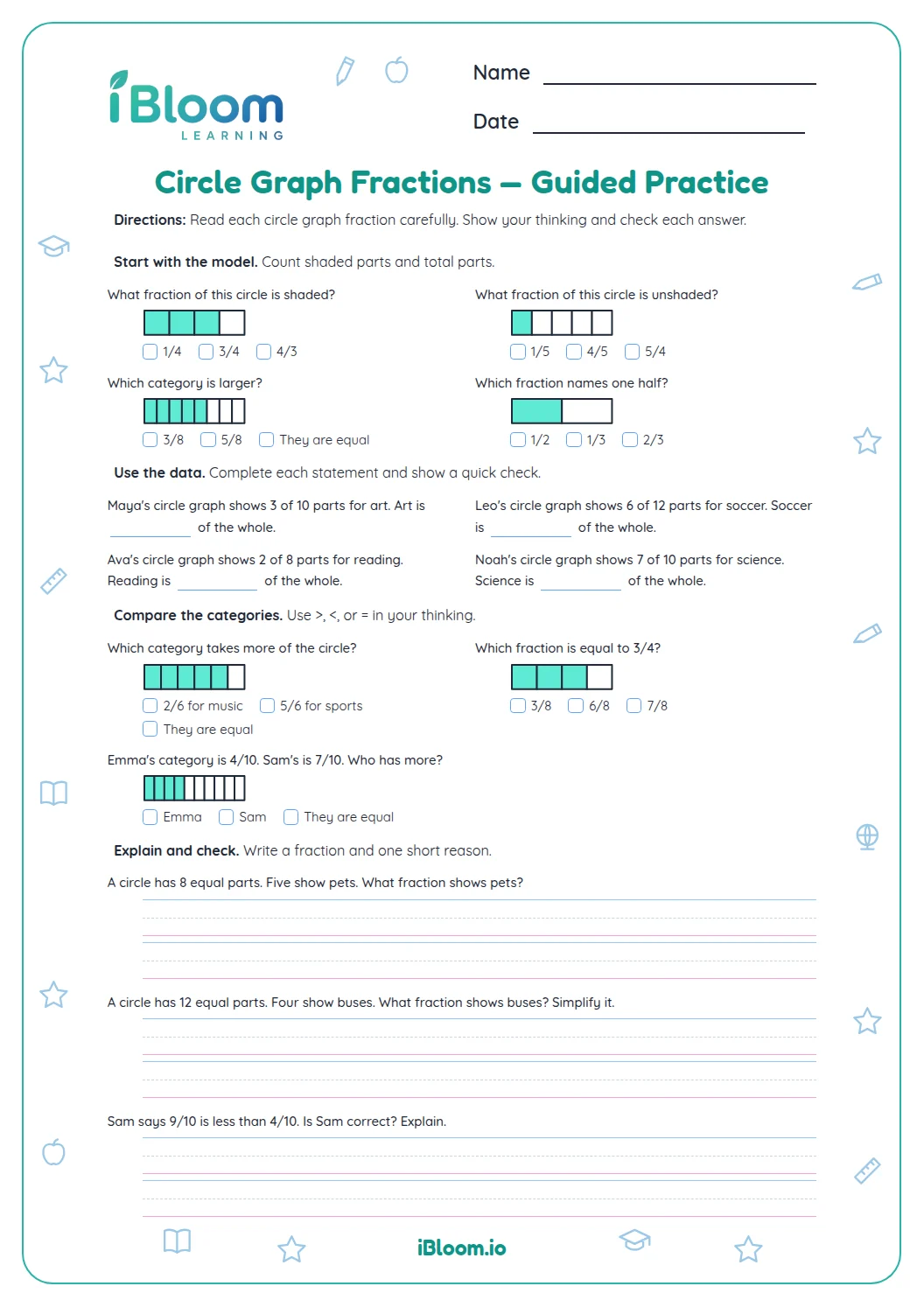
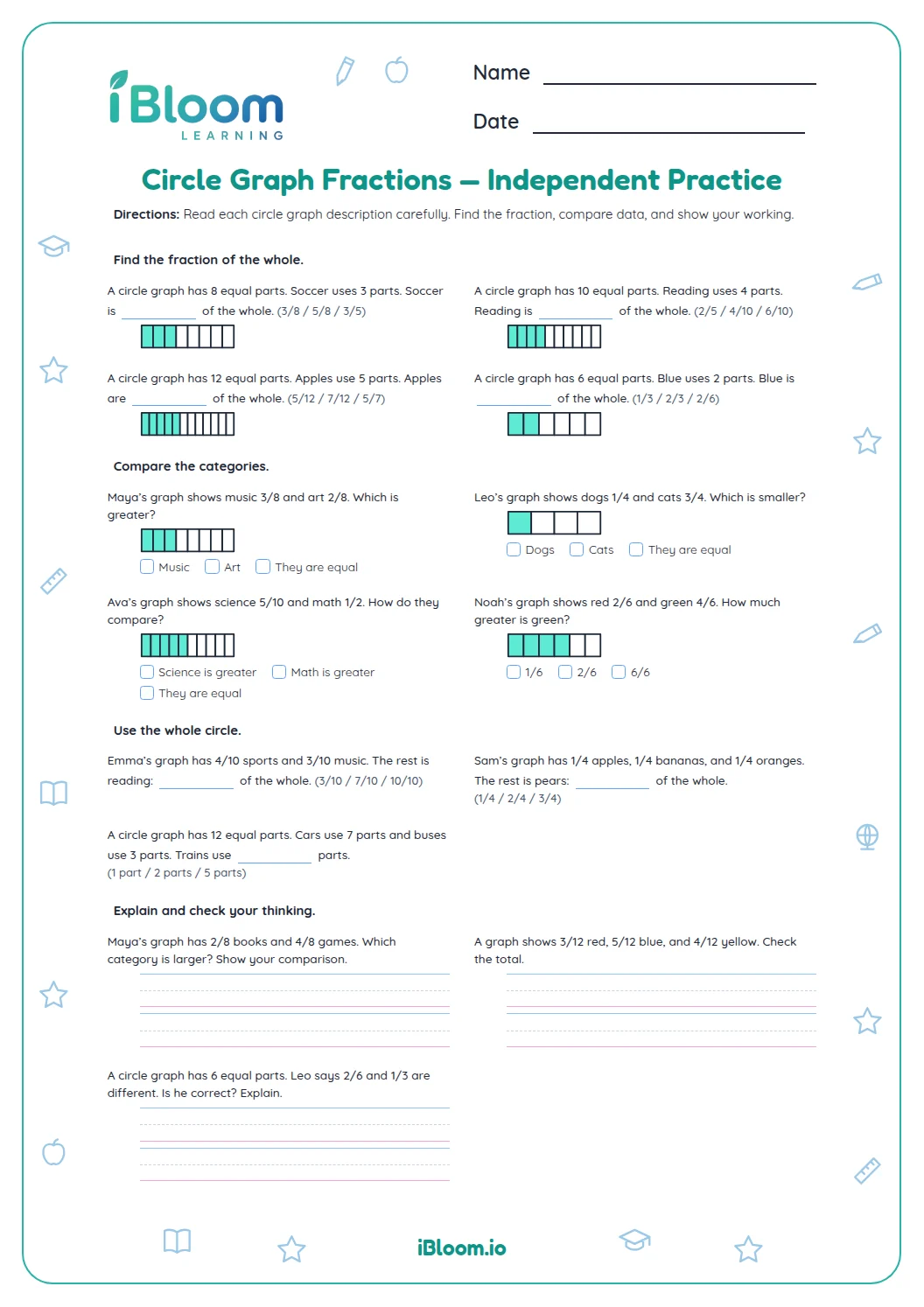
This Grade 5 worksheet introduces chance with familiar events, a fair die, a coin, a spinner, and counters. Students choose likelihood words, write simple probabilities as fractions, and explain what the numerator and denominator count. The separate answer key gives the fraction answers and brief reasoning.
Read a line plot before you reason about chance
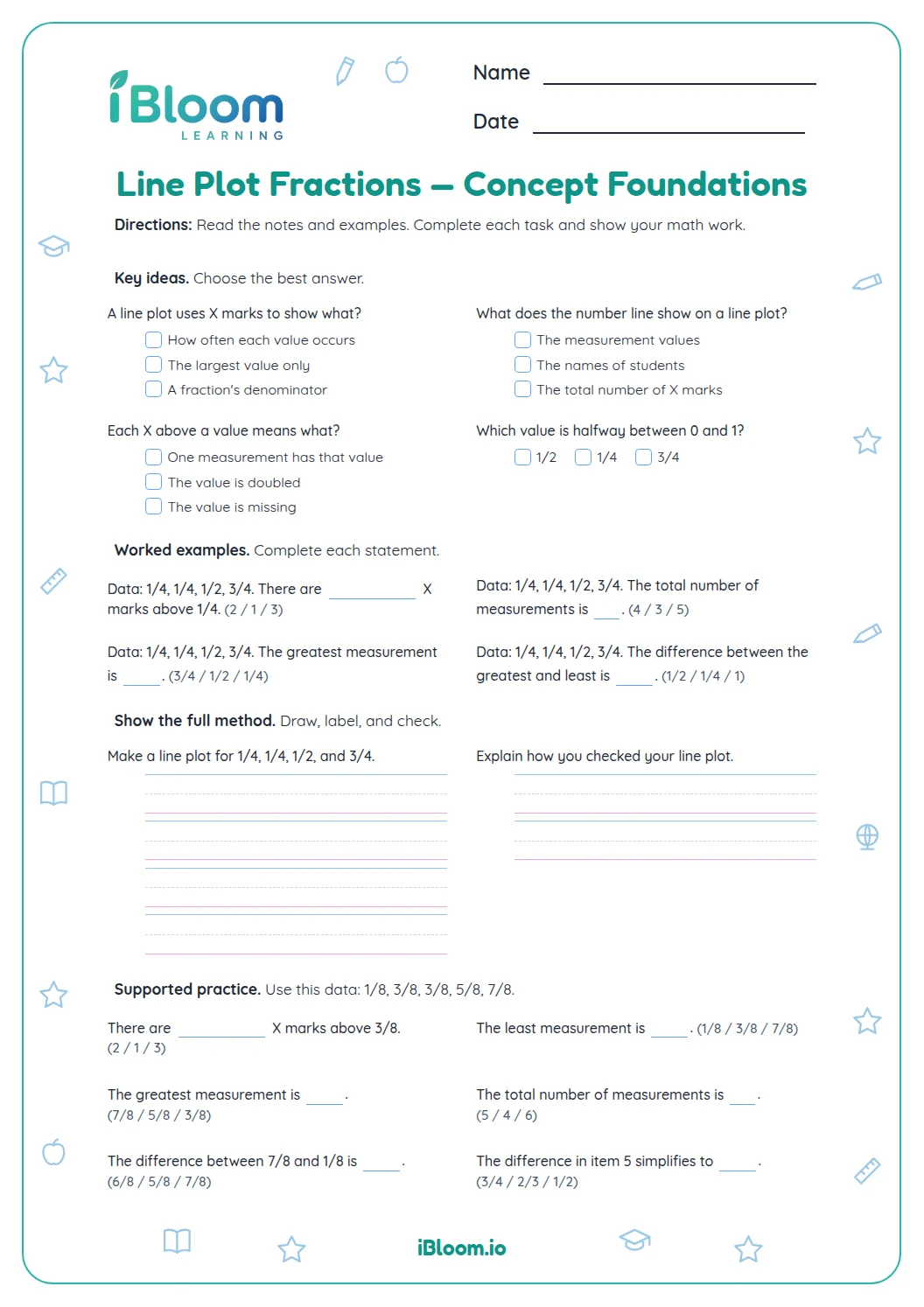
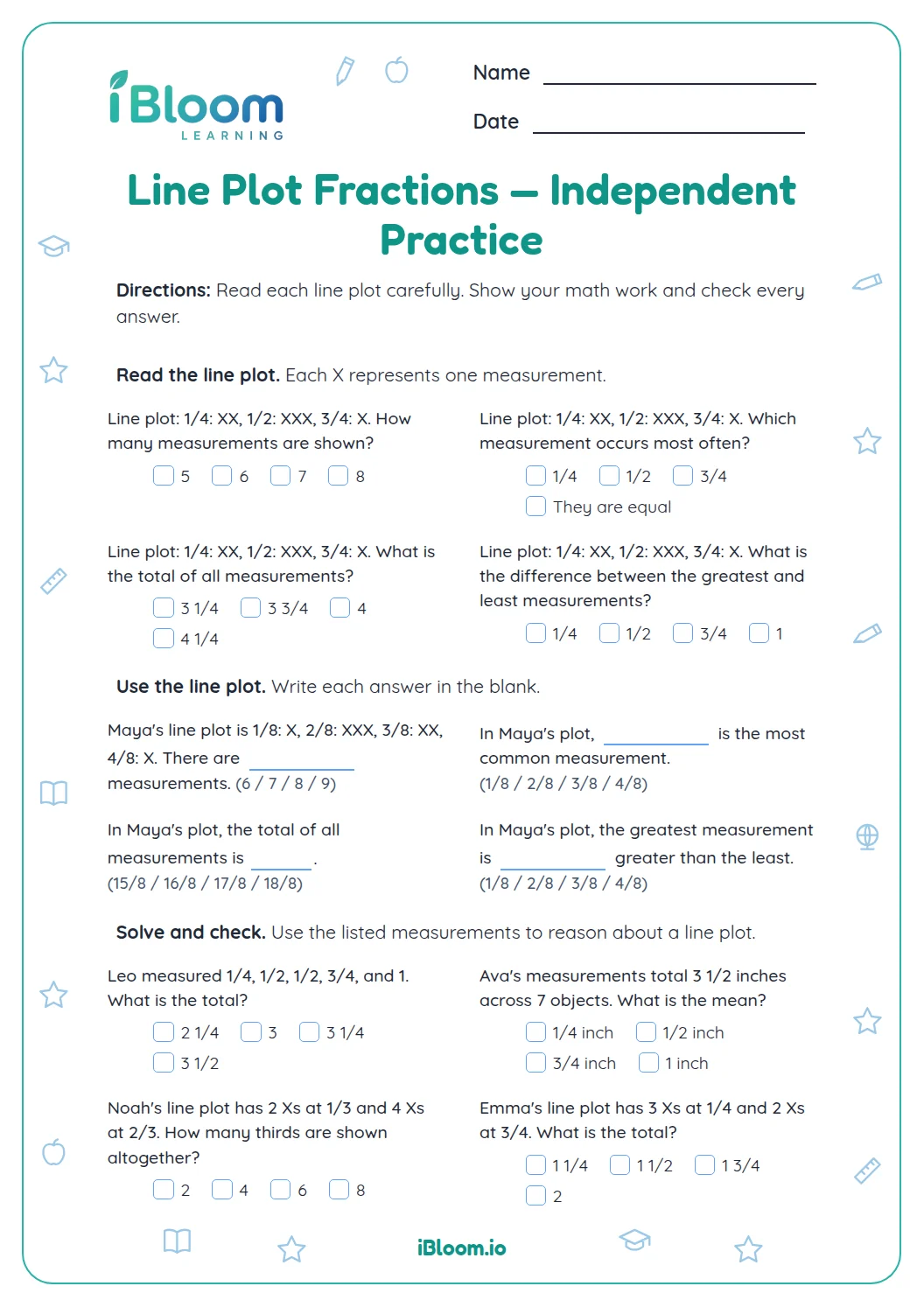
Each X is one measurement. On this sheet, the tallest stack is above 3/4 inch, so 3/4 inch is the most common length. Count all the X marks to find the total number of measurements.
When you compare categories, use the values represented by the data rather than the number of labels. A category can be more likely even when it is not the first option listed.
- Part A: find the most common measurement and total the X marks.
- Part B: compare outcomes and describe simple probabilities.
Use favorable outcomes over total outcomes
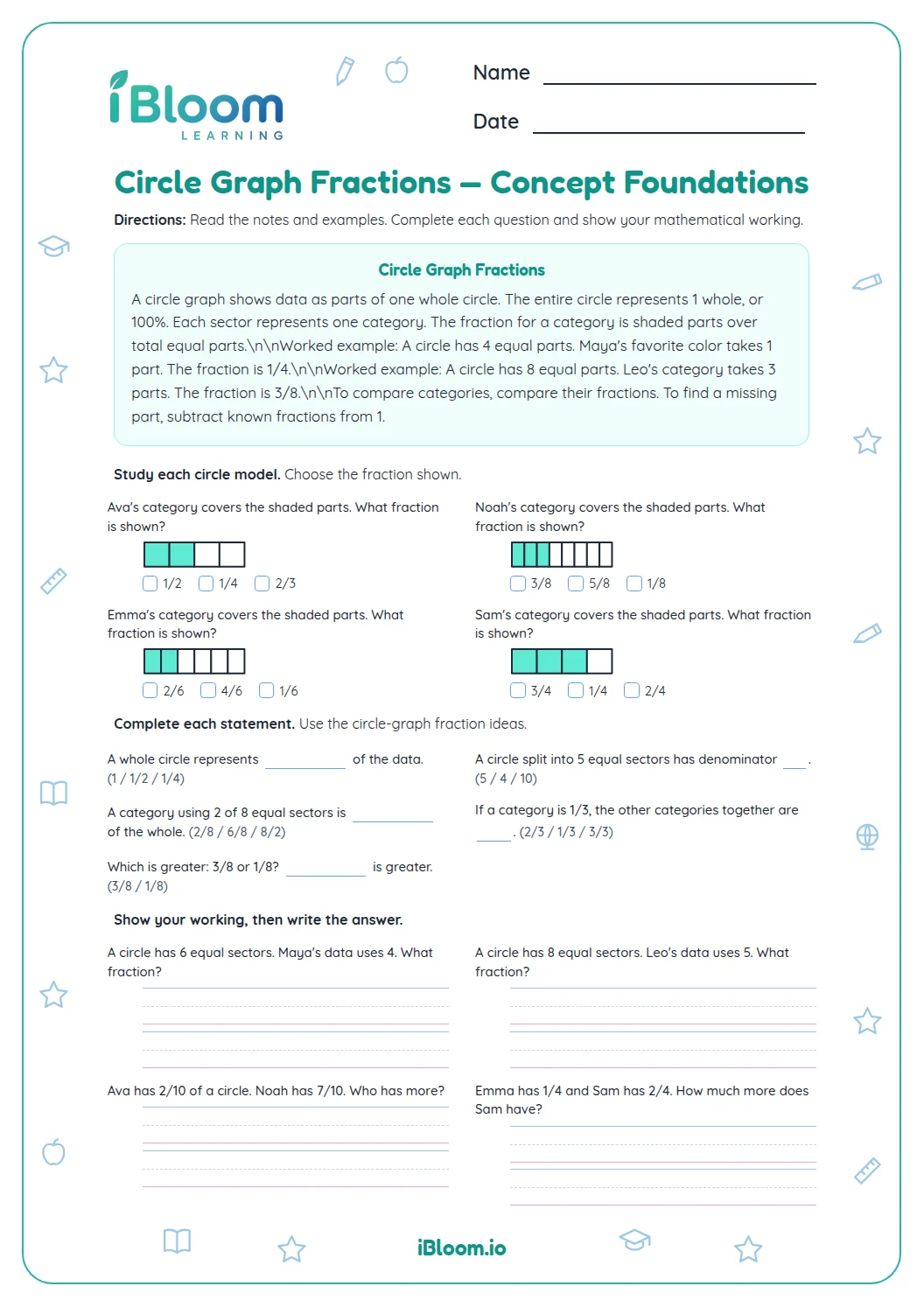
For a probability fraction, the numerator counts the outcomes you want. The denominator counts all equally likely outcomes. Seven grape votes out of 24 votes gives 7/24; four white beads out of eight beads gives 4/8, or 1/2.
Words such as certain and impossible describe the ends of the scale. If an event must happen, it is certain. If the outcome cannot occur, it is impossible. An unlikely event can still happen.
- Ask “How many outcomes match?” for the numerator.
- Ask “How many outcomes are possible altogether?” for the denominator.
How to work through this page
- 1Read the line plot and count each stack of X marks.
- 2Use the counts in the chance situations. Keep the total outcomes in the denominator.
- 3Check that a probability is between zero and one.
Common mistakes and how to check
The mistake
Using the favorable count as the whole fraction
The fix
The denominator is the total number of possible outcomes, not just the outcomes you want. For 7 grape votes out of 24, use 7/24.
The mistake
Calling an unlikely event impossible
The fix
An unlikely event still has a chance to happen. Use impossible only when the outcome cannot occur, such as rolling 7 on a number cube labeled 1 through 6.
What to practice next
Make more practice
Questions parents and teachers ask
What does probability describe?
Probability describes how likely an event is to happen. Events can be impossible, unlikely, equally likely, likely, or certain. On this sheet, rolling an 8 on a fair six-sided die is impossible, while rolling a number from 1 through 6 is certain.
How do I write probability as a fraction?
Count the outcomes that match the event and put that count over the total number of equally likely outcomes. Question 5 has three green marbles among five marbles, so P(green) is 3/5. The numerator counts green marbles and the denominator counts all marbles.
What does equally likely mean?
Two outcomes are equally likely when they have the same chance of happening. A fair coin gives heads and tails equal chances, so P(tails) is 1/2. Question 4 asks students to recognize that balance before they calculate fractions from groups with different counts.
Why is rolling an 8 impossible on a fair die?
A standard fair die has six faces numbered 1 through 6. Since no face shows 8, there are zero favorable outcomes, so the probability is zero. Question 15 asks students to correct Noah’s claim that the chance is 1/6.
Is there an answer key?
Yes. The separate answer key lists the likelihood words and fraction answers, then gives sample reasoning for the written explanations. For a probability fraction, check both counts: the top number is the favorable outcomes and the bottom number is all equally likely outcomes.