
About this worksheet
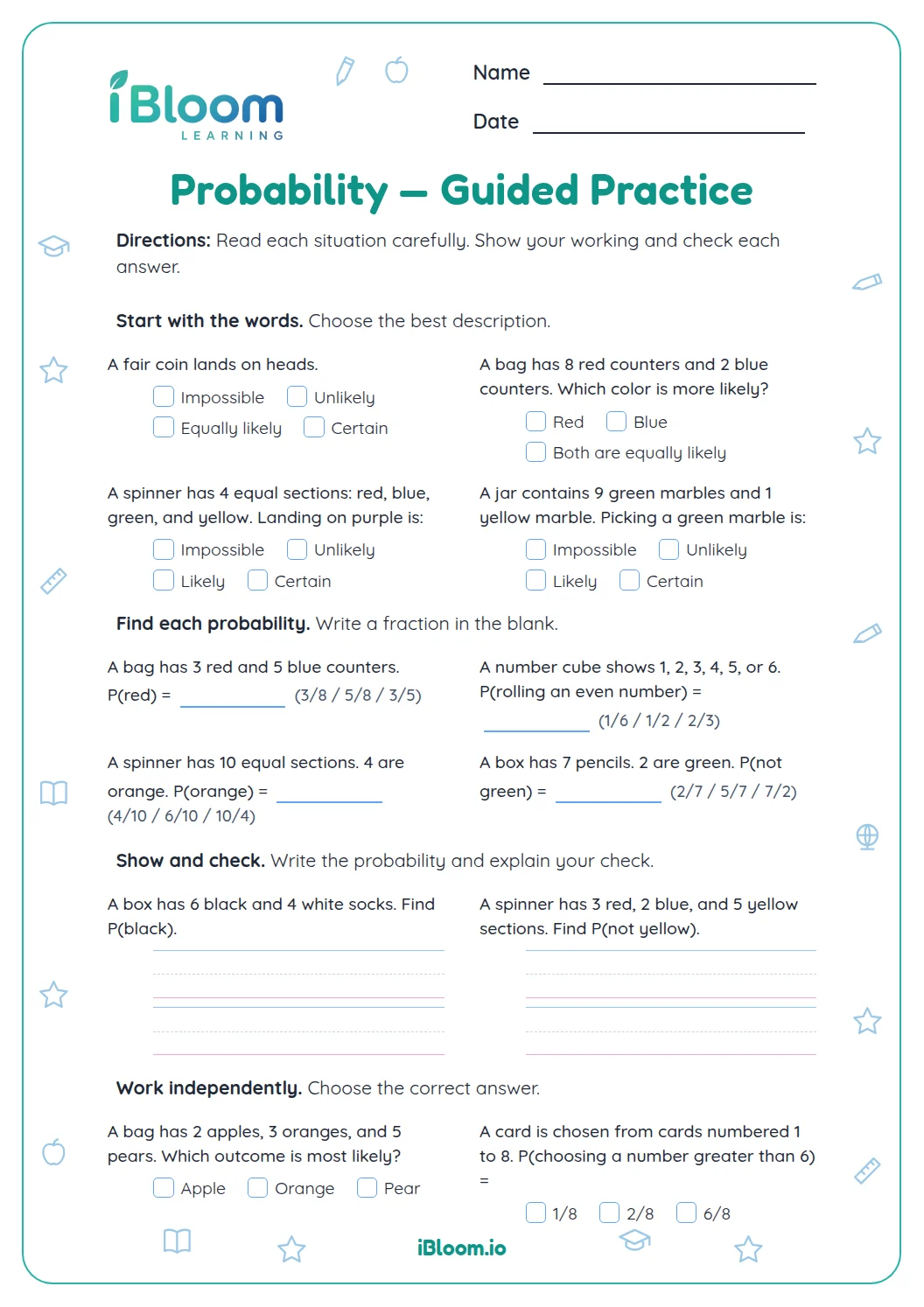
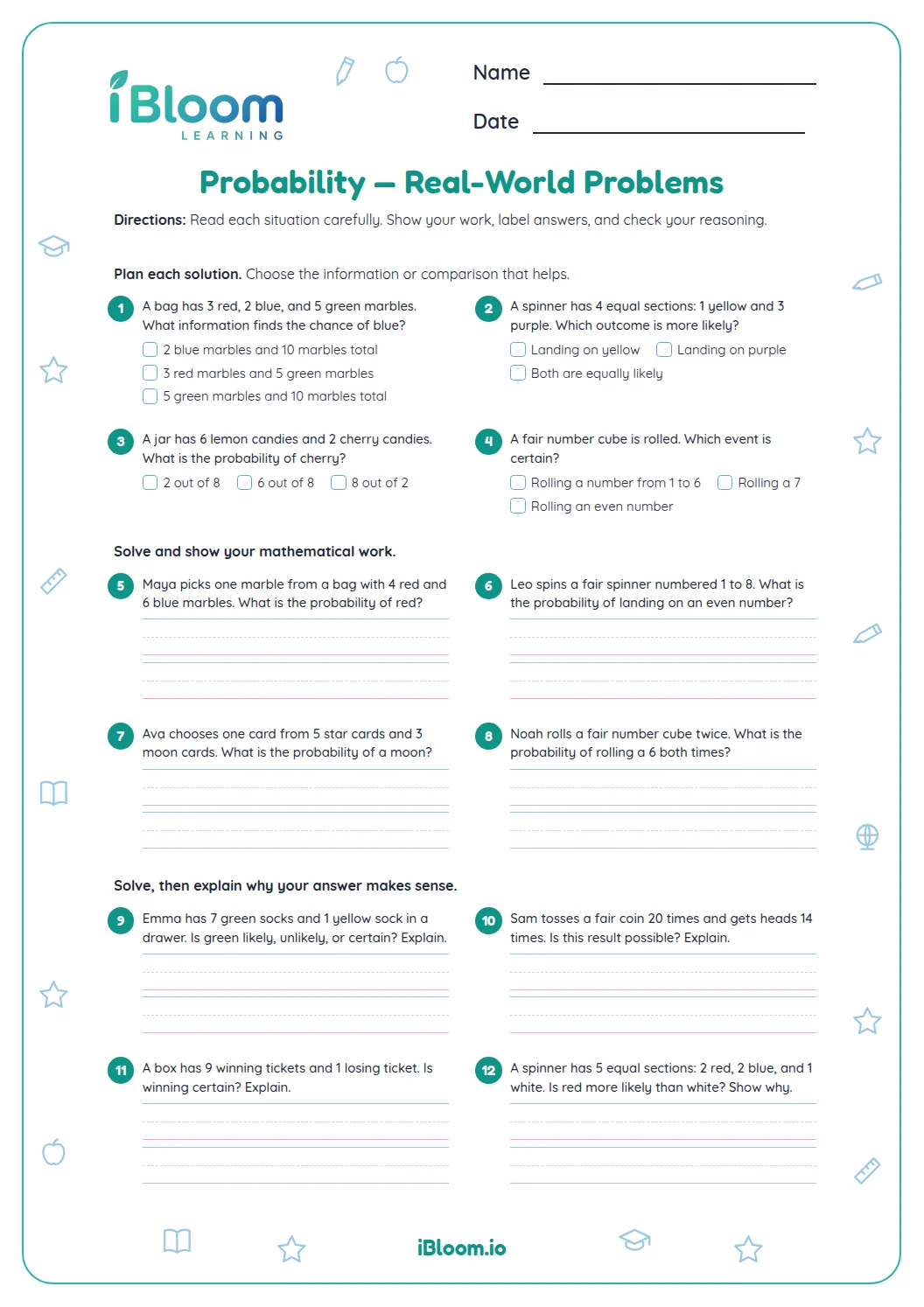
This independent practice page asks students to describe chance with fractions, compare equally likely outcomes, and distinguish a possible event from a certain one. Every situation names the total outcomes so the probability is clear. The final questions separate expected results from guaranteed results.
Aligned to 7.SP.C.5
What is on this worksheet?
Students find probabilities for coins, number cubes, spinners, cards and counters. The first part focuses on favorable outcomes over total outcomes. The next part uses the words impossible and certain, then asks students to reason about trials.
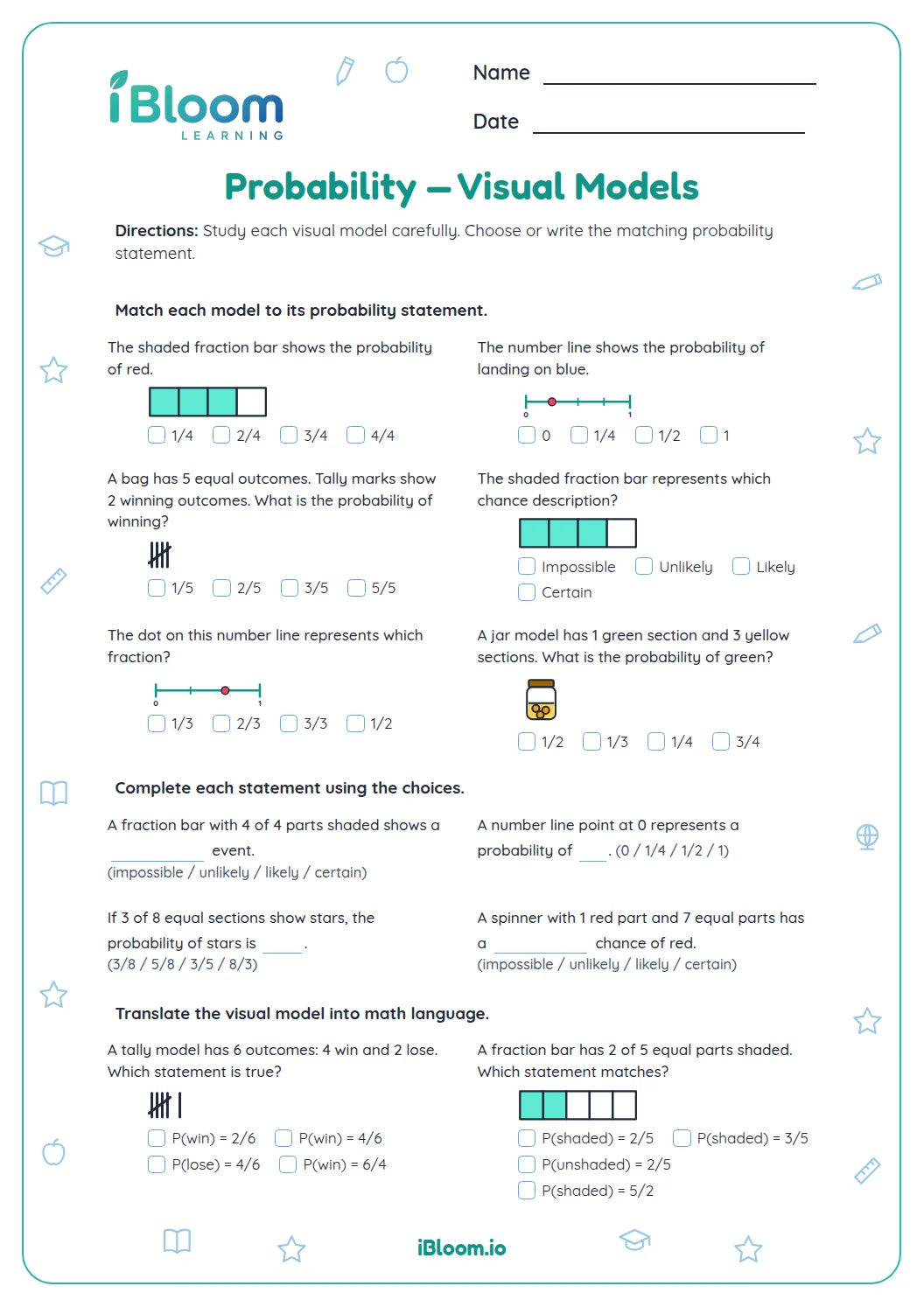
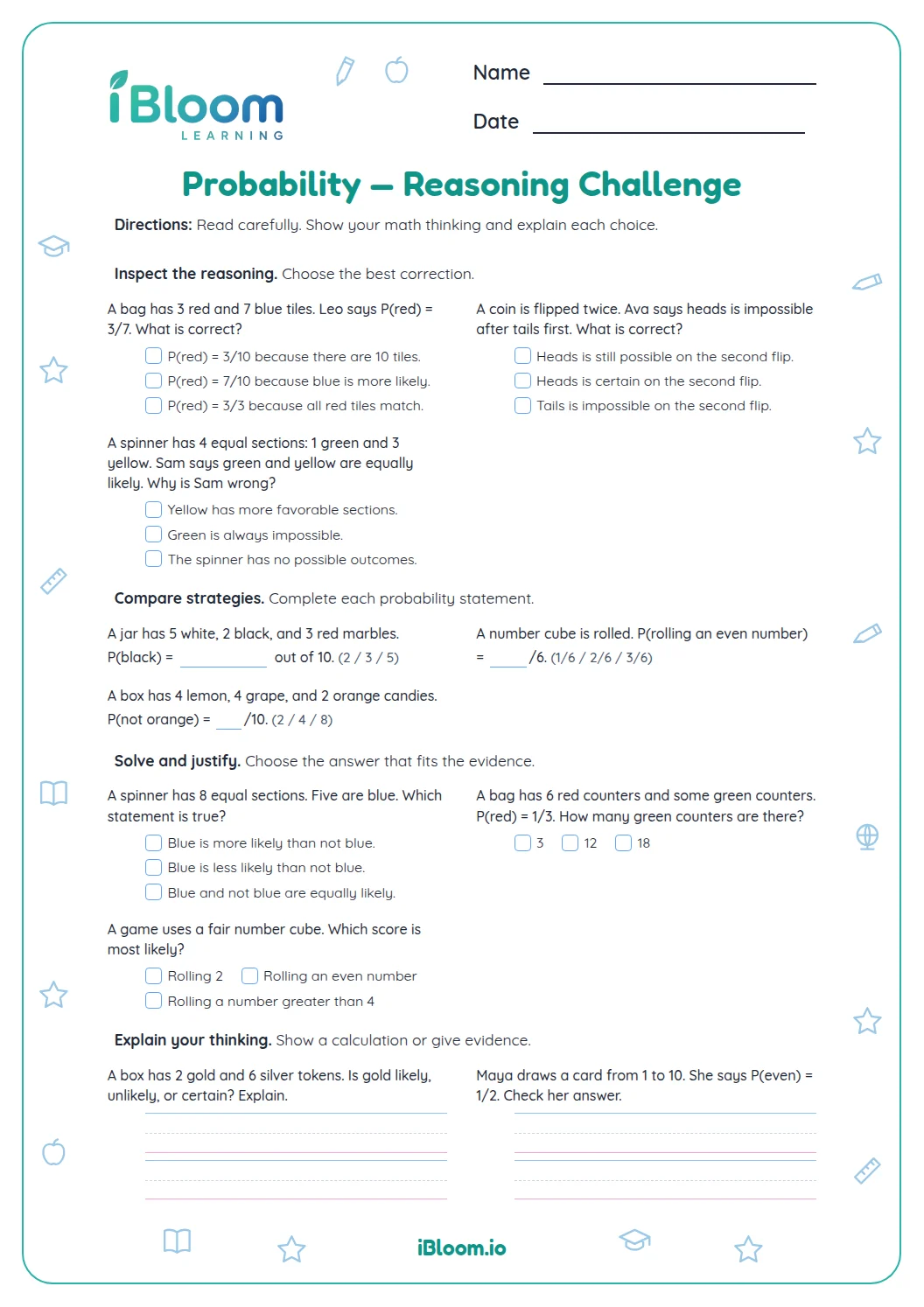
The next part compares chances and uses impossible and certain. The final problems connect outcome counts with a probability fraction.
- Part A: write probabilities for equally likely outcomes.
- Part B: compare chances and use likelihood words.
- Part C: reason from counts and trial results.
How do you write probability as a fraction?
For equally likely outcomes, place the number of favorable outcomes over the total number of outcomes. If two of five tiles are blue, P(blue) = 2/5.
The numerator counts the outcomes that match the event. The denominator counts every possible outcome. Both counts must refer to the same set of choices.
What is the difference between likely and certain?
A likely result has a good chance of happening, but it is not guaranteed. A certain result must happen; an impossible result cannot happen in the situation described.
Even a fair coin can land heads several times in a row. A probability describes chance over many trials, not a promise about the next trial or a fixed number of results.
How to use this worksheet
- 1Count the outcomes that match the event.
- 2Count all equally likely outcomes.
- 3Write favorable outcomes over total outcomes and simplify when useful.
- 4For likelihood words, compare the event with every possible outcome.
- 5Remember that a trial result does not guarantee the next result.
Common mistakes and quick fixes
The mistake
Using the total outcomes as the numerator.
The fix
Put favorable outcomes on top and all equally likely outcomes below.
The mistake
Calling an event certain because it happened in a short run of trials.
The fix
Use the described outcomes to decide whether it must happen.
The mistake
Treating a fair coin’s past tosses as a prediction.
The fix
Each toss is a new trial; a past run does not determine the next result.
Curriculum alignment
The sheet builds probability understanding through equally likely outcomes, fractions, and chance comparisons.
Understand probability as a number from 0 to 1 describing likelihood.
On this sheet: Students express probabilities as fractions for equally likely outcomes and compare the likelihood of events using counts.
Show the official wordingHide the official wording
Understand that the probability of a chance event is a number between 0 and 1 that expresses the likelihood of the event occurring. Larger numbers indicate greater likelihood. A probability near 0 indicates an unlikely event; a probability around 1/2 indicates an event that is neither unlikely nor likely; and a probability near 1 indicates a likely event.
What to practice next
Make more practice
Questions parents and teachers ask
What does the probability fraction mean?
The numerator counts outcomes that match the event. The denominator counts all equally likely outcomes. Two blue tiles among five total tiles give a probability of 2/5; one tails outcome among two coin outcomes gives 1/2. Use the stated objects and counts to explain why the answer fits this particular question.
Does likely mean certain?
No. Likely means an event has a strong chance, but it might not happen. Certain means it must happen in the situation described, while impossible means it cannot happen. Use the stated objects and counts to explain why the answer fits this particular question.
Can a fair coin land heads seven times in ten tosses?
Yes. Seven heads is possible, even though the expected fraction over many tosses is about one half. A fair coin does not guarantee exactly five heads in any set of ten tosses. The ten tosses are one possible sample, not a rule that fixes the number of heads.
Why does this Grade 5 worksheet cite a Grade 7 standard?
The sheet practices probability through small counts and familiar situations. Common Core describes probability understanding in 7.SP.C.5, which connects chance events with values from zero to one and compares their likelihood. The cited standard describes this same probability idea, and the sheet applies it with small whole-number counts.
How many red counters make the colors equally likely?
Add four red counters. The box starts with two red and six blue, so four more red make six red and six blue. Each color then has the same number of counters and the same chance of being selected. Use the stated objects and counts to explain why the answer fits this particular question.