







About this worksheet
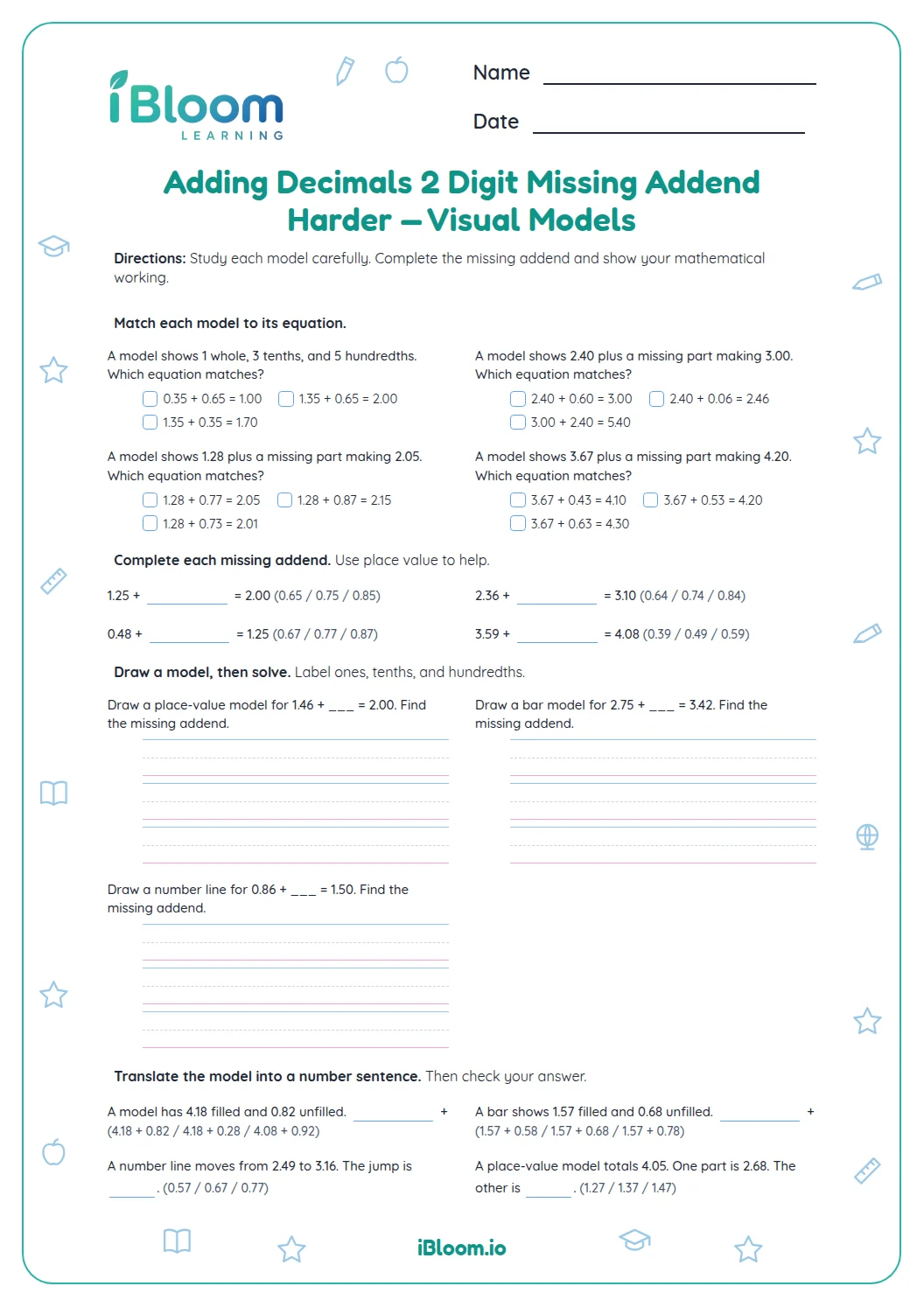
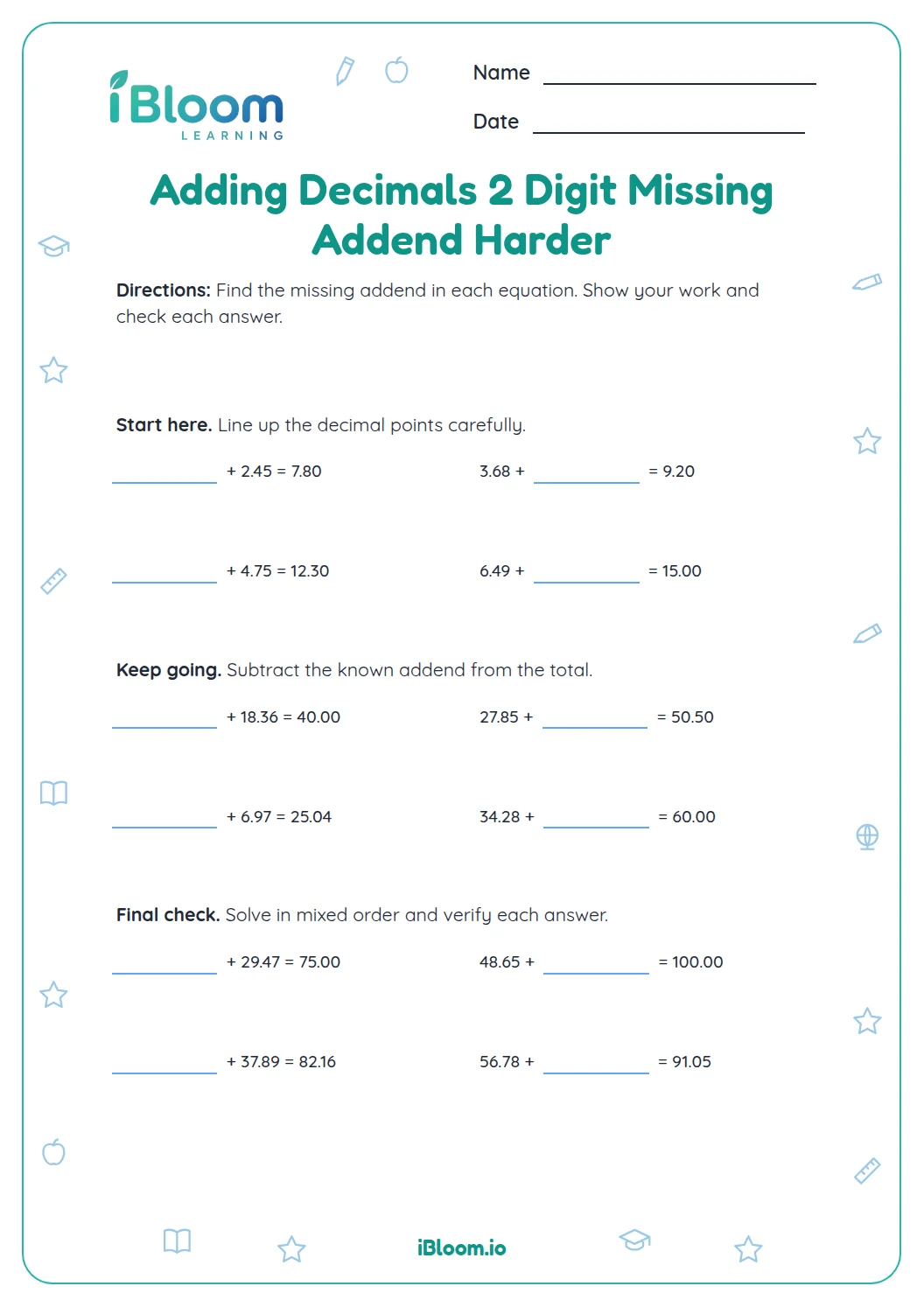
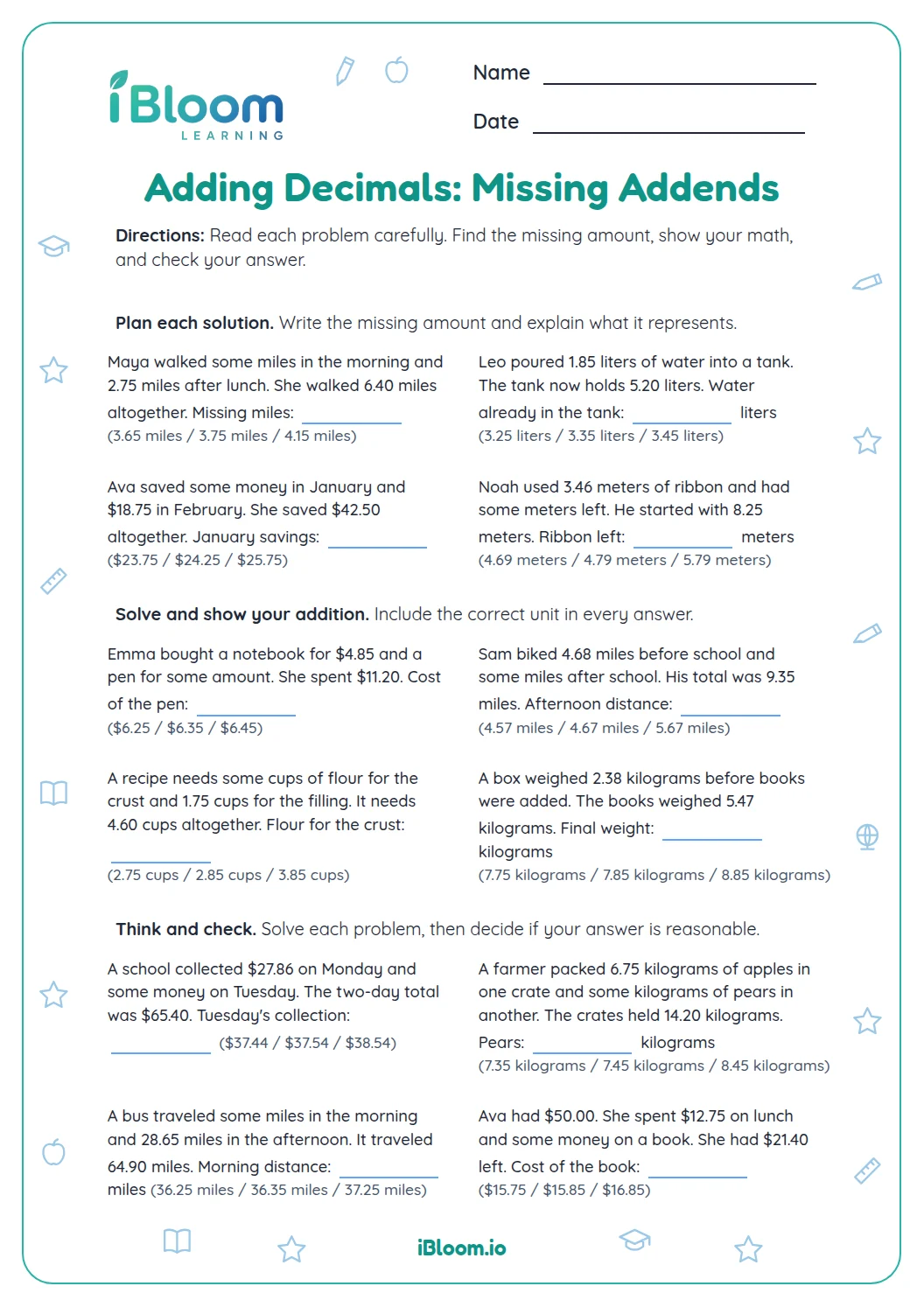
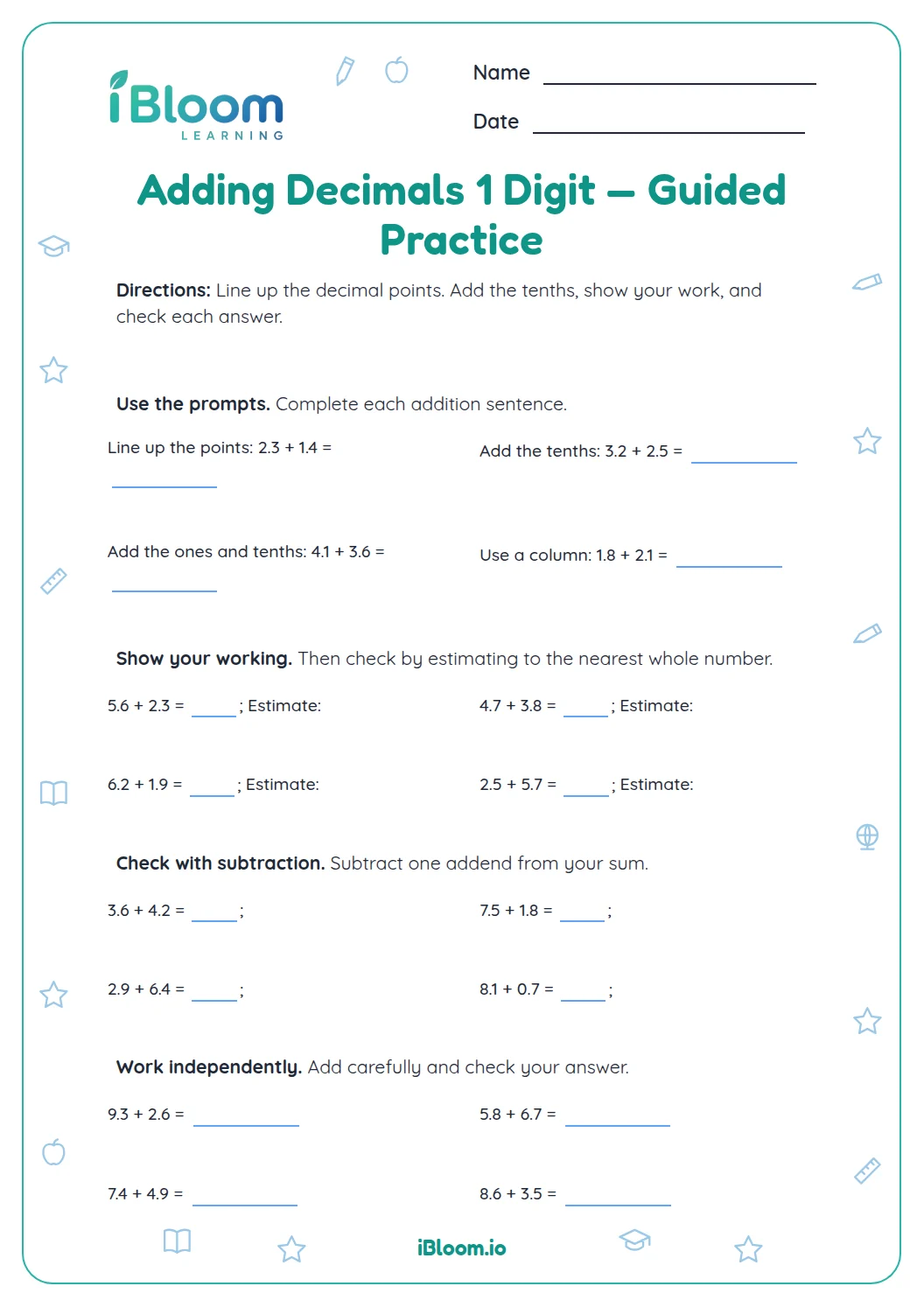
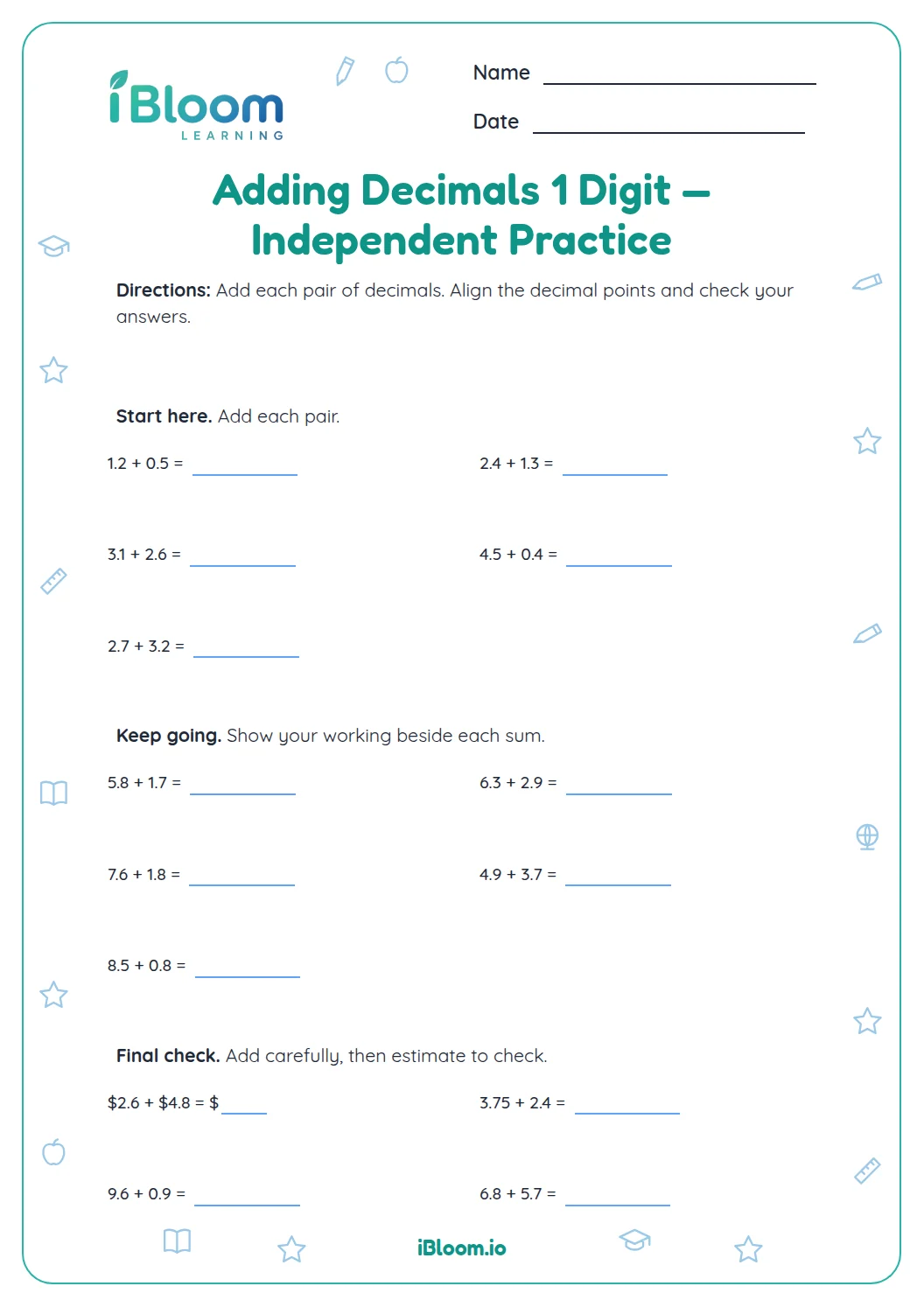
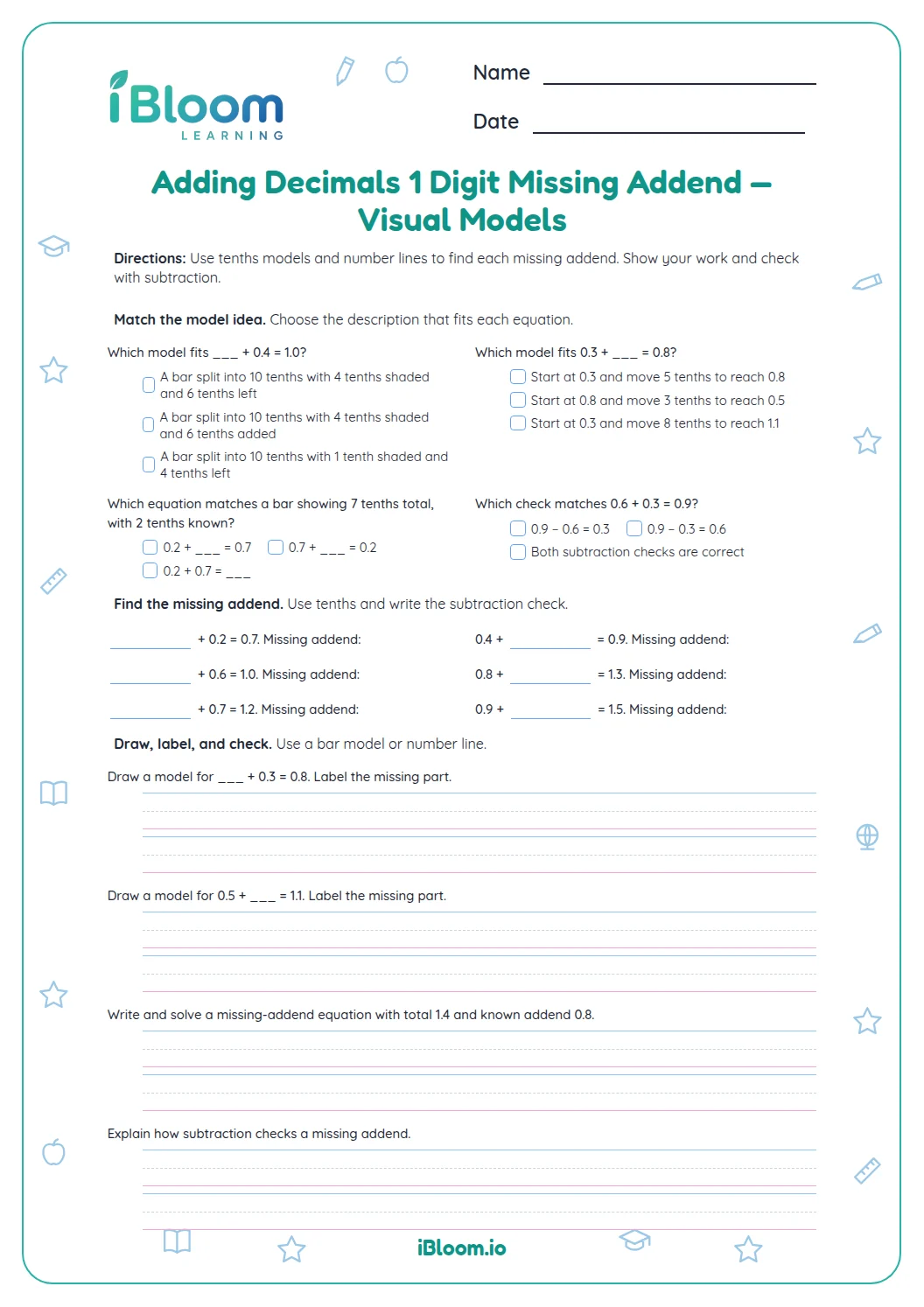
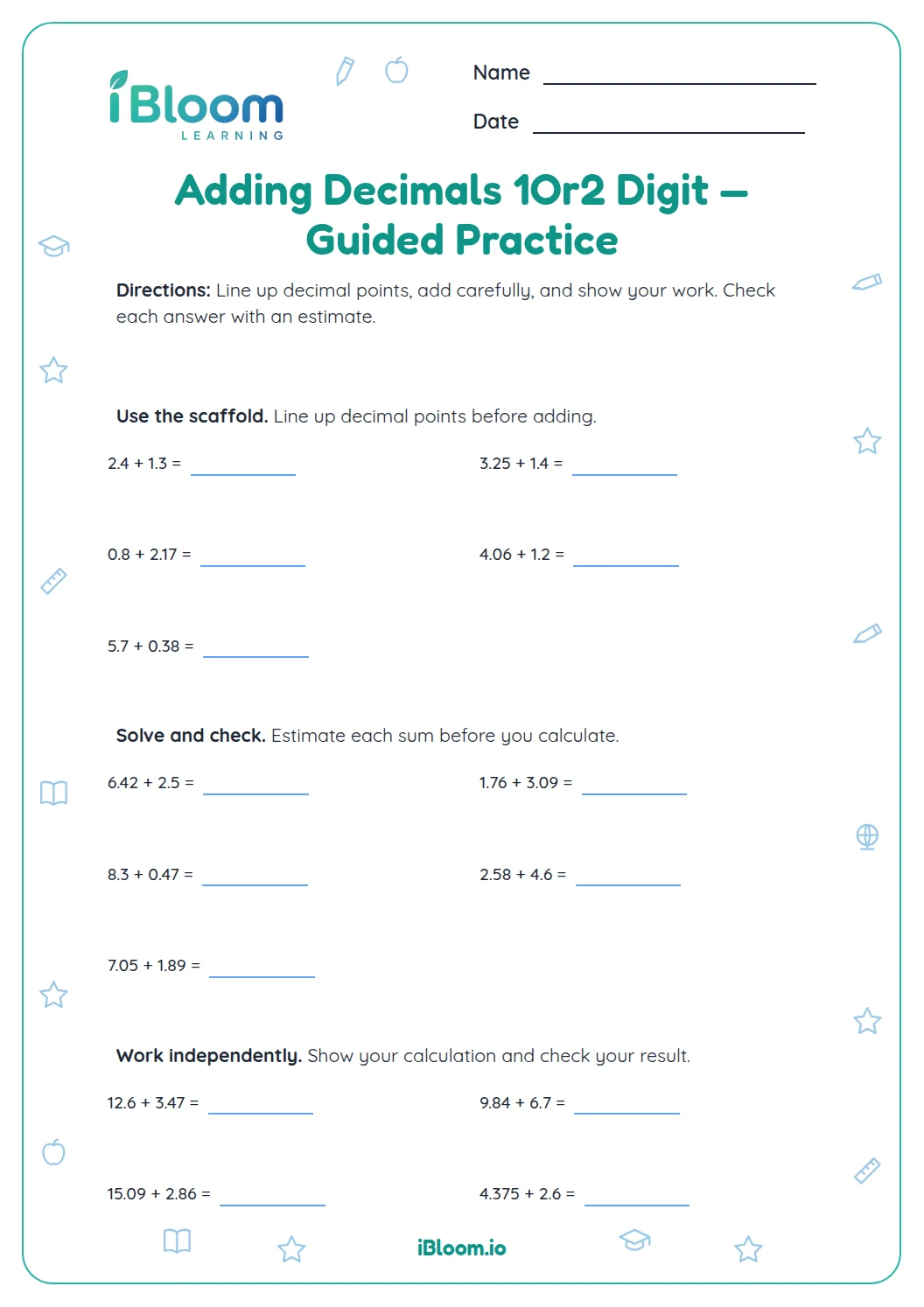
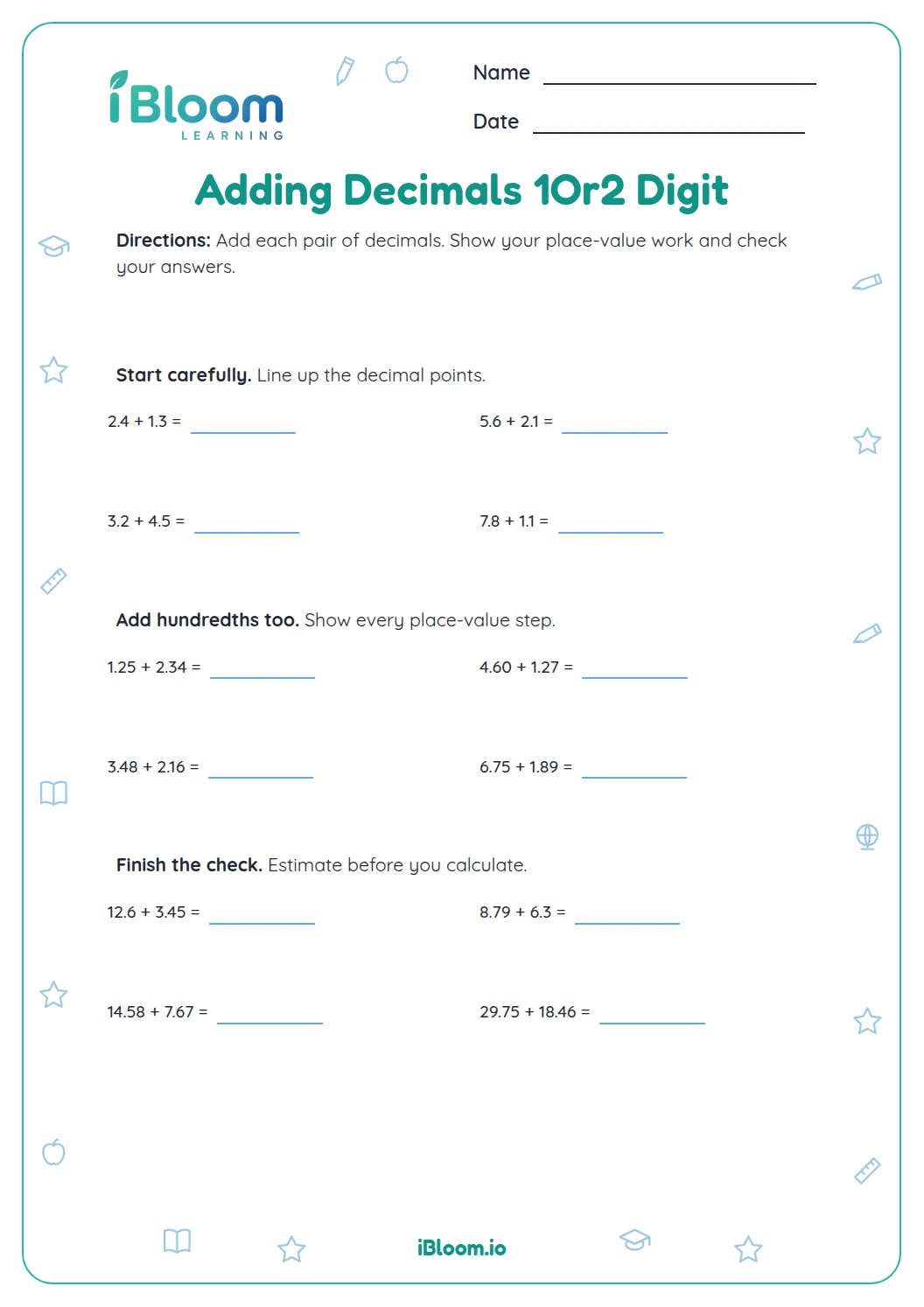
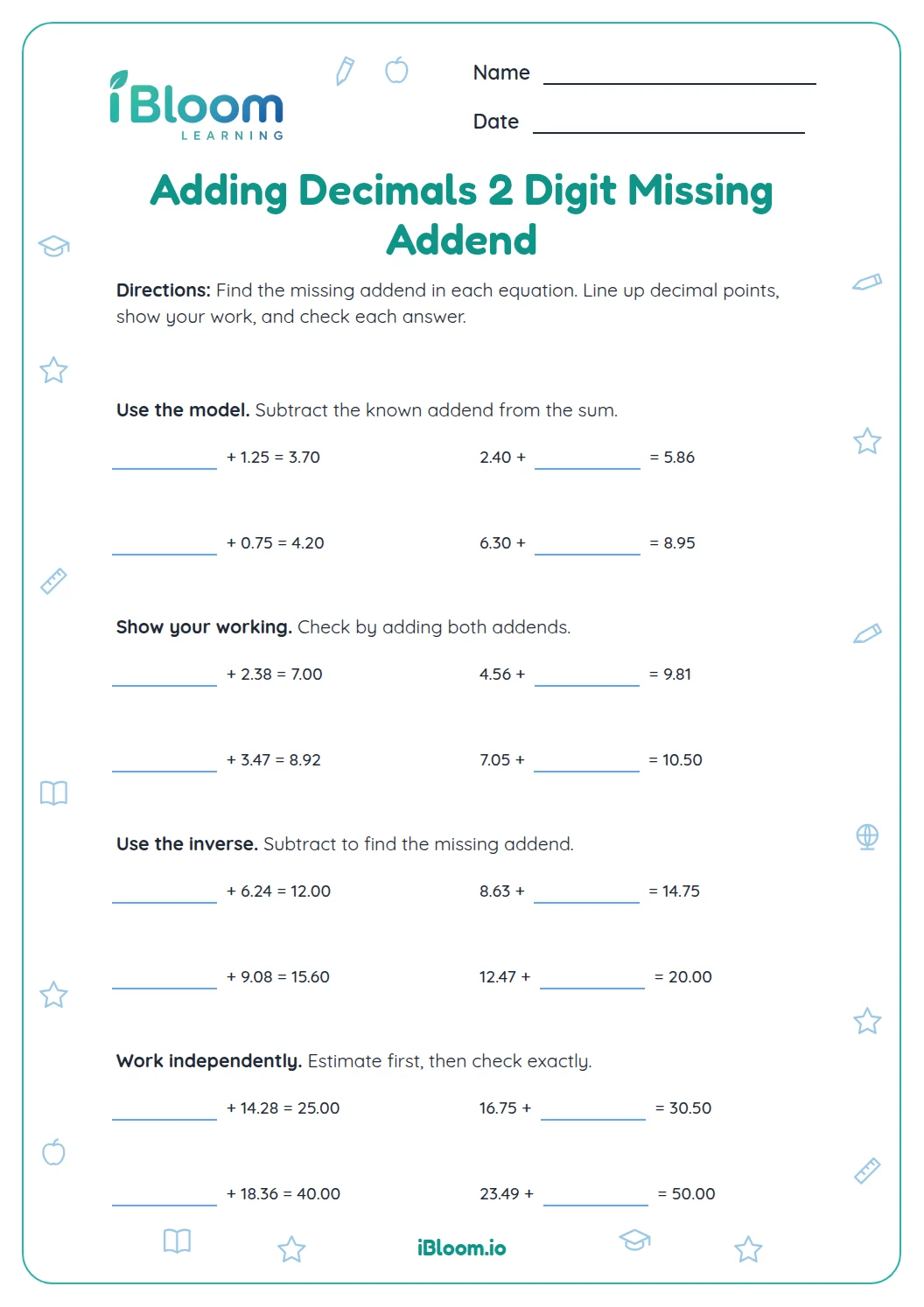
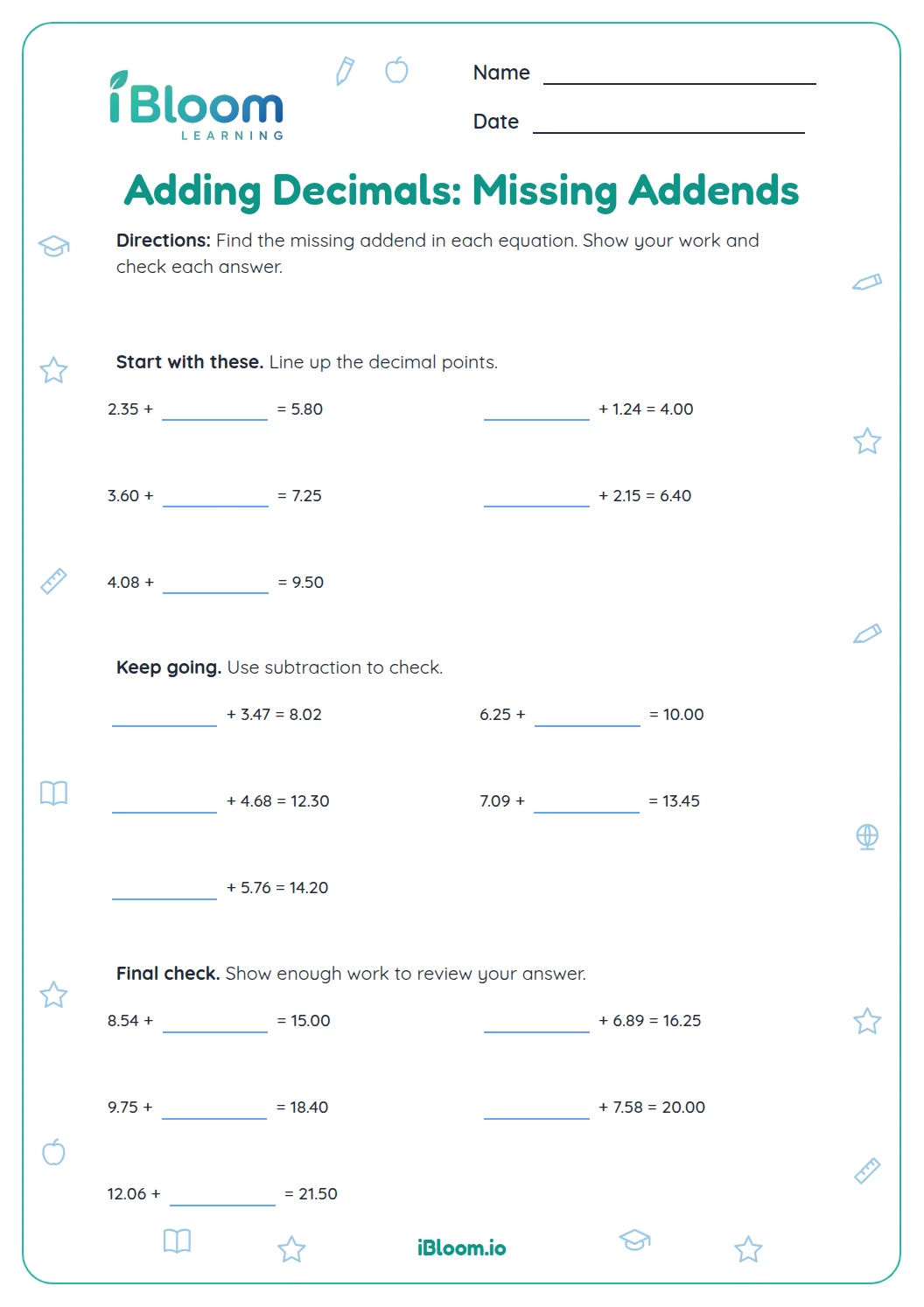
This Grade 5 worksheet has 16 missing-addend problems with decimals to hundredths and a separate answer key. Students solve eight equations, then use the same subtraction strategy in measurement contexts involving length, water, and distance. The directions emphasize lining up decimal points and checking a difference by addition. The work connects addition and subtraction of decimals to hundredths with CCSS 5.NBT.B.7.
Aligned to 5.NBT.B.7
How do the equation problems work?
Questions 1–8 give an addition equation with one addend missing. Subtract the known addend from the total. Keep hundredths in the hundredths column and line up decimal points before calculating.
- Find the total
- Subtract the known addend
- Check by adding
How do you solve a missing addend?
For question 1, compute 6.83 − 2.47 = 4.36. Then check 2.47 + 4.36: the sum is 6.83.
- 12.47 + ___ = 6.83
- 26.83 − 2.47 = 4.36
- 3Check: 2.47 + 4.36 = 6.83
How does the same method work in a story problem?
Questions 9–16 describe a whole measurement and one known part, then ask for the missing part. Write the matching subtraction equation, keep the unit in the final answer, and check that both parts add to the stated whole.
How to solve the decimal problems
- 1Read the equation or word problem and identify the total.
- 2Subtract the known addend or part from the total.
- 3Write each number with decimal points aligned.
- 4Regroup across place values carefully when needed.
- 5Include the measurement unit for a word problem.
- 6Add the two parts to confirm they equal the original total.
Common decimal mistakes and fixes
The mistake
Aligning the last digits instead of the decimal points.
The fix
Write the decimal points directly under one another before subtracting.
The mistake
Subtracting the total from the known part.
The fix
Use total minus known part; addition checks that the difference is the missing part.
The mistake
Leaving off the unit in a measurement problem.
The fix
Copy the unit named in the question, such as meters, liters, or kilometers.
Common Core alignment
The worksheet uses decimal addition and subtraction strategies through hundredths.
Find missing decimal addends by subtracting and verify each result with addition.
On this sheet: The equations and measurement contexts use subtraction as the inverse of addition with decimals to hundredths.
Show the official wordingHide the official wording
Add, subtract, multiply, and divide decimals to hundredths, using concrete models or drawings and strategies based on place value, properties of operations, and/or the relationship between addition and subtraction; relate the strategy to a written method and explain the reasoning used.
What to practice next
Make more practice
Further reading
Questions parents and teachers ask
What is a missing addend?
A missing addend is the number that completes an addition equation. In 2.47 + ___ = 6.83, subtract 2.47 from 6.83 to find 4.36. The same idea appears in the measurement stories, where one part and the total are known.
Why do decimal points need to line up?
Each digit must stay in its place-value column: ones with ones, tenths with tenths, and hundredths with hundredths. Lining up decimal points keeps those columns aligned during subtraction. Students can add their answer to the known addend to check the equation.
How should a student check question 1?
The missing addend is 4.36 because 6.83 − 2.47 = 4.36. To check, add 2.47 + 4.36. The sum is 6.83, which matches the total in the original equation. This reverse-operation check works for both equations and measurement situations. This reverse-operation check works for the equations and measurement stories alike.
What do the word problems ask students to measure?
They use length, water capacity, and distance. Each gives a whole amount and one known part, then asks for the other part. Students should write the unit with the answer, such as meters, liters, or kilometers. Students should preserve the unit from the question in their final response.
Does the key include the decimal answers?
Yes. A separate answer key gives the result for each of the 16 equations and story problems. Students can solve by subtracting, then verify by adding the known and missing parts to see whether they make the stated total. The key makes that reverse-operation check visible.
Which standard is practiced?
The worksheet practices CCSS 5.NBT.B.7 by using addition and subtraction with decimals to hundredths. Its missing-addend equations and measurement contexts connect the two operations: subtraction finds an unknown addend, and addition checks the result. The key shows the expected missing addend for each problem.